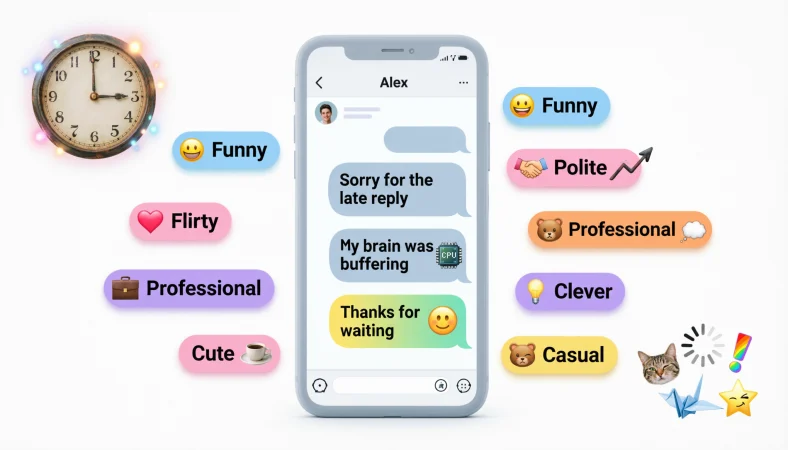
When someone mentions a delay in response, the best reply depends on the situation. You can keep it funny, apologetic, professional, flirty, or completely casual without making things awkward.
Top alternatives: Sorry for the late reply, Thanks for your patience, My bad for the delay, I got caught up, Appreciate you waiting
A delayed reply happens to everyone. Maybe your phone was hiding under a pillow, work suddenly turned into a three-hour meeting, or you simply opened the message and thought, “I’ll answer in five minutes,” only to return three business days later. Yep, we have all been there.
Whether it happens in texting, DMs, work chats, friendships, or with a crush, a delay in response can sometimes feel more dramatic than it actually is. The right reply can instantly remove awkwardness and show that you care.
You might want to apologize, make someone laugh, explain what happened, or simply pick up the conversation like nothing happened. These ready-to-use responses help you handle late replies with confidence, humor, warmth, and just the right amount of personality.
Funny Responses to “Delay in Response”
“My reply took the scenic route.”
Example: Use this after taking much longer than expected to answer a casual message.
Meaning: You are jokingly admitting that your response was late.
“Sorry, my brain was buffering.”
Example: Use this when you saw the message but needed forever to formulate a reply.
Meaning: You are playfully blaming your slow thinking.
“I was emotionally loading.”
Example: Use this after delaying a response to a surprising or complicated message.
Meaning: You are joking that you needed time to process things.
“That reply was stuck in traffic.”
Example: Use this when your response arrives hours after the original message.
Meaning: You are turning your late reply into a lighthearted excuse.
“I replied in my head.”
Example: Use this when you genuinely thought you had already answered someone.
Meaning: You are admitting the classic mistake in a funny way.
“My notification and I had a disagreement.”
Example: Use this when you missed a message among dozens of notifications.
Meaning: You are making your delayed response sound amusing rather than careless.
“I was busy being unavailable professionally.”
Example: Use this with a close friend after disappearing from your phone.
Meaning: You are humorously exaggerating your absence.
“Consider this a delayed but premium reply.”
Example: Use this when you want to make a late response sound intentionally dramatic.
Meaning: You are playfully pretending the wait improved the message.
“I took my sweet time, apparently.”
Example: Use this after noticing that several hours have passed.
Meaning: You are casually acknowledging your delay.
“My response needed a little character development.”
Example: Use this after taking a long time to answer a thoughtful message.
Meaning: You are joking that your reply needed time to develop.
“Breaking news: I finally replied.”
Example: Use this when returning to a chat after disappearing for a while.
Meaning: You are making fun of your own delayed comeback.
“Apologies, I was on airplane mode spiritually.”
Example: Use this with someone who appreciates internet-style humor.
Meaning: You are joking that you were mentally disconnected.
Polite Responses to “Delay in Response”
“Sorry for the delayed response.”
Example: Use this when you want a simple and respectful apology.
Meaning: You acknowledge the delay without overexplaining.
“Apologies for getting back to you late.”
Example: Use this when responding to someone after missing their message.
Meaning: You are politely recognizing the late response.
“Thanks for your patience.”
Example: Use this when someone has been waiting for an answer.
Meaning: You appreciate their understanding.
“I appreciate you waiting for my response.”
Example: Use this when the delay was noticeable or inconvenient.
Meaning: You are showing gratitude for their patience.
“Sorry I took so long to reply.”
Example: Use this with friends, family, or acquaintances.
Meaning: You are offering a warm and straightforward apology.
“Thank you for understanding the delay.”
Example: Use this when circumstances prevented a quick reply.
Meaning: You value the other person’s understanding.
“I apologize for the late response.”
Example: Use this when you want a slightly more formal tone.
Meaning: You are taking responsibility for the delay.
“Sorry for keeping you waiting.”
Example: Use this when someone was expecting an answer from you.
Meaning: You recognize that your delay affected them.
“Thank you for bearing with me.”
Example: Use this after a longer-than-usual communication delay.
Meaning: You appreciate their patience during the wait.
“I’m sorry I couldn’t respond sooner.”
Example: Use this when you had a genuine reason for being unavailable.
Meaning: You acknowledge that a faster reply would have been preferable.
“Thanks for checking in, and sorry for the delay.”
Example: Use this when someone followed up after receiving no response.
Meaning: You combine appreciation with a polite apology.
“I appreciate your patience while I got back to you.”
Example: Use this for a respectful response to a delayed message.
Meaning: You want to close the delay gracefully.
Professional Responses to “Delay in Response”
“Apologies for the delayed response. I’ve now had a chance to review this.”
Example: Use this when replying to a work email after a busy period.
Meaning: You explain the delay while moving the discussion forward.
“Thank you for your patience while I reviewed the details.”
Example: Use this when a response required careful consideration.
Meaning: You show professionalism without unnecessary excuses.
“Sorry for the delay in getting back to you.”
Example: Use this in workplace emails or professional messages.
Meaning: You acknowledge the delay clearly and politely.
“Thank you for following up.”
Example: Use this when someone reminds you about an unanswered message.
Meaning: You appreciate their follow-up rather than treating it negatively.
“I appreciate your patience, and I’m happy to provide an update.”
Example: Use this when responding after a project-related delay.
Meaning: You acknowledge the wait and immediately offer useful information.
“Apologies for the delay. Here is the information you requested.”
Example: Use this when finally delivering an overdue answer.
Meaning: You keep the response concise and solution-focused.
“Thank you for your understanding regarding the delayed response.”
Example: Use this for formal workplace communication.
Meaning: You politely recognize the communication gap.
“I apologize for not responding sooner.”
Example: Use this when a client or colleague has been waiting.
Meaning: You accept responsibility professionally.
“Thank you for your patience while I looked into this.”
Example: Use this when you needed time to investigate an issue.
Meaning: You explain the delay without sounding defensive.
“I’ve reviewed your message and can now provide an update.”
Example: Use this when responding after completing necessary research.
Meaning: You focus attention on the solution instead of the delay.
“Sorry for the delayed reply. I appreciate your understanding.”
Example: Use this when answering a professional message after several hours or days.
Meaning: You combine accountability with appreciation.
“Thank you for your patience. Please find my response below.”
Example: Use this when replying formally to an email.
Meaning: You transition smoothly from apology to useful information.
Flirty Responses to “Delay in Response”
“I was trying to make you miss me.”
Example: Use this with someone you already have playful chemistry with.
Meaning: You turn the delay into a teasing flirt.
“Had to keep you waiting just a little.”
Example: Use this when the conversation already has a teasing vibe.
Meaning: You are playfully pretending the delay was intentional.
“Worth the wait, though, right?”
Example: Use this after sending a charming late reply.
Meaning: You confidently suggest your response made the wait worthwhile.
“I got distracted thinking about you.”
Example: Use this when you want a sweeter flirt.
Meaning: You turn the delayed response into a compliment.
“Sorry, gorgeous. I got caught up.”
Example: Use this with someone comfortable with affectionate language.
Meaning: You apologize while keeping the message charming.
“I’m late, but at least I’m cute about it.”
Example: Use this when the relationship allows playful self-confidence.
Meaning: You use humor to soften the delay.
“You know I couldn’t leave you waiting forever.”
Example: Use this when returning to a flirty conversation.
Meaning: You imply that replying to them matters.
“I took my time because I wanted a good excuse to talk to you.”
Example: Use this when restarting a conversation with a crush.
Meaning: You turn the delay into an invitation to keep chatting.
“Sorry for the delay, I was busy being irresistibly distracted.”
Example: Use this when you want a cheeky response.
Meaning: You use playful confidence to explain your absence.
“Late reply, strong feelings.”
Example: Use this when you want something short and memorable.
Meaning: You suggest that response speed does not reflect interest.
“I may be late, but I’m still thinking about you.”
Example: Use this when you want to reassure someone romantically.
Meaning: You make the delay feel less personal.
“The reply took time, the interest didn’t.”
Example: Use this when someone worries that your delayed response means disinterest.
Meaning: You clearly separate response time from romantic interest.
Cute Responses to “Delay in Response”
“Sorry, I disappeared for a tiny bit.”
Example: Use this when returning to a friendly or affectionate chat.
Meaning: You offer a gentle apology without making things heavy.
“I’m back now!”
Example: Use this after being away from your phone.
Meaning: You signal that you are ready to reconnect.
“Sorry for making you wait.”
Example: Use this when someone has been patiently waiting for your message.
Meaning: You show that you noticed the delay.
“I got busy, but I didn’t forget you.”
Example: Use this when you want to reassure someone important to you.
Meaning: You explain that the delay was not a sign of neglect.
“A little late, but here I am.”
Example: Use this for a simple and cheerful comeback.
Meaning: You acknowledge the delay without overthinking it.
“I promise the wait wasn’t intentional.”
Example: Use this when someone seems slightly bothered by your late response.
Meaning: You reassure them that you did not ignore them deliberately.
“Sorry, life got a little noisy.”
Example: Use this when your day became unexpectedly busy.
Meaning: You gently explain why you were unavailable.
“I finally escaped the chaos.”
Example: Use this after a hectic day.
Meaning: You playfully explain that life kept you occupied.
“You were worth coming back to.”
Example: Use this with someone you care about.
Meaning: You make the person feel valued.
“I’m here now, promise.”
Example: Use this when someone simply wants your attention.
Meaning: You reassure them that you are available now.
“Sorry, my day ran away from me.”
Example: Use this when unexpected tasks caused your delay.
Meaning: You explain the delay in a warm, relatable way.
“Better late than never, right?”
Example: Use this for a lighthearted return to the conversation.
Meaning: You acknowledge the delay while keeping things positive.
Clever Responses to “Delay in Response”
“Response time does not equal response quality.”
Example: Use this when joking about taking time to craft an answer.
Meaning: You suggest that a thoughtful response can be worth waiting for.
“Delayed, not forgotten.”
Example: Use this when you want a concise reassurance.
Meaning: You make it clear that the person was still on your mind.
“Timing was questionable, intention was not.”
Example: Use this after replying later than expected.
Meaning: You admit the timing was poor while reassuring them about your intentions.
“My inbox won the first round.”
Example: Use this when several messages caused you to miss one.
Meaning: You humorously explain that your notifications got overwhelming.
“Consider the delay a plot twist.”
Example: Use this when returning to a casual conversation.
Meaning: You make the unexpected delay sound entertaining.
“I was temporarily offline from civilization.”
Example: Use this when you genuinely stepped away from your phone.
Meaning: You jokingly describe your absence.
“The message arrived faster than my availability.”
Example: Use this when someone wonders why you answered late.
Meaning: You explain that receiving a message does not guarantee immediate availability.
“My schedule had other plans.”
Example: Use this after being unexpectedly busy.
Meaning: You blame circumstances rather than the person.
“I needed a moment before pressing send.”
Example: Use this for an important or emotional message.
Meaning: You suggest that the delay came from careful thought.
“A slow reply can still be a good reply.”
Example: Use this when you want to keep the tone mature and positive.
Meaning: You emphasize quality rather than speed.
“I’m better at replies than response times.”
Example: Use this as a playful self-description.
Meaning: You admit that your communication timing is not perfect.
“The delay was accidental, the reply is intentional.”
Example: Use this when reassuring someone after taking too long.
Meaning: You emphasize that you deliberately chose to reconnect.
Sarcastic Responses to “Delay in Response”
“Sorry, I forgot I was supposed to be online 24/7.”
Example: Use this with close friends who are teasing you about a late reply.
Meaning: You jokingly push back against unrealistic expectations.
“Apologies, the royal response department was closed.”
Example: Use this when joking with someone who is being dramatic about waiting.
Meaning: You exaggerate the importance of your reply for comic effect.
“I know, shocking. I have a life outside my phone.”
Example: Use this with someone who knows your sense of humor.
Meaning: You sarcastically remind them that you cannot always respond instantly.
“Sorry, I was busy starring in my own episode.”
Example: Use this after being unavailable for a while.
Meaning: You humorously exaggerate how busy you were.
“My response schedule clearly needs a manager.”
Example: Use this when your late replies are becoming a running joke.
Meaning: You poke fun at your communication habits.
“Breaking news: humans occasionally get busy.”
Example: Use this when someone jokingly complains about waiting.
Meaning: You use sarcasm to point out that delayed replies are normal.
“I know, the suspense must have been unbearable.”
Example: Use this when someone dramatically mentions your late response.
Meaning: You playfully exaggerate their supposed concern.
“I apologize for interrupting your waiting era.”
Example: Use this when a friend has been teasing you.
Meaning: You turn their patience into a funny exaggeration.
“My phone survived without me. Barely.”
Example: Use this after being offline for several hours.
Meaning: You add sarcastic drama to a normal delay.
“Clearly, I needed to build some anticipation.”
Example: Use this when your reply arrives much later than expected.
Meaning: You pretend the delay was part of a master plan.
“Fast replies are apparently not my brand.”
Example: Use this when late responses are common for you.
Meaning: You jokingly accept your slow texting reputation.
“The waiting period has officially ended.”
Example: Use this when returning after a long silence.
Meaning: You make your comeback sound intentionally dramatic.
Chill And Casual Responses to “Delay in Response”
“Sorry, just saw this.”
Example: Use this when you genuinely missed the message.
Meaning: You give a simple explanation without making it complicated.
“Hey, just getting back to you now.”
Example: Use this when returning to an unanswered message.
Meaning: You casually acknowledge the delay.
“Got caught up for a bit.”
Example: Use this after becoming busy unexpectedly.
Meaning: You explain the delay in a relaxed way.
“Just had a busy day.”
Example: Use this when your schedule prevented a quick reply.
Meaning: You give a straightforward reason for your absence.
“Sorry, I was away from my phone.”
Example: Use this when you were genuinely offline.
Meaning: You explain why you could not answer.
“Just seeing this now.”
Example: Use this when a message slipped past your attention.
Meaning: You make it clear that the delay was not intentional.
“Been a little all over the place today.”
Example: Use this when your day has been hectic.
Meaning: You explain your delayed response casually.
“Finally got a second to breathe.”
Example: Use this after a packed day.
Meaning: You explain that you only recently had free time.
“Sorry for the slow reply.”
Example: Use this when you want a casual apology.
Meaning: You acknowledge the delay without overdoing it.
“I’m catching up on messages now.”
Example: Use this when returning after being offline.
Meaning: You explain that you are working through missed conversations.
“Life got busy for a minute.”
Example: Use this when several things distracted you.
Meaning: You give a natural and relatable explanation.
“Anyway, I’m here now.”
Example: Use this when you want to move past the delay quickly.
Meaning: You redirect attention toward the conversation.
Confident Responses to “Delay in Response”
“I reply when I have the time to actually focus.”
Example: Use this when someone expects instant answers.
Meaning: You confidently establish your communication boundaries.
“I’m not always quick, but I’m genuine.”
Example: Use this when someone questions your response speed.
Meaning: You prioritize authenticity over instant communication.
“My response time isn’t a measure of my interest.”
Example: Use this when someone interprets your delay negatively.
Meaning: You clearly separate timing from emotional investment.
“I was busy, not ignoring you.”
Example: Use this when someone assumes your silence was deliberate.
Meaning: You confidently correct the misunderstanding.
“I take my time when something deserves a thoughtful answer.”
Example: Use this for an important conversation.
Meaning: You present the delay as careful communication.
“I don’t rush replies just to reply.”
Example: Use this when explaining your texting style.
Meaning: You value meaningful responses over speed.
“Late does not always mean careless.”
Example: Use this when someone criticizes your response time.
Meaning: You remind them that delays can happen without bad intentions.
“I got busy, and that’s okay.”
Example: Use this when you want to avoid unnecessary guilt.
Meaning: You calmly acknowledge your priorities.
“I’m here now, so let’s continue.”
Example: Use this when you want to move forward confidently.
Meaning: You focus on the present instead of the delay.
“My schedule was full, not my interest.”
Example: Use this when reassuring someone you care about.
Meaning: You make it clear that being busy did not reduce your interest.
“I’d rather reply properly than reply randomly.”
Example: Use this when you needed time to answer thoughtfully.
Meaning: You prioritize quality communication.
“No drama, just a delayed reply.”
Example: Use this when someone is overthinking your silence.
Meaning: You calmly reduce the emotional tension.
Sweet Responses to “Delay in Response”
“Sorry for the delay, and thank you for waiting.”
Example: Use this when someone patiently waits for your answer.
Meaning: You combine an apology with sincere appreciation.
“I hope the wait wasn’t too annoying.”
Example: Use this with someone you care about.
Meaning: You show consideration for their feelings.
“I’m sorry I made you wait.”
Example: Use this when you know someone was expecting your response.
Meaning: You acknowledge their patience warmly.
“I didn’t mean to leave you hanging.”
Example: Use this when your silence may have seemed intentional.
Meaning: You reassure them that you did not deliberately ignore them.
“Thanks for sticking around.”
Example: Use this when reconnecting after being unavailable.
Meaning: You show appreciation for their patience.
“I may reply late, but I always come back.”
Example: Use this with a close friend or partner.
Meaning: You reassure them that delayed communication does not mean abandonment.
“Sorry, you deserved a quicker reply.”
Example: Use this when you genuinely regret the delay.
Meaning: You show that their message mattered to you.
“I’m glad you waited.”
Example: Use this when returning to an important conversation.
Meaning: You appreciate their willingness to continue.
“Thanks for being patient with me.”
Example: Use this after a stressful or busy period.
Meaning: You recognize their kindness and understanding.
“I didn’t forget about you.”
Example: Use this when someone may feel overlooked.
Meaning: You reassure them that they remained important despite the delay.
“Sorry I took so long, but I’m happy to be talking now.”
Example: Use this when restarting a meaningful conversation.
Meaning: You shift the focus toward reconnecting.
“Your message was worth coming back to.”
Example: Use this when you want to make someone feel valued.
Meaning: You express appreciation for the conversation.
Creative Responses to “Delay in Response”
“My reply took the long way home.”
Example: Use this when returning to a conversation after several hours.
Meaning: You creatively describe the delay without sounding overly serious.
“The message entered the delayed-response department.”
Example: Use this when joking about your inbox.
Meaning: You turn an ordinary delay into a playful imaginary system.
“Your reply ticket has finally been processed.”
Example: Use this with someone who enjoys clever humor.
Meaning: You make your response sound like an amusing customer-service update.
“My inbox temporarily became a jungle.”
Example: Use this after getting overwhelmed by notifications.
Meaning: You creatively explain why your reply was delayed.
“I took a brief intermission from civilization.”
Example: Use this when you were offline for a while.
Meaning: You make your absence sound humorous and dramatic.
“The response train has finally arrived.”
Example: Use this when answering much later than planned.
Meaning: You use an imaginative comparison to acknowledge the delay.
“My reply was delayed by unforeseen plot development.”
Example: Use this when life suddenly became busy.
Meaning: You make an ordinary interruption sound like a story twist.
“Your message survived the inbox Olympics.”
Example: Use this when you had dozens of messages waiting.
Meaning: You jokingly explain how difficult it was to catch up.
“I temporarily misplaced my texting powers.”
Example: Use this after being unusually quiet.
Meaning: You playfully blame your lack of communication energy.
“The response finally escaped the draft dimension.”
Example: Use this when you wrote a response but forgot to send it.
Meaning: You turn a common texting mistake into a creative joke.
“My notification universe needed sorting.”
Example: Use this when messages became overwhelming.
Meaning: You creatively explain that you were catching up.
“Delayed delivery, freshly prepared response.”
Example: Use this when you want a short, polished joke.
Meaning: You frame the late reply as something carefully prepared.
Emotional Responses to “Delay in Response”
“I’m sorry if my silence made you feel ignored.”
Example: Use this when someone seems genuinely hurt by your delay.
Meaning: You validate their feelings without becoming defensive.
“I understand why the delay may have bothered you.”
Example: Use this during a serious conversation.
Meaning: You acknowledge their perspective respectfully.
“I didn’t want my delayed response to make you feel unimportant.”
Example: Use this with someone emotionally close to you.
Meaning: You reassure them that their value did not change.
“I should have communicated sooner.”
Example: Use this when your silence genuinely caused confusion.
Meaning: You accept responsibility in a mature way.
“I’m sorry I left you wondering.”
Example: Use this when your lack of response created uncertainty.
Meaning: You recognize the emotional impact of silence.
“You deserved clarity sooner.”
Example: Use this when responding to an important question after a delay.
Meaning: You acknowledge that better communication was needed.
“I wasn’t trying to distance myself.”
Example: Use this when someone interprets a delayed response as emotional withdrawal.
Meaning: You reassure them that the delay was not intentional rejection.
“I care about how my silence affected you.”
Example: Use this when repairing a meaningful relationship.
Meaning: You show emotional awareness and concern.
“I needed some time, but I should have said that.”
Example: Use this when you intentionally paused before responding.
Meaning: You explain your need for space while accepting responsibility.
“Thank you for giving me time to respond.”
Example: Use this when someone showed patience during a difficult conversation.
Meaning: You appreciate their understanding.
“I’m here now, and I want to talk this through.”
Example: Use this when returning to a serious discussion.
Meaning: You show that you are ready to communicate honestly.
“I hope we can move past the delay and focus on what matters.”
Example: Use this when you want to repair communication.
Meaning: You encourage a healthier conversation going forward.
Dramatic Responses to “Delay in Response”
“At long last, the reply has arrived.”
Example: Use this when returning after an exaggeratedly long silence.
Meaning: You make your comeback intentionally theatrical.
“The waiting era is officially over.”
Example: Use this when joking with someone who has been waiting.
Meaning: You dramatize the end of the delay.
“After centuries of silence, I return.”
Example: Use this with a friend who loves dramatic humor.
Meaning: You exaggerate a normal delay for comedic effect.
“The message has finally received its moment.”
Example: Use this when answering after several hours.
Meaning: You humorously make the response sound important.
“I have returned from the communication wilderness.”
Example: Use this after being offline for a while.
Meaning: You dramatically describe your absence.
“The suspense was almost cinematic.”
Example: Use this when your late reply became a joke.
Meaning: You compare the waiting period to a dramatic movie moment.
“My grand return has been scheduled.”
Example: Use this when replying after disappearing.
Meaning: You make your return sound deliberately theatrical.
“The silence has been broken.”
Example: Use this when restarting a quiet conversation.
Meaning: You playfully frame your response as a major event.
“The delayed-response saga continues.”
Example: Use this when late replies are becoming a running joke.
Meaning: You turn your texting habits into an ongoing story.
“I have defeated the inbox.”
Example: Use this after finally catching up on messages.
Meaning: You dramatize your successful return.
“Your patience has been tested and rewarded.”
Example: Use this with someone who enjoys playful exaggeration.
Meaning: You make the delayed response sound like a grand finale.
“Cue the dramatic entrance.”
Example: Use this when coming back to a chat after being absent.
Meaning: You make your return playful and theatrical.
Short And Simple Responses to “Delay in Response”
“Sorry for the delay!”
Example: Use this when you need a quick apology.
Meaning: You acknowledge the late response directly.
“Sorry, just saw this.”
Example: Use this when you genuinely missed the message.
Meaning: You explain the delay simply.
“My bad for the late reply.”
Example: Use this with friends or casual contacts.
Meaning: You casually accept responsibility.
“Thanks for waiting!”
Example: Use this when someone has been patient.
Meaning: You show appreciation for their time.
“Just getting back to you.”
Example: Use this when returning to an unanswered message.
Meaning: You casually reopen the conversation.
“I got caught up.”
Example: Use this when work or life became unexpectedly busy.
Meaning: You give a concise explanation for the delay.
“I was offline.”
Example: Use this when you were away from your phone.
Meaning: You provide a simple reason for not responding.
“Finally free to reply.”
Example: Use this after a busy period.
Meaning: You explain that you now have time to communicate.
“Sorry I missed this.”
Example: Use this when a message slipped your attention.
Meaning: You acknowledge the missed message.
“I didn’t forget!”
Example: Use this when reassuring someone after a delay.
Meaning: You make it clear that the silence was not intentional.
“Here now!”
Example: Use this when you want to move quickly past the delay.
Meaning: You signal that you are available again.
“Better late than never!”
Example: Use this for a lighthearted delayed response.
Meaning: You acknowledge the delay while keeping things positive.
Playful Responses to “Delay in Response”
“You know I like keeping things interesting.”
Example: Use this when someone jokingly complains about your late reply.
Meaning: You turn the delay into playful teasing.
“I was building suspense.”
Example: Use this with someone who enjoys humor.
Meaning: You pretend the delay was intentional.
“Just adding a little mystery.”
Example: Use this after taking longer than expected to reply.
Meaning: You playfully suggest that the silence added intrigue.
“I wanted my reply to make an entrance.”
Example: Use this when returning to a casual chat.
Meaning: You make the late message feel fun rather than awkward.
“I’m fashionably late to my own inbox.”
Example: Use this when you have been slow to answer messages.
Meaning: You jokingly accept responsibility for your timing.
“I gave you a tiny waiting challenge.”
Example: Use this with a playful friend.
Meaning: You turn the delay into a harmless joke.
“Surprise, I’m alive and replying.”
Example: Use this after disappearing for a while.
Meaning: You use exaggerated humor to announce your return.
“My reply needed some dramatic timing.”
Example: Use this when your message arrives much later than expected.
Meaning: You make the delay sound intentional and playful.
“The timing was questionable, but the vibes are good.”
Example: Use this when you want to keep the mood relaxed.
Meaning: You acknowledge the delay while staying positive.
“I’m late to the party, but I made it.”
Example: Use this when returning to an active conversation.
Meaning: You casually celebrate your return.
“I took the scenic route to your inbox.”
Example: Use this after a long response gap.
Meaning: You turn the delay into a playful metaphor.
“Okay, okay, I’m replying now!”
Example: Use this when someone is teasing you about being slow.
Meaning: You acknowledge the complaint in a cheerful way.
Friendly Responses to “Delay in Response”
“Sorry, things got busy on my end.”
Example: Use this when a friend is waiting for an answer.
Meaning: You give an honest but uncomplicated explanation.
“Thanks for being patient with me.”
Example: Use this when someone waited without complaining.
Meaning: You appreciate their understanding.
“I got caught up, but I’m free now.”
Example: Use this when you want to continue the conversation immediately.
Meaning: You explain the delay and show availability.
“I didn’t mean to disappear on you.”
Example: Use this when your silence lasted longer than planned.
Meaning: You reassure the person that you did not intentionally vanish.
“Sorry, my day got hectic.”
Example: Use this when unexpected responsibilities delayed your reply.
Meaning: You provide a relatable explanation.
“Just catching up on everything now.”
Example: Use this when returning after being away from your phone.
Meaning: You explain that you are working through missed messages.
“I appreciate you checking back in.”
Example: Use this when someone follows up after your silence.
Meaning: You respond positively to their reminder.
“I’m finally catching my breath.”
Example: Use this after a particularly busy day.
Meaning: You explain that you only recently became available.
“Sorry I left you hanging.”
Example: Use this with friends or people you know well.
Meaning: You casually apologize for the delay.
“Thanks for not giving up on the conversation.”
Example: Use this after a long communication gap.
Meaning: You show appreciation for their continued effort.
“I’m back in action.”
Example: Use this after being unavailable.
Meaning: You playfully announce that you are available again.
“Let’s pick up where we left off.”
Example: Use this when you want to move past the delayed response.
Meaning: You show that you are ready to continue naturally.
Mature Responses to “Delay in Response”
“I apologize for the delay, and I understand if it caused inconvenience.”
Example: Use this when your late response affected someone else.
Meaning: You take responsibility without making excuses.
“I should have communicated sooner.”
Example: Use this when a delayed answer created uncertainty.
Meaning: You recognize the communication could have been better.
“I appreciate your patience while I handled everything.”
Example: Use this after dealing with competing responsibilities.
Meaning: You acknowledge their patience respectfully.
“I needed time to give you a thoughtful response.”
Example: Use this when the topic required consideration.
Meaning: You explain that the delay came from wanting to respond carefully.
“I’m sorry for the communication gap.”
Example: Use this when a conversation has been quiet for too long.
Meaning: You acknowledge the break in communication.
“I understand why the delayed response may have been frustrating.”
Example: Use this when someone expresses disappointment.
Meaning: You validate their reaction rather than dismissing it.
“I should have let you know I needed more time.”
Example: Use this when you intentionally delayed answering.
Meaning: You accept that clearer communication would have helped.
“Thank you for giving me the space to respond properly.”
Example: Use this for a thoughtful or sensitive conversation.
Meaning: You appreciate their patience and respect.
“I don’t want the delay to create a misunderstanding.”
Example: Use this when silence could be interpreted negatively.
Meaning: You proactively address possible confusion.
“I’m ready to continue the conversation now.”
Example: Use this after resolving whatever caused the delay.
Meaning: You show that you are present and engaged.
“I appreciate your understanding.”
Example: Use this when you want a calm and mature closing line.
Meaning: You recognize the other person’s patience.
“Let’s focus on getting things moving again.”
Example: Use this in a practical or professional situation.
Meaning: You shift attention from the delay toward progress.
Witty Responses to “Delay in Response”
“My response speed is still under construction.”
Example: Use this when slow replies are part of your personality.
Meaning: You make fun of your texting habits.
“I operate on selective response time.”
Example: Use this with someone who understands your humor.
Meaning: You jokingly suggest that your replies follow their own schedule.
“The reply was delayed, but the Wi-Fi was innocent.”
Example: Use this when you want an unusual excuse joke.
Meaning: You create a playful explanation for your silence.
“I’m apparently running on vintage response speed.”
Example: Use this when your reply takes hours or days.
Meaning: You humorously compare your texting speed to something old-fashioned.
“My inbox requested overtime.”
Example: Use this after becoming overwhelmed by messages.
Meaning: You jokingly blame your workload.
“I was caught in a notification maze.”
Example: Use this when many messages caused you to miss one.
Meaning: You make your inbox overload sound amusing.
“Response delivered after extensive internal negotiations.”
Example: Use this when you spent too long deciding what to say.
Meaning: You jokingly describe overthinking your reply.
“My fingers were ready, my schedule was not.”
Example: Use this when you wanted to respond but lacked time.
Meaning: You explain that availability, not interest, caused the delay.
“My reply had a longer loading screen than expected.”
Example: Use this when you want a modern internet-style joke.
Meaning: You compare the delay to slow technology.
“The message survived the great inbox purge.”
Example: Use this when you missed a message among many others.
Meaning: You humorously explain how difficult it was to find.
“I specialize in delayed but memorable replies.”
Example: Use this when you want a confident joke.
Meaning: You turn slow response time into part of your personality.
“Timing: questionable. Reply: delivered.”
Example: Use this when you want a punchy response.
Meaning: You admit the timing was imperfect while celebrating the reply.
Romantic Responses to “Delay in Response”
“Sorry for the delay, I never meant to make you wonder.”
Example: Use this when a romantic interest has been waiting for reassurance.
Meaning: You show that their feelings matter to you.
“I was busy, but you were still on my mind.”
Example: Use this when you want to reassure someone romantically.
Meaning: You make it clear that the delay did not erase your interest.
“My reply was late, my feelings aren’t.”
Example: Use this when someone connects your response speed with your feelings.
Meaning: You separate communication timing from emotional interest.
“I’m sorry I took so long, sweetheart.”
Example: Use this when affectionate language fits the relationship.
Meaning: You combine an apology with warmth.
“I may have taken my time, but I wanted to reply properly.”
Example: Use this for a meaningful romantic message.
Meaning: You explain that you cared enough to think about your response.
“I didn’t ignore you, I just got caught up.”
Example: Use this when reassuring someone after a busy day.
Meaning: You directly remove the fear of intentional rejection.
“You deserve a proper reply, not a rushed one.”
Example: Use this when answering something important.
Meaning: You frame your delay as an attempt to communicate thoughtfully.
“Sorry for the wait, I’m happy to be talking to you now.”
Example: Use this when restarting a romantic conversation.
Meaning: You emphasize that reconnecting feels good.
“The delay was about timing, never about you.”
Example: Use this when someone takes your silence personally.
Meaning: You reassure them that the issue was circumstantial.
“I’m here now, and you have my attention.”
Example: Use this when you finally have uninterrupted time.
Meaning: You offer focused and affectionate attention.
“Late reply, same crush.”
Example: Use this when you want something short and playful.
Meaning: You make your continued romantic interest obvious.
“Sorry I disappeared, I still like hearing from you.”
Example: Use this when you want to restore a flirty conversation.
Meaning: You reassure them that the connection still matters.
FAQs
What does “delay in response” mean?
“Delay in response” simply means someone took longer than expected to reply to a message, email, question, request, or communication. The reason can be anything from being busy to needing more time to think.
Is a delay in response a bad sign?
Not necessarily. People can be working, sleeping, traveling, overwhelmed, offline, or simply taking time to formulate a thoughtful answer. Response speed alone does not always reveal someone’s feelings or intentions.
Can a delay in response have a flirty meaning?
Sometimes, especially in playful texting. Someone might jokingly say they were building suspense or making you miss them. However, the meaning depends heavily on the existing relationship and overall tone.
What is a polite professional response to a delayed reply?
Simple lines such as “Apologies for the delayed response,” “Thank you for your patience,” or “Sorry for the delay in getting back to you” work well in professional settings.
What should I say if I do not actually mean to apologize?
You do not need to write a dramatic apology. Try something natural such as “Just getting back to you now,” “I got caught up,” or “Thanks for waiting.”
Is humor appropriate when responding late?
Yes, when the relationship and situation allow it. Humor works especially well with friends, close colleagues, and romantic interests. For serious work matters or sensitive conversations, a straightforward response is usually better.
How do I respond when someone complains about my slow reply?
Stay calm and avoid becoming defensive. A response such as “I was busy, not ignoring you” explains the situation while reassuring them that the delay was not personal.
How do I apologize for a long delay?
Keep it honest and concise. Say what you need to say, acknowledge the wait, and then address the actual message instead of spending the entire response explaining yourself.
Conclusion
A delayed reply does not have to turn into an awkward conversation. Whether you need something funny, flirty, professional, sweet, confident, or simply short, the right response can reset the mood instantly. The biggest trick is matching your words to the relationship and situation. A friend may appreciate a ridiculous joke, while a client probably prefers a clear apology and useful update.
With these delay in response replies, you can choose the tone that feels natural instead of staring at the keyboard wondering what to type. Save your favorites, send them when the moment arrives, and remember that good communication is less about perfect timing and more about making the other person feel understood.