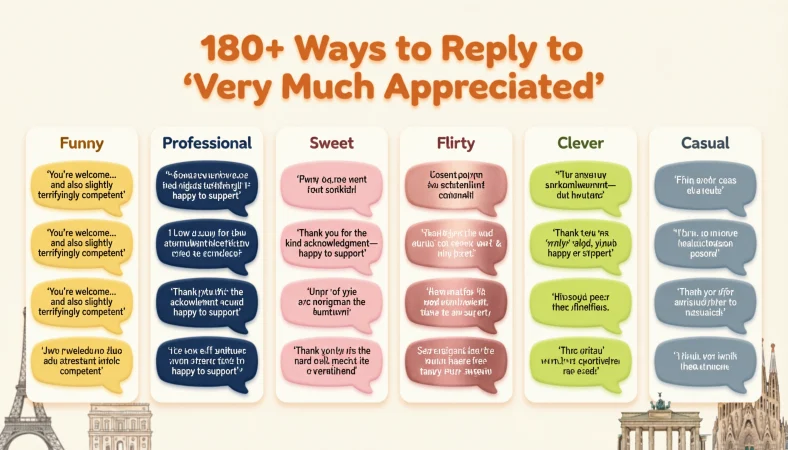
When someone says “very much appreciated,” they are expressing sincere gratitude for your help, kindness, time, or effort. Your reply can stay professional, warm, funny, humble, or casual depending on the relationship and situation.
Top alternatives: You’re very welcome, Happy to help, Anytime, My pleasure, Glad I could help
Someone just hit you with “very much appreciated,” and suddenly a simple “you’re welcome” feels almost too basic. We’ve all been there. Whether it happens in a work email, a group chat, a text from a friend, or a DM from someone you like, the right response can keep the interaction warm instead of making it sound like a customer-service script.
Knowing how to reply to “very much appreciated” gives you plenty of options for matching the moment. You might want to sound professional with a coworker, sweet with a friend, playful with someone close, or slightly flirty with your crush. A thoughtful reply can show confidence, kindness, and personality without trying too hard. From simple “happy to help” messages to witty one-liners, these responses make gratitude feel like a natural part of the conversation.
Funny Responses
1. “Anytime, my good deed quota is officially complete.”
Use this after helping a friend with something small but annoying.
Meaning: It jokingly frames your kindness as a daily achievement.
2. “I accept payment in snacks.”
Use this when someone thanks you for helping them out.
Meaning: It keeps the mood playful and casually hints at a snack-based reward.
3. “Glad my heroic services were useful.”
Use this after solving a friend’s minor crisis.
Meaning: It humorously exaggerates your helpfulness.
4. “No worries, I’ll invoice you later.”
Use this with a friend who appreciates a favor.
Meaning: It turns a simple thank-you into a playful business joke.
5. “Consider it my contribution to society.”
Use this after doing something unexpectedly helpful.
Meaning: It adds self-aware humor to a kind gesture.
6. “You’re welcome, citizen.”
Use this when joking around with a close friend.
Meaning: It makes your reply intentionally dramatic and silly.
7. “Glad to be of service, captain.”
Use this after helping someone complete a task.
Meaning: It gives an ordinary favor a goofy action-movie vibe.
8. “I do what I can for the plot.”
Use this after helping someone during a chaotic situation.
Meaning: It uses internet-style humor to make the moment memorable.
9. “Five-star review incoming, right?”
Use this when a friend thanks you enthusiastically.
Meaning: It jokingly asks for recognition without seriously expecting it.
10. “My work here is done.”
Use this after solving a quick problem.
Meaning: It humorously signals that you’ve completed your mission.
11. “Don’t make me blush now.”
Use this when someone gives you especially enthusiastic appreciation.
Meaning: It playfully downplays the compliment.
12. “I’ll be accepting awards at 8.”
Use this after receiving praise for a simple favor.
Meaning: It exaggerates the praise for comedic effect.
13. “That’ll be one imaginary dollar, please.”
Use this when teasing a friend about owing you.
Meaning: It keeps the exchange playful while making clear you’re not actually charging.
14. “Just doing my unpaid internship in kindness.”
Use this after helping someone without expecting anything back.
Meaning: It turns generosity into a relatable workplace joke.
15. “Look at me being useful.”
Use this when you want to respond modestly but humorously.
Meaning: It celebrates your helpfulness without taking yourself too seriously.
Brutal Responses
1. “I know.”
Use this with someone who appreciates your confidence and humor.
Meaning: It gives an intentionally cocky response.
2. “As it should be.”
Use this when playfully accepting someone’s gratitude.
Meaning: It confidently suggests your help was worth appreciating.
3. “You’re welcome for my greatness.”
Use this with a friend who enjoys sarcastic confidence.
Meaning: It turns gratitude into an exaggerated compliment to yourself.
4. “I expect nothing less than appreciation.”
Use this when joking with someone close.
Meaning: It creates a deliberately demanding but humorous tone.
5. “Glad you finally noticed.”
Use this when someone praises your efforts after a long time.
Meaning: It playfully implies your value was obvious all along.
6. “Took you long enough.”
Use this with a friend who is always slow to acknowledge favors.
Meaning: It teasingly calls out their delayed appreciation.
7. “Correct response.”
Use this after someone thanks you dramatically.
Meaning: It humorously treats their gratitude as the expected answer.
8. “Keep that energy.”
Use this when someone gives you enthusiastic appreciation.
Meaning: It jokingly encourages them to continue showing gratitude.
9. “You’re welcome, obviously.”
Use this with a close friend who understands your sarcasm.
Meaning: It delivers playful confidence rather than genuine arrogance.
10. “Recognition where recognition is due.”
Use this after doing something particularly helpful.
Meaning: It humorously presents appreciation as deserved credit.
11. “Finally, some respect.”
Use this when a friend compliments something you did.
Meaning: It pretends you’ve been waiting forever for recognition.
12. “I’ll add that compliment to my résumé.”
Use this after receiving praise at work or from a friend.
Meaning: It jokingly treats the compliment as career material.
13. “Glad we agree on my excellence.”
Use this when someone praises your help.
Meaning: It turns appreciation into playful self-confidence.
14. “You’re learning.”
Use this with someone who has a sarcastic sense of humor.
Meaning: It teasingly suggests they’ve finally learned to appreciate you.
15. “I knew you’d come around.”
Use this after someone finally recognizes your effort.
Meaning: It jokingly frames appreciation as something they eventually understood.
Flirty Responses
1. “Anything for you.”
Use this when someone you like thanks you for going out of your way.
Meaning: It adds warmth and subtle romantic interest.
2. “For you? Always.”
Use this when replying to someone you’re romantically interested in.
Meaning: It suggests they hold a special place in your priorities.
3. “You make it easy to be helpful.”
Use this when someone you like appreciates your effort.
Meaning: It gives the exchange a soft, affectionate tone.
4. “Just wait until I really impress you.”
Use this when flirting with someone who praised your help.
Meaning: It confidently hints that more charm is coming.
5. “I like making you happy.”
Use this when someone special thanks you sincerely.
Meaning: It communicates genuine affection.
6. “Your appreciation looks good on you.”
Use this when you want a playful flirt.
Meaning: It turns gratitude into a light compliment.
7. “Careful, I might start doing this all the time.”
Use this when someone you like appreciates your effort.
Meaning: It playfully suggests you enjoy doing things for them.
8. “You’re making me want to help you again.”
Use this when the conversation already has a flirty vibe.
Meaning: It keeps the attraction playful and confident.
9. “Anything to earn that smile.”
Use this when helping someone you’re attracted to.
Meaning: It shows that their happiness matters to you.
10. “You’re worth the effort.”
Use this when someone sincerely appreciates something you did.
Meaning: It communicates admiration and romantic interest.
11. “I’ll take that as a reason to see you again.”
Use this when you want to turn gratitude into a future plan.
Meaning: It subtly opens the door to spending more time together.
12. “You’re welcome, trouble.”
Use this when you already have playful chemistry.
Meaning: It adds teasing affection to your response.
13. “Anything else you’d like from your favorite helper?”
Use this when joking with someone you’re flirting with.
Meaning: It confidently invites more playful interaction.
14. “Making you happy might be my favorite hobby.”
Use this when the conversation feels sweet and romantic.
Meaning: It expresses affection in a playful way.
15. “Your thank-you is almost as cute as you are.”
Use this when you want a direct but charming compliment.
Meaning: It turns appreciation into an obvious flirt.
Polite Responses
1. “You’re very welcome.”
Use this in almost any courteous situation.
Meaning: It is warm, respectful, and universally appropriate.
2. “My pleasure.”
Use this after helping someone with a meaningful request.
Meaning: It communicates genuine willingness to help.
3. “Happy to help.”
Use this in everyday conversations and messages.
Meaning: It shows that helping was easy and welcome.
4. “Anytime.”
Use this with someone you are comfortable helping again.
Meaning: It communicates openness and friendliness.
5. “Glad I could help.”
Use this after completing a useful favor.
Meaning: It acknowledges their gratitude while staying humble.
6. “Of course.”
Use this when someone thanks you for something you were happy to do.
Meaning: It makes your help feel natural rather than burdensome.
7. “It was no trouble at all.”
Use this when someone seems especially grateful.
Meaning: It reassures them that helping wasn’t inconvenient.
8. “I’m glad it worked out.”
Use this after assisting someone with a problem.
Meaning: It focuses on the positive result.
9. “You’re most welcome.”
Use this when you want a polished, courteous response.
Meaning: It sounds gracious and respectful.
10. “It was the least I could do.”
Use this after helping someone you care about.
Meaning: It expresses humility and kindness.
11. “Absolutely, happy to help.”
Use this in a friendly but polished message.
Meaning: It reinforces your willingness to assist.
12. “No problem at all.”
Use this for casual gratitude.
Meaning: It reassures the person that their request wasn’t an inconvenience.
13. “I’m always glad to lend a hand.”
Use this when someone thanks you for practical help.
Meaning: It communicates reliability and generosity.
14. “It was my pleasure.”
Use this in a more polished social or professional setting.
Meaning: It warmly confirms that helping was enjoyable.
15. “You’re welcome, and I’m glad I could be there.”
Use this after supporting someone personally.
Meaning: It adds emotional warmth to a standard polite response.
Professional Responses
1. “You’re very welcome.”
Use this in a professional email after assisting a colleague.
Meaning: It is courteous and polished without sounding stiff.
2. “Happy to assist.”
Use this when responding to appreciation from a client or coworker.
Meaning: It communicates professional helpfulness.
3. “Glad I could support the team.”
Use this after contributing to a shared project.
Meaning: It emphasizes teamwork rather than personal credit.
4. “My pleasure. Please let me know if anything else comes up.”
Use this after completing a work-related request.
Meaning: It keeps the door open for future assistance.
5. “You’re welcome. I’m glad we got it sorted.”
Use this after resolving a workplace issue.
Meaning: It focuses on successful collaboration.
6. “Always happy to help where I can.”
Use this in a friendly professional exchange.
Meaning: It sounds supportive while remaining appropriately formal.
7. “Of course. I’m glad it was useful.”
Use this after sharing information or resources.
Meaning: It acknowledges the value of your contribution.
8. “It was my pleasure to assist.”
Use this in a formal email or client-facing message.
Meaning: It provides a polished and respectful response.
9. “Absolutely. I’m glad we could make progress.”
Use this after helping move a project forward.
Meaning: It highlights productivity and cooperation.
10. “You’re welcome. I appreciate you letting me know.”
Use this when a colleague thanks you formally.
Meaning: It acknowledges their gratitude professionally.
11. “Happy to contribute.”
Use this after participating in a team effort.
Meaning: It communicates enthusiasm without sounding boastful.
12. “Glad to be of assistance.”
Use this in a formal workplace exchange.
Meaning: It provides a professional and courteous tone.
13. “Certainly. I’m pleased it helped.”
Use this after providing useful guidance.
Meaning: It sounds composed, polite, and service-oriented.
14. “No problem. We’re all working toward the same goal.”
Use this when collaborating with coworkers.
Meaning: It reinforces teamwork and shared purpose.
15. “You’re welcome. I’m happy we could get this resolved.”
Use this after fixing a workplace problem.
Meaning: It emphasizes the successful outcome.
Creative Responses
1. “Kindness delivered, mission accomplished.”
Use this after helping someone with a personal task.
Meaning: It gives a simple favor a fun mission-like feel.
2. “Glad my little act of chaos was useful.”
Use this when your help involved a messy situation.
Meaning: It adds personality while staying positive.
3. “Your appreciation has been successfully received.”
Use this when you want a playful, unusual reply.
Meaning: It treats gratitude like a formal delivery notification.
4. “Consider your gratitude officially accepted.”
Use this with a friend who likes clever humor.
Meaning: It playfully pretends you’re processing their thanks.
5. “Helping people is apparently my hidden talent.”
Use this after unexpectedly solving a problem.
Meaning: It celebrates your usefulness with self-aware humor.
6. “Another successful side quest completed.”
Use this after helping someone with an everyday problem.
Meaning: It uses gaming language to make the favor sound adventurous.
7. “Tiny favor, big appreciation. I’ll take it.”
Use this when someone thanks you enthusiastically.
Meaning: It acknowledges their gratitude with playful confidence.
8. “Glad I could add a little sparkle to the situation.”
Use this after making someone’s day easier.
Meaning: It frames your help as a positive contribution.
9. “Your gratitude has made my day suspiciously productive.”
Use this after receiving unexpected praise.
Meaning: It turns appreciation into a playful productivity joke.
10. “Happy to be part of the solution.”
Use this when your help solved a meaningful problem.
Meaning: It sounds positive while emphasizing contribution.
11. “One favor down, legendary status pending.”
Use this after helping someone with a small task.
Meaning: It humorously exaggerates the importance of your action.
12. “Glad my timing decided to cooperate.”
Use this after helping at exactly the right moment.
Meaning: It keeps the reply modest and playful.
13. “Just a little kindness with excellent timing.”
Use this when someone is especially grateful.
Meaning: It presents your help warmly without sounding boastful.
14. “Apparently, today I’m everyone’s problem solver.”
Use this after helping multiple people.
Meaning: It makes your helpfulness sound amusingly dramatic.
15. “Happy to add that win to the scoreboard.”
Use this after helping someone succeed.
Meaning: It celebrates the outcome in a fun way.
Sarcastic Responses
1. “Wow, appreciation. My favorite currency.”
Use this when a friend thanks you for a favor.
Meaning: It jokingly treats gratitude as payment.
2. “Finally, the recognition I deserve.”
Use this after someone thanks you dramatically.
Meaning: It playfully exaggerates your need for praise.
3. “I’ll frame this message.”
Use this when someone gives you an unusually sincere thank-you.
Meaning: It jokingly treats their appreciation like a historic event.
4. “Please, hold the applause.”
Use this after doing something simple but useful.
Meaning: It mocks the idea that you’ve done something extraordinary.
5. “I’ll try to stay humble.”
Use this when someone praises your help.
Meaning: It adds playful arrogance to a friendly exchange.
6. “I knew this day would come.”
Use this after receiving recognition from someone who rarely gives it.
Meaning: It makes their appreciation sound dramatically overdue.
7. “This is the validation I needed.”
Use this when someone thanks you enthusiastically.
Meaning: It humorously pretends their gratitude was emotionally essential.
8. “Don’t get too emotional.”
Use this when someone is overly grateful.
Meaning: It lightly teases them for making the moment dramatic.
9. “I’ll be sure to mention this in my autobiography.”
Use this after receiving a compliment for a small favor.
Meaning: It exaggerates the importance of the moment for comedy.
10. “Good. We understand each other.”
Use this with someone who appreciates your effort.
Meaning: It creates a mock-serious tone.
11. “You’re welcome. Try not to make it a habit.”
Use this when joking with a close friend.
Meaning: It playfully pretends you’re reluctant to keep helping.
12. “I’ll add ‘helpful’ to my list of talents.”
Use this after being praised for solving something.
Meaning: It turns the compliment into playful self-promotion.
13. “That’s enough praise for one day.”
Use this after someone sends an enthusiastic thank-you.
Meaning: It jokingly suggests you’ve reached your praise limit.
14. “Careful, compliments might go to my head.”
Use this when someone praises you repeatedly.
Meaning: It acknowledges the compliment while keeping things light.
15. “I expect a statue by Friday.”
Use this after doing a small favor for a friend.
Meaning: It dramatically exaggerates the level of recognition you deserve.
Cute Responses
1. “Aww, you’re welcome.”
Use this when someone thanks you sweetly.
Meaning: It responds with genuine warmth.
2. “Always happy to help you.”
Use this when someone you care about appreciates your effort.
Meaning: It shows affection and willingness.
3. “You’re worth it.”
Use this after doing something thoughtful for someone special.
Meaning: It makes the gratitude feel personal and sincere.
4. “Of course, lovely.”
Use this with someone you’re close to.
Meaning: It adds a soft affectionate touch.
5. “Anytime, sunshine.”
Use this when you want a cheerful response.
Meaning: It gives the message a warm, upbeat feeling.
6. “Glad I could make things a little easier.”
Use this after helping someone through a stressful moment.
Meaning: It shows caring without overdoing it.
7. “You never have to thank me.”
Use this with someone you naturally enjoy helping.
Meaning: It communicates that your kindness is genuine.
8. “Happy to make your day better.”
Use this after doing something thoughtful.
Meaning: It shows that their happiness matters to you.
9. “Aww, that means a lot.”
Use this when their gratitude feels especially sincere.
Meaning: It acknowledges the emotional value of their words.
10. “You’re always welcome.”
Use this with someone you’re close to.
Meaning: It communicates warmth and openness.
11. “Anything for that smile.”
Use this when replying to someone special.
Meaning: It adds a cute hint of affection.
12. “You make helping easy.”
Use this when you enjoy being there for someone.
Meaning: It gives the response a gentle, personal touch.
13. “Glad I could be your person today.”
Use this after helping someone through a difficult moment.
Meaning: It communicates emotional support.
14. “Sending you a little kindness back.”
Use this after receiving heartfelt appreciation.
Meaning: It keeps the exchange warm and wholesome.
15. “You’re welcome, sweetheart.”
Use this with someone you’re genuinely close to.
Meaning: It expresses affectionate warmth.
Dramatic Responses
1. “At last, my efforts have been recognized.”
Use this after completing a simple favor.
Meaning: It humorously makes the moment sound historic.
2. “I shall treasure these words forever.”
Use this when someone thanks you enthusiastically.
Meaning: It playfully exaggerates the emotional importance of their gratitude.
3. “This moment will be remembered.”
Use this after doing something small but useful.
Meaning: It creates mock drama around an ordinary favor.
4. “You have touched my soul.”
Use this when a friend gives you a heartfelt thank-you.
Meaning: It humorously exaggerates your reaction.
5. “The prophecy has been fulfilled.”
Use this after finally helping someone solve a long-standing issue.
Meaning: It turns the situation into a ridiculous epic.
6. “My work here is complete.”
Use this after successfully helping someone.
Meaning: It gives your favor a dramatic finale.
7. “I accept your gratitude with great honor.”
Use this when you want to sound theatrically formal.
Meaning: It makes a normal thank-you hilariously ceremonial.
8. “Tell the kingdom I served well.”
Use this with a friend who enjoys absurd humor.
Meaning: It turns your favor into a royal quest.
9. “This is what I was born to do.”
Use this after solving a minor problem.
Meaning: It dramatically exaggerates your natural talent.
10. “My legacy is secure.”
Use this when someone praises your effort.
Meaning: It jokes that your simple act has made history.
11. “I can retire peacefully now.”
Use this after receiving strong appreciation.
Meaning: It makes the compliment sound like the climax of your career.
12. “A tear has been shed.”
Use this when someone’s thank-you is unusually sweet.
Meaning: It humorously pretends you’ve become emotional.
13. “The universe has restored balance.”
Use this after helping someone who really needed it.
Meaning: It gives an ordinary act of kindness a cosmic twist.
14. “My greatest achievement yet.”
Use this after a simple successful favor.
Meaning: It playfully exaggerates the accomplishment.
15. “And so, the story ends happily.”
Use this after resolving a small problem.
Meaning: It gives the interaction a playful storybook ending.
Chill And Casual Responses
1. “No worries.”
Use this in a relaxed text with a friend or coworker.
Meaning: It reassures them that everything is fine.
2. “Anytime.”
Use this after a simple favor.
Meaning: It shows you’re happy to help again.
3. “Of course.”
Use this when the favor felt completely natural.
Meaning: It keeps the reply simple and friendly.
4. “All good.”
Use this in a casual conversation.
Meaning: It communicates that there was no inconvenience.
5. “You got it.”
Use this after helping someone complete something.
Meaning: It sounds confident, friendly, and relaxed.
6. “No biggie.”
Use this with friends or casual acquaintances.
Meaning: It minimizes the favor in a friendly way.
7. “Glad to help.”
Use this when you want something simple but warm.
Meaning: It acknowledges their appreciation positively.
8. “You’re good.”
Use this when someone seems worried about bothering you.
Meaning: It reassures them that there is no issue.
9. “Absolutely.”
Use this when you want a short and confident reply.
Meaning: It confirms that helping was no problem.
10. “For sure.”
Use this in a relaxed text conversation.
Meaning: It gives the exchange an easygoing tone.
11. “Anytime, seriously.”
Use this when you genuinely want to help again.
Meaning: It reinforces your sincerity.
12. “Glad it worked out.”
Use this after helping someone solve a problem.
Meaning: It focuses on the positive result.
13. “Happy to.”
Use this when you want a quick but warm response.
Meaning: It shows willingness without unnecessary words.
14. “No stress.”
Use this when someone apologizes while thanking you.
Meaning: It reassures them that everything is fine.
15. “You know I got you.”
Use this with a close friend.
Meaning: It communicates loyalty and support.
Confident Responses
1. “Always happy to deliver.”
Use this when someone praises your contribution.
Meaning: It responds with confident but friendly energy.
2. “Glad I could come through.”
Use this after helping someone successfully.
Meaning: It shows confidence in your reliability.
3. “I’ve got you covered.”
Use this when someone thanks you for support.
Meaning: It communicates dependability.
4. “That’s what I do.”
Use this when you want a confident, slightly playful reply.
Meaning: It presents helpfulness as one of your strengths.
5. “Consider it handled.”
Use this when someone appreciates your problem-solving.
Meaning: It communicates competence and confidence.
6. “Happy to make things happen.”
Use this after contributing to a successful outcome.
Meaning: It shows initiative and capability.
7. “Glad I could make a difference.”
Use this after helping someone meaningfully.
Meaning: It confidently recognizes the value of your contribution.
8. “You can count on me.”
Use this when someone thanks you for dependable support.
Meaning: It reinforces trust and reliability.
9. “That’s the kind of result I like.”
Use this after helping someone achieve a goal.
Meaning: It communicates satisfaction with the outcome.
10. “Just doing what I do best.”
Use this when someone compliments your skills.
Meaning: It accepts praise with playful confidence.
11. “Glad I could make it happen.”
Use this after solving a tricky problem.
Meaning: It shows pride in your ability to help.
12. “Mission accomplished.”
Use this after completing a task successfully.
Meaning: It gives the response a confident, upbeat feel.
13. “I knew I could help.”
Use this when your contribution solves the issue.
Meaning: It shows calm confidence in your abilities.
14. “That’s a win for both of us.”
Use this after collaborating successfully.
Meaning: It frames the outcome as shared success.
15. “Always good to be useful.”
Use this after someone recognizes your contribution.
Meaning: It accepts appreciation without sounding overly serious.
Emotional Responses
1. “That genuinely means a lot.”
Use this when someone’s appreciation feels heartfelt.
Meaning: It openly acknowledges the emotional impact of their words.
2. “I’m really glad I could be there for you.”
Use this after supporting someone during a difficult time.
Meaning: It communicates genuine care.
3. “You don’t have to thank me, honestly.”
Use this when helping someone you deeply care about.
Meaning: It suggests your support came without expectations.
4. “I’m just glad things are better now.”
Use this after helping someone through a problem.
Meaning: It focuses on their well-being rather than your effort.
5. “Your appreciation means more than you know.”
Use this after receiving a sincere thank-you.
Meaning: It communicates that their words have real emotional value.
6. “I’m happy I could make things a little easier.”
Use this when someone thanks you for emotional or practical support.
Meaning: It shows compassion and thoughtfulness.
7. “Being there for you was important to me.”
Use this after supporting someone close to you.
Meaning: It makes your care feel intentional and sincere.
8. “I’m grateful I could help.”
Use this after doing something meaningful for another person.
Meaning: It turns the gratitude into a mutual expression of appreciation.
9. “I’m just glad you’re okay.”
Use this when helping someone through a difficult situation.
Meaning: It makes their well-being the priority.
10. “That’s why I’m here.”
Use this when someone thanks you for emotional support.
Meaning: It communicates loyalty and genuine care.
11. “You matter to me, so it was never a question.”
Use this with someone close who sincerely appreciates your support.
Meaning: It expresses deep personal affection.
12. “I’d do it again in a heartbeat.”
Use this after helping someone through something difficult.
Meaning: It emphasizes unconditional support.
13. “I’m really happy I could be there when you needed me.”
Use this after supporting a friend or loved one.
Meaning: It shows that being dependable mattered to you.
14. “Your words honestly made my day.”
Use this when someone gives meaningful appreciation.
Meaning: It openly shows that their gratitude affected you positively.
15. “I’m glad I could be someone you could count on.”
Use this after helping someone through a stressful situation.
Meaning: It reinforces trust and emotional connection.
Sweet Responses
1. “Always, with pleasure.”
Use this when someone you care about thanks you warmly.
Meaning: It combines kindness with sincerity.
2. “You deserve all the help you need.”
Use this when supporting someone special.
Meaning: It communicates generosity and care.
3. “I’m happy I could do something good for you.”
Use this after a thoughtful gesture.
Meaning: It expresses sincere happiness about helping.
4. “You’re more than welcome.”
Use this when you want to sound especially warm.
Meaning: It gives extra emphasis to your generosity.
5. “It made me happy to help.”
Use this after doing something kind for someone.
Meaning: It shows that helping them benefited you emotionally too.
6. “Always here when you need me.”
Use this with a close friend or loved one.
Meaning: It communicates dependable support.
7. “I’m glad I could put a smile on your face.”
Use this after cheering someone up.
Meaning: It highlights their happiness as the reward.
8. “You’re welcome with all my heart.”
Use this for a particularly heartfelt exchange.
Meaning: It adds emotional sincerity to the response.
9. “Helping you was the easy part.”
Use this after someone thanks you for going out of your way.
Meaning: It reassures them that their request wasn’t a burden.
10. “Your happiness is enough thanks for me.”
Use this with someone you’re close to.
Meaning: It emphasizes selfless affection.
11. “I’m always happy to show up for you.”
Use this after supporting a loved one.
Meaning: It expresses loyalty and warmth.
12. “You know I’d do it again.”
Use this after a meaningful favor.
Meaning: It reinforces genuine willingness to help.
13. “That sweet message just made my day.”
Use this after receiving heartfelt appreciation.
Meaning: It returns warmth and acknowledges their kindness.
14. “You’re very welcome, truly.”
Use this when you want sincerity without excessive emotion.
Meaning: It emphasizes genuine goodwill.
15. “I’m just glad I could make a difference.”
Use this after helping someone meaningfully.
Meaning: It focuses on the positive impact of your action.
Clever Responses
1. “Gratitude received loud and clear.”
Use this when someone sends a formal thank-you.
Meaning: It cleverly acknowledges their appreciation.
2. “I’ll consider that a successful mission.”
Use this after helping someone accomplish something.
Meaning: It gives the interaction a playful sense of completion.
3. “Happy to turn effort into results.”
Use this after solving a problem.
Meaning: It confidently highlights the outcome of your work.
4. “Appreciation noted and appreciated.”
Use this when you want a witty, slightly formal response.
Meaning: It humorously reflects their wording back at them.
5. “Glad the kindness landed.”
Use this after doing something thoughtful.
Meaning: It confirms that your gesture was well received.
6. “A productive exchange of goodwill.”
Use this when joking with someone about gratitude.
Meaning: It turns a simple thank-you into clever mock-business language.
7. “Your appreciation has been added to the records.”
Use this when someone thanks you enthusiastically.
Meaning: It creates a playful administrative joke.
8. “I’ll take that as a five-star review.”
Use this after receiving praise.
Meaning: It humorously compares gratitude to customer feedback.
9. “Kindness successfully completed.”
Use this after helping someone.
Meaning: It makes your good deed sound like a completed task.
10. “Happy to make the equation work.”
Use this after solving a complicated issue.
Meaning: It presents your help as a clever contribution to the solution.
11. “Glad my timing passed the vibe check.”
Use this after helping at exactly the right moment.
Meaning: It combines clever humor with internet language.
12. “Appreciation is a pretty good return on investment.”
Use this after doing a favor for someone.
Meaning: It jokingly treats kindness as a worthwhile investment.
13. “I’ll file that under successful outcomes.”
Use this after solving a problem.
Meaning: It gives your response a witty professional flavor.
14. “Good deeds: surprisingly effective.”
Use this after helping someone.
Meaning: It playfully celebrates the positive result.
15. “Glad we could make that happen without a plot twist.”
Use this after resolving something smoothly.
Meaning: It adds humor while celebrating a problem-free outcome.
FAQs
What does “very much appreciated” mean?
“Very much appreciated” means someone is sincerely grateful for something you did, said, provided, or offered.
What is the best reply to “very much appreciated”?
Simple responses such as “You’re very welcome,” “Happy to help,” “My pleasure,” and “Anytime” work in most situations.
Can I give a funny reply to “very much appreciated”?
Absolutely. If you’re talking to a friend or someone who enjoys humor, responses like “I accept payment in snacks” or “My work here is done” can keep things light.
Is “very much appreciated” professional?
Yes. It is commonly used in professional emails, workplace messages, requests, and client communication to express sincere gratitude.
What should I say if I want to sound professional?
Try “Happy to assist,” “My pleasure,” “Glad I could help,” or “I’m pleased it was useful.”
Can “very much appreciated” be flirty?
The phrase itself is usually neutral, but context matters. If someone you’re attracted to says it warmly, a response like “Anything for you” can add a subtle flirty touch.
What if I do not actually mean “you’re welcome”?
You can keep it simple and neutral with “Of course,” “No problem,” or “Glad it worked out.”
Is “no problem” a good response?
Yes, especially in casual conversations. For formal situations, “You’re very welcome” or “My pleasure” may sound more polished.
Can I say “anytime” to a coworker?
Yes, particularly when the workplace relationship is friendly. In a very formal setting, “Happy to assist” may be more appropriate.
Should I match their level of formality?
Definitely. A professional thank-you deserves a polished reply, while a friend’s casual appreciation gives you more room for humor, slang, or playful responses.
What is a warm response to “very much appreciated”?
“You’re very welcome,” “I’m glad I could help,” or “I’m happy I could be there for you” all sound warm without being overly dramatic.
What is a short response?
“Anytime,” “Of course,” “My pleasure,” “Absolutely,” and “You got it” are quick and natural options.
Can I use emojis?
Yes. A simple 😊, 🙌, or ❤️ can make a casual response feel warmer, especially when texting friends or someone close.
Is “it was nothing” a good reply?
It can work casually, but “happy to help” is often warmer because it doesn’t minimize the other person’s gratitude.
What if someone is extremely grateful?
A response like “You really don’t have to thank me, I’m glad I could help” acknowledges their appreciation while keeping the exchange sincere.
Conclusion
A good response to “very much appreciated” does more than simply close a conversation. It can make you sound warm, confident, funny, professional, thoughtful, or even a little flirty depending on the situation. The key is matching your reply to the person and the moment.
Use “my pleasure” when you want polished and respectful, “anytime” when you want casual, or “anything for you” when the vibe is more personal. If humor is your thing, don’t be afraid to throw in a clever one-liner and keep the conversation memorable. Save this list for the next time someone sends a heartfelt thank-you, and share it with the friend who always replies with the same three words. Your next great comeback is ready to go!







1 thought on “180+ Reply To “Very Much Appreciated” Polite, Funny & Clever For 2026”