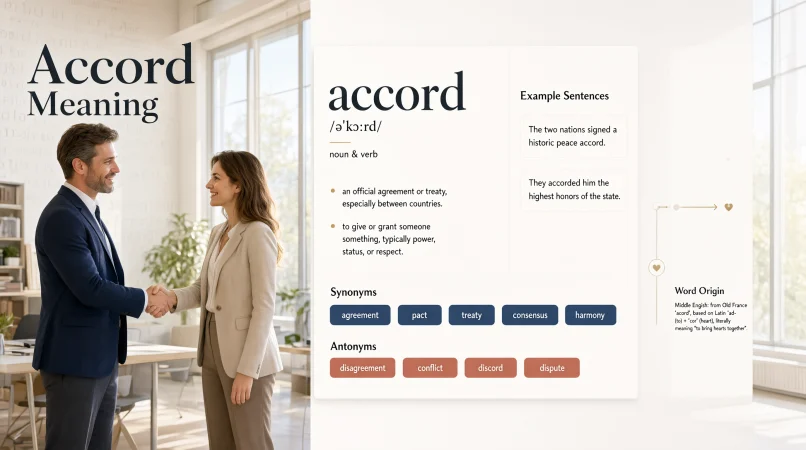
The word “accord” means agreement, harmony, or a shared understanding between two or more people, groups, or organizations. It can also mean giving someone something or allowing them to act freely, depending on how it is used in a sentence.
For example, when two countries reach an accord, they agree on certain terms or conditions. The phrase “of your own accord” means doing something voluntarily, without being forced or pressured. In simple words, accord is commonly associated with agreement, cooperation, and willingness.
Have you ever heard someone say, “They finally reached an accord” or “She left of her own accord” and wondered what the word actually means?
Although accord may sound like a formal or unfamiliar term, it appears in everyday English, news reports, professional discussions, legal writing, and ordinary conversations. Its meaning can change slightly depending on the sentence, making it useful to understand before using it yourself.
Whether you’re reading about an international agreement or trying to understand a common English expression, knowing this word can make communication much easier.
Understanding the accord meaning helps you recognize how the word expresses agreement, mutual understanding, or voluntary action.
According to standard English usage, accord can function as both a noun and a verb. As a noun, it refers to an agreement or a state of harmony, while as a verb, it means to give, grant, or be consistent with something.
Expressions such as “in accord with” and “of your own accord” also have specific meanings in everyday English. In this guide, we’ll explore its definitions, pronunciation, synonyms, examples, and common phrases to help you use the word confidently.
Table of Contents
- What Does Accord Mean?
- The Two Main Uses of Accord
- How Accord Is Used in Everyday English
- Common Expressions and Phrases
- Real-Life Examples of Accord
- Accord vs. Agreement vs. Harmony
- Synonyms and Antonyms
- Why Accord Matters in Communication and Relationships
- Common Mistakes When Using Accord
- Frequently Asked Questions
- Conclusion
What Does Accord Mean?
Accord is a word used to describe agreement, cooperation, or harmony. It generally suggests that people or groups share an understanding, accept the same terms, or are acting in a way that fits together.
For example, when two business partners agree on how to divide responsibilities, they may reach an accord. When two countries accept the same conditions in a peace negotiation, the result can also be called an accord.
The word can also describe a situation in which something is consistent with a particular standard, expectation, or principle. In this sense, it is often used in the phrase in accord with.
Consider these examples:
- The two companies reached an accord after several meetings.
- Her actions were in accord with the organization’s rules.
- He left the gathering of his own accord.
Although these sentences use the same word, each communicates a slightly different idea. The first refers to an agreement, the second describes consistency with a rule, and the third indicates a voluntary decision.
This flexibility makes the term useful in formal writing, professional communication, legal discussions, and everyday conversations.
The Two Main Uses of Accord
The word has two primary grammatical uses: it can function as a noun or a verb. Understanding the difference makes it easier to use correctly.
1. Accord as a Noun
As a noun, accord refers to an agreement, understanding, or state of harmony between people or groups.
It often appears in formal situations, particularly when discussing negotiations, international relations, business arrangements, or shared decisions.
Examples include:
- The leaders signed an accord to improve relations between their countries.
- After several discussions, the employees and management reached an accord.
- The committee worked together in complete accord.
- Their decision showed a strong sense of accord on the issue.
In these examples, the word describes either a shared agreement or a condition in which people cooperate without disagreement.
A formal agreement between governments is sometimes specifically called an accord. However, the word is not limited to politics or international affairs.
2. Accord as a Verb
As a verb, accord means to give, grant, or provide something. It can also mean to be consistent with something.
This use is more formal and less common in everyday conversation than the noun form.
Examples:
- The organization accorded special recognition to its volunteers.
- The committee accorded him the respect he deserved.
- The results accord with the original research findings.
- The award was accorded to the most deserving candidate.
In the first two examples, the verb means to give or grant. In the third, it means to agree with or be consistent with something.
The verb is often used in formal documents, reports, and professional writing. In casual conversation, people usually choose simpler alternatives such as give, grant, or match.
Noun vs. Verb: A Quick Comparison
| Feature | Accord as a noun | Accord as a verb |
| Main meaning | Agreement or harmony | To give, grant, or correspond |
| Grammatical role | Names an idea or condition | Describes an action or relationship |
| Common use | Formal agreements and cooperation | Formal writing and descriptions |
| Example | The groups reached an accord. | The school accorded her special recognition. |
| Similar words | Agreement, understanding | Grant, give, correspond |
How Accord Is Used in Everyday English
Although the word often appears in formal writing, it also has several familiar uses in ordinary English.
Its meaning depends on the surrounding words. Sometimes it describes a shared decision, while other times it highlights personal choice or consistency.
Describing an Agreement
One common use is to describe an understanding between people, organizations, or governments.
For example:
The two departments reached an accord about the new working schedule.
This means both departments accepted the arrangement. They found a solution they could agree on.
The word can make an agreement sound more formal or carefully negotiated than a casual promise.
Describing Harmony
Accord can also refer to a situation in which people, ideas, or actions fit together without conflict.
For example:
The members of the team worked in accord throughout the project.
This suggests that everyone cooperated and shared a common understanding.
It does not necessarily mean that every person had identical opinions. They simply worked together toward an accepted goal.
Describing Independent Choice
The phrase of one’s own accord has a different meaning. It describes something someone does voluntarily, without being forced, ordered, or pressured.
For example:
She decided to leave the organization of her own accord.
This means she made the decision herself.
The phrase is especially useful when explaining that an action was voluntary rather than caused by someone else’s instructions.
Describing Consistency
The expression in accord with means consistent with, following, or agreeing with a particular rule, principle, or standard.
For example:
The decision was made in accord with company policy.
The decision followed the company’s established rules.
This construction is common in formal reports, official statements, and professional documents.
Common Expressions and Phrases
Several established expressions use this word. Learning them is often more useful than memorizing a single dictionary definition.
| Expression | Meaning | Example |
| In accord | In agreement or harmony | The two groups remained in accord. |
| In accord with | Consistent with or following something | The plan is in accord with our goals. |
| Of one’s own accord | Voluntarily or independently | He offered to help of his own accord. |
| With one accord | Together or in agreement | The audience applauded with one accord. |
| Reach an accord | Come to an agreement | The parties reached an accord after negotiations. |
| Accord someone something | Give or grant something | The committee accorded her full recognition. |
In Accord
When people are in accord, they share an understanding or agree about something.
For example:
The two directors were in accord about the company’s future plans.
They shared the same general position and were not in conflict over the decision.
In Accord With
This expression indicates that an action, decision, or statement follows a particular standard.
For example:
The new policy is in accord with national regulations.
It means the policy is consistent with the relevant regulations.
Of One’s Own Accord
This expression highlights personal freedom and voluntary action.
For example:
The employee returned the lost wallet of her own accord.
Nobody forced her to return it. She chose to do so independently.
With One Accord
This phrase describes people acting or responding together, usually with a shared opinion or purpose.
For example:
The students agreed with one accord that the project should continue.
It suggests a united response rather than separate or conflicting decisions.
Real-Life Examples of Accord
The word becomes easier to understand when you see how it works in different situations.
In Business
Businesses often use formal agreements to establish responsibilities, resolve disputes, and organize partnerships.
For example:
After several rounds of negotiation, the two companies reached an accord on delivery terms.
This describes a mutually accepted arrangement. Both companies agreed on the conditions under which products would be delivered.
Another example:
The manager accorded the employee additional responsibilities.
Here, the word is used as a verb meaning that the manager assigned or granted new responsibilities.
In International Relations
International agreements are another familiar context.
For example:
The governments signed an accord to strengthen cooperation on border security.
This describes an agreement between countries or their representatives.
A well-known historical example is the Dayton Peace Accords, which were signed in 1995 and established the framework for ending the war in Bosnia and Herzegovina.
The Good Friday Agreement, reached in 1998, is another important example of a political settlement. It helped establish a framework for peace and power-sharing in Northern Ireland.
These examples show how the term can describe agreements intended to resolve serious disagreements.
In Personal Relationships
The word can also describe cooperation and understanding between individuals.
For example:
The siblings lived in accord despite having different personalities.
This means they maintained a peaceful relationship and found ways to get along.
Another example:
He apologized of his own accord after realizing his mistake.
This indicates that he chose to apologize without being pressured.
In Education
Teachers, students, and school administrators may use the word when discussing rules, decisions, and shared responsibilities.
For example:
The school introduced a new policy in accord with its academic standards.
This means the policy follows the institution’s established expectations.
In Law and Official Documents
Legal and administrative writing sometimes uses the word to describe formal agreements or the granting of rights and recognition.
For example:
The settlement brought both parties into accord.
This suggests that the parties reached an acceptable understanding.
The verb may also appear in formal language:
The court accorded the applicant the protections provided by law.
Here, it means the court granted or recognized those protections.
Accord vs. Agreement vs. Harmony
These words are related, but they are not always interchangeable. Each has a slightly different emphasis.
| Word | Main meaning | Typical emphasis | Example |
| Accord | Agreement or harmony | Mutual understanding or cooperation | The two groups reached an accord. |
| Agreement | A shared decision or accepted arrangement | Terms, conditions, or promises | They signed an agreement. |
| Harmony | A peaceful or balanced relationship | Lack of conflict or compatibility | The family lived in harmony. |
| Consensus | General agreement among a group | A shared opinion or decision | The committee reached a consensus. |
| Understanding | Shared awareness or acceptance | Knowing or accepting another person’s position | They came to an understanding. |
Accord vs. Agreement
Agreement is the more common and general word. It can describe anything from a simple verbal promise to a legally binding contract.
Accord often sounds more formal and can emphasize mutual understanding or cooperation.
For example:
- Agreement: The neighbors made an agreement about parking.
- Accord: The neighboring communities reached an accord after a long dispute.
Both describe an understanding, but the second sounds more formal and may suggest a carefully negotiated resolution.
Accord vs. Harmony
Harmony focuses on peaceful relationships or things working well together.
Accord can describe harmony, but it can also refer to a specific agreement.
For example, two people may live in harmony because they respect one another. Two organizations may reach an accord because they accept the same business terms.
The distinction is useful: harmony describes a condition, while accord can describe either a condition or an agreement.
Accord vs. Consensus
Consensus means general agreement within a group. It does not always require every member to agree completely.
Accord is broader. It can describe an agreement between two individuals, two organizations, or entire countries.
For example:
The committee reached a consensus on the proposal.
This emphasizes a shared group decision.
The two governments reached an accord.
This emphasizes an agreement between the governments.
Synonyms and Antonyms of Accord
Choosing the right alternative depends on the sentence. Some words work well when discussing negotiations, while others are better for describing relationships or personal decisions.
Common Synonyms
| Synonym | Meaning | Example |
| Agreement | A shared decision or arrangement | They reached an agreement. |
| Harmony | A peaceful relationship | The team worked in harmony. |
| Understanding | Mutual awareness or acceptance | They reached an understanding. |
| Consensus | General agreement within a group | The members reached a consensus. |
| Cooperation | Working together toward a goal | Their cooperation improved the project. |
| Compatibility | The ability to exist or work well together | Their ideas showed compatibility. |
| Concord | Agreement or peaceful relations | The communities lived in concord. |
Concord is particularly close in meaning to accord, although it is less common in everyday conversation. Both can describe agreement, unity, or peaceful relations.
Common Antonyms
Antonyms express the opposite idea.
- Disagreement: A situation in which people hold different opinions.
- Conflict: A serious disagreement or struggle.
- Discord: A lack of agreement or harmony.
- Dispute: An argument or disagreement about an issue.
- Division: A state in which people or groups are separated by opposing views.
- Dissension: Disagreement within a group.
For example:
The two departments were in discord over the budget.
This communicates the opposite of working together in accord.
Why Accord Matters in Communication and Relationships
Agreement is not always about having identical opinions. In many situations, it means finding enough common ground to work together.
That is why the concept is useful in personal relationships, workplaces, and public discussions.
It Helps Resolve Disagreements
People can disagree about goals, responsibilities, or expectations without ending a relationship or partnership.
Reaching an accord gives them a way to accept shared conditions and move forward.
For example, two coworkers may disagree about how to organize a project. After discussing their concerns, they might agree to divide the tasks according to each person’s strengths.
They do not need to think alike. They need an arrangement they can both accept.
It Encourages Cooperation
A shared understanding can make teamwork easier.
When people agree on responsibilities and expectations, they are less likely to misunderstand one another. They can focus on completing the work rather than repeatedly debating basic decisions.
This is especially useful in organizations where different departments must coordinate their activities.
It Supports Peaceful Relationships
In personal relationships, accord can describe mutual respect and a willingness to understand another person’s point of view.
For instance, family members may have different preferences but still maintain a peaceful household by respecting boundaries and making reasonable compromises.
Harmony does not require constant agreement. It requires the ability to manage differences without turning every disagreement into a conflict.
It Clarifies Voluntary Decisions
The phrase of one’s own accord is also useful because it distinguishes personal choice from pressure.
Compare these statements:
- She accepted the offer after her manager instructed her to do so.
- She accepted the offer of her own accord.
The first suggests that the decision followed an instruction. The second indicates that she chose independently.
That small difference can change how a reader understands someone’s motivation.
Common Mistakes When Using Accord
Although the word is not particularly difficult, some expressions can be confusing. A few simple guidelines can help you avoid mistakes.
1. Confusing Accord With Agreement
The two words are closely related, but they do not always fit the same sentence naturally.
For example:
- Natural: The two countries reached an accord.
- Also natural: The two countries reached an agreement.
Both are correct. However, agreement is usually more common in casual writing.
2. Misusing “Of One’s Own Accord”
This expression means voluntarily. It does not mean acting together or following another person’s instructions.
Correct:
The volunteer joined the project of her own accord.
Incorrect meaning:
The volunteer joined the project because her supervisor ordered her to.
The second situation involves an instruction, not an independent decision.
3. Confusing “In Accord” With “In Accordance”
These expressions are related but have different grammatical patterns.
- In accord: In agreement or harmony.
- In accordance with: Following a rule, instruction, or standard.
Examples:
The two partners were in accord about the proposal.
The company acted in accordance with its safety policy.
Although in accord with can also mean consistent with something, in accordance with is often the more natural choice when referring to rules or procedures.
4. Using the Verb Form Too Casually
The verb accord is grammatically correct, but it can sound formal.
For example:
The manager accorded the employee special recognition.
This is correct, but in everyday conversation, most people would say:
The manager gave the employee special recognition.
Choose the form that matches your audience and writing style.
FAQs
Is accord a positive word?
Usually, yes. It often suggests agreement, cooperation, or harmony. However, its exact meaning depends on the sentence in which it appears.
Is accord formal or informal?
It is generally considered a formal or moderately formal word. It appears frequently in official writing, negotiations, business discussions, and literature.
What is the plural of accord?
The plural is accords. It is commonly used when referring to multiple agreements, especially political or international arrangements.
Can accord be used for two people?
Yes. Two people can be in accord when they share an understanding, agree on a decision, or maintain a cooperative relationship.
What does “by mutual accord” mean?
It means something is done through the agreement or shared decision of the people involved. Both sides accept the arrangement.
What is the adjective form of accord?
The related adjective is accordant, meaning consistent or in agreement with something. However, it is relatively uncommon compared with expressions such as in accord with.
Conclusion
Accord is a versatile English word that describes agreement, cooperation, and harmony. It can refer to a formal arrangement between countries, a shared understanding between coworkers, or a voluntary personal decision through the phrase of one’s own accord.
Its meaning becomes clearer when you pay attention to the surrounding words and grammatical structure. Whether you encounter it in a business document, a historical discussion, or everyday writing, understanding these uses will help you interpret and use the word with confidence.