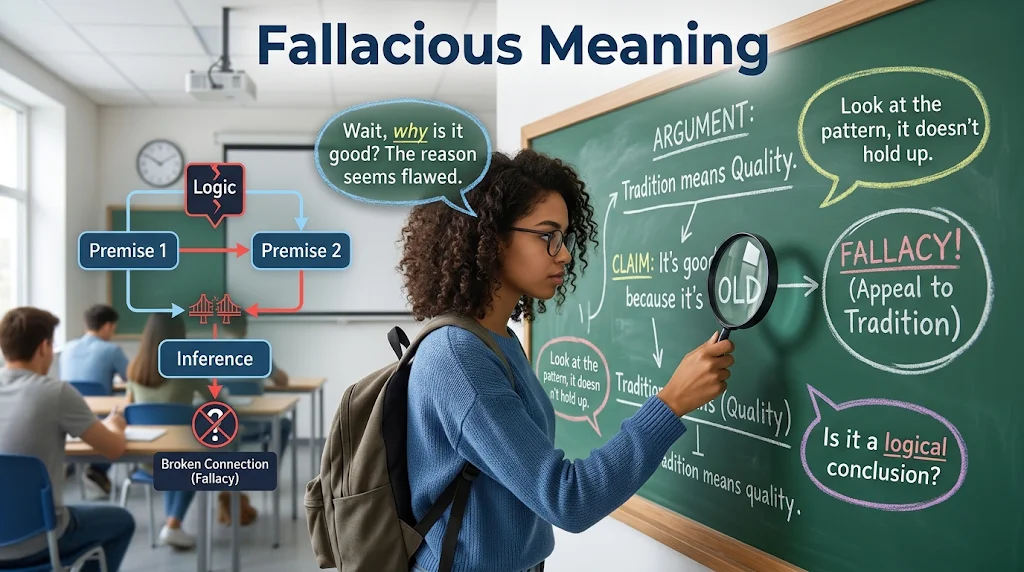
The word “fallacious” means misleading, false, or based on incorrect reasoning or beliefs. It describes an argument, statement, idea, or conclusion that appears logical or convincing but contains a mistake or lacks reliable evidence.
For example, if someone makes a claim using incorrect information or faulty logic, their argument can be described as fallacious. The word is commonly used in academic writing, debates, discussions, philosophy, and everyday conversations about misinformation. In simple terms, fallacious means something that seems true or reasonable but is actually incorrect or misleading.
Have you ever heard someone make an argument that sounds completely convincing at first but falls apart when you look at the facts? Perhaps they use misleading information, make unfair assumptions, or connect two unrelated ideas to prove a point.
You might understand what they’re saying initially, but something doesn’t quite add up. This is where the word fallacious becomes useful. It describes the kind of reasoning that may sound believable on the surface but contains errors, false assumptions, or misleading conclusions.
Understanding the fallacious meaning can help you identify weak arguments and communicate more effectively in discussions, debates, academic writing, and everyday situations. In standard English, fallacious is an adjective used to describe something based on a fallacy, which is a mistaken belief or error in reasoning.
It is particularly common in critical thinking, philosophy, logic, and media discussions, where checking the accuracy of claims is important. In this guide, we’ll explore its definition, pronunciation, synonyms, antonyms, common examples, and practical sentence usage to help you understand the word and recognize fallacious reasoning in real-life situations.
Table of Contents
- What Does Fallacious Mean?
- Origin and History of the Word
- How Is Fallacious Used in Everyday English?
- Common Types of Fallacies
- Real-Life Examples of Fallacious Reasoning
- Fallacious vs. False vs. Misleading vs. Invalid
- Why Do People Use Fallacious Arguments?
- How to Recognize a Fallacious Argument
- Frequently Asked Questions
- Conclusion
What Does Fallacious Mean?
The adjective fallacious describes something that contains a mistake in reasoning or creates a false impression through an argument. It is especially common in discussions about logic, critical thinking, philosophy, politics, and communication.
A fallacious argument can sound convincing without being logically sound. It may use incomplete information, irrelevant evidence, emotional pressure, or an incorrect connection between two ideas to persuade someone.
Consider this example:
Every successful business owner I know wakes up early. Therefore, waking up early guarantees business success.
The statement uses an observation about successful people to suggest that one habit guarantees success. However, the conclusion does not follow from the evidence. Many successful people may wake up early, but that does not prove that waking up early alone causes success.
That is what makes the reasoning fallacious.
The word does not always mean that the final conclusion is false. Sometimes a person reaches a correct conclusion using poor reasoning. The problem lies in the argument itself, not necessarily in the answer.
Fallacious as an Adjective
Fallacious is an adjective, meaning it describes a noun. It commonly appears before words such as argument, reasoning, claim, assumption, and belief.
Here are some common combinations:
- Fallacious argument: An argument built on faulty logic.
- Fallacious reasoning: A process of reaching a conclusion through incorrect logic.
- Fallacious claim: A statement supported by misleading or insufficient reasoning.
- Fallacious assumption: An unsupported belief used as the starting point for an argument.
- Fallacious conclusion: A conclusion reached through flawed reasoning.
For example, a teacher might describe a student’s explanation as fallacious because the evidence does not support the conclusion. A journalist might use the same adjective when discussing an argument that relies on misleading comparisons.
Although the word sounds formal, its meaning is useful in ordinary conversations. It gives people a precise way to explain why an argument does not hold up.
Origin and History of the Word
The word fallacious comes from the Latin word fallacia, meaning deception, trickery, or deceit. It is connected to the Latin verb fallere, which means to deceive or mislead.
The English word developed from this family of terms and became associated with mistaken reasoning and deceptive arguments. Its history helps explain why it describes more than a simple factual error.
A statement can be wrong because someone has incomplete information. A fallacious argument goes a step further: its reasoning creates an unjustified impression or supports a conclusion that the evidence cannot establish.
The related noun is fallacy, which refers to a mistaken belief or a flaw in reasoning. The adjective describes something that contains or relies on such a flaw.
For example:
- The argument contains a fallacy.
- The argument is fallacious.
Both sentences communicate a problem with the reasoning. The first uses the noun, while the second uses the adjective.
Today, the word is particularly common in formal discussions of logic and critical thinking, but it also appears in education, journalism, public debate, and everyday writing.
How Is Fallacious Used in Everyday English?
Although it is often associated with academic discussions, the term can describe many familiar situations. People use it when an explanation sounds reasonable but relies on weak evidence or an incorrect connection between ideas.
1. In Arguments and Debates
During an argument, someone may try to prove a point by attacking the other person’s character instead of addressing their reasoning.
For example:
You cannot be right about climate science because you failed your science class.
This response does not examine the person’s evidence. It attacks their academic history instead.
The argument is fallacious because someone’s past school performance does not automatically determine whether their current scientific statement is correct.
2. In Advertising
Advertisements sometimes use claims that make a product appear more effective than the available evidence supports.
Imagine an advertisement saying:
Thousands of people bought this supplement, so it must be the best option for everyone.
Popularity does not prove that a product is effective or suitable for every person. The argument uses the number of buyers as if it were proof of quality.
This type of reasoning can influence purchasing decisions, especially when customers do not examine the actual evidence.
3. In News and Social Media
Online discussions often include statements based on incomplete information. A post may present one example as proof of a much broader claim.
For instance, someone might say that a particular school system is ineffective because one student received poor grades. A single student’s experience cannot establish the performance of an entire education system.
The reasoning is too broad for the evidence provided.
4. In Academic Writing
Students and researchers are expected to support conclusions with relevant evidence. If an essay relies on unsupported assumptions or irrelevant comparisons, its reasoning may be described as fallacious.
For example, an essay might claim that a historical event happened for one specific reason while ignoring other important factors. If the evidence does not support that single explanation, the argument may contain a logical flaw.
5. In Personal Conversations
Fallacious reasoning can also appear between friends, family members, and colleagues.
Imagine someone saying:
You never listen to me because you disagreed with me yesterday.
Disagreeing with someone once does not prove that a person never listens. The statement turns one incident into a much broader accusation.
People may use this kind of reasoning without realizing it. Recognizing the flaw can help keep conversations focused on facts instead of unfair assumptions.
Common Types of Fallacious Arguments
There are several recognized forms of faulty reasoning. These are commonly called logical fallacies, and each has a different pattern.
Understanding them makes it easier to identify why an argument fails.
| Type of fallacy | Meaning | Simple example |
| Ad hominem | Attacking a person instead of their argument | Your opinion is wrong because you are inexperienced. |
| Straw man | Changing someone’s argument into a weaker version | You support public transport, so you want everyone to stop driving. |
| False dilemma | Presenting only two choices when more options exist | Either you agree with me or you are against me. |
| Hasty generalization | Drawing a broad conclusion from too few examples | Two rude customers prove that the entire shop has bad service. |
| Appeal to authority | Treating someone’s opinion as proof without sufficient evidence | A famous actor recommends it, so it must work. |
| Slippery slope | Claiming one action will automatically lead to extreme consequences | If students get one extra day off, nobody will study again. |
| Circular reasoning | Using the conclusion as its own supporting evidence | This rule is correct because it is the right rule. |
| Post hoc fallacy | Assuming that one event caused another because it happened first | I wore lucky socks and passed the test, so the socks caused my success. |
| Bandwagon fallacy | Treating popularity as proof that something is correct | Everyone believes this rumor, so it must be true. |
| Red herring | Introducing an irrelevant point to distract from the main issue | The company missed its deadline, but its office has beautiful furniture. |
These categories are useful because they show that faulty reasoning can take different forms. Some arguments attack people, while others rely on weak comparisons, unsupported assumptions, or emotional pressure.
Ad Hominem: Attacking the Person
An ad hominem argument shifts attention from the actual claim to the person making it.
For example, dismissing a doctor’s medical explanation because the doctor is young does not prove the explanation is incorrect.
The person’s age and the accuracy of the medical reasoning are separate questions.
Straw Man: Misrepresenting an Argument
A straw man argument changes someone’s actual position into an easier version to criticize.
Imagine one person suggesting that a company should reduce unnecessary spending. Another responds by claiming that the person wants the company to stop spending money entirely.
The response attacks an exaggerated version of the original suggestion rather than addressing what was actually said.
False Dilemma: Offering Too Few Choices
A false dilemma presents two options as if they are the only possibilities.
For example, a manager might say:
You can work overtime every day, or you do not care about this company.
The statement ignores other possibilities, such as working efficiently during normal hours or discussing a realistic schedule.
Hasty Generalization: Using Too Little Evidence
A hasty generalization happens when someone forms a broad conclusion from a small or unrepresentative sample.
For example, meeting two dishonest sellers does not prove that every seller is dishonest.
The conclusion goes beyond what the available examples can establish.
Real-Life Examples of Fallacious Reasoning
The easiest way to understand faulty logic is to see how it appears in familiar situations.
The following examples are fictional, but each illustrates a recognized reasoning problem.
| Situation | Fallacious statement | What makes the reasoning flawed? |
| Workplace | Everyone who stays late gets promoted, so staying late guarantees promotion. | It assumes one behavior guarantees a result. |
| Education | One student failed online classes, so online education never works. | It generalizes from one example. |
| Shopping | This phone is expensive, so it must be the best phone. | Price alone does not prove quality. |
| Health | My neighbor used this remedy and recovered, so it cures everyone. | One person’s experience is not sufficient medical evidence. |
| Politics | The candidate is unpopular, so every policy they support must be wrong. | Popularity does not determine whether a policy is sound. |
| Relationships | You forgot one message, so you never care about me. | One incident is treated as proof of a permanent pattern. |
Example Sentences Using Fallacious
Here are additional examples showing how the adjective works naturally in writing:
- The professor explained why the student’s argument was fallacious.
- Their conclusion was based on fallacious reasoning.
- The advertisement relied on a fallacious comparison.
- A fallacious assumption can weaken an otherwise strong essay.
- The speaker used a fallacious argument to avoid answering the question.
- Her explanation sounded convincing, but its logic was fallacious.
- The article challenged several fallacious beliefs about nutrition.
- A careful reader should question claims supported by fallacious evidence.
Notice that the word usually describes the quality of reasoning rather than simply labeling a person as wrong.
Fallacious vs. False vs. Misleading vs. Invalid
These words are related, but they describe different problems. Choosing the right one can make your writing more accurate.
| Word | Meaning | Main focus |
| Fallacious | Based on faulty reasoning | The logic behind an argument |
| False | Not true or factually incorrect | The truth of a statement |
| Misleading | Likely to create an incorrect impression | How information is presented |
| Invalid | Not logically or legally acceptable, depending on context | Whether something meets the required rules |
| Incorrect | Not accurate or right | A mistake in information or judgment |
| Deceptive | Intended or likely to mislead someone | The misleading nature of an action or presentation |
Fallacious vs. False
A false statement is factually untrue. A fallacious argument contains flawed reasoning.
For example, saying that Paris is the capital of Germany is false. Claiming that Paris must be the capital of Germany because it is a famous European city is fallacious reasoning.
The conclusion is also false, but the reasoning has a separate problem.
A fallacious argument can even lead to a true conclusion by accident. The fact that the answer happens to be correct does not repair the faulty logic used to reach it.
Fallacious vs. Misleading
Misleading information creates an inaccurate impression. It may leave out important details, use confusing wording, or present facts selectively.
Fallacious reasoning specifically involves a problem with the logic connecting evidence to a conclusion.
An advertisement can be misleading without containing a formal logical fallacy. Similarly, an argument can be fallacious even when the speaker does not intend to deceive anyone.
Fallacious vs. Invalid
In formal logic, invalid has a more specific meaning. A deductive argument is invalid when its conclusion does not necessarily follow from its premises.
For example:
- All cats are animals.
- A dog is an animal.
- Therefore, a dog is a cat.
The conclusion does not follow from the premises, so the argument is invalid.
The word fallacious is broader in everyday use and can describe several kinds of faulty reasoning, including invalid arguments.
Why Do People Use Fallacious Arguments?
Not every flawed argument comes from deliberate dishonesty. People sometimes use poor reasoning because they are emotional, misinformed, rushed, or unaware of the assumptions behind their claims.
1. To Win an Argument
Some people care more about winning a disagreement than finding an accurate answer. They may attack the other person’s character, exaggerate their position, or introduce unrelated points.
These tactics can make a conversation louder without making the argument stronger.
2. To Influence Emotions
Emotional language can persuade people before they have time to examine the evidence.
For example, a campaign might suggest that anyone who disagrees with a proposal does not care about children. This connects a complicated policy question to guilt rather than explaining whether the proposal works.
Emotions are not automatically bad in an argument, but they should not replace relevant evidence.
3. Because of Confirmation Bias
Confirmation bias is the tendency to favor information that supports existing beliefs while overlooking information that challenges them.
Someone who strongly believes that a particular product is the best may remember positive reviews and ignore credible criticism. Their conclusion can become difficult to change, even when new evidence appears.
4. To Simplify Complicated Issues
Some subjects involve many causes, conditions, and possible explanations. Reducing them to one simple statement can make them easier to discuss, but it can also distort the facts.
For example, claiming that unemployment is caused by one single factor ignores the many economic and social conditions that can affect employment.
A simple explanation is useful only when it remains accurate.
How to Recognize a Fallacious Argument
You do not need a degree in philosophy to identify weak reasoning. A few practical questions can help you evaluate claims more carefully.
1. Check Whether the Evidence Supports the Conclusion
Ask whether the information actually proves what the speaker is claiming.
If someone says that a restaurant is the best in town because one customer enjoyed a meal there, the evidence is too limited to support such a broad conclusion.
2. Look for Personal Attacks
Notice whether the speaker addresses the argument or attacks the person presenting it.
A person’s appearance, age, job, or personal history does not automatically determine whether their claim is accurate.
3. Watch for Extreme Statements
Words such as always, never, everyone, and nobody can signal overgeneralization.
These words are not always incorrect, but they deserve attention when the speaker provides only a few examples.
4. Consider Other Possible Explanations
When someone claims that one event caused another, ask whether other factors could explain the result.
For example, a business may experience higher sales after changing its logo. That does not prove the logo caused the increase. Seasonal demand, advertising, or pricing changes may also have contributed.
5. Separate Facts From Opinions
An opinion can be reasonable without being a proven fact. A personal experience can provide useful information, but it does not automatically establish a universal rule.
Checking the difference helps prevent weak claims from appearing stronger than they are.
FAQs
What is the noun form of fallacious?
The noun is fallacy, which refers to a mistaken belief or an error in reasoning. Fallacious describes something that contains such a flaw.
What is the opposite of fallacious?
Depending on the context, opposites include logical, sound, valid, reasonable, and well-founded. These words describe reasoning supported by appropriate evidence.
Is fallacious a negative word?
Yes. It generally has a negative meaning because it suggests that an argument or explanation contains faulty reasoning.
Can a fallacious argument have a correct conclusion?
Yes. A conclusion can happen to be correct even when the reasoning used to support it is flawed. A correct answer does not make an argument logically sound.
Is fallacious the same as illogical?
The words are closely related, but fallacious usually points to a specific flaw in reasoning. Illogical is a broader term for something that does not make sense logically.
What is the adverb form of fallacious?
The adverb is fallaciously. For example, a person might argue fallaciously by relying on an unsupported assumption.
Conclusion
Understanding faulty reasoning makes it easier to judge claims, participate in discussions, and recognize when an argument only sounds convincing. A statement does not become logical simply because it is confidently delivered or repeated by many people.
Look at the evidence, examine the connection between ideas, and consider whether the conclusion truly follows. Strong reasoning is not about winning every disagreement. It is about reaching conclusions that can stand up to careful examination.