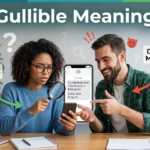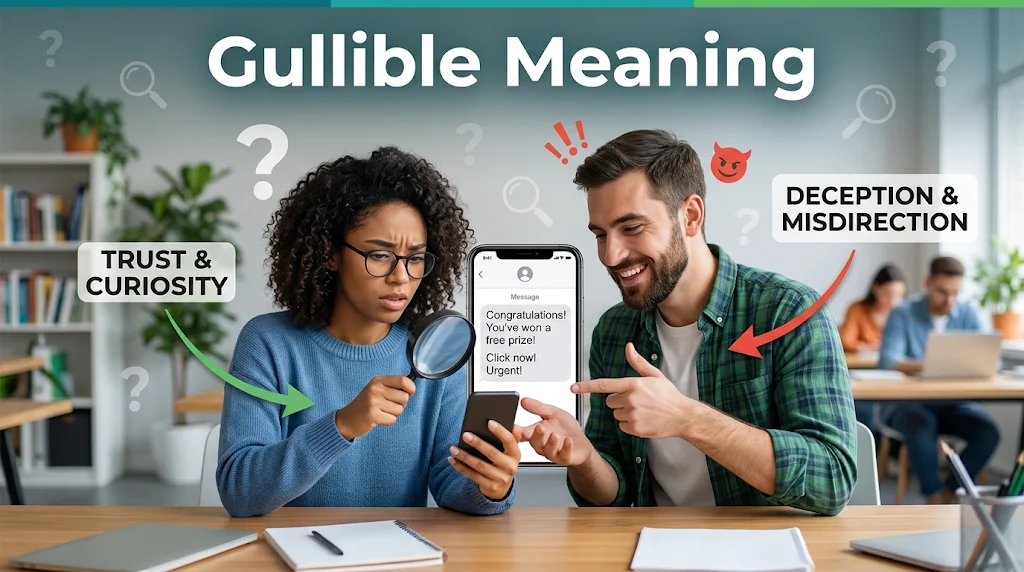
The word “gullible” means easily fooled, tricked, or convinced into believing something, especially when it is not true. It describes someone who tends to trust others too quickly or accepts information without questioning whether it is accurate.
For example, if a friend tells you an unbelievable story and you immediately believe it, someone might call you gullible. The word is usually used in a slightly negative or teasing way, although it does not always mean someone is unintelligent. In simple terms, being gullible means believing things too easily without checking the facts.
Have you ever believed a friend’s ridiculous excuse, fallen for an obvious prank, or trusted a story that turned out to be completely false? Maybe someone later laughed and said, “You’re so gullible!” It can feel embarrassing, but these situations happen to almost everyone.
Sometimes, we believe people because we trust them, don’t expect a joke, or simply don’t think twice before accepting what they say. That’s where the word gullible comes into play. It’s a common English word used in everyday conversations to describe someone who is a little too trusting or easily fooled.
Understanding the gullible meaning can help you recognize how people use this word in conversations, social media posts, jokes, and everyday situations.
In standard English, gullible is an adjective that describes a person who is easily persuaded to believe something without enough evidence. It is often associated with trusting behavior, misinformation, scams, and practical jokes.
However, being gullible does not necessarily mean someone lacks intelligence; it simply suggests that they may accept information too readily. In this guide, we’ll explore its definition, pronunciation, synonyms, antonyms, and practical sentence examples to help you understand and use the word correctly.
Table of Contents
- What Does Gullible Mean?
- Origin and History of the Word
- How Gullibility Works in Everyday Life
- Real-Life Examples of Gullible Behavior
- Gullible vs. Naive vs. Trusting vs. Credulous
- Why Do Some People Believe Things Too Easily?
- Gullibility in the Digital Age
- Is Being Gullible Always a Bad Thing?
- How to Avoid Being Gullible
- Frequently Asked Questions
- Conclusion
What Does Gullible Mean?
The adjective gullible describes a person who is easily tricked, persuaded, or fooled because they tend to believe information without examining whether it is true. Someone with this tendency may accept a stranger’s explanation, fall for an obvious joke, or trust a suspicious offer without asking enough questions.
In simple terms, a gullible person believes things too easily.
Imagine someone receiving a message claiming they have won a prize in a competition they never entered. The message asks them to pay a small delivery fee to receive their reward. Instead of checking the sender or questioning the offer, they immediately provide their payment details. This is an example of gullible behavior.
The word is usually used critically. Calling someone gullible can suggest that they lack skepticism, experience, or the ability to recognize deception. It can also sound insulting, especially when used directly during an argument.
However, the term does not automatically describe someone’s intelligence. A highly educated person can still be fooled by a convincing story, particularly when the information comes from someone they trust.
Gullible as an Adjective
Gullible is an adjective, which means it describes a person or their behavior. It commonly appears before a noun or after linking verbs such as is, seems, and becomes.
Examples include:
- A gullible person: Someone who accepts questionable claims too easily.
- Gullible behavior: Actions based on trusting information without checking it.
- A gullible audience: A group that is easily persuaded by misleading claims.
- Gullible buyers: Customers who believe unrealistic product promises.
- Seemingly gullible: Describing someone who appears easy to deceive.
The word can describe a temporary reaction or a more consistent habit. Someone might be gullible about financial offers but careful when making decisions about relationships.
Origin and History of the Word
The word gullible developed from the English verb gull, which means to deceive, trick, or fool someone. The verb has been used in English for centuries, while gullible became established as a word describing someone who is easily deceived.
Its exact deeper origin is uncertain. Some historical explanations connect gull with older words associated with deception or swallowing something, but there is no need to treat those suggestions as a confirmed explanation.
The connection between the words is easier to understand through their meanings:
- Gull: To deceive or trick someone.
- Gulled: Having been fooled or deceived.
- Gullible: Easily fooled or likely to believe something untrue.
This word family shows how English often develops adjectives from verbs. The adjective describes a person who is especially likely to experience the action expressed by the original verb.
For example, someone who can be easily fooled may be described as gullible. Someone who has already been fooled may be described as having been gulled, although that verb form is uncommon in everyday conversation.
Today, the adjective appears in casual conversations, news reporting, product reviews, discussions about misinformation, and descriptions of scams.
How Gullibility Works in Everyday Life
Gullibility is not limited to believing strange stories or falling for obvious tricks. It can appear in ordinary situations where people accept information without considering its reliability.
The important difference is how someone evaluates a claim before accepting it.
1. Believing Without Checking
A person may hear a surprising statement and immediately accept it as fact. They might repeat the information to friends without checking where it came from.
For example, someone hears that a local shop is giving away expensive electronics to everyone who shares a social media post. They share it immediately, even though the offer has no reliable source.
This behavior shows a willingness to believe information without enough evidence.
2. Trusting Strangers Too Quickly
Some people assume that others are honest simply because they sound friendly or confident.
A stranger might offer an unbelievable investment opportunity, promise a guaranteed return, or claim to represent a familiar company. A gullible person may trust the speaker’s confidence instead of checking their identity.
Friendly communication is not proof of honesty. A convincing presentation can hide a dishonest intention.
3. Falling for Exaggerated Claims
Advertising, sales conversations, and online promotions sometimes use dramatic language to make ordinary products sound extraordinary.
A gullible buyer may believe that a particular cream will solve every skin problem or that a simple online course guarantees instant success. They might purchase it without comparing claims, reading independent reviews, or examining the evidence.
Not every exaggerated claim is a deliberate scam, but accepting promises without questioning them can lead to poor decisions.
4. Taking Jokes Seriously
Gullibility can also appear in harmless social situations.
A friend might say that a famous actor is visiting a small neighborhood café, or that a school has announced an unusual holiday. Someone who believes the statement immediately may become the target of a practical joke.
In this setting, the result may be embarrassment rather than financial loss. Still, the behavior reflects the same tendency to accept information too quickly.
Real-Life Examples of Gullible Behavior
The following examples show how the word applies to different situations. They also demonstrate why context matters when describing someone as gullible.
| Situation | Example of behavior | Why it may be considered gullible |
| Online shopping | Believing a website offering an expensive phone at an unbelievably low price | The buyer accepts an unrealistic offer without checking the seller. |
| Friendship | Believing an obviously exaggerated story from a friend | The listener does not question the details. |
| Workplace | Accepting an unsupported promise of an instant promotion | The employee trusts a claim without confirmation. |
| Social media | Sharing an unverified celebrity rumor | The person spreads information without checking its source. |
| Relationships | Believing repeated excuses despite clear contradictions | The person accepts explanations without considering the evidence. |
| Finance | Sending money to someone promising guaranteed profits | The individual trusts a suspicious financial claim. |
| Entertainment | Believing a clearly staged magic trick is genuine | The viewer does not recognize the performance or illusion. |
Example Sentences Using Gullible
Here are natural examples showing how the word can fit into everyday English:
- She was gullible enough to believe the fake competition announcement.
- Don’t be gullible when someone promises you easy money.
- His friends played a harmless trick because they knew he was gullible.
- The advertisement was designed to attract gullible customers.
- I felt gullible after realizing the entire story was made up.
- A gullible buyer might trust a fake online store.
- He is not foolish, but he can be gullible when someone sounds convincing.
- The scammer targeted people who were unfamiliar with online payments.
These examples show that the adjective can describe a person, a decision, or a group of people who accept questionable information.
Gullible vs. Naive vs. Trusting vs. Credulous
Several English words describe people who believe others easily. However, they do not communicate exactly the same idea.
Understanding the differences helps you choose the right word.
| Word | Main meaning | Usual tone | Example |
| Gullible | Easily fooled or deceived | Usually negative | He believed the fake prize message. |
| Naive | Lacking experience or awareness | Often critical, sometimes gentle | She was naive about how online scams worked. |
| Trusting | Willing to believe or rely on others | Often positive or neutral | He is trusting with close friends. |
| Credulous | Too willing to accept claims as true | Formal and negative | The audience was credulous about the rumor. |
| Innocent | Lacking harmful intentions or knowledge of wrongdoing | Often positive | The child was innocent of the deception. |
| Unsuspecting | Not expecting danger, dishonesty, or a trick | Usually neutral | The unsuspecting customer opened the fake email. |
Gullible vs. Naive
A gullible person is easily convinced by questionable information. A naive person may lack experience or understanding of how a particular situation works.
For instance, someone who has never bought anything online may be naive about internet shopping. If they repeatedly believe fake seller promises without checking them, their behavior may also be described as gullible.
The difference is subtle but useful. Naivety often involves limited experience, while gullibility focuses on believing something too easily.
Gullible vs. Trusting
Being trusting is not necessarily a weakness.
A trusting person may believe their friends, family members, or colleagues because they have good reasons to rely on them. Healthy trust is an important part of relationships.
Gullibility becomes a concern when someone accepts claims without considering whether the speaker is reliable.
In other words, trust can be reasonable. Gullibility often involves too little questioning.
Gullible vs. Credulous
Credulous is a more formal synonym. It describes someone who is too ready to believe information, particularly claims that have not been supported by evidence.
You may encounter it in academic writing, journalism, or discussions about misinformation.
For everyday conversation, gullible is more common and usually easier to understand.
Why Do Some People Believe Things Too Easily?
Gullibility does not have one universal cause. Different personal experiences, emotional conditions, and social situations can influence how readily someone accepts information.
1. Limited Experience
People who are unfamiliar with a subject may struggle to recognize warning signs.
A first-time online shopper, for example, might not know how to identify a suspicious website. Someone with more experience may recognize unusual payment requests or unrealistic discounts more quickly.
This does not mean inexperienced people are unintelligent. They simply have less knowledge to help them evaluate the situation.
2. Strong Emotions
Emotions can affect judgment.
Someone who desperately wants a job may believe a fake recruiter who promises immediate employment. A person who feels lonely may trust someone online who offers sudden affection and attention.
Hope, fear, excitement, and stress can all make a claim feel believable before it has been checked.
3. Trust in Authority
People often rely on information from individuals who appear knowledgeable or powerful.
A speaker wearing a professional uniform, using technical language, or claiming to represent a respected organization may seem credible. However, appearance and confidence do not guarantee accuracy.
It is sensible to consider someone’s qualifications, but it is also important to verify important claims.
4. Desire to Fit In
Social pressure can make people accept ideas they might otherwise question.
If everyone in a group believes a rumor, an individual may feel uncomfortable challenging it. They might repeat the claim simply because they do not want to appear uninformed or different.
Group agreement, however, is not the same as proof.
5. Lack of Critical Thinking
Critical thinking means examining information, asking questions, and considering whether evidence supports a claim.
Someone who rarely checks sources or compares explanations may be more likely to accept misleading statements.
This is a skill that can improve with practice. People do not need to become suspicious of everyone; they need to become more thoughtful about what they believe.
Gullibility in the Digital Age
Online communication gives people access to useful information, entertainment, and communities. It also makes it easier for false claims and dishonest offers to reach large audiences.
A misleading message can be shared thousands of times before anyone checks whether it is accurate. This makes careful evaluation especially important.
Fake Giveaways and Prize Messages
A message might claim that a person has won a smartphone, shopping voucher, or cash prize. It may ask for personal details or a small payment before releasing the reward.
Someone who believes the message without checking the sender may become a target of fraud.
A legitimate-looking logo or professional design does not prove that an offer is genuine.
Investment and Money Scams
Online scammers sometimes promise unusually high returns with little or no risk. They may use impressive charts, fake testimonials, or urgent deadlines to convince people to send money.
A gullible investor may focus on the promised reward rather than asking how the investment works.
Financial claims deserve extra care. Guaranteed high profits, pressure to act immediately, and requests to transfer money to unfamiliar accounts are reasons to stop and investigate.
Fake News and Viral Rumors
False information can spread through social platforms, messaging groups, and websites.
A dramatic headline may encourage people to share a story before reading it. Some posts use edited photographs, misleading captions, or outdated information to create a false impression.
Before believing or sharing a claim, check whether reliable sources support it. Organizations such as the Associated Press and Reuters have established fact-checking and news-reporting standards that can help readers compare claims with documented information.
Impersonation and Fake Profiles
Someone may create a profile using another person’s photograph or pretend to represent a familiar business. They might contact users with requests for money, passwords, or private information.
A gullible person may trust the profile because it looks familiar.
Checking account details through an independent, official channel is safer than relying on a message received from an unknown profile.
Is Being Gullible Always a Bad Thing?
The word usually carries a negative meaning, but it is important to distinguish gullibility from kindness, optimism, and trust.
Being open to other people is not automatically a weakness. Healthy relationships require some willingness to believe what others say. If everyone questioned every ordinary statement, daily communication would become exhausting.
The problem begins when trust replaces reasonable judgment.
For example, believing a close friend when they say they are having a difficult day is usually a normal act of trust. Believing a stranger who promises to double your savings overnight is a different matter.
There is also a difference between making one mistake and having a consistent pattern of being deceived. Almost everyone believes something inaccurate at some point. A single mistake does not define someone’s personality.
It is more useful to consider whether a person learns from experience, checks important claims, and becomes more careful when warning signs appear.
How to Avoid Being Gullible
You do not need to distrust everyone to protect yourself from deception. A few practical habits can help you make better decisions.
1. Pause Before Believing Surprising Claims
When something sounds unbelievable, give yourself time to think. Exciting offers and frightening messages often encourage quick reactions.
A short pause can help you notice details that you might otherwise overlook.
2. Check the Original Source
Ask where the information came from. If a message makes a serious claim, look for the original announcement or a reliable source that confirms it.
Do not treat repeated social media posts as independent proof.
3. Ask Questions
A trustworthy explanation should usually withstand reasonable questions.
If someone avoids basic questions, changes their story, or pressures you to agree immediately, take a step back.
4. Be Careful With Urgent Requests
Scammers often create a sense of urgency. They may claim that an offer expires in minutes or that an account will be closed unless you act immediately.
Avoid making financial or personal decisions under pressure. Verify the request independently.
5. Learn From Mistakes
If you discover that someone has misled you, consider what made the story convincing.
Perhaps the person seemed trustworthy, the offer matched something you wanted, or you did not have enough information. Understanding the reason can help you recognize similar situations later.
Being careful is not about becoming cynical. It is about making trust and evidence work together.
FAQs
What is the noun form of gullible?
The noun form is gullibility, which describes the tendency to believe things too easily or be easily deceived.
What is the opposite of gullible?
Common opposites include skeptical, cautious, discerning, and shrewd. These words describe people who examine information before accepting it.
Is gullible an insult?
It can be insulting because it suggests poor judgment or an inability to recognize deception. However, it may also be used casually to describe someone who falls for a harmless joke.
Can someone be gullible in only one situation?
Yes. A person may be cautious with money but easily persuaded by friends or romantic partners. The tendency can vary depending on experience and circumstances.
Is gullible the same as foolish?
No. Gullibility describes how easily someone believes questionable information, not their overall intelligence. Intelligent and experienced people can also be deceived.
What is the adverb form of gullible?
The adverb is gullibly, although it is less common in everyday conversation. For example, someone might say that a person gullibly accepted an unbelievable story.
Conclusion
Being gullible does not mean someone lacks intelligence or common sense in every part of life. It describes a tendency to accept information too easily, especially when there is little evidence to support it.
Trust and kindness are valuable qualities, but they work best alongside curiosity and good judgment. The next time an offer, rumor, or unbelievable story comes your way, take a moment to check the facts before accepting it.