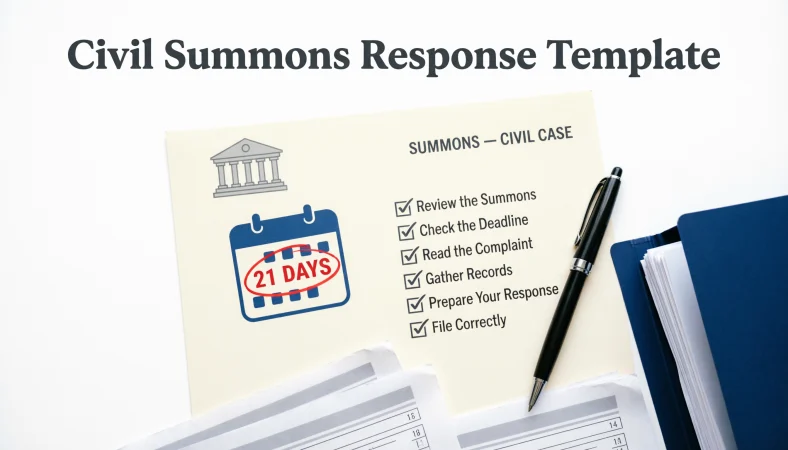
A civil summons response template can help you organize a written response to a lawsuit, but the correct form, deadline, filing method, and required wording depend on the court and jurisdiction. Always check the summons and applicable court rules before filing.
Top alternatives: Answer to Civil Complaint, Defendant Response Template, Written Response to Summons, Civil Court Answer Template, Response to Complaint
Getting served with a civil summons can make your brain immediately jump to worst-case scenarios. One minute you are checking your mail, and the next you are wondering whether you accidentally entered a courtroom drama. A civil summons response template can make the paperwork feel more manageable by giving you a starting point for organizing your response.
Whether you are preparing an answer, responding to allegations, requesting clarification, acknowledging receipt, or communicating with an attorney, the wording matters. A response should be accurate, organized, and appropriate for the court involved. This guide provides practical template language for common situations, including formal, concise, professional, cautious, and easy-to-adapt options.
Because civil procedure varies by jurisdiction, these examples are general writing aids, not legal advice. Check your summons carefully for the deadline, filing instructions, court information, and any required forms before relying on a template.
Simple Civil Summons Response Templates
“I am responding to the civil summons and complaint served upon me.”
Example: Use this as an opening sentence when identifying the purpose of your filing.
Meaning: You clearly state that your document responds to the lawsuit.
“I respectfully submit this response to the complaint.”
Example: Use this for a formal opening in a court filing.
Meaning: You introduce your response in a professional tone.
“I submit this answer in response to the allegations stated in the complaint.”
Example: Use this when preparing a structured answer to allegations.
Meaning: You explain what the document addresses.
“I deny the allegations that are inaccurate or unsupported.”
Example: Use this only when it accurately reflects your position and applicable pleading rules.
Meaning: You dispute allegations you do not believe are correct.
“I admit the allegations that I understand to be accurate.”
Example: Use this only after carefully reviewing each allegation and the rules governing admissions.
Meaning: You acknowledge allegations you believe are true.
“I lack sufficient information to admit or deny this allegation.”
Example: Use this where applicable under the rules governing your case.
Meaning: You state that you cannot responsibly confirm or dispute the allegation.
“I respectfully request that the court consider this response.”
Example: Use this as a formal closing sentence when appropriate.
Meaning: You respectfully ask the court to review your filing.
“I respond to the complaint as follows.”
Example: Use this immediately before numbered responses to allegations.
Meaning: You create a clear transition into the substance of your answer.
“The following responses address the allegations identified in the complaint.”
Example: Use this when organizing a response by paragraph number.
Meaning: You explain how your filing is structured.
“I respectfully deny the allegations to the extent stated incorrectly.”
Example: Use this only when legally appropriate to your circumstances.
Meaning: You challenge statements that you believe are inaccurate.
“I reserve any defenses or objections available under applicable law.”
Example: Use this only after confirming that such language is appropriate under the relevant procedural rules.
Meaning: You avoid casually suggesting that you have waived a potentially applicable position.
“I respectfully submit the following response for the court’s consideration.”
Example: Use this as a polished introductory sentence.
Meaning: You present your filing in a formal and measured way.
Professional Civil Summons Response Templates
“Please accept this document as my formal response to the civil complaint.”
Example: Use this as a professional opening where appropriate.
Meaning: You identify the document as your formal response.
“I respectfully respond to the allegations contained in the complaint.”
Example: Use this before addressing individual allegations.
Meaning: You establish a professional and neutral tone.
“After reviewing the complaint, I provide the following responses.”
Example: Use this when organizing an answer into numbered sections.
Meaning: You signal that each allegation will be addressed separately.
“I respectfully dispute the allegations that are inconsistent with the facts.”
Example: Use this only where the statement accurately reflects your position.
Meaning: You challenge allegations you believe do not match the facts.
“I acknowledge receipt of the summons and complaint.”
Example: Use this in correspondence where acknowledgment is actually appropriate.
Meaning: You confirm that you received the documents.
“I am reviewing the allegations and applicable procedural requirements.”
Example: Use this when communicating outside the formal pleading itself.
Meaning: You indicate that you are taking the matter seriously.
“I intend to respond in accordance with the applicable court rules.”
Example: Use this when communicating with another party or representative.
Meaning: You emphasize compliance rather than making unnecessary statements.
“I respectfully request that all future communications concerning this matter be directed appropriately.”
Example: Use this when establishing a clear communication channel.
Meaning: You ask for organized communication about the case.
“I have reviewed the allegations identified in the complaint.”
Example: Use this as an introductory sentence before your substantive response.
Meaning: You show that your response addresses the filed allegations.
“I respectfully submit this response without waiving any rights available to me.”
Example: Use this only after confirming the wording is suitable for your jurisdiction.
Meaning: You seek to preserve applicable rights without making unnecessary admissions.
“I request that the court consider the factual matters stated in this response.”
Example: Use this when your filing properly presents relevant factual information.
Meaning: You direct attention to your stated facts.
“I respectfully submit this response for consideration by the court.”
Example: Use this as a concise professional closing.
Meaning: You end the document respectfully.
Formal Civil Summons Response Templates
“Comes now the Defendant and respectfully submits the following response.”
Example: Use this only if the terminology and format are appropriate for your jurisdiction.
Meaning: You introduce the defendant’s formal response.
“The Defendant respectfully responds to the allegations set forth in the Complaint.”
Example: Use this as a formal introduction before numbered answers.
Meaning: You identify exactly what the response addresses.
“The Defendant denies each allegation not expressly admitted herein.”
Example: Use this only if permitted and appropriate under the governing procedural rules.
Meaning: You state a broad position concerning allegations not admitted.
“The Defendant admits the allegations contained in paragraph one to the extent they accurately state the facts.”
Example: Use this when responding to a particular numbered allegation.
Meaning: You limit your admission to facts you believe are accurate.
“The Defendant lacks sufficient knowledge to admit or deny the allegation.”
Example: Use this where applicable under the governing rules.
Meaning: You avoid making an unsupported admission or denial.
“The Defendant respectfully denies the allegations contained in paragraph three.”
Example: Use this when directly disputing a numbered allegation.
Meaning: You clearly state your position regarding that allegation.
“The Defendant requests that the Complaint be considered according to applicable law and procedure.”
Example: Use this in formal drafting where appropriate.
Meaning: You emphasize that the matter should follow governing rules.
“The Defendant respectfully requests such relief as the court determines appropriate.”
Example: Use this only when consistent with the relief you actually seek.
Meaning: You ask the court for appropriate consideration without inventing a remedy.
“The Defendant reserves all defenses and objections permitted by applicable law.”
Example: Use this only after confirming that such a reservation is effective in your jurisdiction.
Meaning: You avoid unnecessarily narrowing your legal position.
“The Defendant denies any allegation inconsistent with the facts established by the record.”
Example: Use this when the wording accurately reflects your position.
Meaning: You dispute inconsistent factual allegations.
“The Defendant respectfully requests that the court grant appropriate relief.”
Example: Use this as a formal concluding request where suitable.
Meaning: You identify the requested outcome generally.
“Respectfully submitted.”
Example: Use this as a traditional formal closing when appropriate.
Meaning: You end the filing courteously.
Concise Civil Summons Response Templates
“I submit my response to the complaint.”
Example: Use this when you need a direct introductory sentence.
Meaning: You immediately identify the purpose of the filing.
“I deny the allegations stated in paragraph two.”
Example: Use this when paragraph two contains allegations you dispute.
Meaning: You directly identify your position.
“I admit paragraph four.”
Example: Use this only when the admission is accurate and appropriate.
Meaning: You expressly accept the allegation.
“I lack sufficient information to respond to this allegation.”
Example: Use this where the applicable rules permit such a response.
Meaning: You explain why you cannot confirm or deny the allegation.
“I dispute this allegation.”
Example: Use this when you need concise language identifying a disagreement.
Meaning: You state that the allegation is contested.
“I do not admit this allegation.”
Example: Use this only when appropriate under applicable pleading rules.
Meaning: You avoid affirmatively accepting the statement.
“I request appropriate relief.”
Example: Use this only if it matches what you actually seek.
Meaning: You identify a general request for relief.
“I respectfully deny this allegation.”
Example: Use this for a short, formal response.
Meaning: You clearly reject the allegation.
“I acknowledge this allegation only to the extent stated accurately.”
Example: Use this when an allegation contains both accurate and disputed information.
Meaning: You limit your acknowledgment.
“I disagree with the allegation as stated.”
Example: Use this where a direct disagreement accurately describes your position.
Meaning: You challenge the wording or substance.
“I respond to paragraph six as follows.”
Example: Use this before explaining your answer to a specific paragraph.
Meaning: You make the document easy to follow.
“My response is respectfully submitted.”
Example: Use this as a concise closing line where appropriate.
Meaning: You finish the response formally.
Defendant Response Templates
“I am the Defendant in this matter and submit this response to the Complaint.”
Example: Use this when identifying your role at the beginning of a filing.
Meaning: You establish who is submitting the response.
“As Defendant, I respectfully respond to the allegations.”
Example: Use this when a simple formal introduction is needed.
Meaning: You identify your position in the case.
“I deny the allegation because it does not accurately describe the facts.”
Example: Use this only when supported by your actual understanding of the facts.
Meaning: You explain the basis for disputing an allegation.
“I admit this allegation because it accurately reflects the facts.”
Example: Use this only when you have verified the statement.
Meaning: You acknowledge an allegation you believe is correct.
“I cannot confirm the allegation based on the information currently available to me.”
Example: Use this where legally appropriate when you genuinely lack information.
Meaning: You avoid guessing about disputed facts.
“I dispute the allegation as presented.”
Example: Use this when the allegation does not accurately represent your position.
Meaning: You clearly contest the statement.
“I request that the court consider the facts presented in my response.”
Example: Use this when your filing includes relevant factual information.
Meaning: You ask the court to consider your account.
“I respectfully disagree with the characterization of the events.”
Example: Use this when the basic event may be acknowledged but its description is disputed.
Meaning: You challenge how the facts have been characterized.
“I deny any allegation that is not supported by the facts.”
Example: Use this only when consistent with applicable procedural rules.
Meaning: You challenge unsupported allegations.
“I intend to address each allegation individually.”
Example: Use this at the beginning of a numbered response.
Meaning: You signal an organized approach.
“I respectfully request that the court review the complete record.”
Example: Use this where the complete record is relevant and the request is procedurally appropriate.
Meaning: You ask for consideration of the broader factual context.
“I submit this response respectfully and in good faith.”
Example: Use this as a measured closing statement.
Meaning: You communicate a serious and respectful approach.
Factual Civil Summons Response Templates
“The allegation does not accurately describe what occurred.”
Example: Use this when disputing an inaccurate description of events.
Meaning: You directly challenge the factual account.
“The facts are different from those stated in the complaint.”
Example: Use this when your factual account materially differs.
Meaning: You signal that the complaint presents a different version of events.
“I respectfully dispute this factual statement.”
Example: Use this when an allegation contains a factual error.
Meaning: You clearly identify the statement as contested.
“The relevant facts are as follows.”
Example: Use this before presenting a concise factual timeline.
Meaning: You introduce your version of events.
“The complaint omits relevant facts that provide additional context.”
Example: Use this only when the omission is genuinely relevant.
Meaning: You indicate that additional context may affect how the events are understood.
“I disagree with the timeline presented in the complaint.”
Example: Use this when specific dates or sequence of events are disputed.
Meaning: You challenge the chronology.
“The stated date does not match my records.”
Example: Use this when your documents support a different date.
Meaning: You identify a specific factual discrepancy.
“My records reflect different information.”
Example: Use this when you have documentation that conflicts with an allegation.
Meaning: You point to records without overstating their legal effect.
“I do not have information supporting this allegation.”
Example: Use this only where accurate and procedurally appropriate.
Meaning: You explain that you cannot verify the claim.
“The allegation requires clarification because it does not identify the relevant facts clearly.”
Example: Use this when an allegation is genuinely unclear.
Meaning: You identify a lack of clarity rather than guessing.
“I respectfully request that disputed facts be considered based on the available evidence.”
Example: Use this when evidence is central to the dispute.
Meaning: You emphasize evidence rather than speculation.
“I have stated the facts as accurately as I can based on my records and knowledge.”
Example: Use this when providing a factual account.
Meaning: You emphasize accuracy and good faith.
Calm And Cautious Civil Summons Response Templates
“I am taking the matter seriously and reviewing the documents carefully.”
Example: Use this in correspondence when you need time to understand the situation.
Meaning: You communicate seriousness without making premature statements.
“I am reviewing the complaint before providing a substantive response.”
Example: Use this when you have not yet completed your review.
Meaning: You avoid rushing into unsupported claims.
“I want to ensure that my response is accurate and complete.”
Example: Use this when preparing a detailed answer.
Meaning: You prioritize accuracy.
“I am not prepared to make a factual admission at this time.”
Example: Use this only when legally appropriate.
Meaning: You avoid making a statement before reviewing the facts.
“I need to review the relevant records before responding further.”
Example: Use this when documents are necessary to understand the allegations.
Meaning: You explain why additional review is needed.
“I respectfully request clarification regarding the allegation identified above.”
Example: Use this when an allegation is genuinely unclear and a request for clarification is appropriate.
Meaning: You seek clearer information.
“I do not want to speculate about facts I cannot confirm.”
Example: Use this when you lack reliable information.
Meaning: You emphasize accuracy instead of guessing.
“My response is based on the information currently available to me.”
Example: Use this when your knowledge is limited.
Meaning: You define the basis of your statement.
“I reserve the right to provide additional information where permitted.”
Example: Use this only after confirming that the wording is appropriate under the relevant rules.
Meaning: You indicate that additional information may become relevant.
“I respectfully request sufficient consideration of the documents submitted.”
Example: Use this when relevant documents accompany a filing.
Meaning: You ask that supporting materials be considered.
“I will address the allegations in an organized and factual manner.”
Example: Use this when preparing a structured response.
Meaning: You signal a calm approach.
“I respectfully avoid making statements beyond what I can verify.”
Example: Use this when the facts are incomplete.
Meaning: You emphasize responsible communication.
Respectful Civil Summons Response Templates
“I respectfully disagree with the allegation.”
Example: Use this when you want to dispute a statement without inflammatory language.
Meaning: You clearly disagree while maintaining a professional tone.
“I respectfully deny this allegation.”
Example: Use this when a direct denial is appropriate.
Meaning: You reject the allegation respectfully.
“I appreciate the opportunity to provide my response.”
Example: Use this when beginning a formal written response.
Meaning: You present your response constructively.
“I respectfully ask that my response be considered in full.”
Example: Use this when your position depends on multiple facts.
Meaning: You ask for consideration of the complete response.
“I intend to address the matter respectfully and factually.”
Example: Use this when emotions are running high.
Meaning: You commit to a measured approach.
“I respectfully request consideration of the relevant circumstances.”
Example: Use this when surrounding circumstances matter to your position.
Meaning: You ask that context be considered.
“I disagree with the statement as written.”
Example: Use this when only the wording or characterization is disputed.
Meaning: You identify the specific nature of the disagreement.
“I respectfully clarify the following factual point.”
Example: Use this before correcting a factual statement.
Meaning: You frame a correction professionally.
“I ask that the record reflect my position accurately.”
Example: Use this when correcting your stated position.
Meaning: You seek an accurate record.
“I respectfully submit the following information for consideration.”
Example: Use this before presenting relevant facts or documents.
Meaning: You introduce supporting information politely.
“I appreciate the court’s consideration of this response.”
Example: Use this as a respectful closing.
Meaning: You acknowledge the court’s review.
“Thank you for considering my response.”
Example: Use this only where a courteous closing is appropriate.
Meaning: You close the communication respectfully.
Attorney Review Civil Summons Response Templates
“I am seeking legal advice regarding the summons and complaint.”
Example: Use this when contacting an attorney for assistance.
Meaning: You clearly identify the reason for seeking counsel.
“I would like an attorney to review the summons and complaint.”
Example: Use this when requesting professional review.
Meaning: You ask for legal assistance before taking further action.
“I want to ensure my response complies with the applicable court rules.”
Example: Use this when discussing filing requirements with counsel.
Meaning: You prioritize procedural compliance.
“I have received a civil summons and need assistance determining my response.”
Example: Use this when describing your situation to a lawyer.
Meaning: You provide a concise summary of why you need help.
“I would like advice regarding the response deadline stated on the summons.”
Example: Use this when discussing timing with an attorney.
Meaning: You identify the deadline as an important issue.
“Please review the allegations and advise me regarding an appropriate response.”
Example: Use this when sending the complaint to counsel.
Meaning: You ask for professional assessment.
“I would like assistance preparing a response to the complaint.”
Example: Use this when requesting drafting help from an attorney.
Meaning: You clearly identify the service you need.
“I have gathered the documents related to the allegations.”
Example: Use this when preparing for legal consultation.
Meaning: You indicate that supporting materials are available.
“I would like to discuss the facts and available documentation before responding.”
Example: Use this when the matter is factually complicated.
Meaning: You want professional guidance before making statements.
“I have not yet filed a response and would like advice on the next steps.”
Example: Use this when you need help understanding the process.
Meaning: You disclose your current status and request guidance.
“Please advise whether additional information is needed to evaluate the matter.”
Example: Use this when communicating with counsel.
Meaning: You invite the attorney to identify missing information.
“I would like to review my options before submitting anything to the court.”
Example: Use this when seeking legal advice before filing.
Meaning: You want informed guidance before taking procedural action.
Deadline-Focused Civil Summons Response Templates
“The summons states a response deadline of [date].”
Example: Use this when recording the deadline during your case review.
Meaning: You identify the date shown on the document.
“I am reviewing the deadline stated in the summons.”
Example: Use this when you have not yet confirmed the procedural requirements.
Meaning: You are treating the deadline as an important issue.
“I want to ensure my response is filed before the applicable deadline.”
Example: Use this when organizing your filing process.
Meaning: You emphasize timely action.
“Please confirm the response deadline applicable to this matter.”
Example: Use this when asking an attorney or appropriate court resource for clarification.
Meaning: You seek confirmation rather than guessing.
“I am preparing my response in light of the deadline stated in the summons.”
Example: Use this when explaining why you are acting promptly.
Meaning: You connect your preparation to the stated deadline.
“I am requesting guidance regarding the filing deadline.”
Example: Use this when seeking professional assistance.
Meaning: You identify timing as a procedural concern.
“I understand that deadlines may affect my rights in the case.”
Example: Use this when discussing urgency with counsel.
Meaning: You recognize that timing can be legally significant.
“I am checking the court’s instructions regarding the response deadline.”
Example: Use this when verifying filing requirements.
Meaning: You seek authoritative information instead of relying on assumptions.
“I will confirm the applicable deadline before filing.”
Example: Use this when reviewing multiple documents.
Meaning: You want to avoid relying on an incorrect date.
“The filing deadline requires immediate attention.”
Example: Use this when organizing urgent legal paperwork.
Meaning: You emphasize the importance of timely review.
“I am prioritizing review of the summons and response requirements.”
Example: Use this when managing the matter responsibly.
Meaning: You signal that you are taking the deadline seriously.
“I need to address the response deadline promptly.”
Example: Use this when communicating the urgency of the matter.
Meaning: You recognize that the timing should not be ignored.
Evidence And Document Civil Summons Response Templates
“I have documents that may be relevant to the allegations.”
Example: Use this when organizing records for an attorney or response.
Meaning: You identify potentially relevant evidence.
“The attached document reflects information relevant to this allegation.”
Example: Use this only when the document is actually attached and relevant.
Meaning: You connect a document to a specific factual issue.
“I respectfully submit the referenced document for consideration.”
Example: Use this when filing an appropriate supporting document.
Meaning: You identify the document as supporting material.
“My records contain information relevant to the disputed date.”
Example: Use this when your records address a timeline issue.
Meaning: You point toward documentary evidence.
“I have retained copies of communications related to this matter.”
Example: Use this when informing counsel about available records.
Meaning: You indicate that communications may help establish facts.
“I have preserved relevant records and documents.”
Example: Use this when discussing case preparation with appropriate counsel.
Meaning: You indicate that potentially relevant information has been retained.
“The available records differ from the statement in the complaint.”
Example: Use this when documents actually support a different factual account.
Meaning: You identify a documentary discrepancy.
“I can provide the relevant records for review.”
Example: Use this when communicating with an attorney or authorized party.
Meaning: You offer supporting documentation.
“The document should be reviewed together with the surrounding records.”
Example: Use this when one document needs additional context.
Meaning: You caution against interpreting isolated evidence.
“I have identified records that may help clarify the disputed issue.”
Example: Use this when gathering relevant evidence.
Meaning: You explain why certain records may matter.
“I respectfully identify the following documents as potentially relevant.”
Example: Use this before listing supporting materials.
Meaning: You organize evidence without overstating its legal effect.
“I will rely on the records available to me when stating the relevant facts.”
Example: Use this when preparing a factual response.
Meaning: You emphasize evidence-based accuracy.
Neutral Civil Summons Response Templates
“I acknowledge the allegation and provide the following response.”
Example: Use this when beginning a neutral paragraph-by-paragraph answer.
Meaning: You identify the allegation without agreeing with it.
“I do not agree with the allegation as stated.”
Example: Use this when you need a calm disagreement.
Meaning: You dispute the statement without inflammatory wording.
“The allegation requires a factual response.”
Example: Use this before explaining the relevant circumstances.
Meaning: You shift the focus toward facts.
“I provide the following clarification.”
Example: Use this when correcting an unclear statement.
Meaning: You introduce additional information.
“My understanding of the relevant events is as follows.”
Example: Use this when providing your factual account.
Meaning: You clearly distinguish your account from the complaint.
“I cannot confirm this statement based on my current records.”
Example: Use this when you genuinely lack supporting information.
Meaning: You avoid making an unsupported admission.
“I dispute the allegation to the extent it is inconsistent with the facts.”
Example: Use this when the allegation contains inaccurate information.
Meaning: You limit the dispute to the inaccurate portion.
“I acknowledge only the portion that accurately describes the circumstances.”
Example: Use this when an allegation is partly accurate.
Meaning: You avoid accepting an inaccurate broader statement.
“I respectfully provide additional context below.”
Example: Use this before explaining circumstances omitted from an allegation.
Meaning: You add context in a neutral manner.
“The facts should be considered in their full context.”
Example: Use this when isolated statements may be misleading.
Meaning: You ask for a broader factual view.
“I respectfully state my position as follows.”
Example: Use this before presenting your position.
Meaning: You transition into your substantive response.
“I submit this response based on my current knowledge and records.”
Example: Use this when your response depends on available information.
Meaning: You clarify the basis of your statements.
Closing Civil Summons Response Templates
“For these reasons, I respectfully request appropriate relief.”
Example: Use this only when consistent with the relief you actually seek.
Meaning: You conclude with a general request.
“I respectfully request that the court consider my response.”
Example: Use this as a simple closing request.
Meaning: You ask the court to review your filing.
“I respectfully submit this response for consideration.”
Example: Use this as a concise closing sentence.
Meaning: You end the response formally.
“I respectfully request consideration of the facts and documents provided.”
Example: Use this when your response includes supporting materials.
Meaning: You ask the court to consider your evidence and factual position.
“I respectfully request such further relief as may be appropriate.”
Example: Use this only when appropriate under the applicable rules and your requested relief.
Meaning: You leave the precise remedy to the court without inventing one.
“I submit this response in good faith.”
Example: Use this when a good-faith closing is appropriate.
Meaning: You communicate that the response is intended to be accurate and sincere.
“I respectfully ask that the matter proceed according to applicable law.”
Example: Use this as a neutral closing where appropriate.
Meaning: You emphasize proper legal procedure.
“I appreciate the court’s consideration of this filing.”
Example: Use this as a courteous formal closing.
Meaning: You acknowledge the court’s attention to your response.
“Respectfully submitted by the Defendant.”
Example: Use this where the filing format calls for a formal designation.
Meaning: You identify the submitting party.
“Respectfully submitted on [date].”
Example: Use this when completing a formal document that requires a date.
Meaning: You identify when the filing was prepared or submitted.
“I certify that the information provided is accurate to the best of my knowledge, where certification is required.”
Example: Use this only when the relevant form or rule requires or permits such certification.
Meaning: You address accuracy without creating an unnecessary certification.
“Thank you for your consideration.”
Example: Use this only when a courteous closing is suitable for the particular communication.
Meaning: You end on a respectful note.
FAQs
What is a civil summons response template?
A civil summons response template is a general starting point for organizing a written response to a civil lawsuit. It can help structure headings, admissions, denials, factual responses, and closing language, but it does not automatically satisfy the filing rules for a particular court.
Does receiving a civil summons mean I have already lost the case?
No. A summons generally informs a person that a legal action has been filed and provides information about responding to it. Being served does not by itself mean that the allegations have been proven.
Can I use the same civil summons response template in every court?
No. Court procedures, forms, deadlines, filing methods, pleading requirements, and terminology can differ substantially. A general template should be adapted only after checking the rules that apply to your case.
Can I simply write a letter instead of filing an answer?
Not necessarily. A letter may not satisfy the formal response requirements of the court. Check the summons, complaint, court instructions, and applicable procedural rules to determine what document must actually be filed.
What should I do if I do not understand an allegation?
Do not guess or make an unnecessary admission simply because the wording is confusing. Review the complaint carefully and consider obtaining qualified legal advice about the appropriate response.
What if I disagree with everything in the complaint?
Your response should still address the allegations according to the applicable procedural rules. Avoid relying on a generic statement that you disagree with everything unless that wording is actually permitted and appropriate for your case.
What if some allegations are true and others are false?
A response may need to distinguish between allegations you admit, allegations you deny, and allegations you cannot confirm. The exact method depends on the applicable court rules.
Can I ask for more time to respond?
Possibly, but the procedure and whether an extension is available depend on the applicable rules, the court, and the circumstances. Do not assume that requesting more time automatically extends your deadline.
Should I contact the person who sued me?
That depends on the circumstances. Contacting the opposing party can have legal consequences, and anything you say may matter later. Consider obtaining legal advice before making substantive statements about the dispute.
Should I include every detail in my response?
Not necessarily. A court filing should follow the applicable rules and focus on relevant matters. Extra information can sometimes distract from the issues that actually need to be addressed.
Can I use a funny response to a civil summons?
Court filings are generally not the place for jokes, sarcasm, memes, or casual internet language. A calm, factual, professional tone is usually much more appropriate for formal legal documents.
What if I missed the response deadline?
Act promptly. The consequences of missing a deadline can vary by jurisdiction and case type, so consider contacting a qualified attorney or the appropriate court resource immediately rather than assuming the situation cannot be addressed.
Should I sign a civil summons response?
Many court filings require a signature or other certification, but the exact requirements vary. Follow the instructions on the applicable court forms and rules.
Can I file a response online?
Some courts allow electronic filing while others may have different procedures. Follow the filing instructions provided by the court handling your case.
Is this civil summons response template legal advice?
No. These are general writing examples intended to help explain possible wording. They are not a substitute for advice from a qualified attorney familiar with the facts, jurisdiction, court, and procedural rules of your case.
Conclusion
Receiving a civil summons can feel overwhelming, but a clear and organized response can make the situation easier to approach. The key is not to copy a template blindly. Read the summons carefully, identify the response deadline, review the complaint paragraph by paragraph, gather relevant records, and check the rules that apply to your court.
The wording you use matters because a court filing is very different from a casual text or email. These civil summons response template examples can give you a useful starting point for organizing your thoughts, but your final filing should fit your specific circumstances and legal requirements. Save this guide for reference, share it with someone who may need it, and when the stakes are high, get qualified legal guidance before filing.