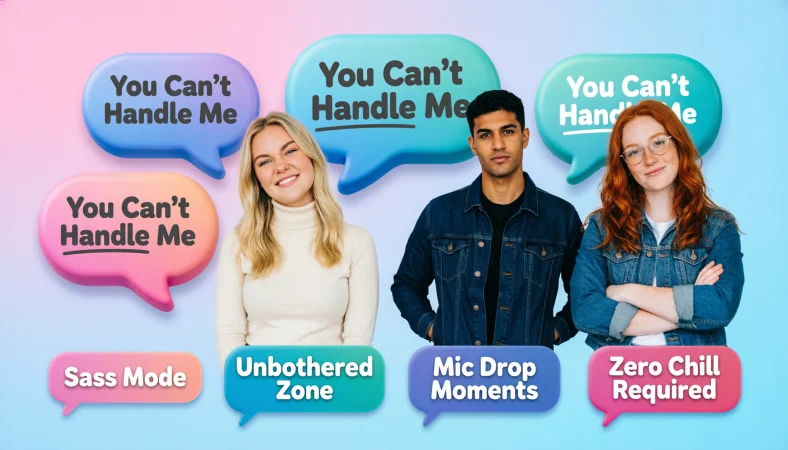
The best You can’t handle me responses depend on the vibe, whether you want something funny, confident, or flirty. Understanding you can t handle me meaning, you can’t handle me meaning, and can you handle me meaning also helps you choose a response that actually fits the conversation.
Top alternatives: “Try me,” “I can handle you,” “Challenge accepted,” “You might be surprised,” “Guess we’ll find out”
“You can’t handle me” is basically an invitation to prove them wrong, especially when the conversation has a playful or flirty vibe. The fun part is choosing whether to tease them back, accept the challenge, or confidently turn the tables.
When someone says “you can’t handle me,” they may be joking about their personality, teasing you about being difficult, or flirting by presenting themselves as a challenge. The phrase can sound confident and playful, so knowing the you can t handle me meaning can make it easier to respond without killing the vibe. In a flirty conversation, a bold comeback can turn their challenge into a fun little competition.
The opposite phrase can be just as interesting. i can’t handle you meaning, you can handle me meaning, and can u handle me meaning can all shift depending on the situation, relationship, and tone. Whether someone texts u can’t handle me meaning or simply says you can handle me, the surrounding conversation usually tells you whether they are joking, teasing, complimenting, or flirting.
You can t handle me meaning
It usually suggests that someone believes their personality, energy, or behaviour might be too much for you. In a flirty setting, it can also be a playful challenge.
Flirting response to you can t handle me
Try, “That sounds like a challenge I’m willing to accept.” It keeps the tone confident while giving the other person something fun to play off.
I can’t handle you meaning
This can mean someone finds your behaviour overwhelming, hilarious, exciting, or difficult to deal with. In a romantic conversation, it can sometimes be a playful way of admitting attraction.
You can’t handle me meaning
The phrase often means, “I’m more than you can deal with.” Depending on the context, it can be serious teasing, confident banter, or flirtatious talk.
Can you handle me meaning
This usually asks whether you can keep up with someone’s personality, energy, or attitude. In a flirty text, it can sound like a direct invitation to flirt back.
You can handle me meaning
It suggests confidence that you can deal with their personality or keep up with their energy. It can also be reassuring when someone has jokingly described themselves as difficult.
U can’t handle me meaning
This is simply a shortened texting version of “you can’t handle me.” The casual spelling often makes it feel more playful, especially in texts or social media messages.
Flirting response to you can t handle me text
You could reply, “Only one way to find out.” It is short, confident, and leaves just enough mystery to keep the flirting going.
Can u handle me meaning
This is an informal way of asking whether someone thinks they can keep up with you. When used romantically, it can carry a teasing or suggestive tone.
You can handle me
A playful response could be, “Good, because I’m not planning to make it easy.” It turns the statement into lighthearted banter without taking the conversation too seriously.
Funny Responses
“I can barely handle Monday, but let’s try.” Use this when you want to turn their confidence into a relatable joke.
Meaning: You are playfully admitting the challenge while keeping things light.
“That sounds like a personal challenge.” Use this when their statement feels teasing and dramatic.
Meaning: You are showing that you are entertained rather than intimidated.
“Do I get a user manual?” Use this when they are acting particularly complicated.
Meaning: You are joking that their personality requires instructions.
“Should I stretch first?” Use this when you want an exaggerated funny comeback.
Meaning: You are pretending their energy requires serious preparation.
“I’ve handled worse group projects.” Use this with a friend who loves playful exaggeration.
Meaning: You are humorously comparing them to an exhausting situation.
“Bold of you to assume I’m scared.” Use this when you want a funny confidence boost.
Meaning: You are teasing them for underestimating you.
“Sounds like a Tuesday problem.” Use this when you want a completely unserious reply.
Meaning: You are pretending their challenge can be postponed.
“I survived my teenage years, so I’m prepared.” Use this with someone who appreciates self-deprecating humor.
Meaning: You are joking that your past experiences built your resilience.
“I accept payment in snacks.” Use this when you want to make the challenge ridiculous.
Meaning: You are turning their dramatic claim into a playful bargain.
“Okay, main character.” Use this when they are being overly confident.
Meaning: You are affectionately teasing them for acting important.
“Plot twist: I’m the problem too.” Use this with someone who enjoys chaotic humor.
Meaning: You are suggesting that you can match their energy.
“This feels like a warning label.” Use this when they are clearly being dramatic.
Meaning: You are joking that their personality comes with a caution notice.
Brutal Responses
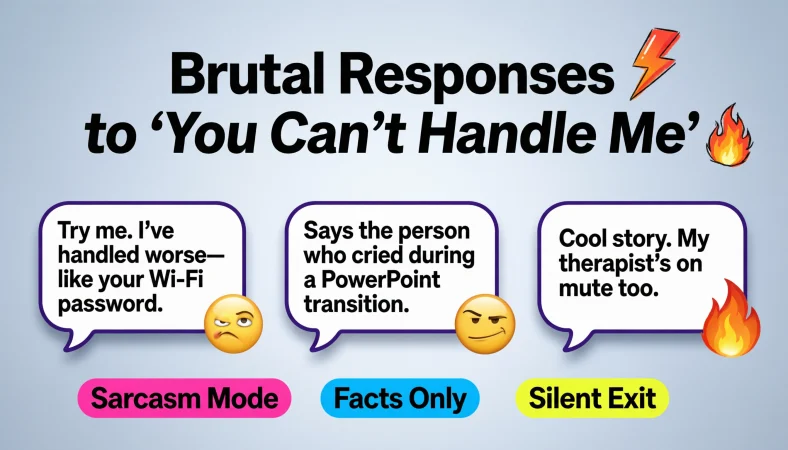
“You’re assuming I’m trying to handle you.” Use this when you want a sharp comeback without being overly harsh.
Meaning: You are reminding them that you are not impressed by the challenge.
“Confidence is cute when it has evidence.” Use this when someone is talking themselves up.
Meaning: You are playfully questioning whether their confidence is justified.
“I’ll decide that for myself.” Use this when you want to sound calm and self-assured.
Meaning: You refuse to let someone else define your limits.
“That’s a lot of confidence for one sentence.” Use this when they are being especially bold.
Meaning: You are calling attention to their confidence with a clever edge.
“Maybe you’re just used to being underestimated.” Use this when you want a more thoughtful comeback.
Meaning: You are turning their challenge into a statement about expectations.
“Don’t confuse complicated with impressive.” Use this when their personality feels unnecessarily dramatic.
Meaning: You are making it clear that difficulty does not automatically equal value.
“I don’t scare that easily.” Use this when they are trying to intimidate you playfully.
Meaning: You are confidently refusing to back down.
“You might be overestimating your difficulty level.” Use this when you want a cool, calculated comeback.
Meaning: You are teasing them for making themselves sound harder to handle than they are.
“I’ve heard that before.” Use this when someone acts like their statement is original.
Meaning: You are calmly suggesting their confidence is nothing new.
“Interesting claim. Prove it.” Use this when you want to turn their words into a challenge.
Meaning: You are inviting them to back up their confidence.
“You’re making quite the case for yourself.” Use this when they are bragging playfully.
Meaning: You are acknowledging their confidence while keeping control of the exchange.
“Let’s not give yourself too much credit.” Use this when friendly teasing is already part of the relationship.
Meaning: You are bringing their confidence back down with playful sass.
Flirty Responses
“Try me and find out.” Use this when the conversation is clearly flirtatious.
Meaning: You are confidently accepting the challenge.
“Who said I wanted easy?” Use this when you want to make their challenge sound attractive.
Meaning: You are suggesting that their intensity is part of the appeal.
“I have a thing for difficult.” Use this when you want a cheeky flirtatious comeback.
Meaning: You are playfully saying their personality interests you.
“You might be exactly my type.” Use this when you want to turn their warning into a compliment.
Meaning: You are showing attraction toward their bold personality.
“I guess you’ll have to test that theory.” Use this when you want to keep the flirting mysterious.
Meaning: You are inviting them to discover whether their claim is true.
“I’m not looking for easy.” Use this when you want confident romantic energy.
Meaning: You are saying that their challenge does not scare you away.
“Careful, I might enjoy the challenge.” Use this when their confidence is turning the conversation playful.
Meaning: You are openly showing interest while teasing them.
“You’re making me curious now.” Use this when you want to encourage more flirting.
Meaning: You are letting them know their confidence caught your attention.
“Maybe I like a little trouble.” Use this when the vibe is cheeky and playful.
Meaning: You are suggesting their personality could be appealing.
“Then I guess we have to find out.” Use this when you want a direct but playful flirt.
Meaning: You are accepting their challenge with confidence.
“I’m pretty good with strong personalities.” Use this when they are emphasizing how intense they are.
Meaning: You are reassuring them that confidence does not intimidate you.
“You’re cute when you underestimate me.” Use this when you want to combine teasing and attraction.
Meaning: You are flirting while making it clear you are not intimidated.
Polite Responses
“I guess everyone has their own personality.” Use this when you want to stay friendly without escalating the teasing.
Meaning: You are acknowledging their comment neutrally.
“I’ll let you surprise me.” Use this when you want a warm and open response.
Meaning: You are staying curious without making a strong commitment.
“We’ll see about that.” Use this when you want to keep things playful but respectful.
Meaning: You are neither accepting nor rejecting their claim.
“I appreciate the warning.” Use this when their comment is clearly playful.
Meaning: You are responding with humor while keeping things courteous.
“Everyone deserves to be themselves.” Use this when you want a mature response.
Meaning: You are showing acceptance rather than judgment.
“I suppose I’ll have to find out.” Use this when you want polite curiosity.
Meaning: You are keeping the exchange open and friendly.
“I’m not one to make assumptions.” Use this when you want to sound composed.
Meaning: You prefer discovering someone’s personality yourself.
“That’s certainly one way to describe yourself.” Use this when their confidence is amusing you.
Meaning: You are acknowledging their statement without fully agreeing.
“I respect the confidence.” Use this when you genuinely admire their self-assurance.
Meaning: You are complimenting their boldness.
“We’ll take it one step at a time.” Use this when you want to slow down an intense conversation.
Meaning: You are keeping the interaction comfortable.
“I guess everyone comes with their own challenges.” Use this when you want a thoughtful response.
Meaning: You recognize that people have different personalities.
“Fair enough, I’ll keep an open mind.” Use this when you want to remain friendly and curious.
Meaning: You are willing to see for yourself.
Professional Responses
“I’m sure we can work with different personalities.” Use this in a workplace conversation where someone is joking about being difficult.
Meaning: You are keeping the tone professional and positive.
“I prefer to judge situations based on experience.” Use this when you want a composed response.
Meaning: You value firsthand experience over assumptions.
“I think every challenge can be managed.” Use this when the discussion involves teamwork.
Meaning: You are emphasizing problem-solving and confidence.
“Let’s focus on finding what works.” Use this when someone is being playful during a work discussion.
Meaning: You are redirecting the conversation toward cooperation.
“I’m confident we can handle it.” Use this when the statement relates to a project or task.
Meaning: You are expressing professional confidence.
“Different personalities can make teams stronger.” Use this when discussing workplace dynamics.
Meaning: You frame differences as potentially valuable.
“I’m always open to learning how people work.” Use this when you want a mature professional answer.
Meaning: You are showing adaptability.
“I prefer collaboration over assumptions.” Use this when someone makes a sweeping statement about themselves.
Meaning: You value communication over labels.
“We’ll find the right approach.” Use this when someone describes themselves as challenging.
Meaning: You are showing practical confidence.
“I’m comfortable with a challenge.” Use this when the workplace conversation is light but professional.
Meaning: You communicate resilience and confidence.
“I think clear communication solves a lot.” Use this when personality differences could affect teamwork.
Meaning: You highlight communication as the solution.
“Let’s see how it goes.” Use this when you want a neutral professional response.
Meaning: You are keeping expectations realistic and open.
Creative Responses
“Maybe I’m the plot twist you didn’t see coming.” Use this when you want a dramatic, imaginative comeback.
Meaning: You are suggesting that you may surprise them.
“Challenge accepted, chapter one begins now.” Use this for playful texting or social media banter.
Meaning: You are turning the exchange into a fun story.
“I came with patience and snacks.” Use this when someone jokes about being difficult.
Meaning: You are humorously claiming you are prepared.
“Let’s see which one of us breaks character first.” Use this when the conversation is full of playful teasing.
Meaning: You are framing the interaction as a fun competition.
“Maybe I’m fluent in difficult.” Use this when you want a witty one-liner.
Meaning: You are claiming that their personality will not overwhelm you.
“I collect challenges for fun.” Use this when you want confident, playful energy.
Meaning: You are suggesting that difficulty makes things more interesting.
“Your warning has officially made things interesting.” Use this when their confidence catches your attention.
Meaning: You are turning their caution into curiosity.
“I’m prepared for season two.” Use this when you want a pop-culture-inspired joke.
Meaning: You are joking that their personality already feels like a series.
“Every good story needs a little chaos.” Use this when they are being dramatic.
Meaning: You are suggesting that their intensity could make life entertaining.
“Maybe I’m built for plot twists.” Use this when you want to sound confident and mysterious.
Meaning: You are showing that surprises do not intimidate you.
“Let’s make this interesting.” Use this when you want to raise the playful energy.
Meaning: You are inviting them to continue the challenge.
“I like a story with an unexpected ending.” Use this when you want a clever, slightly mysterious flirt.
Meaning: You are hinting that the outcome could surprise both of you.
Sarcastic Responses
“Wow, what a humble introduction.” Use this when they are clearly bragging.
Meaning: You are sarcastically teasing their confidence.
“Should I alert the authorities?” Use this when they dramatically describe themselves.
Meaning: You are exaggerating their supposed intensity for humor.
“Thank you for the public service announcement.” Use this when their warning is especially dramatic.
Meaning: You are playfully treating their statement like official information.
“I’ll try to stay strong.” Use this when you want dry humor.
Meaning: You are pretending their personality will be extremely difficult.
“Noted. Very intimidating.” Use this when you want deadpan sarcasm.
Meaning: You are joking that you are completely unimpressed.
“Should I take notes?” Use this when they keep explaining how difficult they are.
Meaning: You are humorously pretending their warning requires preparation.
“I’ll alert my therapist.” Use this when the relationship allows playful exaggeration.
Meaning: You are making their confidence sound hilariously overwhelming.
“The confidence is doing overtime today.” Use this when they are being particularly bold.
Meaning: You are poking fun at their self-assurance.
“I’ll add that to your list of achievements.” Use this when they are bragging.
Meaning: You are sarcastically treating their claim like an accomplishment.
“Groundbreaking information.” Use this when they state something obvious about themselves.
Meaning: You are joking that their announcement is hardly surprising.
“I’m shaking in my imaginary boots.” Use this when you want exaggerated sarcasm.
Meaning: You are making it obvious that you are not intimidated.
“What a terrifying résumé.” Use this when they list all their difficult qualities.
Meaning: You are playfully mocking their dramatic self-description.
Cute Responses
“I think I can handle your cute little attitude.” Use this when the conversation is affectionate.
Meaning: You are turning their confidence into a sweet tease.
“You’re probably easier to love than you think.” Use this when you want a warm response.
Meaning: You are reassuring them with affection.
“I’d still choose you.” Use this when you want something simple and heartfelt.
Meaning: You are showing acceptance despite their warning.
“I think I can manage.” Use this when you want a soft, confident comeback.
Meaning: You are saying their personality does not scare you.
“You’re worth the challenge.” Use this when you want to make them feel special.
Meaning: You are saying their personality is worth understanding.
“I have a feeling we’d be just fine.” Use this when you want gentle romantic energy.
Meaning: You are expressing optimism about the connection.
“You make difficult look adorable.” Use this when they are being playfully stubborn.
Meaning: You are combining teasing with affection.
“I’ll take my chances with you.” Use this when you want a sweet but confident reply.
Meaning: You are saying you are willing to take a chance.
“Maybe I’m exactly who you need.” Use this when the conversation is becoming romantic.
Meaning: You are suggesting that your personalities could complement each other.
“I think I can keep up.” Use this when they have energetic or playful vibes.
Meaning: You are showing confidence without being too intense.
“You’re making the challenge sound adorable.” Use this when their warning is more cute than intimidating.
Meaning: You are affectionately teasing them.
“I’ll figure you out eventually.” Use this when you want a playful relationship-style response.
Meaning: You are showing curiosity and patience.
Dramatic Responses
“Then this is where the legend begins.” Use this when you want to make their statement hilariously dramatic.
Meaning: You are turning a simple challenge into an epic story.
“I fear nothing except bad Wi-Fi.” Use this when you want exaggerated humor.
Meaning: You are making their warning seem less intimidating.
“If this is my final chapter, so be it.” Use this when the conversation is already theatrical.
Meaning: You are playfully exaggerating the supposed danger.
“Tell my family I tried.” Use this when you want an over-the-top joke.
Meaning: You are pretending their personality is an enormous challenge.
“The prophecy has been fulfilled.” Use this when their statement arrives at the perfect dramatic moment.
Meaning: You are making the exchange feel hilariously epic.
“I knew today would test me.” Use this when you want playful melodrama.
Meaning: You are pretending their challenge is a major life event.
“This feels like the beginning of a very questionable decision.” Use this when you want dramatic humor.
Meaning: You are suggesting that accepting the challenge could lead to entertaining trouble.
“I have prepared for this moment my entire life.” Use this when you want an exaggerated response.
Meaning: You are joking that you are completely ready.
“The universe clearly wants me to find out.” Use this when you want dramatic mystery.
Meaning: You are playfully accepting the challenge.
“I was born for this storyline.” Use this when you want confident theatrical energy.
Meaning: You are saying the challenge suits your personality.
“Let history remember my bravery.” Use this when you want a ridiculous dramatic comeback.
Meaning: You are humorously exaggerating the situation.
“Well, this escalated beautifully.” Use this when their comment makes the conversation more entertaining.
Meaning: You are acknowledging the drama with amusement.
Chill And Casual Responses
“We’ll see.” Use this when you want the simplest possible comeback.
Meaning: You are staying relaxed and noncommittal.
“Maybe you’re right.” Use this when you want to tease them casually.
Meaning: You are giving them just enough agreement to keep things interesting.
“Guess we’ll find out.” Use this when you want an easygoing response.
Meaning: You are letting experience decide.
“I’m not worried.” Use this when you want quiet confidence.
Meaning: You are showing that their claim does not bother you.
“Sounds like a challenge.” Use this when you want a relaxed playful reply.
Meaning: You are acknowledging their teasing without overdoing it.
“I can probably manage.” Use this when you want understated confidence.
Meaning: You believe you can handle their personality.
“Only one way to know.” Use this when you want to sound casual and curious.
Meaning: You are suggesting that they should let reality answer.
“Noted.” Use this when you want a short, dry response.
Meaning: You acknowledge their statement without giving it too much attention.
“Fair warning received.” Use this when they are jokingly giving you a caution.
Meaning: You are showing that you heard them while keeping things light.
“I’ll take my chances.” Use this when you want casual confidence.
Meaning: You are willing to see what happens.
“I’m good with a little challenge.” Use this when you want to sound relaxed and capable.
Meaning: You are saying their intensity is manageable.
“Let’s not get ahead of ourselves.” Use this when you want playful restraint.
Meaning: You are keeping the situation grounded.
Confident Responses
“I can handle more than you think.” Use this when you want a direct confidence boost.
Meaning: You are making it clear that you are not easily intimidated.
“You’ll have to do better than that.” Use this when they are trying to challenge you.
Meaning: You are confidently raising the bar.
“I know what I can handle.” Use this when you want a mature response.
Meaning: You trust your own judgment and limits.
“I don’t scare easily.” Use this when someone is testing your confidence.
Meaning: You are showing emotional strength.
“I’m not intimidated.” Use this when you want a straightforward answer.
Meaning: You refuse to let their confidence overwhelm you.
“I’ve got this.” Use this when you want a short, powerful response.
Meaning: You are communicating self-assurance.
“I’m more capable than I look.” Use this when you want a mysterious comeback.
Meaning: You are suggesting there is more to you than they realize.
“Underestimate me at your own risk.” Use this when playful competition is already happening.
Meaning: You are warning them that they may be surprised.
“I trust myself to know when something is too much.” Use this when you want confident maturity.
Meaning: You are showing self-awareness and boundaries.
“I’ve got plenty of patience.” Use this when they claim they are difficult.
Meaning: You are saying their personality will not easily overwhelm you.
“I don’t need easy to feel comfortable.” Use this when you want a thoughtful confidence statement.
Meaning: You are comfortable with complexity.
“You might be surprised by me.” Use this when you want to leave them curious.
Meaning: You are confidently suggesting they do not know your limits yet.
Emotional Responses
“I don’t need you to be easy to care about you.” Use this when the conversation has emotional depth.
Meaning: You are saying affection does not depend on perfection.
“Everyone has parts of themselves that are difficult.” Use this when someone is being vulnerable.
Meaning: You are responding with understanding rather than judgment.
“You don’t have to warn me away.” Use this when someone seems afraid of being too much.
Meaning: You are reassuring them that their personality does not automatically push you away.
“I’d rather understand you than judge you.” Use this when the conversation becomes sincere.
Meaning: You value understanding over quick assumptions.
“You can be complicated and still be worth knowing.” Use this when someone doubts their own appeal.
Meaning: You are separating complexity from worth.
“I’m not looking for perfect.” Use this when someone is worried about being difficult.
Meaning: You are saying authenticity matters more than perfection.
“You don’t have to make yourself smaller for me.” Use this when they describe themselves as too intense.
Meaning: You are encouraging them to be authentic.
“I can handle honesty.” Use this when they are worried about showing their real personality.
Meaning: You are creating emotional safety.
“I’d rather know the real you.” Use this when you want a sincere romantic response.
Meaning: You value authenticity over appearances.
“Being difficult sometimes doesn’t make you unlovable.” Use this when they are expressing insecurity.
Meaning: You are offering reassurance and acceptance.
“We all have layers.” Use this when you want a short but meaningful response.
Meaning: You recognize that people cannot be defined by one trait.
“I’m willing to understand before I decide.” Use this when you want to show emotional maturity.
Meaning: You prefer getting to know someone before forming an opinion.
Sweet Responses
“I think you’re worth figuring out.” Use this when you want a warm romantic reply.
Meaning: You are saying their complexity makes them worth knowing.
“I’m not scared of a little personality.” Use this when they are joking about being intense.
Meaning: You are reassuring them with playful affection.
“I like you exactly as you are.” Use this when the conversation is sincere.
Meaning: You are expressing acceptance without conditions.
“Maybe I can handle you better than you expect.” Use this when you want gentle confidence.
Meaning: You are reassuring them while keeping the tone playful.
“You don’t have to be easy for me to enjoy you.” Use this when they are worried about being complicated.
Meaning: You are saying their personality does not diminish your interest.
“I think we could balance each other.” Use this when you sense complementary personalities.
Meaning: You are suggesting that differences can work well together.
“I’d still like to get to know you.” Use this when someone is trying to scare you off.
Meaning: You are showing genuine curiosity.
“You’re allowed to be a lot.” Use this when they are worried about being too intense.
Meaning: You are reassuring them that they do not need to shrink themselves.
“I’m not going anywhere just because you’re a little complicated.” Use this with someone you genuinely care about.
Meaning: You are offering reassurance and loyalty.
“Maybe your kind of difficult is my kind of favorite.” Use this when you want playful affection.
Meaning: You are turning their warning into a compliment.
“I think there’s more to you than the warning label.” Use this when they are joking about their personality.
Meaning: You are showing that you want to know the person behind the joke.
“You’re probably worth the learning curve.” Use this when you want a cute, clever response.
Meaning: You are saying that understanding them is worth the effort.
Clever Responses
“Handle you? I prefer understand you.” Use this when you want a thoughtful twist on their statement.
Meaning: You are reframing the idea from control to connection.
“Difficulty depends on the person doing the handling.” Use this when you want an intelligent comeback.
Meaning: You are suggesting compatibility changes how challenging someone feels.
“Maybe the real question is whether you can handle me.” Use this when you want to reverse the challenge.
Meaning: You are confidently putting the attention back on yourself.
“Claims require evidence.” Use this when they are making a bold statement.
Meaning: You are challenging them to prove their confidence.
“I’ll reserve judgment until I have data.” Use this with someone who appreciates dry humor.
Meaning: You are jokingly treating their personality like an experiment.
“That sounds like an unverified hypothesis.” Use this when you want a nerdy clever comeback.
Meaning: You are saying their claim has not been proven.
“Perhaps we’re measuring the wrong variable.” Use this when you want intellectual humor.
Meaning: You are playfully questioning their definition of being difficult.
“I prefer firsthand research.” Use this when you want a confident, teasing response.
Meaning: You would rather experience their personality than take their word for it.
“Interesting. I’ll investigate.” Use this when you want a short, mysterious comeback.
Meaning: You are showing curiosity without giving too much away.
“That depends on the definition of ‘handle.’” Use this when you want to challenge the wording itself.
Meaning: You are cleverly questioning their assumption.
“Maybe compatibility makes the impossible look easy.” Use this when you want something deeper.
Meaning: You are suggesting that the right connection can change everything.
“I’m more interested in whether we understand each other.” Use this when you want a mature clever response.
Meaning: You are prioritizing connection over control.
Playful Teasing Responses
“You really enjoy advertising yourself, don’t you?” Use this when they keep hyping themselves up.
Meaning: You are teasing them for their confidence.
“You’re doing a great job convincing me.” Use this when they are playfully persistent.
Meaning: You are humorously acknowledging their sales pitch.
“Keep talking. This is entertaining.” Use this when you want to encourage their banter.
Meaning: You are enjoying their confidence and personality.
“That confidence is almost convincing.” Use this when you want a teasing compliment.
Meaning: You are playfully pretending you are not impressed.
“You make yourself sound like a full-time project.” Use this when they are being dramatically complicated.
Meaning: You are teasing them for exaggerating their personality.
“Should I be impressed or concerned?” Use this when they give you a playful warning.
Meaning: You are keeping the conversation humorous and curious.
“You really came prepared with that warning.” Use this when their confidence seems rehearsed.
Meaning: You are poking fun at how seriously they take their reputation.
“I’ll believe it when I see it.” Use this when you want a classic challenge.
Meaning: You are encouraging them to prove their claim.
“That sounds suspiciously confident.” Use this when you want playful skepticism.
Meaning: You are teasing them for being overly sure of themselves.
“You’re making a strong case for being trouble.” Use this when the conversation is flirtatious.
Meaning: You are playfully suggesting their personality is intriguing.
“You might be talking yourself into a challenge.” Use this when you want to turn their confidence around.
Meaning: You are suggesting their own words may create the challenge.
“I’ll give you points for confidence.” Use this when you want a lighthearted tease.
Meaning: You appreciate their boldness even if you doubt the claim.
Short And Catchy Responses
“Try me.” Use this when you want maximum confidence in two words.
Meaning: You are accepting the challenge.
“Prove it.” Use this when you want a direct comeback.
Meaning: You are asking them to back up their claim.
“Watch me.” Use this when you want confident energy.
Meaning: You are promising to surprise them.
“Bet.” Use this when the conversation is casual and playful.
Meaning: You are confidently accepting the challenge.
“Challenge accepted.” Use this when you want a classic response.
Meaning: You are openly welcoming the test.
“We’ll see.” Use this when you want to stay mysterious.
Meaning: You are leaving the outcome undecided.
“I doubt it.” Use this when you want a calm, teasing response.
Meaning: You are suggesting their claim may be exaggerated.
“Good luck to you.” Use this when you want to flip the challenge.
Meaning: You are implying they may have to handle you too.
“That remains to be seen.” Use this when you want clever confidence.
Meaning: You refuse to accept their claim without evidence.
“Game on.” Use this when you want energetic banter.
Meaning: You are turning their statement into playful competition.
“Interesting.” Use this when you want to create mystery.
Meaning: You are acknowledging the challenge without revealing your reaction.
“I’ll take that bet.” Use this when you want confident playful energy.
Meaning: You believe you can prove them wrong.
Romantic Responses
“I’m not looking for someone easy, I’m looking for someone real.” Use this when the conversation has shifted toward genuine connection.
Meaning: You are saying authenticity matters more than convenience.
“If I like you, I’ll figure out the rest.” Use this when you want confident romantic energy.
Meaning: You are saying genuine interest makes challenges manageable.
“I’d rather discover you than be scared off by a warning.” Use this when someone is opening up emotionally.
Meaning: You are showing patience and curiosity.
“Maybe I’m exactly the kind of person who can understand you.” Use this when you feel a strong connection.
Meaning: You are suggesting compatibility may make the difference.
“You don’t have to be easy for me to choose you.” Use this when you want a sincere romantic message.
Meaning: You are saying someone’s complexity does not reduce their worth.
“I like people with personality.” Use this when you want something short and affectionate.
Meaning: You are turning their warning into a compliment.
“I’d rather have real than perfect.” Use this when someone worries about being too much.
Meaning: You value authenticity over an idealized image.
“You being a challenge doesn’t make you less attractive.” Use this when you want to combine honesty and attraction.
Meaning: You are saying their strong personality can be appealing.
“Maybe I don’t want easy. Maybe I want you.” Use this when you want a more romantic line.
Meaning: You are making your interest clear.
“I think we could surprise each other.” Use this when you want romantic mystery.
Meaning: You are suggesting the connection could be unexpectedly strong.
“You might be the kind of trouble I actually like.” Use this when the flirting is already strong.
Meaning: You are turning their warning into romantic intrigue.
“I’m curious where this goes.” Use this when you want a sincere but low-pressure response.
Meaning: You are expressing interest without rushing the connection.
Boundary-Setting Responses
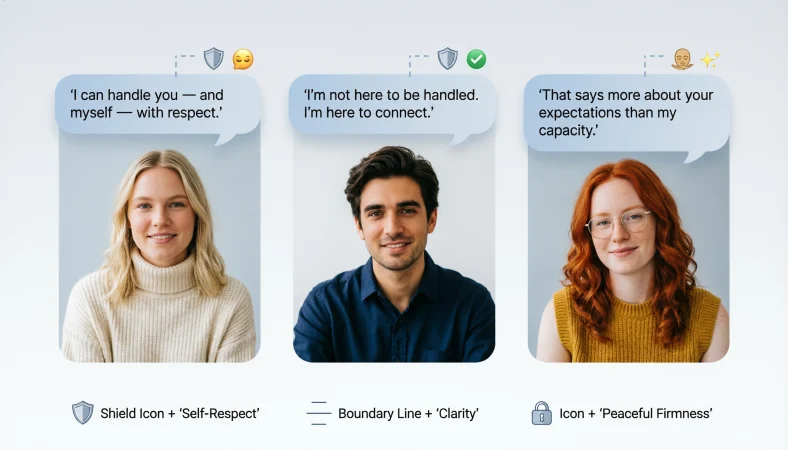
“I can handle confidence, but I value respect too.” Use this when their statement starts feeling less playful.
Meaning: You are making it clear that confidence should come with respect.
“Being yourself is great, but boundaries matter.” Use this when someone uses the phrase to excuse difficult behavior.
Meaning: You are separating authenticity from disrespect.
“I don’t need to handle anyone who doesn’t respect me.” Use this when you want a firm response.
Meaning: You are clearly stating your standards.
“Challenge is fine, disrespect isn’t.” Use this when someone crosses the line.
Meaning: You are setting a simple and direct boundary.
“I’m confident enough to walk away when something isn’t healthy.” Use this when the conversation becomes serious.
Meaning: You are prioritizing your well-being and standards.
“You can be intense without being inconsiderate.” Use this when someone confuses strong personality with poor behavior.
Meaning: You are encouraging healthy communication.
“I don’t handle disrespect, regardless of personality.” Use this when you need a clear boundary.
Meaning: You are establishing a firm limit.
“Being difficult isn’t an excuse for treating people badly.” Use this when their statement feels dismissive.
Meaning: You are separating personality from behavior.
“I’m open to your personality, not unnecessary drama.” Use this when you want a calm but firm answer.
Meaning: You are showing openness while protecting your peace.
“We can joke around, but respect comes first.” Use this when you want to reset the tone.
Meaning: You are keeping the interaction healthy.
“I don’t compete with chaos.” Use this when someone is intentionally creating conflict.
Meaning: You are refusing to participate in unnecessary drama.
“I know what I’m comfortable with.” Use this when you want a short, confident boundary.
Meaning: You are asserting self-awareness and personal limits.
Witty And Social Media Ready Responses
“POV: You underestimated the wrong person.” Use this as a playful caption or comment.
Meaning: You are confidently flipping the challenge around.
“Plot twist: I can handle you.” Use this when you want a social-media-friendly comeback.
Meaning: You are turning their warning into your confidence.
“Respectfully, challenge accepted.” Use this when you want classy confidence with humor.
Meaning: You are accepting their challenge without being overly aggressive.
“Me? Intimidated? That’s adorable.” Use this when you want playful confidence.
Meaning: You are teasing them for thinking they can scare you.
“Adding ‘professional handler’ to my résumé.” Use this when you want a funny comment.
Meaning: You are joking that dealing with them is now your job.
“The confidence is giving main-character energy.” Use this when their personality is bold.
Meaning: You are playfully complimenting their confidence.
“Challenge received. Ego loading.” Use this when you want meme-style humor.
Meaning: You are preparing a playful comeback.
“I came for the plot, apparently.” Use this when their statement makes things unexpectedly entertaining.
Meaning: You are joking that the situation has become a storyline.
“Sounds like content for the group chat.” Use this when your friends would enjoy the situation.
Meaning: You are joking that their confidence deserves commentary.
“And somehow that made me more curious.” Use this when their warning makes them more interesting.
Meaning: You are admitting that their confidence caught your attention.
“Confidence level: noted.” Use this as a short social media comment.
Meaning: You are teasing them for being very self-assured.
“The challenge has entered the chat.” Use this when you want a meme-inspired response.
Meaning: You are making their statement feel like an entertaining event.
FAQs
What Does “You Can’t Handle Me” Mean?
It usually means someone believes their personality, confidence, energy, or behavior is intense enough to challenge another person. Depending on context, it can be playful, flirtatious, boastful, or occasionally defensive.
Is “You Can’t Handle Me” Flirty?
It can be. In texting or dating conversations, it is often a teasing way to create tension and invite someone to flirt back. The tone and relationship matter more than the words alone.
What Is A Good Flirty Response?
Try “Try me and find out,” “Who said I wanted easy?” or “Careful, I might enjoy the challenge.” These keep the energy confident without becoming overly serious.
What If I Want A Funny Response?
Go for something like “Do I get a user manual?” or “I can barely handle Monday, but let’s try.” Humor works especially well when the other person is clearly joking.
Can I Respond Professionally?
Yes, but avoid flirty or overly personal comebacks. In a workplace setting, responses such as “I’m comfortable with a challenge” or “I’m sure we can work with different personalities” are safer.
What If I Don’t Actually Want To Engage?
You do not have to match their energy. A simple “I’m not looking for that kind of dynamic” or “I’ll pass, but I appreciate the honesty” keeps your response clear and respectful.
Is It Okay To Use Humor?
Absolutely, especially when the phrase is being used playfully. Just make sure your humor matches the relationship and does not turn a harmless tease into an uncomfortable exchange.
How Do I Respond Without Sounding Arrogant?
Use calm confidence instead of trying to outdo them. “I guess we’ll find out” is a great option because it keeps the conversation playful without making exaggerated claims.
What If Someone Is Using The Phrase To Excuse Bad Behavior?
Do not feel pressured to accept it. A response such as “Confidence is fine, but respect matters too” makes your boundary clear without unnecessary drama.
Conclusion
The best you can’t handle me responses are the ones that sound like you. If you are naturally funny, lean into humor or If you love playful flirting, turn the challenge into chemistry. If confidence is your style, keep your comeback short and assured. And if the situation feels uncomfortable, there is nothing wrong with setting a clear boundary.
A good response can change the entire mood of a conversation, from a basic text into memorable banter. Try a few different lines, save your favorites, and keep the ones that feel natural in your voice. Whether you are texting a crush, joking with a friend, or answering a bold comment, have fun with it and let your personality do the talking.