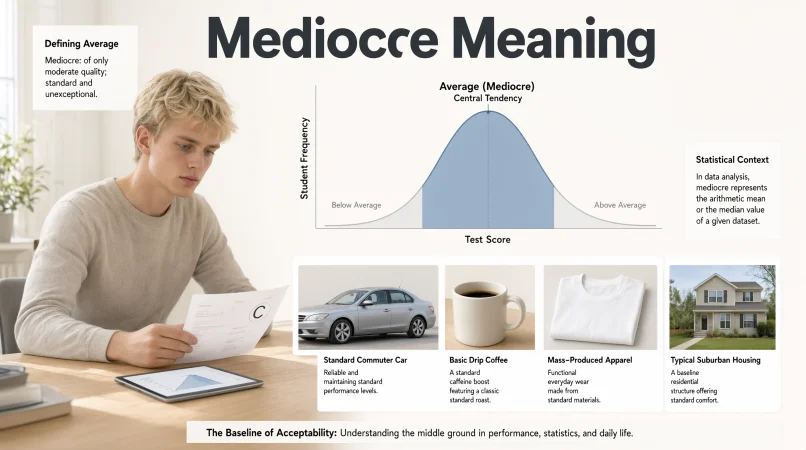
The word “mediocre” means average, ordinary, or not particularly good, impressive, or special. It describes something that meets basic expectations but does not show excellent quality, outstanding performance, or exceptional results.For example, if someone says, “The movie was mediocre,” they mean it was neither terrible nor particularly enjoyable. The word is often used when discussing food, work, school performance, movies, products, or personal achievements. Depending on the context and tone, calling something mediocre can sound like mild criticism because it suggests that it could have been much better.
Have you ever watched a movie that wasn’t terrible but wasn’t worth recommending either? Or tried a restaurant where the food was just okay, nothing special? You might describe that experience as mediocre. It’s one of those English words people use when something falls somewhere between good and bad but fails to leave a positive impression.
You may also hear it in conversations about school grades, workplace performance, sports, entertainment, or everyday experiences. Although it sounds like a simple word, it can carry a slightly negative tone when someone uses it to express disappointment.
Understanding the mediocre meaning can help you recognize how people use this word to describe average quality, ordinary results, or performance that does not meet expectations. In standard English, mediocre is an adjective that refers to something of moderate or low quality rather than something excellent.
It is commonly used in reviews, casual conversations, professional feedback, and everyday writing. In this guide, we’ll explore its definition, pronunciation, synonyms, antonyms, and practical sentence examples so you can understand its meaning and use it naturally in different situations.arries a negative or mildly critical tone because it suggests that something could have been better.
Table of Contents
- What Does Mediocre Mean?
- The Origin and History of the Word
- How Mediocre Is Used in Different Contexts
- Real-Life Examples of Mediocre
- Is Mediocre a Negative Word?
- Mediocre vs. Average vs. Ordinary
- Synonyms and Antonyms
- What Makes Something Mediocre?
- How to Use Mediocre in a Sentence
- Frequently Asked Questions
- Conclusion
What Does Mediocre Mean?
The word mediocre describes something of average or moderate quality that fails to stand out. It is often used when a person, product, performance, or experience is neither especially good nor completely bad.
Think about watching a movie that has a predictable story, ordinary acting, and an ending you forget the next morning. You might not call it terrible because it was still watchable. However, you probably would not recommend it enthusiastically either. That is a good example of something mediocre.
The word can describe different levels of performance and quality:
- A mediocre student: Someone whose academic performance is average or below expectations.
- A mediocre meal: Food that is acceptable but lacks flavor, freshness, or originality.
- A mediocre performance: An effort that does not meet a particularly high standard.
- A mediocre product: An item that works but offers little quality or value compared with better options.
- A mediocre experience: Something that is neither especially enjoyable nor memorable.
The important distinction is that mediocre does not necessarily mean useless, broken, or completely unsuccessful. It means the result is ordinary, disappointing, or less impressive than expected.
For instance, a restaurant may serve perfectly edible food, but if the service is slow and the dishes lack flavor, customers might describe the overall experience as mediocre.
The Origin and History of the Word
The word mediocre has roots in Latin. It comes from mediocris, a term associated with being moderate, ordinary, or in the middle.
The Latin word is linked to medius, meaning “middle.” This connection helps explain the basic idea behind the modern English word: something that sits between excellent and poor rather than reaching an outstanding level.
English adopted the term through French influence. Over time, it became a common adjective for describing average quality, ability, or achievement.
Its original connection with moderation does not automatically suggest failure. Something moderate can be perfectly acceptable. However, modern English often uses the word critically, especially when the speaker expected better results.
For example, describing a restaurant as moderate might simply suggest that its prices or quality are reasonable. Calling it mediocre usually communicates disappointment.
That difference in tone is important. The word has developed a stronger negative association than its basic idea of being in the middle might suggest.
How Mediocre Is Used in Different Contexts
The adjective appears in conversations about work, education, entertainment, products, and personal performance. Its meaning stays fairly consistent, but the reason something receives that description changes with the situation.
1. Mediocre Performance
In work, sports, or other activities, the word describes an effort that falls short of expectations.
For example:
The team delivered a mediocre performance during the final match.
This means the players did not perform particularly well. They may have completed some tasks successfully, but their overall performance was not impressive.
A similar description might apply to an employee who completes assigned duties but rarely shows initiative, creativity, or attention to detail.
It does not necessarily mean the person lacks ability. Their performance simply does not reach the expected standard.
2. Mediocre Academic Results
In education, the word can describe average grades, ordinary assignments, or work that lacks depth.
For example:
Despite studying for several weeks, he received a mediocre result in mathematics.
The result was not necessarily a failure, but it was below what he hoped to achieve.
A teacher might also describe an essay as mediocre if it contains relevant information but has weak arguments, limited examples, and poor organization.
The word can sound discouraging when applied to students, so teachers often use more specific feedback to explain what needs improvement.
3. Mediocre Food and Restaurants
Food is another common subject.
A meal can be mediocre when it is edible but lacks the taste, presentation, or freshness that customers expect.
For example:
The restaurant had beautiful decorations, but the food was mediocre.
The sentence suggests that the restaurant looked impressive but did not deliver a satisfying dining experience.
The same description can apply to a dish that is too bland, poorly prepared, or simply less enjoyable than expected.
4. Mediocre Movies, Books, and Entertainment
In entertainment, the word often describes something that is not memorable or engaging.
For example:
The film had a talented cast, but the storyline was mediocre.
This suggests that the actors may have performed well, but the story failed to make a strong impression.
A book can also be described this way if its characters feel unoriginal, its plot moves slowly, or its writing does not hold the reader’s attention.
Importantly, a mediocre review does not mean everyone will dislike the work. Personal taste still matters.
5. Mediocre Products and Services
When discussing products, the term usually refers to quality that meets basic expectations but offers little reason to choose the item over competitors.
For example:
The headphones were inexpensive, but their sound quality was mediocre.
They may still function properly. However, the sound, comfort, or durability may not satisfy someone looking for a better product.
The same applies to customer service. A company may answer questions and process orders correctly, yet provide an experience that feels slow, unhelpful, or unremarkable.
Real-Life Examples of Mediocre
Here are practical examples showing how the word works in everyday situations.
| Situation | Example sentence | What it suggests |
| Work | His presentation was mediocre. | It lacked quality or impact. |
| Education | She received a mediocre grade. | Her result was average or disappointing. |
| Food | The pasta tasted mediocre. | The meal was acceptable but unimpressive. |
| Movies | The sequel received mediocre reviews. | Critics found it ordinary or disappointing. |
| Sports | The team had a mediocre season. | Its overall performance was not impressive. |
| Shopping | The product offers mediocre value. | Its quality does not justify its price particularly well. |
| Customer service | We received mediocre support. | The assistance was not especially helpful. |
| Writing | The article felt mediocre. | It lacked originality, detail, or strong presentation. |
| Technology | The phone has mediocre battery life. | Its battery performance is less impressive than expected. |
| Travel | The hotel provided a mediocre experience. | The stay was acceptable but not memorable. |
These examples also show that the word can describe both measurable results and personal impressions.
A mediocre examination score may be based on grades, while a mediocre movie review is usually a subjective judgment. Context tells the reader which type of evaluation is being made.
Is Mediocre a Negative Word?
Yes, mediocre usually has a negative or critical tone, although it is not as harsh as words such as terrible, awful, or disastrous.
The word often suggests that something has failed to meet expectations. It can also imply that the person or organization responsible could have done better.
Compare these descriptions:
- The presentation was average. This sounds relatively neutral.
- The presentation was mediocre. This suggests disappointment.
- The presentation was terrible. This communicates a much stronger negative judgment.
The difference is subtle but meaningful.
Can Mediocre Be an Insult?
It can be, particularly when used to describe someone’s intelligence, talent, personality, or abilities.
For example:
Calling someone a mediocre writer may sound dismissive, especially if the comment offers no explanation or useful feedback.
It is generally better to describe the specific issue when discussing someone’s work. Saying that an essay lacks clear arguments is more helpful than simply labeling it mediocre.
Can Mediocre Be Used Positively?
Not usually. The word itself does not carry a positive meaning, even though an average result may be perfectly acceptable in some situations.
For example, a beginner learning to play the guitar might be happy with a mediocre performance because it shows progress from their starting point.
In that situation, the speaker is not praising mediocrity. They are recognizing that a modest result can still represent personal improvement.
Mediocre vs. Average vs. Ordinary
These three words are related, but their tones are different. Choosing the right one can change how a sentence sounds.
| Word | Main meaning | Tone | Example |
| Mediocre | Average or below the expected standard | Usually negative | The service was mediocre. |
| Average | Typical or around the usual level | Mostly neutral | The student received an average score. |
| Ordinary | Common, familiar, or not special | Neutral or mildly negative | It was an ordinary afternoon. |
| Moderate | Neither extreme nor excessive | Usually neutral | The company experienced moderate growth. |
| Unremarkable | Not especially interesting or memorable | Mildly negative or neutral | The performance was unremarkable. |
| Substandard | Below an accepted level of quality | Clearly negative | The building had substandard facilities. |
Mediocre vs. Average
Average generally describes something close to a typical level. It does not always suggest poor quality.
For example:
Her exam result was average.
This simply means her score was around the usual level.
However:
Her exam result was mediocre.
This sounds more critical and may suggest that the result was disappointing compared with expectations.
Mediocre vs. Ordinary
Ordinary describes something common or familiar. It does not necessarily mean that the thing is poorly made or disappointing.
For example:
It was an ordinary cup of coffee.
This means there was nothing particularly special about it.
It was a mediocre cup of coffee.
This suggests that the taste or quality was disappointing.
Mediocre vs. Substandard
Substandard is stronger and more specific. It means something falls below an accepted or required standard.
A mediocre product may still work reasonably well. A substandard product may fail to meet basic quality or safety requirements.
For example, an ordinary pair of shoes might be comfortable but unremarkable. A substandard pair could have weak stitching, poor materials, or construction problems.
Synonyms and Antonyms of Mediocre
Using synonyms can make writing more precise. However, not every alternative has exactly the same tone.
Common Synonyms
| Synonym | Meaning | Example |
| Average | Typical or around the usual level | His performance was average. |
| Ordinary | Not unusual or special | The meal was ordinary. |
| Unremarkable | Not memorable or impressive | The film was unremarkable. |
| Passable | Good enough to be accepted | Her work was passable. |
| So-so | Neither particularly good nor bad | The service was so-so. |
| Second-rate | Inferior to something better | The product felt second-rate. |
| Inferior | Lower in quality or value | This material is inferior to the original. |
| Adequate | Sufficient for a particular purpose | The equipment was adequate. |
| Unimpressive | Failing to create a strong positive impression | The results were unimpressive. |
Some alternatives are more critical than others. Passable and adequate can suggest that something is good enough, while second-rate and inferior express a stronger negative judgment.
Common Antonyms
Antonyms express the opposite idea. These words describe something that stands out because of its quality, skill, or performance.
- Excellent: Extremely good or high in quality.
- Outstanding: Much better than what is normally expected.
- Exceptional: Unusually impressive or remarkable.
- Superb: Extremely good in quality or performance.
- Outstanding: Clearly above the usual standard.
- Remarkable: Worth noticing because of a special quality.
- Exceptional: Far from ordinary in a positive way.
- Superior: Higher in quality, value, or ability.
For example:
The restaurant’s service was exceptional, not mediocre.
This sentence communicates that the service was far better than an ordinary experience.
What Makes Something Mediocre?
Something may receive this description for several reasons. The exact factors depend on what is being evaluated, but a few common patterns appear across different situations.
It Meets Expectations Without Exceeding Them
Sometimes a product, service, or performance does exactly what is required but offers nothing extra.
A presentation might include all the necessary information, yet fail to engage the audience. A phone might perform basic tasks but lack the battery life and camera quality customers expect.
The result is functional, but not impressive.
It Lacks Originality
Originality can make creative work memorable. When an article, movie, advertisement, or design repeats familiar ideas without adding anything interesting, people may describe it as mediocre.
For example, a movie with predictable characters and a familiar plot may entertain some viewers but leave little lasting impression.
It Shows Inconsistent Quality
A result may also feel mediocre when some parts are good and others are disappointing.
A restaurant might have friendly staff but serve poorly prepared food. A website may look attractive but load slowly and contain outdated information.
These mixed experiences make it difficult to describe the overall quality as excellent.
It Falls Below the Expected Standard
Expectations influence how people judge quality.
A beginner’s first attempt at painting may be impressive for someone with no experience. The same painting might appear mediocre in a professional exhibition.
This does not mean quality is entirely subjective. It means the standard being used to evaluate something matters.
How to Use Mediocre in a Sentence
Mediocre is an adjective. It describes a noun, such as a person, result, product, performance, or experience.
It usually appears before the noun or after a linking verb such as is, was, seems, or feels.
Before a Noun
- The company received mediocre customer reviews.
- We watched a mediocre comedy last night.
- He delivered a mediocre presentation.
- The restaurant serves mediocre food.
- She was disappointed with her mediocre results.
After a Linking Verb
- The overall experience was mediocre.
- His performance seemed mediocre.
- The quality of the product feels mediocre.
- The movie turned out to be mediocre.
- Their service remained mediocre throughout the visit.
Common Sentence Patterns
| Pattern | Example |
| Mediocre + noun | It was a mediocre performance. |
| Be + mediocre | The food was mediocre. |
| Seem + mediocre | The results seem mediocre. |
| Rather + mediocre | The service was rather mediocre. |
| Nothing but mediocre | The final product was nothing but mediocre. |
One useful grammar point: the word does not change to agree with a singular or plural noun.
You can say a mediocre result or mediocre results. The adjective remains the same.
FAQs
Is mediocre the same as bad?
No. Mediocre usually means average or unimpressive, while bad describes something of poor quality. Something mediocre may still be acceptable.
What is the noun form of mediocre?
The noun form is mediocrity, which describes average or unremarkable quality, ability, or performance.
What is the adverb form of mediocre?
The related adverb is mediocrely, but it is uncommon. Writers usually choose a clearer phrase, such as in an average way.
Is mediocre worse than average?
Usually, yes, in terms of tone. Average is often neutral, while mediocre commonly suggests that something is disappointing or below expectations.
Can a person be called mediocre?
Yes. It can describe someone’s skills, work, or performance, but it may sound insulting if used as a general judgment of the person.
What does “fear of mediocrity” mean?
It describes the fear of being ordinary, achieving average results, or failing to reach one’s personal or professional potential.
Conclusion
Mediocre describes something that is average, ordinary, or less impressive than expected. Although it does not necessarily mean terrible, the word often carries a critical tone because it suggests room for improvement.
Understanding its difference from words such as average, ordinary, and substandard helps you choose the right expression for each situation. Whether you are reviewing a movie, discussing someone’s performance, or describing a product, this adjective communicates that something was acceptable but never quite stood out.