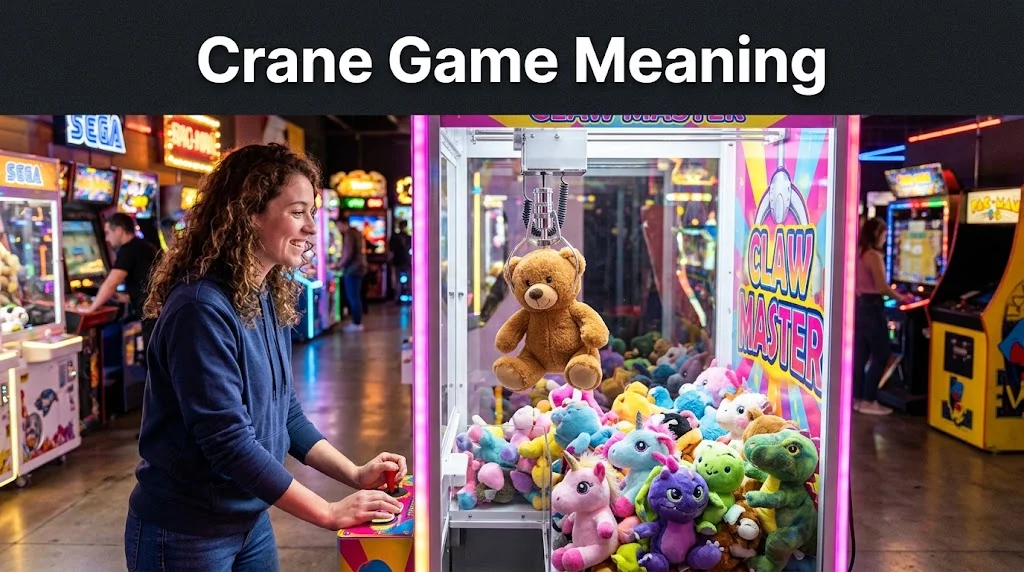
A “crane game” is an arcade-style prize machine that uses a mechanical claw to pick up toys, stuffed animals, or other small prizes and drop them into a collection chute. Players control the claw using buttons or a joystick, trying to grab a prize and move it to the winning area.
These machines are commonly found in shopping malls, arcades, cinemas, and entertainment centers. The game requires a combination of timing, positioning, and luck because the claw may not always grip the prize firmly enough to lift it. In simple words, a crane game is the popular claw machine where you try to win a prize by grabbing it with a mechanical arm.
Have you ever walked past a colorful arcade machine filled with adorable teddy bears, plush toys, and exciting prizes and felt tempted to try your luck? You insert a coin, move the joystick, position the claw, and press the button, hoping it will grab your favorite toy.
Sometimes you win on the first attempt, while other times the prize slips away just before reaching the collection chute. That’s the fun and frustration of a crane game! These machines have become popular entertainment attractions in arcades, shopping malls, and family amusement centers.
Understanding the crane game meaning helps explain why these machines attract players of all ages. Also known as claw machines or claw crane games, they use a mechanical grabbing device to pick up prizes and attempt to deliver them to a designated opening.
The name comes from the crane-like mechanism that moves across the machine to grab objects. Although the gameplay looks simple, factors such as claw strength, prize positioning, timing, and machine settings can influence the chances of winning. In this guide, we’ll explore what a crane game is, how it works, its different types, and why these entertaining machines remain popular worldwide.
Table of Contents
- What Does Crane Game Mean?
- Why Is It Called a Crane Game?
- How Does a Crane Game Work?
- Different Types of Crane Games
- What Can You Win in a Crane Game?
- Why Are Crane Games Difficult to Win?
- Crane Game vs. Claw Machine vs. Skill Crane
- Common Crane Game Terms
- Tips for Playing a Crane Game
- Frequently Asked Questions
- Conclusion
What Does Crane Game Mean?
A crane game is an arcade amusement game that uses a movable mechanical claw to pick up prizes from inside a transparent cabinet. Players usually insert coins, tokens, or make a digital payment to start a round. They then control the claw, trying to position it above a prize and grab it.
The machine gets its name from the crane-like mechanism that lifts and moves objects. Unlike a construction crane, which handles heavy materials, this small version is designed to pick up lightweight items such as stuffed animals, keychains, and boxed toys.
You have probably seen one at a shopping mall, cinema, family entertainment center, or arcade. The colorful prizes are displayed behind glass, making the game look simple and inviting. However, picking up an item is not always as easy as it appears.
A typical machine includes:
- Transparent cabinet: A glass or plastic enclosure that displays the prizes.
- Mechanical claw: A metal or plastic gripping device that moves down to grab an item.
- Joystick or buttons: Controls that allow players to position the claw.
- Prize chute: An opening through which a successfully grabbed prize falls.
- Payment system: A coin slot, token reader, card reader, or digital payment system.
- Control system: Electronic components that manage movement, timing, and other machine functions.
The main objective is simple: grab a prize and deliver it to the collection opening. The difficulty lies in making the claw grip the item securely enough to carry it.
Why Is It Called a Crane Game?
The name comes from the machine’s lifting mechanism. A traditional crane moves objects from one place to another using a lifting system, and an arcade version follows a similar basic idea on a much smaller scale.
The mechanical claw moves across the cabinet, lowers toward a prize, closes around it, and lifts it. This resembles the lifting action of industrial cranes, although the machine is designed for entertainment rather than construction or transportation.
Different countries and arcade communities use different names for the same general game.
For example:
- Crane game: A common name in Japan and in discussions of Japanese arcade games.
- Claw machine: A widely recognized English-language name.
- Claw game: An informal name used by players and arcade visitors.
- Prize crane: A name that emphasizes the machine’s prize-lifting mechanism.
- UFO catcher: A name associated with a popular Japanese style of prize machine.
These terms can refer to similar machines, but not every prize machine uses the same claw design or operating system.
How Does a Crane Game Work?
Although the machine looks complicated from the outside, its basic operation is easy to understand. The player controls a mechanical claw that moves along a system of tracks inside the cabinet.
Most standard machines follow a similar sequence.
1. Insert Payment and Start the Game
The player begins by inserting coins, tokens, or using an accepted payment method. Some machines require one payment for a single attempt, while others offer multiple attempts through a card or credit system.
Once the game starts, the controls become active. The player usually has a limited amount of time to position the claw.
2. Move the Claw Into Position
A joystick or directional buttons allow the player to move the claw horizontally or in different directions.
The goal is to position it directly above a suitable prize. This requires judging the object’s size, shape, location, and distance from other items.
A prize sitting near the top of a pile may be easier to reach than one buried underneath several toys.
3. Lower the Claw
After choosing a position, the player presses a button to lower the claw. The mechanism travels toward the prize and opens its gripping arms.
The claw’s shape and size affect which objects it can pick up. A small claw may struggle with a large plush toy, while a wider one may have a better chance of surrounding it.
4. Grab and Lift the Prize
When the claw reaches the item, its arms close around it. The machine then raises the claw and attempts to carry the prize toward the collection area.
This is often the most uncertain part of the game.
A claw may grip an item firmly, hold it loosely, or fail to catch it at all. Even when the prize leaves the pile, it can slip out during the lift.
5. Drop the Prize Into the Collection Chute
If the claw carries the item successfully, it moves toward the prize chute and releases it. The player can then collect the prize from the opening.
Not every attempt ends this way. Sometimes the claw drops the item before reaching the chute, leaving the player ready for another round.
Different Types of Crane Games
Not every machine uses the same grabbing mechanism. Arcade operators offer different designs to suit different prizes, difficulty levels, and player preferences.
| Type | How it works | Common prizes |
| Standard claw machine | Uses a multi-pronged claw to grab objects | Plush toys and stuffed animals |
| UFO catcher | Often uses two arms or specialized gripping mechanisms | Plush toys and character merchandise |
| Mini claw machine | Uses a smaller claw and compact cabinet | Small toys, candies, and keychains |
| Box prize machine | Attempts to grip or move packaged items | Electronics, collectibles, and boxed toys |
| Candy crane | Uses a claw to pick up loose sweets or small packaged candy | Candy and snack prizes |
| Skill-based prize machine | Uses a particular movement or positioning challenge | Toys, merchandise, and novelty items |
Standard Claw Machines
These are the familiar arcade cabinets with three-pronged or similar mechanical claws. They usually contain a pile of stuffed toys or other lightweight prizes.
Their simple design makes them recognizable, especially in shopping centers and family entertainment venues.
UFO Catchers
UFO catchers are strongly associated with Japanese arcades. They often use distinctive claw arrangements and prize displays.
Some versions are designed around unusual ways of moving prizes rather than simply lifting them. For example, a player may need to push a box toward an opening or catch a plush toy by part of its body.
Mini Crane Games
Mini machines use smaller cabinets and claws. They are commonly found in entertainment venues, restaurants, and other locations where a full-sized machine would take up too much space.
Their prizes are generally smaller, making them suitable for keychains, miniature figures, and small toys.
Box Prize Machines
These machines contain prizes in boxes rather than loose objects. The claw may need to grip the packaging or move it into a winning position.
Box shape, weight distribution, and surface texture can affect how easily the claw handles the item.
What Can You Win in a Crane Game?
The prizes depend on the machine, arcade operator, and intended audience. Some cabinets focus on inexpensive toys, while others display collectible merchandise or branded products.
Common prizes include:
- Stuffed animals: Teddy bears, rabbits, cats, and cartoon characters.
- Keychains: Small accessories featuring popular characters or designs.
- Miniature figures: Collectible models and decorative toys.
- Candy: Individually wrapped sweets and small snack packages.
- Plush cushions: Small pillows and soft decorative items.
- Electronic accessories: Headphones, phone accessories, and other small gadgets.
- Character merchandise: Items featuring recognizable entertainment characters.
Japanese arcades are particularly well known for their prize machines. Some feature licensed merchandise based on popular anime and gaming franchises, including Pokémon, One Piece, and Dragon Ball.
The prizes are part of the attraction. A player may walk past a machine without much interest, then stop after spotting a plush toy or collectible they genuinely want.
Why Are Crane Games Difficult to Win?
A crane game may look like a straightforward test of hand-eye coordination, but several factors influence the outcome. Even an accurate player cannot guarantee a successful grab on every attempt.
Claw Grip Strength
The claw needs enough gripping force to hold the prize while lifting it. If its grip is weak, the item may slip out before reaching the collection chute.
Some machines use adjustable or programmed gripping behavior. The exact setup depends on the model and operator.
Prize Shape and Weight
Not all objects are equally easy to grab.
A round plush toy may roll away when the claw closes. A smooth box may slip between the gripping arms, while a smaller item with a convenient edge may be easier to lift.
Weight also matters. A claw that can pick up a lightweight keychain may struggle with a large stuffed animal.
Prize Arrangement
The position of an item can make a major difference.
A toy sitting near the top of a pile may be accessible from several directions. Another prize might be trapped underneath larger objects, making it difficult for the claw to reach or surround it.
The way prizes are arranged can therefore influence the difficulty of each attempt.
Claw Design and Machine Settings
Different machines have different mechanical systems and settings. Some use three-pronged claws, while others use two arms or specialized gripping tools.
The machine’s movement speed, claw pressure, and programmed behavior can also affect how an attempt works.
It is important not to assume that every machine follows the same rules. Some are designed around positioning and skill, while others may include additional settings that influence prize handling.
Player Timing and Accuracy
Skill still matters.
A player who understands the controls and observes the prize’s position may have a better chance of placing the claw correctly. Poor positioning can lead to a missed grab even when the claw has enough strength.
However, accuracy alone does not guarantee success. The claw must also be able to hold the object securely.
Crane Game vs. Claw Machine vs. Skill Crane
These expressions are closely related, but they can have slightly different uses depending on the location and machine type.
| Term | Meaning | Typical context |
| Crane game | An arcade game using a lifting claw | Japanese arcades and general gaming discussions |
| Claw machine | A prize machine with a mechanical claw | Arcades, malls, and entertainment centers |
| Claw game | An informal name for playing a claw machine | Casual conversations |
| Prize crane | A machine designed to lift prizes | Arcade equipment and amusement venues |
| Skill crane | A prize machine associated with player-controlled skill | Arcade gaming and amusement machines |
| UFO catcher | A specialized prize machine style | Japanese arcade culture |
In everyday conversation, crane game and claw machine usually refer to the same basic attraction.
The term UFO catcher, however, is often associated with particular Japanese machines and designs. It is not simply another name for every claw machine.
Common Crane Game Terms
Players and arcade fans sometimes use specific words when discussing machines, attempts, and prizes.
| Term | Meaning |
| Claw | The gripping mechanism that picks up prizes |
| Prize chute | The opening where a won item is released |
| Grab | An attempt to pick up an object |
| Grip strength | The force the claw uses to hold a prize |
| Plushie | An informal name for a stuffed toy |
| Drop zone | The area where the claw releases an item |
| Prize pile | The collection of objects inside the machine |
| Attempt | One paid round of gameplay |
| Control panel | The buttons or joystick used to move the claw |
| Redemption game | An amusement game in which players win prizes or tickets |
Knowing these terms can help beginners understand arcade instructions and follow discussions about prize machines.
Tips for Playing a Crane Game
Winning is never guaranteed, but a little observation can help you make more informed attempts.
Choose an Accessible Prize
Look for an item that is not buried beneath several other prizes. A toy near the top of the pile may be easier to reach and position the claw around.
Avoid choosing an object that appears too large for the claw.
Study the Claw Before Playing
Take a moment to observe the claw’s size, shape, and movement. Check whether it has two or three arms and whether its opening seems wide enough for your chosen prize.
This can help you decide whether the machine is suitable for the item you want.
Look at the Prize’s Shape
A prize with a narrow section, handle, or convenient edge may be easier to grip than a smooth, round object.
For example, a plush toy with a loose tag or an accessible limb may offer a better gripping point than one tightly packed between other toys.
Understand the Controls
Some machines allow movement in only two directions, while others offer more control. Learn how the joystick or buttons work before spending multiple attempts.
Accurate positioning can prevent unnecessary misses.
Set a Spending Limit
Crane games are designed to be entertaining, but repeated attempts can become expensive. Decide how much you are comfortable spending before starting.
Treat the game as recreation rather than a guaranteed way to obtain a prize. If the machine is not giving you a reasonable experience, walking away is a sensible choice.
FAQs
Are crane games based on skill or luck?
They can involve both. Positioning and timing require skill, but claw strength, prize placement, and machine settings also influence the outcome.
Can you play crane games online?
Yes. Some websites and mobile apps offer virtual claw machines that players control remotely or through simulated gameplay.
Why does the claw drop the prize?
The claw may not have enough grip to hold the item securely. Its shape, weight, position, and the machine’s settings can all contribute to a failed attempt.
Are crane games popular in Japan?
Yes. Prize machines, including UFO catchers, are a familiar feature of Japanese arcade culture and appear in many entertainment venues.
What is the prize chute?
The prize chute is the opening where a successfully captured item is released. Players collect their prizes from this compartment.
Is a crane game the same as a vending machine?
No. A vending machine dispenses products after payment, while a crane game requires players to operate a claw and attempt to retrieve a prize.
Conclusion
A crane game is a familiar arcade attraction that combines mechanical movement, hand-eye coordination, and the excitement of trying to win a prize. Although the basic idea is simple, the claw design, object placement, and machine settings can make each attempt unpredictable.
Whether you call it a claw machine, prize crane, or UFO catcher, the goal remains the same: position the claw, grab an item, and guide it into the collection chute. Understanding how these machines work makes the experience easier to follow and more enjoyable, even when the prize slips away.