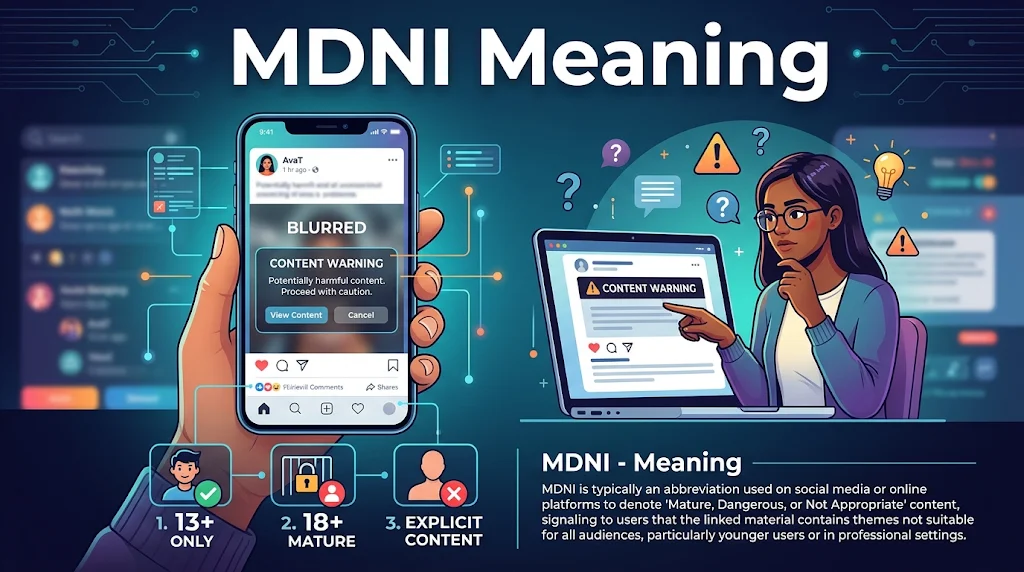
The abbreviation “MDNI” stands for “Minors Do Not Interact.” It is commonly used on social media platforms such as TikTok, Twitter (X), Tumblr, and other online communities, especially in profile bios, posts, and content warnings. People use this acronym to indicate that individuals under the age of 18 should not interact with their content, particularly when it involves mature, sensitive, or adult-oriented topics.
For example, someone might add “MDNI” to their profile or post to establish an age-related boundary. In simple terms, MDNI is a warning asking minors not to engage with certain online content.
Have you ever been scrolling through TikTok, Tumblr, or Twitter (X) and noticed someone adding “MDNI” to their bio, caption, or post? If you’re unfamiliar with internet abbreviations, the four letters might look confusing or seem like another random social media trend.
However, this acronym carries an important message about online boundaries and age restrictions. People often use it to make their audience expectations clear, especially when sharing content that may not be suitable for younger users.
Understanding the MDNI meaning can help you recognize this abbreviation and interpret its purpose in online conversations. MDNI stands for “Minors Do Not Interact” and is commonly used by creators who want to discourage people under 18 from commenting on, messaging, or engaging with their content.
It frequently appears alongside age-related labels and content warnings on social media profiles. In this guide, we’ll explore what MDNI means in text, where people use it, why creators include it in their posts, and how to understand similar internet abbreviations.
Table of Contents
- What Does MDNI Mean?
- Where Is MDNI Used Online?
- Why Do People Use MDNI?
- What Types of Content Are Marked MDNI?
- MDNI vs. DNI vs. 18+ vs. NSFW
- How Should You Respond to an MDNI Label?
- Does MDNI Actually Keep Minors Away?
- What Should Parents and Younger Users Know?
- Frequently Asked Questions
- Conclusion
What Does MDNI Mean?
MDNI is short for Minors Do Not Interact. It is an online boundary-setting phrase that asks people who are under the age of 18 not to participate in a particular discussion, follow an account for certain content, or interact with a creator’s posts.
The abbreviation is most often seen on social media platforms and in online communities where users share personal opinions, fictional writing, mature discussions, or other age-sensitive material.
For example, someone might add MDNI to their profile description to indicate that their account is intended for adults. A writer might place it at the beginning of a post containing mature themes to discourage younger readers from engaging with that material.
The message is straightforward: if you are a minor, this content or account is not intended for you.
Breaking Down the Abbreviation
Each letter represents part of the full phrase:
- M: Minors
- D: Do
- N: Not
- I: Interact
In this context, minors generally means people who have not reached the legal age of adulthood, commonly 18 in the online communities using this label. The exact legal definition of a minor can vary by country and situation.
The word interact is broader than simply viewing something. It can refer to commenting, messaging, following, participating in discussions, sharing posts, or otherwise engaging with an account.
That is why the abbreviation can appear in several places, including profile descriptions, content warnings, hashtags, and pinned posts.
Where Is MDNI Used Online?
The abbreviation is associated with internet communities where users want to establish clear audience boundaries. It is not limited to one platform or type of content.
You may encounter it in the following places.
1. Tumblr
Tumblr has a long history of communities built around blogging, fandom discussions, original writing, artwork, and personal expression.
Some creators use MDNI in their bios or post descriptions to identify accounts or material intended for adults. It may appear near other content labels that explain the subject or tone of a post.
For example, a user sharing mature fictional writing might place the abbreviation before the introduction. This signals that younger readers should not participate.
2. X (Formerly Twitter)
On X, users sometimes include the label in their profile descriptions or posts discussing mature subjects.
A creator may use it to establish an age boundary for their account, especially when posting adult-oriented commentary, relationship discussions, or fictional content.
Because posts can spread beyond their original audience, the label also helps communicate the creator’s intended readership.
3. TikTok
TikTok users may encounter the abbreviation in captions, comments, profile descriptions, or discussions about online boundaries.
A creator might use it when explaining that their content is intended for adults. However, writing MDNI in a caption does not automatically prevent younger users from viewing a video.
The platform’s own age settings and content moderation systems remain separate from user-written labels.
4. Reddit
Reddit contains communities focused on entertainment, personal experiences, creative writing, and adult discussions.
Within some communities, users may use MDNI to communicate that a post or discussion is not intended for minors. The label can appear in a post title, description, or community-specific formatting.
Users should also follow each subreddit’s rules because individual communities may have additional age requirements.
5. Discord
Discord users may place the abbreviation in server descriptions, channel names, or personal profiles.
For example, a community discussing mature topics might include an MDNI notice to communicate its intended audience. Server moderators may also use age restrictions and access controls to manage membership.
A written warning alone, however, does not verify someone’s age.
Why Do People Use MDNI?
People use the abbreviation for several reasons, but the main purpose is to establish an audience boundary.
Online spaces can bring together people of different ages, backgrounds, and experiences. A creator who regularly discusses adult subjects may want to make it clear that younger users should not join those conversations.
1. To Set Age Boundaries
The most direct reason is to tell minors that a particular account, discussion, or post is intended for adults.
This can be especially relevant when the subject involves mature relationship themes, sexual topics, adult humor, or other material that may not be appropriate for younger audiences.
The label communicates the creator’s intended audience before someone decides to engage.
2. To Establish Personal Boundaries
Some creators prefer not to receive messages or comments from minors, particularly when their accounts focus on adult topics.
Using the abbreviation makes that preference visible. It can also help creators explain their expectations without writing a long warning in every post.
For instance, an adult writer might include MDNI in their profile to clarify that younger users should not interact with their mature writing account.
3. To Reduce Unwanted Interactions
A creator may use the label because they want to avoid age-related misunderstandings.
If a minor comments on an adult-oriented post, the creator may feel uncomfortable continuing the conversation. A clear notice can reduce the chance of that situation occurring, although it cannot prevent every interaction.
4. To Identify the Intended Audience
Not every post is suitable for every age group. A label can help readers understand who the creator expects to engage with the material.
This is useful in communities where adult discussions and general-interest content appear side by side.
What Types of Content Are Marked MDNI?
The abbreviation is commonly associated with mature or age-sensitive material, but its exact use depends on the creator and platform.
It does not describe one specific category of content.
| Content type | Why a creator might use MDNI | Example |
| Adult discussions | The subject is intended for an adult audience. | Conversations about adult relationships |
| Mature fictional writing | Stories include themes intended for older readers. | Fiction involving adult situations |
| Sexual topics | The discussion involves sexual themes. | Adult-oriented educational or personal discussions |
| Strong language | The content includes frequent explicit language. | Mature comedy or commentary |
| Sensitive personal topics | The discussion may not be suitable for younger users. | Adult relationship experiences |
| Mature artwork | The material is created for an adult audience. | Art containing mature themes |
The label does not automatically mean that a post contains explicit material. Some creators use it broadly to establish an adult-only audience, even when individual posts are not graphic or sexual.
That distinction matters. You should read the surrounding description rather than assuming every post carrying the abbreviation contains the same type of material.
MDNI vs. DNI vs. 18+ vs. NSFW
MDNI often appears alongside other online abbreviations. Although these expressions can serve similar purposes, their meanings are different.
| Term | Full form | Main purpose |
| MDNI | Minors Do Not Interact | Asks people under 18 not to engage |
| DNI | Do Not Interact | Tells a specified group of people not to engage |
| 18+ | 18 and older | Indicates an age restriction or adult audience |
| NSFW | Not Safe For Work | Warns that content may be inappropriate to view in a workplace or public setting |
| SFW | Safe For Work | Describes content generally suitable for a workplace or public setting |
| CW | Content Warning | Alerts readers to potentially upsetting material |
| TW | Trigger Warning | Warns about material that may be distressing to some readers |
MDNI vs. DNI
The difference is the audience being addressed.
MDNI specifically refers to minors. DNI is broader and can apply to any group that a creator does not want interacting with their content.
For example, a creator might use DNI to discourage harassment, unwanted arguments, or contact from people who repeatedly ignore their boundaries. MDNI focuses specifically on age.
MDNI vs. 18+
These labels are closely related, but they are not identical.
MDNI is a direct request for minors not to interact. The 18+ label generally identifies content, services, or spaces intended for adults.
A profile might use both because the creator wants to make the age boundary especially clear.
MDNI vs. NSFW
NSFW means Not Safe For Work. It warns that content may be inappropriate to open in a professional, public, or shared environment.
It does not automatically mean that the material is restricted to adults. A harmless post containing strong language, for example, could be marked NSFW without being intended exclusively for people over 18.
MDNI, on the other hand, specifically addresses minors.
MDNI vs. Content Warning
A content warning tells readers that a post includes a particular subject that they may find upsetting or uncomfortable.
For example, a writer might add a warning about grief, violence, or discussions of mental health. The purpose is to help readers decide whether they want to continue.
MDNI communicates an age boundary rather than simply describing a potentially sensitive topic.
How Should You Respond to an MDNI Label?
Your response depends on your age and your reason for visiting the account or post. The label is a boundary, so the most respectful approach is to take it seriously.
If You Are Under 18
If you see the abbreviation on an account or post, do not comment, send messages, follow the creator for that material, or participate in the discussion.
You do not need to ask the creator for permission to interact. The label already explains the boundary.
If you accidentally open the content, simply leave it and move on.
If You Are an Adult
Also If you are an adult and the content is otherwise appropriate for you, you can decide whether you want to engage.
However, MDNI does not mean that every adult is automatically welcome. A creator may have additional boundaries listed in their profile or community rules.
Respect those conditions rather than treating the label as an invitation to contact the person privately.
If You Are a Creator
If you want to establish an age boundary, make the wording clear and place it somewhere your audience can easily see.
You can include it in your profile, post description, pinned message, or community rules. If your content has specific themes, separate content warnings can help readers understand what they may encounter.
Avoid relying on an abbreviation alone when the platform provides stronger age restrictions or access controls.
Does MDNI Actually Keep Minors Away?
No. The abbreviation is a written notice, not an age-verification system.
A younger user can still see a public profile, read a caption, or encounter a post containing the label. The creator cannot assume that adding MDNI will automatically block underage viewers.
This is an important distinction between communicating a boundary and enforcing one.
What the Label Can Do
It can:
- Tell younger users that an account is not intended for them.
- Make a creator’s expectations clear.
- Help adult audiences understand the intended age group.
- Give moderators a visible rule to reference when managing interactions.
- Reduce accidental engagement when users respect the notice.
What the Label Cannot Do
It cannot:
- Confirm someone’s actual age.
- Automatically block minors from public content.
- Replace platform moderation or age restrictions.
- Guarantee that every viewer will follow the request.
- Make otherwise prohibited content acceptable under platform rules.
For stronger protection, creators and moderators should use the platform’s available privacy settings, age restrictions, membership controls, and reporting tools.
The abbreviation works best as one part of a wider approach to online safety.
What Should Parents and Younger Users Know?
Online abbreviations can be confusing, especially when they appear in profile descriptions without an explanation. Understanding them can help younger users recognize when a creator has set an age-related boundary.
For Younger Users
If an account says MDNI, treat it as a clear request not to engage if you are under 18.
Avoid trying to get around the restriction by using another account, changing your profile information, or pretending to be older. Age boundaries exist for a reason, and ignoring them can lead to uncomfortable or unsafe interactions.
If you encounter content that makes you uncomfortable, leave the page. You can also use the platform’s reporting or safety tools if the material appears to violate its rules.
For Parents and Guardians
Parents can help children understand common internet abbreviations without making every online interaction feel frightening.
A useful conversation can cover:
- Why some online spaces are intended for adults.
- How to recognize age-related labels.
- Why children should not pretend to be older online.
- How to leave uncomfortable conversations.
- When to report inappropriate messages or content.
It is also helpful to explain that a label is not proof that a page is safe. A profile can display MDNI while still containing misleading information or violating platform policies.
Open communication and age-appropriate privacy settings provide stronger protection than relying on internet slang alone.
FAQs
Is MDNI the same as NSFW?
No. MDNI asks minors not to interact, while NSFW warns that content may be unsuitable for workplaces or public settings.
Does MDNI always mean sexual content?
No. It can be used for different types of mature or adult-oriented discussions, including relationship topics, adult humor, and sensitive subjects.
Can MDNI appear in someone’s social media bio?
Yes. Creators often place it in their bios to make their age-related interaction boundaries visible to visitors.
What does MDNI mean on Tumblr?
On Tumblr, it generally means that minors should not interact with the account or the specific post carrying the label. The exact boundary depends on the creator’s description.
Is MDNI an official social media restriction?
No. It is a user-created abbreviation, not a universal platform setting or formal age-verification feature.
What does MDNI mean when combined with DNI?
It usually reinforces an age-related boundary. MDNI addresses minors specifically, while DNI can identify other groups that a creator does not want engaging with their content.
Conclusion
MDNI is a short online label that communicates a clear age-related boundary: minors should not interact with the specified account, post, or discussion. It commonly appears in social media profiles and communities that share mature or adult-oriented material.
Although the abbreviation helps creators express their expectations, it cannot verify a user’s age or replace platform safety settings. Understanding the label makes online communication easier and helps people respect the boundaries that creators establish.