A constructed response format is a structured way to answer a question using your own words, usually with a clear claim, explanation, evidence, or supporting details. It is useful for school assignments, exams, assessments, interviews, and written discussions.
Top alternatives: short-answer format, written response format, open-ended response, evidence-based answer, extended response format
If you have ever stared at a question thinking, “Okay… but what exactly do they want me to write?” you are definitely not alone. A constructed response format gives your answer some direction instead of leaving you to freestyle like you are writing an essay at 2 a.m.
Whether you are answering a school question, completing an assessment, responding to a reading passage, or explaining your reasoning, structure matters. A strong response usually makes a clear point, supports it with relevant information, and explains why that information matters.
The right format can make answers easier to understand, easier to grade, and much easier to write. In this guide, you will find practical, simple, creative, professional, and easy-to-use constructed response examples for different situations, plus tips for making your answers clearer and more convincing.
Simple Constructed Response Format Examples
1. Make your answer clear and direct.
Example: A student uses this approach when the question asks for a straightforward explanation.
Meaning: Start by answering the actual question instead of circling around it.
2. State your main idea first.
Example: A learner begins with the key point before adding supporting details.
Meaning: The reader immediately understands the purpose of the response.
3. Answer in your own words.
Example: A student explains a textbook concept without copying the original wording.
Meaning: The response demonstrates genuine understanding.
4. Give one strong supporting detail.
Example: A short assessment answer includes one relevant fact after the main claim.
Meaning: The detail strengthens the answer without making it unnecessarily long.
5. Explain why your answer makes sense.
Example: A learner adds a brief reason after stating an opinion about a reading passage.
Meaning: The explanation shows the thinking behind the answer.
6. Stay focused on the question.
Example: A student removes unrelated information from a response before submitting it.
Meaning: Every sentence should contribute to answering the prompt.
7. Use complete sentences.
Example: A learner turns a one-word answer into a short explanatory sentence.
Meaning: Complete sentences make the response clearer and more polished.
8. Include relevant evidence.
Example: A student refers to a specific event from a story to support an interpretation.
Meaning: Evidence makes the response more convincing.
9. Keep the structure easy to follow.
Example: A learner organizes a longer answer into a point, explanation, and example.
Meaning: Good organization helps the reader follow the reasoning.
10. Finish with a clear explanation.
Example: A student adds one final sentence connecting the evidence to the answer.
Meaning: The ending reinforces the main point.
11. Avoid unnecessary filler.
Example: A learner removes repeated statements from a short-answer response.
Meaning: Concise writing makes the important information stand out.
12. Check that every part of the question is answered.
Example: A student reviews a multi-part question before turning in the assignment.
Meaning: A complete response addresses all required elements.
Funny Constructed Response Format Ideas
1. Answer the question, not your entire life story.
Example: A student trims a response that wandered into unrelated personal details.
Meaning: Humorously reminding yourself to stay on topic keeps answers useful.
2. Evidence first, panic later.
Example: A learner gathers supporting details before worrying about wording.
Meaning: Strong evidence gives the response a solid foundation.
3. Keep the answer focused like your Wi-Fi signal.
Example: A student removes random facts that do not support the main point.
Meaning: A focused answer is easier to understand.
4. No plot twists needed.
Example: A learner gives the conclusion clearly instead of hiding it until the final sentence.
Meaning: Direct answers save the reader unnecessary suspense.
5. Say what you mean and back it up.
Example: A student makes a claim and immediately provides relevant evidence.
Meaning: A good response combines clarity with support.
6. Less waffle, more substance.
Example: A learner edits repetitive sentences from an assessment answer.
Meaning: Useful information matters more than extra words.
7. Give your answer a beginning, middle, and happy ending.
Example: A student organizes a response into a claim, explanation, and conclusion.
Meaning: A simple structure keeps writing balanced.
8. Do not let your answer go on a side quest.
Example: A learner deletes an interesting but unrelated fact from the response.
Meaning: Staying relevant keeps the answer effective.
9. Evidence is your answer’s best friend.
Example: A student adds a quotation or fact to support an interpretation.
Meaning: Supporting information makes a claim stronger.
10. Make every sentence earn its place.
Example: A learner removes sentences that repeat the same idea.
Meaning: Purposeful writing is usually clearer.
11. Keep the answer short enough to breathe.
Example: A student shortens an unnecessarily long response.
Meaning: Concise writing improves readability.
12. Write like the marker has coffee waiting.
Example: A learner presents the main point quickly and clearly.
Meaning: Efficient answers make important information easier to find.
Professional Constructed Response Format Examples
1. Clearly identify the central argument.
Example: An employee responds to a workplace assessment by stating the main recommendation first.
Meaning: Professional writing benefits from immediate clarity.
2. Support claims with relevant evidence.
Example: A professional includes project data to justify a recommendation.
Meaning: Evidence increases credibility.
3. Use precise language.
Example: A workplace response replaces vague phrases with specific information.
Meaning: Precision reduces confusion.
4. Maintain an objective tone.
Example: An employee explains a project issue without using emotional or accusatory wording.
Meaning: Neutral language supports professional communication.
5. Explain the reasoning behind your conclusion.
Example: A professional adds a short explanation after presenting a recommendation.
Meaning: Reasoning helps others understand the decision.
6. Address every part of the prompt.
Example: An employee responds to three questions using three clearly connected points.
Meaning: Complete coverage demonstrates attention to detail.
7. Use evidence that directly supports the claim.
Example: A report includes relevant statistics rather than unrelated information.
Meaning: Relevant evidence makes an argument more persuasive.
8. Avoid unsupported assumptions.
Example: A professional distinguishes confirmed information from personal interpretation.
Meaning: Careful wording improves accuracy.
9. Keep the response organized.
Example: An employee uses separate sentences for the recommendation, evidence, and implication.
Meaning: Organization makes professional answers easier to review.
10. End with a practical conclusion.
Example: A workplace response closes by identifying the recommended next step.
Meaning: A useful conclusion turns analysis into action.
11. Use consistent terminology.
Example: A professional uses the same project terms throughout a written response.
Meaning: Consistency prevents misunderstandings.
12. Review before submitting.
Example: An employee checks a response for missing information and unclear wording.
Meaning: Editing improves professionalism and accuracy.
Creative Constructed Response Format Ideas
1. Start with a memorable main point.
Example: A student opens a literary response with a concise but interesting interpretation.
Meaning: A strong opening can make the answer more engaging.
2. Connect the idea to a vivid example.
Example: A learner uses a specific scene from a story to explain a theme.
Meaning: Concrete examples make abstract ideas easier to understand.
3. Use descriptive details when appropriate.
Example: A student explains a historical event with carefully selected contextual details.
Meaning: Relevant description adds depth without creating clutter.
4. Build a logical mini-story.
Example: A learner explains what happened, why it happened, and what resulted.
Meaning: Sequence helps readers understand relationships between ideas.
5. Compare two ideas creatively.
Example: A student explains two characters by contrasting their motivations.
Meaning: Comparison can reveal differences more clearly.
6. Use a surprising but relevant observation.
Example: A learner highlights an overlooked detail from a reading passage.
Meaning: Fresh observations can make an answer more distinctive.
7. Connect evidence to a bigger idea.
Example: A student uses one event to explain a broader theme.
Meaning: Connections demonstrate deeper understanding.
8. Use a strong closing sentence.
Example: A learner finishes a response by returning to the original argument.
Meaning: A memorable ending gives the response a sense of completion.
9. Keep creativity connected to the prompt.
Example: A student adds personality while still directly answering the assessment question.
Meaning: Creative writing works best when relevance remains the priority.
10. Explain ideas through comparison.
Example: A learner compares a difficult concept with a familiar everyday situation.
Meaning: Familiar comparisons can simplify complex ideas.
11. Choose details with purpose.
Example: A student selects one powerful example instead of listing five weak ones.
Meaning: Quality usually matters more than quantity.
12. Let the structure support the creativity.
Example: A learner organizes an imaginative response around one central idea.
Meaning: Structure keeps creative answers understandable.
Clever Constructed Response Format Strategies
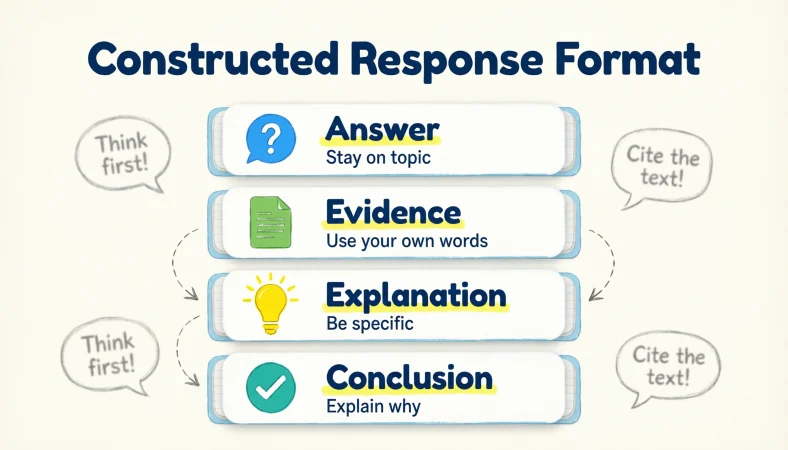
1. Claim, evidence, explanation.
Example: A student answers a literature question using a claim followed by textual support and analysis.
Meaning: This classic structure creates a logical response.
2. Point, proof, connection.
Example: A learner states an argument, provides evidence, and connects it back to the question.
Meaning: Each part has a clear purpose.
3. Answer, because, example.
Example: A student gives a direct answer, explains why, and adds a supporting example.
Meaning: This simple formula works well for short responses.
4. Identify, explain, support.
Example: A learner names a concept before explaining and supporting it.
Meaning: The structure moves naturally from information to reasoning.
5. Use the question’s keywords.
Example: A student repeats important terms from the prompt in the response.
Meaning: Matching the question’s language helps demonstrate relevance.
6. Think evidence before adjectives.
Example: A learner replaces “very important” with a specific supporting fact.
Meaning: Evidence is stronger than unsupported description.
7. Explain the why, not just the what.
Example: A student describes an event and then explains its significance.
Meaning: The reasoning adds depth.
8. Build from simple to specific.
Example: A learner introduces a broad idea before giving a precise example.
Meaning: Readers receive context before detail.
9. Use one strong example instead of many weak ones.
Example: A student selects the clearest piece of evidence for a short assessment.
Meaning: Focused support keeps the answer powerful.
10. Link every paragraph to the prompt.
Example: A learner checks each paragraph for a direct connection to the question.
Meaning: Relevance keeps longer responses on track.
11. Use a conclusion that answers the original question again.
Example: A student briefly restates the main conclusion after explaining the evidence.
Meaning: The ending reinforces the answer.
12. Edit for logic, not just grammar.
Example: A learner checks whether each idea naturally leads to the next.
Meaning: A grammatically correct response can still need better reasoning.
Formal Constructed Response Format Examples
1. The evidence indicates that the main factor was significant.
Example: A student uses this wording when presenting an evidence-based conclusion.
Meaning: It communicates a careful conclusion without sounding overly casual.
2. This demonstrates the importance of the issue.
Example: A learner connects a supporting example to a broader argument.
Meaning: The sentence explains why the evidence matters.
3. The passage suggests that the character changes over time.
Example: A student interprets character development in a literature assessment.
Meaning: The wording presents an interpretation rather than an unsupported fact.
4. One possible explanation is the influence of the environment.
Example: A learner discusses a cause while acknowledging that other factors may exist.
Meaning: The phrase sounds balanced and thoughtful.
5. This evidence supports the argument that…
Example: A student introduces a quotation before explaining its relevance.
Meaning: It directly connects evidence to a claim.
6. The results demonstrate a clear relationship between the factors.
Example: A learner summarizes findings from a classroom investigation.
Meaning: The response presents an evidence-based observation.
7. This suggests that the outcome was influenced by…
Example: A student explains a likely cause after reviewing evidence.
Meaning: The wording communicates interpretation carefully.
8. The primary reason is…
Example: A learner identifies the strongest cause in a history question.
Meaning: It makes the main explanation immediately clear.
9. A significant example can be found in…
Example: A student introduces supporting information from a text.
Meaning: The phrase directs attention toward useful evidence.
10. This can be explained by…
Example: A learner provides reasoning after describing a result.
Meaning: It creates a clear bridge between observation and explanation.
11. The information supports the conclusion that…
Example: A student summarizes several facts before reaching a conclusion.
Meaning: It presents the conclusion as evidence-based.
12. Overall, the evidence suggests…
Example: A learner closes a response after discussing multiple supporting points.
Meaning: It provides a concise and measured conclusion.
Short Constructed Response Format Examples
1. Answer in two clear sentences.
Example: A student responds to a quick classroom question with a direct answer and explanation.
Meaning: Short responses can still demonstrate understanding.
2. Give the answer, then the reason.
Example: A learner states the correct concept and explains it briefly.
Meaning: This provides both information and reasoning.
3. Use one piece of evidence.
Example: A student supports an interpretation with one relevant detail.
Meaning: A single strong detail can be enough for a short prompt.
4. Keep the response focused.
Example: A learner answers a five-mark question without adding unrelated background information.
Meaning: Staying focused protects valuable space and time.
5. Avoid repeating the question word for word.
Example: A student paraphrases the question before giving the answer.
Meaning: Paraphrasing sounds more natural and efficient.
6. Use precise vocabulary.
Example: A learner chooses “increases” instead of the vague phrase “gets bigger.”
Meaning: Precise words communicate ideas efficiently.
7. Add a quick explanation.
Example: A student gives one sentence explaining why an answer is correct.
Meaning: The explanation demonstrates reasoning.
8. Finish with the key point.
Example: A learner places the strongest conclusion at the end of a short response.
Meaning: The final idea leaves the answer clearly focused.
9. Remove repeated ideas.
Example: A student combines two sentences that express the same point.
Meaning: Concise writing improves clarity.
10. Use a simple structure.
Example: A learner follows answer, evidence, and explanation in three sentences.
Meaning: A basic structure works well under time pressure.
11. Prioritize relevant information.
Example: A student chooses the fact that most directly answers the question.
Meaning: Relevance is more valuable than volume.
12. Stop when the answer is complete.
Example: A learner ends a response after fully addressing the prompt.
Meaning: Knowing when to finish prevents unnecessary padding.
Evidence-Based Constructed Response Format
1. Make the claim first.
Example: A student begins a reading response with an interpretation of the author’s message.
Meaning: The claim gives the evidence a clear purpose.
2. Introduce the evidence.
Example: A learner identifies a relevant detail before explaining it.
Meaning: The reader knows what information supports the claim.
3. Explain the evidence.
Example: A student describes how a specific event supports the main argument.
Meaning: Analysis shows why the evidence matters.
4. Connect evidence to the question.
Example: A learner explicitly links a quotation to the assessment prompt.
Meaning: The response remains relevant.
5. Use specific evidence.
Example: A student refers to a precise event rather than saying something generally happened.
Meaning: Specific details create stronger support.
6. Choose trustworthy information.
Example: A learner uses established class materials when supporting an academic answer.
Meaning: Reliable evidence strengthens credibility.
7. Explain significance.
Example: A student describes why a historical event affected later developments.
Meaning: Significance demonstrates deeper understanding.
8. Avoid evidence dumping.
Example: A learner explains each supporting detail instead of listing several facts.
Meaning: Evidence becomes meaningful when it is analyzed.
9. Use evidence selectively.
Example: A student chooses two highly relevant examples for an extended response.
Meaning: Strong selection keeps the argument focused.
10. Distinguish fact from interpretation.
Example: A learner identifies a text detail as evidence and labels the conclusion as interpretation.
Meaning: This creates more careful reasoning.
11. Explain cause and effect when relevant.
Example: A student connects a policy decision to its later consequences.
Meaning: Cause-and-effect reasoning clarifies relationships.
12. Finish by connecting everything.
Example: A learner concludes by showing how the evidence proves the original claim.
Meaning: The final connection gives the response logical closure.
School Assessment Constructed Response Format
1. Read the entire question first.
Example: A student reviews all instructions before beginning a timed assessment.
Meaning: Understanding the task prevents incomplete answers.
2. Identify the command word.
Example: A learner notices whether the question asks them to explain, compare, describe, or evaluate.
Meaning: The command word tells you what kind of answer is expected.
3. Highlight important terms.
Example: A student mentally identifies the topic and required focus of the question.
Meaning: Key terms help maintain relevance.
4. Plan before writing.
Example: A learner spends a minute listing two supporting points before drafting.
Meaning: Quick planning can prevent disorganized writing.
5. Match answer length to the task.
Example: A student gives a brief response to a low-mark question and more detail to an extended prompt.
Meaning: Response length should reflect the question’s demands.
6. Include subject-specific vocabulary.
Example: A learner uses correct scientific terminology in a science assessment.
Meaning: Accurate vocabulary demonstrates knowledge.
7. Support interpretations with evidence.
Example: A student refers to details from a reading passage when explaining its theme.
Meaning: Evidence makes interpretations more convincing.
8. Explain rather than simply list.
Example: A learner describes why two factors are connected instead of merely naming them.
Meaning: Explanation demonstrates understanding.
9. Check every instruction.
Example: A student reviews whether the question required two examples after writing the response.
Meaning: Following instructions protects against avoidable mistakes.
10. Review your conclusion.
Example: A learner checks whether the final sentence actually answers the prompt.
Meaning: A relevant conclusion strengthens the response.
11. Proofread key terms.
Example: A student checks names, dates, formulas, and subject vocabulary before submitting.
Meaning: Small errors can weaken otherwise strong answers.
12. Keep your confidence.
Example: A learner trusts their prepared structure during a timed test.
Meaning: A reliable format reduces unnecessary hesitation.
Constructed Response Format for Reading Questions
1. State the main idea.
Example: A student explains the central message of a nonfiction passage.
Meaning: The answer identifies what the text is mainly communicating.
2. Identify the author’s purpose.
Example: A learner explains whether the author aims to inform, persuade, entertain, or describe.
Meaning: Purpose reveals why the text was written.
3. Support the interpretation with text evidence.
Example: A student refers to a specific passage detail when explaining an idea.
Meaning: Text evidence grounds the interpretation.
4. Explain character motivation.
Example: A learner connects a character’s actions to their goals or emotions.
Meaning: Motivation explains why the character behaves a certain way.
5. Describe a theme.
Example: A student identifies a broader message shown through repeated events.
Meaning: Theme captures an important idea beyond the plot.
6. Explain a cause and effect.
Example: A learner connects a character’s decision with its consequences.
Meaning: The response shows how one event influences another.
7. Analyze word choice.
Example: A student explains how a particular word affects the tone of a passage.
Meaning: Word choice can reveal emotion, attitude, or emphasis.
8. Compare two characters.
Example: A learner identifies one important similarity and one meaningful difference.
Meaning: Comparison highlights character development.
9. Explain a text structure.
Example: A student describes how chronological organization affects understanding.
Meaning: Structure influences how information is presented.
10. Identify an inference.
Example: A learner combines clues from a passage to reach a conclusion.
Meaning: Inference demonstrates reasoning beyond directly stated information.
11. Explain the significance of a detail.
Example: A student discusses why a repeated image matters to the story.
Meaning: Significance connects small details with larger ideas.
12. Finish with the text’s bigger message.
Example: A learner connects the evidence to the overall meaning of the passage.
Meaning: The conclusion demonstrates comprehensive understanding.
Constructed Response Format for Opinion Questions
1. State your position clearly.
Example: A student begins a classroom opinion response with a direct viewpoint.
Meaning: The reader immediately knows the argument.
2. Explain why you hold that position.
Example: A learner gives two reasons supporting their opinion.
Meaning: Reasons turn a personal opinion into a developed response.
3. Add relevant evidence.
Example: A student uses facts to support an argument about school policies.
Meaning: Evidence increases credibility.
4. Acknowledge another viewpoint.
Example: A learner briefly recognizes a reasonable opposing argument.
Meaning: Considering another perspective shows balanced thinking.
5. Explain why your position remains stronger.
Example: A student compares two viewpoints before defending their conclusion.
Meaning: The response demonstrates evaluation.
6. Avoid unsupported claims.
Example: A learner replaces “everyone thinks this” with a specific reason.
Meaning: Accurate claims make arguments more credible.
7. Use respectful language.
Example: A student disagrees with an opposing idea without attacking the person behind it.
Meaning: Respectful disagreement creates mature communication.
8. Use an example from real life.
Example: A learner refers to a familiar situation to illustrate their point.
Meaning: Real-world examples can make arguments easier to understand.
9. Stay connected to the question.
Example: A student removes an interesting argument that does not answer the prompt.
Meaning: Relevance keeps the response focused.
10. Explain consequences.
Example: A learner describes what could happen if their proposed solution were adopted.
Meaning: Consequences add depth to an opinion.
11. Avoid exaggerated language.
Example: A student replaces absolute statements with precise claims.
Meaning: Measured wording sounds more credible.
12. End with your strongest reason.
Example: A learner saves the most convincing point for the conclusion.
Meaning: Strong final reasoning leaves a clear impression.
Comparative Constructed Response Format
1. Identify the main similarity.
Example: A student compares two historical events that share a common cause.
Meaning: Similarities establish the first connection.
2. Identify the key difference.
Example: A learner explains how two characters respond differently to conflict.
Meaning: Differences create a meaningful comparison.
3. Compare the reasons behind each outcome.
Example: A student examines why two decisions produced different results.
Meaning: Comparing causes creates deeper analysis.
4. Use both sides equally.
Example: A learner gives evidence about both texts in a comparison response.
Meaning: Balanced coverage makes the comparison stronger.
5. Use comparison words.
Example: A student uses terms such as similarly, however, unlike, and whereas.
Meaning: Comparison vocabulary makes relationships obvious.
6. Avoid describing only one subject.
Example: A learner discusses both characters instead of writing two separate summaries.
Meaning: True comparison requires connection.
7. Explain why the difference matters.
Example: A student identifies how different choices affect the story’s outcome.
Meaning: Significance adds analytical depth.
8. Compare evidence directly.
Example: A learner places two supporting examples against each other.
Meaning: Direct evidence makes similarities and differences clearer.
9. Compare impact.
Example: A student explains how two policies affected communities differently.
Meaning: Comparing consequences reveals important distinctions.
10. Compare themes.
Example: A learner explains how two stories explore the same theme in different ways.
Meaning: Theme comparison demonstrates deeper reading.
11. End with the most important difference.
Example: A student concludes by identifying the distinction that matters most.
Meaning: The response finishes with a clear takeaway.
12. Make the comparison meaningful.
Example: A learner explains what readers can learn from the similarities and differences.
Meaning: A meaningful comparison goes beyond simple listing.
Extended Constructed Response Format
1. Begin with a clear thesis.
Example: A student opens an extended essay response with the central argument.
Meaning: The thesis gives the entire answer direction.
2. Introduce your first supporting point.
Example: A learner develops the strongest reason immediately after the thesis.
Meaning: The first point establishes the argument.
3. Provide evidence.
Example: A student includes a relevant quotation or factual example.
Meaning: Evidence supports the argument.
4. Analyze the evidence.
Example: A learner explains how the evidence proves the supporting point.
Meaning: Analysis shows understanding rather than simple recall.
5. Develop a second point.
Example: A student adds another reason that strengthens the thesis.
Meaning: Multiple connected points create a developed response.
6. Use transitions.
Example: A learner uses “in addition,” “however,” or “as a result” to connect ideas.
Meaning: Transitions improve flow.
7. Address complexity.
Example: A student recognizes that an issue can have more than one contributing factor.
Meaning: Complexity makes analysis more thoughtful.
8. Explain significance.
Example: A learner connects a specific example to a broader issue.
Meaning: Significance shows why the argument matters.
9. Keep paragraphs focused.
Example: A student gives each paragraph one central supporting idea.
Meaning: Focused paragraphs are easier to follow.
10. Link each point to the thesis.
Example: A learner ends each section by connecting the evidence to the central argument.
Meaning: The thesis remains visible throughout the response.
11. Write a conclusion that synthesizes ideas.
Example: A student combines the major points rather than simply repeating them.
Meaning: Synthesis creates a stronger ending.
12. Answer the original question one final time.
Example: A learner finishes by directly reinforcing the response to the prompt.
Meaning: The conclusion provides closure.
Easy Constructed Response Format Templates
1. Answer + because + evidence.
Example: A student uses this three-part structure for a short academic question.
Meaning: It provides an answer, reason, and supporting detail.
2. Claim + evidence + explanation.
Example: A learner uses the structure for a reading analysis.
Meaning: It connects an argument with proof and reasoning.
3. Point + example + significance.
Example: A student explains a historical development using one specific event.
Meaning: The structure shows both evidence and importance.
4. Opinion + reason + example.
Example: A learner answers an open-ended classroom question.
Meaning: It turns a basic opinion into a developed response.
5. Answer + detail + conclusion.
Example: A student responds to a short assessment requiring a brief explanation.
Meaning: The format keeps the answer compact but complete.
6. What + why + how.
Example: A learner explains a scientific process in three connected steps.
Meaning: The structure covers information, reasoning, and application.
7. Identify + explain + support.
Example: A student analyzes a theme in a literary passage.
Meaning: It moves from recognition to evidence-based reasoning.
8. Compare + contrast + conclude.
Example: A learner answers a question about two historical figures.
Meaning: The format creates a balanced comparison.
9. Problem + cause + solution.
Example: A student responds to a question about an environmental issue.
Meaning: The structure explains the issue and proposes a response.
10. Claim + counterpoint + conclusion.
Example: A learner writes about a topic with competing viewpoints.
Meaning: The format allows balanced argumentation.
11. Observation + evidence + interpretation.
Example: A student analyzes results from a classroom experiment.
Meaning: The structure separates what was observed from what it means.
12. Main idea + support + takeaway.
Example: A learner summarizes a passage while explaining its importance.
Meaning: The format gives the answer a clear beginning and ending.
Confident Constructed Response Format Tips
1. Lead with your answer.
Example: A student avoids delaying the main point until the final paragraph.
Meaning: Direct writing communicates confidence.
2. Trust your evidence.
Example: A learner chooses relevant details and explains them clearly.
Meaning: Strong support gives the response authority.
3. Avoid unnecessary apologies.
Example: A student removes phrases such as “I might be wrong” from a well-supported answer.
Meaning: Confident wording presents reasoning more effectively.
4. Use precise statements.
Example: A learner replaces vague wording with a specific explanation.
Meaning: Precision creates a stronger voice.
5. Explain your reasoning confidently.
Example: A student clearly connects a piece of evidence to a conclusion.
Meaning: Clear reasoning shows understanding.
6. Do not overcomplicate the answer.
Example: A learner uses simple language to explain a difficult concept.
Meaning: Clarity is more impressive than unnecessary complexity.
7. Support every major claim.
Example: A student checks that important statements have evidence or explanation.
Meaning: Confidence works best when it is supported.
8. Use active language.
Example: A learner writes “The policy changed behavior” instead of using a vague passive construction.
Meaning: Active language makes writing more direct.
9. Make your conclusion decisive.
Example: A student ends with a clear answer instead of an uncertain summary.
Meaning: A strong conclusion reinforces the main argument.
10. Keep your tone controlled.
Example: A learner presents a strong opinion without sounding aggressive.
Meaning: Confidence can remain respectful.
11. Edit unnecessary qualifiers.
Example: A student removes words such as “maybe” when the evidence supports certainty.
Meaning: Careful editing creates stronger statements.
12. Let preparation show.
Example: A learner follows a practiced response structure during an assessment.
Meaning: Familiar structure helps confidence come through naturally.
Emotional And Personal Constructed Response Ideas
1. Be honest about your perspective.
Example: A student explains how a story affected their understanding of a topic.
Meaning: Personal insight can add authenticity.
2. Explain why the issue matters to you.
Example: A learner connects a classroom topic with a meaningful personal experience.
Meaning: Personal relevance adds emotional depth.
3. Use respectful emotional language.
Example: A student describes frustration with an issue without attacking anyone.
Meaning: Honest emotion can coexist with thoughtful communication.
4. Connect feelings to evidence.
Example: A learner explains how a particular scene created an emotional reaction.
Meaning: The evidence shows where the response comes from.
5. Avoid making emotion the entire argument.
Example: A student combines personal reaction with factual support.
Meaning: Emotional responses become stronger when balanced with reasoning.
6. Explain personal growth.
Example: A learner describes how studying a topic changed their perspective.
Meaning: Reflection demonstrates learning.
7. Show empathy where appropriate.
Example: A student considers another person’s experience before giving a conclusion.
Meaning: Empathy creates a more nuanced response.
8. Use reflective language.
Example: A learner explains what they realized after reading a challenging passage.
Meaning: Reflection shows deeper engagement.
9. Be specific about emotions.
Example: A student describes feeling disappointed rather than simply saying the event was bad.
Meaning: Specific emotional vocabulary improves clarity.
10. Connect personal insight to the question.
Example: A learner shares a personal reaction that directly relates to the prompt.
Meaning: Personal details work best when relevant.
11. End with what you learned.
Example: A student concludes a reflection by identifying a new understanding.
Meaning: The takeaway demonstrates growth.
12. Keep authenticity without oversharing.
Example: A learner gives enough personal context to explain their viewpoint without adding unrelated details.
Meaning: Balanced personal writing remains focused.
Quick And Casual Constructed Response Format Ideas
1. Keep it simple and direct.
Example: A student writes a short answer during a quick classroom activity.
Meaning: Simple language can communicate complex ideas effectively.
2. Use natural wording.
Example: A learner explains a concept in language they would actually use.
Meaning: Natural wording makes responses easier to understand.
3. Give the key fact first.
Example: A student answers a question before adding a brief explanation.
Meaning: The reader gets the important information immediately.
4. Add one useful example.
Example: A learner supports a definition with a familiar situation.
Meaning: Examples make concepts easier to grasp.
5. Avoid textbook overload.
Example: A student rewrites complicated terminology into clearer language while keeping key terms accurate.
Meaning: Clarity matters more than sounding unnecessarily formal.
6. Keep short answers complete.
Example: A learner gives a concise response that still includes the required reasoning.
Meaning: Brief does not have to mean incomplete.
7. Use simple transitions.
Example: A student connects two ideas with “because,” “however,” or “so.”
Meaning: Basic transitions can create smooth logical flow.
8. Explain unfamiliar terms.
Example: A learner defines a technical word before using it in an answer.
Meaning: Explanation helps readers follow the response.
9. Cut repeated phrases.
Example: A student removes duplicate explanations during proofreading.
Meaning: Less repetition makes casual writing sharper.
10. Keep the tone friendly.
Example: A learner answers a discussion question in a relaxed classroom setting.
Meaning: Friendly wording can make ideas more approachable.
11. Do not sacrifice accuracy for simplicity.
Example: A student simplifies a concept without changing its meaning.
Meaning: Easy language should still remain correct.
12. Stop once the point lands.
Example: A learner ends the answer after giving enough information to support the conclusion.
Meaning: Knowing when to finish keeps writing clean.
FAQs:
What does constructed response format mean?
A constructed response format is a way of answering an open-ended question using your own words. Depending on the task, it may require a claim, explanation, evidence, example, or conclusion.
What is a common constructed response format?
A popular structure is claim, evidence, and explanation. For longer answers, you can expand it into an introduction, supporting points, evidence, analysis, and conclusion.
Can a constructed response be flirty or emotional?
In academic settings, usually no. In personal or creative situations, the phrase can describe any written response that someone constructs rather than selecting from fixed options.
Is constructed response format used professionally?
Yes. Similar structures appear in reports, assessments, interviews, workplace explanations, applications, and written evaluations where people need to explain their reasoning.
What if I do not know the answer?
Start with what you do know, identify relevant evidence, and explain your reasoning. A structured response is often stronger than leaving the question blank.
Should constructed responses be formal?
The tone depends on the situation. School assessments generally require clear and appropriate language, while personal writing can be more relaxed.
Is humor appropriate in a constructed response?
Sometimes. Humor can work in casual or creative assignments, but it should not distract from the answer or undermine a serious academic or professional task.
How long should a constructed response be?
There is no universal length. Follow the instructions, marks, or expected response level, and focus on answering the question completely rather than simply writing more.
Should I include evidence?
When the question asks you to explain, justify, analyze, or support an idea, evidence is usually valuable. Use relevant information and explain how it supports your point.
What makes a constructed response strong?
A strong response directly answers the question, uses relevant details, explains the reasoning, stays organized, and avoids unnecessary information.
Conclusion
A good constructed response does not need to sound like it was written by a professor who owns twelve dictionaries. It simply needs a clear point, useful support, and an explanation that connects everything together. Whether you are answering a school assessment, analyzing a passage, sharing an opinion, or writing a professional response, structure makes the process much easier.
Try different formats until you find the one that feels natural for the question in front of you. Save this guide for your next assignment, share it with a classmate who always says “I don’t know what to write,” and reuse these templates whenever you need a quick writing boost. Your best answer might be one structure away.