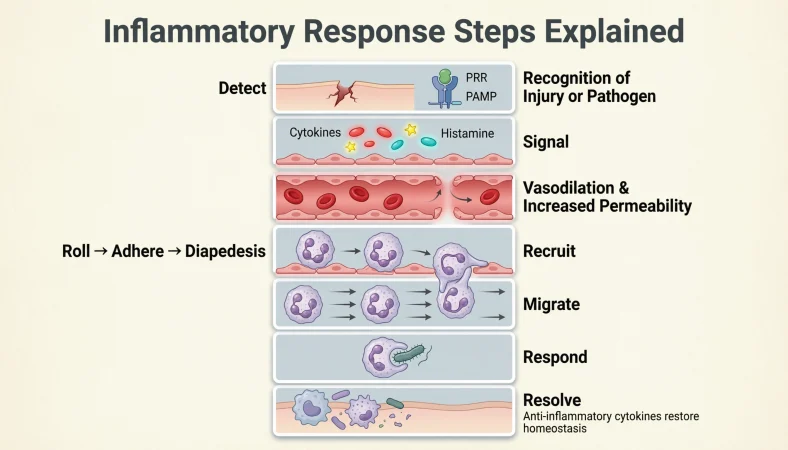
The inflammatory response steps describe how the body detects injury or harmful stimuli, changes local blood flow and vessel permeability, recruits immune cells, removes the threat, and eventually resolves the response. Acute inflammation commonly involves initiation, amplification, destruction, and termination phases.
Top alternatives: stages of inflammation, acute inflammatory response steps, inflammation process, steps of acute inflammation, inflammatory response stages
Ever wondered why a small injury can suddenly become red, warm, swollen, and sore? That whole reaction is your immune system basically saying, “Okay, team, we have a situation.” Understanding the inflammatory response steps makes it much easier to explain what happens after tissue injury, infection, or another harmful stimulus.
Whether you are studying for an exam, explaining biology to a friend, writing notes for work, or trying to make sense of a diagram in a late-night study session, knowing the sequence helps. Acute inflammation involves coordinated vascular and cellular changes, including increased blood flow, increased vascular permeability, and recruitment of white blood cells to the affected area.
The response is useful because it helps the body deal with threats and damaged tissue, but it also needs to be regulated so inflammation does not continue unnecessarily.
Simple Inflammatory Response Steps:
The inflammatory response starts when the body detects injury or a harmful stimulus.
Example: A student uses this line when giving a basic overview of inflammation.
Meaning: It introduces the trigger that begins the response.
Blood vessels change to increase blood flow to the affected area.
Example: A learner summarizes an early vascular change in study notes.
Meaning: It explains why circulation increases around inflamed tissue.
Blood vessel permeability increases during acute inflammation.
Example: A student writes this while reviewing vascular events.
Meaning: It describes how fluid and proteins can move into surrounding tissue.
Fluid moves into the tissue and contributes to swelling.
Example: A learner explains why an injured area becomes puffy.
Meaning: It connects vascular changes with edema.
White blood cells are recruited to the affected tissue.
Example: A student summarizes the cellular phase of inflammation.
Meaning: It explains how immune cells reach the problem area.
Neutrophils are important early responders in acute inflammation.
Example: A biology student reviews immune-cell recruitment before an exam.
Meaning: It identifies a major early cell type.
Leukocytes move toward the site of inflammation.
Example: A learner explains immune-cell migration in simple terms.
Meaning: It describes movement toward the affected tissue.
Immune cells help remove microbes and damaged material.
Example: A student explains why immune cells accumulate after injury.
Meaning: It describes an important protective function.
Inflammatory mediators coordinate many of these changes.
Example: A learner reviews the role of chemical signals.
Meaning: It explains how inflammation is regulated locally.
The response eventually needs to slow down and resolve.
Example: A student summarizes the final phase of acute inflammation.
Meaning: It highlights the importance of controlling inflammation.
Acute inflammation usually develops quickly after an injury or harmful stimulus.
Example: A learner compares acute inflammation with longer-lasting inflammation.
Meaning: It emphasizes the rapid nature of the acute response.
The overall goal is to restore tissue balance and deal with the original problem.
Example: A student prepares a short exam answer.
Meaning: It describes the broader purpose of inflammation.
Funny Inflammatory Response Steps:
Injury detected, immune squad activated.
Example: A student creates a memorable biology revision note.
Meaning: It humorously describes the start of inflammation.
Blood vessels said, “Open the gates.”
Example: A learner jokes while studying vascular changes.
Meaning: It represents vasodilation and increased blood flow.
The immune system saw trouble and called everyone in.
Example: A student explains leukocyte recruitment playfully.
Meaning: It describes immune-cell arrival.
Swelling is basically the body making a temporary guest room.
Example: Someone jokes about fluid accumulation during inflammation.
Meaning: It gives a playful image for tissue swelling.
Neutrophils arrived before the group chat could even load.
Example: A biology student creates a social-media-style study caption.
Meaning: It highlights how quickly neutrophils can appear.
Inflammation: the body’s emergency group project.
Example: A learner uses the phrase in a study post.
Meaning: It compares coordinated immunity with teamwork.
The immune system really said, “Nobody panic, but everybody move.”
Example: A student jokes about coordinated immune activity.
Meaning: It describes rapid but organized response.
Red, warm, swollen, and definitely not ignoring the problem.
Example: Someone summarizes classic visible features of inflammation.
Meaning: It connects symptoms with the body’s response.
Your immune system does not believe in leaving a problem on read.
Example: A learner makes a funny biology revision caption.
Meaning: It emphasizes the body’s active response.
Inflammation enters the chat with zero subtlety.
Example: A student jokes about visible redness and swelling.
Meaning: It makes the inflammatory signs memorable.
The vessels changed the traffic pattern and the leukocytes followed.
Example: A biology learner uses a metaphor for immune-cell movement.
Meaning: It compares blood-flow changes with traffic.
When tissue trouble starts, biology gets busy fast.
Example: A student summarizes acute inflammation humorously.
Meaning: It emphasizes the rapid response.
Professional Inflammatory Response Steps:
The inflammatory response begins with recognition of tissue injury or harmful stimuli.
Example: A healthcare student uses the statement in formal study notes.
Meaning: It introduces the initiating event.
Acute inflammation involves coordinated vascular and cellular changes.
Example: A learner writes a professional exam summary.
Meaning: It emphasizes that inflammation is a coordinated process.
Vasodilation increases local blood flow during acute inflammation.
Example: A student explains vascular changes in a presentation.
Meaning: It identifies a key vascular event.
Increased vascular permeability permits fluid and proteins to leave the circulation.
Example: A learner prepares a pathology revision answer.
Meaning: It explains the basis of inflammatory exudate.
Leukocyte recruitment is a central component of the cellular response.
Example: A biology student summarizes immune-cell movement.
Meaning: It highlights the importance of leukocytes.
Neutrophils commonly predominate during the early cellular response to acute inflammation.
Example: A student prepares a formal pathology answer.
Meaning: It identifies the characteristic early cellular infiltrate.
Leukocytes adhere to activated vascular endothelium before leaving the bloodstream.
Example: A learner explains leukocyte recruitment in formal notes.
Meaning: It describes an important step before tissue migration.
Chemokines help direct leukocytes toward the inflammatory focus.
Example: A student reviews chemical guidance of immune cells.
Meaning: It explains how cells locate the affected area.
Inflammatory cells contribute to removal of pathogens and cellular debris.
Example: A learner summarizes the purpose of cellular recruitment.
Meaning: It describes the protective role of inflammation.
Resolution requires regulation of the inflammatory process.
Example: A student explains why inflammation cannot remain permanently active.
Meaning: It highlights the importance of termination.
Acute inflammation can be organized into initiation, amplification, destruction, and termination phases.
Example: A learner structures a pathology study answer around these phases.
Meaning: It presents a useful high-level model.
The inflammatory response ultimately aims to restore tissue homeostasis.
Example: A healthcare student summarizes the overall purpose of inflammation.
Meaning: It connects the response with recovery.
Clever Inflammatory Response Steps:
Think of inflammation as a coordinated emergency sequence.
Example: A student creates a simple memory aid before an exam.
Meaning: It frames inflammation as an organized process.
First detect the problem, then change the local environment.
Example: A learner summarizes the relationship between recognition and vascular changes.
Meaning: It gives the process a logical order.
Blood flow changes before immune-cell traffic gets busy.
Example: A student remembers the vascular phase through a traffic metaphor.
Meaning: It connects early vascular events with later cellular recruitment.
Swelling reflects what happens when fluid leaves increasingly permeable vessels.
Example: A learner explains the reason behind inflammatory edema.
Meaning: It connects a visible sign with its mechanism.
Rolling is the immune system slowing down to find the exit.
Example: A student uses a metaphor to remember leukocyte rolling.
Meaning: It makes endothelial interactions easier to recall.
Adhesion is the moment the leukocyte stops cruising and commits.
Example: A learner memorizes the transition from rolling to firm adhesion.
Meaning: It describes leukocyte arrest at the endothelium.
Diapedesis is the leukocyte leaving the bloodstream for the tissue.
Example: A student reviews leukocyte extravasation.
Meaning: It gives a concise definition of transmigration.
Chemotaxis gives recruited cells a direction.
Example: A learner studies how leukocytes find inflammatory sites.
Meaning: It explains directional migration.
Phagocytosis helps recruited cells deal with microbes and debris.
Example: A student reviews how immune cells remove harmful material.
Meaning: It describes a major effector function.
Resolution is not the boring ending; it is part of the plan.
Example: A learner remembers why inflammation must be regulated.
Meaning: It emphasizes that stopping inflammation is biologically important.
The whole sequence is controlled chaos with a purpose.
Example: A student creates a memorable revision caption.
Meaning: It captures the coordinated nature of inflammation.
When you understand the sequence, the symptoms stop looking random.
Example: A learner connects redness, heat, swelling, and pain with underlying events.
Meaning: It makes the clinical signs easier to understand.
Sarcastic Inflammatory Response Lines:
The immune system apparently does not believe in subtle notifications.
Example: A student jokes about the obvious signs of acute inflammation.
Meaning: It humorously describes redness, heat, swelling, and pain.
Nothing says “problem detected” like turning the area red.
Example: A learner creates a sarcastic study caption.
Meaning: It highlights visible inflammation.
Because quietly handling tissue damage would be far too simple.
Example: A student jokes about the complexity of inflammatory signaling.
Meaning: It playfully describes the coordinated response.
The blood vessels really chose maximum communication.
Example: A learner jokes about vasodilation and permeability.
Meaning: It highlights the dramatic local vascular changes.
One tiny injury and suddenly everyone gets an assignment.
Example: A biology student jokes about immune-cell recruitment.
Meaning: It compares leukocyte recruitment with a group project.
The neutrophils have entered the building. Everyone can relax now.
Example: A learner creates a humorous revision line.
Meaning: It jokes about early immune-cell recruitment.
Inflammation: because apparently one response was not enough.
Example: A student jokes about multiple coordinated stages.
Meaning: It highlights the many components of inflammation.
First the blood vessels change, then the immune cells clock in. Lovely.
Example: A learner summarizes the vascular and cellular sequence.
Meaning: It presents the process with playful sarcasm.
The body saw a problem and opened the full operations department.
Example: A student describes immune coordination humorously.
Meaning: It emphasizes the organized response.
Nothing like swelling to make sure everyone notices.
Example: A learner jokes about inflammatory edema.
Meaning: It connects swelling with the visible inflammatory response.
Apparently “leave it alone” is not the immune system’s favourite strategy.
Example: A student jokes about immune activation after injury.
Meaning: It highlights the body’s active response.
Resolution eventually arrives after the biological drama.
Example: A learner jokes about the final stage of inflammation.
Meaning: It describes the eventual return toward normal conditions.
Cute And Easy Inflammatory Response Steps:
The body notices a problem and sends help.
Example: A beginner uses this phrase to remember inflammation.
Meaning: It gives a friendly summary of immune activation.
Blood vessels open up to help the response reach the area.
Example: A student simplifies vasodilation for revision.
Meaning: It explains increased local blood flow.
Fluid moves into the tissue, which can cause swelling.
Example: A learner reviews the basis of edema.
Meaning: It connects fluid movement with swelling.
White blood cells travel toward the trouble spot.
Example: A student explains leukocyte recruitment simply.
Meaning: It describes immune-cell movement.
Neutrophils are among the first important cellular responders.
Example: A learner creates a simple biology flashcard.
Meaning: It identifies an early immune-cell population.
Chemokines help guide immune cells where they need to go.
Example: A beginner studies chemical signals during inflammation.
Meaning: It explains directional immune-cell movement.
Leukocytes slow down and interact with the vessel wall.
Example: A student reviews the rolling stage.
Meaning: It introduces leukocyte-endothelium interaction.
Some immune cells squeeze through the vessel wall.
Example: A learner remembers diapedesis using simple language.
Meaning: It describes leukocyte transmigration.
The cells then move through tissue toward the inflammatory area.
Example: A beginner summarizes chemotaxis.
Meaning: It explains movement toward the source of inflammation.
Immune cells help remove harmful material and damaged tissue.
Example: A student reviews the purpose of recruited cells.
Meaning: It describes cleanup and defense.
The response eventually settles when the problem is controlled.
Example: A learner summarizes resolution.
Meaning: It explains why inflammation needs to stop.
The goal is to help the tissue return toward normal.
Example: A student gives a simple final summary.
Meaning: It describes the purpose of resolution.
Dramatic Inflammatory Response Steps:
First, the body detects trouble. Then the entire local response kicks into gear.
Example: A student makes a memorable summary of acute inflammation.
Meaning: It emphasizes rapid activation.
Blood vessels widen and the scene gets noticeably busier.
Example: A learner explains early vascular changes dramatically.
Meaning: It describes increased local blood flow.
Permeability rises, and fluid begins moving into the surrounding tissue.
Example: A student explains the development of swelling.
Meaning: It describes a major vascular change.
The bloodstream becomes the highway for incoming immune cells.
Example: A learner uses a dramatic metaphor for leukocyte recruitment.
Meaning: It compares circulation with immune-cell transport.
Neutrophils arrive as an early wave of cellular responders.
Example: A student creates a memorable pathology note.
Meaning: It emphasizes their early role in acute inflammation.
Rolling begins, and the leukocytes slow down near the activated endothelium.
Example: A learner describes the recruitment cascade.
Meaning: It identifies an important transition before adhesion.
Firm adhesion follows as leukocytes prepare to leave the bloodstream.
Example: A student studies the leukocyte adhesion cascade.
Meaning: It describes the next stage of recruitment.
Diapedesis sends leukocytes across the vessel wall and into tissue.
Example: A learner reviews extravasation before an exam.
Meaning: It defines the movement from blood to tissue.
Chemotaxis pulls the recruited cells toward the inflammatory focus.
Example: A student memorizes directional movement.
Meaning: It explains how immune cells locate the affected area.
The recruited cells act against microbes and damaged material.
Example: A learner summarizes cellular defense.
Meaning: It describes the functional purpose of recruitment.
Once the threat is controlled, the response must begin winding down.
Example: A student explains why inflammation requires termination.
Meaning: It introduces resolution.
The biological finale is restoration rather than endless inflammation.
Example: A learner summarizes the final goal of the response.
Meaning: It connects resolution with homeostasis.
Chill And Casual Inflammatory Response Steps:
Basically, the body notices a problem and starts sending help.
Example: A student explains inflammation to a friend.
Meaning: It gives a relaxed overview.
The blood vessels change so more blood and fluid can reach the area.
Example: A learner explains vascular changes casually.
Meaning: It summarizes the early local response.
That extra fluid is one reason inflamed tissue can swell.
Example: A student explains swelling without heavy terminology.
Meaning: It connects fluid movement with edema.
White blood cells then make their way toward the problem.
Example: A learner explains leukocyte recruitment casually.
Meaning: It describes immune-cell movement.
Neutrophils are some of the early cells on the scene.
Example: A student gives a relaxed explanation of acute inflammation.
Meaning: It identifies an early cellular responder.
The cells slow down, stick to the vessel wall, and get ready to leave.
Example: A learner summarizes rolling and adhesion.
Meaning: It combines several recruitment steps in simple language.
Then they cross the vessel wall and head into the tissue.
Example: A student explains diapedesis informally.
Meaning: It describes leukocyte extravasation.
Chemical signals help point the cells in the right direction.
Example: A learner explains chemotaxis to a classmate.
Meaning: It describes directional signaling.
The recruited cells help deal with microbes and damaged material.
Example: A student summarizes immune-cell function.
Meaning: It explains what the cells do after arriving.
After the job is handled, inflammation needs to calm down.
Example: A learner explains the resolution phase.
Meaning: It emphasizes controlled termination.
It is basically a carefully organized emergency response.
Example: A student uses a simple analogy during revision.
Meaning: It makes the overall process easier to remember.
The whole thing has a purpose, even if the swelling feels annoying.
Example: A learner explains why inflammatory signs occur.
Meaning: It connects uncomfortable symptoms with a protective response.
Confident Inflammatory Response Statements:
I can explain inflammation as a sequence of coordinated vascular and cellular events.
Example: A student prepares a confident exam response.
Meaning: It demonstrates an organized understanding.
The first step is recognizing the injury or harmful stimulus.
Example: A learner answers a biology question confidently.
Meaning: It identifies the initiating event.
Next, vascular changes help establish the local inflammatory environment.
Example: A student explains the vascular phase in class.
Meaning: It connects early blood-vessel changes with inflammation.
Increased permeability contributes to fluid movement into tissue.
Example: A learner explains why edema occurs.
Meaning: It identifies an important mechanism behind swelling.
Leukocyte recruitment follows the vascular changes.
Example: A student summarizes the sequence during revision.
Meaning: It connects vascular and cellular phases.
Rolling and adhesion prepare leukocytes for transmigration.
Example: A learner describes the recruitment cascade.
Meaning: It shows understanding of the order of cellular events.
Diapedesis moves leukocytes from the bloodstream into affected tissue.
Example: A student gives a precise study answer.
Meaning: It defines a key cellular step.
Chemotaxis directs recruited cells toward the inflammatory focus.
Example: A learner explains why leukocytes do not move randomly.
Meaning: It identifies chemical guidance.
Phagocytic activity helps remove microbes and cellular debris.
Example: A student summarizes leukocyte function.
Meaning: It describes an important defensive action.
Resolution is an active part of a controlled inflammatory response.
Example: A learner explains why inflammation must be terminated.
Meaning: It emphasizes regulation.
The sequence makes more sense when vascular and cellular events are studied together.
Example: A student organizes revision notes into two major categories.
Meaning: It creates a useful learning structure.
Understanding the order makes inflammatory signs easier to explain.
Example: A learner prepares for a pathology exam.
Meaning: It connects mechanisms with clinical observations.
Emotional Inflammatory Response Lines:
Inflammation can feel uncomfortable, but the response has an important protective purpose.
Example: A student explains the emotional side of dealing with injury.
Meaning: It acknowledges symptoms while explaining their biological purpose.
Redness and swelling can look alarming, but they can reflect an active immune response.
Example: A learner explains visible inflammatory changes.
Meaning: It provides reassuring biological context without dismissing symptoms.
The body is responding because something has triggered its defense system.
Example: A student explains inflammation in simple emotional language.
Meaning: It frames inflammation as a protective reaction.
Pain can be part of the inflammatory response, not just the original injury.
Example: A learner studies the relationship between inflammation and pain.
Meaning: It explains why inflamed tissue may hurt.
The immune system is trying to deal with the problem, not simply create discomfort.
Example: A student explains the purpose behind inflammatory symptoms.
Meaning: It emphasizes the protective intent of the response.
A healthy response needs action and regulation.
Example: A learner discusses why inflammation should eventually resolve.
Meaning: It highlights balance.
The goal is protection without unnecessary ongoing damage.
Example: A student summarizes why inflammatory regulation matters.
Meaning: It captures the need for controlled inflammation.
Inflammation is a reminder that the immune system is constantly monitoring for trouble.
Example: A learner reflects on innate immune defense.
Meaning: It presents inflammation as part of surveillance and defense.
Recovery depends on bringing the response under control when appropriate.
Example: A student studies the resolution phase.
Meaning: It emphasizes the importance of termination.
The body does not just react; it coordinates a sequence of responses.
Example: A learner explains why inflammation has multiple stages.
Meaning: It highlights the organized nature of the process.
Every stage has a role in moving the tissue toward recovery.
Example: A student summarizes the complete inflammatory sequence.
Meaning: It gives the stages a connected purpose.
Understanding the process can make those uncomfortable signs easier to understand.
Example: A learner explains inflammation to a worried friend.
Meaning: It connects knowledge with reassurance.
Sweet And Supportive Inflammatory Response Explanations:
The body has a built-in way to respond when tissue is injured or threatened.
Example: A student introduces inflammation to a beginner.
Meaning: It describes innate defense simply.
Inflammation brings helpful immune activity to the area that needs attention.
Example: A learner explains why immune cells accumulate at an injury.
Meaning: It describes the protective purpose of recruitment.
Blood vessels adjust to support the local response.
Example: A student explains early vascular changes gently.
Meaning: It simplifies the vascular phase.
Immune cells follow signals that help guide them toward the problem.
Example: A learner explains chemotaxis in friendly language.
Meaning: It describes guided cellular migration.
Neutrophils can be among the first immune cells recruited during acute inflammation.
Example: A student creates a biology flashcard.
Meaning: It identifies early responders.
The response helps the body deal with harmful material and damaged tissue.
Example: A learner explains why inflammation occurs after injury.
Meaning: It describes its protective role.
Swelling can result when fluid leaves more permeable blood vessels.
Example: A student explains a visible inflammatory sign.
Meaning: It connects the symptom with the vascular mechanism.
The immune response works through signals, cells, and blood-vessel changes.
Example: A learner summarizes the major components of inflammation.
Meaning: It shows that inflammation is coordinated.
The response eventually needs to settle so normal tissue function can return.
Example: A student describes resolution.
Meaning: It explains why termination matters.
Learning the sequence can make biology feel much less overwhelming.
Example: A learner creates a study reminder before an exam.
Meaning: It encourages breaking complex processes into steps.
You do not need to memorize everything at once; learn the flow first.
Example: A student shares a revision tip with a classmate.
Meaning: It encourages understanding before memorization.
Once the order clicks, the whole response becomes easier to remember.
Example: A learner reviews the process before a test.
Meaning: It promotes sequence-based learning.
Study-Friendly Inflammatory Response Steps:
Step 1: Recognize the injury or harmful stimulus.
Example: A student starts a numbered study outline.
Meaning: It identifies the initiating event.
Step 2: Release inflammatory mediators.
Example: A learner summarizes the signaling phase.
Meaning: It introduces chemical coordination of inflammation.
Step 3: Increase local blood flow through vascular changes.
Example: A student writes the next step on a flashcard.
Meaning: It describes vasodilation.
Step 4: Increase vascular permeability.
Example: A learner reviews why fluid enters surrounding tissue.
Meaning: It explains an important vascular event.
Step 5: Allow inflammatory fluid and proteins to move into tissue.
Example: A student summarizes exudate formation.
Meaning: It connects permeability with extracellular fluid accumulation.
Step 6: Slow local blood flow and position leukocytes near the vessel wall.
Example: A learner reviews leukocyte margination.
Meaning: It describes an early cellular recruitment event.
Step 7: Leukocytes roll along the activated endothelium.
Example: A student studies selectin-mediated rolling.
Meaning: It explains how leukocytes begin interacting with vessel walls.
Step 8: Leukocytes adhere firmly to the endothelium.
Example: A learner memorizes the transition from rolling to adhesion.
Meaning: It describes stable leukocyte attachment.
Step 9: Leukocytes cross the vessel wall through transmigration or diapedesis.
Example: A student reviews extravasation.
Meaning: It explains how immune cells enter tissue.
Step 10: Chemotaxis directs leukocytes toward the inflammatory focus.
Example: A learner studies chemical guidance of immune cells.
Meaning: It describes directional migration.
Step 11: Recruited cells help neutralize harmful material and remove debris.
Example: A student summarizes cellular defense.
Meaning: It explains the functional response after recruitment.
Step 12: The response is regulated and moves toward resolution.
Example: A learner completes an acute inflammation flowchart.
Meaning: It describes how inflammation is brought under control.
Exam-Ready Inflammatory Response Answers:
Acute inflammation begins after tissue injury or another inflammatory stimulus.
Example: A student uses this as the opening sentence of an exam answer.
Meaning: It identifies the trigger.
Inflammatory mediators initiate local vascular and cellular changes.
Example: A learner explains the role of signaling molecules.
Meaning: It connects mediators with the response.
Vasodilation increases local blood flow.
Example: A student gives a concise vascular answer.
Meaning: It explains the basis of increased redness and heat.
Increased vascular permeability allows fluid and proteins to leave the circulation.
Example: A learner answers a pathology question about edema.
Meaning: It explains exudate formation.
Stasis encourages leukocytes to move toward the vessel wall.
Example: A student describes the transition to leukocyte margination.
Meaning: It explains how slower blood flow supports recruitment.
Leukocyte rolling occurs through interactions with endothelial selectins.
Example: A learner writes a detailed immunology answer.
Meaning: It identifies the molecular basis of rolling.
Chemokines activate leukocytes and help direct their movement.
Example: A student explains leukocyte recruitment.
Meaning: It connects signaling with cellular migration.
Integrins contribute to firm leukocyte adhesion.
Example: A learner reviews the adhesion step before an exam.
Meaning: It identifies a key molecular interaction.
Diapedesis allows leukocytes to cross the endothelial barrier.
Example: A student defines transmigration in an exam answer.
Meaning: It explains movement from blood into tissue.
Chemotaxis directs leukocytes toward the site of inflammation.
Example: A learner explains why recruited cells accumulate at specific locations.
Meaning: It describes directional migration.
Neutrophils are prominent early cellular responders in acute inflammation.
Example: A student answers a question about inflammatory cell types.
Meaning: It identifies a characteristic early cell population.
Resolution terminates or limits the inflammatory response and supports restoration of homeostasis.
Example: A learner completes an answer about the final stage.
Meaning: It describes why controlled termination matters.
Memorable Inflammatory Response One-Liners:
Detect it, signal it, recruit help, remove the problem, resolve it.
Example: A student creates a quick revision mantra.
Meaning: It summarizes the overall sequence.
Vessels change, leukocytes arrive, cleanup begins.
Example: A learner uses a short memory aid before an exam.
Meaning: It condenses vascular and cellular events.
Recognize, recruit, respond, resolve.
Example: A student writes four keywords at the top of a study page.
Meaning: It provides a compact framework.
Inflammation starts with a signal and ends with regulation.
Example: A learner summarizes the entire process.
Meaning: It emphasizes initiation and termination.
Blood flow changes first, immune-cell traffic follows.
Example: A student remembers the broad sequence.
Meaning: It separates vascular and cellular phases.
Rolling, adhesion, migration, action.
Example: A learner memorizes leukocyte recruitment stages.
Meaning: It provides a compact cellular sequence.
The immune response needs direction, not random movement.
Example: A student explains chemotaxis.
Meaning: It emphasizes guided leukocyte migration.
Swelling has a story, and permeability is part of it.
Example: A learner connects edema with vascular changes.
Meaning: It makes the mechanism memorable.
Neutrophils arrive early and help handle the immediate problem.
Example: A student reviews acute inflammation before an exam.
Meaning: It highlights early cellular participation.
Inflammation is coordinated, not accidental.
Example: A learner summarizes the role of mediators and cells.
Meaning: It emphasizes organized biological control.
The response must know when to start and when to stop.
Example: A student reviews inflammatory resolution.
Meaning: It highlights regulation.
Learn the flow, then learn the details.
Example: A student uses the phrase as a study strategy.
Meaning: It encourages understanding the sequence before memorizing molecular details.
FAQs:
What are the inflammatory response steps?
A commonly taught sequence for acute inflammation includes recognition or initiation, vascular changes, leukocyte recruitment, cellular action, and resolution. Some models divide acute inflammation into initiation, amplification, destruction, and termination phases.
What happens first in the inflammatory response?
The process begins when the body detects tissue injury, infection, or another harmful stimulus. This activates inflammatory mediators and initiates local vascular and cellular changes.
What happens to blood vessels during inflammation?
Blood vessels undergo changes including vasodilation and increased permeability. These changes increase local blood flow and allow fluid and proteins to move into surrounding tissue.
What are the main leukocyte recruitment steps?
A simplified sequence includes rolling, activation, firm adhesion, transmigration, and migration toward the inflammatory focus. These steps involve selectins, chemokines, integrins, and other adhesion mechanisms.
Which cells arrive first during acute inflammation?
Neutrophils are typically prominent among the early cellular responders in acute inflammation. Monocytes and macrophages also participate as the response progresses.
What is chemotaxis in the inflammatory response?
Chemotaxis is directed movement of immune cells toward chemical signals concentrated around the inflammatory site. Chemokines are important signals in this process.
What is diapedesis?
Diapedesis, also called leukocyte transmigration or emigration, describes the movement of leukocytes across the blood-vessel wall into surrounding tissue.
Why does inflammation cause swelling?
Swelling can occur because inflammatory changes increase vascular permeability, allowing fluid and proteins to move from the circulation into surrounding tissue.
Is the inflammatory response always harmful?
No. Inflammation is an important defense response, but excessive, prolonged, or poorly regulated inflammation can contribute to tissue damage and disease.
Is humor appropriate when explaining inflammatory response steps?
Humor can make study notes, social posts, and casual explanations more memorable. For clinical, academic, or professional material, keep the core information accurate and use humor sparingly.
Conclusion:
Learning the inflammatory response steps does not have to feel like memorizing a biology novel at 2 a.m. Once you understand the flow, the details become much easier to connect. The body detects a problem, releases signals, changes local blood vessels, recruits immune cells, directs them toward the affected area, responds to the threat, and then works toward resolution.
Use simple phrases when explaining the process to friends, detailed terminology for exams, and memorable lines when making study notes. Try different memory tricks until the sequence clicks. Save this guide for your next revision session, share it with your study group, and make inflammation finally feel a little less intimidating.