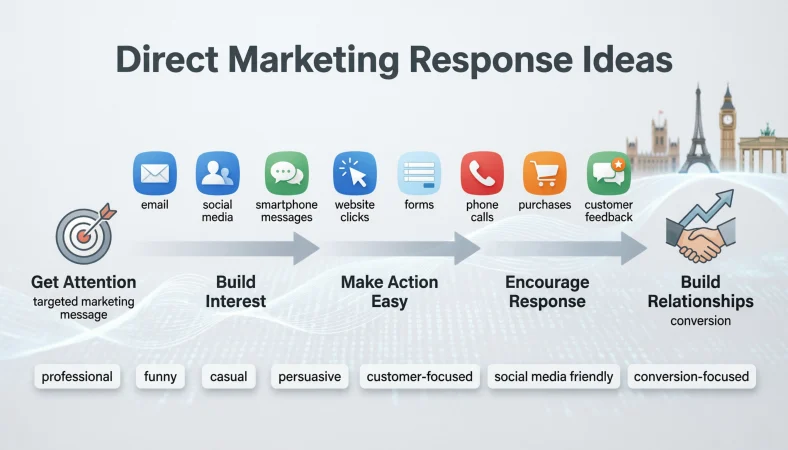
A direct marketing response is the action a customer takes after receiving a targeted marketing message, such as clicking, replying, calling, purchasing, signing up, or requesting more information. The best responses are clear, measurable, and connected to a specific call to action.
Top alternatives: direct response marketing, marketing response examples, customer response strategies, direct marketing replies, response marketing ideas
If a marketing message gets attention but nobody clicks, replies, buys, or signs up, something is missing. That is where a direct marketing response becomes important. Whether you are answering a customer in a DM, replying to a business inquiry, writing a work email, following up with a lead, or creating a campaign for social media, the response can shape what happens next.
Direct marketing focuses heavily on measurable actions, so a good response should make the next step obvious without sounding robotic or overly salesy. Think of it as the difference between “Cool, thanks” and “Yes, send me the details.” One closes the loop, while the other opens a door.
The right wording can build trust, encourage action, reduce hesitation, and keep conversations moving. Basically, good marketing is not just about getting attention. It is about giving people a reason to respond.
Funny Direct Marketing Response Ideas
“Okay, you officially have my attention.”
Example: A potential customer uses this after seeing a surprisingly relevant promotional message.
Meaning: It shows playful interest without committing to a purchase.
“Well, that escalated from scrolling to shopping.”
Example: A social media user reacts after discovering an appealing product.
Meaning: It humorously admits the marketing worked.
“My wallet would like a word with you.”
Example: A customer responds after seeing an irresistible offer.
Meaning: It jokingly signals strong buying interest.
“You had me at the discount.”
Example: A shopper responds to a limited-time promotional offer.
Meaning: It shows that the price incentive captured attention.
“That marketing message knew exactly where to find me.”
Example: A customer reacts to a highly relevant targeted campaign.
Meaning: It praises the campaign’s relevance.
“I was just browsing, but here we are.”
Example: A shopper responds after adding an item to their cart.
Meaning: It playfully admits growing purchase intent.
“My algorithm clearly knows me too well.”
Example: A social media user reacts to a perfectly targeted recommendation.
Meaning: It highlights how relevant the message feels.
“Okay, marketing team, I see what you did there.”
Example: A customer responds to a clever promotional campaign.
Meaning: It compliments the campaign’s creativity.
“This offer is dangerously tempting.”
Example: A shopper considers a promotional deal.
Meaning: It communicates strong interest with humor.
“Fine, take my click.”
Example: A customer clicks through after seeing an engaging call to action.
Meaning: It jokingly acknowledges that the campaign won the click.
“Apparently I needed this before I knew I needed it.”
Example: A customer discovers a product through targeted advertising.
Meaning: It shows successful product positioning.
“Well played, internet.”
Example: A user responds after interacting with a clever online campaign.
Meaning: It humorously admits the marketing was effective.
Professional Direct Marketing Responses:
“Thank you for reaching out. I would be happy to learn more.”
Example: A prospect responds professionally to an introductory marketing email.
Meaning: It communicates polite and genuine interest.
“Please send over the additional details.”
Example: A business contact wants more information before making a decision.
Meaning: It requests useful information without making a commitment.
“Could you provide pricing and available options?”
Example: A potential customer evaluates a service offer.
Meaning: It moves the conversation toward practical details.
“I would appreciate a brief overview of the offer.”
Example: A professional receives an unfamiliar promotional message.
Meaning: It requests clarification before proceeding.
“Thank you for the information. I will review it and follow up.”
Example: A prospect needs time to evaluate a marketing proposal.
Meaning: It acknowledges receipt while keeping the decision open.
“Could you clarify the next steps?”
Example: A lead is interested but unsure how to proceed.
Meaning: It asks the sender to make the conversion path clearer.
“Please share the relevant product specifications.”
Example: A buyer needs technical information before purchasing.
Meaning: It requests details necessary for evaluation.
“I am interested in discussing this opportunity further.”
Example: A business lead sees potential value in an offer.
Meaning: It signals serious interest.
“Could you provide information about the terms and conditions?”
Example: A customer considers signing up for a promotional service.
Meaning: It seeks clarity before commitment.
“Please let me know when would be a convenient time to discuss this.”
Example: A prospect wants a follow-up conversation with a sales representative.
Meaning: It encourages the next stage of communication.
“The offer appears relevant to our current needs.”
Example: A company evaluates a business-to-business marketing message.
Meaning: It signals that the proposal may be worth exploring.
“Thank you. I look forward to reviewing the information.”
Example: A professional receives campaign details by email.
Meaning: It maintains a courteous and positive tone.
Clever Direct Marketing Response Ideas
“Give me the detail that makes this worth my click.”
Example: A prospect wants a stronger reason to engage with an advertisement.
Meaning: It asks for a clear value proposition.
“Show me the benefit, not just the headline.”
Example: A customer evaluates a promotional campaign.
Meaning: It requests practical value rather than hype.
“What problem does this solve for me?”
Example: A prospect receives an unfamiliar product recommendation.
Meaning: It asks the marketer to connect the product with a real need.
“What makes this different from the alternatives?”
Example: A shopper compares several competing offers.
Meaning: It requests a clear differentiator.
“I am interested if the value matches the promise.”
Example: A customer considers a bold marketing claim.
Meaning: It communicates conditional interest.
“Send me the details that matter.”
Example: A prospect wants concise information before responding further.
Meaning: It encourages useful and focused communication.
“The offer caught my eye. Now prove the value.”
Example: A customer considers a premium service.
Meaning: It shows curiosity while remaining selective.
“A good message gets attention. A clear benefit gets action.”
Example: A marketer uses the line when discussing campaign performance.
Meaning: It emphasizes the importance of value-driven messaging.
“Make the next step ridiculously easy.”
Example: A campaign manager reviews a complicated call to action.
Meaning: It encourages reducing friction.
“If the answer is simple, I am listening.”
Example: A busy prospect receives a complicated promotional offer.
Meaning: It signals openness to concise communication.
“Tell me why I should act today.”
Example: A customer evaluates a limited-time offer.
Meaning: It asks for a meaningful reason to act promptly.
“Clarity gets my click.”
Example: A marketer evaluates potential customer behavior.
Meaning: It highlights the value of straightforward messaging.
Creative Direct Marketing Response Lines
“Turn curiosity into a click.”
Example: A marketer creates a short campaign slogan.
Meaning: It connects interest with measurable action.
“You got the attention. Now earn the action.”
Example: A campaign strategist evaluates a promotional message.
Meaning: It stresses the need for a strong value proposition.
“Less sales pitch, more useful answer.”
Example: A brand responds to customer questions on social media.
Meaning: It encourages helpful communication.
“Make the offer feel like an opportunity, not an interruption.”
Example: A marketer develops a customer-focused campaign.
Meaning: It promotes relevance and respect.
“One clear message can start a valuable conversation.”
Example: A business uses a targeted outreach campaign.
Meaning: It emphasizes clarity and engagement.
“Give people a reason to stop scrolling.”
Example: A social media manager creates direct response content.
Meaning: It focuses on earning attention.
“Make the value impossible to misunderstand.”
Example: A campaign team reviews an unclear advertisement.
Meaning: It encourages simple value communication.
“Interest is the spark. Action is the goal.”
Example: A marketer explains the purpose of a response-focused campaign.
Meaning: It separates attention from measurable conversion.
“Every click starts with a reason.”
Example: A content creator reviews a campaign call to action.
Meaning: It emphasizes motivation behind customer actions.
“Give the customer the shortcut.”
Example: A business simplifies its purchase process.
Meaning: It encourages removing unnecessary steps.
“Good marketing starts the conversation. Great marketing keeps it moving.”
Example: A brand plans follow-up communication after a campaign response.
Meaning: It highlights the importance of ongoing engagement.
“Make responding feel effortless.”
Example: A marketer improves a campaign’s call-to-action button.
Meaning: It focuses on reducing response friction.
Casual Direct Marketing Responses
“Sure, send me more info.”
Example: A customer replies casually to a product recommendation.
Meaning: It shows straightforward interest.
“Yeah, I might be interested.”
Example: A prospect responds to an introductory offer.
Meaning: It communicates tentative interest.
“Can you tell me a little more?”
Example: A customer wants additional context before deciding.
Meaning: It keeps the conversation open.
“That actually sounds useful.”
Example: A prospect sees a product that addresses a practical need.
Meaning: It expresses genuine interest.
“Send the details when you can.”
Example: A customer wants more information but is not ready to act immediately.
Meaning: It politely keeps the conversation moving.
“I’ll take a look.”
Example: A prospect receives a link to a product page.
Meaning: It acknowledges interest without promising a purchase.
“That could work for me.”
Example: A customer considers a service that fits their needs.
Meaning: It signals potential acceptance.
“Okay, I’m curious.”
Example: A user sees an intriguing promotional post.
Meaning: It communicates growing interest.
“What’s the catch?”
Example: A customer sees an unusually attractive offer.
Meaning: It playfully asks for clarification.
“Looks interesting. What are the options?”
Example: A prospect wants to compare available packages.
Meaning: It moves curiosity toward evaluation.
“I’m listening.”
Example: A customer receives a relevant offer.
Meaning: It shows openness to hearing more.
“Send it over.”
Example: A prospect wants the promised information or link.
Meaning: It signals a willingness to continue.
Polite Direct Marketing Responses
“Thank you for getting in touch.”
Example: A customer responds politely to an outreach message.
Meaning: It acknowledges the sender respectfully.
“I appreciate you sharing these details.”
Example: A prospect receives useful campaign information.
Meaning: It shows gratitude for the effort.
“Thank you for the offer. I will consider it.”
Example: A customer needs time before deciding.
Meaning: It keeps the response positive without promising action.
“I appreciate the information and will review it shortly.”
Example: A professional receives a marketing proposal during a busy day.
Meaning: It politely acknowledges receipt.
“Could you please provide a little more information?”
Example: A customer wants clarification before responding further.
Meaning: It requests additional context respectfully.
“Thank you, but I am not interested at this time.”
Example: A recipient wants to decline an offer courteously.
Meaning: It gives a clear but respectful refusal.
“I appreciate the opportunity, but I will pass for now.”
Example: A prospect declines a promotional offer.
Meaning: It communicates a friendly no.
“Please keep me informed about future relevant offers.”
Example: A customer declines one campaign but remains interested in the brand.
Meaning: It leaves the relationship open.
“Thank you for reaching out. I appreciate the consideration.”
Example: A professional receives a targeted business proposal.
Meaning: It responds with warmth and professionalism.
“Could you please clarify the offer before I decide?”
Example: A customer finds the promotional terms unclear.
Meaning: It requests transparency.
“Thank you for following up.”
Example: A prospect receives a second marketing message.
Meaning: It acknowledges continued communication politely.
“I appreciate your time and information.”
Example: A customer concludes a marketing conversation respectfully.
Meaning: It closes the interaction warmly.
Sarcastic Direct Marketing Responses
“Wow, you actually read my mind.”
Example: A customer receives an advertisement that feels unusually relevant.
Meaning: It jokingly praises the targeting.
“My inbox definitely needed another sales pitch.”
Example: A recipient receives an unwanted promotional email.
Meaning: It uses sarcasm to express annoyance.
“Because apparently my shopping list was not long enough.”
Example: A shopper sees another tempting product recommendation.
Meaning: It humorously acknowledges temptation.
“Excellent timing, my bank account was feeling too comfortable.”
Example: A customer sees a tempting sale.
Meaning: It jokes about the financial temptation.
“Nothing says peaceful scrolling like another promotion.”
Example: A user encounters repeated advertisements online.
Meaning: It lightly criticizes excessive marketing.
“Clearly, the algorithm knows my weaknesses.”
Example: A user sees a perfectly targeted product advertisement.
Meaning: It jokes about personalized marketing.
“Sure, because I definitely needed another subscription.”
Example: A customer sees a new subscription offer.
Meaning: It humorously questions the need for another purchase.
“My inbox has officially become a shopping mall.”
Example: A recipient receives multiple promotional emails.
Meaning: It jokes about heavy marketing volume.
“That offer is suspiciously convincing.”
Example: A prospect sees a particularly attractive promotion.
Meaning: It playfully admits the offer is persuasive.
“Okay, that was annoyingly well targeted.”
Example: A customer sees an advertisement that matches a recent need.
Meaning: It sarcastically compliments targeting accuracy.
“I blame the marketing team for this impulse purchase.”
Example: A shopper buys after seeing an engaging campaign.
Meaning: It humorously credits the campaign for the decision.
“Fine, the advertisement wins this round.”
Example: A customer finally clicks an offer after ignoring similar ads.
Meaning: It playfully admits the campaign succeeded.
Friendly Direct Marketing Response Ideas
“Thanks for thinking of me.”
Example: A customer receives a personalized product recommendation.
Meaning: It makes the response warm and personal.
“That looks like something I would enjoy.”
Example: A brand sends a relevant recommendation to an existing customer.
Meaning: It communicates positive interest.
“I really appreciate the recommendation.”
Example: A customer receives a useful suggestion from a business.
Meaning: It shows gratitude and openness.
“This is actually helpful, thank you.”
Example: A customer receives useful information rather than a hard sales pitch.
Meaning: It rewards helpful marketing.
“I’d love to see what you have available.”
Example: A prospect wants to browse products or services.
Meaning: It communicates friendly curiosity.
“That sounds promising.”
Example: A potential buyer receives a relevant offer.
Meaning: It shows positive but measured interest.
“Thanks for making the details easy to understand.”
Example: A customer reviews a clearly written promotion.
Meaning: It praises straightforward communication.
“I’m interested in seeing where this goes.”
Example: A prospect responds positively to an introductory campaign.
Meaning: It keeps the conversation open.
“This caught my attention in a good way.”
Example: A customer responds to creative marketing content.
Meaning: It gives positive feedback.
“I appreciate the personal touch.”
Example: A customer receives a personalized recommendation.
Meaning: It recognizes thoughtful communication.
“You made this easy to understand.”
Example: A prospect reviews a simple offer page.
Meaning: It praises clarity.
“Thanks, I’ll keep this in mind.”
Example: A customer is not ready to purchase but likes the offer.
Meaning: It keeps future possibilities open.
Confident Direct Marketing Responses
“I know what I need, so let’s get to the details.”
Example: A qualified customer responds to a product offer.
Meaning: It communicates strong purchase intent.
“Send me the options and I’ll choose.”
Example: A buyer is ready to compare available packages.
Meaning: It moves directly toward a decision.
“I’m interested. What’s the next step?”
Example: A prospect responds positively to a service campaign.
Meaning: It clearly signals readiness to continue.
“The offer works for me.”
Example: A customer accepts a promotional proposal.
Meaning: It communicates straightforward agreement.
“Let’s move forward.”
Example: A qualified lead has reviewed the necessary information.
Meaning: It signals readiness to proceed.
“I’ve seen enough to be interested.”
Example: A prospect responds after reviewing a product page.
Meaning: It shows that the campaign has provided sufficient motivation.
“Send the checkout details.”
Example: A shopper is ready to purchase.
Meaning: It communicates strong conversion intent.
“I’m ready to take the next step.”
Example: A prospect wants to begin a service.
Meaning: It signals commitment.
“This matches what I was looking for.”
Example: A customer discovers a suitable product through targeted marketing.
Meaning: It indicates strong product-market relevance.
“The value makes sense to me.”
Example: A buyer evaluates the benefits of a service.
Meaning: It communicates confidence in the offer.
“I’m interested enough to discuss it further.”
Example: A business prospect sees potential in an offer.
Meaning: It signals meaningful interest.
“Let’s make it happen.”
Example: A customer has decided to proceed with an offer.
Meaning: It communicates enthusiasm and action.
Emotional Direct Marketing Responses
“This feels like exactly what I needed right now.”
Example: A customer discovers a product during a personally relevant moment.
Meaning: It expresses strong emotional relevance.
“You really understood what I was looking for.”
Example: A customer receives a highly personalized recommendation.
Meaning: It communicates feeling understood by the brand.
“This genuinely made my day.”
Example: A customer receives a useful surprise promotion.
Meaning: It expresses positive emotional impact.
“I did not expect to connect with this message.”
Example: A prospect encounters unusually relatable campaign content.
Meaning: It shows emotional engagement.
“This feels personal in the best way.”
Example: A customer receives thoughtful personalized marketing.
Meaning: It praises relevant personalization.
“You made this decision much easier.”
Example: A customer receives clear information before purchasing.
Meaning: It shows that the campaign reduced uncertainty.
“I appreciate how relevant this was.”
Example: A customer receives an offer matching a recent need.
Meaning: It recognizes thoughtful targeting.
“This actually solved a problem for me.”
Example: A customer discovers a useful service through direct outreach.
Meaning: It shows strong practical and emotional value.
“I’m glad I stopped to read this.”
Example: A user engages with a compelling social media advertisement.
Meaning: It indicates that the content earned attention.
“That message came at the perfect time.”
Example: A customer receives an offer when actively searching for the product.
Meaning: It highlights timing and relevance.
“This feels like a recommendation, not a sales pitch.”
Example: A customer responds positively to helpful brand communication.
Meaning: It praises authentic messaging.
“You made me feel like more than just a customer.”
Example: A loyal customer receives personalized outreach.
Meaning: It recognizes relationship-focused marketing.
Short Direct Marketing Response Lines
“Send details.”
Example: A prospect wants additional information quickly.
Meaning: It communicates immediate curiosity.
“I’m interested.”
Example: A customer responds to a relevant offer.
Meaning: It clearly signals interest.
“Tell me more.”
Example: A prospect wants more information before deciding.
Meaning: It keeps the conversation open.
“What’s included?”
Example: A buyer evaluates a service package.
Meaning: It asks about the offer’s contents.
“What’s the price?”
Example: A shopper considers a promotional product.
Meaning: It requests essential purchase information.
“How does it work?”
Example: A customer sees an unfamiliar service.
Meaning: It asks for a simple explanation.
“Can I see the options?”
Example: A prospect wants to compare available products.
Meaning: It encourages further evaluation.
“Is there a trial?”
Example: A customer considers an unfamiliar subscription service.
Meaning: It asks for a lower-risk way to evaluate the offer.
“What’s the deadline?”
Example: A customer sees a limited-time promotion.
Meaning: It asks about urgency.
“Where can I sign up?”
Example: A prospect has decided to take action.
Meaning: It shows strong conversion intent.
“Can you send the link?”
Example: A customer wants to visit the offer page.
Meaning: It requests an immediate next step.
“I’ll take a look.”
Example: A prospect wants to review the offer before deciding.
Meaning: It communicates cautious interest.
Witty Direct Marketing Responses
“You made the click feel worth it.”
Example: A customer reaches a useful landing page after an advertisement.
Meaning: It praises the value delivered after engagement.
“That headline did its job.”
Example: A marketer reviews a campaign that generated strong engagement.
Meaning: It recognizes effective attention-grabbing copy.
“Okay, that call to action actually worked.”
Example: A customer responds after completing a campaign action.
Meaning: It humorously acknowledges effective conversion messaging.
“You turned curiosity into commitment.”
Example: A customer decides to purchase after exploring an offer.
Meaning: It describes successful movement through the customer journey.
“That was a smooth conversion.”
Example: A marketer reviews an easy customer journey.
Meaning: It praises a frictionless path to action.
“The message was short, but it said enough.”
Example: A customer responds positively to concise marketing copy.
Meaning: It praises clarity and efficiency.
“You gave me a reason to care.”
Example: A prospect engages with a problem-focused campaign.
Meaning: It highlights relevance.
“That offer answered my question before I asked it.”
Example: A customer receives highly useful campaign information.
Meaning: It praises proactive communication.
“This is what useful marketing looks like.”
Example: A customer responds to helpful promotional content.
Meaning: It compliments customer-focused messaging.
“The value proposition finally makes sense.”
Example: A prospect understands a previously confusing offer.
Meaning: It shows that the campaign successfully communicated value.
“That was a better pitch than I expected.”
Example: A customer responds to a thoughtful promotional message.
Meaning: It acknowledges effective persuasion.
“You earned another look.”
Example: A prospect is not ready to purchase but remains interested.
Meaning: It signals continued consideration.
Social Media Friendly Direct Marketing Responses
“Okay, this deserves a click.”
Example: A user reacts to an engaging brand post.
Meaning: It shows that the content motivated action.
“This is actually useful content.”
Example: A follower sees a helpful promotional post.
Meaning: It praises value rather than pure promotion.
“Adding this to my list.”
Example: A shopper discovers an interesting product through Instagram content.
Meaning: It communicates future purchase interest.
“Saving this for later.”
Example: A user discovers a useful service while browsing social media.
Meaning: It shows interest without immediate action.
“Why is this so relevant?”
Example: A follower sees a highly targeted recommendation.
Meaning: It highlights strong personalization.
“Okay, brand, I’m listening.”
Example: A user sees an intriguing campaign post.
Meaning: It signals curiosity.
“This just solved my problem.”
Example: A follower discovers a product that addresses a current need.
Meaning: It shows strong practical relevance.
“Drop the details.”
Example: A social media user wants more information about an offer.
Meaning: It encourages the brand to continue the conversation.
“Link please.”
Example: A follower wants to visit a product or service page.
Meaning: It shows direct interest.
“This is going straight into my saved posts.”
Example: A user finds useful promotional content.
Meaning: It communicates intent to revisit the offer.
“Okay, I need to know more.”
Example: A follower sees a curiosity-driven campaign.
Meaning: It signals growing interest.
“That was a good use of my scroll time.”
Example: A user encounters helpful branded content.
Meaning: It praises content that earns attention.
Customer-Focused Direct Marketing Responses
“What would you recommend for someone like me?”
Example: A customer wants personalized guidance before purchasing.
Meaning: It invites the brand to tailor its recommendation.
“Can you help me choose the right option?”
Example: A shopper feels uncertain between several products.
Meaning: It asks for assistance in making a decision.
“I need something simple and reliable.”
Example: A customer explains their priorities before purchasing.
Meaning: It gives the marketer useful decision criteria.
“My main concern is value for money.”
Example: A prospect evaluates different offers.
Meaning: It clearly states the customer’s priority.
“Can you explain the difference between these options?”
Example: A shopper compares multiple service packages.
Meaning: It asks for decision-making support.
“I’m interested, but I need more information first.”
Example: A prospect likes the offer but still has questions.
Meaning: It expresses interest while identifying hesitation.
“What happens after I sign up?”
Example: A customer wants to understand the post-purchase process.
Meaning: It seeks clarity about the customer journey.
“Is there support if I need help?”
Example: A buyer evaluates a digital service.
Meaning: It asks about customer care.
“Can you explain the benefits in simple terms?”
Example: A prospect finds technical marketing language confusing.
Meaning: It requests clearer value communication.
“I want to know what I’m actually getting.”
Example: A customer reviews a bundled promotional offer.
Meaning: It asks for transparency.
“What makes this a better choice?”
Example: A buyer compares a product with competitors.
Meaning: It asks for a compelling reason to choose the offer.
“If you can make the process easy, I’m interested.”
Example: A busy prospect considers a service that seems useful.
Meaning: It connects purchase intent with ease and convenience.
Persuasive Direct Marketing Response Ideas
“Yes, send me the offer.”
Example: A qualified prospect responds positively to a targeted campaign.
Meaning: It signals clear interest.
“I’m ready to learn more.”
Example: A customer responds after reading a persuasive advertisement.
Meaning: It indicates movement toward consideration.
“This sounds like a good fit.”
Example: A prospect sees that the offer matches their needs.
Meaning: It communicates positive product relevance.
“I’m interested in seeing the full package.”
Example: A buyer wants to evaluate all available benefits.
Meaning: It encourages deeper consideration.
“The benefits are relevant to what I need.”
Example: A prospect reviews a service offer.
Meaning: It confirms that the value proposition resonates.
“Show me how this can help.”
Example: A customer wants practical evidence before buying.
Meaning: It asks the brand to connect features with outcomes.
“I’m open to giving it a try.”
Example: A prospect sees enough value to consider a trial.
Meaning: It communicates moderate purchase intent.
“This is worth exploring.”
Example: A business lead sees potential value in a proposal.
Meaning: It signals serious consideration.
“The offer makes sense based on what I need.”
Example: A customer evaluates a targeted promotion.
Meaning: It communicates alignment between need and offer.
“I’d like to see the next step.”
Example: A prospect wants to continue after reviewing campaign content.
Meaning: It signals readiness for further engagement.
“You’ve given me a reason to act.”
Example: A customer responds to a compelling limited-time offer.
Meaning: It acknowledges effective persuasion.
“Let’s see where this goes.”
Example: A prospect agrees to continue discussing a relevant offer.
Meaning: It communicates openness and curiosity.
Smart And Conversion-Focused Responses
“Make the value clear and I’ll keep going.”
Example: A prospect evaluates a landing page with too much information.
Meaning: It emphasizes clarity as a conversion factor.
“Give me fewer steps and more reasons to act.”
Example: A marketer reviews a complicated purchase journey.
Meaning: It encourages simplicity and stronger motivation.
“The faster I understand it, the faster I can decide.”
Example: A customer evaluates a new service.
Meaning: It connects clarity with decision speed.
“A clear offer beats a complicated pitch.”
Example: A marketing professional reviews campaign messaging.
Meaning: It promotes simple communication.
“Answer my biggest question first.”
Example: A prospect reads a long promotional page.
Meaning: It encourages customer-first messaging.
“Tell me the outcome, not just the feature.”
Example: A buyer evaluates a technical product.
Meaning: It asks marketers to communicate benefits.
“Give me proof before asking for commitment.”
Example: A cautious prospect evaluates an unfamiliar brand.
Meaning: It emphasizes trust and credibility.
“If it saves me time, you have my attention.”
Example: A busy customer evaluates a convenience-focused service.
Meaning: It identifies time savings as a strong motivator.
“If it solves the problem, show me how.”
Example: A customer evaluates a problem-solving product.
Meaning: It requests evidence of practical value.
“Do not make me hunt for the next step.”
Example: A customer navigates a confusing campaign landing page.
Meaning: It encourages clear calls to action.
“Give me enough information to say yes confidently.”
Example: A prospect is interested but needs reassurance.
Meaning: It highlights the role of useful information in conversion.
“Good marketing respects my time.”
Example: A customer responds positively to concise brand communication.
Meaning: It emphasizes relevance and efficiency.
Relationship-Building Direct Marketing Responses
“Thanks for keeping me updated.”
Example: A returning customer receives useful campaign information.
Meaning: It reinforces an ongoing relationship.
“I appreciate the recommendations you send.”
Example: A loyal customer receives relevant product suggestions.
Meaning: It shows that personalization feels valuable.
“Keep me posted when something similar comes up.”
Example: A customer declines one offer but wants future recommendations.
Meaning: It preserves future marketing opportunities.
“I like that you remembered my preferences.”
Example: A returning customer receives a personalized recommendation.
Meaning: It recognizes thoughtful customer retention.
“I’ll definitely check out future offers.”
Example: A customer has a positive experience with a campaign.
Meaning: It signals future engagement.
“Thanks for making the choice easier.”
Example: A brand provides helpful comparison information.
Meaning: It praises customer-focused communication.
“I appreciate the follow-up.”
Example: A prospect receives a useful message after an initial inquiry.
Meaning: It acknowledges continued attention.
“This is the kind of update I actually want.”
Example: A customer receives relevant rather than generic marketing.
Meaning: It rewards useful personalization.
“You can keep sending relevant recommendations.”
Example: A customer wants future product suggestions.
Meaning: It gives permission for continued relevant outreach.
“I’m glad I subscribed.”
Example: A customer receives valuable email content after signing up.
Meaning: It confirms satisfaction with ongoing communication.
“You’ve earned my attention for future launches.”
Example: A customer enjoys a successful campaign experience.
Meaning: It signals increased brand interest.
“Keep the useful stuff coming.”
Example: A customer responds to consistently valuable marketing content.
Meaning: It encourages continued relevance.
FAQs:
What does direct marketing response mean?
A direct marketing response is a measurable action taken after someone receives a targeted marketing message. It can include a click, reply, call, purchase, registration, download, inquiry, or other desired action.
What is a good direct marketing response?
A good response clearly communicates interest, asks a useful question, takes the requested action, or politely declines. The best response depends on the campaign goal and the customer’s situation.
Can a direct marketing response be emotional?
Yes. Customers may respond emotionally when marketing feels personal, timely, helpful, or highly relevant. Emotional responses can show that a campaign connected with a genuine need or feeling.
Can a direct marketing response be professional?
Absolutely. Professional responses often ask about pricing, specifications, terms, availability, next steps, or implementation. They should stay clear, respectful, and focused.
What if I am not interested in the offer?
You can simply say, “Thank you, but I’m not interested at this time.” A clear and polite response is usually better than leaving the sender uncertain.
Can humor work in direct marketing responses?
Yes, especially on social media, casual messages, and consumer campaigns. Keep humor appropriate to the audience and avoid letting the joke make the actual call to action confusing.
Why are direct marketing responses important?
They help marketers understand whether a campaign is generating the desired customer action. Responses can also reveal customer interests, objections, questions, and purchasing intent.
What are common examples of direct responses?
Common examples include clicking an advertisement, submitting a form, calling a business, replying to an email, requesting information, signing up, downloading content, or completing a purchase.
How can businesses get better responses?
Use a clear offer, relevant messaging, a strong value proposition, simple calls to action, useful information, and as little unnecessary friction as possible.
Conclusion
A strong direct marketing response does more than acknowledge a message. It can start a conversation, reveal genuine interest, answer a question, move someone toward a purchase, or politely close the door. The key is choosing words that match the situation instead of sending the same bland reply every time.
Keep responses clear when the moment calls for professionalism, add personality when the setting is casual, and use humor when it genuinely fits the audience. Your response helps shape how people experience a brand, campaign, or offer. Save these ideas for emails, DMs, social posts, customer conversations, and marketing campaigns. Try a few different styles, see what feels natural, and keep the best ones ready to reuse.