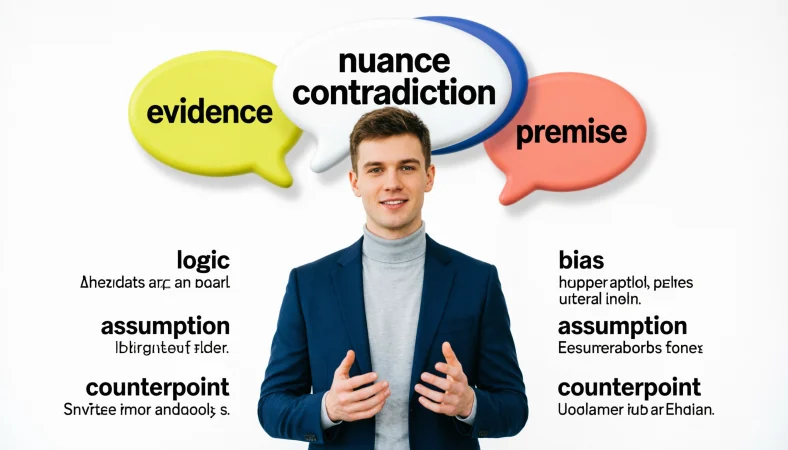
The best way of winning arguments with big words is not to use the longest vocabulary you know. Use precise, confident language that makes your point clearer, stronger, and harder to misunderstand.
Top alternatives: articulate your point, use persuasive language, sound intelligent in an argument, smart words for debates, powerful words for arguments
Ever had a perfectly good argument ruined because the right word decided to disappear from your brain? Same. Whether you are debating a friend over text, defending your opinion in a group chat, discussing something at work, or trying to make a convincing point in person, strong vocabulary can completely change how your argument lands.
Winning arguments with big words is less about sounding like you swallowed a dictionary and more about choosing language that is precise, confident, and difficult to misinterpret. A well-placed word can turn a messy thought into a sharp point, while an overly complicated sentence can make everyone wonder what just happened.
The goal is simple: communicate better, stay composed, and make your reasoning memorable. Here are useful words, phrases, and responses for sounding articulate without becoming unnecessarily complicated.
Intelligent Words for Winning Arguments
- “That is a contradiction.”
Use this when someone’s statements conflict with each other.
Meaning: You are calmly pointing out an inconsistency. - “That assumption is questionable.”
Use this when someone presents an unproven belief as fact.
Meaning: You are challenging their reasoning politely. - “Let’s examine the premise.”
Use this when the entire argument seems built on a shaky idea.
Meaning: You want to inspect the foundation of their claim. - “That conclusion doesn’t necessarily follow.”
Use this when their evidence does not support their final point.
Meaning: You are separating evidence from interpretation. - “You’re conflating two separate issues.”
Use this when someone mixes unrelated subjects together.
Meaning: You are identifying a reasoning error. - “That is an oversimplification.”
Use this when someone reduces a complicated topic to one easy explanation.
Meaning: You are asking for more nuance. - “The distinction matters.”
Use this when two similar ideas are being treated as identical.
Meaning: You are emphasizing an important difference. - “That argument lacks sufficient context.”
Use this when important information has been ignored.
Meaning: You are saying the claim is incomplete. - “That is an inference, not a fact.”
Use this when someone presents their interpretation as proven truth.
Meaning: You are separating evidence from assumption. - “Your reasoning is circular.”
Use this when their argument repeatedly proves itself using itself.
Meaning: You are identifying circular reasoning. - “That claim requires evidence.”
Use this when someone makes a strong statement without support.
Meaning: You are asking them to substantiate their point. - “Let’s distinguish opinion from evidence.”
Use this during debates involving personal beliefs.
Meaning: You are separating subjective views from factual support.
Sophisticated Words That Make Your Point Stronger
- “Precisely.”
Use this when someone finally reaches the point you were making.
Meaning: You are confirming the exact idea. - “Consequently.”
Use this when explaining the result of something.
Meaning: It means “as a result.” - “Nevertheless.”
Use this when introducing an important opposing point.
Meaning: You acknowledge something without abandoning your argument. - “Fundamentally.”
Use this when discussing the basic nature of an issue.
Meaning: You are focusing on what matters at the core. - “Arguably.”
Use this when presenting a defensible interpretation.
Meaning: You acknowledge that reasonable disagreement exists. - “Substantially.”
Use this when describing something significant in size or importance.
Meaning: It emphasizes a considerable difference. - “Inherently.”
Use this when discussing a quality that belongs naturally to something.
Meaning: The characteristic exists as part of its nature. - “Ultimately.”
Use this when bringing an argument toward its final point.
Meaning: You are focusing on the final conclusion. - “Notwithstanding.”
Use this when acknowledging something while maintaining your position.
Meaning: It means “despite that.” - “Accordingly.”
Use this when connecting reasoning to a logical result.
Meaning: It means “for that reason.” - “Objectively.”
Use this when encouraging evaluation based on evidence rather than emotion.
Meaning: You are asking for an impartial perspective. - “Contextually.”
Use this when explaining that circumstances affect interpretation.
Meaning: You are emphasizing surrounding circumstances.
Clever Words for Calling Out Weak Arguments
- “That is speculative.”
Use this when someone is guessing without reliable evidence.
Meaning: Their claim is based on possibility rather than proof. - “That is anecdotal.”
Use this when someone relies only on a personal experience.
Meaning: One experience does not automatically establish a general truth. - “That is irrelevant.”
Use this when their point does not address the actual issue.
Meaning: You are bringing the discussion back on topic. - “That is a false equivalence.”
Use this when two unequal things are treated as equal.
Meaning: You are challenging an unfair comparison. - “That is a generalization.”
Use this when someone makes a broad claim from limited information.
Meaning: You are questioning the scope of their conclusion. - “That is anecdote, not evidence.”
Use this when personal stories are being used as proof.
Meaning: You are requesting stronger support. - “That premise is unsupported.”
Use this when the starting assumption has no clear foundation.
Meaning: You are challenging the basis of the argument. - “That is an unsupported assertion.”
Use this when someone simply declares something to be true.
Meaning: You are asking for justification. - “That comparison is misleading.”
Use this when an analogy creates a false impression.
Meaning: You are questioning the fairness of the comparison. - “That conclusion is premature.”
Use this when someone reaches a decision too quickly.
Meaning: More information is needed first. - “The evidence does not establish that.”
Use this when available facts are insufficient for their claim.
Meaning: You are keeping the argument evidence-based. - “You are moving the goalposts.”
Use this when someone changes their standard after you meet it.
Meaning: You are identifying an unfair debate tactic.
Powerful Words for Staying Calm in an Argument
- “Let’s be reasonable.”
Use this when emotions are beginning to take over.
Meaning: You want the discussion grounded in logic. - “I understand your perspective.”
Use this when acknowledging someone without agreeing.
Meaning: You are showing respect while maintaining your position. - “Let’s focus on the actual issue.”
Use this when the discussion becomes distracted.
Meaning: You want to return to the central question. - “I disagree, but I can explain why.”
Use this when you want a mature disagreement.
Meaning: You are choosing reasoning instead of hostility. - “Let’s separate emotion from evidence.”
Use this when feelings are dominating the discussion.
Meaning: You are asking for a more objective evaluation. - “There is a difference between perception and reality.”
Use this when someone’s interpretation is being treated as fact.
Meaning: You are questioning whether their perception reflects reality. - “I’m listening, but I’m not convinced.”
Use this when their explanation has not persuaded you.
Meaning: You remain open without pretending to agree. - “That deserves a more nuanced discussion.”
Use this when the topic is too complex for a simple answer.
Meaning: You are asking for greater depth. - “Let’s not confuse confidence with correctness.”
Use this when someone sounds certain without being accurate.
Meaning: Confidence alone does not prove a claim. - “I would need more evidence before accepting that.”
Use this when their claim remains unproven.
Meaning: You are setting a reasonable evidentiary standard. - “We may be interpreting the same facts differently.”
Use this when disagreement comes from interpretation.
Meaning: You recognize that the dispute may not be purely factual. - “Disagreement does not require disrespect.”
Use this when an argument becomes personal.
Meaning: You are establishing a mature boundary.
Big Words for Winning a Debate Politely
- “I respectfully disagree.”
Use this in professional or serious discussions.
Meaning: You reject the point without attacking the person. - “I see the logic, but I question the conclusion.”
Use this when part of an argument makes sense.
Meaning: You acknowledge valid reasoning while challenging its result. - “That is a reasonable interpretation, but not the only one.”
Use this when multiple perspectives exist.
Meaning: You are adding nuance. - “Could you clarify that distinction?”
Use this when someone’s point is unclear.
Meaning: You invite them to explain rather than guessing. - “What evidence supports that conclusion?”
Use this when you want a claim backed up.
Meaning: You are politely requesting proof. - “I think we are approaching the issue from different premises.”
Use this when you disagree about the starting point.
Meaning: You explain why the disagreement exists. - “That is worth considering.”
Use this when someone raises a potentially valid point.
Meaning: You remain open-minded. - “I would frame it differently.”
Use this when you want to challenge an interpretation.
Meaning: You are offering another perspective. - “That interpretation overlooks an important factor.”
Use this when something significant has been ignored.
Meaning: You are identifying missing context. - “There may be merit to that argument.”
Use this when you see some validity in their position.
Meaning: You acknowledge partial agreement. - “I think the evidence points elsewhere.”
Use this when facts support a different conclusion.
Meaning: You challenge their conclusion using evidence. - “Let’s compare the reasoning rather than the personalities.”
Use this when a debate becomes personal.
Meaning: You want to evaluate arguments rather than people.
Witty Words for Text Arguments
- “Interesting conclusion. Questionable route.”
Use this for a clever but controlled text response.
Meaning: You are questioning how they reached their point. - “Confidence is not corroboration.”
Use this when someone sounds certain without proof.
Meaning: Certainty does not validate a claim. - “That sounds persuasive until you inspect it.”
Use this when an argument looks strong at first glance.
Meaning: You believe closer examination exposes weaknesses. - “The logic took a brief vacation there.”
Use this with a friend when humor fits.
Meaning: You jokingly point out flawed reasoning. - “Bold claim. Where is the evidence?”
Use this when someone makes an unsupported statement.
Meaning: You challenge them to substantiate it. - “That argument needs a little more seasoning.”
Use this for a playful debate.
Meaning: Their reasoning needs more substance. - “We have officially entered assumption territory.”
Use this when facts disappear from the discussion.
Meaning: You believe their argument is becoming speculative. - “Respectfully, that math is not mathing.”
Use this in casual online discussions.
Meaning: You think their reasoning does not add up. - “I admire the confidence, honestly.”
Use this when someone’s certainty exceeds their evidence.
Meaning: You are humorously highlighting the mismatch. - “That explanation has several plot holes.”
Use this when their story contains inconsistencies.
Meaning: You are pointing out gaps in their reasoning. - “You made a compelling case for the wrong conclusion.”
Use this when their reasoning starts well but ends poorly.
Meaning: You separate good presentation from a weak conclusion. - “I would counter that with actual evidence.”
Use this when you want to redirect the argument toward facts.
Meaning: You prefer proof over confidence.
Persuasive Phrases for Strong Arguments
- “The central issue is…”
Use this when narrowing a complicated discussion.
Meaning: You identify the main point. - “The key distinction is…”
Use this when two concepts need to be separated.
Meaning: You highlight the most important difference. - “The strongest evidence suggests…”
Use this when making an evidence-based claim.
Meaning: You base your point on available support. - “A more accurate interpretation would be…”
Use this when correcting someone’s conclusion.
Meaning: You offer a clearer alternative. - “The logical implication is…”
Use this when explaining what follows from established facts.
Meaning: You connect evidence to a conclusion. - “The underlying problem is…”
Use this when addressing a deeper issue.
Meaning: You move beyond surface-level disagreement. - “That distinction changes the argument.”
Use this when new context affects the debate.
Meaning: You explain why a difference matters. - “The evidence is more consistent with…”
Use this when comparing competing explanations.
Meaning: You identify which explanation better fits the evidence. - “That conclusion depends on the assumption that…”
Use this when exposing a hidden premise.
Meaning: You show what the argument requires to be true. - “There is insufficient evidence to conclude…”
Use this when someone claims certainty without enough support.
Meaning: You challenge overconfidence. - “The strongest counterpoint is…”
Use this when addressing the opposing side fairly.
Meaning: You demonstrate that you understand the debate. - “Once we establish that, the conclusion becomes clearer.”
Use this when building an argument step by step.
Meaning: You connect evidence logically.
Advanced Vocabulary for Calling Out Contradictions
- “That position is internally inconsistent.”
Use this when someone’s claims conflict.
Meaning: Their argument does not remain logically consistent. - “You are contradicting your earlier premise.”
Use this when they change their starting position.
Meaning: You highlight a direct inconsistency. - “Those two claims cannot comfortably coexist.”
Use this when statements appear mutually incompatible.
Meaning: You are pointing out tension between their claims. - “Your conclusion conflicts with your premise.”
Use this when their final point undermines their starting point.
Meaning: Their reasoning does not connect properly. - “That standard appears selectively applied.”
Use this when someone judges similar situations differently.
Meaning: You are pointing out inconsistency. - “You are applying different criteria to similar cases.”
Use this when standards change depending on the situation.
Meaning: You are challenging fairness. - “That principle seems inconsistent with your previous position.”
Use this when their current argument differs from what they previously supported.
Meaning: You are asking for consistency. - “The inconsistency is difficult to overlook.”
Use this when the contradiction is particularly obvious.
Meaning: You calmly emphasize the problem. - “Your argument changes depending on the outcome.”
Use this when their reasoning shifts conveniently.
Meaning: You question whether their standard is consistent. - “That creates a logical tension.”
Use this when two ideas do not fit together neatly.
Meaning: You identify an apparent conflict. - “That reasoning seems selectively convenient.”
Use this when their logic benefits their position unusually well.
Meaning: You question their consistency. - “Consistency would require applying that principle here too.”
Use this when someone refuses to apply their own standard.
Meaning: You ask them to follow their reasoning consistently.
Strong Words for Emotional Arguments
- “I understand that you feel strongly about this.”
Use this when someone is emotionally invested.
Meaning: You acknowledge their feelings without conceding. - “Your feelings are valid, but they do not establish the facts.”
Use this when emotions are being used as evidence.
Meaning: You respect emotion while separating it from proof. - “Let’s address the issue without making it personal.”
Use this when emotions become attacks.
Meaning: You redirect the conversation toward the subject. - “I am responding to the argument, not attacking you.”
Use this when disagreement feels personal.
Meaning: You clarify your intention. - “Emotional intensity does not automatically make a claim accurate.”
Use this when someone is very passionate.
Meaning: Strong emotion is not proof. - “I would rather resolve this than escalate it.”
Use this when an argument is becoming heated.
Meaning: You prioritize resolution. - “We can disagree without diminishing each other.”
Use this when respect is slipping.
Meaning: You establish a healthy boundary. - “I hear the frustration behind your point.”
Use this when acknowledging someone’s emotional state.
Meaning: You recognize their feelings before addressing the argument. - “Let’s pause before we say something unnecessary.”
Use this when the conversation is becoming hostile.
Meaning: You want to prevent avoidable conflict. - “I care about the conversation, which is why I want to be precise.”
Use this when you want a serious discussion.
Meaning: You value clarity over winning at all costs. - “We both seem frustrated, so clarity matters more than volume.”
Use this when emotions are running high.
Meaning: You emphasize calm communication. - “Being heard and being agreed with are not the same thing.”
Use this when someone expects agreement after expressing feelings.
Meaning: Listening does not require surrendering your position.
Confident Phrases That Sound Intelligent
- “I stand by my reasoning.”
Use this when you are confident in your position.
Meaning: You are calmly maintaining your argument. - “I have considered the counterargument.”
Use this when someone assumes you ignored the opposing side.
Meaning: You show that your position was considered carefully. - “I am open to being corrected by better evidence.”
Use this when you want to sound confident and reasonable.
Meaning: You value truth over ego. - “You have not addressed my central point.”
Use this when someone responds around your argument.
Meaning: You are bringing attention back to the unanswered issue. - “That does not refute the argument I made.”
Use this when their response fails to challenge your actual claim.
Meaning: You distinguish disagreement from refutation. - “I would reconsider my position if the evidence changed.”
Use this during serious debates.
Meaning: Your confidence is based on evidence rather than stubbornness. - “That is a response, but it is not a rebuttal.”
Use this when they reply without actually challenging your point.
Meaning: You distinguish answering from disproving. - “Let’s test that claim logically.”
Use this when you want to examine their reasoning.
Meaning: You invite their argument to be evaluated. - “I think the distinction is quite clear.”
Use this when the relevant difference has been explained.
Meaning: You express confidence without unnecessary aggression. - “My position is based on the available evidence.”
Use this when defending an evidence-based view.
Meaning: You explain the foundation of your confidence. - “I am not persuaded by that explanation.”
Use this when their reasoning does not convince you.
Meaning: You clearly reject the argument without insulting them. - “If you have stronger evidence, I am willing to consider it.”
Use this when you want an evidence-focused discussion.
Meaning: You remain confident and open-minded.
Academic-Sounding Words for Serious Debates
- “Premise.”
Use this when discussing the starting assumption of an argument.
Meaning: A proposition used as the foundation for reasoning. - “Inference.”
Use this when discussing a conclusion drawn from information.
Meaning: A conclusion reached through reasoning. - “Corroboration.”
Use this when asking whether evidence confirms a claim.
Meaning: Additional support that strengthens evidence. - “Implication.”
Use this when explaining what a fact or statement suggests.
Meaning: A consequence or meaning that follows. - “Context.”
Use this when surrounding circumstances affect interpretation.
Meaning: Information that helps explain an issue properly. - “Nuance.”
Use this when a topic has subtle differences.
Meaning: A small but important distinction. - “Validity.”
Use this when examining whether reasoning is logically sound.
Meaning: The quality of being logically or factually defensible. - “Relevance.”
Use this when deciding whether information applies to the issue.
Meaning: The degree to which something relates to the subject. - “Consistency.”
Use this when evaluating whether reasoning remains stable.
Meaning: Agreement between statements, principles, or actions. - “Causality.”
Use this when discussing whether one thing actually causes another.
Meaning: A cause-and-effect relationship. - “Correlation.”
Use this when two things appear connected.
Meaning: A relationship that does not necessarily prove causation. - “Counterargument.”
Use this when presenting an opposing position.
Meaning: A reason or argument against another argument.
Short Big-Word Responses for Group Chats
- “Respectfully, that is not the point.”
Use this when a group chat drifts away from the issue.
Meaning: You redirect everyone without unnecessary hostility. - “That requires considerably more context.”
Use this when someone gives an oversimplified take.
Meaning: You believe the situation is more complicated. - “Interesting, but where is the evidence?”
Use this when a claim appears unsupported.
Meaning: You challenge the statement playfully. - “That is an interpretation, not an established fact.”
Use this when opinions are presented as facts.
Meaning: You distinguish belief from evidence. - “You are arguing against a point I did not make.”
Use this when someone misrepresents your position.
Meaning: You identify a misunderstanding. - “That comparison is doing a lot of heavy lifting.”
Use this when an analogy carries too much of the argument.
Meaning: You suggest the comparison is weaker than it appears. - “We are going to need receipts for that.”
Use this in casual discussions when proof is missing.
Meaning: You humorously ask for evidence. - “That is certainly one interpretation.”
Use this when you strongly disagree but want to stay composed.
Meaning: You acknowledge their perspective without endorsing it. - “I think we have identified the actual disagreement.”
Use this when a debate finally becomes clear.
Meaning: You recognize the central point of conflict. - “Let’s not turn assumptions into conclusions.”
Use this when speculation is becoming certainty.
Meaning: You ask everyone to distinguish guesses from facts. - “The logic is admirable; the evidence is missing.”
Use this when their argument sounds polished but lacks support.
Meaning: You separate presentation from substance. - “I respectfully request a source for that plot twist.”
Use this when humor is appropriate.
Meaning: You jokingly ask them to support an unexpected claim.
Persuasive Words for Workplace Arguments
- “I would like to clarify the objective.”
Use this when a work discussion becomes unfocused.
Meaning: You want everyone aligned on the goal. - “Could we evaluate the evidence before deciding?”
Use this during workplace disagreements.
Meaning: You encourage an informed decision. - “I see a potential issue with that approach.”
Use this when challenging a colleague respectfully.
Meaning: You identify a concern without sounding confrontational. - “I recommend considering an alternative.”
Use this when presenting another solution.
Meaning: You disagree constructively. - “That assumption may create unintended consequences.”
Use this when a proposed idea could cause problems.
Meaning: You are highlighting possible outcomes. - “Let’s distinguish the immediate problem from the underlying issue.”
Use this when a discussion focuses only on symptoms.
Meaning: You want to address the deeper cause. - “The available information suggests otherwise.”
Use this when evidence contradicts a workplace claim.
Meaning: You disagree using information rather than personality. - “I think we should examine the implications first.”
Use this before committing to a decision.
Meaning: You want to consider potential consequences. - “That proposal has merit, although I see one concern.”
Use this when partially agreeing.
Meaning: You balance appreciation with constructive criticism. - “Could we establish the criteria before comparing the options?”
Use this when people are judging options inconsistently.
Meaning: You want a fair evaluation. - “I would prefer a decision based on measurable outcomes.”
Use this when opinions dominate a discussion.
Meaning: You favor objective standards. - “Perhaps we should revisit the original premise.”
Use this when the discussion has moved away from its foundation.
Meaning: You want to reassess the starting assumption.
Sarcastic but Smart Argument Responses
- “What an impressively unsupported conclusion.”
Use this when someone makes a bold claim without evidence.
Meaning: You sarcastically highlight the lack of support. - “I see the confidence arrived before the evidence.”
Use this when someone sounds extremely certain.
Meaning: You humorously question their certainty. - “That certainly sounded better than it was.”
Use this when their argument is polished but weak.
Meaning: You distinguish style from substance. - “A fascinating theory. Evidence remains optional, apparently.”
Use this when someone relies entirely on speculation.
Meaning: You mock the missing proof without using personal insults. - “I appreciate the creativity of that conclusion.”
Use this when their reasoning takes an unexpected leap.
Meaning: You imply that the conclusion is imaginative rather than convincing. - “That is one way to interpret the facts.”
Use this when their interpretation seems questionable.
Meaning: You express skepticism politely. - “The argument has entered its fictional era.”
Use this when someone starts inventing unsupported claims.
Meaning: You humorously call out speculation. - “Bold strategy, questionable evidence.”
Use this when their argument is confident but unsupported.
Meaning: You summarize the problem with playful sarcasm. - “I admire the commitment to that interpretation.”
Use this when someone refuses to reconsider a weak point.
Meaning: You sarcastically highlight their persistence. - “The evidence appears to have missed the meeting.”
Use this when proof is noticeably absent.
Meaning: You make the lack of evidence humorous. - “That explanation deserves a sequel, preferably with sources.”
Use this when their explanation is incomplete.
Meaning: You jokingly request stronger support. - “I would applaud, but the logic needs revision.”
Use this when someone delivers a confident but flawed argument.
Meaning: You humorously challenge their reasoning.
Creative Words and Phrases for Winning Arguments
- “Let’s zoom out for a moment.”
Use this when someone is focusing on one tiny detail.
Meaning: You want to consider the bigger picture. - “There is more beneath the surface.”
Use this when the obvious explanation is incomplete.
Meaning: You are pointing toward deeper context. - “That changes the entire equation.”
Use this when new information affects the discussion.
Meaning: The new fact significantly changes the reasoning. - “That is where the argument starts to unravel.”
Use this when identifying the weakest part of a position.
Meaning: You believe the reasoning stops holding together. - “Let’s follow that idea to its logical conclusion.”
Use this when testing whether a claim works consistently.
Meaning: You want to examine its consequences. - “The devil is in the details.”
Use this when small facts matter significantly.
Meaning: Important problems may hide within details. - “That creates a rather inconvenient contradiction.”
Use this when pointing out an awkward inconsistency.
Meaning: You highlight a conflict with subtle humor. - “That sounds simple until we examine the variables.”
Use this when someone oversimplifies an issue.
Meaning: You believe several factors need consideration. - “The bigger picture tells a different story.”
Use this when isolated facts create a misleading impression.
Meaning: Broader context changes the interpretation. - “That argument has a missing puzzle piece.”
Use this when important information has been overlooked.
Meaning: The reasoning is incomplete. - “Let’s not mistake the symptom for the cause.”
Use this when someone addresses the wrong problem.
Meaning: You distinguish an effect from its underlying cause. - “The details are where this argument gets interesting.”
Use this when deeper examination reveals important information.
Meaning: You invite closer analysis.
Respectful Words for Ending an Argument
- “I think we have reached an impasse.”
Use this when neither person is changing their position.
Meaning: You recognize that agreement is unlikely. - “We may simply have to disagree.”
Use this when the discussion has become repetitive.
Meaning: You end the debate respectfully. - “I appreciate the discussion.”
Use this after a productive disagreement.
Meaning: You value the exchange despite differing opinions. - “I have made my position clear.”
Use this when you have already explained yourself.
Meaning: You do not want to repeat the same argument. - “I do not think continuing this will add anything useful.”
Use this when the discussion becomes circular.
Meaning: You choose to stop rather than escalate. - “We have different interpretations of the issue.”
Use this when disagreement remains unresolved.
Meaning: You recognize the difference without hostility. - “I respect your right to disagree.”
Use this when you want to close the conversation maturely.
Meaning: You acknowledge their autonomy. - “Let’s leave it there.”
Use this when you want a simple ending.
Meaning: You are choosing not to continue the argument. - “I think we have covered the relevant points.”
Use this in a formal or serious discussion.
Meaning: You believe enough has been said. - “I am comfortable with my position.”
Use this when someone keeps trying to persuade you.
Meaning: You are confident without becoming hostile. - “Perhaps we can revisit this when we have more information.”
Use this when evidence is incomplete.
Meaning: You leave room for future discussion. - “No hard feelings, just different perspectives.”
Use this with friends or casual acquaintances.
Meaning: You separate disagreement from personal conflict.
Extra Smart Phrases for Winning Arguments Without Sounding Pretentious
- “That is a fair point, but it does not settle the issue.”
Use this when the other person makes a valid observation.
Meaning: You acknowledge their point while explaining why it is insufficient. - “I think you are right about one part, but not the conclusion.”
Use this when you partially agree.
Meaning: You separate accurate observations from incorrect conclusions. - “The question is not whether it is possible, but whether it is supported.”
Use this when someone confuses possibility with proof.
Meaning: Something being possible does not make it established. - “That would be relevant if the circumstances were identical.”
Use this when someone makes an imperfect comparison.
Meaning: You explain why the comparison does not fully apply. - “You have identified a possibility, not demonstrated a certainty.”
Use this when someone treats speculation as fact.
Meaning: You distinguish possibility from proof. - “I think we are debating the conclusion before establishing the facts.”
Use this when people jump to conclusions.
Meaning: You want evidence considered first. - “That interpretation requires several assumptions.”
Use this when their argument depends on multiple guesses.
Meaning: You show that their conclusion is less certain than presented. - “The stronger argument depends on evidence, not volume.”
Use this when someone becomes louder instead of more persuasive.
Meaning: Intensity does not replace reasoning. - “I would rather be accurate than merely persuasive.”
Use this when the debate becomes competitive.
Meaning: You prioritize truth over simply winning. - “A convincing argument should survive reasonable scrutiny.”
Use this when evaluating a strong claim.
Meaning: Good reasoning should withstand questions. - “If the premise changes, the conclusion must be reconsidered.”
Use this when new information changes the situation.
Meaning: Logical conclusions depend on their premises. - “The burden of proof belongs with the person making the claim.”
Use this when someone expects you to disprove an unsupported statement.
Meaning: The person asserting something should provide support.
Clever One-Liners for Winning Arguments
- “Facts first, conclusions second.”
Use this when someone jumps to a conclusion.
Meaning: You prioritize evidence. - “A strong opinion is still an opinion.”
Use this when certainty is mistaken for fact.
Meaning: Confidence does not change the nature of a claim. - “Correlation does not automatically establish causation.”
Use this when someone assumes one thing caused another simply because they are related.
Meaning: Association alone does not prove cause and effect. - “Specificity strengthens an argument.”
Use this when someone makes vague claims.
Meaning: Clear details make reasoning more credible. - “Context is not a technicality.”
Use this when someone dismisses important circumstances.
Meaning: Context can change the meaning of evidence. - “A conclusion needs a bridge from the evidence.”
Use this when someone leaps from facts to an unsupported result.
Meaning: Reasoning must connect evidence to conclusions. - “Being technically possible does not make something probable.”
Use this when someone uses possibility as proof.
Meaning: Possibility and likelihood are different. - “One example cannot carry an entire argument.”
Use this when someone relies on a single anecdote.
Meaning: One case may not establish a general rule. - “Precision beats exaggeration.”
Use this when someone uses dramatic claims.
Meaning: Accurate language is more persuasive. - “A rebuttal should address the argument actually made.”
Use this when someone misrepresents your point.
Meaning: Criticism should target the real claim. - “Complex issues rarely have convenient explanations.”
Use this when someone oversimplifies a topic.
Meaning: Nuance often matters. - “If the evidence changes, the conclusion can change too.”
Use this when discussing an open-minded position.
Meaning: Good reasoning should respond to new information.
FAQs
What Does “Winning Arguments With Big Words” Mean?
It means using precise, sophisticated vocabulary to communicate your reasoning clearly and persuasively. The goal is not to use complicated words just to sound intelligent.
Do Big Words Actually Help You Win an Argument?
They can help when they make your meaning more precise. Words such as “contradiction,” “premise,” “inference,” and “corroboration” can make complex reasoning easier to express.
What Is the Best Word to Use in an Argument?
There is no single best word. “Contradiction,” “assumption,” “inference,” “premise,” “evidence,” “nuance,” and “inconsistency” are useful because they describe specific reasoning problems.
Can Big Words Make You Sound Pretentious?
Yes, especially if the vocabulary is unnecessarily complicated. Clear language usually sounds more intelligent than a sentence packed with obscure words.
How Can I Sound Smarter Without Being Rude?
Focus on the argument instead of the person. Say “That conclusion is unsupported” rather than insulting someone’s intelligence.
What Should I Say When Someone Gets Emotional?
Try “I understand that you feel strongly about this, but let’s separate the emotion from the evidence.” It acknowledges their feelings while keeping the discussion focused.
What Is a Good Professional Phrase for Disagreement?
Try “I respectfully disagree, and here is the reasoning behind my position.” It sounds confident without becoming confrontational.
What If I Am Not Sure I Am Right?
Stay open-minded. “I am willing to reconsider if stronger evidence comes up” is often more persuasive than pretending to have absolute certainty.
Are Big Words Useful in Text Arguments?
Yes, but keep them short and natural. A concise phrase such as “That is an unsupported assumption” usually works better than a giant paragraph.
Is Humor Appropriate During an Argument?
It depends on the situation. Light humor can work with friends, but professional or emotional disagreements usually call for a calmer and more respectful tone.
Conclusion
Winning arguments with big words is really about choosing the right words, not the biggest ones. A perfectly timed “That is an unsupported assumption” can say more than a paragraph full of complicated vocabulary. The smartest approach is to stay calm, understand the other person’s point, identify weak reasoning, and explain your position clearly.
Use sophisticated language when it adds precision, but do not turn every discussion into a vocabulary competition. Confidence comes from knowing what you mean and being able to explain why you believe it. Save these phrases for your next debate, group chat, classroom discussion, or workplace conversation. Pick your favorites, use them naturally, and let your reasoning do the heavy lifting.










3 thoughts on “180+ Big Words To Win Arguments That Make You Sound Smarter & More Confident In 2026”