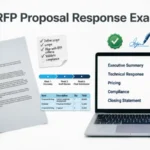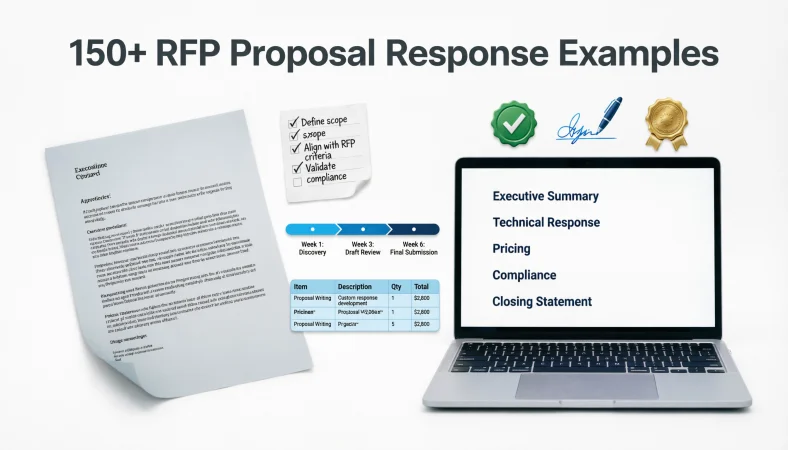
The best RFP proposal response examples show how to answer a Request for Proposal clearly, professionally, and persuasively. A strong response addresses the client’s requirements, highlights relevant experience, explains your solution, and demonstrates why your organization is the right fit.
Top alternatives: RFP response templates, proposal introduction examples, executive summary examples, RFP cover letter examples, winning proposal response phrases
Ever found an RFP sitting in your inbox and thought, “Okay, where do we even start?” You’re not alone. Responding to a Request for Proposal can feel like juggling deadlines, pricing, compliance requirements, and a dozen documents while trying to sound confident enough to win the project.
Whether you’re a small business bidding for your first contract, a sales professional preparing a client proposal, or an established company competing for a major opportunity, the words you choose matter.
These RFP proposal response examples will help you write clear, persuasive, and professional answers for different sections of a proposal. From executive summaries and company introductions to technical approaches, pricing explanations, and closing statements, you’ll find practical wording you can adapt to your needs.
A successful proposal isn’t about making the biggest promises. It’s about understanding the client’s priorities, providing evidence, and showing exactly how your solution delivers value.
Professional RFP Proposal Response Examples
Opening and Introducing Your RFP Proposal
1. Thank you for the opportunity to submit our proposal.
Example: Use this as the opening sentence when formally responding to a prospective client’s RFP.
Meaning: Expresses appreciation and establishes a professional tone.
2. We are pleased to present our proposed solution for your consideration.
Example: Use this when introducing a complete proposal package.
Meaning: Positions your submission as a considered response to the client’s needs.
3. Our proposal addresses the requirements outlined in your RFP.
Example: Use this when confirming that your submission responds to the stated scope.
Meaning: Shows that the proposal is aligned with the client’s request.
Demonstrating Capabilities and Commitment
4. We appreciate the opportunity to demonstrate our capabilities.
Example: Use this when competing for a new contract or long-term partnership.
Meaning: Communicates confidence without sounding overly promotional.
5. Our team is committed to delivering a reliable and effective solution.
Example: Use this when introducing your service delivery approach.
Meaning: Emphasizes dependability and execution.
6. We have developed an approach tailored to your organization’s objectives.
Example: Use this when your proposal addresses specific business challenges.
Meaning: Shows that the response is customized rather than generic.
Confirming Requirements and Business Alignment
7. Our submission includes the information requested in the RFP.
Example: Use this when confirming that the required sections and attachments are included.
Meaning: Reassures evaluators that the response follows the requested structure.
8. We welcome the opportunity to discuss our proposal in greater detail.
Example: Use this in a closing paragraph when follow-up discussions are appropriate.
Meaning: Opens the door to clarification and further engagement.
9. Our proposed services are designed to support your operational priorities.
Example: Use this when explaining how your services fit the client’s business needs.
Meaning: Connects your offer with practical outcomes.
Highlighting Value and Closing Professionally
10. We believe our experience and approach make us a strong candidate for this project.
Example: Use this when summarizing your organization’s suitability.
Meaning: Presents a confident case based on relevant strengths.
11. We are prepared to work collaboratively with your team throughout the engagement.
Example: Use this when partnership and communication are important evaluation factors.
Meaning: Highlights cooperation and shared responsibility.
12. Thank you for considering our response. We look forward to the next steps.
Example: Use this as the final line of a formal proposal letter.
Meaning: Ends the submission courteously and professionally.
RFP Proposal Executive Summary Examples
Summarizing the Proposed Solution and Client Needs
1. Our solution addresses your key requirements through a practical, results-focused approach.
Example: Use this as the opening statement of an executive summary.
Meaning: Quickly connects the proposed solution with the client’s priorities.
2. We combine relevant experience, proven processes, and dedicated project support.
Example: Use this when your organization has strong credentials relevant to the project.
Meaning: Summarizes the main strengths behind your proposal.
3. Our approach prioritizes quality, efficiency, and measurable outcomes.
Example: Use this when the RFP emphasizes performance and business results.
Meaning: Highlights the outcomes your delivery model aims to support.
Demonstrating Understanding and Implementation Planning
4. We understand the challenges outlined in your RFP and have designed our response accordingly.
Example: Use this when summarizing a solution developed around specific client needs.
Meaning: Shows that the proposal reflects the client’s stated challenges.
5. Our proposal outlines a clear path from planning to implementation.
Example: Use this when the project requires several delivery phases.
Meaning: Emphasizes structure and practical execution.
6. We aim to deliver value through a combination of expertise, communication, and accountability.
Example: Use this when presenting the overall value of your service.
Meaning: Connects expertise with the way the work will be managed.
Highlighting Capabilities and Business Value
7. Our team is equipped to support the project within the proposed scope.
Example: Use this when summarizing staffing, resources, and capabilities.
Meaning: Communicates readiness while keeping the claim tied to the defined scope.
8. The proposed solution balances immediate needs with long-term objectives.
Example: Use this when the client wants both short-term delivery and future scalability.
Meaning: Shows that the proposal considers current and future requirements.
9. We have structured our response around your evaluation criteria and business priorities.
Example: Use this when introducing a proposal organized around the RFP’s scoring categories.
Meaning: Helps evaluators connect the response with their assessment process.
Explaining Delivery, Continuity, and Deliverables
10. Our delivery model emphasizes transparency, coordination, and continuous improvement.
Example: Use this when project governance and communication are key concerns.
Meaning: Highlights how the engagement will be managed.
11. We offer a solution designed to meet the stated requirements while supporting operational continuity.
Example: Use this when service disruption is a concern.
Meaning: Connects compliance with dependable operations.
12. This proposal explains our recommended solution, implementation plan, and expected deliverables.
Example: Use this as a summary of what the submission contains.
Meaning: Gives decision-makers a quick overview of the proposal.
RFP Proposal Introduction Examples
Opening the Proposal Professionally
1. We are pleased to submit our response to your Request for Proposal for [project name].
Example: Use this in the first paragraph of a formal RFP response.
Meaning: Identifies the purpose of the submission clearly.
2. Thank you for inviting us to participate in this procurement process.
Example: Use this when an organization has invited your company to bid.
Meaning: Acknowledges the invitation respectfully.
3. After reviewing your requirements, we have prepared a proposal aligned with your stated objectives.
Example: Use this when introducing a response based on a detailed review of the RFP.
Meaning: Demonstrates attention to the client’s requirements.
Demonstrating Understanding of Client Needs
4. We understand that your organization is seeking a solution that supports [business objective].
Example: Use this when the RFP clearly identifies a central business goal.
Meaning: Shows that the proposal begins with the client’s needs.
5. Our team appreciates the opportunity to contribute to this important initiative.
Example: Use this when responding to a strategic project opportunity.
Meaning: Communicates interest and professionalism.
6. This submission outlines our proposed approach, relevant experience, and delivery commitments.
Example: Use this when previewing the main sections of the proposal.
Meaning: Helps the reader understand what follows.
Structuring the Response and Presenting Capabilities
7. We have organized our response to address the requirements and questions in your RFP.
Example: Use this when following the client’s requested response format.
Meaning: Signals a structured and evaluator-friendly submission.
8. Our proposal reflects our understanding of your current needs and desired outcomes.
Example: Use this when the RFP describes existing challenges and future goals.
Meaning: Connects the proposed work with the client’s situation.
9. We welcome the opportunity to explain how our services may support your objectives.
Example: Use this when introducing a service-based proposal.
Meaning: Expresses interest without assuming the contract will be awarded.
Presenting Recommendations and Setting Expectations
10. We have prepared this response to provide a clear view of our capabilities and recommendations.
Example: Use this when the proposal includes both credentials and a recommended solution.
Meaning: Sets expectations for the content.
11. Our response presents a practical approach to the scope described in your RFP.
Example: Use this when introducing a project plan or technical solution.
Meaning: Emphasizes a solution grounded in the stated scope.
12. We appreciate your consideration and look forward to presenting our proposed approach.
Example: Use this as the final sentence of an introductory section.
Meaning: Ends the introduction on a positive, professional note.
RFP Cover Letter Response Examples
Formal Openings for an RFP Cover Letter
1. Dear Evaluation Committee, we are pleased to submit our proposal for [project name].
Example: Use this when the RFP identifies an evaluation committee but does not name an individual contact.
Meaning: Addresses the intended reviewers formally.
2. Please find our proposal submitted in response to your Request for Proposal dated [date].
Example: Use this when referencing a specific RFP release.
Meaning: Identifies the procurement document your submission addresses.
3. We confirm that our submission has been prepared in accordance with the instructions provided.
Example: Use this only after verifying that the proposal follows the stated submission requirements.
Meaning: Confirms procedural alignment without making an unsupported claim.
Presenting Qualifications and Submission Details
4. Our proposal outlines our qualifications, proposed methodology, and pricing for the requested services.
Example: Use this when summarizing the key contents of a cover letter.
Meaning: Gives reviewers a concise overview.
5. We appreciate your consideration of our organization for this opportunity.
Example: Use this in the opening or closing paragraph of a cover letter.
Meaning: Expresses gratitude without sounding overly familiar.
6. We believe our relevant experience positions us to address the requirements of this engagement.
Example: Use this when your organization has experience related to the project.
Meaning: States your value proposition confidently.
Confirming Contacts and Procurement Requirements
7. Our designated contact for this proposal is [name and contact details].
Example: Use this when providing the authorized point of contact requested in the RFP.
Meaning: Makes follow-up communication easier.
8. We have included the requested supporting documents with our submission.
Example: Use this only after checking that every required attachment is included.
Meaning: Directs attention to the supporting materials.
9. We acknowledge the submission conditions and requirements specified in the RFP.
Example: Use this when a cover letter requires confirmation of procurement instructions.
Meaning: Shows awareness of the stated process.
Offering Clarification and Closing Professionally
10. We are available to provide clarification in accordance with the procurement process.
Example: Use this when the RFP permits clarification requests or presentations.
Meaning: Shows readiness to answer questions through the proper channel.
11. Thank you for the opportunity to participate in this competitive process.
Example: Use this when responding to a formal tender or public-sector solicitation.
Meaning: Maintains a courteous and neutral tone.
12. Sincerely, [authorized representative’s name and title].
Example: Use this to close a formal cover letter signed by the appropriate representative.
Meaning: Provides a professional sign-off and identifies the responsible person.
RFP Technical Proposal Response Examples
Defining the Technical Solution and Architecture
1. Our proposed technical solution addresses the functional requirements specified in the RFP.
Example: Use this when introducing a solution architecture or technical approach.
Meaning: Connects the technical proposal with the requested functionality.
2. The solution is designed around the stated performance and reliability requirements.
Example: Use this when responding to uptime, capacity, or performance criteria.
Meaning: Shows that technical decisions reflect the client’s specifications.
3. We will document the proposed architecture, dependencies, and implementation assumptions.
Example: Use this when the project requires a clear technical design.
Meaning: Promotes transparency about how the solution will work.
Planning Implementation and Quality Assurance
4. Our approach includes testing and validation before production deployment.
Example: Use this when the RFP requires implementation controls or quality checks.
Meaning: Emphasizes verification before a solution goes live.
5. We will assess integration requirements during the planning phase.
Example: Use this when the solution must connect with existing platforms or systems.
Meaning: Recognizes that integration needs must be understood early.
6. The implementation plan includes defined milestones and technical deliverables.
Example: Use this when presenting a project schedule.
Meaning: Makes progress and expected outputs easier to track.
Managing Risks, Scalability, and Acceptance Criteria
7. We will document relevant technical risks and proposed mitigation measures.
Example: Use this when the RFP asks for risk management details.
Meaning: Demonstrates a structured approach to technical uncertainty.
8. The proposed design considers maintainability and future expansion.
Example: Use this when scalability is an evaluation factor.
Meaning: Shows that the solution is planned beyond initial deployment.
9. We will validate the solution against the agreed acceptance criteria.
Example: Use this when the client specifies measurable completion requirements.
Meaning: Defines how technical completion will be evaluated.
Coordinating Teams and Preparing for Handover
10. Our technical team will coordinate with the client’s designated specialists.
Example: Use this when successful delivery depends on access to internal technical staff.
Meaning: Emphasizes collaboration across teams.
11. We will identify technical dependencies before the relevant implementation activities begin.
Example: Use this when delivery relies on third-party systems, access, or infrastructure.
Meaning: Helps prevent avoidable implementation delays.
12. Final technical documentation will reflect the solution delivered and approved.
Example: Use this when the contract requires handover documentation.
Meaning: Supports maintainability and operational continuity.
RFP Compliance Response Examples
Confirming Compliance With RFP Requirements
1. We confirm compliance with this requirement as stated in the RFP.
Example: Use this when the proposed solution fully meets a specific requirement.
Meaning: Gives evaluators a direct compliance statement.
2. The proposed solution meets the requirement through [specific capability].
Example: Use this when explaining how a product or service satisfies a criterion.
Meaning: Supports the compliance claim with a concrete detail.
3. This requirement is addressed in Section [number] of our proposal.
Example: Use this when directing evaluators to the relevant response section.
Meaning: Makes the submission easier to review.
Providing Documentation and Compliance Evidence
4. We have included the requested documentation in Appendix [letter or number].
Example: Use this when attaching evidence such as certifications or policy documents.
Meaning: Helps reviewers locate supporting material.
5. Our response addresses each applicable item in the compliance matrix.
Example: Use this when submitting a completed requirements matrix.
Meaning: Shows that requirements have been reviewed systematically.
6. This requirement is partially met, subject to the clarification described below.
Example: Use this when a requirement cannot be fully confirmed without additional information.
Meaning: Discloses a limitation rather than overstating compliance.
Clarifying Assumptions and Identifying Exceptions
7. We request clarification regarding the interpretation of this requirement.
Example: Use this when the RFP wording is ambiguous and the procurement rules permit questions.
Meaning: Seeks a clear basis for preparing an accurate response.
8. The proposed approach is consistent with the stated requirement, subject to the listed assumptions.
Example: Use this when compliance depends on clearly identified conditions.
Meaning: Makes the boundaries of the claim transparent.
9. We have identified this item as an exception to the requested specification.
Example: Use this when your proposal departs from a stated requirement.
Meaning: Makes a deviation visible to the evaluator.
Documenting Reviews and Compliance Conditions
10. Supporting evidence is provided alongside the relevant response.
Example: Use this when claims are backed by test results, certifications, or documented experience.
Meaning: Helps evaluators verify the statement.
11. We have reviewed the applicable requirements and documented our response to each item.
Example: Use this after completing a detailed compliance review.
Meaning: Describes a systematic response process.
12. All compliance statements should be read alongside the assumptions and exceptions listed in this submission.
Example: Use this when the proposal contains qualifications that affect how commitments apply.
Meaning: Prevents broad claims from being interpreted without their conditions.
RFP Project Management Response Examples
Establishing Project Leadership and Planning
1. We will assign a project lead to coordinate delivery and communication.
Example: Use this when describing project governance and the primary contact.
Meaning: Establishes responsibility for coordination.
2. The project will follow a structured plan with agreed milestones.
Example: Use this when outlining the proposed delivery schedule.
Meaning: Shows that the work will be organized and trackable.
3. We will hold regular progress reviews with the client’s designated stakeholders.
Example: Use this when the project requires ongoing communication.
Meaning: Creates a clear process for monitoring progress.
Managing Risks, Decisions, and Scope Changes
4. Project risks will be recorded, reviewed, and managed throughout delivery.
Example: Use this when explaining risk management responsibilities.
Meaning: Shows that risks will receive ongoing attention.
5. Key decisions and action items will be documented after project meetings.
Example: Use this when accountability and traceability are important.
Meaning: Reduces confusion about responsibilities and next steps.
6. Changes to scope will follow an agreed review and approval process.
Example: Use this when the project may involve change requests.
Meaning: Helps manage expectations and prevent uncontrolled scope growth.
Coordinating Resources and Resolving Issues
7. Resource requirements will be reviewed against the delivery schedule.
Example: Use this when staffing and availability could affect project progress.
Meaning: Connects resource planning with timely delivery.
8. Dependencies will be tracked to identify potential schedule impacts early.
Example: Use this when delivery depends on client decisions or external suppliers.
Meaning: Helps the team anticipate possible delays.
9. Escalation procedures will identify how significant issues reach decision-makers.
Example: Use this when the RFP asks about governance or issue resolution.
Meaning: Clarifies how serious concerns will be handled.
Tracking Deliverables, Reporting, and Project Closeout
10. Deliverables will be reviewed against agreed acceptance criteria.
Example: Use this when the project has formal approval stages.
Meaning: Provides a consistent basis for reviewing completed work.
11. We will provide status reports at the frequency agreed with the client.
Example: Use this when reporting requirements are defined in the RFP.
Meaning: Sets a clear expectation for project updates.
12. A closeout review will capture outcomes, open items, and lessons learned.
Example: Use this when describing the final project handover.
Meaning: Supports a clear transition and future improvement.
RFP Pricing Proposal Response Examples
Presenting Pricing and Cost Breakdowns
1. Our pricing is based on the scope and assumptions described in this proposal.
Example: Use this when introducing a pricing schedule.
Meaning: Explains the basis on which the quoted price was developed.
2. The attached pricing table outlines the proposed costs by deliverable.
Example: Use this when the RFP requests itemized pricing.
Meaning: Helps evaluators understand the cost breakdown.
3. Our proposal identifies the fees associated with each service component.
Example: Use this when multiple services are included in the offer.
Meaning: Makes the pricing structure easier to compare.
Clarifying Inclusions, Exclusions, and Pricing Assumptions
4. The proposed price includes the activities specifically listed in the scope.
Example: Use this when clarifying what the quoted amount covers.
Meaning: Connects the price to defined work rather than broad assumptions.
5. Optional services are listed separately for transparent evaluation.
Example: Use this when offering additional services beyond the core scope.
Meaning: Distinguishes required costs from optional purchases.
6. Any exclusions or additional charges are identified in the pricing notes.
Example: Use this when certain costs depend on usage, travel, or third-party services.
Meaning: Helps prevent misunderstandings about the total cost.
Explaining Payment Terms and Commercial Details
7. Our pricing assumptions are documented for review.
Example: Use this when the quote depends on specific volumes, resources, or timelines.
Meaning: Makes the basis of the estimate clear.
8. The proposed payment schedule is outlined in the commercial section.
Example: Use this when explaining payment milestones or billing intervals.
Meaning: Directs evaluators to the relevant financial terms.
9. We can clarify the pricing breakdown through the permitted procurement channel.
Example: Use this when the client may need more detail about a cost item.
Meaning: Offers clarification while respecting the procurement process.
Addressing Scope Changes and RFP Requirements
10. The cost model reflects the scope and service levels proposed.
Example: Use this when pricing depends on coverage or service commitments.
Meaning: Connects cost with the proposed level of service.
11. Any change to the agreed scope may require a corresponding pricing review.
Example: Use this when explaining how additional work would be assessed.
Meaning: Sets expectations for changes after the scope is agreed.
12. We have provided the requested financial information in the specified format.
Example: Use this after confirming that all required pricing forms are complete.
Meaning: Signals that the financial response follows the RFP instructions.
RFP Company Experience and Qualifications Examples
Demonstrating Relevant Company Experience
1. Our team brings relevant experience in projects with similar requirements.
Example: Use this when describing experience that directly relates to the client’s needs.
Meaning: Connects past work with the current opportunity.
2. We have included project examples that demonstrate our relevant capabilities.
Example: Use this when presenting case studies or a project portfolio.
Meaning: Supports capability claims with concrete examples.
3. Our proposed team includes specialists with experience relevant to the scope.
Example: Use this when introducing key personnel and their expertise.
Meaning: Shows how the team aligns with the work required.
Showcasing Qualifications and Lessons Learned
4. Our approach draws on lessons learned from comparable engagements.
Example: Use this when explaining how previous project experience informs your method.
Meaning: Demonstrates practical learning from past work.
5. We have provided references where permitted and requested.
Example: Use this when including client references in the submission.
Meaning: Gives evaluators a way to verify relevant experience.
6. Our qualifications are documented in the supporting materials.
Example: Use this when certifications, licenses, or credentials are required.
Meaning: Directs evaluators to evidence of professional qualifications.
Presenting Team Structure and Key Personnel
7. The proposed team structure reflects the needs of this engagement.
Example: Use this when explaining why specific roles are assigned to the project.
Meaning: Shows that staffing decisions follow the scope.
8. We will identify the responsibilities and relevant experience of key personnel.
Example: Use this when the RFP requests biographies or staff qualifications.
Meaning: Helps evaluators assess the proposed team’s suitability.
9. Our previous work demonstrates experience with comparable challenges.
Example: Use this when describing a similar problem your organization has addressed.
Meaning: Connects past performance with the client’s likely needs.
Maintaining Transparency and Meeting Evaluation Criteria
10. We have distinguished confirmed experience from planned project arrangements.
Example: Use this when a proposal includes both existing capabilities and proposed resources.
Meaning: Maintains accuracy and transparency.
11. Our references can provide additional context about relevant past engagements.
Example: Use this when authorized references are available.
Meaning: Offers another way to support your experience claims.
12. We have aligned our qualifications section with the criteria identified in the RFP.
Example: Use this when organizing credentials around the evaluation requirements.
Meaning: Makes relevant strengths easier to assess.
RFP Implementation Plan Response Examples
Planning the Implementation and Confirming Requirements
1. We propose a phased implementation beginning with discovery and planning.
Example: Use this when introducing a project with multiple stages.
Meaning: Establishes an organized starting point.
2. The initial phase will confirm requirements, stakeholders, and dependencies.
Example: Use this when describing project discovery activities.
Meaning: Shows that key details will be validated before execution.
3. We will develop a schedule based on the agreed scope and resource availability.
Example: Use this when presenting the proposed timeline.
Meaning: Connects scheduling with realistic delivery conditions.
Defining Phases, Testing, and Readiness
4. Each phase will have defined activities and expected outputs.
Example: Use this when explaining project milestones.
Meaning: Makes the implementation plan easier to follow.
5. Testing will take place before the solution moves into live operation.
Example: Use this when the project requires deployment or system changes.
Meaning: Emphasizes validation before launch.
6. The transition plan will identify responsibilities for handover and support.
Example: Use this when a new supplier or service will replace an existing arrangement.
Meaning: Helps clarify how ownership will transfer.
Managing Training, Risks, and Project Progress
7. We will review readiness before proceeding to the next implementation stage.
Example: Use this when the project requires approval gates.
Meaning: Reduces the risk of advancing before prerequisites are met.
8. Training and knowledge transfer will be planned according to the agreed scope.
Example: Use this when users or client staff need to operate the delivered solution.
Meaning: Supports a more effective handover.
9. Implementation risks and dependencies will be reviewed at key milestones.
Example: Use this when the project has technical or operational uncertainty.
Meaning: Keeps potential obstacles visible during delivery.
Tracking Acceptance and Completing the Handover
10. The project team will track progress against the approved plan.
Example: Use this when describing schedule monitoring.
Meaning: Creates a basis for identifying delays.
11. Acceptance activities will confirm whether the agreed deliverables meet requirements.
Example: Use this when formal client sign-off is needed.
Meaning: Connects completion with defined standards.
12. The final handover will include agreed documentation and outstanding action items.
Example: Use this when describing the end of implementation.
Meaning: Supports a clear transition into normal operations.
RFP Risk Management Response Examples
Identifying Risks and Assigning Responsibilities
1. We will identify project risks during planning and review them throughout delivery.
Example: Use this when the RFP requests a formal risk management approach.
Meaning: Shows that risk assessment is an ongoing activity.
2. Each significant risk will have an assigned owner and proposed response.
Example: Use this when describing risk registers and accountability.
Meaning: Makes risk management responsibilities clear.
3. We will document assumptions that could affect the proposed schedule or cost.
Example: Use this when the delivery plan depends on client inputs or external conditions.
Meaning: Makes important uncertainties visible.
Managing Dependencies and Reducing Project Risks
4. Potential delays will be escalated according to the agreed governance process.
Example: Use this when explaining how schedule risks will be communicated.
Meaning: Establishes a route for addressing significant problems.
5. We will assess dependencies before committing to the related activities.
Example: Use this when access, approvals, or third-party systems are involved.
Meaning: Helps identify blockers early.
6. Mitigation measures will be proportionate to the likelihood and impact of each risk.
Example: Use this when describing how risks will be prioritized.
Meaning: Shows that responses will reflect the level of exposure.
Communicating Risks and Preparing Contingencies
7. Material changes in project risk will be communicated to the appropriate stakeholders.
Example: Use this when the project requires regular risk reporting.
Meaning: Keeps decision-makers informed of important developments.
8. We will maintain a record of identified risks and agreed actions.
Example: Use this when the client expects formal risk documentation.
Meaning: Supports accountability and follow-up.
9. Contingency arrangements will be defined where the scope and risk profile require them.
Example: Use this when the project needs backup plans for critical activities.
Meaning: Shows that disruptions have been considered.
Addressing Security and Improving Risk Planning
10. Security and data protection risks will be assessed where relevant to the engagement.
Example: Use this when the project involves sensitive information or connected systems.
Meaning: Highlights attention to relevant security obligations.
11. We will review risk responses when project conditions change.
Example: Use this when requirements or dependencies may evolve.
Meaning: Keeps mitigation plans relevant.
12. Lessons from previous projects will inform risk planning where applicable.
Example: Use this when comparable engagements provide useful lessons.
Meaning: Applies past experience to reduce avoidable problems.
RFP Customer Support and Service Level Examples
Defining Support Commitments and Communication Channels
1. Our support approach will follow the service levels defined in the proposal.
Example: Use this when describing support commitments included in the bid.
Meaning: Connects service delivery with stated performance terms.
2. Support requests will be handled through the agreed communication channels.
Example: Use this when explaining how customers will contact the support team.
Meaning: Clarifies how assistance can be requested.
3. We will document the process for logging, prioritizing, and tracking support issues.
Example: Use this when the RFP asks about ticket management.
Meaning: Shows that support requests will follow a consistent process.
Managing Escalations and Measuring Service Performance
4. Escalation procedures will address issues that require additional expertise.
Example: Use this when explaining support tiers or specialist involvement.
Meaning: Describes how complex issues can receive further attention.
5. Service performance will be reviewed against the agreed reporting measures.
Example: Use this when the contract includes service-level monitoring.
Meaning: Connects performance with measurable indicators.
6. We will communicate material service disruptions through the agreed channels.
Example: Use this when describing incident notifications.
Meaning: Shows how important service information will reach stakeholders.
Clarifying Responsibilities and Tracking Support Issues
7. Support coverage and response targets are detailed in the service schedule.
Example: Use this when providing specific operating hours or response commitments.
Meaning: Directs the evaluator to the exact service terms.
8. We will clarify the responsibilities of the client and service provider.
Example: Use this when support depends on cooperation between both parties.
Meaning: Helps prevent gaps in responsibility.
9. Customer issues will be tracked until the agreed resolution or closure criteria are met.
Example: Use this when describing case management.
Meaning: Emphasizes consistent follow-through.
Reporting Results and Improving Ongoing Service
10. We will provide service reports at the frequency agreed with the client.
Example: Use this when reporting requirements are part of the RFP.
Meaning: Establishes a predictable reporting routine.
11. Service improvements will be considered through regular performance reviews.
Example: Use this when the engagement includes ongoing service optimization.
Meaning: Shows that performance can inform future improvements.
12. Support arrangements will be aligned with the agreed scope and contract terms.
Example: Use this when defining the boundaries of post-launch support.
Meaning: Keeps support commitments clear and realistic.
RFP Security and Data Protection Response Examples
Defining Security Requirements and Access Controls
1. We will address the security requirements identified in the RFP.
Example: Use this when introducing the security section of a proposal.
Meaning: Connects your response with the client’s stated security needs.
2. Our proposed controls will be documented against the applicable requirements.
Example: Use this when completing a security questionnaire or compliance matrix.
Meaning: Helps evaluators review the controls systematically.
3. Access to project information will follow the agreed authorization procedures.
Example: Use this when describing access control for sensitive data.
Meaning: Emphasizes controlled access.
Establishing Data Handling and Security Responsibilities
4. Data handling practices will be defined in accordance with applicable obligations.
Example: Use this when explaining how project information will be managed.
Meaning: Shows that data handling requires clear rules and accountability.
5. Relevant security responsibilities will be assigned to designated personnel.
Example: Use this when the project requires named security contacts or owners.
Meaning: Clarifies who is responsible for security-related activities.
6. Security incidents will be managed through the agreed reporting and escalation process.
Example: Use this when describing incident handling during the engagement.
Meaning: Explains how security concerns will be raised and managed.
Documenting Security Evidence and Managing Risks
7. We will identify any security-related assumptions or exceptions in our submission.
Example: Use this when certain controls depend on the client’s environment or scope.
Meaning: Promotes transparency about limitations.
8. Required security evidence will be provided where available and permitted.
Example: Use this when the RFP requests policies, certifications, or assessment reports.
Meaning: Supports claims with appropriate documentation.
9. Data retention and disposal arrangements will be defined for the engagement.
Example: Use this when project data must be handled at the end of a contract.
Meaning: Addresses the information lifecycle.
Aligning Stakeholders and Defining Security Commitments
10. Third-party dependencies will be considered in the relevant risk assessment.
Example: Use this when the solution relies on external vendors or hosted services.
Meaning: Recognizes that risks can extend beyond direct operations.
11. Security requirements will be reviewed with the appropriate client stakeholders.
Example: Use this when the project needs confirmation of security expectations.
Meaning: Encourages alignment before work begins.
12. Our security commitments will be limited to the controls and obligations expressly agreed.
Example: Use this when defining the scope of contractual security responsibilities.
Meaning: Keeps commitments accurate and clearly bounded.
RFP Clarification and Follow-Up Response Examples
Clarifying Proposal Details and Scope
1. Thank you for your question. We would be pleased to clarify our proposed approach.
Example: Use this when responding to a formal question from the evaluation team.
Meaning: Offers clarification in a professional tone.
2. The relevant details are provided in Section [number] of our submission.
Example: Use this when a reviewer asks about information already included in the proposal.
Meaning: Directs the reviewer to the appropriate section.
3. To clarify, our proposed scope includes [specific activity].
Example: Use this when explaining exactly what a quoted service covers.
Meaning: Removes ambiguity around scope.
Addressing Assumptions and Requested Revisions
4. Our response is based on the assumption that [specific condition].
Example: Use this when a timeline or cost depends on a stated condition.
Meaning: Makes the basis of the proposal explicit.
5. We would welcome clarification regarding the expected deliverable.
Example: Use this when the RFP does not clearly define a requested output.
Meaning: Seeks information needed for an accurate response.
6. We have updated the relevant section to address the clarification request.
Example: Use this only when a permitted revision has actually been made.
Meaning: Confirms that the response has been adjusted.
Managing Timelines and Supporting Evidence
7. The proposed timeline remains subject to the dependencies identified in our submission.
Example: Use this when explaining schedule assumptions during a follow-up.
Meaning: Keeps timing expectations realistic.
8. We can provide supporting evidence through the approved submission channel.
Example: Use this when additional documentation is permitted.
Meaning: Offers evidence while respecting procurement rules.
9. We appreciate the opportunity to clarify this point.
Example: Use this when replying to a question about your solution or qualifications.
Meaning: Maintains a cooperative tone.
Handling Commercial Questions and Follow-Up Communication
10. Our pricing explanation is provided in the commercial response.
Example: Use this when the evaluator asks where cost details can be found.
Meaning: Directs the reviewer to the relevant financial information.
11. We have noted the requested information and will respond within the stated deadline.
Example: Use this when acknowledging a permitted clarification request that needs further work.
Meaning: Confirms receipt and sets an appropriate expectation.
12. Thank you for helping us ensure our response addresses the requirement accurately.
Example: Use this when a clarification helps resolve ambiguity.
Meaning: Shows appreciation for a clearer evaluation process.
RFP Proposal Closing Statement Examples
Expressing Appreciation and Professionalism
1. Thank you for considering our proposal. We appreciate the opportunity to participate.
Example: Use this as the final statement in a formal submission.
Meaning: Ends with gratitude and professionalism.
2. We believe our proposed approach aligns with your stated requirements and objectives.
Example: Use this when summarizing the fit between your solution and the RFP.
Meaning: Reinforces relevance without guaranteeing selection.
3. We welcome the opportunity to provide further clarification through the established process.
Example: Use this when the procurement process allows additional questions.
Meaning: Shows readiness to support the evaluation.
Highlighting Readiness and Proposal Value
4. Our team is prepared to discuss the proposed scope, timeline, and deliverables.
Example: Use this when a presentation or follow-up meeting may be part of the process.
Meaning: Offers a practical next step.
5. We appreciate your time and the careful consideration of our submission.
Example: Use this in the final paragraph of a cover letter.
Meaning: Acknowledges the effort involved in evaluating proposals.
6. We look forward to the possibility of working with your organization.
Example: Use this when closing a proposal for a potential client.
Meaning: Expresses interest without assuming the award.
Reinforcing Communication and Submission Readiness
7. Our proposal provides the details needed to evaluate our recommended solution.
Example: Use this when summarizing a complete technical and commercial submission.
Meaning: Reminds reviewers that the response supports an informed assessment.
8. We remain available to address questions in accordance with the RFP process.
Example: Use this when follow-up communication is permitted.
Meaning: Communicates availability while respecting procurement procedures.
9. We appreciate the opportunity to present our experience and recommendations.
Example: Use this when closing a proposal that includes consulting or advisory services.
Meaning: Expresses gratitude for the chance to demonstrate capability.
Closing with Confidence and a Positive Outlook
10. We are committed to clear communication throughout any resulting engagement.
Example: Use this when communication is an important part of the proposed service.
Meaning: Highlights an intention to maintain transparency.
11. We have included the required information and supporting documents for your review.
Example: Use this after verifying that the submission is complete.
Meaning: Confirms the package is ready for evaluation.
12. Thank you again for the opportunity. We look forward to hearing from you.
Example: Use this as a courteous final line when the RFP permits a closing expression of interest.
Meaning: Ends the proposal on a positive and respectful note.
FAQs
What Are RFP Proposal Response Examples?
They are sample phrases and formats that help businesses answer a Request for Proposal clearly and professionally.
What Should an RFP Proposal Response Include?
It usually includes an executive summary, company qualifications, technical approach, pricing, compliance details, and supporting documents.
How Do You Start an RFP Proposal Response?
Thank the organization for the opportunity, identify the RFP, and briefly connect your proposal to its requirements.
What Makes an RFP Response Strong?
A strong response follows instructions, answers requirements directly, provides evidence, and explains the value of the solution.
Can I Use Templates for RFP Responses?
Yes. Use templates for structure, but tailor each answer to the client’s requirements and evaluation criteria.
How Do You Respond to an RFP Requirement You Cannot Meet?
State the limitation honestly, explain any available alternative, and follow the RFP’s rules for exceptions.
How Long Should an RFP Proposal Response Be?
Follow the page limits and formatting instructions in the RFP, keeping every answer relevant and easy to evaluate.
How Do You Write a Professional RFP Closing Statement?
Thank the evaluators, summarize your interest, and offer clarification through the permitted procurement process.
Should Pricing Be Included in the RFP Response?
Include pricing in the requested format and section, following all instructions about separate technical and commercial submissions.
Is Humor Appropriate in an RFP Proposal?
Generally, keep formal RFP responses professional and clear. Use humor only if the context explicitly supports it.
How Can I Make My RFP Response Stand Out?
Address the stated criteria directly, provide credible evidence, explain measurable value, and avoid unsupported promises.
What Is the Difference Between an RFP and an RFP Response?
An RFP is the buyer’s request for proposals; an RFP response is the supplier’s submission answering that request.
Conclusion
Writing a strong RFP response doesn’t have to feel like decoding a secret corporate language. The best proposals are clear, relevant, honest, and easy for evaluators to assess. Use these RFP proposal response examples to structure your executive summary, cover letter, technical approach, pricing explanation, and closing statement.
Then tailor every section to the actual requirements, evaluation criteria, and submission rules. Avoid empty promises, support your claims with evidence, and make it easy for reviewers to understand the value you offer. Save this guide for your next bid, share it with your proposal team, and use the examples as a starting point for a more convincing submission.