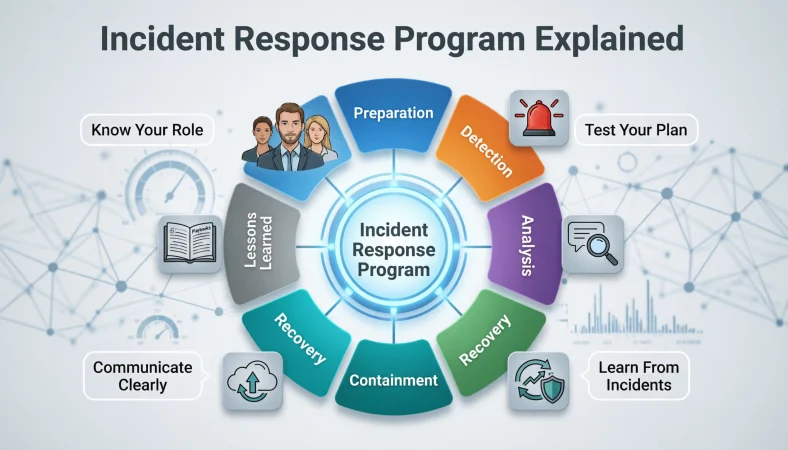
An incident response program is an organized approach for preparing for, detecting, responding to, recovering from, and learning from security incidents. It gives teams clear responsibilities, procedures, communication steps, and recovery goals when something goes wrong.
Top alternatives: incident response plan, incident management program, cybersecurity response program, security incident response framework, incident response strategy
A strong incident response program can be the difference between a stressful security incident and complete organizational chaos. Whether you are discussing cybersecurity at work, explaining a security process in a team chat, preparing a report, or helping colleagues understand what happens during an incident, having the right words matters.
Nobody wants the digital equivalent of everyone running around shouting, “Has anyone seen the backup?” A good response program gives people structure before, during, and after an incident. It defines who does what, how incidents get reported, how teams communicate, and how organizations recover and improve.
The following ready-to-use lines cover professional, practical, funny, clever, confident, and educational ways to discuss an incident response program without making the topic sound like a textbook escaped from a filing cabinet.
Simple Incident Response Program Explanations:
An incident response program prepares an organization to handle security incidents effectively.
Example: A beginner uses this line when explaining cybersecurity fundamentals.
Meaning: It gives a straightforward definition of the program.
An incident response program helps teams know what to do when something goes wrong.
Example: A manager explains response planning to a nontechnical team.
Meaning: It focuses on clarity and preparedness.
It provides a structured approach to identifying, containing, and recovering from incidents.
Example: A security professional summarizes the purpose of a response program.
Meaning: It highlights the major stages of incident handling.
The program turns emergency reactions into organized actions.
Example: A presenter explains why organizations need response procedures.
Meaning: It emphasizes preparation instead of improvisation.
An incident response program defines responsibilities before an incident happens.
Example: A team discusses roles during a security planning meeting.
Meaning: It highlights the importance of assigning ownership in advance.
It helps organizations respond consistently to security events.
Example: A cybersecurity student writes a short study answer.
Meaning: It explains why standardized processes matter.
The program connects preparation, detection, response, recovery, and improvement.
Example: A security analyst summarizes the full response lifecycle.
Meaning: It shows that response does not end when the immediate threat disappears.
An incident response program gives teams a roadmap during stressful situations.
Example: A manager explains the value of having documented procedures.
Meaning: It shows how preparation reduces confusion.
It helps reduce confusion when a serious incident occurs.
Example: A business leader explains the benefit of defined response roles.
Meaning: It focuses on coordinated action.
The program establishes repeatable processes for handling incidents.
Example: A consultant describes a mature cybersecurity operation.
Meaning: It emphasizes consistency and repeatability.
Good incident response starts before the incident.
Example: A security trainer uses this line during an awareness session.
Meaning: It reinforces proactive preparation.
An incident response program helps people respond instead of simply react.
Example: A team leader explains why preparation matters.
Meaning: It contrasts planned action with panic.
Professional Incident Response Program Statements:
Our incident response program establishes clear procedures for managing security incidents.
Example: A company uses this statement in a cybersecurity overview.
Meaning: It presents the program as an organized business capability.
The program defines roles, responsibilities, escalation paths, and communication procedures.
Example: A security manager describes program components to executives.
Meaning: It highlights organizational structure.
Our response procedures support timely identification, containment, investigation, and recovery.
Example: A security team summarizes its operational approach.
Meaning: It describes the response lifecycle professionally.
Incident response responsibilities are assigned before security events occur.
Example: A company explains its preparedness strategy during an audit.
Meaning: It emphasizes advance planning.
The incident response program supports coordinated action across relevant teams.
Example: A security leader explains collaboration between IT, legal, and communications.
Meaning: It highlights cross-functional coordination.
Our procedures are reviewed regularly to maintain operational readiness.
Example: A manager describes how response documentation is maintained.
Meaning: It communicates ongoing program maintenance.
The program provides a consistent framework for managing security incidents.
Example: A company includes the statement in formal documentation.
Meaning: It emphasizes consistency.
Incident response activities are documented to support accountability and improvement.
Example: A security team explains its post-incident process.
Meaning: It connects documentation with organizational learning.
Our response process includes defined communication and escalation requirements.
Example: A policy document describes incident coordination.
Meaning: It emphasizes communication discipline.
The program is designed to support effective response and recovery.
Example: An executive summary describes the organization’s security capabilities.
Meaning: It presents a concise program objective.
Response procedures are aligned with organizational risk and business priorities.
Example: A security manager explains why response plans differ between organizations.
Meaning: It connects incident handling with business needs.
Our incident response program is continuously improved using lessons learned from incidents and exercises.
Example: A cybersecurity leader describes program maturity.
Meaning: It shows that the program evolves over time.
Funny Incident Response Program Lines:
Our incident response program exists because “hope for the best” is not a security strategy.
Example: A security professional jokes during a team presentation.
Meaning: It highlights the need for preparation.
Incident response is where the checklist suddenly becomes everyone’s best friend.
Example: A team jokes during an emergency preparedness exercise.
Meaning: It shows how useful documented procedures become under pressure.
When the alert goes off, nobody wants to invent the plan from scratch.
Example: A security analyst explains why playbooks matter.
Meaning: It humorously supports advance preparation.
Our incident response program is basically the emergency contact list for the digital world.
Example: A presenter explains response roles to beginners.
Meaning: It uses a familiar comparison to explain coordination.
Security incidents are stressful enough without adding improvisation to the group project.
Example: A manager jokes about undocumented response procedures.
Meaning: It explains why structure matters.
The incident happened, and suddenly everyone remembered why we wrote the playbook.
Example: A team reflects on a successful response exercise.
Meaning: It highlights the practical value of preparation.
Nothing says teamwork like five people asking who is supposed to call whom.
Example: A security professional jokes about unclear escalation procedures.
Meaning: It shows the problems caused by missing responsibilities.
Our response plan is the adult supervision of cybersecurity.
Example: A manager uses humor during an awareness session.
Meaning: It portrays the plan as a source of structure.
The incident response program keeps panic from getting promoted to project manager.
Example: A security leader jokes about chaotic incident handling.
Meaning: It emphasizes controlled decision-making.
When cybersecurity gets messy, the playbook gets famous.
Example: A team discusses why documented procedures matter.
Meaning: It humorously celebrates preparation.
No plan, no peace, just twelve browser tabs and questions.
Example: A developer jokes about responding to an unexpected incident.
Meaning: It contrasts chaos with preparation.
Incident response: because “we’ll figure it out” needs a backup plan.
Example: A consultant uses the line in a security presentation.
Meaning: It humorously reinforces preparedness.
Clever Incident Response Program Ideas:
Build the response process before you need the response process.
Example: A security manager introduces a preparedness strategy.
Meaning: It encourages proactive planning.
A good incident response program turns uncertainty into defined actions.
Example: A consultant explains why structured response matters.
Meaning: It connects preparation with confidence.
The best response plan answers the important questions before the incident does.
Example: A team reviews its response documentation.
Meaning: It encourages anticipating difficult decisions.
Every unclear responsibility becomes a potential delay during an incident.
Example: A manager explains why roles should be assigned early.
Meaning: It highlights the operational cost of ambiguity.
A response program should be tested, not merely stored.
Example: A security team discusses tabletop exercises.
Meaning: It emphasizes practical validation.
Documentation is useful only when people know how to use it.
Example: A security leader reviews an incident playbook with staff.
Meaning: It connects documentation with training.
A mature response program learns from every serious event.
Example: A security manager explains post-incident improvement.
Meaning: It emphasizes organizational learning.
The fastest response is often built on preparation completed months earlier.
Example: A consultant explains why readiness matters.
Meaning: It shows how preparation can improve response speed.
Incident response should be repeatable even when the incident is unpredictable.
Example: A security professional explains the value of response frameworks.
Meaning: It distinguishes flexible incidents from consistent processes.
Clear escalation paths can prevent small problems from becoming larger ones.
Example: A manager reviews incident escalation procedures.
Meaning: It emphasizes early communication.
Response plans should be practical enough to use under pressure.
Example: A security team simplifies an overly complicated playbook.
Meaning: It prioritizes usability.
A strong program measures readiness, not just paperwork.
Example: A security leader evaluates response maturity.
Meaning: It encourages meaningful program assessment.
Sarcastic Incident Response Program Responses:
Because apparently cybersecurity incidents do not schedule themselves politely.
Example: A security analyst jokes about unexpected alerts.
Meaning: It humorously explains why preparedness matters.
Yes, we could improvise, but that sounds wonderfully inefficient.
Example: A manager responds to someone questioning response planning.
Meaning: It sarcastically supports structured procedures.
Nothing could possibly go wrong without a response plan. Right?
Example: A security professional jokes during a planning session.
Meaning: It highlights the obvious value of preparedness.
Who needs documented roles when everyone loves guessing?
Example: A team jokes about unclear incident responsibilities.
Meaning: It sarcastically points out the weakness of ambiguity.
The incident response plan is apparently less exciting than the incident itself.
Example: A presenter jokes about low interest in preparedness training.
Meaning: It reminds people that boring preparation can be valuable.
Sure, let’s wait for the incident before deciding who is in charge.
Example: A manager reacts sarcastically to missing ownership.
Meaning: It criticizes delayed role assignment.
Nothing builds confidence like searching for the emergency procedure during an emergency.
Example: A security analyst jokes about poorly maintained documentation.
Meaning: It highlights the importance of accessible plans.
Our strategy is simple: panic first, documentation later.
Example: A team jokes about an intentionally bad response process.
Meaning: It uses irony to emphasize why preparation matters.
The backup plan is hoping the first plan works perfectly. Brilliant.
Example: A security professional jokes about weak contingency planning.
Meaning: It criticizes unrealistic assumptions.
Apparently, practice is optional until the real incident arrives.
Example: A manager jokes about skipped exercises.
Meaning: It stresses the value of testing.
Why prepare today when tomorrow can bring a surprise?
Example: A consultant jokes about poor planning habits.
Meaning: It encourages proactive thinking through sarcasm.
Cybersecurity chaos: now available in every department.
Example: A security professional captions a humorous incident scenario.
Meaning: It jokes about the consequences of poor coordination.
Creative Incident Response Program Concepts:
Think of your incident response program as a fire drill for your digital environment.
Example: A trainer explains preparedness to nontechnical employees.
Meaning: It compares cybersecurity readiness with familiar emergency preparation.
Your response playbook is the map you hope you never need.
Example: A security leader describes incident documentation.
Meaning: It explains why preparedness remains valuable even when unused.
Every incident teaches the program something new.
Example: A manager discusses post-incident reviews.
Meaning: It presents incidents as opportunities for improvement.
A response team without defined roles is a band without a setlist.
Example: A presenter explains why responsibilities should be assigned.
Meaning: It compares coordination with organized performance.
Good preparation gives chaos fewer places to hide.
Example: A security consultant describes the value of clear procedures.
Meaning: It connects structure with reduced confusion.
Your incident response program should work when everyone’s stress level is at 100 percent.
Example: A team reviews whether its procedures are easy to follow.
Meaning: It emphasizes usability during pressure.
The playbook should tell people where to go when the alarm starts ringing.
Example: A security manager explains escalation procedures.
Meaning: It describes the playbook as a practical navigation tool.
A response program is part strategy, part choreography, and zero guesswork.
Example: A presenter describes coordinated incident handling.
Meaning: It emphasizes planned teamwork.
Preparation turns “What do we do?” into “Here is what we do.”
Example: A manager introduces a new incident response program.
Meaning: It shows how preparation creates clarity.
The goal is not perfect prediction; it is reliable preparation.
Example: A security professional explains why response plans need flexibility.
Meaning: It acknowledges that incidents cannot always be predicted.
A strong program creates calm through clarity.
Example: A leader explains why clear responsibilities reduce stress.
Meaning: It connects organization with confidence.
Your response plan should be boring until you desperately need it.
Example: A consultant jokes about the value of routine preparedness.
Meaning: It shows that preparedness is most valuable during unexpected events.
Chill And Casual Incident Response Program Lines:
Basically, it is our game plan for security incidents.
Example: A teammate explains the program during an informal discussion.
Meaning: It gives a relaxed definition.
We already know who handles what when something goes wrong.
Example: A team member explains response roles casually.
Meaning: It highlights assigned responsibilities.
The plan keeps everyone from guessing during an incident.
Example: A manager describes the benefit of documented procedures.
Meaning: It focuses on reducing confusion.
We have a process, so nobody has to freestyle the emergency.
Example: A security analyst jokes during a team meeting.
Meaning: It combines casual language with a practical point.
If something happens, we know where to start.
Example: A team member explains the purpose of response procedures.
Meaning: It emphasizes having a clear first step.
The response program keeps things organized when the situation gets messy.
Example: A manager explains the program to a new employee.
Meaning: It connects planning with calm execution.
We check the issue, contain it, fix it, and learn from it.
Example: A security professional summarizes the response cycle.
Meaning: It provides an easy-to-remember overview.
The playbook is there so nobody has to reinvent everything at 2 a.m.
Example: An analyst jokes about after-hours incidents.
Meaning: It highlights the value of ready procedures.
We test the plan so it is not just sitting there collecting digital dust.
Example: A security team discusses exercises.
Meaning: It emphasizes testing and maintenance.
Everyone knows their lane when an incident happens.
Example: A manager explains team responsibilities.
Meaning: It describes role clarity in casual language.
We keep the process simple enough to actually use.
Example: A team reviews an overly complicated playbook.
Meaning: It prioritizes practical usability.
The goal is organized response, not emergency improv night.
Example: A security professional jokes about preparedness.
Meaning: It reinforces structured response.
Confident Incident Response Program Statements:
We are prepared to respond because our responsibilities are already defined.
Example: A security manager explains organizational readiness.
Meaning: It communicates confidence based on preparation.
Our response program gives the team a clear path forward.
Example: An executive summarizes security preparedness.
Meaning: It highlights confidence and direction.
We do not wait for incidents to decide how we will respond.
Example: A security leader explains proactive planning.
Meaning: It emphasizes advance preparation.
Our procedures are designed for action, not decoration.
Example: A manager discusses practical incident documentation.
Meaning: It shows that plans should be operational.
We test our response capabilities before they are needed.
Example: A security team discusses exercises and simulations.
Meaning: It communicates proactive readiness.
Every major response has a defined escalation path.
Example: A security manager explains incident coordination.
Meaning: It highlights organizational control.
We know how to communicate when an incident demands attention.
Example: A leader describes the communication side of response planning.
Meaning: It emphasizes controlled information sharing.
Our incident response program is built for real situations, not just audits.
Example: A security professional explains the program’s practical purpose.
Meaning: It emphasizes genuine operational readiness.
We turn lessons learned into stronger response capabilities.
Example: A manager explains post-incident improvement.
Meaning: It communicates continuous growth.
Preparedness gives our team confidence under pressure.
Example: An executive discusses the value of response exercises.
Meaning: It connects preparation with confidence.
Our response process gives every incident a structured starting point.
Example: A security analyst explains how the team begins investigations.
Meaning: It highlights consistency.
We are ready to adapt without abandoning the process.
Example: A security leader explains flexible incident handling.
Meaning: It balances structure with adaptability.
Emotional Incident Response Program Messages:
When an incident happens, people need clarity as much as they need technology.
Example: A manager discusses the human side of cybersecurity response.
Meaning: It recognizes the importance of communication and confidence.
A strong response program helps teams stay calm when pressure rises.
Example: A security leader explains why preparedness matters emotionally.
Meaning: It connects planning with reduced stress.
Preparedness protects more than systems; it protects confidence.
Example: A presenter discusses organizational resilience.
Meaning: It highlights the human value of preparation.
Nobody should face a security crisis wondering what happens next.
Example: A manager advocates for clear incident procedures.
Meaning: It emphasizes certainty during stressful events.
Good response planning gives people something solid to follow.
Example: A team leader explains the value of playbooks.
Meaning: It connects structure with reassurance.
Clear communication can make a difficult incident easier to navigate.
Example: A security manager discusses stakeholder communication.
Meaning: It highlights the emotional importance of information.
A response program helps turn fear into focused action.
Example: A trainer explains the human benefits of preparedness.
Meaning: It describes how structure can reduce uncertainty.
The people responding to an incident need support too.
Example: A security leader discusses response-team wellbeing.
Meaning: It recognizes the human demands of incident handling.
Every lesson learned can make the next response stronger.
Example: A manager reflects after a security incident.
Meaning: It frames recovery as an opportunity for growth.
Trust grows when people know the organization is prepared.
Example: An executive explains why response readiness matters to stakeholders.
Meaning: It connects preparedness with confidence and trust.
A calm response begins with clear expectations.
Example: A team leader discusses incident communication procedures.
Meaning: It emphasizes preparation as a foundation for calm.
The goal is to help people move through an incident with purpose.
Example: A manager describes the human goal of response planning.
Meaning: It focuses on guided action rather than panic.
Sweet And Supportive Incident Response Program Lines:
We have a plan, and nobody has to handle an incident alone.
Example: A team leader reassures employees during security training.
Meaning: It emphasizes teamwork and support.
Everyone has a role, and every role matters.
Example: A manager explains cross-functional response responsibilities.
Meaning: It reinforces the value of each team member.
Good preparation makes difficult moments easier to manage.
Example: A security professional encourages employees to participate in exercises.
Meaning: It connects readiness with reassurance.
We learn together so we can respond better together.
Example: A team summarizes its approach to post-incident learning.
Meaning: It promotes collaboration.
Our response plan is here to support the team when pressure rises.
Example: A manager introduces an incident playbook.
Meaning: It presents procedures as helpful rather than restrictive.
No question is too small when security is involved.
Example: A security awareness leader encourages reporting.
Meaning: It promotes open communication.
We would rather prepare together than troubleshoot alone.
Example: A team discusses response exercises.
Meaning: It encourages collaborative preparedness.
Every exercise is a chance to become more confident.
Example: A manager motivates employees before a tabletop exercise.
Meaning: It frames practice positively.
The goal is to protect the organization and support its people.
Example: An executive explains the broader purpose of incident response.
Meaning: It combines technical and human priorities.
Strong teams communicate early and support each other throughout an incident.
Example: A security leader explains response-team expectations.
Meaning: It promotes teamwork and timely communication.
Preparation is one way we look after each other during difficult situations.
Example: A manager discusses organizational resilience.
Meaning: It gives preparedness a supportive human meaning.
We improve together after every lesson learned.
Example: A team reflects on an incident review.
Meaning: It emphasizes collective improvement.
Educational Incident Response Program Responses:
An incident response program provides a repeatable structure for managing incidents.
Example: A student uses this line in a cybersecurity assignment.
Meaning: It explains the program’s central purpose.
Preparation is an important part of effective incident response.
Example: A learner summarizes the first stage of response planning.
Meaning: It explains why organizations prepare before incidents.
Detection helps teams identify potentially harmful security events.
Example: A student explains an early response activity.
Meaning: It describes the purpose of detection.
Containment focuses on limiting the impact of an incident.
Example: A learner defines containment during a study session.
Meaning: It explains why teams try to control an active incident.
Eradication focuses on removing the underlying threat or cause.
Example: A cybersecurity student explains a response stage.
Meaning: It distinguishes eradication from containment.
Recovery focuses on restoring normal operations after an incident.
Example: A learner prepares an exam answer.
Meaning: It explains the purpose of recovery.
Lessons learned can improve future response capabilities.
Example: A student describes the importance of post-incident review.
Meaning: It connects incidents with continuous improvement.
Incident response programs often involve technical and nontechnical teams.
Example: A learner explains why cybersecurity response requires collaboration.
Meaning: It highlights cross-functional participation.
Communication is an important part of incident coordination.
Example: A student explains why stakeholders need appropriate updates.
Meaning: It recognizes communication as part of effective response.
Roles and responsibilities should be clear before incidents occur.
Example: A learner summarizes a core preparedness principle.
Meaning: It explains why advance ownership matters.
Exercises can help organizations evaluate how well their response procedures work.
Example: A student describes tabletop testing.
Meaning: It explains why practice is useful.
An incident response program should evolve as threats, technology, and organizational needs change.
Example: A learner discusses program improvement.
Meaning: It emphasizes adaptability and ongoing maintenance.
Strategic Incident Response Program Ideas:
Align incident response with the organization’s broader risk strategy.
Example: A security leader presents a program roadmap to executives.
Meaning: It connects response capabilities with business risk.
Define success before measuring response performance.
Example: A manager develops incident response metrics.
Meaning: It encourages purposeful measurement.
Build relationships between security, IT, legal, communications, and leadership teams.
Example: A security manager plans a cross-functional exercise.
Meaning: It emphasizes collaboration.
Keep critical response information accessible during an incident.
Example: A team reviews where its emergency procedures are stored.
Meaning: It focuses on operational accessibility.
Use exercises to uncover weaknesses before real incidents do.
Example: A security team plans a tabletop scenario.
Meaning: It encourages proactive testing.
Review major incidents for both technical and organizational lessons.
Example: A manager leads a post-incident review.
Meaning: It broadens learning beyond technical causes.
Create escalation rules that match incident severity and business impact.
Example: A security leader updates escalation procedures.
Meaning: It connects response decisions with organizational risk.
Keep response documentation current and practical.
Example: A manager reviews an outdated incident playbook.
Meaning: It emphasizes useful documentation.
Train people on their responsibilities instead of simply giving them a document.
Example: A security team introduces role-based incident training.
Meaning: It prioritizes understanding over paperwork.
Measure how quickly and effectively the organization can coordinate.
Example: A security leader evaluates response exercises.
Meaning: It focuses on operational performance.
Use lessons from incidents to strengthen controls and procedures.
Example: A manager updates the security program after an incident review.
Meaning: It connects response with prevention and improvement.
Treat incident response as an ongoing capability, not a one-time project.
Example: An executive discusses long-term cybersecurity maturity.
Meaning: It emphasizes continuous development.
Practical Incident Response Program Responses:
Start with clearly defined incident categories and severity levels.
Example: A security manager organizes an incident classification process.
Meaning: It creates structure for prioritizing events.
Document who needs to be notified for each major incident type.
Example: A team updates its escalation guide.
Meaning: It supports timely communication.
Keep response contact information current.
Example: An administrator reviews an incident contact list.
Meaning: It prevents outdated information from slowing response.
Create simple playbooks for common incident scenarios.
Example: A security team develops procedures for frequently encountered events.
Meaning: It makes response more repeatable.
Test the playbooks with realistic scenarios.
Example: A team conducts a tabletop exercise.
Meaning: It checks whether procedures work in practice.
Record important decisions during major incidents.
Example: An incident lead maintains a response timeline.
Meaning: It supports accountability and later review.
Define when an incident should be escalated.
Example: A manager establishes severity-based escalation rules.
Meaning: It helps teams make consistent decisions.
Make sure response teams know how to communicate securely.
Example: A security leader prepares communication procedures.
Meaning: It recognizes communication as part of incident handling.
Review response performance after significant incidents.
Example: A security manager leads a post-incident meeting.
Meaning: It supports continuous improvement.
Update procedures when technology or organizational structures change.
Example: A company revises its playbook after a major system migration.
Meaning: It keeps response documentation relevant.
Coordinate recovery planning with business continuity needs.
Example: A security manager works with operational teams after an incident.
Meaning: It connects cybersecurity recovery with business operations.
Turn lessons learned into specific improvement actions.
Example: A security team creates follow-up tasks after an incident review.
Meaning: It converts observations into measurable improvements.
Executive-Friendly Incident Response Program Statements:
Our incident response program helps protect business operations during security incidents.
Example: An executive uses this statement during a leadership presentation.
Meaning: It connects cybersecurity response with business continuity.
Prepared response capabilities can reduce confusion and improve decision-making during incidents.
Example: A security leader explains program value to executives.
Meaning: It focuses on organizational outcomes.
The program provides defined responsibilities and escalation paths for significant incidents.
Example: A CISO summarizes governance arrangements.
Meaning: It highlights accountability.
Incident response readiness is part of broader organizational resilience.
Example: A security executive discusses resilience planning.
Meaning: It connects incident response with business preparedness.
Our program supports coordinated decisions across technical and business teams.
Example: A leader describes cross-functional incident management.
Meaning: It emphasizes collaboration.
Response exercises help leadership understand organizational readiness.
Example: An executive participates in a tabletop exercise.
Meaning: It presents testing as a leadership tool.
The program helps translate security incidents into structured business decisions.
Example: A security leader explains executive involvement.
Meaning: It connects technical events with business priorities.
Clear communication supports informed decisions during high-impact incidents.
Example: An executive reviews crisis communication procedures.
Meaning: It highlights the importance of timely information.
We use lessons learned to strengthen resilience over time.
Example: A CISO summarizes the improvement process after an incident.
Meaning: It presents learning as a strategic benefit.
A mature response capability supports confidence across the organization.
Example: A security executive explains program maturity.
Meaning: It connects readiness with organizational confidence.
Incident response should be measured by meaningful outcomes, not paperwork alone.
Example: A leader discusses response metrics with management.
Meaning: It emphasizes practical performance.
Our goal is a prepared organization that can respond, recover, and improve.
Example: An executive summarizes the long-term response vision.
Meaning: It captures the broader purpose of the program.
Memorable Incident Response Program One-Liners:
Prepare first, respond smarter.
Example: A security team uses the line as an internal awareness slogan.
Meaning: It promotes proactive preparation.
Know the plan before you need the plan.
Example: A manager uses the phrase during security training.
Meaning: It encourages advance familiarity with procedures.
Less guessing, more responding.
Example: A security team uses the phrase on an internal poster.
Meaning: It emphasizes structured action.
Plan for the incident, not the panic.
Example: A security leader uses the line during a preparedness session.
Meaning: It focuses attention on controlled response.
Prepared teams move with purpose.
Example: A manager summarizes the value of readiness.
Meaning: It connects preparation with focused action.
Every alert deserves a clear next step.
Example: A security analyst describes the value of playbooks.
Meaning: It emphasizes operational clarity.
Response starts with readiness.
Example: A security team uses the line in an awareness campaign.
Meaning: It reinforces preparation.
Good plans make hard moments manageable.
Example: A manager motivates employees to participate in exercises.
Meaning: It connects planning with resilience.
Test the plan before reality tests you.
Example: A security leader introduces a tabletop exercise.
Meaning: It encourages proactive testing.
Clear roles create faster decisions.
Example: A manager explains why responsibilities are assigned in advance.
Meaning: It connects role clarity with response efficiency.
Learn from yesterday, prepare for tomorrow.
Example: A security team uses the line during a post-incident review.
Meaning: It promotes continuous improvement.
When security gets serious, preparation gets real.
Example: A presenter closes a cybersecurity awareness session.
Meaning: It reinforces the practical value of readiness.
FAQs:
What does an incident response program mean?
An incident response program is an organized capability for preparing for, identifying, managing, recovering from, and learning from security incidents. It typically includes people, processes, procedures, communication, training, and supporting technology.
Why is an incident response program important?
It gives an organization a structured way to handle security incidents instead of relying on improvised decisions. Clear roles and procedures can improve coordination during stressful situations.
Is an incident response program the same as an incident response plan?
Not exactly. An incident response plan is usually a specific documented plan, while an incident response program is broader and can include governance, training, exercises, playbooks, roles, procedures, metrics, and continuous improvement.
Can an incident response program be used professionally?
Yes. The phrase is appropriate in security policies, business reports, presentations, audits, cybersecurity documentation, training materials, and executive discussions.
Does an incident response program only involve cybersecurity teams?
Not necessarily. Depending on the organization and incident, response may involve IT, security, legal, communications, leadership, compliance, human resources, business operations, and other stakeholders.
What should an incident response program include?
Common elements include preparation, defined roles, incident reporting, detection, analysis, containment, eradication, recovery, communication, documentation, exercises, and lessons learned.
What can I say if I do not fully understand an incident response program?
You can simply say, “It is the organization’s structured approach for handling security incidents.” This keeps the explanation accurate and easy to understand.
Is humor appropriate when discussing an incident response program?
Humor can work well in casual team chats, awareness campaigns, social posts, and training sessions. Keep formal policies, executive reports, customer communications, and active incident messaging professional.
Can an incident response program improve after an incident?
Yes. Post-incident reviews can identify weaknesses, capture lessons learned, and support improvements to procedures, controls, training, communication, and future response capabilities.
What is the best simple way to describe an incident response program?
A simple explanation is: “It is the organization’s game plan for preparing for and handling security incidents.”
Conclusion:
A strong incident response program gives teams something incredibly valuable when a security incident arrives: direction. Instead of wondering who should act, what should happen next, or where the emergency procedure disappeared to, people can follow established responsibilities and processes. The best programs also evolve.
Teams practice, review incidents, learn from mistakes, and improve their ability to respond. Whether you need a professional statement, a simple explanation, a clever one-liner, or a friendly way to describe cybersecurity readiness, the right wording can make a complicated topic much easier to understand. Save these ideas for your next report, presentation, training session, or team discussion, and share this guide with anyone building a stronger response culture.