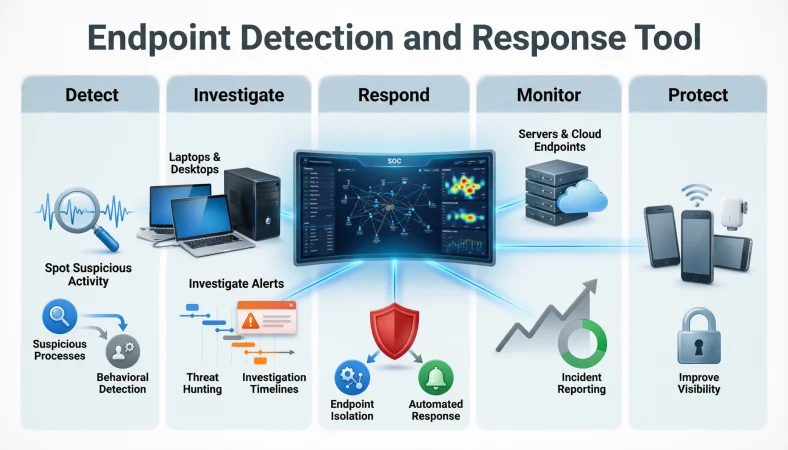
An endpoint detection and response tool helps security teams monitor endpoints, detect suspicious activity, investigate threats, and respond to security incidents. The best solutions combine visibility, threat detection, investigation, automation, and rapid response.
Top alternatives: EDR platform, endpoint security solution, endpoint threat detection, endpoint monitoring software, cybersecurity response platform
One suspicious login, one weird process, and suddenly the whole security team is wide awake. That is where an endpoint detection and response tool becomes especially useful. Whether you are discussing cybersecurity in a work chat, comparing platforms with your IT team, researching software for a business, or explaining endpoint security to a friend who thinks antivirus solves literally everything, the right wording matters.
EDR solutions are designed to give security teams deeper visibility into endpoint activity and help them investigate and respond to potential threats. A good response is not simply about spotting something unusual. It is about understanding what happened, deciding whether it is genuinely dangerous, containing the problem, and learning from the incident.
The following ready-to-use lines cover professional, technical, casual, clever, practical, and social-media-friendly ways to discuss endpoint detection and response.
Professional Endpoint Detection And Response Tool Responses:
1. “An EDR solution provides visibility into endpoint activity.”
Example: Use this when explaining the purpose of EDR during a business security meeting.
Meaning: It highlights endpoint visibility as a core capability.
2. “The platform helps security teams detect suspicious endpoint behavior.”
Example: Use this when introducing EDR to nontechnical colleagues.
Meaning: It explains detection in straightforward language.
3. “EDR supports investigation and response after a security alert.”
Example: Use this in a cybersecurity presentation.
Meaning: It emphasizes that detection is only part of the process.
4. “Endpoint telemetry can provide valuable context during an incident.”
Example: Use this when discussing security investigations.
Meaning: It explains why endpoint data matters.
5. “The solution can help accelerate incident response.”
Example: Use this in a security strategy document.
Meaning: It focuses on response efficiency.
6. “EDR strengthens visibility across managed endpoints.”
Example: Use this during an enterprise security discussion.
Meaning: It highlights centralized endpoint awareness.
7. “The platform helps analysts investigate potentially malicious activity.”
Example: Use this during a security operations presentation.
Meaning: It describes the investigative role of EDR.
8. “Endpoint monitoring supports faster identification of unusual behavior.”
Example: Use this when explaining proactive security monitoring.
Meaning: It connects monitoring with earlier detection.
9. “Response capabilities can help contain affected endpoints.”
Example: Use this when discussing incident containment.
Meaning: It describes how endpoint response can limit impact.
10. “EDR can complement existing security controls.”
Example: Use this when discussing layered cybersecurity.
Meaning: It positions EDR as part of a broader defense strategy.
11. “Security teams can use endpoint evidence to reconstruct incidents.”
Example: Use this during a forensic investigation discussion.
Meaning: It emphasizes historical endpoint information.
12. “A strong EDR deployment combines visibility, detection, investigation, and response.”
Example: Use this as a summary during a security presentation.
Meaning: It captures the broader purpose of EDR.
Funny Endpoint Detection And Response Tool Responses
1. “The endpoint saw something suspicious before anyone else did.”
Example: Use this as a playful cybersecurity presentation line.
Meaning: It gives endpoint monitoring a humorous personality.
2. “Someone clicked the mystery link, and EDR noticed.”
Example: Use this in a light security-awareness post.
Meaning: It jokes about common workplace security mistakes.
3. “The endpoint has receipts.”
Example: Use this as a social-media-friendly cybersecurity caption.
Meaning: It humorously refers to endpoint activity records.
4. “Your laptop knows more than you think.”
Example: Use this in an educational security post.
Meaning: It highlights how much activity endpoints can generate.
5. “EDR said, ‘Nice try.’”
Example: Use this as a playful security graphic caption.
Meaning: It portrays detection as stopping suspicious behavior.
6. “The suspicious process has entered the group chat.”
Example: Use this for a cybersecurity meme.
Meaning: It humorously frames a security alert as social drama.
7. “Nothing says Monday like an unexpected security alert.”
Example: Use this for an IT team social post.
Meaning: It jokes about inconvenient alerts.
8. “Your endpoint just became the office gossip.”
Example: Use this when explaining endpoint telemetry humorously.
Meaning: It compares detailed activity visibility to gossip.
9. “Cybersecurity: because ‘I have no idea’ is not an incident report.”
Example: Use this on a security-awareness graphic.
Meaning: It emphasizes investigation and documentation.
10. “One weird process walks into an EDR dashboard.”
Example: Use this as a playful cybersecurity caption.
Meaning: It turns detection into a mini story.
11. “EDR is basically the security team’s extra pair of eyes.”
Example: Use this when explaining endpoint monitoring casually.
Meaning: It makes the concept approachable.
12. “The endpoint chose chaos, EDR chose evidence.”
Example: Use this as a humorous cybersecurity caption.
Meaning: It contrasts suspicious activity with investigation.
Simple Endpoint Detection And Response Tool Responses
1. “EDR watches endpoint activity for suspicious behavior.”
Example: Use this when explaining EDR to beginners.
Meaning: It gives a simple description of detection.
2. “It helps security teams investigate alerts.”
Example: Use this in an introductory cybersecurity lesson.
Meaning: It explains the investigation function.
3. “It can help identify potential threats on endpoints.”
Example: Use this in a beginner-friendly security article.
Meaning: It explains threat detection simply.
4. “It provides security teams with endpoint visibility.”
Example: Use this when defining EDR.
Meaning: It highlights visibility as a central benefit.
5. “It can support faster incident response.”
Example: Use this in a short cybersecurity explanation.
Meaning: It describes the response advantage.
6. “EDR helps connect endpoint activity with security alerts.”
Example: Use this during a basic security discussion.
Meaning: It explains how context can support investigations.
7. “It can help isolate an affected endpoint.”
Example: Use this when discussing containment capabilities.
Meaning: It describes a common response function.
8. “It records useful endpoint security information.”
Example: Use this when explaining telemetry.
Meaning: It introduces the idea of endpoint data collection.
9. “It helps analysts understand what happened.”
Example: Use this when explaining incident investigation.
Meaning: It focuses on understanding events.
10. “EDR goes beyond basic antivirus monitoring.”
Example: Use this when comparing security approaches.
Meaning: It highlights broader detection and response capabilities.
11. “It helps turn endpoint activity into security insight.”
Example: Use this in educational content.
Meaning: It explains the value of collected data.
12. “EDR helps teams spot, investigate, and respond to threats.”
Example: Use this as a concise definition.
Meaning: It summarizes the main workflow.
Technical Endpoint Detection And Response Tool Responses
1. “Endpoint telemetry provides context for security investigations.”
Example: Use this when discussing EDR architecture.
Meaning: It highlights the value of endpoint-generated data.
2. “Behavioral detection can identify activity that looks suspicious.”
Example: Use this during a technical security presentation.
Meaning: It explains behavior-based detection.
3. “Process activity can help analysts trace suspicious execution.”
Example: Use this in an endpoint investigation discussion.
Meaning: It describes how process information supports analysis.
4. “Command-line activity can provide useful investigation context.”
Example: Use this during a technical incident review.
Meaning: It highlights a potentially valuable endpoint artifact.
5. “EDR data can support threat hunting workflows.”
Example: Use this when discussing proactive security operations.
Meaning: It connects endpoint telemetry with hunting.
6. “Endpoint timelines can help reconstruct attack activity.”
Example: Use this during forensic analysis.
Meaning: It describes how chronological evidence supports investigation.
7. “Detection rules can identify known suspicious patterns.”
Example: Use this in a technical cybersecurity discussion.
Meaning: It explains one approach to identifying threats.
8. “Automated response can reduce repetitive analyst work.”
Example: Use this when discussing security operations efficiency.
Meaning: It highlights automation benefits.
9. “Endpoint isolation can support incident containment.”
Example: Use this during a response planning session.
Meaning: It explains how affected systems may be separated.
10. “EDR telemetry can support post-incident analysis.”
Example: Use this during an incident review.
Meaning: It shows that endpoint data remains useful after containment.
11. “Detection quality depends on visibility, context, and analytics.”
Example: Use this during an EDR evaluation.
Meaning: It explains why detection performance involves several factors.
12. “A mature EDR program combines technology with skilled analysts.”
Example: Use this during a cybersecurity strategy meeting.
Meaning: It emphasizes the human role in security operations.
Clever Endpoint Detection And Response Tool Responses
1. “Detection without context is just another notification.”
Example: Use this during a security operations discussion.
Meaning: It emphasizes the importance of investigation context.
2. “The goal is not more alerts, it is better decisions.”
Example: Use this when evaluating an EDR platform.
Meaning: It focuses on useful security outcomes.
3. “Visibility turns guesses into evidence.”
Example: Use this as a cybersecurity presentation line.
Meaning: It highlights the value of endpoint data.
4. “A suspicious process deserves a closer look.”
Example: Use this in an incident investigation discussion.
Meaning: It encourages investigation rather than assumptions.
5. “Good endpoint security tells the story behind the alert.”
Example: Use this when explaining EDR value.
Meaning: It emphasizes contextual investigation.
6. “Security teams need signals, not endless noise.”
Example: Use this during an EDR comparison.
Meaning: It highlights alert quality.
7. “The faster you understand an incident, the faster you can respond.”
Example: Use this during a security presentation.
Meaning: It connects investigation speed with response.
8. “Endpoint visibility makes the invisible less invisible.”
Example: Use this as a memorable cybersecurity caption.
Meaning: It describes the visibility advantage.
9. “Every alert is a question waiting for context.”
Example: Use this during threat-hunting training.
Meaning: It frames alerts as starting points for investigation.
10. “Good detection starts the investigation, not the celebration.”
Example: Use this as a security-awareness line.
Meaning: It reminds teams that detection is only the beginning.
11. “Response is where detection proves its value.”
Example: Use this during an EDR strategy discussion.
Meaning: It emphasizes actionable response.
12. “Better visibility creates better security conversations.”
Example: Use this in an enterprise security presentation.
Meaning: It connects evidence with informed decision-making.
Casual Endpoint Detection And Response Tool Responses
1. “Think of EDR as extra eyes on your endpoints.”
Example: Use this when explaining EDR to a nontechnical coworker.
Meaning: It makes the concept easy to visualize.
2. “It watches for things that look out of place.”
Example: Use this during an informal security chat.
Meaning: It simplifies behavioral detection.
3. “It helps the security team figure out what happened.”
Example: Use this when explaining incident investigation casually.
Meaning: It focuses on the investigative role.
4. “Basically, it helps security teams keep tabs on endpoints.”
Example: Use this when introducing EDR casually.
Meaning: It gives a simple overview.
5. “It is like having security cameras for endpoint activity.”
Example: Use this as an analogy for beginners.
Meaning: It makes endpoint visibility easier to understand.
6. “When something looks weird, EDR can help investigate.”
Example: Use this in a casual cybersecurity discussion.
Meaning: It explains the detection-to-investigation process.
7. “It helps turn suspicious activity into something analysts can examine.”
Example: Use this when discussing alerts.
Meaning: It explains how detection supports investigation.
8. “Your endpoint leaves clues, and EDR helps collect them.”
Example: Use this as a friendly security analogy.
Meaning: It explains endpoint telemetry.
9. “It is more than just watching for viruses.”
Example: Use this when comparing EDR with basic antivirus.
Meaning: It highlights broader capabilities.
10. “Security teams get a much better view of what is happening.”
Example: Use this when describing EDR benefits.
Meaning: It focuses on visibility.
11. “It helps connect suspicious activity to the bigger picture.”
Example: Use this during an informal security conversation.
Meaning: It explains the importance of context.
12. “Basically, detect it, investigate it, respond to it.”
Example: Use this as a quick EDR summary.
Meaning: It captures the core workflow.
Confident Endpoint Detection And Response Tool Statements
1. “Strong endpoint visibility should be a security priority.”
Example: Use this during a cybersecurity strategy meeting.
Meaning: It emphasizes the importance of endpoint awareness.
2. “We need security controls that support action, not just alerts.”
Example: Use this during an EDR evaluation.
Meaning: It prioritizes actionable detection.
3. “Our endpoint strategy should support rapid investigation.”
Example: Use this in a security planning session.
Meaning: It establishes investigation as an important goal.
4. “We should know what is happening across managed endpoints.”
Example: Use this during an enterprise security discussion.
Meaning: It emphasizes organizational visibility.
5. “Response capabilities matter as much as detection.”
Example: Use this during a platform comparison.
Meaning: It highlights the importance of taking action.
6. “An EDR platform should fit our security operations workflow.”
Example: Use this when assessing cybersecurity products.
Meaning: It focuses on operational compatibility.
7. “We need useful telemetry, not data for the sake of data.”
Example: Use this during a technical evaluation.
Meaning: It prioritizes meaningful information.
8. “Security teams should be able to investigate alerts efficiently.”
Example: Use this during an EDR planning discussion.
Meaning: It emphasizes analyst productivity.
9. “Automation should reduce response time without removing oversight.”
Example: Use this when discussing automated response.
Meaning: It balances efficiency with human control.
10. “Endpoint security needs measurable outcomes.”
Example: Use this in a cybersecurity strategy presentation.
Meaning: It encourages performance evaluation.
11. “The platform should support both detection and investigation.”
Example: Use this when comparing EDR solutions.
Meaning: It defines two important capabilities.
12. “A security platform is only useful if the team can act on its findings.”
Example: Use this during a security technology review.
Meaning: It connects technology with practical outcomes.
Educational Endpoint Detection And Response Tool Responses
1. “EDR stands for Endpoint Detection and Response.”
Example: Use this when introducing the acronym to beginners.
Meaning: It provides the basic definition.
2. “Endpoints include devices such as computers and servers.”
Example: Use this when explaining what EDR monitors.
Meaning: It clarifies the meaning of endpoint.
3. “Detection focuses on finding potentially suspicious activity.”
Example: Use this in an introductory cybersecurity lesson.
Meaning: It explains the detection stage.
4. “Response focuses on taking action after suspicious activity is identified.”
Example: Use this when teaching EDR fundamentals.
Meaning: It explains the response stage.
5. “Investigation helps analysts understand the alert.”
Example: Use this during security training.
Meaning: It describes the investigative step.
6. “Telemetry provides information about endpoint activity.”
Example: Use this in a beginner cybersecurity article.
Meaning: It introduces endpoint data.
7. “EDR can help identify patterns that traditional security controls may miss.”
Example: Use this when explaining layered security.
Meaning: It highlights the broader detection approach.
8. “Threat hunting can use endpoint data to search for suspicious behavior.”
Example: Use this during a cybersecurity course.
Meaning: It connects EDR with proactive investigation.
9. “Isolation can help limit communication from a potentially affected device.”
Example: Use this when teaching response concepts.
Meaning: It explains a common containment action.
10. “EDR does not eliminate the need for security professionals.”
Example: Use this when discussing automation.
Meaning: It emphasizes the continuing importance of human analysis.
11. “EDR is part of a broader cybersecurity strategy.”
Example: Use this during security training.
Meaning: It avoids treating one technology as complete protection.
12. “The goal is faster and better-informed security response.”
Example: Use this as a lesson summary.
Meaning: It captures the practical purpose of EDR.
Social Media Friendly Endpoint Detection And Response Tool Captions
1. “Your endpoints have stories. EDR helps security teams read them.”
Example: Use this as a LinkedIn cybersecurity caption.
Meaning: It makes endpoint telemetry memorable.
2. “Detect early. Investigate smarter. Respond faster.”
Example: Use this on an EDR awareness graphic.
Meaning: It summarizes the security workflow.
3. “Cybersecurity starts with knowing what is happening.”
Example: Use this as an endpoint security caption.
Meaning: It emphasizes visibility.
4. “More visibility, fewer blind spots.”
Example: Use this on a professional security graphic.
Meaning: It highlights the value of endpoint monitoring.
5. “Every endpoint tells part of the security story.”
Example: Use this in a cybersecurity post.
Meaning: It emphasizes distributed endpoint evidence.
6. “Alerts are only useful when you can investigate them.”
Example: Use this as an EDR education caption.
Meaning: It emphasizes actionable security information.
7. “Your security dashboard should tell you more than ‘something happened.’”
Example: Use this in an EDR comparison post.
Meaning: It highlights the need for context.
8. “Threat detection meets real-world response.”
Example: Use this as a short cybersecurity caption.
Meaning: It connects detection with action.
9. “Endpoint security is not just about watching. It is about responding.”
Example: Use this on an EDR awareness post.
Meaning: It emphasizes response capabilities.
10. “Suspicious activity deserves more than a shrug.”
Example: Use this as a security awareness caption.
Meaning: It encourages investigation.
11. “Good security sees the signal behind the noise.”
Example: Use this in a cybersecurity graphic.
Meaning: It emphasizes useful detection.
12. “Know your endpoints. Know your risks.”
Example: Use this as a short LinkedIn security caption.
Meaning: It connects visibility with risk awareness.
Creative Endpoint Detection And Response Tool Responses
1. “Think of EDR as a detective for endpoint activity.”
Example: Use this when making cybersecurity education more approachable.
Meaning: It compares investigation to detective work.
2. “Every process can leave a clue.”
Example: Use this during threat-hunting content.
Meaning: It highlights the investigative value of endpoint activity.
3. “The endpoint is where the story gets interesting.”
Example: Use this as a cybersecurity presentation opener.
Meaning: It draws attention to endpoint evidence.
4. “EDR turns scattered clues into an investigation.”
Example: Use this in an educational security post.
Meaning: It explains how telemetry can provide context.
5. “Security teams need eyes where the action happens.”
Example: Use this as an EDR marketing-style caption.
Meaning: It highlights endpoint visibility.
6. “Suspicious behavior is easier to understand with context.”
Example: Use this during a security training session.
Meaning: It emphasizes contextual analysis.
7. “Your endpoint may be the first witness.”
Example: Use this as a memorable cybersecurity caption.
Meaning: It presents endpoint telemetry as evidence.
8. “The alert is the headline; the telemetry is the story.”
Example: Use this during analyst training.
Meaning: It distinguishes an alert from deeper investigation data.
9. “Good response starts with knowing what happened.”
Example: Use this in a cybersecurity presentation.
Meaning: It connects investigation with response.
10. “Every security event deserves the right context.”
Example: Use this in an EDR awareness campaign.
Meaning: It highlights the importance of understanding events.
11. “Visibility is the bridge between suspicion and evidence.”
Example: Use this as a security education caption.
Meaning: It describes how endpoint data supports investigation.
12. “When endpoints talk, security teams should listen.”
Example: Use this as a creative cybersecurity slogan.
Meaning: It encourages attention to endpoint activity.
Practical Endpoint Detection And Response Tool Responses
1. “Start by defining which endpoints need monitoring.”
Example: Use this during an EDR deployment discussion.
Meaning: It encourages clear scope.
2. “Make sure endpoint data is useful to your security team.”
Example: Use this when evaluating telemetry collection.
Meaning: It focuses on practical value.
3. “Create clear processes for investigating alerts.”
Example: Use this during security operations planning.
Meaning: It encourages consistent investigation.
4. “Define who can take response actions.”
Example: Use this during EDR governance planning.
Meaning: It clarifies responsibilities.
5. “Test response procedures before a major incident.”
Example: Use this during security preparedness planning.
Meaning: It encourages practical readiness.
6. “Review alert volume regularly.”
Example: Use this when improving security operations.
Meaning: It helps identify excessive noise.
7. “Tune detections to reduce unnecessary alerts.”
Example: Use this during EDR optimization.
Meaning: It emphasizes detection quality.
8. “Document important investigation findings.”
Example: Use this after responding to an incident.
Meaning: It supports learning and future investigations.
9. “Keep endpoint agents properly managed and updated.”
Example: Use this during endpoint security maintenance.
Meaning: It encourages reliable deployment.
10. “Connect EDR findings with the wider security workflow.”
Example: Use this when designing security operations.
Meaning: It promotes coordinated incident handling.
11. “Review response permissions carefully.”
Example: Use this during EDR administration.
Meaning: It emphasizes controlled access.
12. “Measure response time and investigation efficiency.”
Example: Use this during security program reviews.
Meaning: It encourages measurable improvement.
Strategic Endpoint Detection And Response Tool Statements
1. “EDR should support the organization’s broader security strategy.”
Example: Use this during cybersecurity planning.
Meaning: It places EDR within a wider program.
2. “Endpoint visibility can strengthen incident investigation.”
Example: Use this in an executive security presentation.
Meaning: It identifies a strategic benefit.
3. “Detection capabilities should align with organizational risks.”
Example: Use this during security planning.
Meaning: It connects technology choices with actual risk.
4. “Response workflows should match the team’s operational capacity.”
Example: Use this when selecting an EDR platform.
Meaning: It encourages realistic implementation.
5. “Security technology should support measurable outcomes.”
Example: Use this during a technology investment discussion.
Meaning: It focuses on results.
6. “A strong endpoint strategy requires visibility and accountability.”
Example: Use this in a cybersecurity strategy document.
Meaning: It emphasizes both awareness and responsibility.
7. “EDR can contribute valuable evidence during security investigations.”
Example: Use this when discussing incident response capabilities.
Meaning: It highlights investigative value.
8. “Security teams should evaluate detection quality, not just feature counts.”
Example: Use this when comparing platforms.
Meaning: It encourages meaningful evaluation.
9. “Automation should support analysts rather than replace sound judgment.”
Example: Use this during an automation discussion.
Meaning: It balances technology with human oversight.
10. “The best solution is the one the security team can operate effectively.”
Example: Use this during procurement planning.
Meaning: It focuses on practical usability.
11. “Endpoint security should evolve as threats and business needs change.”
Example: Use this during long-term security planning.
Meaning: It encourages continuous improvement.
12. “Visibility, context, and response should work together.”
Example: Use this as a strategic EDR summary.
Meaning: It captures the relationship between key capabilities.
Endpoint Detection And Response Tool Comparison Responses
1. “Compare detection capabilities before comparing feature lists.”
Example: Use this when evaluating several EDR platforms.
Meaning: It encourages outcome-focused comparison.
2. “Look at how quickly analysts can investigate an alert.”
Example: Use this during a platform demonstration.
Meaning: It focuses on investigation efficiency.
3. “Check how endpoint isolation works.”
Example: Use this when reviewing response features.
Meaning: It examines containment functionality.
4. “Evaluate the quality of endpoint telemetry.”
Example: Use this during a technical product assessment.
Meaning: It focuses on the usefulness of collected data.
5. “Consider how much alert noise the platform creates.”
Example: Use this during EDR comparisons.
Meaning: It highlights analyst workload.
6. “Review integrations with your existing security environment.”
Example: Use this during procurement discussions.
Meaning: It checks operational compatibility.
7. “Ask how the platform supports threat hunting.”
Example: Use this when comparing advanced security capabilities.
Meaning: It examines proactive investigation support.
8. “Check whether response actions are easy to control.”
Example: Use this during a product evaluation.
Meaning: It considers governance and usability.
9. “Look beyond the dashboard and test the investigation workflow.”
Example: Use this during an EDR demonstration.
Meaning: It prioritizes real-world analyst experience.
10. “Evaluate reporting and incident documentation features.”
Example: Use this during enterprise software selection.
Meaning: It considers post-incident needs.
11. “Consider scalability before making a long-term decision.”
Example: Use this when selecting EDR for a growing organization.
Meaning: It highlights future requirements.
12. “Choose based on security outcomes, not marketing buzzwords.”
Example: Use this when comparing vendors.
Meaning: It encourages practical evaluation.
FAQs:
What is an endpoint detection and response tool?
An endpoint detection and response tool, commonly called EDR, is a cybersecurity solution designed to monitor endpoint activity, identify potentially suspicious behavior, support investigations, and provide response capabilities.
What does EDR stand for?
EDR stands for Endpoint Detection and Response.
What does an endpoint mean in cybersecurity?
An endpoint is generally a device connected to an organization’s environment, such as a laptop, desktop computer, server, or other managed device.
Is an endpoint detection and response tool the same as antivirus?
Not exactly. Traditional antivirus primarily focuses on preventing or detecting known malicious software, while EDR generally provides broader endpoint visibility, behavioral detection, investigation capabilities, and response functions.
Can EDR detect every cyberattack?
No cybersecurity solution can guarantee detection of every threat. Effectiveness depends on factors such as configuration, endpoint visibility, detection logic, telemetry quality, integrations, and the skills of the security team.
Is an endpoint detection and response tool useful for businesses?
Yes. EDR can provide security teams with greater visibility into endpoint activity and help them investigate and respond to suspicious events.
Can EDR automatically respond to threats?
Some EDR platforms can automate certain response actions, depending on their capabilities and configuration. Organizations should carefully define automation rules and permissions.
Is EDR useful for threat hunting?
Yes. Endpoint telemetry can provide valuable information for security teams conducting proactive searches for suspicious activity.
Can EDR help after an incident?
Yes. Endpoint data can support investigation, incident reconstruction, documentation, and lessons-learned activities after a security event.
Is humor appropriate when discussing EDR?
Absolutely, especially in cybersecurity awareness content, training, memes, presentations, and social media. Just keep the humor professional when discussing an active security incident or sensitive breach.
What should I look for in an endpoint detection and response tool?
Consider endpoint visibility, detection quality, investigation workflows, response capabilities, integrations, scalability, alert volume, usability, reporting, administration, and how well the platform fits your organization’s security operations.
Is EDR enough to protect an entire organization?
No. EDR is one component of a broader cybersecurity strategy. Organizations typically need multiple layers of security, appropriate policies, identity controls, network protections, backups, employee awareness, monitoring, and incident response processes.
Conclusion
An endpoint detection and response tool can turn mysterious endpoint activity into useful security context, helping teams detect suspicious behavior, investigate incidents, and respond more effectively. But choosing or discussing EDR should go beyond flashy feature lists. The real questions are simple: Can your team see what matters? Can analysts investigate efficiently?
Also can the organization respond appropriately? Can the platform fit into the wider security workflow? Whether you are writing a cybersecurity post, preparing a presentation, comparing platforms, or explaining EDR to someone who still thinks every security problem can be fixed by restarting the laptop, clear communication makes a difference. Save these responses, share your favorites, and use them to make your next endpoint security conversation sharper, smarter, and much easier to understand.