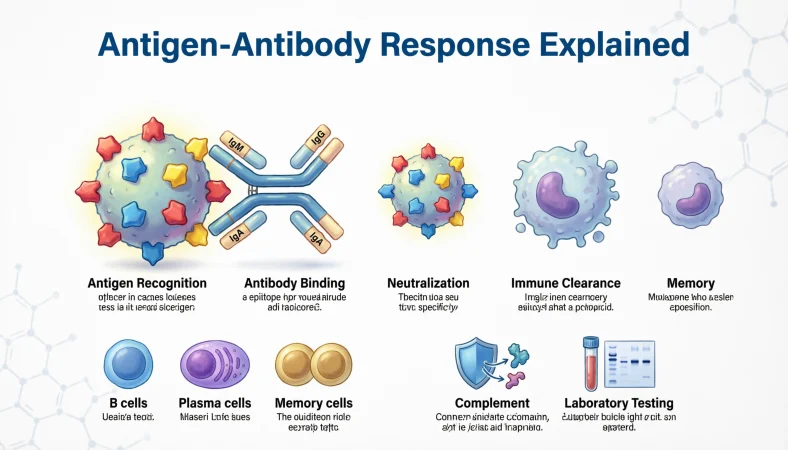
The antigen-antibody response is an immune reaction in which antibodies recognize and bind to specific antigens, helping the body identify and deal with foreign substances such as parts of pathogens.
It is a key part of adaptive immunity and helps explain how the immune system develops targeted protection.Top alternatives: immune response, antibody response, antigen recognition, humoral immune response, antigen-antibody reaction
If biology terms sometimes look like they were invented specifically to make your notes longer, welcome to the club. The antigen-antibody response becomes much easier once you break it into simple pieces: an antigen is something the immune system can recognize, while an antibody is a specialized protein that binds to a particular target.
This interaction plays an important role in defending the body and is also used in laboratory testing and medical research. Whether you are studying for an exam, reviewing immunology, making revision notes, explaining the topic to a friend, or trying to turn a complicated textbook paragraph into something understandable, knowing how to describe the response clearly matters.
From antigen recognition and antibody binding to immune memory and diagnostic tests, this guide gives you 180+ easy, memorable explanations and response-style lines.
Simple Antigen-Antibody Response Explanations:
1. Antibodies recognize specific antigens.
Example: A student uses this line when explaining the basic idea of immune recognition.
Meaning: Antibodies are designed to bind particular molecular targets.
2. An antigen can trigger an immune response.
Example: A learner uses this statement in introductory immunology notes.
Meaning: The immune system may respond when it detects a recognizable foreign substance.
3. Antibodies bind to antigens.
Example: A student gives this concise answer on a biology quiz.
Meaning: Antigen binding is central to antibody function.
4. The response is highly specific.
Example: A learner explains why one antibody does not generally bind every antigen.
Meaning: Antibody recognition depends on molecular compatibility.
5. B cells produce antibodies.
Example: A student uses this fact when reviewing humoral immunity.
Meaning: B lymphocytes and their descendants are responsible for antibody production.
6. Antibodies are proteins.
Example: A learner answers a basic question about antibody structure.
Meaning: Antibodies belong to the immunoglobulin family of proteins.
7. Antigens contain recognizable regions.
Example: A student explains why antibodies can target particular parts of a larger molecule.
Meaning: Specific regions can be recognized by immune receptors.
8. Antibody binding can help neutralize pathogens.
Example: A learner describes one protective effect of antibodies.
Meaning: Antibodies can interfere with the ability of some pathogens or toxins to cause harm.
9. Antibodies can mark targets for immune cells.
Example: A student explains how antibody binding can assist other immune mechanisms.
Meaning: Antibody-coated targets may become easier for immune cells to recognize.
10. Immune responses can create memory.
Example: A learner connects antibody responses with later protection.
Meaning: Adaptive immunity can produce long-lasting immune memory.
11. Antigen recognition starts a targeted immune process.
Example: A student summarizes how adaptive immunity responds to a foreign target.
Meaning: Recognition helps direct the immune response toward a particular antigen.
12. Antigen and antibody fit matters.
Example: A learner uses this phrase to remember why binding is selective.
Meaning: Molecular shape and chemical interactions influence whether binding occurs.
Funny Antigen-Antibody Response Lines:
1. Antibodies are basically immune system detectives.
Example: A student uses this comparison when explaining recognition to a friend.
Meaning: Antibodies help identify specific molecular targets.
2. The immune system said, “I know that shape.”
Example: A learner uses this playful line to remember antibody specificity.
Meaning: Recognition depends partly on compatible molecular structures.
3. Antibodies do not just vibe with every antigen.
Example: A student uses this casual explanation during revision.
Meaning: Antibody binding is selective rather than random.
4. Immune recognition has serious password energy.
Example: A learner compares antigen recognition with a password system.
Meaning: Only compatible molecular interactions produce effective recognition.
5. Antibodies bring receipts.
Example: A student jokes about antibody binding identifying a target.
Meaning: Antibodies provide targeted recognition rather than general detection.
6. The antigen walks in, and immunity clocks it.
Example: A learner uses this phrase as a memory trick.
Meaning: The immune system can recognize foreign molecular patterns.
7. Biology really said, “Match the shape.”
Example: A student remembers antibody specificity through this simple joke.
Meaning: Molecular compatibility contributes to antibody-antigen binding.
8. Antibody meets antigen, chemistry gets involved.
Example: A learner uses the line when remembering noncovalent interactions.
Meaning: Molecular forces help stabilize antibody-antigen binding.
9. Your immune system has a guest list.
Example: A student uses this analogy while explaining specificity.
Meaning: Immune recognition distinguishes among different molecular structures.
10. Not every antigen gets VIP access.
Example: A learner uses this phrase to remember selective binding.
Meaning: Antibodies generally recognize particular targets.
11. The immune system does not blindly hit “accept.”
Example: A student uses this line when studying immune specificity.
Meaning: Adaptive immunity relies on recognition rather than indiscriminate targeting.
12. Antibodies came prepared with target information.
Example: A learner uses this phrase as a quick revision cue.
Meaning: Antibodies have binding regions suited to particular antigens.
Professional Antigen-Antibody Response Statements:
1. The antigen-antibody response demonstrates adaptive immune specificity.
Example: A student uses this sentence in a formal biology assignment.
Meaning: The response illustrates the targeted nature of adaptive immunity.
2. Antibodies recognize specific antigenic determinants.
Example: A learner uses the statement in an immunology report.
Meaning: Antibodies bind particular regions known as epitopes.
3. Antibody binding depends on molecular complementarity.
Example: A student explains the basis of selective antigen recognition.
Meaning: Compatible structural and chemical features support binding.
4. Antibody responses are mediated by B lymphocytes.
Example: A learner includes this point in an immune-system summary.
Meaning: B cells give rise to antibody-producing cells.
5. Antibody binding can support pathogen neutralization.
Example: A student describes an important protective mechanism.
Meaning: Antibodies can prevent some pathogens or toxins from interacting with their targets.
6. Antigen recognition can promote clonal expansion.
Example: A learner discusses adaptive immune activation in an assignment.
Meaning: Activated lymphocytes can multiply and produce specialized immune cells.
7. Antibodies can facilitate immune clearance.
Example: A student explains how antibody binding can assist removal of targets.
Meaning: Antibody interactions can recruit or support other immune mechanisms.
8. Antibody production can generate memory cells.
Example: A learner explains why subsequent responses may be faster.
Meaning: Some activated B cells develop into long-lived memory cells.
9. Antigen-antibody interactions are used diagnostically.
Example: A student discusses laboratory immunoassays.
Meaning: Specific binding can help detect antigens or antibodies.
10. Antibody specificity depends on variable regions.
Example: A learner explains antibody structure in an immunology class.
Meaning: Variable regions contain binding sites that differ among antibodies.
11. The immune response involves coordinated cellular activity.
Example: A student describes antibody production within the broader immune system.
Meaning: Antibodies work alongside other immune components.
12. Antigen-antibody binding is governed by molecular interactions.
Example: A learner explains why antibody binding can be strong yet reversible.
Meaning: Multiple noncovalent forces contribute to the interaction.
Clever Antigen-Antibody Response Explanations:
1. Think of an antibody as a molecular matchmaker.
Example: A student uses this analogy to remember selective binding.
Meaning: Antibodies connect with compatible antigenic targets.
2. Epitopes are the spots antibodies recognize.
Example: A learner uses this phrase during exam revision.
Meaning: An epitope is a specific antigenic region recognized by an antibody or receptor.
3. Specificity is the star of the show.
Example: A student summarizes the defining feature of antibody recognition.
Meaning: Antibody binding is generally directed toward particular targets.
4. Binding does not automatically mean destruction.
Example: A learner corrects a misconception about antibody function.
Meaning: Antibodies can neutralize, tag, or otherwise influence targets without directly destroying them.
5. The antibody is not the whole immune response.
Example: A student explains antibody activity within adaptive immunity.
Meaning: Antibodies operate alongside cells and other immune mechanisms.
6. Recognition comes before many immune actions.
Example: A learner describes the sequence from detecting a target to responding.
Meaning: Identifying a target helps guide subsequent immune activity.
7. Shape helps determine molecular compatibility.
Example: A student uses this concept to explain antibody specificity.
Meaning: Structural complementarity influences binding.
8. Stronger binding is not simply about shape.
Example: A learner explains that chemical interactions also matter.
Meaning: Hydrogen bonds, electrostatic forces, hydrophobic interactions, and other forces can contribute.
9. Memory cells make future responses smarter.
Example: A student explains why repeat exposure can produce a faster response.
Meaning: Immune memory helps the adaptive system respond more efficiently.
10. Antibody classes have different roles.
Example: A learner compares IgM, IgG, IgA, IgE, and IgD in revision notes.
Meaning: Different immunoglobulin classes have distinct distributions and functions.
11. Immune specificity is not perfect isolation.
Example: A student explains cross-reactivity during an advanced discussion.
Meaning: Some antibodies can recognize related molecular structures.
12. Context matters in every antibody response.
Example: A learner discusses how location, antigen, and immune history influence responses.
Meaning: Immune reactions depend on more than one molecular interaction.
Educational Antigen-Antibody Response Answers:
1. An antigen is a substance recognized by the immune system.
Example: A student uses this definition in introductory biology notes.
Meaning: Antigens can contain structures recognized by immune receptors.
2. An antibody is an immunoglobulin protein.
Example: A learner defines antibodies during exam preparation.
Meaning: Antibodies are specialized proteins produced by B-cell descendants.
3. Epitopes are antigenic determinants.
Example: A student explains antibody recognition at the molecular level.
Meaning: Epitopes are specific parts of antigens recognized by antibodies.
4. B cells are central to antibody production.
Example: A learner summarizes humoral immunity.
Meaning: Activated B cells can differentiate into antibody-secreting plasma cells.
5. Plasma cells secrete antibodies.
Example: A student answers a question about where antibodies come from.
Meaning: Plasma cells are specialized antibody-producing cells.
6. Memory B cells support future responses.
Example: A learner explains adaptive immune memory.
Meaning: Memory B cells can persist and respond upon later antigen exposure.
7. Antibodies contain antigen-binding regions.
Example: A student studies antibody structure before an exam.
Meaning: Specific regions of antibodies interact with antigenic determinants.
8. The antigen-antibody response is part of humoral immunity.
Example: A learner places antibody activity within the larger adaptive immune system.
Meaning: Antibody-mediated protection is a major component of humoral immunity.
9. Antibody responses can vary over time.
Example: A student compares early and later antibody responses.
Meaning: The quantity and class of antibodies can change during an immune response.
10. Secondary responses can be faster.
Example: A learner explains the role of immune memory.
Meaning: Memory cells can support a more rapid response after repeat exposure.
11. Antibodies can recognize soluble or cell-associated targets.
Example: A student discusses different forms of antigen recognition.
Meaning: Antibody interactions can occur with targets in different biological settings.
12. Immune protection involves multiple mechanisms.
Example: A learner avoids reducing immunity to antibodies alone.
Meaning: Antibodies work alongside cellular and innate immune defenses.
Antigen-Antibody Response In Immunology:
1. Antigen recognition activates adaptive immunity.
Example: A student describes how immune cells respond to a recognized target.
Meaning: Recognition can initiate antigen-specific immune activity.
2. B-cell receptors recognize antigen before antibody secretion.
Example: A learner explains the relationship between B cells and antibodies.
Meaning: B cells use antigen receptors, and activated descendants can secrete antibodies with related specificity.
3. Helper T cells can support B-cell activation.
Example: A student discusses antibody responses to protein antigens.
Meaning: T-cell help is important for many antibody responses.
4. Class switching changes antibody isotype.
Example: A learner explains why a B cell can produce different antibody classes.
Meaning: Class-switch recombination changes the antibody constant region while preserving antigen specificity.
5. Somatic hypermutation can refine antibody binding.
Example: A student studies affinity maturation.
Meaning: Mutations in antibody variable regions can produce variants with altered affinity.
6. Affinity maturation can improve antibody binding.
Example: A learner describes changes during germinal-center reactions.
Meaning: Selection can favor B cells producing antibodies with higher affinity for antigen.
7. Germinal centers support B-cell maturation.
Example: A student explains where important antibody refinement occurs.
Meaning: Germinal centers provide an environment for processes including somatic hypermutation and selection.
8. Antibodies can activate complement.
Example: A learner explains one mechanism of antibody-mediated defense.
Meaning: Certain antibody-antigen complexes can initiate complement pathways.
9. Antibodies can promote opsonization.
Example: A student explains how antibody coating can help phagocytes recognize targets.
Meaning: Opsonization facilitates immune-cell uptake of marked material.
10. Neutralization blocks harmful interactions.
Example: A learner describes antibodies binding a toxin or viral surface protein.
Meaning: Antibodies can prevent targets from interacting with host cells.
11. Antibody-dependent cellular cytotoxicity involves immune cells.
Example: A student reviews antibody-mediated killing mechanisms.
Meaning: Certain immune cells can recognize antibody-coated targets through Fc receptors.
12. Antibody function depends on its class and context.
Example: A learner compares antibodies found in blood and mucosal tissues.
Meaning: Different immunoglobulin classes have specialized biological roles.
Antigen-Antibody Response In Simple Terms:
1. Antigen means recognizable target.
Example: A student uses this phrase to remember the basic definition.
Meaning: An antigen contains features the immune system can recognize.
2. Antibody means targeted immune protein.
Example: A learner uses this phrase for quick revision.
Meaning: Antibodies bind specific antigenic structures.
3. The immune system spots the target.
Example: A student summarizes antigen recognition for a beginner.
Meaning: Immune receptors identify molecular features.
4. The antibody attaches to the antigen.
Example: A learner explains the basic binding step.
Meaning: Antigen-antibody interaction occurs through compatible binding sites.
5. The antibody can block the target.
Example: A student describes neutralization in simple language.
Meaning: Binding can prevent certain pathogens or toxins from acting.
6. The antibody can label the target.
Example: A learner explains opsonization without technical jargon.
Meaning: Antibody coating can make targets easier for immune cells to detect.
7. The immune system can remember previous exposure.
Example: A student explains why adaptive immunity can respond differently the second time.
Meaning: Memory cells help maintain antigen-specific immune memory.
8. Not every antibody recognizes every antigen.
Example: A learner explains specificity to a beginner.
Meaning: Antibodies have selective binding properties.
9. Some antibodies remain in circulation.
Example: A student explains how immune protection can persist after an immune response.
Meaning: Long-lived plasma cells can maintain antibody production.
10. Some immune cells become memory cells.
Example: A learner explains long-term adaptive immunity.
Meaning: Memory cells can persist after the initial response.
11. Antibody binding is reversible.
Example: A student discusses molecular interactions at the binding site.
Meaning: Antigen-antibody interactions rely largely on noncovalent forces.
12. The whole process is highly coordinated.
Example: A learner summarizes the antigen-antibody response before an exam.
Meaning: Antibody activity depends on cooperation among multiple immune mechanisms.
Antigen-Antibody Response And Immune Memory:
1. Immune memory can improve future responses.
Example: A student explains why adaptive immunity can react efficiently after repeat exposure.
Meaning: Memory cells preserve antigen-specific information.
2. Memory B cells can persist after activation.
Example: A learner describes long-term B-cell responses.
Meaning: Memory B cells can remain available for later antigen encounters.
3. Long-lived plasma cells can maintain antibodies.
Example: A student explains persistent antibody levels after an immune response.
Meaning: Some plasma cells continue secreting antibodies for extended periods.
4. Secondary responses can differ from primary responses.
Example: A learner compares first exposure with later exposure to the same antigen.
Meaning: Immune memory can alter the speed and magnitude of subsequent responses.
5. Memory is antigen-specific.
Example: A student explains why exposure to one antigen does not create identical memory for every antigen.
Meaning: Adaptive memory is directed toward previously encountered targets.
6. Antibody affinity can improve after activation.
Example: A learner studies affinity maturation during a secondary response.
Meaning: Selection can favor B cells producing antibodies with improved antigen binding.
7. Memory supports adaptive protection.
Example: A student summarizes the long-term benefit of B-cell memory.
Meaning: Memory allows the immune system to respond more efficiently to familiar targets.
8. Antibody levels can change over time.
Example: A learner explains why measurable antibody concentrations are not always constant.
Meaning: Production and persistence depend on the immune response and individual factors.
9. Different antibody classes can appear during an immune response.
Example: A student compares early IgM with later IgG responses.
Meaning: Class switching can change the antibody isotype produced.
10. Memory does not mean permanent immunity in every case.
Example: A learner avoids oversimplifying immune protection.
Meaning: The duration and strength of protection vary by antigen and immune context.
11. Immune memory is a feature of adaptive immunity.
Example: A student distinguishes adaptive memory from immediate innate defenses.
Meaning: Adaptive responses can retain antigen-specific information.
12. Memory helps explain repeat-response behavior.
Example: A learner uses this concept in an immunology exam answer.
Meaning: Previous exposure can influence later antibody responses.
Antigen-Antibody Response And Antibody Classes:
1. IgM is commonly produced early in many primary responses.
Example: A student reviews the typical sequence of antibody production.
Meaning: IgM is often an early antibody isotype during initial immune responses.
2. IgG is abundant in blood and tissues.
Example: A learner studies the distribution of major antibody classes.
Meaning: IgG is an important systemic antibody isotype.
3. IgA is important at mucosal surfaces.
Example: A student explains antibody protection in respiratory or intestinal secretions.
Meaning: IgA contributes to mucosal immune defense.
4. IgE is associated with allergic responses and parasites.
Example: A learner reviews antibody classes for an immunology test.
Meaning: IgE participates in responses involving mast cells and certain parasitic infections.
5. IgD is primarily associated with B-cell surfaces.
Example: A student studies immunoglobulin distribution.
Meaning: IgD functions largely as a B-cell receptor isotype.
6. Antibody classes have different constant regions.
Example: A learner compares IgG with IgA.
Meaning: Constant-region differences influence antibody function and distribution.
7. Class switching changes antibody function.
Example: A student explains how activated B cells alter antibody isotype.
Meaning: Switching changes the constant region while generally preserving antigen specificity.
8. Isotype does not simply mean different target.
Example: A learner clarifies a common misconception about antibody classes.
Meaning: Different isotypes can retain specificity for the same antigen while performing different functions.
9. IgG can cross the placenta.
Example: A student explains passive maternal antibody transfer.
Meaning: Maternal IgG can provide temporary protection to a fetus and newborn.
10. IgA can appear in secretions.
Example: A learner discusses mucosal immune defense.
Meaning: Secretory IgA helps protect mucosal surfaces.
11. IgM is often effective at complement activation.
Example: A student explains why antibody structure affects function.
Meaning: IgM can efficiently activate the classical complement pathway when bound appropriately.
12. Antibody class helps determine biological role.
Example: A learner compares antibodies found in different body compartments.
Meaning: Immunoglobulin isotypes are specialized for different immune environments.
Antigen-Antibody Response And Laboratory Testing:
1. Antigen-antibody binding can be measured in the laboratory.
Example: A student explains the principle behind an immunoassay.
Meaning: Specific molecular interactions can be used for detection.
2. Immunoassays rely on specific binding.
Example: A learner studies diagnostic laboratory methods.
Meaning: Antibodies can help identify particular antigens or antibodies.
3. ELISA uses antigen-antibody interactions.
Example: A student describes a common laboratory testing method.
Meaning: ELISA can detect or quantify specific biological molecules using immunological binding.
4. Diagnostic tests may detect antigens.
Example: A learner explains how some tests identify pathogen components.
Meaning: Antigen detection looks for specific molecular material.
5. Diagnostic tests may detect antibodies.
Example: A student discusses serological testing.
Meaning: Antibody tests can indicate an immune response to a particular antigen.
6. Specificity matters in laboratory testing.
Example: A learner explains why test design requires careful antibody selection.
Meaning: Specific binding helps distinguish intended targets from unrelated molecules.
7. Sensitivity and specificity are different concepts.
Example: A student compares diagnostic test characteristics.
Meaning: Sensitivity concerns detecting true positives, while specificity concerns correctly identifying true negatives.
8. Controls help validate laboratory assays.
Example: A learner explains why positive and negative controls are included.
Meaning: Controls help determine whether a test performed as expected.
9. Antibody binding can produce a measurable signal.
Example: A student describes color or fluorescence in an immunoassay.
Meaning: Detection systems convert molecular binding into a measurable output.
10. Cross-reactivity can affect test results.
Example: A learner explains why closely related targets may sometimes complicate interpretation.
Meaning: An antibody can occasionally bind a structurally similar unintended target.
11. Laboratory results require context.
Example: A student explains why an antibody test should not be interpreted in isolation.
Meaning: Test results must be considered alongside timing, clinical context, and test characteristics.
12. Immunological testing depends on molecular recognition.
Example: A learner summarizes the basic principle of antibody-based diagnostics.
Meaning: Specific immune binding forms the foundation of many laboratory assays.
Antigen-Antibody Response And Neutralization:
1. Neutralization can block pathogen attachment.
Example: A student explains how antibodies may interfere with viral entry.
Meaning: Binding can prevent a pathogen from interacting with host-cell receptors.
2. Antibodies can neutralize some toxins.
Example: A learner describes antibodies binding harmful molecules.
Meaning: Antibody binding can prevent toxins from reaching or interacting with their cellular targets.
3. Neutralizing antibodies target functional sites.
Example: A student explains why antibodies can stop a pathogen from performing a key function.
Meaning: Binding to important regions can interfere with biological activity.
4. Neutralization does not require direct destruction.
Example: A learner corrects a misconception during an immunology lesson.
Meaning: Antibodies can protect by blocking function rather than physically destroying the target.
5. Antibody specificity supports targeted neutralization.
Example: A student explains why antibodies need compatible binding sites.
Meaning: Effective neutralization depends on binding the relevant target.
6. Neutralization can occur before cell entry.
Example: A learner describes antibody protection against extracellular viral particles.
Meaning: Antibodies can bind free pathogens before they reach host cells.
7. Toxin neutralization can protect tissues.
Example: A student explains antibody protection against certain bacterial toxins.
Meaning: Antibodies can prevent toxins from binding their cellular targets.
8. Neutralization is one antibody function among several.
Example: A learner lists neutralization alongside opsonization and complement activation.
Meaning: Antibodies have multiple mechanisms of action.
9. Antibody concentration can influence protection.
Example: A student discusses how antibody abundance may affect target binding.
Meaning: More available antibody can increase opportunities for antigen recognition, although protection depends on many factors.
10. Neutralizing antibodies are often studied in infectious disease research.
Example: A learner discusses how researchers evaluate protective immune responses.
Meaning: Neutralization can provide evidence about whether antibodies interfere with pathogen function.
11. Neutralization depends on antibody-target compatibility.
Example: A student explains why not every antibody blocks the same pathogen.
Meaning: Only antibodies targeting relevant functional regions may neutralize effectively.
12. Neutralization is a targeted defense strategy.
Example: A learner summarizes the concept in an exam response.
Meaning: Antibodies can reduce harm by preventing specific molecular interactions.
Antigen-Antibody Response And Complement:
1. Complement is part of the immune defense system.
Example: A student introduces complement while explaining antibody-mediated immunity.
Meaning: Complement proteins contribute to pathogen defense and inflammation.
2. Some antibodies can activate complement.
Example: A learner explains the classical complement pathway.
Meaning: Certain antigen-bound antibodies can initiate complement activation.
3. IgM can efficiently activate classical complement.
Example: A student compares complement activation by different antibody classes.
Meaning: The structure of IgM makes it particularly effective in this pathway when appropriately bound.
4. Some IgG subclasses can activate complement.
Example: A learner discusses differences among antibody isotypes.
Meaning: Complement activation varies by antibody subclass and context.
5. Complement can enhance opsonization.
Example: A student explains how complement fragments can mark targets.
Meaning: Complement components can make pathogens easier for phagocytes to recognize.
6. Complement can contribute to inflammation.
Example: A learner explains one consequence of complement activation.
Meaning: Complement fragments can promote inflammatory signaling.
7. Complement activation is regulated.
Example: A student explains why immune activation must be controlled.
Meaning: Regulatory mechanisms limit damage to healthy tissues.
8. Antibody and complement can cooperate.
Example: A learner describes how adaptive and innate mechanisms interact.
Meaning: Antibody binding can recruit complement-mediated effects.
9. Complement is not an antibody.
Example: A student separates the two concepts during revision.
Meaning: Complement consists mainly of plasma and membrane-associated proteins rather than immunoglobulins.
10. Complement contributes to pathogen clearance.
Example: A learner describes how complement supports immune defense.
Meaning: Complement can promote opsonization, inflammation, and in some cases membrane attack.
11. Classical complement activation involves antigen-bound antibodies.
Example: A student explains the starting point of the classical pathway.
Meaning: Complement recognition can occur when appropriate antibodies are bound to antigen.
12. Antibody-complement cooperation strengthens immune defense.
Example: A learner summarizes adaptive and innate immune interaction.
Meaning: Multiple immune mechanisms can work together against a target.
Antigen-Antibody Response And Specificity:
1. Specificity is a defining antibody feature.
Example: A student explains why antibodies target particular antigens.
Meaning: Antibody binding sites have selective molecular recognition properties.
2. Epitopes determine what antibodies can recognize.
Example: A learner studies antibody-antigen interactions.
Meaning: Antibodies bind specific antigenic determinants.
3. One antigen can contain multiple epitopes.
Example: A student explains why different antibodies can recognize the same antigen.
Meaning: A larger antigen may present several distinct antibody-binding regions.
4. Different antibodies can recognize different epitopes.
Example: A learner discusses polyclonal responses.
Meaning: Multiple antibodies can target separate regions of one antigen.
5. Monoclonal antibodies recognize a specific epitope.
Example: A student explains why monoclonal antibodies are highly targeted.
Meaning: A monoclonal antibody population originates from one B-cell clone and typically recognizes one epitope.
6. Polyclonal antibodies can recognize multiple epitopes.
Example: A learner compares laboratory antibody preparations.
Meaning: Polyclonal preparations contain antibodies produced by multiple B-cell clones.
7. Cross-reactivity can occur.
Example: A student explains why related molecules may sometimes bind the same antibody.
Meaning: Structural similarity can occasionally result in recognition of more than one target.
8. Affinity describes binding strength.
Example: A learner defines affinity during an immunology review.
Meaning: Affinity refers to the strength of interaction between one antibody binding site and its antigenic epitope.
9. Avidity considers multiple interactions.
Example: A student compares antibody binding concepts.
Meaning: Avidity reflects the overall strength of multivalent interactions.
10. Molecular shape contributes to recognition.
Example: A learner explains the importance of complementary surfaces.
Meaning: Structural compatibility supports antibody-antigen binding.
11. Chemical forces also matter.
Example: A student explains why shape alone does not tell the whole story.
Meaning: Multiple noncovalent interactions stabilize antibody-antigen complexes.
12. Specificity makes targeted immune defense possible.
Example: A learner summarizes the importance of antibody recognition.
Meaning: Selective binding allows the immune system to focus responses on particular targets.
Clinical And Practical Antigen-Antibody Response Statements:
1. Antibody testing can provide evidence of immune exposure.
Example: A student describes the purpose of serological testing.
Meaning: Detecting specific antibodies can indicate an immune response to a particular antigen.
2. Antigen testing looks for target molecules.
Example: A learner explains the difference between antigen and antibody tests.
Meaning: Antigen assays seek components of the target itself.
3. Antibody levels can vary over time.
Example: A student explains why testing results may depend on timing.
Meaning: Immune responses change as exposure progresses.
4. Timing matters when interpreting immune tests.
Example: A learner explains why an early test can differ from a later test.
Meaning: Antigen and antibody levels can change during an immune response.
5. A positive antibody result has context.
Example: A student explains why a laboratory result should be interpreted alongside other information.
Meaning: Test meaning depends on assay characteristics, timing, and circumstances.
6. Antigen detection and antibody detection answer different questions.
Example: A learner compares two types of laboratory tests.
Meaning: One searches for target material, while the other searches for an immune response.
7. Antibody responses can be used in research.
Example: A student discusses immune monitoring in a laboratory study.
Meaning: Antibody measurements can help researchers study immune activity.
8. Monoclonal antibodies have many practical applications.
Example: A learner studies laboratory and therapeutic uses of antibody technology.
Meaning: Highly specific antibodies can be used for detection, research, and certain medical treatments.
9. Immune complexes can have biological effects.
Example: A student discusses what can happen when antibodies bind soluble antigens.
Meaning: Antigen-antibody complexes can interact with immune pathways.
10. Antibody function depends on more than concentration.
Example: A learner explains why quantity alone does not fully describe protection.
Meaning: Specificity, affinity, isotype, location, and other factors influence antibody activity.
11. Immune responses differ among individuals.
Example: A student avoids assuming every person develops identical antibody levels.
Meaning: Immune responses can vary due to biological and environmental factors.
12. Antigen-antibody interactions have broad scientific applications.
Example: A learner summarizes their importance in diagnostics and research.
Meaning: Specific immune binding is useful far beyond basic immune defense.
Exam-Friendly Antigen-Antibody Response Answers:
1. Define the antigen-antibody response as specific immune recognition.
Example: A student uses this sentence for a short-answer examination.
Meaning: It captures the central relationship between antigens and antibodies.
2. Mention antibody production by B cells.
Example: A learner answers a question about humoral immunity.
Meaning: B-cell descendants produce antibodies.
3. Include antigenic determinants in detailed answers.
Example: A student adds the term epitope to an immunology response.
Meaning: Epitopes are the regions recognized by antibodies.
4. Explain antibody specificity.
Example: A learner answers why antibodies do not bind every antigen.
Meaning: Antibody binding sites have selective molecular compatibility.
5. Mention neutralization as one function.
Example: A student lists antibody-mediated protection mechanisms.
Meaning: Antibodies can block certain pathogens or toxins.
6. Mention opsonization as another function.
Example: A learner explains how antibodies assist immune-cell recognition.
Meaning: Antibody coating can facilitate phagocytic clearance.
7. Mention complement activation where relevant.
Example: A student answers an advanced question about antibody effects.
Meaning: Certain antigen-bound antibodies can activate the classical complement pathway.
8. Explain immune memory.
Example: A learner discusses why repeat exposure can trigger a different response.
Meaning: Memory B cells and long-lived plasma cells can contribute to lasting immunity.
9. Distinguish primary and secondary responses.
Example: A student compares first exposure with later exposure.
Meaning: Secondary responses can be faster and stronger because of immune memory.
10. Use precise immunology vocabulary.
Example: A learner uses terms such as epitope, specificity, affinity, and isotype correctly.
Meaning: Accurate terminology makes scientific answers clearer.
11. Avoid saying antibodies destroy everything directly.
Example: A student corrects an oversimplified exam statement.
Meaning: Antibodies often work by neutralizing or marking targets and recruiting other mechanisms.
12. End with the main biological purpose.
Example: A learner concludes a long answer by connecting antibody recognition to protection.
Meaning: The response helps the immune system target potentially harmful substances.
Advanced Antigen-Antibody Response Concepts:
1. Affinity refers to the strength of a single binding interaction.
Example: A student distinguishes affinity from overall multivalent binding.
Meaning: Affinity describes the interaction between one antibody binding site and one epitope.
2. Avidity reflects combined binding strength.
Example: A learner compares IgM with monovalent interactions.
Meaning: Avidity considers the total strength of multiple simultaneous interactions.
3. Antibody affinity can change through maturation.
Example: A student studies germinal-center reactions.
Meaning: Somatic hypermutation and selection can produce antibodies with improved affinity.
4. Fc regions influence antibody function.
Example: A learner explains why antibodies do more than simply bind antigen.
Meaning: Fc regions interact with immune receptors and complement components.
5. Fab regions contain antigen-binding sites.
Example: A student reviews antibody structure.
Meaning: Fab portions contain the variable regions responsible for antigen recognition.
6. Variable regions determine specificity.
Example: A learner explains differences among antibody binding sites.
Meaning: Variable-region sequences create diverse antigen-recognition capabilities.
7. Constant regions influence effector functions.
Example: A student compares antibody isotypes.
Meaning: Constant-region differences affect interactions with immune cells and complement.
8. Antibody binding can be reversible.
Example: A learner studies molecular equilibrium in antigen-antibody interactions.
Meaning: Noncovalent interactions can form and dissociate depending on conditions.
9. Equilibrium influences antibody binding.
Example: A student examines how association and dissociation affect complexes.
Meaning: Antigen-antibody binding reflects dynamic molecular interactions.
10. Structural complementarity affects affinity.
Example: A learner explains why some antibodies bind more strongly than others.
Meaning: Better molecular compatibility can increase interaction strength.
11. Epitope accessibility matters.
Example: A student explains why an antibody may bind a target differently depending on its structure.
Meaning: A hidden or inaccessible epitope may be harder for an antibody to reach.
12. Antigen-antibody interactions are dynamic.
Example: A learner summarizes advanced binding concepts.
Meaning: Immune complexes form through continuously changing molecular interactions.
Creative Ways To Remember The Antigen-Antibody Response:
1. Remember it as “target meets match.”
Example: A student uses the phrase before an immunology exam.
Meaning: The antigen is the target and the antibody provides specific recognition.
2. Think “recognize, bind, respond.”
Example: A learner memorizes the basic sequence with three words.
Meaning: Recognition leads to antigen binding and downstream immune effects.
3. Use the lock-and-key analogy carefully.
Example: A student uses the analogy to remember specificity.
Meaning: It illustrates compatibility, although real molecular binding is more dynamic.
4. Remember “B cells build antibodies.”
Example: A learner uses alliteration as a revision trick.
Meaning: B-cell descendants produce antibody proteins.
5. Think “epitope equals target spot.”
Example: A student memorizes the definition before a test.
Meaning: An epitope is the specific region recognized by an antibody.
6. Remember “IgA likes mucosal areas.”
Example: A learner connects IgA with secretions and mucosal surfaces.
Meaning: IgA is a major antibody at mucosal barriers.
7. Remember “IgG goes systemic.”
Example: A student recalls the major distribution of IgG.
Meaning: IgG is prominent in blood and extracellular tissues.
8. Remember “IgM often appears early.”
Example: A learner reviews the typical primary response sequence.
Meaning: IgM is commonly the first antibody isotype produced during a primary response.
9. Remember “memory means faster.”
Example: A student summarizes secondary immune responses.
Meaning: Memory cells can enable a more rapid response to familiar antigens.
10. Remember “neutralize or tag.”
Example: A learner recalls two major antibody functions.
Meaning: Antibodies can block targets or mark them for other immune mechanisms.
11. Remember “specific does not mean perfect.”
Example: A student recalls the possibility of cross-reactivity.
Meaning: Antibodies can sometimes recognize structurally related targets.
12. Remember “antibodies cooperate.”
Example: A learner summarizes antibody interaction with complement and immune cells.
Meaning: Antibodies are one part of a broader immune defense network.
Common Antigen-Antibody Response Misconceptions:
1. Antibodies do not recognize every antigen.
Example: A student corrects the idea that all antibodies are universal defenders.
Meaning: Antibody binding is generally antigen-specific.
2. Antibodies do not always directly kill pathogens.
Example: A learner explains the difference between neutralization and cellular destruction.
Meaning: Antibodies can recruit other immune mechanisms.
3. An antigen is not always an entire pathogen.
Example: A student explains why pathogen components can also be antigenic.
Meaning: Specific molecular structures within pathogens can be recognized by the immune system.
4. Antibodies are not immune cells.
Example: A learner distinguishes antibodies from B lymphocytes.
Meaning: Antibodies are proteins produced by specialized cells.
5. Antibody binding is not purely a shape puzzle.
Example: A student explains the role of chemical interactions.
Meaning: Multiple molecular forces influence binding.
6. More antibodies do not automatically mean complete protection.
Example: A learner avoids making a simple assumption about antibody levels.
Meaning: Protection depends on specificity, function, location, timing, and other factors.
7. Immune memory is not identical to permanent immunity.
Example: A student explains why protection can vary over time.
Meaning: The durability of immune protection depends on the antigen and immune response.
8. IgM and IgG are not interchangeable.
Example: A learner compares their biological roles.
Meaning: Different antibody classes have different structures and functions.
9. Antigen tests and antibody tests are different.
Example: A student explains two laboratory testing approaches.
Meaning: One detects target material while the other detects an immune response.
10. Cross-reactivity is possible.
Example: A learner explains why an antibody may sometimes recognize a related molecule.
Meaning: Structural similarity can produce unintended binding.
11. One antigen can have multiple epitopes.
Example: A student explains how multiple antibodies can bind different regions of one antigen.
Meaning: Complex antigens may contain several distinct antigenic determinants.
12. The antigen-antibody response is not the entire immune system.
Example: A learner places antibody activity within innate and adaptive immunity.
Meaning: Immune defense involves many coordinated mechanisms.
FAQs:
What does antigen-antibody response mean?
The antigen-antibody response describes the specific interaction between antigens and antibodies as part of adaptive immunity. Antibodies recognize and bind particular antigenic regions.
What is the basic antigen-antibody response?
In simple terms, the immune system recognizes an antigen, B-cell responses lead to antibody production, and antibodies bind specific antigenic targets. The binding can contribute to neutralization, tagging, complement activation, or other immune effects.
Is the antigen-antibody response emotional or flirty?
No. This is a biological and immunological term. It is not a phrase used to communicate romantic or emotional feelings.
Is antigen-antibody response used professionally?
Yes. The term is widely appropriate in biology, immunology, laboratory science, medicine, research, and academic writing.
What if I do not fully understand the term?
Break it into two words. Think of antigen as the recognizable target and antibody as the specific immune protein that can bind it.
Can humor be used when explaining antigen-antibody response?
Absolutely, especially for study notes or social educational content. Humor can make terminology easier to remember, as long as the scientific meaning remains accurate.
What is the difference between an antigen and an antibody?
An antigen is a substance or molecular structure recognized by the immune system, while an antibody is an immunoglobulin protein produced by B-cell descendants that can specifically bind an antigen.
What happens when an antibody binds an antigen?
Binding can produce several effects depending on the situation, including neutralization, opsonization, complement activation, or formation of immune complexes.
Why is antibody specificity important?
Specificity allows antibodies to recognize particular molecular targets rather than reacting equally with everything they encounter.
Do antibodies destroy antigens?
Not necessarily. Antibodies can block, neutralize, or mark targets and can recruit other immune mechanisms that help clear them.
Conclusion:
The antigen-antibody response may sound like one of those biology terms that demands a full study session, but the core idea is surprisingly simple: the immune system recognizes a target, antibodies bind specific antigenic regions, and that interaction can help coordinate protection. Once you understand concepts such as specificity, epitopes, neutralization, immune memory, antibody classes, and laboratory detection, the topic becomes much easier to explain.
Use the short response lines in this guide for revision, assignments, study notes, presentations, or quick exam preparation. Save this list for your next immunology study session, share it with someone who is battling biology vocabulary, and keep learning one immune concept at a time.