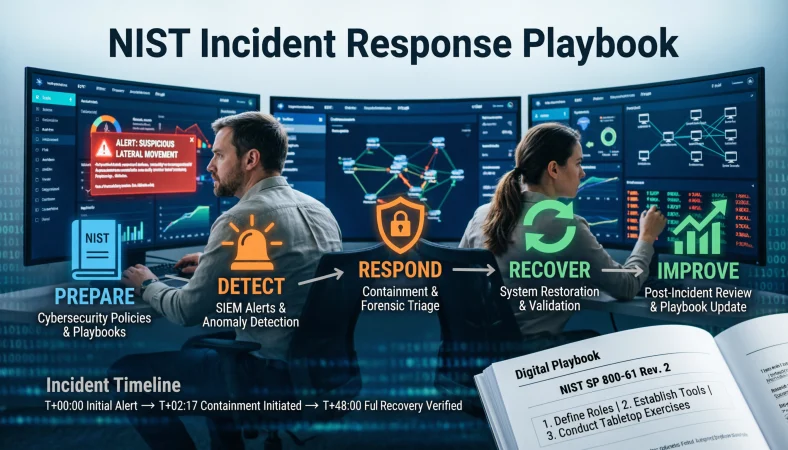
A NIST incident response playbook is a practical set of documented actions that helps teams handle specific cybersecurity incidents consistently. NIST’s current incident response guidance is SP 800-61 Rev. 3, finalized in April 2025, which superseded Rev. 2 and aligns incident response with the NIST Cybersecurity Framework 2.0.
Top alternatives: NIST incident response plan, cybersecurity incident response playbook, NIST IR playbook, incident handling playbook, security incident response procedure
When a security incident hits, nobody wants the team staring at each other like a group chat that suddenly went silent. A well-designed nist incident response playbook gives people practical actions, responsibilities, escalation points, and decision guidance before the pressure arrives. NIST’s current SP 800-61 Rev.
3 treats incident response as part of broader cybersecurity risk management and organizes response around Detect, Respond, and Recover, supported by preparation activities and continuous improvement. A playbook can make those ideas easier to apply to specific situations such as ransomware, phishing, compromised accounts, malware, or data exposure.
Whether you work in a SOC, IT team, compliance department, or security program, the right playbook helps turn uncertainty into a repeatable process. The goal is not to predict every possible attack. It is to make the next important action much easier to identify.
NIST Incident Response Playbook Basics
“Define the incident before defining the response.”
Example: Use this when creating the opening section of a new playbook.
Meaning: It establishes a clear understanding of what the procedure is designed to address.
“Give the team a repeatable response path.”
Example: Use this when explaining why an organization needs playbooks.
Meaning: It emphasizes consistency during stressful incidents.
“Document actions people can actually perform.”
Example: Use this when reviewing a technical response procedure.
Meaning: It keeps the playbook practical instead of theoretical.
“Make responsibilities obvious.”
Example: Use this when assigning incident response roles.
Meaning: It reduces confusion about who should act.
“Start with preparation.”
Example: Use this when introducing incident response planning.
Meaning: It highlights readiness before an incident occurs.
“Detect, respond, recover, improve.”
Example: Use this as a memorable summary of the response lifecycle.
Meaning: It captures the core operational flow and continuous learning.
“Write for the person working at 2 a.m.”
Example: Use this when reviewing whether a playbook is easy to follow.
Meaning: It encourages simple instructions that work under pressure.
“Every playbook needs a clear trigger.”
Example: Use this when defining when a procedure should begin.
Meaning: It prevents uncertainty about when to activate the workflow.
“Keep escalation paths visible.”
Example: Use this when documenting incident ownership.
Meaning: It helps responders know when and where to escalate.
“Separate required actions from optional investigation.”
Example: Use this when simplifying a complex response procedure.
Meaning: It helps responders prioritize urgent work.
“Make the next action easy to find.”
Example: Use this when designing playbook pages.
Meaning: It improves usability during high-pressure events.
“A playbook should reduce guesswork.”
Example: Use this when explaining its operational purpose.
Meaning: It connects documentation with faster decision-making.
Funny NIST Incident Response Playbook Ideas
“Because panic is not an incident response strategy.”
Example: Use this as a light introduction to a security awareness presentation.
Meaning: It humorously reinforces the value of preparation.
“When the alert screams, check the playbook.”
Example: Use this in a SOC training slide.
Meaning: It encourages responders to follow established procedures.
“The incident has entered the group chat.”
Example: Use this in an internal security awareness post.
Meaning: It humorously signals that coordinated action is needed.
“Keep calm and investigate the evidence.”
Example: Use this as a cybersecurity poster phrase.
Meaning: It encourages measured investigation.
“No improvisation Olympics today.”
Example: Use this when reminding teams to follow documented procedures.
Meaning: It discourages unnecessary guesswork.
“Your future self wrote this playbook for a reason.”
Example: Use this when encouraging documentation.
Meaning: It highlights the value of preparation.
“Incident detected. Brain cells activated.”
Example: Use this for informal SOC training content.
Meaning: It adds humor to the transition from alert to investigation.
“The alert is loud. The response should be organized.”
Example: Use this when explaining incident coordination.
Meaning: It contrasts urgency with disciplined action.
“Cybersecurity chaos called. We sent the playbook.”
Example: Use this in a security team presentation.
Meaning: It presents the playbook as a stabilizing resource.
“Screenshots are not a response plan.”
Example: Use this when discussing weak incident documentation.
Meaning: It humorously emphasizes structured procedures.
“First rule of incident club: know who owns the next step.”
Example: Use this during incident response training.
Meaning: It highlights accountability.
“If everyone is responsible, nobody is responsible.”
Example: Use this when discussing unclear incident ownership.
Meaning: It reinforces the importance of assigned roles.
Professional NIST Incident Response Playbook Examples
“Establish documented incident response procedures.”
Example: Use this in a cybersecurity governance document.
Meaning: It emphasizes formalized response processes.
“Define incident response roles and responsibilities.”
Example: Use this when building an organizational response plan.
Meaning: It establishes accountability.
“Document incident prioritization criteria.”
Example: Use this when creating severity guidance.
Meaning: It helps teams determine which incidents require urgent attention.
“Establish clear escalation requirements.”
Example: Use this when designing incident workflows.
Meaning: It defines when incidents should move to higher-level support.
“Maintain current response procedures.”
Example: Use this during security program reviews.
Meaning: It recognizes that outdated procedures can reduce effectiveness.
“Integrate incident response with cybersecurity risk management.”
Example: Use this in an executive security strategy.
Meaning: It reflects NIST’s current approach to incident response.
“Define communication responsibilities before incidents occur.”
Example: Use this when creating an incident communications plan.
Meaning: It prevents communication confusion during an event.
“Establish recovery decision points.”
Example: Use this when documenting incident recovery procedures.
Meaning: It identifies when recovery actions should begin.
“Document lessons learned after significant incidents.”
Example: Use this during post-incident planning.
Meaning: It turns experience into future improvement.
“Test documented procedures periodically.”
Example: Use this when creating an exercise program.
Meaning: It verifies that procedures remain practical.
“Align procedures with organizational risk.”
Example: Use this during playbook development.
Meaning: It keeps response priorities connected to business impact.
“Maintain evidence and documentation requirements.”
Example: Use this when developing investigation procedures.
Meaning: It supports consistent incident analysis and reporting.
NIST Incident Response Playbook For Preparation
“Identify critical assets before an incident.”
Example: Use this when preparing an enterprise response program.
Meaning: It gives responders context about what matters most.
“Know your important systems.”
Example: Use this when building asset inventories.
Meaning: It helps responders prioritize affected technology.
“Define response authorities.”
Example: Use this when documenting who can isolate or shut down systems.
Meaning: It prevents authorization delays during incidents.
“Maintain current contact information.”
Example: Use this when preparing an emergency response directory.
Meaning: It helps teams reach the right people quickly.
“Create scenario-specific procedures.”
Example: Use this when developing ransomware or phishing playbooks.
Meaning: It makes guidance more actionable.
“Identify external support contacts.”
Example: Use this when preparing for incidents that may require outside assistance.
Meaning: It ensures important contacts are available before an emergency.
“Define severity levels.”
Example: Use this when designing incident classification.
Meaning: It creates a common language for prioritization.
“Prepare communication templates.”
Example: Use this when developing incident communications.
Meaning: It reduces writing delays during stressful situations.
“Document required approvals.”
Example: Use this when creating response decision trees.
Meaning: It clarifies which actions require authorization.
“Practice the procedure.”
Example: Use this when organizing tabletop exercises.
Meaning: It exposes gaps before a real incident.
“Review the playbook after exercises.”
Example: Use this after completing a simulation.
Meaning: It turns testing into practical improvement.
“Keep preparation connected to risk.”
Example: Use this during annual security planning.
Meaning: It keeps readiness focused on meaningful threats.
NIST Incident Response Playbook For Detection
“Define what qualifies as a security event.”
Example: Use this when creating detection guidance.
Meaning: It establishes a common starting point.
“Document alert sources.”
Example: Use this when mapping security monitoring systems.
Meaning: It helps responders understand where signals originate.
“Record the initial detection time.”
Example: Use this during incident triage.
Meaning: It establishes an important timeline point.
“Preserve the original alert context.”
Example: Use this when investigating a suspicious notification.
Meaning: It keeps useful evidence available.
“Validate before escalating.”
Example: Use this when designing alert triage procedures.
Meaning: It reduces unnecessary escalation.
“Escalate when defined severity thresholds are met.”
Example: Use this when creating detection workflows.
Meaning: It connects detection with consistent prioritization.
“Identify the affected asset.”
Example: Use this when responding to an endpoint alert.
Meaning: It establishes the immediate scope.
“Identify the affected account.”
Example: Use this when investigating suspicious identity activity.
Meaning: It adds user context to the incident.
“Capture relevant timestamps.”
Example: Use this during initial investigation.
Meaning: It supports timeline development.
“Record the evidence used for classification.”
Example: Use this when documenting triage decisions.
Meaning: It makes incident decisions easier to review.
“Distinguish events from confirmed incidents.”
Example: Use this when explaining incident classification.
Meaning: It prevents every alert from being treated identically.
“Move confirmed incidents into the response workflow.”
Example: Use this when closing the detection stage.
Meaning: It creates a clear transition into response.
NIST Incident Response Playbook For Analysis
“Start with the available evidence.”
Example: Use this when an alert becomes a confirmed incident.
Meaning: It keeps the investigation evidence-focused.
“Build a timeline.”
Example: Use this when analyzing suspicious activity.
Meaning: It helps responders understand sequence and progression.
“Identify affected systems.”
Example: Use this during incident scoping.
Meaning: It establishes the potential impact area.
“Identify affected accounts.”
Example: Use this during identity-related investigations.
Meaning: It helps connect activity to users or credentials.
“Review related events.”
Example: Use this when investigating a suspicious alert.
Meaning: It expands the investigation beyond one isolated signal.
“Look for evidence of additional compromise.”
Example: Use this during incident scoping.
Meaning: It helps determine whether the issue extends beyond the original asset.
“Document investigative findings.”
Example: Use this throughout an incident.
Meaning: It creates a reliable record of what was discovered.
“Separate confirmed facts from assumptions.”
Example: Use this when writing an incident summary.
Meaning: It improves analytical accuracy.
“Record unresolved questions.”
Example: Use this when an investigation remains incomplete.
Meaning: It gives the next responder a clear starting point.
“Reassess severity as evidence changes.”
Example: Use this during a developing incident.
Meaning: It allows incident priority to adapt to new information.
“Identify the likely scope.”
Example: Use this when determining incident impact.
Meaning: It supports appropriate response decisions.
“Document why the investigation reached its conclusion.”
Example: Use this when closing analysis.
Meaning: It creates a defensible record of the decision.
NIST Incident Response Playbook For Containment
“Define immediate containment actions.”
Example: Use this when creating a malware response procedure.
Meaning: It establishes actions intended to limit ongoing exposure.
“Identify who can authorize containment.”
Example: Use this when documenting response authority.
Meaning: It prevents delays caused by unclear approval.
“Consider business impact before disruptive actions.”
Example: Use this when deciding whether to isolate a critical system.
Meaning: It balances security needs with operational consequences.
“Document every containment action.”
Example: Use this during active incident response.
Meaning: It creates a clear response history.
“Confirm the affected scope before expanding containment.”
Example: Use this when dealing with multiple potentially affected assets.
Meaning: It encourages evidence-based containment.
“Coordinate technical and business teams.”
Example: Use this during major incident response.
Meaning: It helps align security actions with operational needs.
“Preserve important evidence before destructive actions when appropriate.”
Example: Use this during forensic-sensitive incidents.
Meaning: It recognizes that containment and evidence preservation can both matter.
“Review whether containment worked.”
Example: Use this after an isolation action.
Meaning: It verifies whether the immediate objective was achieved.
“Update the incident scope after containment.”
Example: Use this when new evidence appears.
Meaning: It keeps the response aligned with current information.
“Prepare a path from containment to eradication.”
Example: Use this when documenting response stages.
Meaning: It connects immediate control with longer-term remediation.
“Avoid treating containment as the finish line.”
Example: Use this when training incident responders.
Meaning: It reinforces that additional response work may remain.
“Record the reason for each major containment decision.”
Example: Use this during incident documentation.
Meaning: It supports later review and learning.
NIST Incident Response Playbook For Ransomware
“Confirm the ransomware indicators.”
Example: Use this when creating an initial ransomware triage procedure.
Meaning: It establishes whether the suspected incident fits the scenario.
“Identify affected systems quickly.”
Example: Use this during ransomware response.
Meaning: It helps establish scope.
“Prioritize critical business services.”
Example: Use this when assessing ransomware impact.
Meaning: It connects technical response with business priorities.
“Coordinate security and leadership teams.”
Example: Use this during a major ransomware event.
Meaning: It supports coordinated decision-making.
“Document the timeline from first detection.”
Example: Use this during ransomware investigation.
Meaning: It preserves important incident context.
“Assess whether additional systems may be affected.”
Example: Use this when expanding ransomware investigation.
Meaning: It helps identify possible broader impact.
“Use established containment procedures.”
Example: Use this when developing ransomware playbook actions.
Meaning: It prevents responders from improvising critical steps.
“Protect recovery resources during the response.”
Example: Use this when planning recovery from destructive incidents.
Meaning: It emphasizes the importance of recovery readiness.
“Coordinate recovery decisions with business owners.”
Example: Use this when restoring critical services.
Meaning: It connects technical recovery with operational priorities.
“Document major response decisions.”
Example: Use this during a high-impact ransomware incident.
Meaning: It creates an auditable response history.
“Review lessons learned after recovery.”
Example: Use this during post-incident analysis.
Meaning: It supports future resilience.
“Update the ransomware playbook after testing.”
Example: Use this after an exercise or real incident.
Meaning: It turns experience into improved preparedness.
NIST Incident Response Playbook For Phishing
“Capture the suspicious message.”
Example: Use this when an employee reports a phishing email.
Meaning: It preserves useful investigation context.
“Identify the affected recipient.”
Example: Use this during initial phishing triage.
Meaning: It establishes the first known target.
“Check whether the message reached others.”
Example: Use this when investigating a campaign.
Meaning: It helps determine potential scope.
“Determine whether the link was accessed.”
Example: Use this when analyzing a reported phishing attempt.
Meaning: It helps distinguish exposure from simple delivery.
“Determine whether credentials were submitted.”
Example: Use this when investigating suspected credential phishing.
Meaning: It helps assess potential account compromise.
“Review related authentication activity.”
Example: Use this when suspicious credentials may have been exposed.
Meaning: It adds identity context to the investigation.
“Preserve relevant email evidence.”
Example: Use this during phishing analysis.
Meaning: It supports investigation and documentation.
“Identify similar messages.”
Example: Use this when multiple users report the same campaign.
Meaning: It helps establish campaign scope.
“Escalate confirmed compromise.”
Example: Use this when phishing leads to suspicious account activity.
Meaning: It moves the event into a broader response workflow.
“Document user-reported indicators.”
Example: Use this when collecting phishing reports.
Meaning: It preserves useful frontline information.
“Review why the message appeared convincing.”
Example: Use this after resolving a phishing incident.
Meaning: It supports future awareness improvements.
“Update phishing response guidance after lessons learned.”
Example: Use this during post-incident review.
Meaning: It turns experience into better preparedness.
NIST Incident Response Playbook For Compromised Accounts
“Confirm the suspicious account activity.”
Example: Use this when an identity alert is generated.
Meaning: It establishes whether the event requires investigation.
“Identify the affected account.”
Example: Use this as the first step in identity incident triage.
Meaning: It defines the investigation target.
“Review recent authentication activity.”
Example: Use this when investigating unusual account behavior.
Meaning: It helps establish the activity timeline.
“Check for unexpected account changes.”
Example: Use this when investigating suspected compromise.
Meaning: It identifies potential signs of unauthorized activity.
“Assess whether other accounts may be involved.”
Example: Use this during broader identity investigations.
Meaning: It considers potential expansion.
“Coordinate account containment with identity teams.”
Example: Use this when responding to a confirmed compromise.
Meaning: It connects technical action with responsible ownership.
“Document the reason for containment.”
Example: Use this during account response.
Meaning: It preserves decision context.
“Review access associated with the account.”
Example: Use this when evaluating possible impact.
Meaning: It helps determine what resources may have been exposed.
“Investigate suspicious follow-on activity.”
Example: Use this after initial account containment.
Meaning: It checks whether additional activity occurred.
“Confirm recovery steps before restoring normal access.”
Example: Use this during account recovery.
Meaning: It adds a verification point before returning the account to normal.
“Monitor the account after recovery.”
Example: Use this when completing an identity incident.
Meaning: It supports continued observation.
“Add lessons learned to the identity playbook.”
Example: Use this after resolving an account incident.
Meaning: It improves future response readiness.
NIST Incident Response Playbook For Malware
“Identify the suspected malware event.”
Example: Use this when an endpoint security alert appears.
Meaning: It establishes the initial response trigger.
“Identify the affected endpoint.”
Example: Use this during malware triage.
Meaning: It defines the first investigation target.
“Review relevant endpoint activity.”
Example: Use this when analyzing suspicious software behavior.
Meaning: It provides context around the detection.
“Determine whether additional devices show related indicators.”
Example: Use this when assessing possible spread.
Meaning: It expands investigation beyond one device.
“Preserve relevant evidence.”
Example: Use this during malware investigation.
Meaning: It supports deeper analysis.
“Follow approved containment procedures.”
Example: Use this when a device appears compromised.
Meaning: It establishes controlled response.
“Document the suspected infection timeline.”
Example: Use this during incident analysis.
Meaning: It helps reconstruct what happened.
“Assess potential business impact.”
Example: Use this when malware affects an important endpoint.
Meaning: It connects technical findings with operational consequences.
“Coordinate eradication actions with responsible teams.”
Example: Use this after confirming malware.
Meaning: It establishes ownership for remediation.
“Validate recovery before returning the endpoint to service.”
Example: Use this during restoration.
Meaning: It reduces the chance of returning an unresolved issue to production.
“Monitor for recurrence.”
Example: Use this after malware remediation.
Meaning: It checks whether suspicious behavior returns.
“Update malware response procedures with lessons learned.”
Example: Use this during post-incident review.
Meaning: It improves future response capability.
NIST Incident Response Playbook For Communication
“Define who communicates during an incident.”
Example: Use this when creating an incident communications section.
Meaning: It establishes communication ownership.
“Create an internal escalation path.”
Example: Use this during response planning.
Meaning: It helps information reach the right decision-makers.
“Separate technical facts from assumptions.”
Example: Use this when preparing incident updates.
Meaning: It reduces confusion and unsupported claims.
“Use clear incident language.”
Example: Use this when writing stakeholder updates.
Meaning: It makes complex events easier to understand.
“Document when major updates are required.”
Example: Use this when designing communication triggers.
Meaning: It creates consistent reporting expectations.
“Identify business owners for affected services.”
Example: Use this during major incident preparation.
Meaning: It connects technical response with operational leadership.
“Coordinate security and legal stakeholders when appropriate.”
Example: Use this when preparing escalation procedures.
Meaning: It recognizes that some incidents require broader organizational involvement.
“Keep communication records.”
Example: Use this during significant incident response.
Meaning: It preserves an incident history.
“Avoid unnecessary speculation.”
Example: Use this when drafting incident updates.
Meaning: It keeps communications evidence-based.
“Update stakeholders when material facts change.”
Example: Use this during a developing incident.
Meaning: It keeps communication aligned with current information.
“Define external communication responsibilities.”
Example: Use this when preparing major incident procedures.
Meaning: It clarifies who handles communications outside the organization.
“Review communication performance afterward.”
Example: Use this during post-incident lessons learned.
Meaning: It helps improve future incident communications.
NIST Incident Response Playbook For Recovery And Improvement
“Define recovery criteria before an incident.”
Example: Use this when building a recovery section.
Meaning: It establishes what must be true before normal operations resume.
“Prioritize critical services.”
Example: Use this when planning recovery after a major incident.
Meaning: It connects restoration with business needs.
“Validate recovered systems.”
Example: Use this before returning systems to normal operations.
Meaning: It adds a verification step to recovery.
“Monitor after recovery.”
Example: Use this when restoring affected systems.
Meaning: It checks for signs that the incident may not be fully resolved.
“Document recovery decisions.”
Example: Use this during major service restoration.
Meaning: It preserves important response context.
“Record what worked.”
Example: Use this during post-incident review.
Meaning: It identifies practices worth retaining.
“Record what failed.”
Example: Use this during lessons learned.
Meaning: It identifies areas needing improvement.
“Update the playbook after meaningful incidents.”
Example: Use this when closing a post-incident review.
Meaning: It turns real-world experience into better procedures.
“Use exercises to test recovery assumptions.”
Example: Use this during tabletop planning.
Meaning: It exposes gaps before a real crisis.
“Track recurring response problems.”
Example: Use this during security program improvement.
Meaning: It identifies patterns that require attention.
“Measure response performance.”
Example: Use this during program reviews.
Meaning: It supports objective improvement.
“Feed lessons learned back into preparation.”
Example: Use this when explaining continuous improvement.
Meaning: It connects past incidents with future readiness, consistent with NIST’s current incident response model.
NIST Incident Response Playbook Best Practices
“Keep every playbook scenario-specific.”
Example: Use this when deciding whether one procedure should cover multiple incident types.
Meaning: It keeps instructions focused and actionable.
“Write steps in the order responders need them.”
Example: Use this when editing a playbook.
Meaning: It improves usability during active incidents.
“Use plain language wherever possible.”
Example: Use this when writing procedures for mixed technical teams.
Meaning: It makes instructions easier to understand.
“Define the trigger and the exit condition.”
Example: Use this when designing a new playbook.
Meaning: It clarifies when the procedure begins and ends.
“Make ownership impossible to misunderstand.”
Example: Use this when assigning incident roles.
Meaning: It reduces response delays.
“Keep contact information current.”
Example: Use this during playbook maintenance.
Meaning: It prevents outdated communication paths.
“Test playbooks with real people.”
Example: Use this during tabletop exercises.
Meaning: It reveals usability problems that documents alone may miss.
“Update procedures when technology changes.”
Example: Use this during security architecture changes.
Meaning: It keeps instructions aligned with the actual environment.
“Do not write a playbook nobody can use.”
Example: Use this when simplifying overly technical procedures.
Meaning: It prioritizes practical usability.
“Connect each action to its purpose.”
Example: Use this when training new responders.
Meaning: It helps people understand why each step matters.
“Keep evidence requirements visible.”
Example: Use this when documenting investigation procedures.
Meaning: It reminds responders to preserve important information.
“Treat every playbook as a living document.”
Example: Use this during incident response program planning.
Meaning: It encourages continuous review and improvement.
FAQs
What is a NIST incident response playbook?
A NIST incident response playbook is a scenario-focused guide with documented, actionable response tasks, based on NIST incident response guidance and SP 800-61 Rev. 3.
What is the current NIST incident response standard?
NIST finalized SP 800-61 Rev. 3 in April 2025. It superseded SP 800-61 Rev. 2 and aligns incident response recommendations with the NIST Cybersecurity Framework 2.0.
Is NIST SP 800-61 Rev. 2 still current?
No. NIST’s current final guidance is SP 800-61 Rev. 3, while Rev. 2 has been superseded.
What are the main incident response activities in NIST Rev. 3?
The current NIST model places Detect, Respond, and Recover at the core of incident response, with broader preparation activities and continuous improvement supporting the lifecycle.
Can a NIST incident response playbook be used for ransomware?
Yes. Organizations can create scenario-specific procedures for ransomware and other common incident types. NIST also emphasizes documenting procedures for common incidents and threats.
Is a playbook the same as an incident response plan?
Not exactly. A plan establishes broader organizational direction, responsibilities, and expectations, while a playbook can provide more specific, actionable tasks for a particular scenario.
Who should use an incident response playbook?
SOC analysts, incident responders, IT teams, security leaders, system owners, and other designated personnel may use playbooks depending on their roles and the organization’s response structure.
How often should an incident response playbook be tested?
There is no universal testing schedule. Playbooks should be regularly tested and reviewed, especially after major organizational or environmental changes.
What should a NIST incident response playbook contain?
A useful playbook covers triggers, roles, severity, investigation, containment, communication, recovery, evidence, escalation, and lessons learned.
Can humor be used in an incident response playbook?
Humor can make training memorable, but operational procedures should remain clear, professional, and accurate, especially during serious incidents.
Conclusion
A strong NIST incident response playbook gives security teams something incredibly valuable during an incident: clarity. Instead of wondering who should act, what should happen next, or when an issue needs escalation, responders can follow a documented path built around preparation, detection, response, recovery, and continuous improvement.
NIST’s current SP 800-61 Rev. 3 also emphasizes that incident response belongs within broader cybersecurity risk management, making playbooks most useful when they connect technical actions with organizational priorities. Keep your procedures practical, test them regularly, update them when your environment changes, and learn from every incident. Save this guide, share it with your security team, and use it as inspiration for building clearer response workflows.