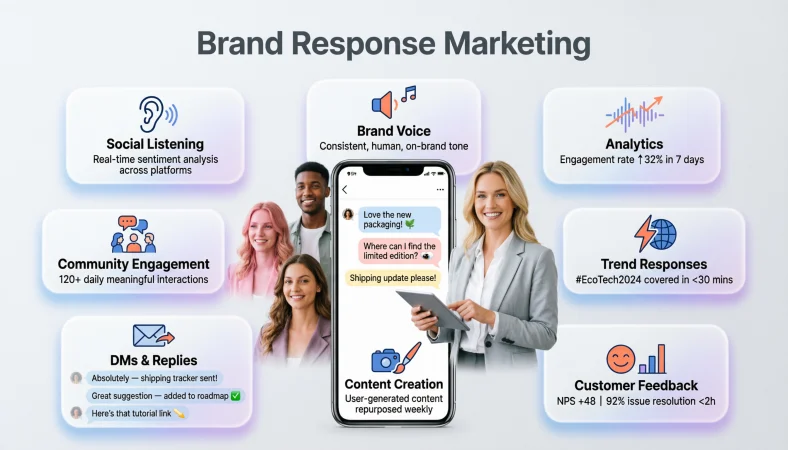
Brand response marketing is the practice of creating timely, relevant marketing responses to customer comments, trends, questions, reviews, mentions, and cultural moments. It helps brands stay conversational, recognizable, and connected to their audiences.
Top alternatives: real-time brand marketing, reactive marketing, responsive marketing, social response marketing, conversational brand marketing
A brand can post the most polished campaign ever and still get more attention from one clever reply in the comments. That is where brand response marketing comes in. Instead of only publishing planned campaigns, brands respond to conversations already happening around them.
This can happen in social media comments, customer reviews, DMs, trending topics, product questions, community discussions, or unexpected moments. The best responses feel natural rather than forced. They can be funny, helpful, confident, warm, or simply quick and relevant.
Think of it as joining the conversation instead of standing on a stage shouting your message. Whether you are replying to a customer, reacting to a trend, handling feedback, or turning a comment into content, the right response can make a brand feel more human. And yes, sometimes one sentence can do more than an entire billboard.
Funny Brand Response Marketing Ideas
“We came for the comments and accidentally stayed for the engagement.”
Example: Use this when a brand’s comment section becomes unusually active.
Meaning: It adds humor while celebrating audience interaction.
“Okay, that comment deserves its own campaign.”
Example: Use this when a follower leaves an unexpectedly creative comment.
Meaning: It shows appreciation and playful spontaneity.
“The comment section understood the assignment.”
Example: Use this when customers respond enthusiastically to a post.
Meaning: It celebrates the audience’s participation.
“Our social media manager is typing very respectfully.”
Example: Use this before a playful response to a customer comment.
Meaning: It creates anticipation around the brand’s reply.
“We did not expect this plot twist.”
Example: Use this when a post receives an unexpected reaction.
Meaning: It humorously acknowledges an unpredictable moment.
“Adding this to the brand lore immediately.”
Example: Use this when a memorable customer interaction occurs.
Meaning: It turns an ordinary interaction into part of the brand story.
“The internet has spoken, and we are taking notes.”
Example: Use this when followers suggest improvements or ideas.
Meaning: It shows that the brand pays attention to its audience.
“Well, that escalated beautifully.”
Example: Use this when a simple post develops into a fun conversation.
Meaning: It celebrates unexpected engagement.
“We might need a group chat for this comment section.”
Example: Use this when many followers are joining the same conversation.
Meaning: It makes community engagement feel personal.
“That was not on today’s content calendar.”
Example: Use this when a spontaneous moment becomes popular.
Meaning: It highlights authentic, unplanned engagement.
“Someone give this person a marketing job.”
Example: Use this when a customer creates a clever slogan or idea.
Meaning: It compliments the follower’s creativity.
“BRB, putting this in our content strategy.”
Example: Use this when an audience suggestion is genuinely useful.
Meaning: It playfully shows that customer feedback matters.
Creative Brand Response Marketing Strategies
“Turn comments into content.”
Example: Use this when a recurring audience question deserves a dedicated post.
Meaning: It transforms engagement into useful marketing material.
“Let customers inspire the next post.”
Example: Use this when followers frequently request specific topics.
Meaning: It makes content more audience-driven.
“Build a response library around real questions.”
Example: Use this when teams repeatedly answer similar customer queries.
Meaning: It makes future engagement faster and more consistent.
“Make the reply feel native to the platform.”
Example: Use this when adapting responses for TikTok, Instagram, LinkedIn, or another network.
Meaning: It encourages platform-specific communication.
“Give ordinary comments extraordinary context.”
Example: Use this when a simple customer comment can become a relatable story.
Meaning: It encourages creative repurposing.
“Use audience language in future campaigns.”
Example: Use this when customers repeatedly use memorable phrases.
Meaning: It helps brands communicate in language their audience recognizes.
“Create a content series from recurring reactions.”
Example: Use this when similar comments appear across several posts.
Meaning: It turns a pattern into repeatable content.
“Respond with personality, not just information.”
Example: Use this when answering a simple product question.
Meaning: It makes functional replies more memorable.
“Make the audience part of the creative process.”
Example: Use this when asking followers to suggest names, ideas, or features.
Meaning: It encourages participation and community ownership.
“Turn customer stories into brand moments.”
Example: Use this when someone shares a memorable experience with the product.
Meaning: It gives authentic experiences greater visibility.
“Use a great reply as the beginning, not the end.”
Example: Use this when a comment response starts gaining attention.
Meaning: It encourages brands to develop successful interactions into larger content.
“Let spontaneity have a seat at the strategy table.”
Example: Use this during social media planning.
Meaning: It balances planned campaigns with real-time opportunities.
Professional Brand Response Marketing Examples
“Thank you for sharing your feedback with us.”
Example: Use this when responding to constructive customer feedback.
Meaning: It acknowledges the customer’s contribution respectfully.
“We appreciate you bringing this to our attention.”
Example: Use this when addressing a reported issue.
Meaning: It shows that customer concerns are being taken seriously.
“We are happy to help you find the right solution.”
Example: Use this when responding to a support-related comment.
Meaning: It communicates a helpful and professional attitude.
“Thank you for choosing our brand.”
Example: Use this when responding to positive customer feedback.
Meaning: It expresses appreciation for the customer’s support.
“We understand your concern and would like to help.”
Example: Use this when a customer expresses frustration publicly.
Meaning: It acknowledges the issue without becoming defensive.
“Your feedback helps us improve.”
Example: Use this after receiving a useful suggestion.
Meaning: It positions feedback as valuable input.
“We appreciate your patience while we look into this.”
Example: Use this when an issue requires additional investigation.
Meaning: It manages expectations professionally.
“We are glad to hear that you had a positive experience.”
Example: Use this when replying to a favorable review.
Meaning: It reinforces customer satisfaction.
“Please reach out through our support channel so we can assist further.”
Example: Use this when sensitive account information should not be discussed publicly.
Meaning: It moves the conversation to a more appropriate setting.
“We value your experience and appreciate the opportunity to improve.”
Example: Use this when responding to criticism.
Meaning: It combines accountability with professionalism.
“Thank you for taking the time to share this.”
Example: Use this when acknowledging detailed feedback.
Meaning: It recognizes the customer’s effort.
“We appreciate the conversation and your perspective.”
Example: Use this when participating in a thoughtful public discussion.
Meaning: It keeps the brand approachable and respectful.
Witty Brand Response Marketing Ideas
“You noticed. We love that for us.”
Example: Use this when a follower points out a clever product detail.
Meaning: It celebrates attention with playful confidence.
“That is one way to put it.”
Example: Use this when a customer makes a humorous observation.
Meaning: It responds playfully without overexplaining.
“We have entered the comment section.”
Example: Use this when a brand joins a popular discussion.
Meaning: It signals active participation.
“Honestly, we cannot argue with that.”
Example: Use this when a customer makes a fair and funny point.
Meaning: It shows confidence and openness.
“Noted, screenshot saved.”
Example: Use this when a customer shares a particularly useful suggestion.
Meaning: It playfully indicates that the idea was noticed.
“This comment has marketing energy.”
Example: Use this when a follower creates an effective phrase.
Meaning: It compliments their communication skills.
“You might have just improved our content calendar.”
Example: Use this when a comment inspires a future post.
Meaning: It gives credit to the audience.
“That was smoother than our last campaign meeting.”
Example: Use this when responding to a clever remark.
Meaning: It uses workplace humor to create personality.
“We will pretend this was the plan all along.”
Example: Use this when something unexpectedly works.
Meaning: It turns an unplanned success into a humorous moment.
“The algorithm may have helped, but you made it fun.”
Example: Use this when audience engagement drives a post.
Meaning: It credits the community for the interaction.
“This deserves a pinned comment.”
Example: Use this when a follower says something particularly memorable.
Meaning: It highlights audience-generated content.
“Okay, internet. We see you.”
Example: Use this when a trend unexpectedly gains traction.
Meaning: It acknowledges online attention in a playful way.
Customer-Focused Brand Response Marketing
“We hear you.”
Example: Use this when acknowledging a customer’s concern.
Meaning: It communicates that the feedback has been noticed.
“Thanks for telling us what you think.”
Example: Use this when inviting honest opinions.
Meaning: It makes feedback feel welcome.
“How can we make this better for you?”
Example: Use this when responding to constructive criticism.
Meaning: It opens the door to practical improvement.
“We appreciate you giving us the details.”
Example: Use this when a customer explains a problem clearly.
Meaning: It recognizes useful information.
“That sounds frustrating, and we understand why.”
Example: Use this when responding to a genuine service complaint.
Meaning: It acknowledges the customer’s experience empathetically.
“Let’s see what we can do.”
Example: Use this when a support issue needs investigation.
Meaning: It signals willingness to help.
“Thanks for helping us spot that.”
Example: Use this when a customer identifies an error.
Meaning: It treats the customer as a helpful participant.
“Your experience matters to us.”
Example: Use this when responding to customer concerns.
Meaning: It emphasizes customer-centered communication.
“We are listening.”
Example: Use this when several customers raise a similar concern.
Meaning: It communicates attention to recurring feedback.
“We appreciate the honest feedback.”
Example: Use this when a customer shares criticism respectfully.
Meaning: It welcomes transparency.
“We are glad you reached out.”
Example: Use this when resolving a customer’s issue.
Meaning: It makes the support interaction feel more welcoming.
“Thanks for being part of the conversation.”
Example: Use this when customers actively discuss a brand online.
Meaning: It encourages continued community participation.
Social Media Brand Response Marketing
“We saw that comment.”
Example: Use this when joining an active comment thread.
Meaning: It signals that the brand is paying attention.
“Okay, this belongs on our feed.”
Example: Use this when a follower creates a highly shareable response.
Meaning: It recognizes strong community content.
“Tag the friend who needs this.”
Example: Use this when a post naturally invites sharing.
Meaning: It encourages audience-to-audience distribution.
“The comments are carrying today.”
Example: Use this when engagement is especially entertaining.
Meaning: It celebrates community activity.
“This deserves more than one reply.”
Example: Use this when a comment sparks a larger discussion.
Meaning: It encourages deeper engagement.
“We are officially joining the conversation.”
Example: Use this when a brand responds to a relevant trend.
Meaning: It communicates timely participation.
“Consider this our contribution to the timeline.”
Example: Use this when posting a timely response.
Meaning: It gives the brand a casual social voice.
“The timeline was too quiet, so we had to say something.”
Example: Use this when responding to a relevant online moment.
Meaning: It frames the brand as an active participant.
“Comment section, your turn.”
Example: Use this when inviting audience opinions.
Meaning: It encourages direct interaction.
“We need your verdict on this one.”
Example: Use this when asking followers to choose between options.
Meaning: It invites participation without making the interaction overly formal.
“This conversation deserves a sequel.”
Example: Use this when a discussion receives strong engagement.
Meaning: It creates an opportunity for follow-up content.
“Internet, keep the ideas coming.”
Example: Use this when audience suggestions are useful and entertaining.
Meaning: It encourages continued participation.
Sarcastic Brand Response Marketing Ideas
“Naturally, the comments have become the main event.”
Example: Use this when the comment section attracts more attention than expected.
Meaning: It humorously highlights audience engagement.
“We planned everything except that comment.”
Example: Use this when a customer says something unexpected.
Meaning: It jokes about the unpredictability of social media.
“Excellent timing, internet.”
Example: Use this when a trend appears at the perfect moment.
Meaning: It playfully acknowledges timely engagement.
“Because apparently we needed another opinion.”
Example: Use this when joking with a familiar audience.
Meaning: It uses light sarcasm to create personality.
“Sure, let us add that to the ever-growing list.”
Example: Use this when customers suggest multiple ideas.
Meaning: It playfully acknowledges a flood of suggestions.
“The internet has once again chosen chaos for the comments.”
Example: Use this when a comment section becomes unusually lively.
Meaning: It humorously describes unpredictable engagement.
“We were definitely prepared for that question.”
Example: Use this when a follower asks something unexpected.
Meaning: It creates playful self-awareness.
“Nothing like a surprise comment to brighten the workday.”
Example: Use this when a customer leaves a funny remark.
Meaning: It shows appreciation for spontaneous interaction.
“Clearly, our content calendar had other plans.”
Example: Use this when audience reactions change the direction of content.
Meaning: It jokes about flexible social strategy.
“And here we thought the post was finished.”
Example: Use this when comments generate new content opportunities.
Meaning: It highlights the continuing life of a social post.
“The comment section refuses to clock out.”
Example: Use this when engagement keeps growing.
Meaning: It humorously celebrates sustained activity.
“Well, that escalated into content.”
Example: Use this when a comment inspires a new post.
Meaning: It shows how spontaneous interactions can become marketing material.
Polite Brand Response Marketing Examples
“Thank you for sharing your thoughts.”
Example: Use this when responding to a customer’s opinion.
Meaning: It acknowledges the person’s contribution respectfully.
“We appreciate your feedback.”
Example: Use this after receiving constructive input.
Meaning: It communicates openness to feedback.
“Thank you for bringing this to our attention.”
Example: Use this when a customer identifies an issue.
Meaning: It shows that the concern has been noticed.
“We are grateful for your support.”
Example: Use this when replying to a loyal customer.
Meaning: It expresses appreciation.
“We understand your perspective.”
Example: Use this when responding to a disagreement respectfully.
Meaning: It acknowledges another viewpoint without escalating the discussion.
“We appreciate you taking the time to comment.”
Example: Use this when a customer leaves detailed feedback.
Meaning: It recognizes their effort.
“Thank you for giving us the opportunity to clarify.”
Example: Use this when correcting a misunderstanding.
Meaning: It keeps the response informative and respectful.
“We are happy to hear that.”
Example: Use this when responding to positive feedback.
Meaning: It returns the customer’s positivity warmly.
“We appreciate your patience.”
Example: Use this during a service delay or investigation.
Meaning: It acknowledges the customer’s time.
“We would be glad to assist further.”
Example: Use this when a public reply needs a private follow-up.
Meaning: It offers continued support.
“Thank you for being part of our community.”
Example: Use this when engaging with a long-term follower.
Meaning: It strengthens the sense of community.
“We appreciate the thoughtful response.”
Example: Use this when someone contributes meaningfully to a discussion.
Meaning: It encourages constructive conversation.
Bold Brand Response Marketing Strategies
“Say less, mean more.”
Example: Use this when simplifying a brand response.
Meaning: It encourages concise and confident communication.
“Respond when the moment actually matters.”
Example: Use this when creating a real-time engagement strategy.
Meaning: It prioritizes relevance over constant posting.
“Own the conversation without dominating it.”
Example: Use this when engaging with a community discussion.
Meaning: It balances brand visibility with audience participation.
“Make your response unmistakably yours.”
Example: Use this when developing a recognizable brand voice.
Meaning: It encourages consistent personality.
“Turn attention into interaction.”
Example: Use this when a post receives significant visibility.
Meaning: It encourages brands to create two-way engagement.
“Answer the question behind the question.”
Example: Use this when a customer’s comment hints at a larger concern.
Meaning: It encourages deeper understanding.
“Be timely without being desperate.”
Example: Use this when reacting to trends.
Meaning: It emphasizes relevance without forcing participation.
“Let confidence replace corporate filler.”
Example: Use this when rewriting stiff social responses.
Meaning: It encourages direct, human language.
“Make the audience feel seen.”
Example: Use this when responding to frequent commenters.
Meaning: It emphasizes recognition and community.
“Turn a mention into a moment.”
Example: Use this when someone tags the brand unexpectedly.
Meaning: It encourages meaningful engagement.
“Respond like a brand with a personality.”
Example: Use this when creating social media voice guidelines.
Meaning: It encourages human and recognizable communication.
“Give people a reason to reply back.”
Example: Use this when ending an engaging brand response.
Meaning: It encourages two-way conversations.
Emotional Brand Response Marketing
“We genuinely appreciate you being here.”
Example: Use this when recognizing loyal community members.
Meaning: It communicates sincere gratitude.
“Your support means more than you know.”
Example: Use this when celebrating customer loyalty.
Meaning: It expresses emotional appreciation.
“Messages like this make our day.”
Example: Use this when responding to heartfelt feedback.
Meaning: It shows the human impact of customer support.
“We are grateful you shared this with us.”
Example: Use this when someone tells a meaningful customer story.
Meaning: It recognizes the emotional value of the interaction.
“Thank you for trusting us.”
Example: Use this when a customer shares a positive experience involving the brand.
Meaning: It emphasizes trust and appreciation.
“This is exactly why we love our community.”
Example: Use this when followers support one another around a brand post.
Meaning: It celebrates community connection.
“We are so glad this helped.”
Example: Use this after resolving a customer’s issue.
Meaning: It focuses on the customer’s positive outcome.
“You just made our whole team smile.”
Example: Use this when receiving especially warm feedback.
Meaning: It adds genuine personality to the response.
“Thank you for making this moment special.”
Example: Use this when customers participate in a meaningful campaign.
Meaning: It recognizes audience contribution.
“We are listening, and we appreciate you speaking up.”
Example: Use this when receiving serious but constructive feedback.
Meaning: It communicates respect and openness.
“Your story deserves to be heard.”
Example: Use this when a customer shares a meaningful experience.
Meaning: It validates the importance of their contribution.
“We are lucky to have people like you in the community.”
Example: Use this when recognizing supportive customers.
Meaning: It expresses warm appreciation.
Trend-Based Brand Response Marketing
“We saw the trend and brought our brand voice with us.”
Example: Use this when participating in a relevant social trend.
Meaning: It combines timely participation with brand identity.
“Yes, we are absolutely noticing this trend.”
Example: Use this when a trend aligns naturally with the brand.
Meaning: It signals awareness without forcing participation.
“The trend made sense, so we joined.”
Example: Use this when a trend genuinely fits the brand.
Meaning: It communicates intentional participation.
“Consider this our version.”
Example: Use this when adapting a popular format to the brand.
Meaning: It gives a familiar trend a branded twist.
“We could not resist this one.”
Example: Use this when participating in a highly relevant trend.
Meaning: It communicates playful enthusiasm.
“Trending, but make it us.”
Example: Use this when adapting a trend to a recognizable brand voice.
Meaning: It prioritizes brand identity.
“The trend has officially reached our social team.”
Example: Use this when joining a popular conversation.
Meaning: It playfully acknowledges the timing.
“Same trend, different brand energy.”
Example: Use this when putting a distinctive spin on a trend.
Meaning: It emphasizes differentiation.
“We waited until it actually made sense.”
Example: Use this when explaining why a brand joined a trend later.
Meaning: It suggests relevance matters more than speed alone.
“Our take just entered the timeline.”
Example: Use this when publishing trend-based content.
Meaning: It introduces the brand’s contribution casually.
“If the trend fits, the brand posts.”
Example: Use this as a playful rule for selective trend participation.
Meaning: It emphasizes relevance.
“Trending is fun. Staying recognizable is better.”
Example: Use this when discussing trend strategy.
Meaning: It balances timeliness with brand consistency.
Smart Brand Response Marketing For Negative Feedback
“Thank you for letting us know.”
Example: Use this as the first response to a legitimate complaint.
Meaning: It acknowledges the issue without becoming defensive.
“We are sorry the experience did not meet expectations.”
Example: Use this when a customer reports a disappointing experience.
Meaning: It recognizes the customer’s dissatisfaction.
“We would like to understand what happened.”
Example: Use this when more information is needed.
Meaning: It opens the door to investigation.
“That is not the experience we want for our customers.”
Example: Use this when acknowledging a service problem.
Meaning: It communicates that the reported experience is not the intended standard.
“We appreciate you raising this.”
Example: Use this when feedback identifies a genuine issue.
Meaning: It treats criticism as useful information.
“Let’s take this conversation somewhere we can help properly.”
Example: Use this when account details should be discussed privately.
Meaning: It moves sensitive support matters away from public comments.
“We are looking into this.”
Example: Use this when a complaint requires investigation.
Meaning: It signals that the matter is being reviewed.
“We understand why you are frustrated.”
Example: Use this when a customer is clearly upset.
Meaning: It acknowledges the emotional impact without arguing.
“We want to make this right where possible.”
Example: Use this when a service issue needs resolution.
Meaning: It communicates a willingness to address the problem.
“Thanks for giving us the chance to investigate.”
Example: Use this when a customer provides details for review.
Meaning: It encourages constructive resolution.
“We appreciate the direct feedback.”
Example: Use this when criticism is specific and useful.
Meaning: It recognizes honesty.
“We will use this feedback to improve the experience.”
Example: Use this after reviewing a recurring complaint.
Meaning: It connects feedback with future improvement.
Community-Building Brand Response Marketing
“We love seeing your ideas.”
Example: Use this when followers regularly contribute suggestions.
Meaning: It encourages continued participation.
“Keep the comments coming.”
Example: Use this when a post generates useful discussion.
Meaning: It invites more engagement.
“You are officially part of the brainstorming session.”
Example: Use this when asking customers for creative input.
Meaning: It makes participation feel fun and meaningful.
“Your idea might be the next big thing here.”
Example: Use this when a follower suggests an interesting concept.
Meaning: It gives the audience a sense of influence.
“This community keeps surprising us.”
Example: Use this when followers create unexpected content or discussion.
Meaning: It celebrates audience creativity.
“Tag someone who would have an opinion on this.”
Example: Use this when a topic naturally invites discussion between friends.
Meaning: It encourages organic conversation.
“We want to hear your take.”
Example: Use this when asking followers for opinions.
Meaning: It makes audience perspectives part of the content.
“You brought the energy today.”
Example: Use this when engagement is especially lively.
Meaning: It celebrates active participation.
“This is what community looks like.”
Example: Use this when customers support each other in comments.
Meaning: It highlights positive community behavior.
“Thanks for making this conversation better.”
Example: Use this when someone adds useful context or insight.
Meaning: It rewards constructive participation.
“Keep sharing your experiences with us.”
Example: Use this when customers post stories about using the product.
Meaning: It encourages authentic community content.
“We are listening to what you want to see next.”
Example: Use this when planning future content based on audience feedback.
Meaning: It makes followers feel included in content decisions.
Data-Driven Brand Response Marketing Ideas
“Find the comments people keep repeating.”
Example: Use this when analyzing social engagement patterns.
Meaning: It identifies recurring customer needs.
“Track which replies start conversations.”
Example: Use this when reviewing social media performance.
Meaning: It focuses on responses that generate interaction.
“Measure response time, not just post reach.”
Example: Use this when evaluating community management.
Meaning: It recognizes responsiveness as a useful performance factor.
“Look for questions that deserve content.”
Example: Use this when reviewing customer comments.
Meaning: It turns recurring questions into content opportunities.
“Watch which topics create meaningful discussion.”
Example: Use this when studying audience behavior.
Meaning: It identifies themes that resonate with the community.
“Turn repeated feedback into strategy.”
Example: Use this when similar customer suggestions appear frequently.
Meaning: It connects audience feedback with planning.
“Compare engagement quality, not only quantity.”
Example: Use this when reviewing campaign responses.
Meaning: It encourages attention to the substance of interactions.
“Identify the replies that earn genuine follow-ups.”
Example: Use this when measuring conversational content.
Meaning: It highlights responses that encourage two-way communication.
“Track recurring customer frustrations.”
Example: Use this during social listening.
Meaning: It helps identify potential experience problems.
“Use response patterns to improve your content calendar.”
Example: Use this during monthly content planning.
Meaning: It turns community behavior into future topics.
“Monitor sentiment alongside engagement.”
Example: Use this when evaluating a major campaign discussion.
Meaning: It provides broader context than engagement numbers alone.
“Let evidence guide the next response.”
Example: Use this when refining a brand’s social strategy.
Meaning: It encourages decisions based on observed audience behavior.
Long-Term Brand Response Marketing Best Practices
“Build a recognizable response style.”
Example: Use this when creating social media voice guidelines.
Meaning: It helps customers recognize the brand through its replies.
“Respond quickly when relevance matters.”
Example: Use this during fast-moving social conversations.
Meaning: It emphasizes timing without requiring constant posting.
“Keep every response human.”
Example: Use this when reviewing customer-facing copy.
Meaning: It prevents communication from feeling overly corporate.
“Know when not to respond.”
Example: Use this when a conversation is irrelevant or unproductive.
Meaning: It recognizes that restraint is also part of strategy.
“Never sacrifice clarity for a clever line.”
Example: Use this when reviewing humorous responses.
Meaning: It keeps communication understandable.
“Protect customer privacy.”
Example: Use this when handling account-specific issues publicly.
Meaning: It encourages sensitive information to remain private.
“Match the tone to the situation.”
Example: Use this when responding across different types of comments.
Meaning: It prevents jokes from appearing inappropriate.
“Give teams clear escalation guidelines.”
Example: Use this when building a community management process.
Meaning: It helps staff know when a response needs additional review.
“Learn from your best conversations.”
Example: Use this during monthly social media reviews.
Meaning: It turns successful interactions into repeatable lessons.
“Keep the brand voice flexible.”
Example: Use this when communicating across platforms and audiences.
Meaning: It allows personality without forcing identical wording everywhere.
“Treat every response as part of the brand experience.”
Example: Use this when training social media teams.
Meaning: It emphasizes that small interactions can shape brand perception.
“Make people remember how the brand made them feel.”
Example: Use this when developing long-term community strategy.
Meaning: It connects individual responses with broader brand relationships.
FAQs
What does brand response marketing mean?
Brand response marketing means using timely, relevant responses to customer comments, reviews, questions, mentions, trends, and online conversations as part of a brand’s marketing strategy.
Is brand response marketing the same as reactive marketing?
They can overlap, but brand response marketing is broader. It can include reactive trend participation as well as everyday responses to customers, communities, reviews, and social conversations.
Why is brand response marketing important?
It can make brands feel more responsive and human while creating opportunities for engagement, customer relationships, useful content, and stronger community interaction.
Is brand response marketing only for social media?
No. It can also appear in review responses, email communication, customer service, community platforms, DMs, online discussions, and other customer-facing channels.
Can brand response marketing be funny?
Yes, when the situation and brand voice make humor appropriate. Customer complaints, sensitive subjects, or serious issues usually require a more thoughtful tone.
What should a brand say when a customer complains?
A useful response can acknowledge the concern, thank the customer for raising it, show willingness to investigate, and provide an appropriate next step.
Can brand response marketing help build a community?
Yes. Responding to audience ideas, questions, stories, and feedback can encourage people to participate more actively in conversations around the brand.
Should every customer comment receive a response?
Not necessarily. Brands can prioritize comments based on relevance, customer needs, potential value, safety, and the nature of the conversation.
How quickly should a brand respond?
The ideal timing depends on the platform, situation, and urgency. Real-time trends may require fast responses, while detailed customer issues may need more careful handling.
Can small businesses use brand response marketing?
Absolutely. Small businesses can use replies, comments, reviews, DMs, and customer conversations to build relationships without needing a large content production budget.
What makes a brand response feel authentic?
A response usually feels more authentic when it is relevant to the specific comment, matches the brand’s established voice, avoids unnecessary corporate language, and actually addresses what the person said.
Is brand response marketing useful for SEO?
It can support broader content and audience strategies by revealing customer language, recurring questions, content ideas, and topics people discuss around a brand.
Conclusion
Great brand response marketing is not about replying to everything or forcing a clever line into every comment. It is about knowing when the conversation matters and showing up with the right voice. A thoughtful response can turn a question into useful content, a comment into community engagement, or feedback into a better customer experience.
The key is to stay relevant, human, clear, and consistent while giving your audience room to participate. Try different response styles, study which conversations create genuine engagement, and keep refining your brand voice. Save this list for your next social media planning session, share it with your marketing team, and turn everyday interactions into memorable brand moments.