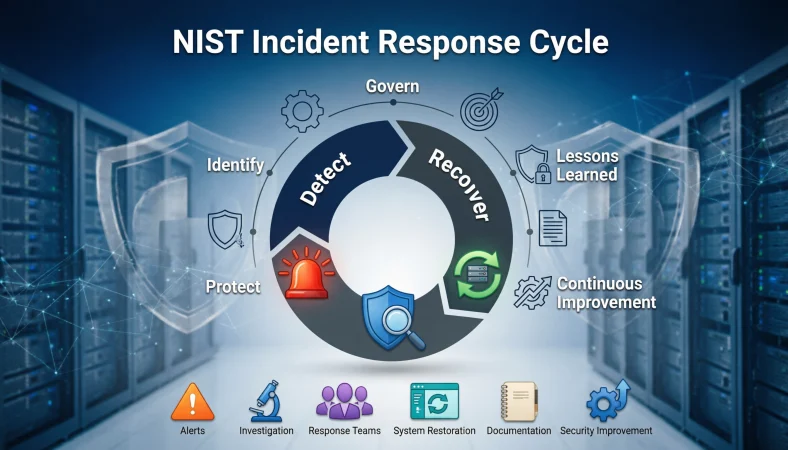
The NIST incident response cycle is a structured approach for preparing for, detecting, responding to, and recovering from cybersecurity incidents. The current NIST SP 800-61 Rev. 3 model centers incident response on Detect, Respond, and Recover, supported by broader cybersecurity risk management and continuous improvement.
Top alternatives: NIST incident response framework, NIST incident response lifecycle, NIST incident handling process, NIST cybersecurity incident response, NIST SP 800-61
Cybersecurity incident response sounds serious until you actually have to explain it in a meeting, an exam, a project, or a group chat where someone asks, “So what exactly happens after the alert?” That is where the NIST incident response cycle becomes useful.
Whether you are writing security documentation, studying for a certification, preparing an incident response plan, or trying to explain ransomware response without turning the conversation into alphabet soup, knowing the stages makes everything easier.
NIST updated SP 800-61 in April 2025, with Revision 3 replacing Revision 2 and aligning incident response with the NIST Cybersecurity Framework 2.0. The current model emphasizes Detect, Respond, and Recover, with continuous improvement feeding lessons back into cybersecurity risk management.
Simple NIST Incident Response Cycle Explanations:
“The NIST incident response cycle is a structured way to handle cybersecurity incidents.”
Example: Use this when explaining incident response to someone new to cybersecurity.
Meaning: It describes an organized approach for managing security incidents.
“Detect, Respond, Recover is the core of the current NIST model.”
Example: Use this as a quick study note for NIST SP 800-61 Rev. 3.
Meaning: These three functions form the central incident response portion of the updated model.
“Detection means figuring out that something is wrong.”
Example: Use this when explaining the first active response stage.
Meaning: Organizations identify potential cybersecurity incidents through monitoring and other sources.
“Response means taking action after an incident is identified.”
Example: Use this in a beginner-friendly security guide.
Meaning: Response activities address and manage the detected incident.
“Recovery means restoring affected systems and operations.”
Example: Use this when explaining the final active response function.
Meaning: Recovery helps return systems and business activities to an appropriate operating state.
“NIST treats incident response as part of broader cybersecurity risk management.”
Example: Use this in a simple presentation.
Meaning: Incident response is integrated into the organization’s overall security program.
“Continuous improvement helps make the next incident easier to handle.”
Example: Use this as a simple explanation of lessons learned.
Meaning: Organizations use experience from response activities to improve future cybersecurity practices.
“The NIST cycle is designed to reduce the impact of security incidents.”
Example: Use this in a cybersecurity introduction.
Meaning: Effective incident response aims to limit damage and improve response and recovery efficiency.
“Incident response is not just about fixing hacked computers.”
Example: Use this when correcting an overly narrow explanation.
Meaning: Modern incident response involves detection, coordination, response, recovery, and improvement.
“The cycle connects security alerts with practical action.”
Example: Use this in a beginner training session.
Meaning: Incident response turns information about potential incidents into coordinated security activities.
“NIST helps organizations replace panic with a process.”
Example: Use this as a memorable presentation line.
Meaning: A defined response structure helps teams act consistently during stressful incidents.
“The goal is simple: identify, act, recover, and improve.”
Example: Use this as a final revision line.
Meaning: It summarizes the practical purpose of structured incident response.
Professional NIST Incident Response Cycle Descriptions:
“NIST SP 800-61 Rev. 3 integrates incident response recommendations with the NIST Cybersecurity Framework 2.0.”
Example: Use this in professional cybersecurity documentation.
Meaning: The current publication connects incident response with broader CSF 2.0 risk management activities.
“The current NIST incident response model centers on Detect, Respond, and Recover.”
Example: Use this in an executive security briefing.
Meaning: These functions represent the core incident response activities in Revision 3.
“Preparation activities support incident response but extend beyond incident response itself.”
Example: Use this when explaining the updated NIST model.
Meaning: Govern, Identify, and Protect are broader cybersecurity risk management activities that support response capability.
“Continuous improvement connects lessons learned to future cybersecurity activities.”
Example: Use this in an incident response program description.
Meaning: Findings from incidents are analyzed and used to improve organizational security.
“Incident response should be integrated throughout cybersecurity risk management.”
Example: Use this in a security governance document.
Meaning: Response should not operate as an isolated technical function.
“Detection activities provide the information needed to identify potential incidents.”
Example: Use this in a SOC process document.
Meaning: Monitoring and analysis support timely identification of security events.
“Response activities focus on managing confirmed or suspected cybersecurity incidents.”
Example: Use this in an incident management policy.
Meaning: The organization takes coordinated action to address the incident.
“Recovery activities restore appropriate operational capabilities.”
Example: Use this in business continuity documentation.
Meaning: Recovery focuses on returning affected operations to an acceptable state.
“Lessons learned should influence future security decisions.”
Example: Use this in a post-incident review.
Meaning: Incident experience should contribute to risk reduction and program improvement.
“The NIST approach supports coordinated incident management.”
Example: Use this in a cybersecurity strategy document.
Meaning: Effective response requires collaboration across relevant organizational functions.
“SP 800-61 Rev. 3 supersedes Revision 2.”
Example: Use this when updating older incident response documentation.
Meaning: Revision 3 is the current NIST publication, while Revision 2 was withdrawn in April 2025.
“The modern NIST model emphasizes integration rather than treating incident response as a standalone activity.”
Example: Use this in a professional security presentation.
Meaning: Incident response is connected to broader organizational cybersecurity risk management.
Beginner-Friendly NIST Incident Response Cycle Lines:
“Detect means notice the problem.”
Example: Use this as a beginner flashcard.
Meaning: Detection identifies potential cybersecurity incidents.
“Respond means deal with the problem.”
Example: Use this in introductory training.
Meaning: Response involves taking appropriate action against the incident.
“Recover means get things working again.”
Example: Use this when explaining recovery to nontechnical staff.
Meaning: Recovery restores affected systems and operations.
“Improvement means learn from what happened.”
Example: Use this as a simple explanation of continuous improvement.
Meaning: Lessons from incidents are used to strengthen future practices.
“NIST gives security teams a roadmap.”
Example: Use this in an introductory cybersecurity lesson.
Meaning: The framework provides structured guidance for organizing security activities.
“An alert is not automatically an incident.”
Example: Use this when teaching basic SOC concepts.
Meaning: Security teams generally need analysis to determine whether activity represents an incident.
“Detection starts the investigation.”
Example: Use this as a simple training phrase.
Meaning: Identifying suspicious activity can trigger analysis and response processes.
“Response is where decisions become actions.”
Example: Use this in a beginner presentation.
Meaning: Teams move from understanding the incident to actively managing it.
“Recovery is about restoring trusted operations.”
Example: Use this when explaining the recovery function.
Meaning: Recovery focuses on bringing affected capabilities back into service appropriately.
“The cycle does not end when the system comes back online.”
Example: Use this to explain continuous improvement.
Meaning: Lessons from the incident should continue informing future cybersecurity activities.
“Good incident response is planned before the emergency.”
Example: Use this in security awareness training.
Meaning: Preparation and risk management support effective response when incidents occur.
“The goal is organized action, not cybersecurity improvisation.”
Example: Use this as a memorable training line.
Meaning: Structured processes help teams respond consistently under pressure.
Funny NIST Incident Response Cycle Study Lines:
“Detect, respond, recover, repeat the security homework.”
Example: Use this as a light study caption.
Meaning: Incident response is an ongoing organizational process.
“Cybersecurity sees an alert and suddenly everyone becomes very available.”
Example: Use this as a humorous SOC training caption.
Meaning: Significant incidents often require coordinated attention from multiple teams.
“Detect is basically the ‘uh-oh’ stage.”
Example: Use this when memorizing the first core function.
Meaning: Detection identifies activity that may indicate an incident.
“Respond is where the group chat gets serious.”
Example: Use this as a playful security-team analogy.
Meaning: Response involves coordinated action after an incident is identified.
“Recover is cybersecurity’s ‘okay, let’s put everything back together’ moment.”
Example: Use this as a recovery reminder.
Meaning: Recovery focuses on restoring appropriate operations.
“NIST: because ‘we’ll figure it out when we get hacked’ is not a strategy.”
Example: Use this as a cybersecurity social caption.
Meaning: Organizations benefit from having structured response capabilities before incidents occur.
“The incident happened, but the lessons are staying.”
Example: Use this for a post-incident review caption.
Meaning: Organizations should use incident experience to improve future security.
“Cybersecurity without a plan is just premium-level guessing.”
Example: Use this as a humorous awareness line.
Meaning: Formal response processes reduce uncertainty during incidents.
“Detect first, panic never.”
Example: Use this as a short SOC poster line.
Meaning: Structured detection and response encourage disciplined action.
“Recovery is the security version of cleaning up after the party.”
Example: Use this as a light analogy.
Meaning: Recovery restores systems and operations after an incident.
“Every incident comes with a free lesson, whether you ordered one or not.”
Example: Use this for a lessons-learned presentation.
Meaning: Incidents can reveal weaknesses that should be addressed.
“NIST turns ‘what now?’ into ‘here’s what we do next.’”
Example: Use this as a memorable training slogan.
Meaning: Structured guidance helps teams respond methodically.
Clever NIST Incident Response Cycle Comparisons:
“Detect is the alarm, Respond is the action, Recover is the reset.”
Example: Use this as a quick presentation analogy.
Meaning: The three core functions represent identification, action, and restoration.
“Incident response is less about reacting fast and more about reacting correctly.”
Example: Use this when explaining response quality.
Meaning: Speed matters, but coordinated and appropriate decisions are equally important.
“Detection gives you the signal; response gives the signal direction.”
Example: Use this as a clever study phrase.
Meaning: Detection identifies potential issues, while response determines appropriate action.
“Recovery closes the immediate disruption, while improvement strengthens the next round.”
Example: Use this when explaining continuous improvement.
Meaning: Recovery restores operations while lessons learned improve future preparedness.
“A response cycle is a playbook, not a crystal ball.”
Example: Use this when discussing incident response plans.
Meaning: Procedures guide decisions without predicting every possible incident.
“Good incident response turns chaos into sequence.”
Example: Use this in a cybersecurity presentation.
Meaning: Structured processes make complex incidents easier to manage.
“Detection answers ‘what is happening?’ while response asks ‘what should we do?’”
Example: Use this when teaching SOC workflows.
Meaning: Detection and response address different stages of incident handling.
“Recovery asks ‘how do we restore?’ while improvement asks ‘how do we prevent a repeat?’”
Example: Use this as a lessons-learned comparison.
Meaning: Recovery restores operations while improvement addresses future resilience.
“The incident may be unexpected, but the response should not be.”
Example: Use this as a security leadership quote.
Meaning: Organizations should prepare processes before incidents occur.
“A mature security program treats every incident as both an event and a lesson.”
Example: Use this in a security maturity discussion.
Meaning: Incidents provide information that can improve future controls and processes.
“The best response process keeps moving even when the incident changes.”
Example: Use this when discussing dynamic incidents.
Meaning: Effective response requires adaptable decision-making.
“NIST connects incident response with the bigger cybersecurity picture.”
Example: Use this as a concise framework comparison.
Meaning: Current guidance integrates response with CSF 2.0 risk management.
Practical NIST Incident Response Cycle Phrases:
“Start by confirming what the security alert actually represents.”
Example: Use this when discussing detection and analysis.
Meaning: Teams need to distinguish potential incidents from ordinary activity.
“Prioritize the incident according to business and security impact.”
Example: Use this in an incident response procedure.
Meaning: Response resources should be directed according to risk and consequences.
“Preserve relevant evidence while managing the incident.”
Example: Use this in an incident handling checklist.
Meaning: Useful information should be protected for investigation and decision-making.
“Coordinate technical and business stakeholders.”
Example: Use this in a response plan.
Meaning: Incidents can affect more than technical systems and often require cross-functional coordination.
“Contain the impact before it spreads further.”
Example: Use this when discussing practical incident handling.
Meaning: Response should aim to limit additional damage.
“Remove the underlying cause where appropriate.”
Example: Use this in a remediation discussion.
Meaning: Effective response should address the conditions that allowed the incident to occur.
“Restore affected services carefully.”
Example: Use this in a recovery procedure.
Meaning: Recovery should prioritize reliable and appropriately secured restoration.
“Monitor restored systems for signs of continued compromise.”
Example: Use this in recovery planning.
Meaning: Returning a system to service does not automatically prove that the incident is fully resolved.
“Document important decisions throughout the incident.”
Example: Use this in a security operations procedure.
Meaning: Clear records support coordination, accountability, and later review.
“Communicate according to the incident response plan.”
Example: Use this in a response policy.
Meaning: Consistent communication helps prevent confusion during an incident.
“Capture lessons learned after response activities.”
Example: Use this in a post-incident review.
Meaning: Lessons can guide future security improvements.
“Turn incident findings into measurable security improvements.”
Example: Use this in a cybersecurity program review.
Meaning: Incident knowledge becomes valuable when it leads to concrete improvements.
NIST Detect Function Response Lines:
“Detect focuses on finding potential cybersecurity incidents.”
Example: Use this as a basic definition of the Detect function.
Meaning: Detection activities help identify suspicious or harmful activity.
“Monitoring provides visibility into potential security events.”
Example: Use this in a SOC documentation section.
Meaning: Security monitoring supplies information that can reveal incidents.
“Detection depends on useful security information.”
Example: Use this in a security architecture discussion.
Meaning: Logs, alerts, reports, and other information can contribute to identifying incidents.
“Not every security event becomes a cybersecurity incident.”
Example: Use this when explaining alert triage.
Meaning: Events often require analysis before being classified as incidents.
“Detection should support timely investigation.”
Example: Use this in a SOC performance discussion.
Meaning: Useful detection allows teams to investigate suspicious activity promptly.
“Strong visibility improves incident awareness.”
Example: Use this when discussing monitoring capabilities.
Meaning: Better visibility helps organizations identify suspicious behavior.
“Detection creates the starting point for response.”
Example: Use this as a concise framework statement.
Meaning: Response depends on recognizing potential incidents.
“Security alerts need context.”
Example: Use this in an analyst training guide.
Meaning: Context helps analysts understand whether an alert indicates a real threat.
“Effective detection supports better response decisions.”
Example: Use this in a security operations presentation.
Meaning: Accurate information helps teams choose appropriate actions.
“Detection should cover relevant environments and assets.”
Example: Use this in an enterprise security plan.
Meaning: Important systems and activities need sufficient monitoring.
“Detection is about finding the signal in the noise.”
Example: Use this as a memorable SOC phrase.
Meaning: Security teams must identify meaningful threats among large volumes of activity.
“A good detection process turns suspicious activity into actionable information.”
Example: Use this in a security strategy document.
Meaning: Useful detection enables investigation and response.
NIST Respond Function Response Lines:
“Respond means taking coordinated action against a cybersecurity incident.”
Example: Use this as a basic definition for training.
Meaning: The Respond function covers actions taken to manage an incident.
“Response should be guided by established plans and priorities.”
Example: Use this in an incident response policy.
Meaning: Teams should rely on predefined processes while adapting to circumstances.
“Containment can help limit further impact.”
Example: Use this when discussing active incident handling.
Meaning: Containment seeks to prevent an incident from causing additional harm.
“Response requires clear decision-making.”
Example: Use this in an incident management presentation.
Meaning: Teams must determine appropriate actions as facts develop.
“Communication is part of effective incident response.”
Example: Use this when discussing stakeholder coordination.
Meaning: Relevant parties need accurate and timely information.
“Response actions should reflect the incident’s risk.”
Example: Use this in an incident prioritization guide.
Meaning: The scale and urgency of action should correspond to potential impact.
“Technical response is only one part of incident management.”
Example: Use this in an executive briefing.
Meaning: Legal, communications, operations, management, and other functions may also be involved.
“Evidence and documentation support informed response decisions.”
Example: Use this in an incident handling procedure.
Meaning: Reliable information helps teams understand and manage the incident.
“Response should adapt as new information appears.”
Example: Use this when discussing complex incidents.
Meaning: Incident conditions can change and require updated decisions.
“The response phase aims to control the incident, not simply acknowledge it.”
Example: Use this as a security training line.
Meaning: Effective response involves meaningful action.
“A coordinated response reduces unnecessary confusion.”
Example: Use this in incident management training.
Meaning: Clear roles and communication improve operational efficiency.
“Good response turns detection into risk reduction.”
Example: Use this as a concise security leadership phrase.
Meaning: Response should reduce the impact and consequences of the incident.
NIST Recover Function Response Lines:
“Recover focuses on restoring affected capabilities.”
Example: Use this as a basic definition of the Recover function.
Meaning: Recovery returns systems and operations to an appropriate state.
“Recovery should consider both technology and business operations.”
Example: Use this in a business continuity discussion.
Meaning: Cyber incidents can affect organizational services beyond individual systems.
“Restoration should be carefully validated.”
Example: Use this when discussing system recovery.
Meaning: Teams should verify that restored systems are functioning appropriately.
“Recovery is more than switching systems back on.”
Example: Use this in a recovery training session.
Meaning: Restoration requires confidence that systems can operate safely and reliably.
“Recovery plans should support organizational priorities.”
Example: Use this in business resilience documentation.
Meaning: Recovery decisions should reflect critical business needs.
“Communication remains important during recovery.”
Example: Use this when explaining stakeholder management.
Meaning: Teams need visibility into restoration progress and operational status.
“Recovery should incorporate lessons from the incident.”
Example: Use this in a post-incident discussion.
Meaning: Restoration and improvement can benefit from what the incident revealed.
“Restored systems should be monitored appropriately.”
Example: Use this in a recovery checklist.
Meaning: Monitoring can help identify remaining or recurring problems.
“Recovery helps return the organization to an acceptable operating condition.”
Example: Use this in professional documentation.
Meaning: The objective is to restore appropriate operational capability.
“Recovery marks restoration, not the end of learning.”
Example: Use this as a memorable training line.
Meaning: Lessons learned can continue to improve cybersecurity after systems recover.
“A successful recovery restores both confidence and capability.”
Example: Use this in an executive presentation.
Meaning: Effective recovery addresses operational needs and organizational assurance.
“Recover, review, improve, repeat.”
Example: Use this as a concise security poster line.
Meaning: Recovery should feed into ongoing cybersecurity improvement.
Continuous Improvement And NIST Incident Response:
“Continuous improvement keeps incident response from becoming a one-time exercise.”
Example: Use this in a security program overview.
Meaning: Response capabilities should evolve based on experience.
“Lessons learned should influence future cybersecurity activities.”
Example: Use this in a post-incident report.
Meaning: Incident findings can reveal improvements needed across the organization.
“Improvement turns incident experience into stronger security.”
Example: Use this as an executive summary line.
Meaning: Lessons become valuable when they produce meaningful changes.
“Every incident can reveal a gap worth investigating.”
Example: Use this during a security review.
Meaning: Incidents can expose weaknesses in technology, processes, or awareness.
“The goal is not merely to close the ticket.”
Example: Use this in a security operations discussion.
Meaning: Organizations should consider the underlying causes and lessons associated with incidents.
“Measure what worked and what did not.”
Example: Use this during an incident retrospective.
Meaning: Evaluating response performance helps identify improvement opportunities.
“Update procedures when real-world incidents expose weaknesses.”
Example: Use this in incident response governance.
Meaning: Response documentation should evolve as organizations learn.
“Use lessons from incidents to strengthen risk management.”
Example: Use this in a cybersecurity strategy.
Meaning: Incident experience can inform broader risk decisions.
“Continuous improvement connects yesterday’s incident with tomorrow’s readiness.”
Example: Use this as a presentation tagline.
Meaning: Past experiences can improve future preparedness.
“A mature response program learns faster than threats change.”
Example: Use this as a security leadership statement.
Meaning: Organizations should continually adapt their response capabilities.
“Incident reviews should produce actions, not just meeting notes.”
Example: Use this when planning a retrospective.
Meaning: Lessons learned should lead to concrete improvements.
“Improvement is where response becomes resilience.”
Example: Use this as a concise closing statement.
Meaning: Repeated learning can strengthen an organization’s ability to withstand future incidents.
NIST Incident Response Cycle For Businesses:
“Business priorities should influence incident response decisions.”
Example: Use this in an enterprise incident response plan.
Meaning: Security actions should account for operational and business consequences.
“Critical services need appropriate response priorities.”
Example: Use this when developing business-focused incident procedures.
Meaning: Not every system has the same operational importance.
“Incident response should involve relevant business stakeholders.”
Example: Use this in executive security planning.
Meaning: Cyber incidents can create legal, financial, operational, and reputational consequences.
“A technical incident can quickly become a business incident.”
Example: Use this in management training.
Meaning: Security disruptions can affect customers, employees, revenue, and operations.
“Response plans should define roles before incidents occur.”
Example: Use this when reviewing organizational readiness.
Meaning: Clear responsibilities reduce confusion during emergencies.
“Business continuity and incident response should work together.”
Example: Use this in resilience planning.
Meaning: Security response and operational continuity often have overlapping objectives.
“Recovery priorities should reflect business impact.”
Example: Use this in disaster recovery planning.
Meaning: Critical operations may require earlier restoration.
“Leadership needs clear incident information.”
Example: Use this during executive response planning.
Meaning: Decision-makers require accurate information to make appropriate risk decisions.
“Customers may be affected even when internal systems remain available.”
Example: Use this when considering incident impact.
Meaning: Cybersecurity incidents can affect external services, data, or trust.
“Incident metrics should connect security activity with business outcomes.”
Example: Use this in security reporting.
Meaning: Metrics become more useful when they show operational and risk impact.
“Good response protects more than computers.”
Example: Use this in a business security presentation.
Meaning: Incident response can protect operations, information, customers, and organizational trust.
“Resilient businesses plan for disruption before disruption arrives.”
Example: Use this as a leadership-focused security line.
Meaning: Preparation and risk management improve the ability to respond effectively.
NIST Incident Response Cycle For SOC Teams:
“SOC teams turn security signals into investigation and response.”
Example: Use this when explaining the role of a security operations center.
Meaning: SOC analysts help identify and manage potential security incidents.
“Alert triage helps separate routine activity from potential threats.”
Example: Use this in SOC training.
Meaning: Analysts assess alerts to determine which require further investigation.
“Context makes security alerts more useful.”
Example: Use this when discussing detection quality.
Meaning: Asset, user, network, and threat context can improve investigation.
“Escalation should follow defined criteria.”
Example: Use this in a SOC procedure.
Meaning: Clear thresholds help analysts determine when additional response resources are needed.
“Incident severity should influence response priorities.”
Example: Use this during SOC process design.
Meaning: Higher-risk incidents may require faster or broader action.
“Documentation keeps the investigation understandable.”
Example: Use this when training security analysts.
Meaning: Accurate records support continuity and later review.
“Threat intelligence can improve incident understanding.”
Example: Use this in a SOC strategy.
Meaning: Relevant intelligence can provide context about suspicious activity.
“Automation can support repetitive response tasks.”
Example: Use this when discussing security operations efficiency.
Meaning: Automated workflows can reduce manual work for suitable activities.
“Human judgment remains important for complex incidents.”
Example: Use this in an SOC training guide.
Meaning: Analysts often need context and judgment when automated signals are ambiguous.
“Containment decisions should consider business impact.”
Example: Use this during response planning.
Meaning: Isolating a system can reduce risk while also disrupting operations.
“Recovery status should be visible to the response team.”
Example: Use this in incident coordination.
Meaning: Shared awareness helps teams understand whether operations are returning to normal.
“A strong SOC learns from every significant incident.”
Example: Use this as a security operations motto.
Meaning: Incident findings can improve detection, response, and future readiness.
Short NIST Incident Response Cycle Revision Lines:
“NIST IR: Detect, Respond, Recover.”
Example: Use this as a three-word exam reminder.
Meaning: These are the core incident response functions in the current NIST model.
“Detect = identify.”
Example: Use this on a flashcard.
Meaning: Detection identifies potential cybersecurity incidents.
“Respond = act.”
Example: Use this as a quick revision cue.
Meaning: Response involves taking appropriate action.
“Recover = restore.”
Example: Use this before an exam.
Meaning: Recovery restores affected capabilities.
“Improvement = learn.”
Example: Use this to remember the improvement concept.
Meaning: Lessons from cybersecurity activities inform future improvements.
“First find it, then handle it, then restore.”
Example: Use this as a simple memory trick.
Meaning: It summarizes detection, response, and recovery.
“Detection starts the process.”
Example: Use this as a flashcard heading.
Meaning: Potential incidents must be identified before response can begin.
“Response manages the incident.”
Example: Use this as a quick study line.
Meaning: Response activities address the identified incident.
“Recovery restores operations.”
Example: Use this as an exam reminder.
Meaning: Recovery returns affected capabilities to an appropriate state.
“Lessons improve future readiness.”
Example: Use this to remember continuous improvement.
Meaning: Incident experience can strengthen future cybersecurity practices.
“Current NIST guidance: Detect, Respond, Recover.”
Example: Use this when distinguishing current guidance from older models.
Meaning: Revision 3 uses these three functions for the incident response portion of the model.
“Old model and current model are not identical.”
Example: Use this when revising NIST publications.
Meaning: SP 800-61 Rev. 3 replaced the older Rev. 2 lifecycle approach.
FAQs:
What is the NIST incident response cycle?
The NIST incident response cycle is a structured approach for managing cybersecurity incidents. The current SP 800-61 Rev. 3 model centers incident response on Detect, Respond, and Recover, with continuous improvement and broader cybersecurity risk management supporting the process.
What are the current NIST incident response phases?
In the current NIST model, the core incident response functions are Detect, Respond, and Recover. Govern, Identify, and Protect are broader CSF 2.0 cybersecurity risk management functions that support incident response rather than being treated as the incident response itself.
Is the old NIST incident response lifecycle still current?
The older SP 800-61 Rev. 2 model used Preparation, Detection and Analysis, Containment, Eradication and Recovery, and Post-Incident Activity. However, Rev. 2 was withdrawn in April 2025 and superseded by Rev. 3.
Why do people still talk about preparation, detection, containment, eradication, and recovery?
Those terms come from the widely used SP 800-61 Rev. 2 incident handling lifecycle. They remain common in cybersecurity training and documentation, but organizations using current NIST guidance should understand that Rev. 3 has changed the model.
Is the NIST incident response cycle a professional framework?
Yes. NIST SP 800-61 Rev. 3 is an official NIST publication designed to help organizations incorporate incident response recommendations into cybersecurity risk management using the NIST Cybersecurity Framework 2.0.
What does Detect mean in the NIST incident response cycle?
Detect involves identifying potential cybersecurity incidents through appropriate monitoring, analysis, reporting, and other sources of security information.
What does Respond mean?
Respond involves taking coordinated action to manage a cybersecurity incident, reduce its impact, communicate appropriately, and address the situation.
What does Recover mean?
Recover focuses on restoring affected capabilities and helping the organization return to an appropriate operating condition.
Is the NIST incident response cycle useful for businesses?
Yes. A structured response approach can help organizations coordinate technical and business decisions, reduce incident impact, improve recovery, and strengthen future cybersecurity practices.
Can the NIST cycle be used by small organizations?
Yes. The principles can be scaled according to organizational size, technology, resources, risks, and operational needs. The key is having a practical response process rather than copying a complex enterprise procedure word for word.
Is humor appropriate when discussing the NIST incident response cycle?
Humor can make training and revision more memorable, especially for study notes or social content. Professional incident documentation should remain clear, accurate, and appropriately formal.
What if I do not want to use the phrase “NIST incident response cycle”?
You can use alternatives such as “NIST incident response framework,” “NIST incident response lifecycle,” or “NIST SP 800-61 incident response model,” depending on the context.
Conclusion:
The NIST incident response cycle becomes much easier once you stop treating it like a giant cybersecurity vocabulary test. The current NIST SP 800-61 Rev. 3 model centers on Detect, Respond, and Recover, while broader risk management activities and continuous improvement support the entire process. The biggest takeaway is simple: identify what is happening, take appropriate action, restore operations, and learn from the experience.
Whether you are studying for a certification, writing security documentation, or building an incident response program, clear language makes the framework easier to remember and use. Save this guide, share it with your security team, and keep these quick phrases handy when the next alert appears.