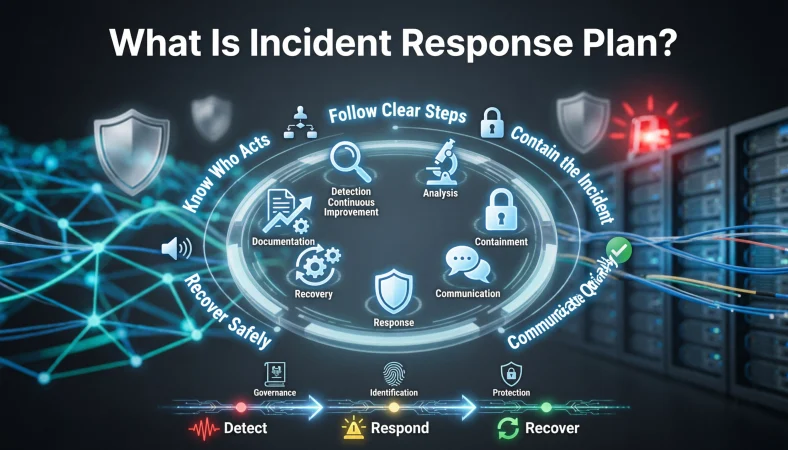
An incident response plan is a documented set of instructions that tells an organization how to prepare for, detect, respond to, contain, and recover from cybersecurity incidents. It helps teams know who does what, when to act, and how to restore normal operations without turning a security incident into total workplace chaos.
NIST’s current guidance, SP 800-61 Rev. 3, places incident response within broader cybersecurity risk management and focuses on Detect, Respond, and Recover, supported by the wider CSF 2.0 functions.
Top alternatives: incident response plan definition, cybersecurity incident response plan, incident response procedure, security incident response plan, incident response strategy
Ever wondered what happens when a company suddenly discovers ransomware, a stolen password, suspicious network activity, or a major data breach? Hopefully, someone is not just standing there saying, “Okay… now what?” That is where an incident response plan comes in. If you are searching what is incident response plan, the simplest answer is that it is a documented playbook for handling cybersecurity incidents in a controlled and organized way.
It can explain who should be contacted, how an incident should be assessed, what systems may need to be isolated, how evidence should be handled, how stakeholders should be informed, and how recovery should happen. NIST’s latest SP 800-61 Rev. 3, finalized in April 2025, supersedes the older Rev. 2 guidance and integrates incident response into the Cybersecurity Framework 2.0.
Simple What Is Incident Response Plan Explanations:
“An incident response plan is a playbook for handling cybersecurity incidents.”
Example: Use this when explaining the concept to someone new to cybersecurity.
Meaning: It gives a simple definition of the plan’s main purpose.
“It tells an organization what to do when a security incident happens.”
Example: Use this for a beginner-friendly cybersecurity article.
Meaning: It focuses on action during an incident.
“Think of it as an emergency checklist for cyber problems.”
Example: Use this when explaining the idea casually.
Meaning: It makes a technical concept easier to visualize.
“It turns panic into a planned response.”
Example: Use this as a short presentation line.
Meaning: It highlights why preparation matters.
“An incident response plan gives teams a roadmap during a security crisis.”
Example: Use this when introducing incident response to employees.
Meaning: It emphasizes coordinated action.
“It defines who responds, what they do, and when they do it.”
Example: Use this in an introductory cybersecurity guide.
Meaning: It highlights roles, responsibilities, and timing.
“It helps organizations respond to incidents consistently.”
Example: Use this in professional cybersecurity content.
Meaning: It explains the value of repeatable procedures.
“The plan is prepared before the emergency, not invented during it.”
Example: Use this when explaining why planning matters.
Meaning: It stresses preparation before an incident occurs.
“It connects detection, response, communication, and recovery.”
Example: Use this in a security awareness presentation.
Meaning: It summarizes the major areas covered by incident response.
“It is the organization’s cybersecurity emergency playbook.”
Example: Use this for a social-media-friendly explanation.
Meaning: It provides a memorable analogy.
“The goal is to reduce confusion when every second matters.”
Example: Use this when explaining incident response to management.
Meaning: It focuses on speed and coordination.
“A good plan helps the right people take the right actions quickly.”
Example: Use this in an introductory article.
Meaning: It summarizes the practical purpose of planning.
Professional Incident Response Plan Definitions:
“An incident response plan documents procedures for managing cybersecurity incidents.”
Example: Use this in a formal cybersecurity report.
Meaning: It provides a concise professional definition.
“It establishes responsibilities, communication channels, escalation paths, and response procedures.”
Example: Use this when describing plan components.
Meaning: It identifies core organizational elements.
“The plan supports coordinated detection, response, and recovery activities.”
Example: Use this in corporate security documentation.
Meaning: It connects the plan to the incident response lifecycle.
“An incident response plan provides a structured framework for managing security events.”
Example: Use this in a professional presentation.
Meaning: It emphasizes organized incident handling.
“It defines how an organization prepares for and manages cybersecurity incidents.”
Example: Use this in a policy document.
Meaning: It describes both preparation and response.
“The plan establishes processes for escalation, containment, investigation, and recovery.”
Example: Use this in cybersecurity training.
Meaning: It identifies common response activities.
“Incident response planning supports organizational resilience during cyber incidents.”
Example: Use this in an executive briefing.
Meaning: It connects incident response with resilience.
“The plan provides a common operating framework for incident responders.”
Example: Use this for security-team documentation.
Meaning: It promotes consistent team coordination.
“It helps align technical actions with organizational priorities.”
Example: Use this when explaining incident response to leadership.
Meaning: It connects cybersecurity actions with business needs.
“An effective plan defines decision-making authority during incidents.”
Example: Use this in a governance discussion.
Meaning: It clarifies who can approve important actions.
“It establishes procedures for communicating incident information to relevant stakeholders.”
Example: Use this in a compliance-focused document.
Meaning: It highlights communication responsibilities.
“The plan should be maintained and improved as organizational risks change.”
Example: Use this in a cybersecurity governance article.
Meaning: It recognizes that incident response planning is ongoing.
Funny Incident Response Plan Lines:
“It is the cyber version of knowing where the fire extinguisher is.”
Example: Use this to make a cybersecurity presentation more relatable.
Meaning: It compares incident response planning with emergency preparedness.
“Because ‘everyone panic’ is not an incident response strategy.”
Example: Use this as a humorous cybersecurity caption.
Meaning: It shows why structured planning matters.
“The plan answers the famous question: ‘Okay, now what?’”
Example: Use this when introducing incident response.
Meaning: It captures the uncertainty that follows an unexpected incident.
“Cybersecurity without a response plan is basically freestyle mode.”
Example: Use this in a casual security-awareness post.
Meaning: It jokes about the risks of improvising.
“When the alert goes off, the plan should go on.”
Example: Use this as a short security-team slogan.
Meaning: It encourages immediate use of established procedures.
“The incident can be dramatic; the response should not be.”
Example: Use this when discussing crisis management.
Meaning: It encourages calm and structured action.
“Your incident response plan is the adult supervision of cybersecurity.”
Example: Use this in a lighthearted presentation.
Meaning: It suggests the plan keeps reactions organized.
“No one wants a cybersecurity crisis powered by vibes.”
Example: Use this for an informal security awareness campaign.
Meaning: It highlights the need for documented procedures.
“If the plan lives only in someone’s memory, it is already playing hide-and-seek.”
Example: Use this when discussing undocumented procedures.
Meaning: It stresses the importance of written plans.
“A security incident is not the time for a team-wide guessing game.”
Example: Use this in employee training.
Meaning: It emphasizes preparation.
“The goal is fewer ‘Wait, who handles this?’ moments.”
Example: Use this when describing roles and responsibilities.
Meaning: It highlights the value of clear ownership.
“Good incident response is less superhero movie and more practiced routine.”
Example: Use this in a cybersecurity awareness article.
Meaning: It explains why preparation and repetition matter.
Creative Incident Response Plan Explanations:
“Picture an incident response plan as a GPS for a cybersecurity crisis.”
Example: Use this analogy in a beginner cybersecurity guide.
Meaning: It shows how the plan helps teams navigate uncertainty.
“It is the choreography behind a coordinated security response.”
Example: Use this in a creative presentation.
Meaning: It illustrates how different responders work together.
“Think of it as a backstage script for the cybersecurity emergency.”
Example: Use this for a social-media-friendly explanation.
Meaning: It highlights planned roles behind the scenes.
“The plan turns scattered reactions into coordinated movement.”
Example: Use this in a leadership presentation.
Meaning: It explains how structure improves response.
“It gives every responder a map when the digital road gets messy.”
Example: Use this as an infographic caption.
Meaning: It makes the purpose of the plan memorable.
“A response plan is the bridge between ‘something happened’ and ‘we know what to do.’”
Example: Use this when introducing incident management.
Meaning: It describes the plan as a connection between detection and action.
“It transforms cybersecurity surprises into practiced scenarios.”
Example: Use this in security awareness content.
Meaning: It emphasizes preparedness.
“The plan is where technical response meets business priorities.”
Example: Use this in an executive presentation.
Meaning: It connects security operations with organizational decisions.
“Think less chaos, more choreography.”
Example: Use this as a short presentation headline.
Meaning: It summarizes coordinated response.
“A good plan gives uncertainty a structure.”
Example: Use this in an incident response article.
Meaning: It explains the psychological and operational value of preparation.
“Every major incident needs a story, and the plan provides the plot.”
Example: Use this as a creative analogy.
Meaning: It illustrates how procedures guide the response.
“Prepared teams do not eliminate incidents; they make them easier to manage.”
Example: Use this in an educational post.
Meaning: It explains the realistic goal of incident response.
Smart Incident Response Plan Statements:
“A plan is valuable only if people know how to use it.”
Example: Use this when discussing incident response training.
Meaning: It emphasizes practical readiness.
“Documentation without testing is only half a plan.”
Example: Use this when explaining exercises and drills.
Meaning: It highlights the need to validate procedures.
“Clear ownership is one of the foundations of effective incident response.”
Example: Use this in a security governance discussion.
Meaning: It stresses accountability.
“Every response plan should match the organization’s actual environment.”
Example: Use this when discussing customization.
Meaning: It discourages copying generic plans without adaptation.
“A plan should answer both technical and organizational questions.”
Example: Use this in a professional cybersecurity article.
Meaning: It recognizes that incidents affect more than technology.
“The best plan is specific enough to guide action and flexible enough to handle uncertainty.”
Example: Use this in a leadership presentation.
Meaning: It balances structure with real-world unpredictability.
“Incident response planning should reflect the organization’s most important risks.”
Example: Use this when discussing risk-based planning.
Meaning: It connects response preparation with risk management.
“Communication should be planned before the incident, not improvised afterward.”
Example: Use this in crisis-management training.
Meaning: It highlights the importance of communication readiness.
“Recovery should be part of the plan from the beginning.”
Example: Use this when discussing business continuity.
Meaning: It reminds teams that response does not end with containment.
“Lessons learned should improve future response capabilities.”
Example: Use this after an incident review.
Meaning: It emphasizes continuous improvement.
“A response plan should identify dependencies before those dependencies become problems.”
Example: Use this in resilience planning.
Meaning: It encourages teams to understand critical systems and relationships.
“Incident response works best when preparation is treated as an ongoing process.”
Example: Use this in cybersecurity strategy content.
Meaning: It rejects the idea that a plan is a one-time document.
Chill And Casual Incident Response Plan Explanations:
“Basically, it is the plan for when cybersecurity gets messy.”
Example: Use this when explaining incident response to a friend.
Meaning: It provides a simple informal definition.
“It tells everyone what to do when something suspicious happens.”
Example: Use this for a beginner audience.
Meaning: It focuses on clear action.
“Think of it as a cybersecurity emergency checklist.”
Example: Use this in a casual explanation.
Meaning: It makes the concept easy to remember.
“It keeps the team from making things up as they go.”
Example: Use this when explaining why plans matter.
Meaning: It highlights the danger of improvisation.
“The plan basically says, ‘Here is what happens next.’”
Example: Use this as a simple social caption.
Meaning: It captures the plan’s purpose.
“When something goes wrong, the plan becomes the cheat sheet.”
Example: Use this in informal training content.
Meaning: It describes the plan as a quick reference.
“It is your cybersecurity ‘stay calm and follow the steps’ document.”
Example: Use this for nontechnical employees.
Meaning: It makes the concept approachable.
“It covers who gets called, what gets checked, and what happens next.”
Example: Use this when explaining plan contents.
Meaning: It summarizes practical responsibilities.
“Good plans save everyone from the dreaded ‘Who knows what to do?’ moment.”
Example: Use this in security awareness content.
Meaning: It highlights the value of assigned roles.
“The idea is simple: prepare now so you are not guessing later.”
Example: Use this as a short training message.
Meaning: It summarizes the reason for preparation.
“It is basically a roadmap for cyber emergencies.”
Example: Use this in a beginner article.
Meaning: It gives an easy analogy.
“No complicated vibes, just clear steps when things go sideways.”
Example: Use this as a casual social caption.
Meaning: It emphasizes simplicity and structure.
Confident Incident Response Plan Statements
“Every organization should know how it will respond before an incident occurs.”
Example: Use this in an executive cybersecurity presentation.
Meaning: It communicates the importance of preparation.
“A documented plan gives responders confidence under pressure.”
Example: Use this in team training.
Meaning: It connects preparation with confident decision-making.
“Prepared teams respond with structure instead of guesswork.”
Example: Use this as a security awareness slogan.
Meaning: It contrasts preparation with improvisation.
“Clear roles make faster decisions possible.”
Example: Use this in a management briefing.
Meaning: It explains why responsibilities should be defined.
“Incident response should be practiced, not merely written.”
Example: Use this when discussing exercises.
Meaning: It stresses operational readiness.
“A serious cybersecurity program needs a serious response capability.”
Example: Use this in professional content.
Meaning: It connects security maturity with incident readiness.
“Organizations cannot control every incident, but they can prepare for response.”
Example: Use this in a risk-management discussion.
Meaning: It distinguishes prevention from response readiness.
“The plan should be accessible to the people who need it.”
Example: Use this when reviewing incident documentation.
Meaning: It emphasizes usability.
“Response authority should never be a mystery during a crisis.”
Example: Use this in incident governance content.
Meaning: It stresses clearly defined decision rights.
“Preparedness is a security capability, not paperwork.”
Example: Use this in an executive presentation.
Meaning: It emphasizes practical implementation.
“A strong response plan protects both systems and decision-making.”
Example: Use this when discussing organizational resilience.
Meaning: It recognizes technical and managerial benefits.
“Confidence during an incident comes from preparation before the incident.”
Example: Use this as a closing training statement.
Meaning: It summarizes the value of readiness.
Technical Incident Response Plan Lines:
“An incident response plan defines procedures for identifying, analyzing, containing, responding to, and recovering from incidents.”
Example: Use this in technical cybersecurity training.
Meaning: It describes the operational scope of response planning.
“Detection provides the signal that an incident may require investigation.”
Example: Use this when explaining incident workflows.
Meaning: It describes the starting point for response activity.
“Triage helps teams determine the nature and priority of an incident.”
Example: Use this in SOC training.
Meaning: It explains how teams prioritize events.
“Containment limits the potential spread or impact of an incident.”
Example: Use this in technical response documentation.
Meaning: It explains the purpose of containment.
“Investigation helps establish what happened and how it happened.”
Example: Use this when describing incident analysis.
Meaning: It focuses on understanding the incident.
“Evidence preservation can support investigation and later analysis.”
Example: Use this in digital forensics training.
Meaning: It highlights the importance of preserving relevant information.
“Eradication focuses on removing the underlying malicious presence or cause.”
Example: Use this when explaining traditional incident-handling terminology.
Meaning: It describes removal of the threat.
“Recovery focuses on restoring affected systems and services safely.”
Example: Use this in incident recovery training.
Meaning: It describes the transition toward normal operations.
“Validation confirms that restored systems are functioning as intended.”
Example: Use this when explaining recovery verification.
Meaning: It emphasizes checking restoration results.
“Documentation creates a record of decisions, actions, findings, and outcomes.”
Example: Use this during incident response training.
Meaning: It highlights the value of accurate records.
“Post-incident analysis can identify improvements for future response.”
Example: Use this when explaining lessons learned.
Meaning: It connects incidents with continuous improvement.
“NIST SP 800-61 Rev. 3 frames incident response around Detect, Respond, and Recover, supported by broader cybersecurity risk-management activities.”
Example: Use this in an updated cybersecurity article.
Meaning: It reflects NIST’s current incident response model.
Incident Response Plan For Employees:
“Report suspicious activity instead of trying to investigate it yourself.”
Example: Use this in employee security awareness training.
Meaning: It encourages safe escalation.
“Know how to contact your security or IT team.”
Example: Use this in employee onboarding.
Meaning: It ensures workers know where to report incidents.
“Do not ignore unusual security warnings.”
Example: Use this in a workplace security guide.
Meaning: It encourages employees to report potential problems.
“Follow the reporting process defined by your organization.”
Example: Use this in an employee handbook.
Meaning: It promotes consistent incident reporting.
“Avoid sharing sensitive incident details through unofficial channels.”
Example: Use this when explaining communication procedures.
Meaning: It reduces the risk of information leakage.
“Do not assume someone else has already reported the issue.”
Example: Use this in phishing awareness training.
Meaning: It encourages prompt reporting.
“Keep incident communication factual and concise.”
Example: Use this during employee training.
Meaning: It reduces confusion during a security event.
“Do not delete potentially relevant information unless instructed.”
Example: Use this when explaining evidence preservation.
Meaning: It helps protect useful investigative information.
“Know your role before an incident occurs.”
Example: Use this in organizational preparedness training.
Meaning: It encourages employees to understand their responsibilities.
“Practice the reporting process before you need it.”
Example: Use this during security drills.
Meaning: It reinforces practical preparedness.
“If something feels suspicious, use the official reporting route.”
Example: Use this in a workplace poster.
Meaning: It provides a simple employee action.
“Good security starts with knowing when and how to raise your hand.”
Example: Use this in a friendly awareness campaign.
Meaning: It encourages early escalation without panic.
Incident Response Plan For Businesses:
“A business incident response plan should protect critical operations as well as information systems.”
Example: Use this when discussing enterprise resilience.
Meaning: It connects cybersecurity with business priorities.
“Identify critical services before deciding how incidents will affect them.”
Example: Use this during business risk planning.
Meaning: It supports prioritization.
“Define escalation paths for incidents with significant business impact.”
Example: Use this in corporate governance content.
Meaning: It ensures serious incidents reach appropriate decision-makers.
“Assign owners for technical, legal, communications, and business decisions.”
Example: Use this when building an enterprise plan.
Meaning: It creates cross-functional accountability.
“Include third-party and supplier considerations in the response strategy.”
Example: Use this when discussing supply-chain risk.
Meaning: It recognizes that incidents can involve external partners.
“Document how leadership will receive incident updates.”
Example: Use this in executive preparedness planning.
Meaning: It establishes predictable communication.
“Define criteria for escalating an incident.”
Example: Use this when designing response procedures.
Meaning: It establishes thresholds for higher-level action.
“Plan recovery around business priorities, not just technical restoration.”
Example: Use this in resilience planning.
Meaning: It connects recovery with organizational needs.
“Identify important dependencies before an incident exposes them.”
Example: Use this during business impact analysis.
Meaning: It encourages proactive understanding of systems and services.
“Test communication procedures as well as technical procedures.”
Example: Use this during incident response exercises.
Meaning: It recognizes that communication can determine response effectiveness.
“Review the plan after major incidents and exercises.”
Example: Use this in governance documentation.
Meaning: It supports continuous improvement.
“Treat incident response as part of cybersecurity risk management, not a standalone emergency document.”
Example: Use this in an executive cybersecurity article.
Meaning: It reflects NIST’s current approach to integrating response across the broader risk-management program.
Incident Response Plan Steps And Process Lines:
“Start by defining what qualifies as a cybersecurity incident.”
Example: Use this when creating an incident response framework.
Meaning: It establishes the scope of response.
“Identify the people responsible for responding.”
Example: Use this during plan development.
Meaning: It creates clear ownership.
“Document how incidents are reported and escalated.”
Example: Use this when designing response procedures.
Meaning: It establishes communication and escalation paths.
“Determine how incidents will be assessed and prioritized.”
Example: Use this during response planning.
Meaning: It helps teams focus on the most important incidents.
“Define appropriate containment actions for different incident types.”
Example: Use this when developing technical playbooks.
Meaning: It creates predefined response options.
“Document investigation and evidence-handling expectations.”
Example: Use this in a technical response plan.
Meaning: It supports consistent investigation.
“Define how affected systems will be recovered.”
Example: Use this when building recovery procedures.
Meaning: It connects response with restoration.
“Specify who approves major recovery decisions.”
Example: Use this in an enterprise response plan.
Meaning: It establishes decision authority.
“Create communication procedures for internal stakeholders.”
Example: Use this during plan development.
Meaning: It organizes internal incident communication.
“Identify external notification requirements that may apply.”
Example: Use this in compliance-focused planning.
Meaning: It encourages consideration of legal and regulatory obligations.
“Test the plan through exercises and realistic scenarios.”
Example: Use this during security preparedness programs.
Meaning: It validates whether the documented procedures actually work.
“Update the plan based on lessons learned.”
Example: Use this after an exercise or real incident.
Meaning: It turns experience into stronger future preparedness.
What Is Incident Response Plan In Simple Words:
“It is a written plan for handling cyber trouble.”
Example: Use this as a one-line definition.
Meaning: It makes the concept extremely simple.
“It tells the team what to do when security goes wrong.”
Example: Use this for beginners.
Meaning: It focuses on immediate action.
“It is a roadmap for cybersecurity emergencies.”
Example: Use this in an infographic.
Meaning: It gives the plan a memorable analogy.
“It tells people who should act and what they should do.”
Example: Use this in employee training.
Meaning: It explains roles and procedures.
“It helps a company respond without guessing.”
Example: Use this in a social post.
Meaning: It highlights preparation.
“It turns a security crisis into a series of planned actions.”
Example: Use this in an educational article.
Meaning: It explains how planning creates structure.
“It is the cybersecurity version of an emergency plan.”
Example: Use this when explaining the concept casually.
Meaning: It compares cyber preparedness with familiar emergency planning.
“It tells the organization what happens after an alert.”
Example: Use this when explaining incident workflows.
Meaning: It focuses on the transition from detection to response.
“It helps teams respond quickly and consistently.”
Example: Use this in a beginner-friendly guide.
Meaning: It highlights two major benefits.
“It is preparation for the moment nobody wants to have.”
Example: Use this as a memorable caption.
Meaning: It explains why organizations prepare for incidents.
“It keeps cybersecurity response organized under pressure.”
Example: Use this in professional content.
Meaning: It emphasizes calm coordination.
“In short, it is the plan for what happens when something goes wrong.”
Example: Use this as a final simple definition.
Meaning: It summarizes the entire concept in plain language.
FAQs:
What is an incident response plan?
An incident response plan is a documented set of procedures, responsibilities, communication methods, and decision-making steps for managing cybersecurity incidents. It helps an organization respond in a coordinated way instead of improvising during a crisis. NIST’s current SP 800-61 Rev. 3 integrates incident response into broader cybersecurity risk management.
What is the main purpose of an incident response plan?
Its main purpose is to help an organization detect, respond to, contain, and recover from cybersecurity incidents while reducing confusion, damage, and downtime.
Is an incident response plan the same as a disaster recovery plan?
No. They overlap, but they have different purposes. Incident response focuses on managing the security incident, while disaster recovery primarily focuses on restoring systems, services, and operations after disruption.
What should an incident response plan include?
Common elements include roles and responsibilities, incident definitions, reporting procedures, escalation rules, communication processes, investigation guidance, containment procedures, recovery steps, documentation requirements, and testing procedures.
What are the current NIST incident response phases?
NIST SP 800-61 Rev. 3 presents incident response around Detect, Respond, and Recover, while broader CSF 2.0 functions such as Govern, Identify, and Protect support incident response preparation and capabilities.
Is the old NIST incident response lifecycle still current?
NIST SP 800-61 Rev. 3, finalized in April 2025, supersedes Rev. 2. The older model commonly described Preparation, Detection and Analysis, Containment, Eradication and Recovery, and Post-Incident Activity. Current NIST guidance uses the CSF 2.0-based approach instead.
Who should be involved in an incident response plan?
Depending on the organization, participants may include security teams, IT, system owners, management, legal, privacy, communications, human resources, compliance, and relevant third parties.
Is an incident response plan only for large companies?
No. Small businesses need incident response planning too. The plan can be scaled according to the organization’s size, technology, risks, resources, and regulatory obligations.
Should an incident response plan be tested?
Yes. Testing helps reveal unclear responsibilities, outdated contact information, missing procedures, and gaps between what the document says and what the organization can actually do.
Can humor be used when explaining an incident response plan?
Absolutely. Light humor can make cybersecurity concepts easier to remember, especially in employee training and social content. During an actual incident, however, communication should remain clear, professional, and focused.
What if a company does not actually have an incident response plan?
The organization may have to improvise during an incident, increasing the risk of confusion, delays, inconsistent decisions, and missed responsibilities. Creating and testing a basic plan is a strong starting point.
How often should an incident response plan be updated?
There is no universal calendar that fits every organization. It should be reviewed whenever major systems, risks, personnel, vendors, regulations, or response procedures change, and it should also be improved after exercises and real incidents.
Conclusion:
Knowing what is incident response plan does not mean memorizing a pile of cybersecurity jargon. At its heart, it is about being ready before the pressure hits. A good plan tells people who acts, what happens next, how information moves, and how the organization works toward recovery. The strongest plans are not forgotten documents sitting in a shared folder.
They are tested, understood, updated, and connected to the organization’s real risks. NIST’s current guidance also emphasizes integrating incident response throughout broader cybersecurity risk management rather than treating it as an isolated activity. Save this guide, share it with your security team, and use these simple explanations whenever someone asks what incident response really means.