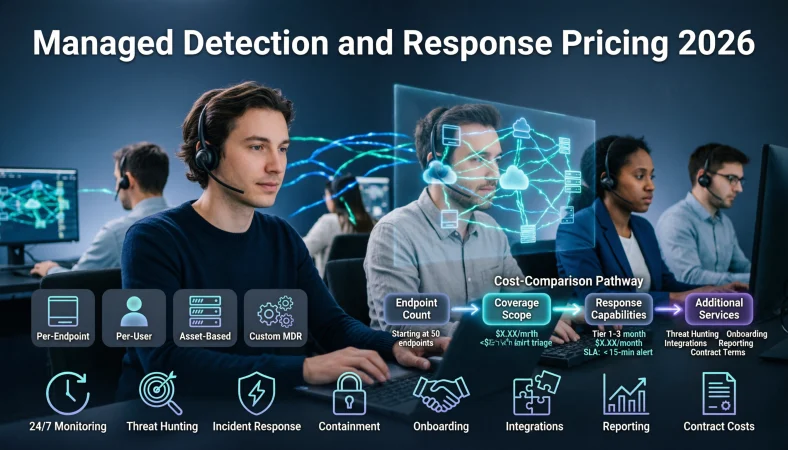
Managed detection and response pricing varies widely because providers price MDR by endpoints, users, assets, data sources, service scope, response coverage, and contract terms. Current published examples range from roughly $8 to $30+ per endpoint per month, while many providers use custom quotes. (MDRCost.com)
Top alternatives: MDR pricing, MDR cost, managed security pricing, SOC-as-a-Service pricing, managed cybersecurity cost
Nothing makes a cybersecurity budget meeting more interesting than someone asking, “So, how much does MDR actually cost?” Then the spreadsheet opens, three vendors give three different pricing models, and suddenly everyone needs coffee. Managed detection and response pricing can be surprisingly difficult to compare because providers may charge per endpoint, per user, by assets covered, or through customized packages.
The service itself can also include very different levels of monitoring, threat hunting, incident response, onboarding, integrations, and reporting. Current market references show published MDR prices ranging from single-digit dollars per endpoint monthly to much higher custom arrangements, while several major providers require buyers to request a quote. (MDRCost.com) Whether you are texting a colleague, preparing a proposal, comparing vendors, or building a security budget, knowing what sits behind the price tag makes the conversation much easier.
Funny Managed Detection And Response Pricing Responses
1. “Apparently cybersecurity does not come with a snack-size option.”
Example: Use this when a teammate reacts to a surprisingly detailed MDR quote.
Meaning: It jokes about how quickly security services can become complex.
2. “My spreadsheet just developed a threat.”
Example: Use this when multiple MDR pricing options make budgeting confusing.
Meaning: It adds humour to pricing complexity.
3. “The endpoint count has entered the chat.”
Example: Use this when someone asks what determines MDR pricing.
Meaning: It highlights endpoint-based pricing.
4. “Nothing says Friday like comparing SOC quotes.”
Example: Use this in a workplace message about a late-week vendor review.
Meaning: It humorously captures the reality of cybersecurity procurement.
5. “Our budget would like a word with our security team.”
Example: Use this after reviewing several MDR proposals.
Meaning: It jokes about balancing security needs with spending.
6. “The quote has more layers than our onion model.”
Example: Use this when a vendor proposal contains many pricing components.
Meaning: It makes a complicated quote easier to laugh about.
7. “Per endpoint sounded simple five minutes ago.”
Example: Use this when additional service charges appear.
Meaning: It jokes about pricing becoming more complicated.
8. “Cybersecurity math is doing cybersecurity things.”
Example: Use this during a pricing discussion with technical colleagues.
Meaning: It playfully acknowledges unusual pricing structures.
9. “The SOC is watching, and apparently the CFO is too.”
Example: Use this when security and finance teams review MDR costs together.
Meaning: It highlights the financial side of security decisions.
10. “Our endpoints have expensive personalities.”
Example: Use this when endpoint counts affect the quote.
Meaning: It humorously describes variable endpoint costs.
11. “One quote, twelve questions, zero chill.”
Example: Use this before a vendor pricing meeting.
Meaning: It captures the stress of comparing security contracts.
12. “At least the hackers are not doing the accounting.”
Example: Use this as a light joke during budget discussions.
Meaning: It keeps a serious cybersecurity topic playful.
Professional Managed Detection And Response Pricing Responses
1. “The price should be evaluated alongside the coverage scope.”
Example: Use this in a formal vendor discussion.
Meaning: It encourages comparison beyond the headline price.
2. “Please clarify whether the quoted rate includes response.”
Example: Use this before approving an MDR proposal.
Meaning: It checks whether hands-on response is part of the package.
3. “Can you confirm the billing unit?”
Example: Use this when comparing different MDR providers.
Meaning: It establishes whether pricing is based on endpoints, users, assets, or another measure.
4. “Please provide the complete annual cost.”
Example: Use this when a monthly rate hides additional charges.
Meaning: It requests a clearer budget figure.
5. “What onboarding fees apply?”
Example: Use this during procurement.
Meaning: It identifies implementation costs outside recurring pricing.
6. “Are threat-hunting services included?”
Example: Use this when reviewing MDR scope.
Meaning: It checks whether proactive security work is covered.
7. “Please document the response SLA.”
Example: Use this when reviewing service commitments.
Meaning: It asks for measurable response expectations.
8. “What is included in the base subscription?”
Example: Use this when a quote contains several packages.
Meaning: It separates included features from add-ons.
9. “Are servers priced differently from workstations?”
Example: Use this when endpoint categories vary.
Meaning: It checks whether different assets carry different costs.
10. “Does the agreement include incident response?”
Example: Use this before contract approval.
Meaning: It verifies what happens during a confirmed security incident.
11. “Please identify all optional charges.”
Example: Use this when seeking transparent procurement information.
Meaning: It helps reveal possible extras.
12. “We need pricing based on our actual environment.”
Example: Use this when a generic estimate is not sufficient.
Meaning: It requests a quote tailored to the organization.
Managed Detection And Response Pricing Questions To Ask Vendors
1. “How much does each endpoint cost?”
Example: Use this as the first question when the provider uses endpoint-based pricing.
Meaning: It establishes the basic unit cost.
2. “Is the price per month or per year?”
Example: Use this when comparing vendor advertisements.
Meaning: It clarifies the billing period.
3. “Is there a minimum endpoint commitment?”
Example: Use this when your organization has a small environment.
Meaning: It checks whether a minimum purchase applies.
4. “Are users billed separately?”
Example: Use this when identity monitoring is included.
Meaning: It identifies another possible pricing dimension.
5. “Are cloud workloads included?”
Example: Use this when your environment includes cloud infrastructure.
Meaning: It confirms the coverage boundary.
6. “Is identity monitoring included?”
Example: Use this when evaluating broader MDR coverage.
Meaning: It checks whether identity telemetry is part of the service.
7. “How much log ingestion is included?”
Example: Use this when the service includes SIEM functionality.
Meaning: It identifies possible data-volume limitations.
8. “Is threat hunting unlimited?”
Example: Use this when comparing service depth.
Meaning: It clarifies whether proactive investigations have limits.
9. “What happens during a confirmed incident?”
Example: Use this before signing a contract.
Meaning: It reveals the provider’s response process and possible extra costs.
10. “Can you isolate an endpoint automatically?”
Example: Use this when response authority matters.
Meaning: It checks whether containment can happen without manual approval.
11. “Are integrations charged separately?”
Example: Use this when connecting several security platforms.
Meaning: It identifies integration-related costs.
12. “What is the cancellation policy?”
Example: Use this during contract negotiations.
Meaning: It clarifies financial obligations if the service ends early.
Managed Detection And Response Pricing By Endpoint
1. “Per-endpoint pricing is easy to understand.”
Example: Use this when explaining a straightforward MDR quote.
Meaning: The cost scales according to covered devices.
2. “Our quote covers 100 endpoints.”
Example: Use this when documenting the scope of a proposal.
Meaning: It establishes the number of protected devices.
3. “We need pricing for 500 endpoints.”
Example: Use this when requesting a larger deployment estimate.
Meaning: It gives the provider a concrete sizing requirement.
4. “Please include servers in the endpoint calculation.”
Example: Use this when building an accurate asset count.
Meaning: It prevents underestimating coverage requirements.
5. “What happens when endpoint volume increases?”
Example: Use this during long-term planning.
Meaning: It checks whether volume discounts or pricing changes apply.
6. “Does the per-endpoint rate decrease at scale?”
Example: Use this when negotiating larger deployments.
Meaning: It asks about volume-based pricing.
7. “Is the endpoint definition clearly documented?”
Example: Use this before comparing two quotes.
Meaning: It ensures both vendors count assets consistently.
8. “Are inactive devices still billed?”
Example: Use this when asset turnover is frequent.
Meaning: It checks how billing handles inactive endpoints.
9. “How are temporary devices handled?”
Example: Use this when contractors or temporary machines are common.
Meaning: It clarifies short-term asset billing.
10. “Are virtual machines counted separately?”
Example: Use this for environments with substantial virtualization.
Meaning: It identifies how virtual assets affect pricing.
11. “Can endpoint pricing be fixed for the contract term?”
Example: Use this during contract negotiations.
Meaning: It seeks predictable budgeting.
12. “Please show the price at our expected endpoint count.”
Example: Use this when comparing vendors at the same scale.
Meaning: It creates a more meaningful price comparison.
Managed Detection And Response Pricing By User
1. “Is your MDR priced per user?”
Example: Use this when a provider discusses user-based billing.
Meaning: It determines whether people rather than devices drive the quote.
2. “What does each user license include?”
Example: Use this before evaluating a per-user plan.
Meaning: It connects the price to actual service coverage.
3. “Are shared accounts included?”
Example: Use this when multiple people access shared systems.
Meaning: It clarifies how unusual account structures are billed.
4. “Are privileged users priced differently?”
Example: Use this when identity risk varies across employees.
Meaning: It checks whether pricing changes by user category.
5. “Does user pricing include identity monitoring?”
Example: Use this when evaluating identity-focused MDR.
Meaning: It verifies the scope of protection.
6. “How are contractors counted?”
Example: Use this when external workers access company systems.
Meaning: It clarifies billing for nonemployees.
7. “What happens when headcount changes?”
Example: Use this when staffing levels fluctuate.
Meaning: It checks how the subscription adapts.
8. “Is there a minimum user commitment?”
Example: Use this for smaller organizations.
Meaning: It identifies minimum billing requirements.
9. “Are service accounts included?”
Example: Use this when the environment contains automated identities.
Meaning: It checks coverage for nonhuman accounts.
10. “Can we combine user and endpoint pricing?”
Example: Use this when the environment needs mixed coverage.
Meaning: It explores flexible pricing structures.
11. “Are identity alerts included in the base rate?”
Example: Use this when comparing broader MDR services.
Meaning: It checks whether identity monitoring costs extra.
12. “Please provide pricing for our actual user count.”
Example: Use this when generic pricing is too broad.
Meaning: It requests a practical estimate.
Managed Detection And Response Pricing For Small Businesses
1. “We need protection without a huge security team.”
Example: Use this when explaining why an SMB is considering MDR.
Meaning: It highlights the staffing gap MDR may help address.
2. “Can you price a 25-endpoint environment?”
Example: Use this when requesting a small-business quote.
Meaning: It gives the vendor a concrete starting point.
3. “What is your smallest MDR package?”
Example: Use this when budgets are limited.
Meaning: It identifies the provider’s entry-level offering.
4. “Is 24/7 monitoring included?”
Example: Use this when comparing small-business plans.
Meaning: It checks whether continuous monitoring is part of the service.
5. “Does the plan include active containment?”
Example: Use this when response capability matters.
Meaning: It determines whether the provider can take action during threats.
6. “Are there setup fees?”
Example: Use this before calculating the first-year cost.
Meaning: It identifies upfront expenses.
7. “Can we scale as we grow?”
Example: Use this when headcount or devices may increase.
Meaning: It checks whether the service supports business growth.
8. “Do you require a long-term contract?”
Example: Use this when comparing flexible options.
Meaning: It clarifies contract commitment.
9. “What support comes with the entry plan?”
Example: Use this when comparing basic packages.
Meaning: It connects price to actual service levels.
10. “Can you provide a total monthly estimate?”
Example: Use this when planning a small-business budget.
Meaning: It turns the proposal into an easier budgeting figure.
11. “What costs are outside the subscription?”
Example: Use this when trying to avoid surprises.
Meaning: It reveals additional charges.
12. “Show us the price at our current size.”
Example: Use this when a vendor gives only broad ranges.
Meaning: It asks for a practical small-business quote.
Managed Detection And Response Pricing For Mid-Market Companies
1. “We need a quote based on our complete environment.”
Example: Use this when a company has endpoints, cloud workloads, and identity systems.
Meaning: It asks for comprehensive pricing.
2. “Please separate recurring and one-time costs.”
Example: Use this during procurement.
Meaning: It makes the financial structure easier to understand.
3. “What is included in enterprise support?”
Example: Use this when evaluating higher service tiers.
Meaning: It clarifies premium coverage.
4. “How does pricing change at 500 endpoints?”
Example: Use this when planning expansion.
Meaning: It checks scale economics.
5. “Can we include cloud telemetry?”
Example: Use this when cloud infrastructure is important.
Meaning: It tests whether the provider can cover broader attack surfaces.
6. “Do you support identity and endpoint correlation?”
Example: Use this when evaluating XDR-style coverage.
Meaning: It checks whether multiple signals can be analyzed together.
7. “What reporting is included?”
Example: Use this when leadership requires regular security visibility.
Meaning: It connects pricing with reporting deliverables.
8. “Is there a dedicated security advisor?”
Example: Use this when evaluating premium service levels.
Meaning: It checks whether strategic guidance is included.
9. “Are custom detection rules included?”
Example: Use this when the organization has specialized risks.
Meaning: It identifies customization capabilities.
10. “What is the incident-response escalation process?”
Example: Use this during technical due diligence.
Meaning: It clarifies how serious incidents are handled.
11. “What contract term gives us the quoted rate?”
Example: Use this when reviewing multi-year proposals.
Meaning: It connects pricing to contractual commitment.
12. “Please show three service scenarios.”
Example: Use this when comparing basic, standard, and advanced coverage.
Meaning: It makes scope-based price differences easier to evaluate.
Managed Detection And Response Pricing For Enterprise
1. “We need enterprise pricing based on actual asset volume.”
Example: Use this when requesting a large-scale proposal.
Meaning: It asks for environment-specific pricing.
2. “Please include all covered asset categories.”
Example: Use this when the environment includes endpoints, servers, cloud, and identity.
Meaning: It prevents gaps in the pricing scope.
3. “What volume discounts are available?”
Example: Use this when negotiating large deployments.
Meaning: It asks whether scale affects unit cost.
4. “Can pricing remain predictable as telemetry grows?”
Example: Use this when avoiding unexpected data-based charges.
Meaning: It focuses on budget stability.
5. “Is unlimited log ingestion included?”
Example: Use this when comparing MDR platforms with SIEM functionality.
Meaning: It identifies potential data-volume restrictions.
6. “What are the enterprise SLA commitments?”
Example: Use this when reviewing critical-service coverage.
Meaning: It checks contractual service expectations.
7. “Is incident response included?”
Example: Use this before signing a large contract.
Meaning: It determines whether serious incidents trigger additional charges.
8. “Are dedicated analysts available?”
Example: Use this when evaluating premium services.
Meaning: It checks whether specialist personnel are part of the package.
9. “What compliance reporting is supported?”
Example: Use this when regulatory requirements affect security operations.
Meaning: It connects MDR capabilities with governance needs.
10. “How are international environments priced?”
Example: Use this when operations span several regions.
Meaning: It identifies geographic pricing considerations.
11. “What is the renewal pricing mechanism?”
Example: Use this during contract negotiations.
Meaning: It checks how future costs may change.
12. “Please provide a five-year cost model.”
Example: Use this for long-term enterprise planning.
Meaning: It supports multi-year financial analysis.
Managed Detection And Response Pricing And Features
1. “The price includes 24/7 monitoring.”
Example: Use this when documenting the scope of a provider’s proposal.
Meaning: It identifies continuous security monitoring.
2. “Threat hunting is part of the package.”
Example: Use this when comparing proactive services.
Meaning: It indicates that analysts actively search for threats.
3. “Incident response is included.”
Example: Use this when summarizing a comprehensive MDR package.
Meaning: It confirms response support during incidents.
4. “Endpoint protection is bundled.”
Example: Use this when a service combines EDR and MDR.
Meaning: It indicates that technology licensing is included.
5. “Cloud monitoring is an additional option.”
Example: Use this when reviewing optional coverage.
Meaning: It identifies an extra pricing component.
6. “Identity monitoring is included.”
Example: Use this when the service covers identity signals.
Meaning: It expands coverage beyond endpoints.
7. “Onboarding is included in year one.”
Example: Use this when documenting implementation costs.
Meaning: It clarifies whether setup is covered.
8. “Custom detections are part of the premium tier.”
Example: Use this when comparing service levels.
Meaning: It distinguishes advanced customization from basic monitoring.
9. “Reporting is included monthly.”
Example: Use this when leadership requires recurring updates.
Meaning: It confirms regular reporting.
10. “The service includes remediation guidance.”
Example: Use this when assessing incident support.
Meaning: It indicates that the provider helps determine corrective actions.
11. “The package includes security advisory support.”
Example: Use this when evaluating higher-touch MDR services.
Meaning: It identifies strategic guidance as part of the service.
12. “Pricing follows the protected environment.”
Example: Use this when explaining asset-based MDR.
Meaning: The quote reflects the scope of monitored assets.
Managed Detection And Response Pricing And Hidden Costs
1. “What happens after the included onboarding?”
Example: Use this when calculating first-year versus ongoing costs.
Meaning: It checks for future implementation charges.
2. “Are integrations extra?”
Example: Use this when connecting third-party platforms.
Meaning: It identifies possible integration fees.
3. “Are additional data sources billed separately?”
Example: Use this when expanding monitoring coverage.
Meaning: It checks whether broader telemetry changes the bill.
4. “Is incident response included after confirmation?”
Example: Use this before choosing a low headline price.
Meaning: It checks whether serious incidents trigger additional charges.
5. “Are premium reports extra?”
Example: Use this when leadership requires customized reporting.
Meaning: It identifies possible reporting add-ons.
6. “Is data retention included?”
Example: Use this when investigation history matters.
Meaning: It clarifies how long security data remains available.
7. “Are professional services billed separately?”
Example: Use this during implementation planning.
Meaning: It identifies consulting costs.
8. “Is after-hours escalation included?”
Example: Use this when evaluating 24/7 claims.
Meaning: It distinguishes true round-the-clock response from limited coverage.
9. “Are custom detection rules extra?”
Example: Use this when specialized monitoring is required.
Meaning: It checks customization costs.
10. “Does the price include threat hunting?”
Example: Use this when comparing apparently similar packages.
Meaning: It identifies a potentially important scope difference.
11. “Are minimum commitments required?”
Example: Use this when considering a smaller deployment.
Meaning: It checks whether actual usage can fall below contracted volume.
12. “Please list every possible additional charge.”
Example: Use this before contract approval.
Meaning: It seeks pricing transparency.
Managed Detection And Response Pricing Comparisons
1. “Let’s compare coverage, not just price.”
Example: Use this when two providers have different service scopes.
Meaning: It encourages an apples-to-apples comparison.
2. “Vendor A uses endpoint pricing.”
Example: Use this when documenting a provider’s billing model.
Meaning: It identifies the primary pricing unit.
3. “Vendor B uses a custom quote.”
Example: Use this when a provider does not publish a standard rate.
Meaning: It explains why direct comparison may require a proposal.
4. “This plan includes response.”
Example: Use this when comparing service packages.
Meaning: It identifies a key difference in coverage.
5. “This quote excludes onboarding.”
Example: Use this when reviewing a proposal carefully.
Meaning: It highlights a separate implementation cost.
6. “This package includes cloud coverage.”
Example: Use this when evaluating broader monitoring.
Meaning: It identifies additional telemetry coverage.
7. “This provider charges by protected assets.”
Example: Use this when summarizing asset-based pricing.
Meaning: It describes the billing model.
8. “This vendor offers published pricing.”
Example: Use this when a provider posts public rates.
Meaning: It distinguishes transparent list pricing from custom quoting.
9. “This proposal requires a minimum commitment.”
Example: Use this when comparing contracts.
Meaning: It identifies a commercial constraint.
10. “This service has a separate incident-response retainer.”
Example: Use this when response is not bundled.
Meaning: It highlights an additional security cost.
11. “The cheaper quote covers fewer signals.”
Example: Use this when comparing two different scopes.
Meaning: It explains why headline price alone can mislead.
12. “The final decision depends on scope.”
Example: Use this when summarizing several MDR proposals.
Meaning: It emphasizes the importance of matching price to coverage.
Managed Detection And Response Pricing For 2026
1. “Current MDR pricing is highly variable.”
Example: Use this in a 2026 cybersecurity budget discussion.
Meaning: Different providers use different pricing structures.
2. “Some vendors publish endpoint rates.”
Example: Use this when researching current market pricing.
Meaning: Public pricing exists for some services.
3. “Many MDR providers require custom quotes.”
Example: Use this when explaining why online comparisons can be difficult.
Meaning: Published price lists are not universal. (MDRCost.com)
4. “Published rates are not always apples to apples.”
Example: Use this when comparing different MDR packages.
Meaning: Similar-looking numbers may represent different coverage.
5. “The service scope drives the final number.”
Example: Use this when explaining a vendor’s customized quote.
Meaning: Monitoring and response requirements affect cost.
6. “Endpoint count remains a common pricing factor.”
Example: Use this when discussing standard MDR models.
Meaning: Protected devices often influence the subscription.
7. “User-based models also exist.”
Example: Use this when evaluating identity-focused services.
Meaning: Some providers price around users rather than devices.
8. “Asset-based pricing can improve predictability.”
Example: Use this when discussing services priced around protected infrastructure.
Meaning: The cost can be linked directly to covered assets.
9. “Response capability matters as much as detection.”
Example: Use this when comparing service descriptions.
Meaning: A monitoring-only service may differ substantially from full MDR.
10. “Incident volume may not determine every MDR bill.”
Example: Use this when comparing providers with bundled response.
Meaning: Some services price around protected assets rather than individual incidents. (Rapid7)
11. “Contract terms can change effective pricing.”
Example: Use this when comparing annual and multi-year agreements.
Meaning: Commitment length can affect commercial terms. (Amazon Web Services, Inc.)
12. “Always verify the current quote.”
Example: Use this when publishing a 2026 pricing comparison.
Meaning: Vendor pricing can change and estimates are not contractual rates.
Managed Detection And Response Pricing Budget Examples
1. “100 endpoints at $10 each is $1,000 monthly.”
Example: Use this as a simple planning calculation.
Meaning: Endpoint count multiplied by monthly unit price gives a basic estimate.
2. “500 endpoints at $10 each is $5,000 monthly.”
Example: Use this for a larger planning scenario.
Meaning: The calculation scales with endpoint count.
3. “200 endpoints at $20 each is $4,000 monthly.”
Example: Use this when illustrating a mid-range estimate.
Meaning: Unit price has a direct effect on monthly spending.
4. “1,000 endpoints at $15 each is $15,000 monthly.”
Example: Use this for enterprise budgeting exercises.
Meaning: Large environments can produce significant recurring costs.
5. “Annualize the monthly figure before comparing contracts.”
Example: Use this during procurement.
Meaning: Annual totals make long-term costs easier to compare.
6. “Separate setup costs from subscription costs.”
Example: Use this when creating a first-year budget.
Meaning: One-time and recurring expenses should be visible separately.
7. “Include every monitored asset in the calculation.”
Example: Use this when estimating total coverage.
Meaning: Missing servers or workloads can distort the budget.
8. “Model growth before signing.”
Example: Use this when endpoint counts are expected to increase.
Meaning: Future asset growth can change subscription costs.
9. “Calculate the cost per protected asset.”
Example: Use this when comparing differently structured proposals.
Meaning: A normalized figure can help compare coverage.
10. “Include possible add-ons.”
Example: Use this when preparing a conservative budget.
Meaning: Optional services can affect the real cost.
11. “Ask for a three-year total.”
Example: Use this during longer procurement cycles.
Meaning: Multi-year totals reveal the broader financial commitment.
12. “Keep estimates separate from quoted prices.”
Example: Use this in a financial planning document.
Meaning: It prevents planning assumptions from being mistaken for contractual figures.
Managed Detection And Response Pricing Buying Tips
1. “Ask what the headline price actually covers.”
Example: Use this before comparing two advertised rates.
Meaning: It reveals differences in service scope.
2. “Request pricing in writing.”
Example: Use this before final vendor selection.
Meaning: Written terms provide a clearer reference for comparison.
3. “Compare identical endpoint counts.”
Example: Use this when requesting multiple quotes.
Meaning: Matching scale makes unit comparisons more meaningful.
4. “Check response authority.”
Example: Use this during technical due diligence.
Meaning: It establishes what the provider can do during an incident.
5. “Review the SLA.”
Example: Use this before signing a service agreement.
Meaning: It clarifies expected response and service performance.
6. “Ask about threat hunting.”
Example: Use this when comparing monitoring depth.
Meaning: It distinguishes proactive investigation from basic alert handling.
7. “Confirm onboarding.”
Example: Use this before calculating first-year cost.
Meaning: It identifies implementation responsibilities and fees.
8. “Check retention periods.”
Example: Use this when investigations or compliance require historical data.
Meaning: Data retention can affect both capability and cost.
9. “Ask about integrations.”
Example: Use this when several security products must connect.
Meaning: Integration requirements can affect scope and price.
10. “Review renewal terms.”
Example: Use this when evaluating a multi-year relationship.
Meaning: Renewal conditions affect future budgeting.
11. “Test the escalation process.”
Example: Use this during vendor evaluation.
Meaning: A practical scenario can reveal how the service handles serious events.
12. “Choose based on your required coverage.”
Example: Use this when a low price does not include necessary capabilities.
Meaning: The service should match the organization’s actual security requirements.
Managed Detection And Response Pricing Smart Responses For Teams
1. “Let’s normalize every quote before comparing.”
Example: Use this in a procurement meeting.
Meaning: It creates a fairer financial comparison.
2. “Show me the price with all required coverage.”
Example: Use this when vendors present attractive base prices.
Meaning: It asks for a realistic total.
3. “Separate included features from add-ons.”
Example: Use this when reviewing vendor proposals.
Meaning: It makes package differences easier to see.
4. “What happens when something actually goes wrong?”
Example: Use this during MDR due diligence.
Meaning: It focuses attention on real incident response.
5. “Who investigates the alert?”
Example: Use this when evaluating human involvement.
Meaning: It clarifies the analyst role behind the service.
6. “Who can contain the threat?”
Example: Use this when discussing response authority.
Meaning: It identifies who is responsible for containment.
7. “What happens at 2 a.m.?”
Example: Use this when checking 24/7 claims.
Meaning: It tests whether overnight response is genuinely available.
8. “What is the first-year total?”
Example: Use this when comparing implementation and subscription costs.
Meaning: It gives a more complete budget picture.
9. “What is the renewal cost?”
Example: Use this before entering a longer agreement.
Meaning: It checks future pricing.
10. “Can we scale without rebuilding the contract?”
Example: Use this for growing environments.
Meaning: It checks whether expansion is commercially simple.
11. “Which features are optional?”
Example: Use this when a package description is broad.
Meaning: It identifies services that could increase spending.
12. “Give us the full picture, not just the starting price.”
Example: Use this when a vendor advertises an unusually low entry rate.
Meaning: It asks for transparent total-cost information.
Managed Detection And Response Pricing Clever Responses
1. “The cheapest number is not automatically the lowest total cost.”
Example: Use this when a basic quote excludes important services.
Meaning: It distinguishes headline price from complete cost.
2. “Scope is the missing number in most pricing debates.”
Example: Use this during a cybersecurity budget discussion.
Meaning: It highlights the importance of coverage.
3. “An endpoint price means little without the service definition.”
Example: Use this when comparing provider rates.
Meaning: Unit pricing needs context.
4. “Ask what happens after the alert.”
Example: Use this when evaluating an MDR provider.
Meaning: It focuses on the response component.
5. “Price the response, not just the dashboard.”
Example: Use this when a vendor emphasizes its platform.
Meaning: It prioritizes actual security action.
6. “A quote should answer more questions than it creates.”
Example: Use this when reviewing unclear proposals.
Meaning: Transparent pricing should be understandable.
7. “Count coverage before counting dollars.”
Example: Use this during vendor comparison.
Meaning: It puts scope before price.
8. “Normalize the units before doing the math.”
Example: Use this when one vendor charges per user and another per endpoint.
Meaning: Different billing models need a common comparison point.
9. “The contract is where the real pricing lives.”
Example: Use this when an advertised rate differs from negotiated terms.
Meaning: Contract details matter more than promotional figures.
10. “Ask about the first real incident.”
Example: Use this when assessing response inclusions.
Meaning: It reveals what happens when the service is actually needed.
11. “If the scope is fuzzy, the comparison is fuzzy.”
Example: Use this when vendor proposals lack detailed coverage descriptions.
Meaning: Clear scope is essential for meaningful comparisons.
12. “Good MDR pricing should be understandable before it is impressive.”
Example: Use this when reviewing polished vendor presentations.
Meaning: Transparency matters more than flashy packaging.
Managed Detection And Response Pricing Final Checklist
1. “Endpoint count confirmed.”
Example: Use this as the first item in an MDR procurement checklist.
Meaning: The protected-device quantity is established.
2. “Users and identities confirmed.”
Example: Use this when identity monitoring is part of the service.
Meaning: User-based coverage has been accounted for.
3. “Cloud workloads confirmed.”
Example: Use this when cloud systems are included.
Meaning: Cloud assets are included in the scope.
4. “24/7 coverage confirmed.”
Example: Use this before approving an MDR provider.
Meaning: Continuous monitoring expectations are documented.
5. “Human analyst coverage confirmed.”
Example: Use this when evaluating a managed service.
Meaning: The role of human analysts is clear.
6. “Threat hunting confirmed.”
Example: Use this when proactive investigation is required.
Meaning: Hunting capabilities are part of the agreed service.
7. “Incident response confirmed.”
Example: Use this when response capability is essential.
Meaning: Incident handling is explicitly addressed.
8. “Containment authority confirmed.”
Example: Use this during contract review.
Meaning: The provider’s ability to take response actions is understood.
9. “Onboarding costs confirmed.”
Example: Use this before calculating first-year spend.
Meaning: Setup expenses are accounted for.
10. “Renewal terms confirmed.”
Example: Use this before signing a multi-year contract.
Meaning: Future pricing obligations are understood.
11. “Add-on costs confirmed.”
Example: Use this when reviewing the final proposal.
Meaning: Extra charges have been identified.
12. “Total cost confirmed.”
Example: Use this before procurement approval.
Meaning: The organization has a complete financial picture.
FAQs
What does managed detection and response pricing mean?
MDR pricing is the cost of security services that monitor, investigate, and respond to threats. Pricing varies based on endpoints, users, assets, data sources, response coverage, and contract terms.
How much does MDR usually cost?
MDR pricing has no fixed universal rate. Many services cost around $10–$30 per endpoint per month, but prices vary by provider, plan, and service scope.
Is managed detection and response pricing per endpoint?
Often, yes, but not always. Providers may use per-endpoint, per-user, asset-based, tiered, or customized pricing models.
Is MDR pricing per user or per device?
It can be either. The correct comparison depends on what the provider monitors and how the service defines a billable user, endpoint, server, cloud workload, or identity.
What factors affect MDR pricing?
MDR pricing depends on protected assets, service level, response capabilities, threat hunting, cloud and identity coverage, integrations, data retention, onboarding, and contract terms.
Does MDR include incident response?
Some MDR services include incident response and containment, while others charge extra or offer limited response capabilities. Always check the provider’s proposal and contract for exact coverage.
Is a cheap MDR plan always the better option?
Price alone doesn’t show the full MDR service. Compare providers based on monitoring, response, integrations, data retention, and support, not just the quoted price.
Can MDR pricing change with more endpoints?
Endpoint-based MDR pricing usually increases with the number of protected devices, though volume discounts and pricing tiers may apply.
What should I ask before accepting an MDR quote?
Ask about pricing, monitoring, response, support, integrations, data retention, contract terms, and additional fees.
Is humor appropriate when discussing MDR pricing?
Workplace humor can make technical discussions more engaging, but contracts, procurement documents, and executive presentations should use clear, professional language.
Conclusion
Managed detection and response pricing can look confusing at first, especially when one provider gives a per-endpoint rate while another sends a custom enterprise quote. The trick is to look beyond the number and understand exactly what the service covers.
Endpoint volume, users, cloud workloads, threat hunting, response authority, incident handling, onboarding, integrations, retention, and contract terms can all affect the final cost. Current MDR pricing references show why there is no single universal price tag, with some providers publishing rates and others requiring customized quotes.
Save this checklist, share it with your security or procurement team, and use these questions whenever a new MDR quote lands in your inbox. Better questions make pricing conversations much easier.