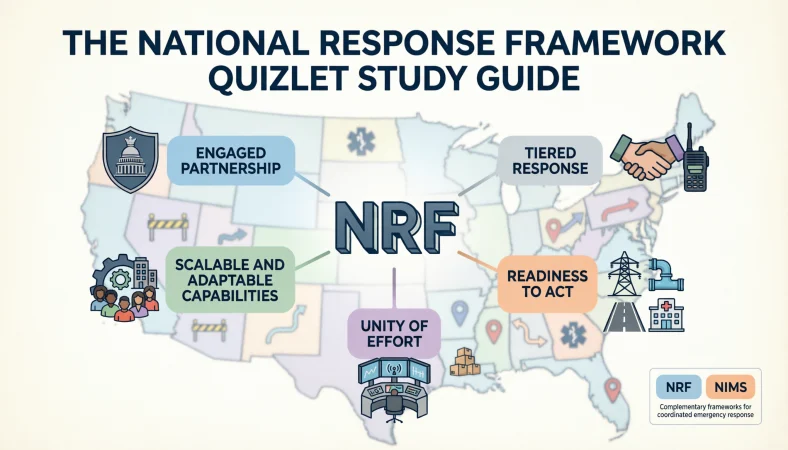
The National Response Framework Quizlet usually refers to study flashcards and quiz-style material covering the National Response Framework, or NRF. The NRF explains how the nation coordinates all-hazards response across government, private-sector, nonprofit, and community partners.
Top alternatives: National Response Framework flashcards, NRF Quizlet answers, NRF study questions, National Response Framework quiz, FEMA 800 study guide
If you have ever opened a Quizlet set five minutes before a test and thought, “Okay, I definitely should have studied this sooner,” you are not alone. The the national response framework quizlet search is popular because students and emergency management learners often want quick ways to review NRF concepts, terminology, principles, roles, and response structures.
The National Response Framework explains how the nation approaches all-hazards response and how different partners coordinate during incidents. Whether you are studying for a FEMA course, reviewing notes for work, making flashcards, or testing yourself with friends, knowing the basic concepts makes the material much easier to remember.
The goal is not to memorize random words and hope for the best. It is to understand what each term means, how the pieces connect, and why the framework matters when an incident gets serious.
Funny The National Response Framework Quizlet Study Responses:
“NRF means National Response Framework. Easy start.”
Example: A student uses this as a quick memory cue before beginning a study session.
Meaning: It creates an easy association between the acronym and its full name.
“Five principles, zero excuses.”
Example: A learner reviews the five NRF guiding principles before a quiz.
Meaning: It turns memorization into a playful study reminder.
“When disaster strikes, coordination enters the chat.”
Example: A student remembers the NRF purpose through a social-media-style phrase.
Meaning: It connects NRF with coordinated emergency response.
“Quizlet at midnight, NRF by sunrise.”
Example: A student makes a humorous last-minute study reminder.
Meaning: It jokes about late-night exam preparation.
“The acronym has entered the emergency-management era.”
Example: A learner uses humor while reviewing NRF terminology.
Meaning: It makes technical material feel less intimidating.
“NRF: because disasters do not schedule meetings.”
Example: A student remembers why preparedness and response structures matter.
Meaning: It highlights the need to be ready before incidents happen.
“Five principles walking into one exam.”
Example: A learner reviews the five guiding principles before testing.
Meaning: It makes a group of concepts easier to visualize.
“Study now, panic less later.”
Example: A student creates a reminder before an NRF exam.
Meaning: It encourages preparation instead of last-minute stress.
“All hazards, one framework.”
Example: A learner uses the phrase to remember the broad NRF scope.
Meaning: It reinforces the all-hazards concept.
“Emergency management, but make it organized.”
Example: A student summarizes the purpose of coordinated response.
Meaning: It humorously emphasizes structured response.
“NRF flashcards are my new emergency contact.”
Example: A learner jokes about repeatedly reviewing study cards.
Meaning: It shows how heavily the student is relying on study material.
“No panic, just principles.”
Example: A student repeats this before starting an NRF practice quiz.
Meaning: It encourages calm and organized studying.
Basic The National Response Framework Quizlet Answers:
“NRF stands for National Response Framework.”
Example: A learner answers an acronym question during a study session.
Meaning: It identifies the framework by its official name.
“The NRF guides national all-hazards response.”
Example: A student answers a question about the framework’s primary purpose.
Meaning: It summarizes the NRF’s central role.
“The framework applies to disasters and emergencies of different sizes.”
Example: A learner reviews the scope of NRF before an exam.
Meaning: It emphasizes that the framework can support both smaller and catastrophic incidents.
“The NRF supports coordinated response.”
Example: A student answers a question about why the framework exists.
Meaning: It highlights coordination among response partners.
“The NRF is built around scalable, flexible, and adaptable concepts.”
Example: A learner studies the relationship between NRF and NIMS.
Meaning: It identifies an important design concept of the framework.
“The NRF describes roles, responsibilities, and coordinating structures.”
Example: A student answers a framework-content question.
Meaning: It explains what the NRF organizes.
“The NRF focuses on the Response mission area.”
Example: A learner reviews the five national preparedness mission areas.
Meaning: It distinguishes NRF from the other national frameworks.
“The framework can be implemented at different levels.”
Example: A student studies how NRF structures can be used during incidents.
Meaning: It emphasizes flexible implementation.
“The NRF supports whole-community response.”
Example: A learner reviews who participates in national response.
Meaning: It recognizes that government alone is not the entire response system.
“The NRF connects national response doctrine with operational coordination.”
Example: A student summarizes the framework for an exam note.
Meaning: It links broad principles with practical response structures.
“The NRF is designed for all hazards.”
Example: A learner answers a scope question.
Meaning: It means the framework is not limited to one type of emergency.
“The NRF helps partners provide a unified response.”
Example: A student explains the framework during a study group.
Meaning: It emphasizes coordinated action across organizations.
The National Response Framework Quizlet Principles
“Engaged partnership.”
Example: A student identifies the first NRF guiding principle from a flashcard.
Meaning: It emphasizes shared goals and coordinated participation.
“Tiered response.”
Example: A learner matches a principle with its definition during practice.
Meaning: It emphasizes handling incidents at the lowest appropriate level while adding support when needed.
“Scalable, flexible, and adaptable operational capabilities.”
Example: A student reviews the longest NRF principle before a test.
Meaning: It means response capabilities should adjust as incident conditions change.
“Unity of effort through unified command.”
Example: A learner answers a question about coordination among agencies.
Meaning: It emphasizes cooperation while respecting organizational responsibilities.
“Readiness to act.”
Example: A student identifies the fifth NRF guiding principle.
Meaning: It highlights the importance of being prepared to respond.
“Five guiding principles shape NRF response.”
Example: A learner memorizes the principles as a group.
Meaning: It provides a quick way to recall the framework’s response doctrine.
“Partnership means nobody responds in isolation.”
Example: A student explains engaged partnership in simple language.
Meaning: It highlights shared responsibility.
“Tiered response means support expands when needed.”
Example: A learner explains tiered response to a study partner.
Meaning: It captures the principle’s basic idea.
“Scalability means the response can grow with the incident.”
Example: A student prepares a flashcard definition.
Meaning: It connects response capacity with changing conditions.
“Unified command supports coordinated objectives.”
Example: A learner reviews command principles before an exam.
Meaning: It highlights coordination among participating organizations.
“Readiness means being prepared to act.”
Example: A student simplifies the fifth principle into a memory phrase.
Meaning: It makes the concept easier to recall.
“Remember: partnership, tiers, flexibility, unity, readiness.”
Example: A learner uses a five-word memory chain before a quiz.
Meaning: It provides a compact mnemonic for the principles.
Professional The National Response Framework Quizlet Answers
“The NRF establishes a national approach to domestic incident response.”
Example: A professional uses this wording in an emergency management study note.
Meaning: It describes the framework’s national response function.
“The framework defines response roles and responsibilities.”
Example: A learner answers a professional certification question.
Meaning: It highlights organizational accountability.
“The NRF supports coordinated incident response.”
Example: A professional reviews response doctrine before training.
Meaning: It emphasizes coordination.
“The NRF is applicable across hazards and incident scales.”
Example: A student summarizes the framework for an emergency management class.
Meaning: It captures the broad scope of NRF.
“The framework aligns with NIMS concepts.”
Example: A learner answers a question about NRF and NIMS.
Meaning: It identifies their relationship.
“The NRF provides national-level response doctrine.”
Example: A student writes a concise exam answer.
Meaning: It describes the framework’s policy and coordination role.
“Response partners use NRF structures according to incident needs.”
Example: A learner explains flexible implementation.
Meaning: It emphasizes adaptable coordination.
“The NRF supports whole-community participation.”
Example: A professional reviews partner responsibilities.
Meaning: It recognizes government, nonprofit, private-sector, and community involvement.
“The framework identifies capabilities needed for effective response.”
Example: A student answers a question about NRF content.
Meaning: It focuses on operational capability.
“NRF supports unified national response.”
Example: A learner prepares a short definition for an exam.
Meaning: It summarizes the framework’s coordination goal.
“The framework applies before, during, and after incidents as appropriate.”
Example: A student studies how response structures can be activated.
Meaning: It reflects the framework’s flexible implementation.
“The NRF connects partners through common response structures.”
Example: A professional reviews coordination concepts.
Meaning: It emphasizes interoperability and shared action.
Easy The National Response Framework Quizlet Memory Lines
“NRF equals national response.”
Example: A student creates a basic acronym association.
Meaning: It provides a simple starting point for remembering NRF.
“All hazards, all hands.”
Example: A learner remembers the broad response approach.
Meaning: It emphasizes broad hazard coverage and participation.
“Think coordination, not chaos.”
Example: A student recalls the purpose of structured response.
Meaning: It links NRF with organized action.
“Lowest level first, more support when needed.”
Example: A learner studies the tiered response principle.
Meaning: It captures the core idea of tiered response.
“Adapt when the incident changes.”
Example: A student remembers scalable response capabilities.
Meaning: It reinforces flexibility.
“Work together, keep responsibilities clear.”
Example: A learner studies unity of effort.
Meaning: It connects collaboration with organizational accountability.
“Ready before the emergency.”
Example: A student reviews readiness to act.
Meaning: It reinforces preparedness.
“Partners make response stronger.”
Example: A learner studies engaged partnership.
Meaning: It highlights collaboration.
“Response is bigger than one agency.”
Example: A student reviews whole-community response.
Meaning: It emphasizes broad participation.
“Match resources to the incident.”
Example: A learner studies scalable response.
Meaning: It connects capabilities with incident needs.
“Common goals, coordinated action.”
Example: A student summarizes unified response.
Meaning: It emphasizes shared objectives.
“Know the principle, then know the example.”
Example: A learner prepares for scenario-based questions.
Meaning: It encourages understanding instead of pure memorization.
Scenario-Based The National Response Framework Quizlet Answers
“Use tiered response when an incident needs additional support.”
Example: A student answers a scenario involving local resources becoming insufficient.
Meaning: It connects the scenario with escalating assistance.
“Use scalable capabilities when incident conditions change.”
Example: A learner answers a question about an expanding emergency.
Meaning: It connects changing conditions with adaptable response.
“Use unified command when multiple organizations need coordinated action.”
Example: A student analyzes a multi-agency incident scenario.
Meaning: It identifies coordinated leadership as the key concept.
“Use engaged partnership when organizations align goals and capabilities.”
Example: A learner answers a question about community collaboration.
Meaning: It matches shared planning with partnership.
“Use readiness to act when immediate preparation matters.”
Example: A student evaluates a no-notice incident scenario.
Meaning: It emphasizes preparedness and forward action.
“A local incident can receive additional support when needed.”
Example: A learner answers a question about tiered response.
Meaning: It shows that local management can be strengthened by additional capabilities.
“A growing incident requires adaptable response capabilities.”
Example: A student studies an escalating emergency scenario.
Meaning: It connects incident growth with scalability.
“Multiple jurisdictions require strong coordination.”
Example: A learner reviews a cross-jurisdiction scenario.
Meaning: It emphasizes unified effort.
“Shared objectives help partners work together.”
Example: A student answers a scenario involving multiple organizations.
Meaning: It reinforces unity of effort.
“Response structures can be implemented according to incident needs.”
Example: A learner studies a scenario requiring selective NRF implementation.
Meaning: It highlights flexibility.
“Whole-community response uses more than government resources.”
Example: A student evaluates a large disaster scenario.
Meaning: It recognizes the contribution of nonprofits, private organizations, and communities.
“The best response matches the incident’s size and complexity.”
Example: A learner explains why NRF structures are scalable.
Meaning: It summarizes adaptable response planning.
The National Response Framework Quizlet And NIMS
“NIMS and NRF are companion concepts.”
Example: A student compares the two during exam preparation.
Meaning: It recognizes their complementary roles.
“NIMS provides an incident management template.”
Example: A learner reviews the difference between NIMS and NRF.
Meaning: It identifies NIMS as the broader incident management system.
“NRF provides national-level response structures and mechanisms.”
Example: A student answers a comparison question.
Meaning: It distinguishes NRF from NIMS.
“The NRF is built on scalable, flexible, and adaptable NIMS concepts.”
Example: A learner studies how the frameworks connect.
Meaning: It identifies a direct relationship between them.
“NIMS focuses on managing incidents.”
Example: A student creates a comparison flashcard.
Meaning: It summarizes NIMS’s management role.
“NRF focuses on national response.”
Example: A learner creates a second comparison card.
Meaning: It summarizes NRF’s response coordination role.
“Together they support coordinated incident management and response.”
Example: A student answers a framework comparison question.
Meaning: It explains why both systems matter.
“NIMS is not a replacement for NRF.”
Example: A learner reviews common exam confusion.
Meaning: It prevents treating the two frameworks as identical.
“NRF and NIMS connect response capabilities and management.”
Example: A student explains the relationship during a study session.
Meaning: It highlights their complementary functions.
“Remember: NIMS manages, NRF structures national response.”
Example: A learner uses a short comparison mnemonic.
Meaning: It creates a memorable distinction.
“Both support a coordinated nationwide approach.”
Example: A student summarizes their shared purpose.
Meaning: It emphasizes interoperability.
“Know both names before the quiz.”
Example: A learner reviews acronyms before an exam.
Meaning: It prevents an easy terminology mistake.
The National Response Framework Quizlet Core Concepts
“All-hazards response.”
Example: A student identifies the framework’s broad response approach.
Meaning: It means the NRF is designed for many types of incidents.
“Whole community.”
Example: A learner reviews who contributes to emergency response.
Meaning: It emphasizes broad participation.
“Community lifelines.”
Example: A student studies what response efforts aim to stabilize.
Meaning: It refers to essential services and functions communities rely on.
“Core capabilities.”
Example: A learner answers a question about national preparedness concepts.
Meaning: It refers to capabilities needed to accomplish response missions.
“Coordinating structures.”
Example: A student reviews how organizations organize response activities.
Meaning: It describes structures that support coordinated action.
“Response mission area.”
Example: A learner studies the national preparedness mission areas.
Meaning: It identifies the area specifically addressed by NRF.
“Emergency Support Functions.”
Example: A student reviews the role of ESFs in federal coordination.
Meaning: ESFs organize federal resources and capabilities by functional areas.
“Support Annexes.”
Example: A learner studies the different NRF annex categories.
Meaning: They address supporting aspects common to incidents.
“Incident Annexes.”
Example: A student reviews specialized NRF structures.
Meaning: They address specific incident or hazard circumstances.
“Unified response.”
Example: A learner summarizes the framework in one phrase.
Meaning: It emphasizes coordinated action among response partners.
“Scalability.”
Example: A student reviews how response changes with incident size.
Meaning: It means capabilities can expand or contract as needed.
“Readiness.”
Example: A learner reviews one of the NRF’s guiding principles.
Meaning: It emphasizes being prepared to act.
Exam-Ready The National Response Framework Quizlet Lines:
“What is NRF? A guide for national all-hazards response.”
Example: A student turns the definition into a flashcard.
Meaning: It provides the core exam answer.
“What does NRF describe? Principles, roles, responsibilities, and coordinating structures.”
Example: A learner reviews a definition question.
Meaning: It summarizes the framework’s major components.
“What are the five principles? Partnership, tiered response, scalability, unity, readiness.”
Example: A student memorizes the principles using shortened labels.
Meaning: It creates a quick recall pattern.
“What is tiered response? Manage incidents at the lowest appropriate level with added support when needed.”
Example: A learner prepares for a multiple-choice question.
Meaning: It explains the basic tiered-response concept.
“What is scalability? Adjusting response capabilities as conditions change.”
Example: A student studies an incident-growth scenario.
Meaning: It connects flexibility with changing requirements.
“What is unity of effort? Coordinating organizations around common objectives.”
Example: A learner studies multi-agency response.
Meaning: It explains coordinated action.
“What is readiness to act? Being prepared to respond when circumstances require action.”
Example: A student reviews preparedness terminology.
Meaning: It links readiness with timely response.
“What is engaged partnership? Developing shared goals and aligning capabilities.”
Example: A learner studies community participation.
Meaning: It emphasizes collaborative preparation.
“What is the NRF scope? Incidents from local emergencies to catastrophic events.”
Example: A student reviews a scope question.
Meaning: It demonstrates the framework’s broad applicability.
“Who uses NRF concepts? Government, private-sector, nonprofit, community, and response partners.”
Example: A learner reviews the framework audience.
Meaning: It emphasizes whole-community involvement.
“When can NRF elements be implemented? When needed for a threat, hazard, or incident.”
Example: A student answers a question about implementation timing.
Meaning: It highlights that NRF is not limited to one type of event.
“Why study NRF? Because coordinated response depends on shared principles.”
Example: A learner writes a personal study note.
Meaning: It connects memorization with practical relevance.
The National Response Framework Quizlet Professional Study Notes
“NRF supports coordinated domestic incident response.”
Example: An emergency management student prepares a professional study card.
Meaning: It summarizes the framework’s purpose.
“Response partners should understand their roles.”
Example: A learner reviews organizational responsibilities.
Meaning: It emphasizes role clarity.
“Preparedness strengthens response capability.”
Example: A student connects planning with response performance.
Meaning: It highlights the relationship between preparation and action.
“Training and exercises support readiness.”
Example: A learner reviews preparedness activities.
Meaning: It connects practice with response capability.
“Resource management supports effective response.”
Example: A student studies how capabilities are delivered during incidents.
Meaning: It highlights the importance of available resources.
“Coordination reduces fragmented response.”
Example: A learner summarizes why multiple organizations need shared structures.
Meaning: It emphasizes coordinated action.
“Response must match incident requirements.”
Example: A student reviews scalable response concepts.
Meaning: It emphasizes adaptability.
“Different partners bring different capabilities.”
Example: A learner studies whole-community response.
Meaning: It recognizes the value of diverse organizations.
“Unified effort does not erase organizational responsibilities.”
Example: A student reviews unified command concepts.
Meaning: It emphasizes collaboration while maintaining accountability.
“Local response remains important within national doctrine.”
Example: A learner studies tiered response.
Meaning: It reinforces the importance of managing incidents at the lowest appropriate level.
“Federal support can expand when circumstances require it.”
Example: A student studies large-scale response scenarios.
Meaning: It illustrates the tiered nature of assistance.
“The framework is designed to be adaptable.”
Example: A learner writes a final review note.
Meaning: It captures one of the NRF’s central concepts.
The National Response Framework Quizlet Multiple-Choice Practice:
“Which framework guides national all-hazards response? The National Response Framework.”
Example: A student creates a multiple-choice flashcard.
Meaning: It tests the most basic NRF identification question.
“Which principle means incidents are managed at the lowest appropriate level? Tiered response.”
Example: A learner reviews a principle-matching question.
Meaning: It identifies the correct concept.
“Which principle emphasizes changing capabilities with changing incidents? Scalable, flexible, and adaptable operational capabilities.”
Example: A student studies a scenario-based question.
Meaning: It connects incident changes with adaptable response.
“Which principle focuses on shared goals and aligned capabilities? Engaged partnership.”
Example: A learner reviews a collaboration question.
Meaning: It identifies partnership as the answer.
“Which principle emphasizes coordinated action through unified command? Unity of effort through unified command.”
Example: A student practices an agency-coordination question.
Meaning: It tests understanding of unified effort.
“Which principle emphasizes preparedness to respond? Readiness to act.”
Example: A learner reviews a preparedness question.
Meaning: It connects readiness with action.
“Which system is closely aligned with NRF? National Incident Management System.”
Example: A student reviews an NRF and NIMS comparison.
Meaning: It tests framework relationships.
“Which approach covers many types of hazards? All-hazards.”
Example: A learner answers a scope question.
Meaning: It identifies the broad response approach.
“Which partners participate in whole-community response? Multiple sectors and levels of the community.”
Example: A student studies a partner-involvement question.
Meaning: It emphasizes broad participation.
“What can NRF structures do as an incident changes? Scale and adapt.”
Example: A learner answers a scenario-based question.
Meaning: It tests flexibility.
“What does the NRF describe? Response principles, roles, responsibilities, and structures.”
Example: A student reviews a content question.
Meaning: It summarizes the framework.
“What is the best response approach? One that matches incident needs and supports coordination.”
Example: A learner answers a scenario requiring adaptable planning.
Meaning: It combines the framework’s major ideas.
The National Response Framework Quizlet Flashcard Ideas
“Front: NRF. Back: National Response Framework.”
Example: A student creates a basic acronym flashcard.
Meaning: It reinforces the full name.
“Front: NRF purpose. Back: Guide national all-hazards response.”
Example: A learner creates a purpose card.
Meaning: It captures the central definition.
“Front: Five principles. Back: Partnership, tiered response, scalability, unity, readiness.”
Example: A student creates a principle card.
Meaning: It helps recall the five guiding ideas.
“Front: Tiered response. Back: Lowest appropriate level plus support when needed.”
Example: A learner creates a definition card.
Meaning: It summarizes tiered response.
“Front: Scalability. Back: Adapt capabilities as incidents change.”
Example: A student prepares a scenario card.
Meaning: It reinforces adaptability.
“Front: Unified command. Back: Coordinate around common objectives.”
Example: A learner creates a command-related flashcard.
Meaning: It highlights unified effort.
“Front: Readiness. Back: Be prepared to act.”
Example: A student creates a short memory card.
Meaning: It simplifies the principle.
“Front: Engaged partnership. Back: Align goals and capabilities.”
Example: A learner creates a collaboration card.
Meaning: It makes the concept easier to recall.
“Front: NIMS relationship. Back: NRF aligns with NIMS concepts.”
Example: A student creates a comparison card.
Meaning: It reinforces the framework connection.
“Front: All hazards. Back: Response applies across incident types.”
Example: A learner creates a scope card.
Meaning: It emphasizes broad applicability.
“Front: ESFs. Back: Functional mechanisms for federal assistance.”
Example: A student studies federal response structures.
Meaning: It connects ESFs with organized assistance.
“Front: NRF always in effect. Back: Elements can be implemented when needed.”
Example: A learner reviews an often-tested NRF concept.
Meaning: It reinforces flexible implementation.
The National Response Framework Quizlet Quick Review
“NRF = national response guide.”
Example: A student reviews the acronym seconds before a quiz.
Meaning: It provides an instant memory cue.
“NIMS + NRF = coordinated incident management and response.”
Example: A learner reviews both systems together.
Meaning: It reinforces their complementary relationship.
“Five principles guide response.”
Example: A student reviews the basic NRF doctrine.
Meaning: It reminds the learner to recall all five principles.
“Tiered response starts locally.”
Example: A learner reviews the basic hierarchy of response.
Meaning: It emphasizes local management with additional support when needed.
“Scalability follows incident needs.”
Example: A student studies an expanding emergency.
Meaning: It connects response size with incident requirements.
“Partnership connects organizations.”
Example: A learner studies community coordination.
Meaning: It highlights collaboration.
“Unified effort connects objectives.”
Example: A student reviews multi-agency coordination.
Meaning: It emphasizes common goals.
“Readiness supports timely action.”
Example: A learner reviews preparedness concepts.
Meaning: It connects readiness with effective response.
“All hazards means broad application.”
Example: A student reviews NRF scope.
Meaning: It means the framework is not restricted to one hazard.
“Community lifelines are response priorities.”
Example: A learner studies response outcomes.
Meaning: It connects response activity with stabilizing essential community functions.
“Core capabilities support mission objectives.”
Example: A student reviews preparedness terminology.
Meaning: It connects capabilities with accomplishing response goals.
“Coordination is the recurring theme.”
Example: A learner summarizes the NRF before an exam.
Meaning: It captures the framework’s central emphasis.
Clever The National Response Framework Quizlet Answers
“Think five words: partnership, tiers, adaptability, unity, readiness.”
Example: A student uses the phrase as a memorization shortcut.
Meaning: It condenses the five principles into a recall sequence.
“If the incident grows, the response grows.”
Example: A learner remembers scalable capabilities through a simple rule.
Meaning: It connects incident complexity with response adaptation.
“If one group cannot handle it, support expands.”
Example: A student remembers tiered response through a practical example.
Meaning: It explains why additional capabilities may be needed.
“Different agencies, shared objectives.”
Example: A learner remembers unity of effort.
Meaning: It summarizes coordinated multi-agency response.
“Preparedness makes readiness possible.”
Example: A student links planning with readiness to act.
Meaning: It explains why preparation matters.
“The whole community brings the whole picture.”
Example: A learner studies whole-community participation.
Meaning: It highlights the value of multiple sectors.
“NRF tells you how national response fits together.”
Example: A student writes a one-line study definition.
Meaning: It provides an intuitive understanding of the framework.
“NIMS and NRF are teammates, not twins.”
Example: A learner remembers that the two systems have related but different roles.
Meaning: It prevents confusing their functions.
“Response is about action, coordination, and capability.”
Example: A student creates a three-word memory cue.
Meaning: It summarizes major response themes.
“The framework can scale without losing coordination.”
Example: A learner studies adaptable response structures.
Meaning: It connects flexibility with organized action.
“Know the principle, then spot it in the scenario.”
Example: A student prepares for application-based questions.
Meaning: It encourages practical recognition of concepts.
“Do not memorize the words without learning the idea.”
Example: A learner prepares for a difficult certification exam.
Meaning: It encourages conceptual understanding.
The National Response Framework Quizlet Final Exam Review
“NRF is a guide for how the nation responds to disasters and emergencies.”
Example: A student writes the central definition before an exam.
Meaning: It summarizes the framework’s primary purpose.
“The NRF uses an all-hazards approach.”
Example: A learner answers a scope question.
Meaning: It shows that the framework applies across different hazards.
“The NRF is aligned with NIMS.”
Example: A student reviews a framework relationship question.
Meaning: It connects national response doctrine with incident management concepts.
“The five principles are essential study material.”
Example: A learner reviews the principles before a final quiz.
Meaning: It identifies a major exam topic.
“Engaged partnership means shared goals and aligned capabilities.”
Example: A student reviews a principle-definition question.
Meaning: It explains collaborative preparedness.
“Tiered response means support expands when required.”
Example: A learner reviews a local-to-broader response scenario.
Meaning: It explains escalation of assistance.
“Scalable capabilities adjust to changing incident needs.”
Example: A student reviews an expanding disaster scenario.
Meaning: It connects adaptability with incident complexity.
“Unity of effort supports common objectives.”
Example: A learner reviews a multi-agency scenario.
Meaning: It emphasizes coordinated action.
“Readiness to act means maintaining a prepared posture.”
Example: A student reviews a no-notice incident scenario.
Meaning: It emphasizes preparation for action.
“The NRF can be implemented selectively or fully depending on circumstances.”
Example: A learner reviews an implementation question.
Meaning: It highlights flexibility in using framework structures.
“The NRF supports coordinated roles across the whole community.”
Example: A student answers a partner-involvement question.
Meaning: It emphasizes broad participation.
“Understand the framework instead of memorizing isolated terms.”
Example: A learner prepares for scenario-based testing.
Meaning: It encourages deeper exam preparation.
FAQs
What does “The National Response Framework Quizlet” mean?
It generally refers to Quizlet flashcards or study sets covering the National Response Framework, including definitions, principles, roles, responsibilities, and response concepts.
Is Quizlet the official source for the National Response Framework?
No. Quizlet contains user-created study materials. For authoritative information, students should compare flashcards with official FEMA National Response Framework resources.
What is the National Response Framework?
The NRF is a guide for how the nation conducts all-hazards response. It describes response principles, roles, responsibilities, and coordinating structures.
What are the five NRF guiding principles?
The five principles are engaged partnership, tiered response, scalable, flexible, and adaptable operational capabilities, unity of effort through unified command, and readiness to act.
Is the National Response Framework related to NIMS?
Yes. FEMA describes the NRF as being built on scalable, flexible, and adaptable concepts identified in NIMS, while the two provide complementary approaches to incident management and national response.
Is the NRF only used for major disasters?
No. The framework applies across incident sizes, from serious local events to large-scale or catastrophic incidents.
Can the NRF be implemented before an incident?
Yes. NRF elements can be implemented in anticipation of threats or hazards and can be partially or fully implemented according to circumstances.
Is humor useful when studying NRF material?
Absolutely. Funny memory cues can make dry terminology easier to remember, but students should always verify important definitions against authoritative FEMA materials.
What if a Quizlet answer conflicts with FEMA material?
Use the official FEMA material as the authority and treat the Quizlet card as a study aid. User-created flashcards can contain outdated, incomplete, or incorrect information.
Is the National Response Framework difficult to learn?
It can seem terminology-heavy at first, but grouping the material into principles, roles, capabilities, coordination, and scenarios makes it much easier to understand.
Conclusion
The the national response framework quizlet search can be a useful starting point when you need fast study material, but the real win comes from understanding the ideas behind the flashcards. Focus on the NRF’s purpose, five guiding principles, relationship with NIMS, scalable response concepts, whole-community participation, and coordination structures.
Once those pieces click, scenario questions become much less intimidating. Do not worry if the terminology feels like alphabet soup at first. Break it into small groups, test yourself, and connect every term to a practical situation. Use these study lines to review, create your own flashcards, or prepare for a quiz. Save this guide, share it with your study group, and go into that exam ready to respond.