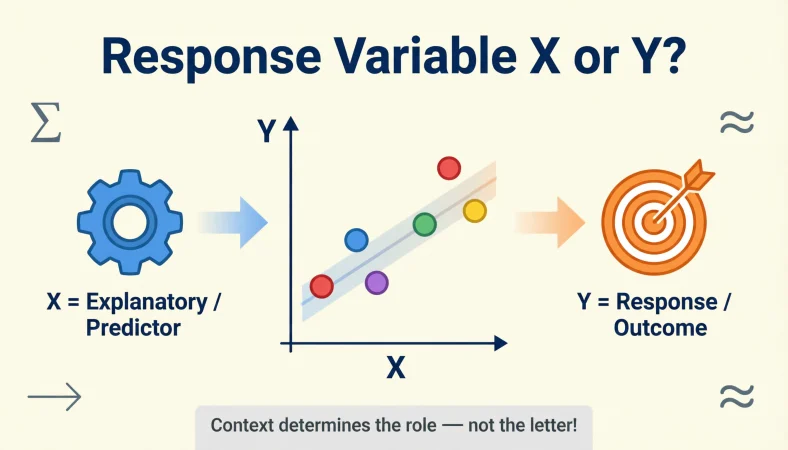
A response variable x or y usually refers to the variable being measured or observed in an experiment, study, or graph. Depending on the context, X is often the explanatory or independent variable, while Y is commonly the response or dependent variable.
Top alternatives: response variable, dependent variable, explanatory variable, independent variable, x and y variables
If you have ever stared at a statistics question thinking, “Okay, but which variable is actually the response variable?” you are definitely not alone. The phrase response variable x or y comes up in statistics, science, research, spreadsheets, graphs, and classroom assignments, and the answer can feel confusing when X and Y seem to be playing musical chairs.
Usually, the response variable is the outcome you measure, while the explanatory variable is the factor that may help explain or predict that outcome. In many common graphs, X represents the explanatory variable and Y represents the response variable.
But context matters, because notation is not a universal law. Whether you are texting a classmate, answering a homework question, preparing a report, or explaining a graph to your team, knowing what X and Y actually represent makes everything much easier.
Simple Response Variable X Or Y Explanations:
“The response variable is usually Y.”
Example: Use this as a quick answer when a basic statistics question asks which variable is the response.
Meaning: In common statistical notation, Y often represents the outcome being measured.
“X usually explains, while Y usually responds.”
Example: Use this as a simple memory trick before a statistics quiz.
Meaning: X commonly represents the explanatory variable and Y the response variable.
“The response variable is the outcome.”
Example: Use this when explaining variables to a beginner.
Meaning: It is the measurement researchers want to understand or predict.
“Think X causes the question and Y gives the result.”
Example: Use this as an easy classroom analogy.
Meaning: X is often treated as the predictor and Y as the resulting measurement.
“If you measure Y after changing X, Y is usually the response.”
Example: Use this in an experiment involving two variables.
Meaning: The measured outcome commonly serves as the response variable.
“X is often the input, Y is often the output.”
Example: Use this when explaining a graph to a new student.
Meaning: This provides a simple way to remember the common relationship.
“The response variable answers what happened.”
Example: Use this when identifying variables in a word problem.
Meaning: It represents the outcome being observed.
“The explanatory variable helps explain the response.”
Example: Use this in a statistics study guide.
Meaning: The explanatory variable is used to understand differences in the response.
“Y is not automatically the response just because it is Y.”
Example: Use this when correcting an oversimplified classroom rule.
Meaning: Variable roles depend on the context of the study.
“Ask what you are measuring, and you can find the response variable.”
Example: Use this as a homework-solving tip.
Meaning: The measured outcome is usually the response variable.
“Response variable means measured outcome.”
Example: Use this on a revision flashcard.
Meaning: It is the variable whose behavior or value is being studied.
“When in doubt, identify the outcome before choosing X or Y.”
Example: Use this before answering a graphing question.
Meaning: Context is more important than the letter assigned to a variable.
Funny Response Variable X Or Y Lines:
“X starts the drama, Y reports the consequences.”
Example: Use this as a humorous statistics study caption.
Meaning: X is framed as the explanatory variable and Y as the outcome.
“Y is usually where the plot happens.”
Example: Use this when making statistics revision more memorable.
Meaning: Y commonly represents the response or measured outcome.
“X asks the question, Y brings the receipts.”
Example: Use this as a playful classroom analogy.
Meaning: X can act as the predictor while Y provides the observed result.
“Variables really said, ‘It depends.’”
Example: Use this when explaining why X is not always the response variable.
Meaning: Variable roles depend on how a study is designed.
“Y is the main character when it is the response variable.”
Example: Use this as a social-friendly statistics caption.
Meaning: The response variable is the outcome receiving attention.
“X brings the input, Y brings the outcome.”
Example: Use this for a quick study meme.
Meaning: It summarizes the common input-output relationship.
“Statistics: where one tiny letter can start a whole argument.”
Example: Use this when classmates are debating X and Y.
Meaning: Variable notation can be confusing without context.
“Do not let X and Y gaslight you.”
Example: Use this as a playful reminder to check variable definitions.
Meaning: The letters themselves do not determine variable roles.
“Y did not choose the response variable life.”
Example: Use this for a humorous study post.
Meaning: Y is often assigned the role of measured outcome by convention.
“X walks in, Y gets measured.”
Example: Use this as an easy-to-remember analogy.
Meaning: X can represent the explanatory factor while Y represents the measured response.
“Plot twist: Y is not always the answer.”
Example: Use this when teaching variable identification.
Meaning: The response variable depends on the study context.
“Statistics has entered the group chat.”
Example: Use this as a light caption for a variables lesson.
Meaning: It adds humor to an otherwise technical concept.
Clever Response Variable X Or Y Comparisons:
“X explains; Y responds.”
Example: Use this as a concise study slogan.
Meaning: It captures the most common relationship between explanatory and response variables.
“X is the predictor, Y is the outcome.”
Example: Use this in a statistics revision note.
Meaning: This is a common way to distinguish the two variable roles.
“Do not memorize the letter; identify the role.”
Example: Use this when correcting a memorization-based approach.
Meaning: The function of a variable matters more than whether it is labeled X or Y.
“The response variable is defined by purpose, not alphabet order.”
Example: Use this in a statistics explanation.
Meaning: Variable roles come from the research question.
“Y often follows X, but the letters are not the boss.”
Example: Use this as a memorable explanation.
Meaning: Conventional notation is useful, but context determines meaning.
“Find the measured result first, then label it.”
Example: Use this when solving a word problem.
Meaning: Identifying the outcome helps determine the response variable.
“A graph shows positions; a study gives those positions meaning.”
Example: Use this when explaining scatterplots.
Meaning: The role of a variable depends on the research question.
“The response variable is what you want to explain.”
Example: Use this in an introductory statistics lesson.
Meaning: It is the outcome researchers seek to understand.
“The explanatory variable is what you use to explain it.”
Example: Use this alongside the previous line.
Meaning: It represents a predictor or factor associated with the response.
“X and Y are labels; context gives them jobs.”
Example: Use this as a revision phrase.
Meaning: Letters do not inherently determine whether a variable is explanatory or responsive.
“Correlation can involve X and Y without proving that X causes Y.”
Example: Use this when discussing relationships between variables.
Meaning: A statistical association does not automatically establish causation.
“Good variable identification starts with a good question.”
Example: Use this before analyzing a research problem.
Meaning: The research question helps establish which variable is the response.
Professional Response Variable X Or Y Descriptions:
“The response variable represents the outcome measured in a study.”
Example: Use this in an academic report.
Meaning: It identifies the primary outcome under investigation.
“The explanatory variable is used to account for variation in the response variable.”
Example: Use this in a statistics assignment.
Meaning: The explanatory variable helps describe or predict changes in the response.
“In standard notation, Y commonly denotes the response variable.”
Example: Use this in formal statistical writing.
Meaning: Y is frequently used for the dependent or outcome variable.
“X commonly represents the explanatory variable.”
Example: Use this in a regression analysis explanation.
Meaning: X is often used as the predictor or input variable.
“Variable roles should be determined from the research question.”
Example: Use this in methodology documentation.
Meaning: Context should guide the classification of variables.
“The response variable is the quantity researchers seek to explain or predict.”
Example: Use this in a research methods section.
Meaning: It represents the study outcome.
“A response variable may be continuous, categorical, or otherwise structured depending on the study.”
Example: Use this in a statistics course report.
Meaning: Response variables can take different forms.
“The response variable should be clearly defined before analysis begins.”
Example: Use this in a data analysis plan.
Meaning: Clear definitions help ensure appropriate statistical methods.
“Regression models commonly express the response as a function of explanatory variables.”
Example: Use this in a professional statistics discussion.
Meaning: Regression analyzes how an outcome relates to one or more predictors.
“Notation provides convenience, but research design determines variable roles.”
Example: Use this in a methodological explanation.
Meaning: Letters are conventions rather than absolute definitions.
“The response variable should align with the primary research objective.”
Example: Use this in a research proposal.
Meaning: The selected outcome should directly reflect what the study intends to investigate.
“Correct variable classification supports appropriate statistical interpretation.”
Example: Use this in a data analysis report.
Meaning: Identifying variable roles correctly helps guide modeling and interpretation.
Beginner-Friendly Response Variable X Or Y Study Lines:
“Ask: What am I measuring?”
Example: Use this as the first step in a homework problem.
Meaning: The answer often identifies the response variable.
“Ask: What am I changing or using as a predictor?”
Example: Use this when identifying the explanatory variable.
Meaning: The answer often points toward X in conventional notation.
“The thing being measured is usually the response.”
Example: Use this in an introductory lesson.
Meaning: The measured outcome is commonly the response variable.
“The thing doing the explaining is usually the explanatory variable.”
Example: Use this when studying paired variables.
Meaning: It describes the predictor or factor associated with the outcome.
“Y often means the result.”
Example: Use this as a quick flashcard.
Meaning: Y commonly represents the response variable.
“X often means the predictor.”
Example: Use this beside a Y flashcard.
Meaning: X commonly represents the explanatory variable.
“Look at the question before looking at the letters.”
Example: Use this when a graph seems confusing.
Meaning: The research context determines variable roles.
“Response means outcome.”
Example: Use this as a two-word study reminder.
Meaning: The response variable is the outcome being observed.
“Explanatory means predictor.”
Example: Use this to remember the other variable role.
Meaning: The explanatory variable is used to explain or predict the response.
“A scatterplot can show both X and Y.”
Example: Use this in a graphing lesson.
Meaning: Both variables can be displayed while serving different analytical roles.
“The horizontal axis is often X.”
Example: Use this when reading a conventional graph.
Meaning: X is commonly placed on the horizontal axis.
“The vertical axis is often Y.”
Example: Use this as a graph-reading reminder.
Meaning: Y is commonly placed on the vertical axis.
Creative Response Variable X Or Y Analogies:
“X is the recipe ingredient; Y is the finished dish.”
Example: Use this analogy when explaining predictor and outcome variables.
Meaning: X represents an input while Y represents the resulting measurement.
“X presses the button; Y shows what happened.”
Example: Use this in a beginner statistics presentation.
Meaning: X is treated as the explanatory factor and Y as the outcome.
“X is the weather; Y is whether you carry an umbrella.”
Example: Use this to create a memorable everyday analogy.
Meaning: The explanatory factor is linked to an observed response.
“X is the study question’s clue; Y is the answer you measure.”
Example: Use this in a classroom explanation.
Meaning: The response variable provides the measured outcome.
“X is the steering wheel; Y is where the car ends up.”
Example: Use this as a simple conceptual comparison.
Meaning: X represents a potential influence and Y the resulting outcome.
“X is the input box; Y is the results box.”
Example: Use this when explaining a simple model.
Meaning: It presents the common input-output relationship.
“X brings the context; Y brings the measurement.”
Example: Use this as a study caption.
Meaning: X can represent an explanatory factor while Y represents the measured response.
“Think of X as the setup and Y as the score.”
Example: Use this when discussing an experiment.
Meaning: The response variable is often the measured result.
“X asks, ‘What might matter?’ Y answers, ‘Here is what we measured.’”
Example: Use this as a memorable classroom analogy.
Meaning: It distinguishes explanatory and response roles.
“X is the forecast input; Y is the weather report.”
Example: Use this in a playful statistics lesson.
Meaning: The predictor is distinguished from the observed outcome.
“X is the cause candidate; Y is the outcome.”
Example: Use this when discussing experimental variables.
Meaning: X may be treated as a possible influence while Y is measured.
“X and Y are teammates, but they do different jobs.”
Example: Use this for a beginner-friendly infographic.
Meaning: The variables can work together while having different analytical roles.
Sarcastic Response Variable X Or Y Lines:
“Because apparently two letters needed an entire statistics lesson.”
Example: Use this as a humorous study caption.
Meaning: X and Y can create surprising confusion for beginners.
“Y is the response until context walks into the room.”
Example: Use this when discussing conventional notation.
Meaning: Y often represents the response, but context determines the actual role.
“Never trust a variable by its alphabet position.”
Example: Use this as a playful warning.
Meaning: The letter itself does not establish whether a variable is a response.
“X said it was independent, and Y said, ‘Fine, I’ll respond.’”
Example: Use this as a statistics meme caption.
Meaning: It personifies the common independent and dependent variable relationship.
“Statistics really made a personality test for letters.”
Example: Use this when joking about variable roles.
Meaning: The same letters can receive different roles depending on context.
“Y did not become the response variable by magic.”
Example: Use this when teaching variable identification.
Meaning: The research question determines the role.
“If you only memorize X equals this and Y equals that, good luck.”
Example: Use this as a playful study warning.
Meaning: Understanding variable roles is more reliable than memorizing letters.
“Context remains undefeated.”
Example: Use this as a short statistics caption.
Meaning: Context determines how variables should be interpreted.
“The alphabet did not design your research study.”
Example: Use this when explaining variable notation.
Meaning: Variable labels are conventions, not fixed rules.
“X and Y are labels, not job descriptions.”
Example: Use this as a clever classroom line.
Meaning: Their roles must be identified from the study.
“Plot twist: the response variable can exist without being called Y.”
Example: Use this when discussing different notation systems.
Meaning: Variable labels vary across studies.
“Statistics said, ‘Read the question first.’”
Example: Use this as a quick revision joke.
Meaning: The research question is the best guide for identifying variable roles.
Confident Response Variable X Or Y Answers:
“The response variable is the measured outcome, regardless of its label.”
Example: Use this when answering a statistics question confidently.
Meaning: The role matters more than the symbol.
“Y is commonly the response variable, but context decides.”
Example: Use this in an exam answer.
Meaning: This gives the conventional rule while acknowledging its limitation.
“Identify the outcome first, then identify its notation.”
Example: Use this when solving unfamiliar problems.
Meaning: Understanding the study prevents notation-based mistakes.
“Do not confuse graph position with variable purpose.”
Example: Use this in a statistics explanation.
Meaning: Being on an axis does not independently determine analytical role.
“The response variable is what the study wants to explain.”
Example: Use this in a written assignment.
Meaning: It identifies the central outcome.
“The explanatory variable provides information about the response.”
Example: Use this in a research methods answer.
Meaning: It represents a predictor or explanatory factor.
“X and Y are conventional labels, not universal laws.”
Example: Use this when discussing notation.
Meaning: Different fields and studies can use different symbols.
“A correct answer starts with the research question.”
Example: Use this before analyzing variables.
Meaning: The question establishes which outcome matters.
“If Y is what you measure, Y is the response variable.”
Example: Use this when the problem explicitly defines Y as an outcome.
Meaning: Variable definitions override general conventions.
“If X is the outcome, then X can be the response variable.”
Example: Use this when discussing custom notation.
Meaning: Any symbol can represent a response variable when defined that way.
“The response variable follows the study objective.”
Example: Use this in a research proposal.
Meaning: The outcome should reflect what the study is designed to investigate.
“Know the role, not just the letter.”
Example: Use this as a final exam reminder.
Meaning: Conceptual understanding is more reliable than memorizing notation.
Chill And Casual Response Variable X Or Y Lines:
“Usually Y, but check the context.”
Example: Use this as a quick reply to a classmate.
Meaning: Y commonly represents the response, but it is not automatic.
“X is often the predictor, Y is often the result.”
Example: Use this in a casual study chat.
Meaning: It summarizes the common convention.
“Just find what you are measuring.”
Example: Use this when helping someone with homework.
Meaning: The measured outcome is usually the response variable.
“Think input versus output.”
Example: Use this when explaining a graph quickly.
Meaning: X often serves as input and Y as output.
“Do not overthink the letters.”
Example: Use this when someone is stuck on notation.
Meaning: The study context matters more than the symbols.
“Y often gets the response role.”
Example: Use this as a casual revision line.
Meaning: Y is frequently used for the dependent outcome.
“X and Y are just labels.”
Example: Use this when simplifying statistics.
Meaning: Their roles come from how the variables are defined.
“Find the result, and you are halfway there.”
Example: Use this as a homework tip.
Meaning: Identifying the outcome helps locate the response variable.
“If it is being measured, it is probably the response.”
Example: Use this for a basic statistics question.
Meaning: The measured outcome commonly serves as the response.
“Context wins every time.”
Example: Use this when notation seems inconsistent.
Meaning: The research setup determines variable roles.
“X predicts, Y responds, most of the time.”
Example: Use this as a quick memory aid.
Meaning: It reflects the common statistical convention.
“Simple rule: outcome equals response.”
Example: Use this as a last-minute study note.
Meaning: The response variable is generally the outcome of interest.
Emotional Response Variable X Or Y Study Lines:
“Do not let one confusing letter ruin your statistics day.”
Example: Use this when encouraging a classmate before an exam.
Meaning: Variable identification becomes easier when you focus on the concept.
“You do not need to fear X and Y.”
Example: Use this in a beginner study post.
Meaning: The distinction is manageable once the roles are understood.
“The outcome has a name, even when the notation feels confusing.”
Example: Use this when explaining variables patiently.
Meaning: The response variable can be identified from the study objective.
“Statistics gets easier when you stop memorizing and start asking questions.”
Example: Use this as an encouraging study reminder.
Meaning: Understanding the research question helps identify variables.
“You can absolutely figure out which variable responds.”
Example: Use this before an exam.
Meaning: Careful reading usually reveals the measured outcome.
“One graph does not define every graph.”
Example: Use this when discussing different conventions.
Meaning: Variable notation can vary between contexts.
“It is okay if X and Y looked confusing at first.”
Example: Use this for beginner-friendly educational content.
Meaning: Variable notation often becomes clearer with practice.
“Focus on what the study measures.”
Example: Use this when helping someone who feels stuck.
Meaning: The measured outcome identifies the response variable.
“Once you see the outcome, the label gets easier.”
Example: Use this as a motivational study phrase.
Meaning: Understanding the role simplifies notation.
“You are not bad at statistics because X and Y confused you.”
Example: Use this as a supportive study caption.
Meaning: Confusion about notation is common and fixable.
“Learn the relationship, and the letters become background noise.”
Example: Use this when encouraging conceptual learning.
Meaning: Understanding variable roles reduces reliance on memorization.
“One clear question can make the whole graph click.”
Example: Use this before reviewing a statistics problem.
Meaning: Asking what is being measured often reveals the response variable.
Social Media Friendly Response Variable X Or Y Captions:
“X predicts. Y responds. Statistics made simple.”
Example: Use this as an Instagram study caption.
Meaning: It summarizes the common relationship between the variables.
“Which one is the response variable? Find the outcome.”
Example: Use this as an educational carousel headline.
Meaning: The measured outcome is the key clue.
“X or Y? Context decides.”
Example: Use this as a short statistics graphic caption.
Meaning: Variable labels do not automatically determine their roles.
“Y is often the outcome, but never skip the question.”
Example: Use this as a study reminder.
Meaning: Y is commonly the response, but context remains important.
“Variables have roles, not just letters.”
Example: Use this as a Pinterest educational graphic caption.
Meaning: Function matters more than notation.
“Response variable = outcome.”
Example: Use this on a statistics cheat sheet.
Meaning: The response variable represents the measured result.
“Explanatory variable = predictor.”
Example: Use this beside a response variable graphic.
Meaning: The explanatory variable helps explain or predict the outcome.
“Stop guessing. Start identifying the outcome.”
Example: Use this as a study motivation caption.
Meaning: Finding the measured result makes variable classification easier.
“X and Y just got a statistics makeover.”
Example: Use this for a playful educational post.
Meaning: It introduces the distinction between explanatory and response variables.
“The graph is not confusing. The labels are just being dramatic.”
Example: Use this as a humorous study caption.
Meaning: Understanding the variable roles makes graphs easier to interpret.
“Save this before your next statistics quiz.”
Example: Use this as a social-friendly study post ending.
Meaning: The content is positioned as a quick revision resource.
“Know the outcome, know the response.”
Example: Use this as a memorable infographic headline.
Meaning: The outcome is generally the response variable.
Exam-Friendly Response Variable X Or Y Answers:
“The response variable is the outcome being measured.”
Example: Use this as a short-answer exam response.
Meaning: It provides the standard definition.
“The explanatory variable is used to explain or predict the response variable.”
Example: Use this when defining both variables.
Meaning: It distinguishes the predictor from the outcome.
“Y commonly represents the response variable.”
Example: Use this when the question follows conventional statistical notation.
Meaning: Y is frequently used for the dependent variable.
“X commonly represents the explanatory variable.”
Example: Use this when describing a conventional regression setup.
Meaning: X is often used for the predictor.
“The response variable should be identified from the study context.”
Example: Use this in a conceptual question.
Meaning: Context determines the role.
“Variable notation does not determine causation.”
Example: Use this in a correlation question.
Meaning: Labeling a variable X or Y does not prove one causes the other.
“In a scatterplot, X is commonly on the horizontal axis and Y on the vertical axis.”
Example: Use this in a graph interpretation answer.
Meaning: This is a common plotting convention.
“The response variable represents what researchers want to explain.”
Example: Use this in a theory question.
Meaning: It identifies the outcome of interest.
“The explanatory variable represents a factor used to explain variation in the response.”
Example: Use this in a statistics exam.
Meaning: It identifies the predictor role.
“A variable can be called X or Y depending on the notation used.”
Example: Use this when a question uses nonstandard labels.
Meaning: Symbols are flexible.
“Always follow the definitions given in the problem.”
Example: Use this as an exam strategy.
Meaning: Explicit definitions override general conventions.
“The safest rule is: identify the outcome first.”
Example: Use this as a final exam reminder.
Meaning: The measured outcome usually identifies the response variable.
Smart And Witty Response Variable X Or Y Phrases:
“Y is commonly the response, but context gets the final vote.”
Example: Use this as a polished educational caption.
Meaning: It combines the common convention with the important qualification.
“Letters label variables; questions assign their roles.”
Example: Use this in a statistics article.
Meaning: Research questions determine whether a variable is explanatory or responsive.
“The response variable is the destination of your analysis.”
Example: Use this as a memorable study phrase.
Meaning: It represents the outcome the analysis aims to understand.
“X may explain the story, but Y often tells the ending.”
Example: Use this in a creative statistics lesson.
Meaning: X is commonly the predictor and Y the outcome.
“Do not memorize the alphabet; understand the relationship.”
Example: Use this for exam preparation.
Meaning: Conceptual understanding is more useful than rigid notation rules.
“Response is about role, not reputation.”
Example: Use this as a playful statistics slogan.
Meaning: A variable becomes a response variable because of its analytical role.
“The outcome gets measured; the predictor gets examined.”
Example: Use this in an introductory research methods guide.
Meaning: It distinguishes the response from the explanatory variable.
“Good statistics starts with good variable questions.”
Example: Use this as a study caption.
Meaning: Asking what is measured and what explains it clarifies variable roles.
“X and Y are flexible characters in the statistics story.”
Example: Use this in an educational post.
Meaning: Their labels can change depending on the study.
“The response variable is what you care enough to measure.”
Example: Use this as a memorable informal definition.
Meaning: It represents the study outcome of interest.
“If you know the outcome, you know where the response role belongs.”
Example: Use this in a statistics guide.
Meaning: Identifying the measured outcome helps classify the response variable.
“The smartest answer is the one that checks the context.”
Example: Use this as a final revision line.
Meaning: Contextual understanding prevents notation-based mistakes.
FAQs:
What does “response variable X or Y” mean?
It asks which of two variables, X or Y, represents the outcome being measured or studied. In common statistical notation, Y is often the response variable and X is often the explanatory variable.
Is the response variable always Y?
No. Y is a common convention, but it is not an absolute rule. The response variable is determined by the research question and how the variables are defined.
Is X usually the independent variable?
In many common statistical and experimental settings, X is used for the explanatory or independent variable. However, the exact role depends on the study design.
Is Y always the dependent variable?
Not necessarily. Y is frequently used for the dependent or response variable, but notation can vary.
How do I identify the response variable?
Ask, “What outcome am I measuring, explaining, or trying to predict?” The answer is generally the response variable.
What is the difference between X and Y?
In common notation, X often represents an explanatory or predictor variable, while Y often represents a response or outcome variable.
Can X be the response variable?
Yes. If a study defines X as the outcome being measured, then X is the response variable.
Can Y be the explanatory variable?
Yes. A study can use Y as an explanatory variable if its notation defines it that way.
Is the response variable the same as the dependent variable?
Often, yes. In many introductory statistics contexts, “response variable” and “dependent variable” refer to the outcome being studied.
What is a simple way to remember X and Y?
Try: X explains, Y responds. Just remember that this is a common convention, not a universal rule.
Can I use “response variable” in professional writing?
Absolutely. It is a standard statistical term and works well in research reports, academic assignments, data analysis, and technical documentation.
Is humor appropriate when explaining response variables?
Yes, especially in study notes, social posts, classroom content, and informal explanations. For academic or professional reports, keep the wording clear and appropriately formal.
Conclusion
Understanding response variable x or y becomes much easier when you focus on the job each variable performs rather than memorizing two letters. In many statistical examples, X is the explanatory variable and Y is the response variable, but the real rule is simple: identify the outcome being measured. Once that clicks, graphs, experiments, regression questions, and research problems become far less intimidating.
Your wording also matters when explaining statistics to classmates, coworkers, or social media followers. A clear response can turn a confusing concept into an easy one. Save these explanations for your next study session, share them with someone stuck on X and Y, and keep exploring statistics with confidence.