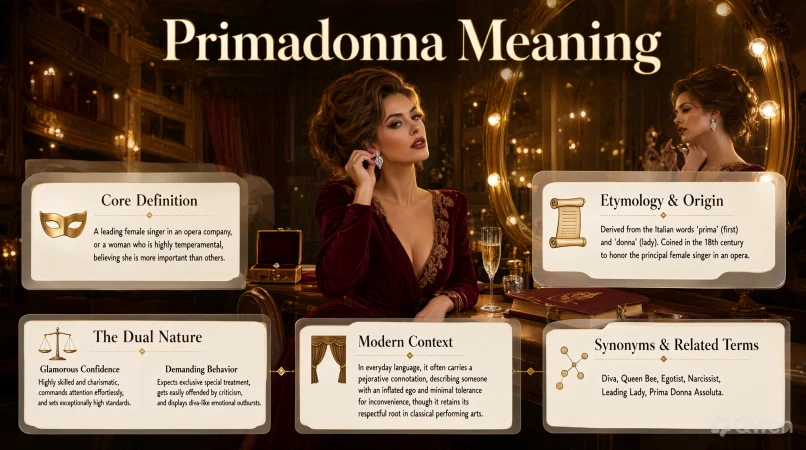
The word “primadonna” (more commonly spelled “prima donna”) refers to a person, usually a woman, who behaves as if they are more important than everyone else and expects special treatment, attention, or admiration. Originally, the Italian term described the leading female singer in an opera company. Over time, its meaning expanded to describe someone who is overly demanding, self-centered, dramatic, or difficult to please.
For example, if someone refuses to cooperate unless everything goes exactly their way, you might call them a prima donna. Depending on the context, the expression can be playful, critical, or insulting.
Have you ever met someone who always wants to be the center of attention, expects everyone to follow their rules, and gets upset when things don’t go their way?
Maybe they act like the world revolves around them or demand special treatment in situations where everyone should be treated equally. You might hear someone describe this behavior by saying, “Stop acting like a prima donna!
Although the expression sounds elegant, its modern meaning often carries a hint of sarcasm or criticism. It’s commonly used in everyday conversations, entertainment discussions, workplace situations, and social media posts.
Understanding the primadonna meaning helps you recognize how this expression is used to describe demanding or self-important behavior.
The original Italian phrase prima donna literally means “first lady” and refers to the principal female singer in an opera production. Historically, these performers often held prominent positions and received considerable attention because of their leading roles.
Today, however, the expression is also used figuratively for people who behave as though they deserve constant admiration or special privileges. In this guide, we’ll explore its definition, origin, pronunciation, synonyms, examples, and common uses to help you understand the expression clearly.
Table of Contents
- What Does Primadonna Mean?
- Origin and History of the Word
- How the Meaning Changed Over Time
- Primadonna in Everyday Life
- Examples of Primadonna Behavior
- Primadonna vs. Diva vs. Drama Queen
- Is Primadonna an Insult?
- How to Use Primadonna in a Sentence
- Frequently Asked Questions
- Conclusion
What Does Primadonna Mean?
A primadonna is someone who expects to receive special attention, privileges, or treatment, sometimes without considering the needs of other people. The person may become upset when things do not go according to their preferences. They might demand the best position, refuse ordinary responsibilities, or expect others to adjust their plans.
The word has a particularly interesting history because it did not begin as an insult. In opera, a prima donna was the principal female singer, often the most important performer in a production. She usually played the leading role and received considerable attention because of her musical ability.
Over time, the expression developed another meaning. People began using it for individuals who acted as though their importance made them more deserving than everyone else. Today, the word can describe someone in almost any profession or social setting.
For example:
- A coworker who refuses to complete ordinary tasks because they believe the work is beneath them may be called a primadonna.
- A performer who demands special arrangements before agreeing to appear on stage might receive the same description.
- A friend who expects everyone to follow their plans but rarely considers anyone else’s preferences may also fit the description.
The important distinction is that being confident or having high standards does not automatically make someone one. The negative meaning usually involves unreasonable expectations, entitlement, or difficult behavior.
Origin and History of the Word
The expression comes from Italian. It combines two words: prima, meaning “first,” and donna, meaning “woman.” Together, they translate roughly as “first woman.”
The phrase originally described the leading female singer in an opera company. She typically performed the central female role and held a prominent position in the production. Her voice, musical skill, and stage presence often made her one of the main attractions.
Opera developed as a major musical form in Italy during the late 16th and early 17th centuries. As opera companies became established, audiences and performers recognized the importance of leading singers. The title prima donna became associated with the woman who held the principal female singing role.
Why Was the Prima Donna So Important?
Opera productions require more than beautiful music. They combine singing, acting, costumes, orchestral performance, and stage direction. The principal singer often carries much of the emotional weight of the story.
A leading performer may have demanding vocal passages, long rehearsals, and significant performance responsibilities. Her reputation can also influence ticket sales and public interest in a production.
This position naturally brought recognition and influence. However, the attention given to famous performers sometimes created stories about demanding personalities and backstage disagreements. Those associations helped shape the modern, less flattering meaning of the expression.
Why Is It Sometimes Written as Two Words?
In its traditional Italian form, the expression is written as prima donna, with two separate words. English dictionaries also commonly use this spelling.
The single-word form, primadonna, appears in everyday writing and informal usage. Both forms can communicate the same general idea, although prima donna is the more traditional spelling.
How the Meaning Changed Over Time
The change from an opera title to a description of difficult behavior happened gradually. The original expression identified a professional position, not a personality problem. A singer could be a prima donna simply because she performed the leading female role.
As celebrated singers became famous, stories about their backstage demands and strong personalities became part of public discussion. Some performers were described as temperamental or difficult to work with. Eventually, the title became associated with the stereotype of an artist who expected everyone to accommodate her.
The expression then moved beyond music and entertainment. People started applying it to colleagues, athletes, celebrities, friends, and family members.
Its meaning now depends heavily on context.
| Usage | Meaning | Example |
| Traditional opera | Leading female singer | The prima donna received the longest solo. |
| Entertainment | A demanding performer | The actor was criticized for behaving like a primadonna. |
| Workplace | An entitled colleague | Nobody wanted to work with the primadonna on the team. |
| Social situations | Someone who expects special treatment | He acted like a primadonna when the restaurant was fully booked. |
| Informal description | A dramatic or difficult person | Stop being such a primadonna about the schedule. |
This change is important because the original title could be respectful, while the modern description is usually critical.
Primadonna in Everyday Life
You do not need to work in an opera house to encounter this expression. It appears in conversations about work, relationships, entertainment, sports, and ordinary social situations.
The modern usage generally describes behavior rather than a person’s actual profession or gender. Although the historical expression referred to a female singer, people now use it for people of all genders.
In the Workplace
A coworker may be described this way when they expect everyone else to handle routine responsibilities while they receive special privileges. They might refuse reasonable requests, complain about ordinary tasks, or become difficult whenever plans change.
For example, imagine a team preparing an important presentation. One employee insists on choosing the meeting time, controlling every small detail, and refusing to help with basic preparation. If the behavior continues, colleagues may privately call that person a primadonna.
However, having professional standards is different from acting entitled. Someone who requests fair working conditions, clear responsibilities, or appropriate recognition is not automatically displaying this behavior.
In Relationships
In personal relationships, the term can describe someone who expects constant attention and becomes upset when they do not get their way.
For example, one partner may expect the other person to cancel plans whenever they want to meet. They might also become irritated if a restaurant, holiday, or activity does not match their preferences.
The problem is not having preferences. Everyone has them. The issue is expecting another person to satisfy every demand without compromise.
In Entertainment and Celebrity Culture
The entertainment industry is closely connected to the expression’s history. Singers, actors, musicians, and other performers sometimes face intense public attention, demanding schedules, and competitive working environments.
A performer may have specific requirements for a show because of health, safety, or technical needs. Those requests are not necessarily unreasonable. The label becomes more fitting when someone makes excessive demands, treats staff disrespectfully, or refuses to cooperate without a good reason.
In Sports
Sports commentators may use the expression for an athlete who appears unwilling to accept coaching, criticism, or team responsibilities.
For instance, a player who expects special treatment, argues over every decision, and refuses to cooperate with teammates might be described as a primadonna.
There is an important distinction between confidence and entitlement. A talented athlete can be outspoken, ambitious, and competitive without behaving this way.
Examples of Primadonna Behavior
The word becomes easier to understand when you see the kinds of situations in which people use it. These examples show common behavior associated with the modern meaning.
1. Expecting Everyone to Follow Your Preferences
A person insists that every group activity must happen at their preferred time and location. They rarely accept suggestions from others.
2. Refusing Ordinary Responsibilities
Someone avoids simple tasks because they believe those responsibilities should be handled by other people.
3. Making Unreasonable Demands
A performer requests arrangements that are unnecessary, expensive, or difficult to provide, then becomes angry when others cannot meet them.
4. Reacting Dramatically to Small Problems
A minor inconvenience turns into a major argument because the person expects everything to be perfect.
5. Treating Others as Less Important
Someone speaks rudely to assistants, coworkers, restaurant staff, or team members while expecting them to remain helpful.
6. Refusing to Compromise
A person rejects every alternative, even when others are making reasonable efforts to find a solution.
7. Expecting Constant Praise
Someone becomes irritated when they do not receive recognition for ordinary contributions or expects compliments during every interaction.
Not every demanding moment makes someone a primadonna. People can have difficult days, personal boundaries, or legitimate reasons for making requests. The label generally describes a repeated pattern of entitlement rather than one isolated disagreement.
Primadonna vs. Diva vs. Drama Queen
These expressions are related, but they do not mean exactly the same thing. All three can describe someone who attracts attention or behaves dramatically, yet each has a slightly different emphasis.
| Term | Main Meaning | Typical Tone | Example |
| Primadonna | Someone who expects special treatment | Usually negative | He acts like a primadonna whenever plans change. |
| Diva | A celebrated or demanding personality, often a performer | Can be positive or negative | She is a talented diva with a strong stage presence. |
| Drama queen | Someone who exaggerates situations or reacts emotionally | Usually negative and informal | He became a drama queen over a small mistake. |
| Prima donna | Traditional term for a leading female opera singer; also an entitled person | Depends on context | The prima donna performed the leading role. |
| Perfectionist | Someone who wants work or results to meet very high standards | Neutral or positive | She is a perfectionist about every presentation. |
| Attention seeker | Someone who regularly tries to attract notice | Usually negative | He keeps interrupting because he wants attention. |
Primadonna vs. Diva
A diva can be a highly talented, confident, or influential performer. The word is often used admiringly, especially when describing someone with exceptional artistic ability.
Primadonna, in its modern figurative sense, focuses more on entitlement and unreasonable expectations. Someone can be a diva because of their talent or presence without being difficult to work with.
Primadonna vs. Drama Queen
A drama queen tends to exaggerate problems or respond emotionally to relatively small events. A primadonna is more closely associated with demanding special treatment.
The two behaviors can overlap. Someone who expects everyone to meet their demands and reacts dramatically when they do not may be described using either expression.
Primadonna vs. Perfectionist
A perfectionist has high standards and wants things done correctly. That attitude can be useful in creative work, education, and professional settings.
A primadonna may also have high standards, but the negative label usually comes from how they treat other people. The distinction is not about wanting excellent results. It is about entitlement and a lack of consideration.
Is Primadonna an Insult?
In modern everyday conversation, calling someone a primadonna is generally critical. It suggests that the person is self-important, overly demanding, or unwilling to cooperate.
However, the strength of the insult depends on the relationship between the speakers and the situation. Friends might use it jokingly when someone is being unusually particular about dinner plans. In a workplace, the same comment could sound disrespectful or damage a professional relationship.
The word can also be used humorously about oneself. Someone might say, “I’m being a little primadonna about my coffee today,” to admit that they are making unnecessary demands.
Can It Be Used as a Compliment?
Sometimes the expression carries a playful or theatrical tone, especially when someone is joking about confidence or glamorous behavior. However, it is not a reliable compliment.
If you want to praise someone, words such as talented, confident, elegant, ambitious, or charismatic are clearer choices. They recognize positive qualities without suggesting that the person is difficult to deal with.
Is It Gender-Specific?
Historically, the phrase referred to a female opera singer. Its modern figurative use is not limited to women.
A man can be called a primadonna if he behaves in an entitled or demanding way. The expression describes a pattern of behavior rather than a person’s gender.
How to Use Primadonna in a Sentence
This expression is most often used as a noun. It can describe a person directly or appear in comparisons that criticize someone’s behavior.
Here are examples showing how it works in different situations:
- He is acting like a primadonna. This suggests that his behavior has become demanding or self-important.
- Nobody wants to work with a primadonna. This describes a person whose attitude makes teamwork difficult.
- The singer was treated like a primadonna backstage. This can refer to the special attention given to a famous performer.
- Stop being such a primadonna about the restaurant. This is an informal way to tell someone to stop making excessive demands.
- She has talent, but her primadonna attitude causes problems. This separates professional ability from difficult behavior.
- The director refused to tolerate primadonna behavior. This refers to unreasonable demands or a lack of cooperation.
- I was being a bit of a primadonna this morning. This is a humorous way to admit to being overly particular.
- The team cannot afford another primadonna. This suggests that the group needs cooperation rather than special treatment.
Common Expressions
A few common phrases help show how the word is used naturally:
- Acting like a primadonna: Behaving as though you deserve special treatment.
- Primadonna attitude: A demanding or self-important way of behaving.
- Primadonna behavior: Actions that involve entitlement, excessive demands, or poor cooperation.
- A real primadonna: A person who strongly displays these characteristics.
- Primadonna treatment: Special attention or privileges given to someone, sometimes because of their status.
One small grammar point: primadonna is a countable noun in English. You can say “a primadonna,” “the primadonna,” or “two primadonnas.”
FAQs
Is primadonna one word or two?
The traditional Italian expression is written as two words: prima donna. The single-word spelling, primadonna, is also used in English.
What is the opposite of a primadonna?
There is no exact opposite, but team player, considerate person, and easygoing person describe qualities that contrast with the negative meaning.
What is the plural of primadonna?
The common English plural is primadonnas. The traditional Italian plural is prime donne.
Does primadonna always describe a famous person?
No. It can describe an ordinary person who expects special treatment, even if they have no public recognition or professional status.
Can a man be called a primadonna?
Yes. Although the original title referred to a female opera singer, the modern figurative expression can describe anyone who behaves in an entitled or demanding way.
What is the difference between prima donna and prima ballerina?
A prima donna traditionally refers to the leading female opera singer, while a prima ballerina is the principal female dancer in a ballet company.
Conclusion
Primadonna began as a respectful title for the leading female singer in an opera company, but its everyday meaning has changed considerably. Today, it usually describes someone who expects special treatment, makes excessive demands, or struggles to cooperate with others.
The word can be playful among friends, but it often sounds critical in professional or personal conversations. Understanding its history makes the expression more interesting and helps you use it with the right tone.