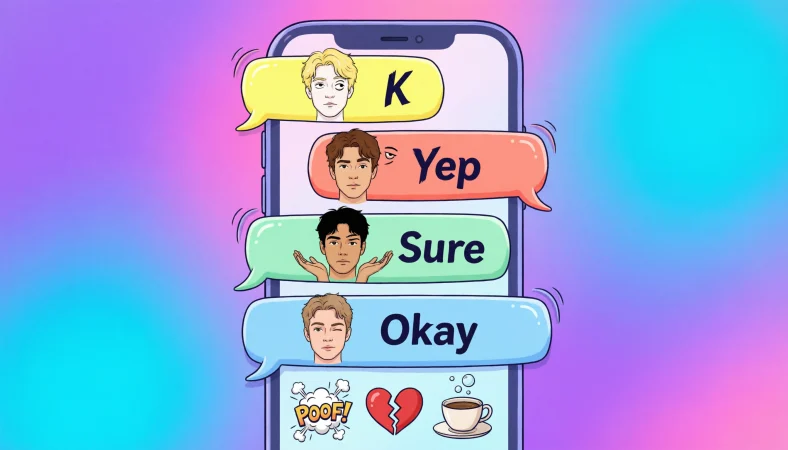
One word text replies from guys can mean anything from being busy or casual to losing interest, depending on the word, timing, and overall texting pattern. The best response is usually confident, relaxed, and matched to his energy.
Top alternatives: K, Okay, Yeah, Yep, Sure
Ever send a thoughtful text and get hit with a tiny little “K”? Suddenly you are analyzing punctuation like it is a criminal investigation. One word text replies from guys can be confusing because the same short message can mean completely different things depending on the situation.
A guy might be busy, distracted, naturally brief, joking around, or simply not feeling chatty. Sometimes, though, a one word reply can signal low effort or fading interest. Whether you are texting a crush, talking to a boyfriend, messaging a friend, or communicating with someone from work, context matters more than the word itself.
Knowing how to read the vibe can save you from unnecessary overthinking. This guide breaks down common one word responses, what they may mean, and clever ways to reply without chasing, panicking, or turning a simple text into a full detective case.
Funny One Word Text Replies From Guys
“K.”
Use it when he sends the driest possible response and you want to tease him.
Meaning: You are playfully calling out his low-effort texting.
“Yeah.”
Use it when his serious-sounding reply feels unintentionally hilarious.
Meaning: You are keeping things light instead of taking the dryness personally.
“Yep.”
Use it when he gives you a very casual confirmation.
Meaning: You are matching his relaxed energy.
“Nah.”
Use it after he gives a blunt refusal that deserves a little humor.
Meaning: You are jokingly accepting his straightforward answer.
“Sure.”
Use it when “sure” sounds suspiciously unenthusiastic.
Meaning: You are playfully questioning his enthusiasm.
“Fine.”
Use it when he responds dramatically to something minor.
Meaning: You are turning his seriousness into a joke.
“Okay.”
Use it when he gives you a classic short reply.
Meaning: You are acknowledging the message without overthinking it.
“Bet.”
Use it when he agrees quickly to your plan.
Meaning: You are showing confidence and keeping the vibe fun.
“Facts.”
Use it when he agrees with something obvious or funny.
Meaning: You are matching his internet-style energy.
“Mood.”
Use it when his one-word response perfectly summarizes the situation.
Meaning: You are showing playful agreement.
“Valid.”
Use it when you want to approve his answer with a little attitude.
Meaning: You are humorously giving his opinion your official stamp.
“Real.”
Use it when his reply perfectly captures something relatable.
Meaning: You are connecting through shared humor.
“Honestly.”
Use it when his response accidentally sounds like the beginning of a dramatic confession.
Meaning: You are exaggerating the seriousness for fun.
“Absolutely.”
Use it when you want to make his short answer sound dramatically important.
Meaning: You are jokingly turning a basic response into an event.
“Noted.”
Use it when you want to tease him without sounding annoyed.
Meaning: You are playfully pretending his tiny response was an official statement.
Brutal Responses to One Word Texts
“That all you got?”
Use it when his reply feels especially low effort.
Meaning: You are directly challenging the lack of effort.
“Impressive vocabulary.”
Use it when he gives you a painfully short response.
Meaning: You are sarcastically pointing out how brief he was.
“Save your words, apparently.”
Use it when the conversation suddenly becomes extremely dry.
Meaning: You are teasing him about being unusually quiet.
“Blink twice if you’re bored.”
Use it when his message feels completely uninterested.
Meaning: You are calling out the energy without sounding overly serious.
“You really gave that message everything.”
Use it after an especially lazy reply.
Meaning: You are using sarcasm to highlight his lack of effort.
“Wow, a whole word.”
Use it when he sends the bare minimum.
Meaning: You are jokingly demanding more effort.
“And the Pulitzer goes to…”
Use it when his answer is hilariously short.
Meaning: You are exaggerating his tiny contribution for comedic effect.
“That response had zero calories.”
Use it when his text feels completely empty.
Meaning: You are humorously describing a lack of substance.
“Communication is thriving.”
Use it when his answer barely keeps the conversation alive.
Meaning: You are sarcastically highlighting the weak communication.
“We love the effort.”
Use it when you are clearly not impressed.
Meaning: You are using playful sarcasm to make your point.
“Okay, Shakespeare.”
Use it when he sends a ridiculously short message.
Meaning: You are mocking the lack of words in a lighthearted way.
“A novel, truly.”
Use it when his reply is only one word.
Meaning: You are exaggerating the length for humor.
“Your keyboard must be tired.”
Use it after repeated one-word messages.
Meaning: You are joking that he is conserving his typing energy.
“I see you chose minimalism.”
Use it when he consistently keeps replies short.
Meaning: You are humorously labeling his texting style.
“Should I bring subtitles?”
Use it when his short answers make the conversation confusing.
Meaning: You are teasing him about his mysterious communication style.
Flirty One Word Text Replies
“Cute.”
Use it when his short reply secretly makes you smile.
Meaning: You are flirting while keeping your response effortless.
“Interesting.”
Use it when you want to create a little mystery.
Meaning: You are inviting him to wonder what you are thinking.
“Tempting.”
Use it when his message has a playful or romantic undertone.
Meaning: You are showing interest without giving everything away.
“Maybe.”
Use it when you want to flirt while keeping him guessing.
Meaning: You are creating playful uncertainty.
“Hmm.”
Use it when you want to make him wonder what is going through your mind.
Meaning: You are using mystery as a flirting tool.
“Really?”
Use it when his short answer catches your attention.
Meaning: You are encouraging him to elaborate.
“Finally.”
Use it when he gives you the answer you were hoping for.
Meaning: You are playfully suggesting you were waiting for him.
“Dangerous.”
Use it when his message feels confidently flirty.
Meaning: You are signaling attraction with playful caution.
“Bold.”
Use it when he says something unexpectedly confident.
Meaning: You are acknowledging his flirtiness while teasing him.
“Smooth.”
Use it when his short message actually lands well.
Meaning: You are complimenting his charm.
“Noted.”
Use it when you want to flirt without revealing too much.
Meaning: You are letting him know his words caught your attention.
“Possibly.”
Use it when you want to keep the flirting mysterious.
Meaning: You are showing openness without committing.
“Adorable.”
Use it when his short answer is unexpectedly sweet.
Meaning: You are responding with warm affection.
“Oh?”
Use it when you want him to explain a flirty comment.
Meaning: You are encouraging him to continue.
“Careful.”
Use it when his message is becoming confidently flirtatious.
Meaning: You are playfully warning him while showing interest.
Polite Responses to One Word Texts
“Gotcha.”
Use it when you want to acknowledge his message naturally.
Meaning: You understand and are keeping things friendly.
“Thanks.”
Use it when his brief reply answers your question.
Meaning: You are being courteous without adding unnecessary text.
“Okay, thanks.”
Use it when you want a polite acknowledgment.
Meaning: You are closing the exchange respectfully.
“Sounds good.”
Use it when he confirms plans or agrees with you.
Meaning: You are showing positive agreement.
“Understood.”
Use it when his message provides clear information.
Meaning: You are confirming that you understand.
“Perfect.”
Use it when his response solves the issue.
Meaning: You are showing appreciation and satisfaction.
“Sure thing.”
Use it when you want to sound warm and cooperative.
Meaning: You are agreeing in a friendly way.
“No worries.”
Use it when he apologizes or gives a brief explanation.
Meaning: You are showing that you are not upset.
“Absolutely.”
Use it when you want to enthusiastically agree.
Meaning: You are communicating clear support.
“Of course.”
Use it when you want to respond warmly to a request.
Meaning: You are being helpful and considerate.
“All good.”
Use it when you want to keep the interaction relaxed.
Meaning: You are signaling that everything is fine.
“Fair enough.”
Use it when you accept his perspective.
Meaning: You respect his answer even if you disagree.
“Appreciate it.”
Use it when he gives you useful information or help.
Meaning: You are expressing genuine gratitude.
“Makes sense.”
Use it when his short explanation is reasonable.
Meaning: You understand his point.
“Got it.”
Use it when you simply need to acknowledge his response.
Meaning: You have received and understood the message.
Chill And Casual Responses
“Cool.”
Use it when you want to keep the conversation relaxed.
Meaning: You are acknowledging his message without making it serious.
“Yep.”
Use it when he confirms something simple.
Meaning: You are casually agreeing.
“Same.”
Use it when his message reflects your own feelings.
Meaning: You are showing quick agreement.
“Bet.”
Use it when you are down for the plan.
Meaning: You are casually saying yes.
“True.”
Use it when you agree with his observation.
Meaning: You are validating what he said.
“Facts.”
Use it when you strongly agree with something relatable.
Meaning: You are showing enthusiastic agreement.
“Mood.”
Use it when his message perfectly matches your feelings.
Meaning: You are saying you completely relate.
“Fair.”
Use it when his point is reasonable.
Meaning: You are casually acknowledging his perspective.
“Nice.”
Use it when he shares something positive.
Meaning: You are responding with simple enthusiasm.
“Valid.”
Use it when his opinion makes sense to you.
Meaning: You are casually approving his point.
“Word.”
Use it when you want to agree in a laid-back way.
Meaning: You are signaling agreement with casual confidence.
“Definitely.”
Use it when you strongly agree but want to stay relaxed.
Meaning: You are confirming your interest or agreement.
“Exactly.”
Use it when he says something you completely agree with.
Meaning: You are reinforcing his point.
“Yepper.”
Use it when the conversation is playful and informal.
Meaning: You are adding a goofy twist to a simple yes.
“For sure.”
Use it when you want to agree without making things formal.
Meaning: You are confidently confirming your answer.
Confident Responses to One Word Texts
“Got it. Your move.”
Use it when you want him to continue the conversation.
Meaning: You are confidently putting the next step in his hands.
“Cool, keep me posted.”
Use it when plans are still developing.
Meaning: You are interested without chasing.
“Sounds good to me.”
Use it when you are comfortable with his answer.
Meaning: You are showing calm confidence.
“Works for me.”
Use it when he suggests something you like.
Meaning: You are agreeing without overexplaining.
“Perfect. Done.”
Use it when you have reached an agreement.
Meaning: You are decisive and self-assured.
“Noted. I’ll remember that.”
Use it when his message gives you useful information.
Meaning: You are calmly acknowledging what he said.
“Alright, we’re clear.”
Use it when you want to end uncertainty.
Meaning: You are establishing confidence and clarity.
“Easy enough.”
Use it when something is simple to handle.
Meaning: You are showing that you are not stressed.
“No problem.”
Use it when you want to reassure him.
Meaning: You are communicating calmness and control.
“I can work with that.”
Use it when his answer is acceptable.
Meaning: You are showing flexibility without sounding needy.
“Fair answer.”
Use it when you respect his response.
Meaning: You are acknowledging him confidently.
“That works.”
Use it when his suggestion suits you.
Meaning: You are giving a clear, uncomplicated yes.
“We’ll see.”
Use it when you want to remain mysterious.
Meaning: You are keeping your options open.
“I’ll take that.”
Use it when his answer works in your favor.
Meaning: You are playfully showing confidence.
“Good to know.”
Use it when you receive information worth remembering.
Meaning: You are acknowledging it without overreacting.
Cute Responses to One Word Texts
“Aww.”
Use it when his short reply is unexpectedly sweet.
Meaning: You are showing warmth and affection.
“Hehe.”
Use it when the exchange has a playful vibe.
Meaning: You are responding with lighthearted affection.
“Yay.”
Use it when his message brings good news.
Meaning: You are expressing genuine excitement.
“Cute.”
Use it when his answer makes you smile.
Meaning: You are giving him a sweet little compliment.
“Awww, okay.”
Use it when he says something adorable.
Meaning: You are acknowledging him warmly.
“Sweet.”
Use it when he does something thoughtful.
Meaning: You appreciate his kindness.
“Stoppp.”
Use it when he says something that makes you blush.
Meaning: You are playfully pretending to protest.
“Love that.”
Use it when he shares something you genuinely like.
Meaning: You are showing enthusiastic affection.
“Yesss.”
Use it when he gives you good news.
Meaning: You are celebrating the moment.
“Okayyy.”
Use it when you want to make a basic response sound playful.
Meaning: You are adding personality to the conversation.
“Adorbs.”
Use it when something he says is especially cute.
Meaning: You are responding with playful affection.
“He’s learning.”
Use it when he finally gives you the answer you wanted.
Meaning: You are teasing him affectionately.
“Look at you.”
Use it when he does something unexpectedly sweet.
Meaning: You are playfully complimenting him.
“Precious.”
Use it when his response is genuinely adorable.
Meaning: You are expressing fondness.
“My favorite.”
Use it when you want to make the exchange more affectionate.
Meaning: You are showing that he holds a special place with you.
Sarcastic Responses to One Word Texts
“Thrilling.”
Use it after a painfully dry reply.
Meaning: You are sarcastically pretending to be entertained.
“Groundbreaking.”
Use it when his answer is extremely predictable.
Meaning: You are joking about how unsurprising his response is.
“Revolutionary.”
Use it when his message contributes almost nothing.
Meaning: You are exaggerating the importance of his reply.
“Incredible insight.”
Use it when his response is obvious.
Meaning: You are playfully mocking the lack of detail.
“Deep.”
Use it when his one-word message sounds hilariously shallow.
Meaning: You are using sarcasm to poke fun at the response.
“Compelling.”
Use it when his message gives you very little to work with.
Meaning: You are sarcastically rating his contribution.
“Fascinating.”
Use it when he sends a particularly dry answer.
Meaning: You are pretending his response is much more interesting than it is.
“Poetry.”
Use it when his message is comically short.
Meaning: You are exaggerating the literary quality of his text.
“What a speech.”
Use it when he sends only one word.
Meaning: You are humorously calling attention to the brevity.
“Oscar-worthy.”
Use it when his response is dramatically unimpressive.
Meaning: You are making fun of his tiny contribution.
“The enthusiasm is unmatched.”
Use it when he sounds completely unenthusiastic.
Meaning: You are using irony to highlight his dry tone.
“I felt that essay.”
Use it when his response is only one word.
Meaning: You are exaggerating the message length for humor.
“Such detail.”
Use it when he provides almost none.
Meaning: You are sarcastically pointing out the missing context.
“10/10 explanation.”
Use it when his answer explains nothing.
Meaning: You are playfully criticizing the lack of information.
“And people say texting is dead.”
Use it after an especially dry reply.
Meaning: You are joking about how little effort went into the message.
Clever Responses to One Word Texts
“Short and mysterious. I respect it.”
Use it when you want to acknowledge his brief style positively.
Meaning: You are turning his short reply into something intriguing.
“I’ll let you keep your secrets.”
Use it when he gives a vague answer.
Meaning: You are playfully acknowledging the mystery.
“Noted for future reference.”
Use it when his answer might matter later.
Meaning: You are showing that you pay attention.
“Message received.”
Use it when you want a confident acknowledgment.
Meaning: You are clearly confirming that you understand.
“Loud and clear.”
Use it when his one word gives you enough information.
Meaning: You are saying there is no confusion.
“Crystal clear.”
Use it when his answer is straightforward.
Meaning: You understand exactly what he means.
“That tells me enough.”
Use it when you do not need more information.
Meaning: You are confidently closing the subject.
“Interesting choice of words.”
Use it when his reply could have multiple meanings.
Meaning: You are subtly inviting him to explain.
“I’ll read between the lines.”
Use it when his response is vague.
Meaning: You are playfully suggesting there is more behind his words.
“Keeping it concise, I see.”
Use it when he consistently texts briefly.
Meaning: You are cleverly acknowledging his style.
“Minimalism suits you.”
Use it when his texting is consistently short.
Meaning: You are turning his habit into a playful observation.
“Efficient communicator.”
Use it when his message gets the point across quickly.
Meaning: You are framing brevity positively.
“I see the strategy.”
Use it when his short reply seems intentional.
Meaning: You are playfully pretending he has a texting master plan.
“Mystery unlocked.”
Use it when you finally understand his brief response.
Meaning: You are making the interaction playful.
“Consider that officially decoded.”
Use it when his one-word reply makes sense.
Meaning: You are showing clever confidence.
Dramatic Responses to One Word Texts
“That changed everything.”
Use it when his simple answer has a funny impact.
Meaning: You are exaggerating the significance for entertainment.
“My entire evening is ruined.”
Use it when his dry reply disappoints you jokingly.
Meaning: You are playfully pretending to be devastated.
“I may never recover.”
Use it when his response is hilariously underwhelming.
Meaning: You are exaggerating your reaction for humor.
“How will I survive?”
Use it when his answer is not what you expected.
Meaning: You are being intentionally dramatic.
“This is heartbreaking.”
Use it when his message is comically dry.
Meaning: You are turning mild disappointment into playful drama.
“Call the authorities.”
Use it when his response deserves an exaggerated reaction.
Meaning: You are jokingly treating the situation like an emergency.
“We need to talk about this.”
Use it when his one word creates unexpected tension.
Meaning: You are playfully pretending the message is serious.
“I need a moment.”
Use it when his answer catches you off guard.
Meaning: You are exaggerating your reaction for fun.
“I was not prepared for that.”
Use it when his reply is unexpectedly blunt.
Meaning: You are highlighting the surprise humorously.
“This is a plot twist.”
Use it when his response changes the direction of the conversation.
Meaning: You are making the situation sound dramatically exciting.
“My character development begins now.”
Use it after a surprising response.
Meaning: You are joking that his message has transformed you.
“And just like that, everything changed.”
Use it when a tiny reply has a funny impact.
Meaning: You are dramatically exaggerating the moment.
“I shall remember this.”
Use it when his answer deserves playful revenge energy.
Meaning: You are teasing him without making an actual threat.
“The audacity.”
Use it when his one word feels unexpectedly bold.
Meaning: You are humorously pretending to be offended.
“We may never speak of this again.”
Use it when you want to dramatically end a funny exchange.
Meaning: You are turning a minor moment into comedy.
Sweet Responses to One Word Texts
“Thanks for letting me know.”
Use it when he gives you a simple but useful answer.
Meaning: You appreciate his communication.
“I appreciate that.”
Use it when his short response is considerate.
Meaning: You are expressing sincere gratitude.
“That’s good to hear.”
Use it when his answer contains positive news.
Meaning: You are showing genuine happiness for him.
“Glad you told me.”
Use it when his message gives you important information.
Meaning: You value his honesty.
“That means a lot.”
Use it when his brief reply is emotionally meaningful.
Meaning: You are acknowledging its importance.
“I’m happy for you.”
Use it when he shares something positive.
Meaning: You are showing supportive affection.
“Take care.”
Use it when the conversation is naturally ending.
Meaning: You are closing warmly.
“Have a good one.”
Use it when you want to end a casual conversation positively.
Meaning: You are wishing him well.
“Hope everything goes well.”
Use it when he mentions something important happening.
Meaning: You are offering sincere support.
“I understand.”
Use it when his short answer explains his position.
Meaning: You are responding with empathy.
“That’s okay.”
Use it when his message involves an apology or minor issue.
Meaning: You are reassuring him.
“I’m here if you need me.”
Use it when his short reply suggests he is dealing with something.
Meaning: You are offering support without pressure.
“Glad we cleared that up.”
Use it after resolving confusion.
Meaning: You appreciate reaching mutual understanding.
“I’m glad to hear that.”
Use it when he shares good news.
Meaning: You are responding with genuine warmth.
“You’ve got this.”
Use it when his short message suggests he needs encouragement.
Meaning: You are giving him supportive confidence.
Professional One Word Text Replies
“Noted.”
Use it when confirming workplace information.
Meaning: You acknowledge the information professionally.
“Understood.”
Use it when receiving instructions.
Meaning: You clearly confirm comprehension.
“Confirmed.”
Use it when agreeing to a meeting, deadline, or task.
Meaning: You are formally confirming the details.
“Approved.”
Use it when you have authority to approve something.
Meaning: You are giving a clear professional decision.
“Received.”
Use it when acknowledging a document or message.
Meaning: You confirm that it reached you.
“Thanks.”
Use it after receiving helpful information.
Meaning: You are keeping the exchange courteous.
“Agreed.”
Use it when you support a workplace decision.
Meaning: You clearly express agreement.
“Perfect.”
Use it when a professional arrangement works for you.
Meaning: You are confirming satisfaction.
“Absolutely.”
Use it when you strongly support a request or idea.
Meaning: You are expressing confident agreement.
“Certainly.”
Use it when responding to a professional request.
Meaning: You are politely agreeing.
“Correct.”
Use it when confirming accurate information.
Meaning: You are clearly validating the statement.
“Pending.”
Use it when an item still requires action or approval.
Meaning: You are communicating the current status.
“Complete.”
Use it when a task has been finished.
Meaning: You are clearly reporting completion.
“Available.”
Use it when confirming that you can attend or assist.
Meaning: You are communicating your availability efficiently.
“Forwarded.”
Use it when confirming that information has been sent onward.
Meaning: You are providing a concise status update.
Emotional Responses to One Word Texts
“Okay, I understand.”
Use it when his short message communicates something emotionally important.
Meaning: You are showing that you hear him without escalating the situation.
“I hear you.”
Use it when he is struggling to express himself.
Meaning: You are offering emotional acknowledgment.
“That’s fair.”
Use it when you accept his feelings even if they differ from yours.
Meaning: You are showing emotional maturity.
“I get it.”
Use it when his short response finally makes sense.
Meaning: You are communicating empathy.
“Take your time.”
Use it when he seems overwhelmed or unavailable.
Meaning: You are giving him emotional space.
“No pressure.”
Use it when you want him to feel comfortable responding honestly.
Meaning: You are reducing emotional pressure.
“I respect that.”
Use it when he shares a boundary or preference.
Meaning: You are showing respect for his feelings.
“Thanks for being honest.”
Use it when his short response tells you the truth.
Meaning: You value honesty over a pleasing answer.
“I appreciate your honesty.”
Use it when his answer is difficult but sincere.
Meaning: You are responding maturely to emotional truth.
“I’m not upset.”
Use it when he seems worried about your reaction.
Meaning: You are reassuring him.
“We’re okay.”
Use it when you want to calm unnecessary tension.
Meaning: You are communicating emotional reassurance.
“I’m listening.”
Use it when you want him to feel comfortable opening up.
Meaning: You are making space for honest communication.
“I understand how you feel.”
Use it when his brief response reflects an emotional concern.
Meaning: You are acknowledging his perspective.
“You can tell me.”
Use it when he appears hesitant to explain himself.
Meaning: You are encouraging openness.
“I’m not going anywhere.”
Use it when someone you care about seems distant or uncertain.
Meaning: You are offering emotional reassurance and stability.
Playful Responses to One Word Texts
“Okaaay.”
Use it when you want to make his simple reply sound suspicious.
Meaning: You are playfully implying there is more to the story.
“Hmm, noted.”
Use it when his answer makes you curious.
Meaning: You are showing interest while keeping things teasing.
“Say more.”
Use it when his response leaves you wanting details.
Meaning: You are inviting him to continue.
“Go on.”
Use it when you think there is more behind his message.
Meaning: You are encouraging him to elaborate.
“I’m listening.”
Use it when the conversation suddenly gets interesting.
Meaning: You are signaling that he has your attention.
“Now we’re talking.”
Use it when his answer finally becomes interesting.
Meaning: You are rewarding better conversation with playful enthusiasm.
“That sounds suspicious.”
Use it when his one-word answer feels mysterious.
Meaning: You are creating playful tension.
“Interesting development.”
Use it when his reply changes the vibe.
Meaning: You are highlighting the shift with humor.
“You’re being mysterious today.”
Use it when he keeps giving vague responses.
Meaning: You are teasing him about his communication style.
“I see what you’re doing.”
Use it when you suspect his short response is intentional.
Meaning: You are playfully suggesting you have figured him out.
“Okay, secret agent.”
Use it when he refuses to give details.
Meaning: You are teasing him for being unusually mysterious.
“That’s one way to answer.”
Use it when his response is technically an answer but not very helpful.
Meaning: You are playfully calling attention to his evasiveness.
“You’re keeping me guessing.”
Use it when he gives an ambiguous answer.
Meaning: You are showing curiosity without pressure.
“I’ll allow it.”
Use it when his short response is acceptable.
Meaning: You are jokingly pretending to be the authority.
“Okay, mystery man.”
Use it when his replies are vague and intriguing.
Meaning: You are teasing him in a playful way.
FAQs
What Do One Word Text Replies From Guys Usually Mean?
They can mean many things, including being busy, distracted, casual, naturally brief, uninterested, or simply unsure what else to say. The surrounding context matters more than one word alone.
Do One Word Replies Mean He Is Losing Interest?
Not necessarily. Look for a pattern instead of one isolated message. If he consistently gives short replies, never asks questions, and rarely starts conversations, the pattern may suggest low interest.
Can One Word Replies Be Flirty?
Absolutely. Words such as “maybe,” “interesting,” “really,” or “careful” can create playful tension when the overall conversation already has a flirty vibe.
What If I Do Not Actually Like His One Word Replies?
You can be direct without being dramatic. Try saying, “You seem quiet today, everything okay?” This gives him a chance to explain rather than forcing you to guess.
Should I Match His One Word Energy?
Sometimes, yes. Matching his energy can keep you from overinvesting in a conversation that feels one-sided. However, do not turn every text into an energy competition.
Are One Word Replies Rude?
They can be, but they are not automatically rude. Some people naturally communicate briefly, especially when they are busy or multitasking.
What Is the Best Response to “K”?
It depends on the vibe. For humor, try “Wow, a whole word.” For confidence, try “Got it.” If you want to keep the conversation moving, ask a specific follow-up question.
What Does “Yep” Mean From a Guy?
Usually, “yep” simply means yes or agreement. His tone, previous messages, and texting habits can help determine whether it is casual, rushed, or dismissive.
What Does “Sure” Mean in Texting?
“Sure” can mean genuine agreement, reluctant acceptance, or simple acknowledgment. Context and punctuation often help reveal the tone.
Is It Okay to Joke About His Dry Texting?
Yes, especially if you already have a playful relationship. Keep the joke light rather than turning it into criticism.
Conclusion
One word text replies from guys do not have to send you into full detective mode. A short “okay,” “yeah,” or “sure” can mean different things depending on his personality, mood, schedule, and the conversation around it. Instead of automatically assuming the worst, look at the bigger pattern. If he is normally warm and suddenly brief, he may simply be busy.
If every conversation feels like pulling teeth, that tells you something different. The best response is one that matches your personality while protecting your confidence. Try something funny, chill, flirty, direct, or sweet depending on the situation. Save this list, share it with your texting partner in crime, and keep your replies effortlessly on point.







4 thoughts on “180+ One-Word Text Replies From Guys: What They Really Mean & How To Respond In 2026”