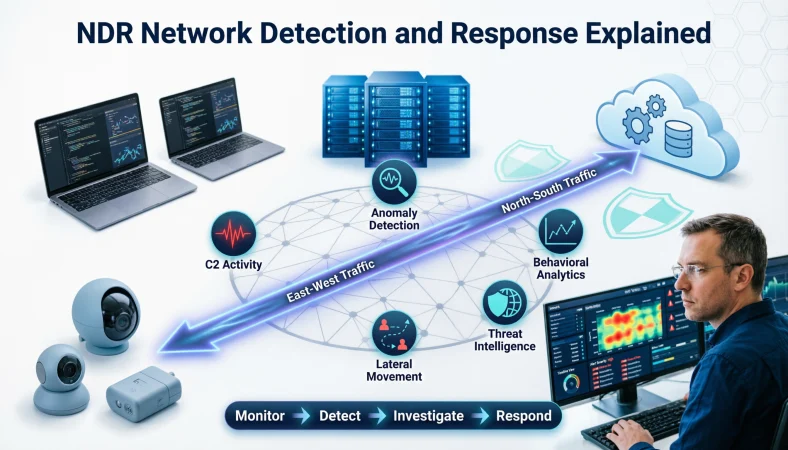
NDR network detection and response is a cybersecurity capability that continuously analyzes network traffic and behavior to spot suspicious activity, investigate threats, and support or automate response actions. It can help security teams see activity that endpoint-focused tools may miss.
Top alternatives: network threat detection, network traffic analysis, NDR security, network security monitoring, network threat response
Ever wondered how security teams notice something suspicious moving through a network before it turns into a full-blown incident? That is where NDR network detection and response enters the chat. Instead of watching only individual computers, NDR focuses on network communications and traffic patterns, looking for behavior that does not fit the normal baseline.
It can be useful at work, during security investigations, while studying cybersecurity, or when comparing tools such as EDR, SIEM, IDS, and NDR. Modern NDR platforms can use behavioral analytics, machine learning, threat intelligence, and other techniques to identify suspicious activity, investigate what happened, and support containment.
The acronym may sound like another corporate alphabet puzzle, but the basic idea is surprisingly simple: watch the network, spot unusual behavior, investigate it, and respond.
What NDR Network Detection And Response Means
NDR stands for Network Detection and Response.
Example: Use this when explaining the acronym to someone new to cybersecurity.
Meaning: NDR describes security capabilities focused on detecting and responding to threats through network activity analysis.
NDR watches network activity for suspicious behavior.
Example: Use this when describing the technology in simple terms.
Meaning: Its core purpose is to identify unusual or potentially malicious network behavior.
NDR looks beyond individual endpoints.
Example: Use this when comparing network visibility with endpoint monitoring.
Meaning: NDR focuses on communications between systems rather than relying only on endpoint agents.
NDR can help identify abnormal traffic patterns.
Example: Use this when explaining behavioral detection.
Meaning: Unusual communication patterns can become indicators for investigation.
NDR is closely related to network traffic analysis.
Example: Use this when researching the history of the technology.
Meaning: NDR evolved from network traffic analysis capabilities and expanded toward detection and response.
NDR can support security investigations.
Example: Use this when describing a security operations workflow.
Meaning: Network evidence can help analysts understand suspicious activity.
NDR can identify threats that bypass other controls.
Example: Use this when discussing visibility gaps.
Meaning: Network analysis can expose activity that endpoint or perimeter tools may not reveal.
NDR is designed for modern network environments.
Example: Use this when discussing cloud and hybrid infrastructure.
Meaning: Modern NDR approaches can analyze activity across distributed environments.
NDR does not simply mean watching bandwidth.
Example: Use this when correcting a common misunderstanding.
Meaning: NDR focuses on security-relevant behavior, not merely network performance.
NDR can combine multiple analytical techniques.
Example: Use this when explaining how modern platforms operate.
Meaning: Behavioral analytics, machine learning, rules, and threat intelligence may work together.
The response part of NDR matters.
Example: Use this when distinguishing NDR from passive monitoring.
Meaning: NDR can support actions after suspicious activity is identified.
Think of NDR as a security camera for network conversations.
Example: Use this as a beginner-friendly analogy.
Meaning: The analogy highlights its focus on communication patterns across the network.
NDR Network Detection And Response Explained Simply
NDR watches how devices communicate.
Example: Use this when explaining NDR to a nontechnical colleague.
Meaning: The technology focuses on communication behavior across the environment.
Normal traffic creates a behavioral baseline.
Example: Use this when explaining anomaly detection.
Meaning: A baseline helps security systems recognize activity that deviates from expected patterns.
Unusual traffic can trigger an alert.
Example: Use this during a basic SOC explanation.
Meaning: Significant deviations may be presented to analysts for investigation.
Analysts investigate suspicious network behavior.
Example: Use this when describing the next step after detection.
Meaning: Alerts provide starting points for understanding potential incidents.
NDR can add context to security alerts.
Example: Use this when discussing investigation efficiency.
Meaning: Network evidence can help analysts understand relationships between systems and events.
NDR can observe internal traffic.
Example: Use this when explaining east-west visibility.
Meaning: Internal system-to-system communication can reveal lateral movement and other suspicious behavior.
NDR can also observe external network communication.
Example: Use this when explaining north-south traffic.
Meaning: Traffic crossing the enterprise boundary can provide additional security context.
NDR helps answer “who talked to whom?”
Example: Use this when teaching network investigation basics.
Meaning: Communication relationships can reveal suspicious connections.
NDR can help answer “when did it happen?”
Example: Use this during incident timeline analysis.
Meaning: Network telemetry can help establish event timing.
NDR can help answer “what changed?”
Example: Use this when investigating unusual behavior.
Meaning: Deviations from established behavior can point analysts toward potential threats.
NDR turns network activity into security evidence.
Example: Use this when describing its investigative role.
Meaning: Network telemetry can become useful context for threat detection.
The goal is not simply more alerts.
Example: Use this when explaining effective NDR.
Meaning: Useful detection depends on meaningful context and actionable investigation.
NDR Network Detection And Response Capabilities
Traffic monitoring is a core NDR capability.
Example: Use this when listing basic platform functions.
Meaning: NDR needs network visibility to analyze communication behavior.
Behavioral analysis is commonly used by NDR.
Example: Use this when discussing detection methods.
Meaning: Behavioral models help identify activity that differs from expected patterns.
Machine learning can support NDR detection.
Example: Use this when explaining modern analytical techniques.
Meaning: Machine learning can help model behavior and identify anomalies.
Threat intelligence can enrich NDR analysis.
Example: Use this when explaining contextual detection.
Meaning: External intelligence can add information about suspicious indicators or behaviors.
Threat hunting can be supported by NDR.
Example: Use this when discussing proactive investigation.
Meaning: Analysts can search network evidence for signs of compromise.
Network forensics can be supported by NDR.
Example: Use this when explaining incident investigation.
Meaning: Network evidence can help reconstruct what happened.
Alerting is an important NDR function.
Example: Use this when describing SOC workflows.
Meaning: Suspicious activity can be surfaced to security teams.
Response automation can be part of NDR.
Example: Use this when discussing automated containment.
Meaning: Some platforms can trigger or coordinate actions after detection.
NDR can integrate with other security systems.
Example: Use this when discussing a broader security architecture.
Meaning: Network findings can feed other security and response workflows.
NDR can provide investigation context.
Example: Use this when reviewing a suspicious connection.
Meaning: Context helps analysts determine whether activity deserves escalation.
NDR can monitor east-west traffic.
Example: Use this when discussing internal network visibility.
Meaning: Internal communications can reveal movement between systems.
NDR can monitor north-south traffic.
Example: Use this when discussing perimeter-related traffic.
Meaning: External communications provide another source of threat evidence.
NDR Network Detection And Response For Threat Detection
NDR can detect anomalous network behavior.
Example: Use this when explaining its primary security purpose.
Meaning: It identifies traffic patterns that differ from expected behavior.
NDR can help identify command-and-control activity.
Example: Use this when discussing suspicious external communication.
Meaning: Repeated or unusual communication can indicate possible C2 behavior.
NDR can help identify lateral movement.
Example: Use this during an internal threat investigation.
Meaning: Unusual system-to-system communication may reveal movement after initial compromise.
NDR can help identify data exfiltration patterns.
Example: Use this when investigating unusual outbound traffic.
Meaning: Unexpected data movement can become a detection signal.
NDR can detect suspicious communication patterns.
Example: Use this when investigating a compromised account.
Meaning: Changes in communication behavior may reveal malicious activity.
NDR can identify activity without relying entirely on signatures.
Example: Use this when comparing behavioral and signature detection.
Meaning: Behavioral methods can identify suspicious patterns even when a specific signature is unavailable.
NDR can help detect malware-related network activity.
Example: Use this when investigating suspicious connections.
Meaning: Malware often creates communication patterns that network analysis can expose.
NDR can provide visibility into unmanaged devices.
Example: Use this when discussing IoT or contractor devices.
Meaning: Network monitoring can observe communications without requiring an endpoint agent on every device.
NDR can help investigate insider-related activity.
Example: Use this when reviewing unusual internal communication.
Meaning: Network behavior can provide evidence for investigating suspicious activity.
NDR can identify unusual destinations.
Example: Use this when investigating outbound connections.
Meaning: Unexpected destinations can become useful investigation clues.
NDR can correlate behavior across systems.
Example: Use this when analyzing a multi-stage incident.
Meaning: Network relationships can connect otherwise separate events.
Detection quality depends on visibility and context.
Example: Use this when setting realistic expectations.
Meaning: NDR effectiveness depends on what traffic and telemetry the organization can observe.
NDR Network Detection And Response For Security Teams
NDR can give SOC analysts network-level visibility.
Example: Use this when describing a security operations center workflow.
Meaning: Analysts gain another perspective on potential threats.
NDR alerts can become investigation starting points.
Example: Use this when describing alert triage.
Meaning: Analysts can examine the associated network evidence.
NDR can help prioritize suspicious activity.
Example: Use this when discussing alert management.
Meaning: Context can help teams focus attention on activity that appears more relevant.
NDR can support threat hunting.
Example: Use this during proactive security investigations.
Meaning: Analysts can use network evidence to search for signs of compromise.
NDR can help build incident timelines.
Example: Use this when reconstructing an attack.
Meaning: Network events can provide chronological evidence.
NDR can reveal communication relationships.
Example: Use this when investigating affected systems.
Meaning: Analysts can see which devices or services communicated.
NDR can complement endpoint security.
Example: Use this when explaining layered defense.
Meaning: Network and endpoint perspectives can provide different evidence.
NDR can complement SIEM platforms.
Example: Use this when discussing security data integration.
Meaning: Network telemetry can enrich broader security event analysis.
NDR can support incident containment workflows.
Example: Use this when discussing response processes.
Meaning: Findings can trigger or inform containment actions.
NDR does not eliminate analyst judgment.
Example: Use this when setting realistic expectations.
Meaning: Security teams still need to validate alerts and choose appropriate actions.
Good NDR workflows reduce investigation guesswork.
Example: Use this when discussing operational efficiency.
Meaning: Better network context can help analysts understand incidents faster.
NDR works best as part of a broader security strategy.
Example: Use this when discussing layered security.
Meaning: Network detection complements rather than replaces every other security control.
NDR Network Detection And Response And EDR
NDR focuses primarily on network activity.
Example: Use this when comparing security technologies.
Meaning: NDR observes communications between systems and services.
EDR focuses primarily on endpoint activity.
Example: Use this when explaining the basic distinction.
Meaning: EDR monitors activity occurring on endpoints such as computers and servers.
NDR can see traffic from devices without endpoint agents.
Example: Use this when discussing unmanaged devices.
Meaning: Network visibility does not require an endpoint agent on every device.
EDR can provide endpoint-specific process information.
Example: Use this when comparing investigation perspectives.
Meaning: Endpoint telemetry can reveal what processes and activities occurred on a host.
NDR can reveal communication between compromised systems.
Example: Use this when investigating lateral movement.
Meaning: Network evidence can expose system-to-system behavior.
EDR and NDR can complement each other.
Example: Use this when discussing layered detection.
Meaning: Combining endpoint and network perspectives can provide broader visibility.
NDR is not simply another name for EDR.
Example: Use this when correcting terminology.
Meaning: They monitor different parts of an environment.
EDR can focus on what happened on a device.
Example: Use this during a tool comparison.
Meaning: Endpoint telemetry provides host-level evidence.
NDR can focus on how systems communicated.
Example: Use this during a network investigation.
Meaning: Communication behavior provides network-level evidence.
An NDR alert can lead analysts toward an endpoint investigation.
Example: Use this when describing cross-tool workflows.
Meaning: Network evidence can identify a host that deserves deeper endpoint analysis.
An EDR alert can lead analysts toward network investigation.
Example: Use this when describing incident correlation.
Meaning: Endpoint evidence can reveal network activity that needs further examination.
The two technologies answer different security questions.
Example: Use this when comparing platform roles.
Meaning: Their visibility overlaps in places but remains fundamentally different.
NDR Network Detection And Response And SIEM
NDR analyzes network activity directly.
Example: Use this when comparing it with log-focused technologies.
Meaning: Network telemetry is central to NDR.
SIEM commonly aggregates security logs and events.
Example: Use this when explaining the basic SIEM role.
Meaning: SIEM provides centralized analysis across many security data sources.
NDR can feed network findings into a SIEM.
Example: Use this when discussing integration.
Meaning: Network evidence can become part of broader security correlation.
SIEM can provide organization-wide event context.
Example: Use this during incident investigation.
Meaning: Centralized events can connect information from different systems.
NDR provides a network-focused perspective.
Example: Use this when explaining the distinction.
Meaning: Its primary visibility comes from network communications.
SIEM and NDR can work together.
Example: Use this when designing a layered security architecture.
Meaning: Combining different telemetry sources can improve investigative context.
NDR can add network evidence to a SIEM investigation.
Example: Use this when reviewing a suspicious login.
Meaning: Network behavior can add another dimension to the event.
SIEM can correlate NDR findings with endpoint events.
Example: Use this when describing security operations integration.
Meaning: Multiple telemetry sources can help create a broader incident timeline.
NDR is not simply a replacement for SIEM.
Example: Use this when correcting a common assumption.
Meaning: The technologies serve different primary functions.
SIEM is not simply a replacement for NDR.
Example: Use this when discussing network visibility.
Meaning: Centralized logs do not automatically provide the same network perspective.
Integration can reduce security visibility gaps.
Example: Use this when discussing defense-in-depth.
Meaning: Different tools can contribute complementary evidence.
Tool overlap does not mean tool equivalence.
Example: Use this when comparing security platforms.
Meaning: Similar detection outcomes can still come from different telemetry sources.
NDR Network Detection And Response And IDS
IDS stands for Intrusion Detection System.
Example: Use this when introducing the comparison.
Meaning: IDS is designed to identify potentially malicious or unauthorized activity.
Traditional IDS approaches often rely heavily on signatures and rules.
Example: Use this when explaining historical detection methods.
Meaning: Known patterns can be matched against observed traffic.
NDR commonly emphasizes behavioral analysis.
Example: Use this when discussing modern detection approaches.
Meaning: NDR can identify anomalies beyond known signatures.
NDR can provide investigation context.
Example: Use this when comparing alerting capabilities.
Meaning: NDR platforms can connect suspicious activity with network evidence.
IDS primarily emphasizes detection.
Example: Use this when explaining the acronym.
Meaning: Traditional IDS functionality centers on identifying suspicious activity.
NDR includes response capabilities.
Example: Use this when distinguishing the two concepts.
Meaning: NDR extends detection toward investigation and response workflows.
NDR can analyze internal traffic.
Example: Use this when discussing east-west visibility.
Meaning: Internal communications can reveal activity after an initial compromise.
NDR can analyze external traffic.
Example: Use this when discussing north-south visibility.
Meaning: External communication can provide evidence of suspicious connections.
IDS and NDR can coexist.
Example: Use this when planning layered network security.
Meaning: Different detection methods can provide complementary coverage.
NDR is not simply an IDS with a newer name.
Example: Use this when clarifying terminology.
Meaning: Modern NDR encompasses broader analytics and response capabilities.
Detection technology should match the visibility requirement.
Example: Use this when evaluating security architecture.
Meaning: Different tools provide different forms of evidence.
The right comparison depends on the actual deployment.
Example: Use this when evaluating security products.
Meaning: Features vary between implementations and vendors.
NDR Network Detection And Response For Cloud Security
NDR can extend network visibility into cloud environments.
Example: Use this when discussing hybrid infrastructure.
Meaning: Modern NDR approaches can analyze cloud network telemetry.
Cloud traffic can be more distributed than traditional network traffic.
Example: Use this when explaining cloud security challenges.
Meaning: Workloads and services may communicate across multiple environments.
NDR can help monitor communication between cloud workloads.
Example: Use this when discussing internal cloud visibility.
Meaning: Network relationships can reveal unexpected communication.
Cloud traffic mirrors can provide NDR telemetry.
Example: Use this when explaining one possible data source.
Meaning: Mirrored traffic can give NDR systems network data to analyze.
Flow logs can also provide network telemetry.
Example: Use this when discussing cloud monitoring options.
Meaning: Flow records provide metadata about network connections.
Cloud NDR can help identify unusual destinations.
Example: Use this when investigating outbound workload traffic.
Meaning: Unexpected external communication can become a security clue.
Cloud NDR can support lateral movement investigations.
Example: Use this when analyzing compromised workloads.
Meaning: Internal communication patterns may reveal suspicious movement.
NDR can complement cloud-native security controls.
Example: Use this when planning a cloud security stack.
Meaning: Network-level visibility can add another layer of context.
Cloud visibility depends on architecture.
Example: Use this when setting expectations.
Meaning: The telemetry available to NDR depends on where and how traffic is observed.
Encrypted traffic can create visibility challenges.
Example: Use this when discussing modern network monitoring.
Meaning: Encryption can limit direct inspection of content, making metadata and behavior important.
Hybrid environments can benefit from unified network visibility.
Example: Use this when discussing mixed infrastructure.
Meaning: Consistent monitoring can help analysts understand communication across environments.
Cloud NDR still requires thoughtful deployment.
Example: Use this when planning implementation.
Meaning: Sensors, telemetry sources, coverage, and response integrations must match the environment.
NDR Network Detection And Response For Ransomware
NDR can help identify suspicious network behavior associated with ransomware.
Example: Use this when discussing ransomware detection.
Meaning: Network activity can provide clues about malicious behavior.
Lateral movement can be a ransomware investigation signal.
Example: Use this when examining unusual internal connections.
Meaning: Unexpected movement between systems may indicate an active intrusion.
Unusual outbound communication can be investigated with NDR.
Example: Use this when reviewing possible command-and-control traffic.
Meaning: Network behavior may provide evidence of malicious coordination.
NDR can help identify affected systems.
Example: Use this during incident scoping.
Meaning: Network relationships can help determine which devices communicated suspiciously.
NDR can provide an attack timeline.
Example: Use this when reconstructing ransomware activity.
Meaning: Network events can help establish when suspicious communication occurred.
NDR can support containment workflows.
Example: Use this when discussing response integration.
Meaning: Detection findings can inform or trigger appropriate containment actions.
NDR can complement EDR during ransomware investigations.
Example: Use this when combining network and endpoint evidence.
Meaning: Network behavior and endpoint activity can provide different views of the incident.
NDR does not replace backup strategy.
Example: Use this when discussing ransomware resilience.
Meaning: Detection and response are only part of a broader ransomware preparedness program.
NDR does not guarantee ransomware prevention.
Example: Use this when setting realistic expectations.
Meaning: Security controls reduce risk but cannot promise that every attack will be stopped.
Behavioral detection can matter when malware changes.
Example: Use this when explaining signature limitations.
Meaning: Behavior-based approaches can help identify suspicious activity without relying exclusively on fixed signatures.
Rapid investigation matters during active incidents.
Example: Use this when discussing operational response.
Meaning: Faster understanding can help teams make containment decisions sooner.
NDR is one layer in ransomware defense.
Example: Use this when explaining layered security.
Meaning: Network detection should operate alongside endpoint, identity, backup, and other controls.
NDR Network Detection And Response For Threat Hunting
Threat hunting uses NDR to search for suspicious network behavior.
Example: Use this when describing proactive security work.
Meaning: Analysts can investigate activity that may not have generated a traditional alert.
Hunting can begin with unusual communication.
Example: Use this when exploring network anomalies.
Meaning: Unexpected connections can provide a useful starting point.
Analysts can investigate rare destinations.
Example: Use this when examining outbound network behavior.
Meaning: Rare communication patterns may deserve additional attention.
Analysts can investigate unusual internal connections.
Example: Use this when searching for lateral movement.
Meaning: Unexpected east-west communication can indicate suspicious activity.
Analysts can compare current traffic with historical behavior.
Example: Use this when explaining behavioral baselines.
Meaning: Historical patterns help identify meaningful deviations.
NDR can help visualize communication relationships.
Example: Use this when building an investigation timeline.
Meaning: Relationship data can make complex network behavior easier to understand.
Threat intelligence can enrich a hunt.
Example: Use this when researching suspicious indicators.
Meaning: Intelligence can provide additional context for network observations.
NDR can support hypothesis-driven hunting.
Example: Use this when planning a proactive investigation.
Meaning: Analysts can search for network evidence related to a specific threat behavior.
Hunting can reveal activity missed by automated alerts.
Example: Use this when explaining proactive analysis.
Meaning: Human-led investigation can explore patterns that automated rules may not flag.
NDR can preserve useful network evidence.
Example: Use this when discussing forensic investigation.
Meaning: Historical telemetry can help analysts understand previous activity.
Good hunting requires context.
Example: Use this when teaching junior analysts.
Meaning: An unusual connection is not automatically malicious.
The goal of hunting is understanding, not collecting endless alerts.
Example: Use this when explaining SOC efficiency.
Meaning: Effective hunting focuses on meaningful security questions.
NDR Network Detection And Response Response Actions
NDR can generate alerts for suspicious traffic.
Example: Use this when describing the first response stage.
Meaning: Detection findings can notify security personnel.
Some NDR platforms can trigger automated actions.
Example: Use this when discussing response automation.
Meaning: Certain products can coordinate or initiate protective actions.
NDR can integrate with firewalls.
Example: Use this when discussing automated containment.
Meaning: Detection findings may be used to request or trigger network control changes.
NDR can integrate with SOAR platforms.
Example: Use this when describing security automation.
Meaning: Network detections can feed predefined response workflows.
NDR can help isolate suspicious communication.
Example: Use this when discussing containment.
Meaning: Network-level controls may be used to disrupt malicious connections.
NDR can provide evidence for manual response.
Example: Use this when analysts need to validate an alert.
Meaning: Network context supports human decision-making.
Automated response should be carefully configured.
Example: Use this when discussing production security systems.
Meaning: Incorrect automation can disrupt legitimate business traffic.
Not every NDR platform blocks traffic directly.
Example: Use this when comparing vendor capabilities.
Meaning: Some products focus on detection and orchestration rather than inline blocking.
Response workflows should define escalation paths.
Example: Use this when building SOC procedures.
Meaning: Analysts need clear instructions for suspicious events.
Response actions should match confidence and risk.
Example: Use this when designing automated playbooks.
Meaning: High-impact actions require appropriate validation.
NDR findings can support incident containment.
Example: Use this when discussing active incidents.
Meaning: Network evidence can help teams identify communication that needs to be disrupted.
Response is where detection becomes operational security.
Example: Use this when explaining the “R” in NDR.
Meaning: Useful detection should lead toward investigation and appropriate action.
NDR Network Detection And Response Benefits
NDR provides network-level visibility.
Example: Use this when explaining its primary benefit.
Meaning: Teams can observe communication patterns across the environment.
NDR can identify anomalous behavior.
Example: Use this when discussing behavioral security.
Meaning: Deviations from expected activity can become detection signals.
NDR can help detect unknown threats.
Example: Use this when explaining non-signature-based approaches.
Meaning: Behavioral methods do not require every threat to have a known signature.
NDR can support faster investigations.
Example: Use this when discussing SOC workflows.
Meaning: Rich network context can reduce the time needed to understand suspicious activity.
NDR can expose lateral movement.
Example: Use this when discussing post-compromise activity.
Meaning: Internal communication patterns can reveal movement between systems.
NDR can help identify command-and-control traffic.
Example: Use this when discussing malicious external communication.
Meaning: Network patterns can provide evidence of potential C2 activity.
NDR can help investigate data movement.
Example: Use this when reviewing possible exfiltration.
Meaning: Unusual outbound transfers can become investigation signals.
NDR can cover unmanaged devices.
Example: Use this when discussing IoT environments.
Meaning: Network visibility can exist even when an endpoint agent cannot be installed.
NDR can complement endpoint security.
Example: Use this when discussing defense in depth.
Meaning: Network and endpoint telemetry provide different perspectives.
NDR can improve incident context.
Example: Use this when discussing alert enrichment.
Meaning: Network relationships can help explain what an alert actually means.
NDR can support security automation.
Example: Use this when discussing integrated response.
Meaning: Detection findings can trigger predefined workflows.
NDR can help reduce blind spots.
Example: Use this when explaining why organizations deploy it.
Meaning: Additional network visibility can expose activity missed by other controls.
NDR Network Detection And Response Limitations
NDR is not a magic security button.
Example: Use this when setting realistic expectations.
Meaning: Network detection is powerful but still has technical and operational limitations.
NDR depends on network visibility.
Example: Use this when planning deployment.
Meaning: Traffic that cannot be observed cannot be analyzed.
Encrypted traffic can limit content visibility.
Example: Use this when discussing encrypted communications.
Meaning: Encryption can restrict direct inspection of payload content.
Poor sensor placement can create blind spots.
Example: Use this when designing monitoring architecture.
Meaning: Network telemetry is only useful where the system can actually observe traffic.
Alert volume can become a challenge.
Example: Use this when discussing SOC operations.
Meaning: Excessive alerts can overwhelm analysts if detection is not tuned.
False positives can consume analyst time.
Example: Use this when explaining operational challenges.
Meaning: Legitimate unusual behavior can sometimes resemble malicious activity.
False negatives are also possible.
Example: Use this when discussing detection limitations.
Meaning: Some threats may evade detection despite network monitoring.
NDR does not replace endpoint security.
Example: Use this when building a security architecture.
Meaning: Endpoint telemetry provides information NDR cannot fully reproduce.
NDR does not replace identity security.
Example: Use this when discussing account compromise.
Meaning: Network visibility cannot replace strong authentication and identity controls.
NDR does not replace secure network architecture.
Example: Use this when discussing defense in depth.
Meaning: Detection should complement prevention and segmentation.
Response automation can create operational risk if poorly configured.
Example: Use this when discussing automated blocking.
Meaning: Incorrect actions can affect legitimate business traffic.
NDR should be evaluated against actual security requirements.
Example: Use this when comparing platforms.
Meaning: The useful feature set depends on the organization’s environment and goals.
NDR Network Detection And Response Best Practices
Define what network traffic needs to be visible.
Example: Use this before deploying sensors.
Meaning: Coverage should match the organization’s architecture and security objectives.
Monitor important east-west traffic.
Example: Use this when protecting internal systems.
Meaning: Internal communication can reveal lateral movement and suspicious behavior.
Monitor relevant north-south traffic.
Example: Use this when protecting external communication paths.
Meaning: Internet-facing communication can provide valuable threat evidence.
Establish meaningful behavioral baselines.
Example: Use this when configuring anomaly detection.
Meaning: Detection depends on understanding expected behavior.
Tune noisy detections.
Example: Use this during SOC optimization.
Meaning: Reducing unnecessary alerts can help analysts focus on meaningful events.
Integrate NDR with existing security workflows.
Example: Use this when designing a SOC architecture.
Meaning: Network detections become more useful when connected to investigation and response processes.
Connect NDR with endpoint telemetry where appropriate.
Example: Use this during incident correlation.
Meaning: Network and endpoint evidence can complement one another.
Use threat intelligence carefully.
Example: Use this when enriching detections.
Meaning: Intelligence should add useful context rather than unnecessary noise.
Test response playbooks regularly.
Example: Use this when preparing automated containment.
Meaning: Tested workflows are easier to trust during real incidents.
Document escalation procedures.
Example: Use this when building SOC operations.
Meaning: Analysts should know what to do after a significant detection.
Review visibility gaps periodically.
Example: Use this when maintaining an NDR deployment.
Meaning: Infrastructure changes can create new monitoring blind spots.
Measure NDR against real security outcomes.
Example: Use this when reviewing a security program.
Meaning: The value of NDR should be assessed through detection, investigation, and response effectiveness.
NDR Network Detection And Response For Beginners
Start by learning what network traffic means.
Example: Use this when beginning cybersecurity studies.
Meaning: Understanding communication basics makes NDR concepts easier.
Learn the difference between north-south and east-west traffic.
Example: Use this when studying NDR architecture.
Meaning: These terms describe different directions of network communication.
Understand what a network baseline is.
Example: Use this when learning anomaly detection.
Meaning: A baseline describes expected behavior against which deviations can be evaluated.
Learn what lateral movement means.
Example: Use this when studying post-compromise activity.
Meaning: Lateral movement describes attacker movement between systems within an environment.
Understand command-and-control traffic.
Example: Use this when learning threat detection.
Meaning: C2 communication can allow an attacker-controlled system to communicate with external infrastructure.
Learn how EDR differs from NDR.
Example: Use this when comparing cybersecurity tools.
Meaning: EDR focuses on endpoints while NDR focuses on network communication.
Learn how SIEM differs from NDR.
Example: Use this when exploring security operations platforms.
Meaning: SIEM generally centralizes security events while NDR specializes in network-level detection.
Study network flow data.
Example: Use this when learning how network telemetry is collected.
Meaning: Flow records provide useful metadata about network communications.
Learn why encrypted traffic matters.
Example: Use this when studying modern network monitoring.
Meaning: Encryption changes what network security systems can directly inspect.
Practice reading communication patterns.
Example: Use this when developing threat-hunting skills.
Meaning: Patterns can reveal relationships between devices, services, and destinations.
Learn how alerts become incidents.
Example: Use this when studying SOC operations.
Meaning: Detection is followed by triage, investigation, and potentially response.
Keep the fundamentals simple.
Example: Use this when feeling overwhelmed by cybersecurity acronyms.
Meaning: Understanding traffic, behavior, detection, and response provides a strong NDR foundation.
FAQs.
What does NDR network detection and response mean?
NDR stands for Network Detection and Response. It is a cybersecurity capability that analyzes network traffic and behavior to detect suspicious activity, investigate threats, and support response actions.
What is NDR in cybersecurity?
NDR is a network-focused security technology or capability designed to identify suspicious or malicious behavior by analyzing network communications and related telemetry.
Is NDR the same as network traffic analysis?
They are closely related. NDR evolved from network traffic analysis and expanded the focus toward threat detection, investigation, and response.
What does NDR detect?
NDR can help detect anomalous traffic, lateral movement, command-and-control communication, suspicious connections, potential data exfiltration, and other unusual network behavior.
Is NDR better than EDR?
NDR and EDR serve different primary purposes. NDR focuses on network communication, while EDR focuses on endpoint activity. They can complement each other rather than functioning as direct substitutes.
Is NDR the same as SIEM?
No. SIEM generally brings together security logs and events from multiple sources, while NDR specializes in network-level visibility and analysis. NDR findings can also be integrated into SIEM workflows.
Can NDR detect encrypted traffic?
NDR can still analyze some characteristics and metadata associated with encrypted communications, but encryption can limit direct inspection of content. The exact visibility depends on the technology and deployment.
Can NDR monitor cloud networks?
Yes. Modern NDR approaches can analyze network telemetry from cloud and hybrid environments, depending on available traffic sources and architecture.
Can NDR automatically block threats?
Some NDR platforms can support or trigger automated response actions, while others primarily alert and integrate with separate enforcement or orchestration systems. Capabilities vary by product.
Does NDR replace a firewall?
No. A firewall and NDR serve different purposes. A firewall primarily controls network traffic according to security policies, while NDR focuses on detecting suspicious behavior and supporting investigation and response.
Does NDR replace antivirus?
No. Antivirus and endpoint security tools focus on endpoint threats, while NDR provides network-level visibility. Both can contribute to a layered security strategy.
Is NDR useful for threat hunting?
Yes. NDR can provide network telemetry and behavioral context that security analysts can use when investigating suspicious activity or searching for signs of compromise.
Is NDR useful for ransomware detection?
NDR can help identify network behaviors associated with ransomware activity, including suspicious communication and lateral movement, but it is one component of a broader ransomware defense strategy.
What are common NDR data sources?
Depending on the platform, data can come from network packets, network taps, switch mirror or SPAN ports, cloud traffic mirrors, flow records, DNS, firewall, VPN, and other network telemetry sources.
Why is NDR important?
NDR provides another layer of visibility into how systems communicate. That perspective can help security teams identify suspicious behavior that may not be obvious from endpoint or perimeter data alone.
Conclusion
NDR network detection and response may sound like another cybersecurity acronym destined to live rent-free in every SOC meeting, but its core idea is straightforward: understand network behavior, identify suspicious activity, investigate what happened, and support the right response. NDR can provide visibility into internal and external communication, help uncover lateral movement and unusual connections, and complement technologies such as EDR and SIEM.
The real value comes from using that visibility thoughtfully, with appropriate monitoring coverage, tuned detections, clear investigation workflows, and carefully tested response actions. Save this guide for your next cybersecurity study session, share it with your security team, and keep exploring the network side of threat detection.











1 thought on “180+ NDR Network Detection And Response Facts, Examples, And Cybersecurity Tips For 2026”