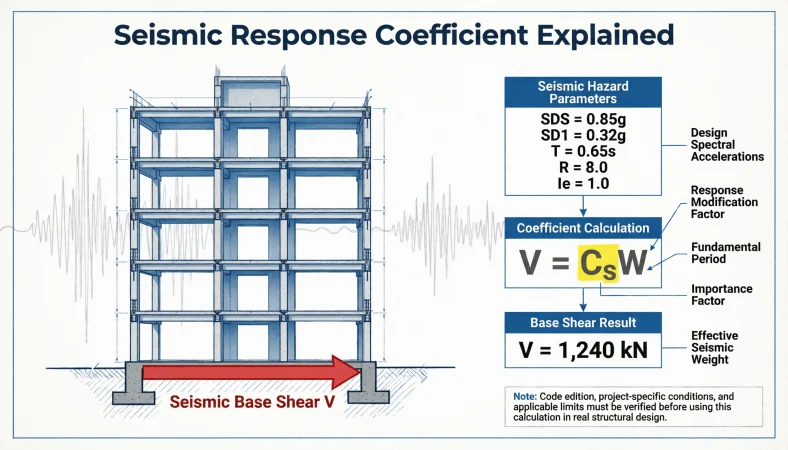
The seismic response coefficient, commonly written as Cs, is a dimensionless factor used in seismic design to calculate design base shear. Under ASCE 7 procedures, the base shear is calculated as V = CsW, where W is the effective seismic weight.
Top alternatives: seismic coefficient, seismic design coefficient, Cs seismic coefficient, seismic response factor, seismic base shear coefficient
A small number with a very big job: that is basically Cs.
Ever opened a structural design calculation and found seismic response coefficient sitting beside symbols like Cs, SDS, SD1, R, Ie, and T, then wondered if the equation was written specifically to test your patience? You are definitely not alone. The seismic response coefficient is one of those terms that looks intimidating at first but becomes much easier once each piece has a job.
In seismic design, Cs is used with the effective seismic weight to determine the design base shear. Under ASCE 7, the relationship is expressed as V = CsW. The coefficient depends on seismic demand, structural characteristics, importance, and the applicable design procedure.
Whether you are studying structural engineering, checking calculations at work, reviewing a building model, or simply trying to understand seismic design without drowning in equations, knowing what Cs means can make the whole topic feel much more manageable.
Seismic Response Coefficient In Simple Words
Cs is a seismic design coefficient.
Example: Use this when introducing seismic design calculations to a beginner.
Meaning: Cs represents a dimensionless factor used to determine design seismic force.
Cs helps convert seismic weight into base shear.
Example: Use this when explaining the basic purpose of the coefficient.
Meaning: The coefficient is multiplied by effective seismic weight to obtain base shear.
The basic relationship is V = CsW.
Example: Use this as the first equation in a seismic calculation.
Meaning: Base shear equals the seismic response coefficient multiplied by effective seismic weight.
Cs has no physical unit.
Example: Use this when checking dimensional consistency.
Meaning: Cs is dimensionless.
A larger Cs generally produces a larger calculated base shear when W stays constant.
Example: Use this when comparing two calculations.
Meaning: Base shear changes directly with Cs in the equation V = CsW.
Cs is not the building’s weight.
Example: Use this when distinguishing coefficient from load.
Meaning: W represents effective seismic weight, while Cs is the multiplier.
Cs is not the response modification factor.
Example: Use this when sorting out R and Cs.
Meaning: R is a separate structural system parameter.
Cs is not the importance factor.
Example: Use this when explaining Ie.
Meaning: Ie is an input used within seismic coefficient calculations.
Cs is not the building period.
Example: Use this when explaining T.
Meaning: T represents the structure’s fundamental period used in applicable equations.
Cs connects seismic demand with structural weight.
Example: Use this in a structural engineering summary.
Meaning: It helps translate seismic design parameters into a base-shear value.
Cs is commonly written with a lowercase s.
Example: Use this when reading engineering drawings or spreadsheets.
Meaning: The standard notation is Cs.
Think of Cs as the multiplier that turns seismic weight into design base shear.
Example: Use this as a memory trick before an exam.
Meaning: The analogy captures its role in V = CsW.
Seismic Response Coefficient Formula
Cs = SDS / (R/Ie) is a commonly used ASCE 7 expression.
Example: Use this when reviewing the basic equivalent lateral force calculation.
Meaning: The coefficient depends on SDS, R, and Ie.
Cs can also be written as SDSIe/R.
Example: Use this when simplifying the algebra.
Meaning: Dividing by R/Ie is equivalent to multiplying by Ie/R.
SDS represents design spectral response acceleration at short periods.
Example: Use this when identifying the first major input.
Meaning: SDS represents the short-period design spectral acceleration parameter.
R represents the response modification factor.
Example: Use this when identifying the structural system parameter.
Meaning: R accounts for the selected seismic force-resisting system according to the applicable code table.
Ie represents the seismic importance factor.
Example: Use this when identifying the occupancy-related parameter.
Meaning: Ie reflects the importance category assigned to the structure.
The formula produces a dimensionless Cs value.
Example: Use this when checking your calculation units.
Meaning: The acceleration units cancel appropriately in the coefficient relationship.
Cs is not always determined from one formula alone.
Example: Use this when explaining code limits.
Meaning: Upper and lower limits can affect the final coefficient.
The fundamental period T can influence the applicable upper limit.
Example: Use this when calculating a building’s design coefficient.
Meaning: Period-dependent equations can control the final Cs value.
SD1 is used in period-dependent limits.
Example: Use this when reviewing the long-period portion of the calculation.
Meaning: SD1 is the design spectral response acceleration parameter at one second.
TL is the long-period transition period.
Example: Use this when identifying the boundary between period-dependent expressions.
Meaning: TL separates applicable long-period regions of the design spectrum.
A final Cs value must follow the governing provisions of the adopted code.
Example: Use this when checking a real project.
Meaning: The applicable code version and project conditions determine which limits and equations apply.
Never calculate Cs from a remembered formula without checking the applicable code edition.
Example: Use this before finalizing structural calculations.
Meaning: Seismic provisions can differ between code editions and design procedures.
Seismic Response Coefficient And Base Shear
Base shear is commonly calculated as V = CsW.
Example: Use this when starting an equivalent lateral force calculation.
Meaning: Cs multiplies effective seismic weight to determine total design base shear.
V represents seismic base shear.
Example: Use this when labeling a calculation sheet.
Meaning: V is the total horizontal seismic design force at the base.
W represents effective seismic weight.
Example: Use this when identifying the second input in the equation.
Meaning: W is the effective seismic weight used by the applicable seismic procedure.
If W doubles while Cs stays constant, V doubles.
Example: Use this for a quick proportionality check.
Meaning: Base shear is directly proportional to effective seismic weight.
If Cs increases while W stays constant, V increases.
Example: Use this when comparing design scenarios.
Meaning: Base shear responds directly to the coefficient.
Cs and W work together.
Example: Use this when explaining why both numbers matter.
Meaning: Neither value alone determines the base shear.
A spreadsheet may calculate Cs before calculating V.
Example: Use this when organizing structural design worksheets.
Meaning: The coefficient is normally established before applying it to seismic weight.
The coefficient should be checked before accepting the base shear result.
Example: Use this during calculation review.
Meaning: An incorrect Cs can propagate directly into the calculated base shear.
Base shear is a force, while Cs is dimensionless.
Example: Use this when checking units.
Meaning: Multiplying dimensionless Cs by weight produces a force.
A small Cs can still create a substantial base shear for a heavy structure.
Example: Use this when explaining large buildings.
Meaning: W can be large enough that even a moderate coefficient produces significant force.
A large Cs does not automatically mean the structure is heavier.
Example: Use this when comparing different buildings.
Meaning: Cs and W represent different design characteristics.
V = CsW is one of the easiest seismic equations to remember.
Example: Use this as an exam revision shortcut.
Meaning: The equation directly links the coefficient and effective seismic weight.
Seismic Response Coefficient And SDS
SDS is one of the key inputs in Cs calculations.
Example: Use this when identifying seismic hazard parameters.
Meaning: SDS represents design spectral acceleration in the short-period range.
Higher SDS can increase Cs when other factors remain unchanged.
Example: Use this when comparing two sites with different seismic demand.
Meaning: SDS appears in the numerator of the basic expression.
SDS is expressed as an acceleration parameter.
Example: Use this when reviewing a seismic hazard table.
Meaning: SDS represents a design spectral acceleration value.
SDS is not the same as Cs.
Example: Use this when teaching seismic terminology.
Meaning: SDS is an input parameter, while Cs is a derived coefficient.
SDS relates to the design response spectrum.
Example: Use this when explaining where the parameter comes from.
Meaning: It represents a specific point or parameter of the design spectral acceleration framework.
Short-period behavior matters when determining SDS.
Example: Use this when discussing low-period structural response.
Meaning: SDS is specifically associated with the short-period portion of the design spectrum.
Changing SDS can change the resulting base shear.
Example: Use this when running alternative site scenarios.
Meaning: Cs changes when its governing seismic demand input changes.
SDS is not simply the peak ground acceleration.
Example: Use this when correcting terminology.
Meaning: SDS is a design spectral response parameter, not a generic replacement for PGA.
The source of SDS depends on the adopted seismic design standard.
Example: Use this when working across jurisdictions.
Meaning: Different standards can define hazard parameters differently.
The units of SDS should be handled consistently.
Example: Use this when checking spreadsheet inputs.
Meaning: Consistent units prevent calculation errors.
SDS should be documented in a seismic calculation.
Example: Use this when preparing engineering documentation.
Meaning: Recording the input makes the calculation easier to review.
Cs cannot be interpreted correctly without understanding SDS.
Example: Use this when studying seismic design.
Meaning: SDS is one of the principal quantities controlling the coefficient.
Seismic Response Coefficient And SD1
SD1 represents design spectral response acceleration at a one-second period.
Example: Use this when explaining period-dependent Cs limits.
Meaning: SD1 is the one-second design spectral acceleration parameter.
SD1 appears in the period-dependent Cs expressions.
Example: Use this when reviewing an ASCE 7 calculation.
Meaning: SD1 helps establish the coefficient for structures in applicable period ranges.
SD1 is different from SDS.
Example: Use this when comparing spectral parameters.
Meaning: SDS is associated with short periods, while SD1 corresponds to one-second response.
The building period T interacts with SD1.
Example: Use this when explaining why structural period matters.
Meaning: Period-dependent equations use SD1 together with T.
A longer period can change the governing Cs expression.
Example: Use this when reviewing the design spectrum.
Meaning: Different period regions use different coefficient relationships.
SD1 should be taken from the applicable design procedure.
Example: Use this when preparing seismic input data.
Meaning: The adopted standard determines how SD1 is established.
SD1 is not the seismic response coefficient itself.
Example: Use this when separating input and output variables.
Meaning: SD1 is a spectral parameter used to calculate Cs.
The one-second reference is important in seismic design.
Example: Use this when studying response spectra.
Meaning: One-second spectral response is a key point used in code-based calculations.
SD1 can become important for taller or longer-period structures.
Example: Use this when discussing period effects.
Meaning: Long-period behavior can make SD1-based expressions relevant.
A calculation sheet should clearly label SD1.
Example: Use this when preparing engineering documentation.
Meaning: Clear labels prevent confusion between spectral parameters.
Do not substitute SDS for SD1.
Example: Use this when checking a spreadsheet.
Meaning: They represent different spectral acceleration parameters.
Understanding SDS and SD1 makes Cs formulas much easier to follow.
Example: Use this when studying seismic design.
Meaning: These two parameters explain much of the structure of the equations.
Seismic Response Coefficient And Response Modification Factor
R is the response modification factor.
Example: Use this when identifying structural system inputs.
Meaning: R is assigned according to the applicable seismic force-resisting system provisions.
R appears in the denominator of the basic Cs expression.
Example: Use this when explaining the formula.
Meaning: Increasing R reduces the calculated coefficient when other inputs remain unchanged.
R is not the same as Cs.
Example: Use this when teaching structural design notation.
Meaning: R is an input, while Cs is the resulting seismic response coefficient.
Different structural systems can have different R values.
Example: Use this when comparing seismic force-resisting systems.
Meaning: The applicable code assigns system-specific response modification factors.
R reflects the design philosophy for the structural system.
Example: Use this when explaining why R exists.
Meaning: It is part of the code framework used to represent structural response characteristics.
A larger R can reduce calculated design forces under the applicable procedure.
Example: Use this when explaining the algebra of Cs.
Meaning: R divides the seismic demand term.
R should never be selected casually.
Example: Use this when reviewing a structural model.
Meaning: The correct value depends on the permitted structural system and code requirements.
The structural material can affect the applicable R system classification.
Example: Use this when discussing steel and concrete systems.
Meaning: Code tables classify seismic force-resisting systems by structural characteristics.
The selected R must match the actual seismic force-resisting system.
Example: Use this during design review.
Meaning: The coefficient is tied to the system being designed.
R is found in the applicable code table.
Example: Use this when preparing a calculation.
Meaning: It is not normally chosen from an arbitrary engineering preference.
Changing R changes Cs.
Example: Use this when performing a sensitivity check.
Meaning: R directly affects the coefficient.
Cs should always be reviewed alongside R.
Example: Use this during peer review.
Meaning: An unexpected Cs value may result from an incorrect R selection.
Seismic Response Coefficient And Importance Factor
Ie is the seismic importance factor.
Example: Use this when explaining occupancy-related seismic parameters.
Meaning: Ie reflects the importance assigned to the structure under the applicable code.
Ie appears in the numerator when Cs is written as SDSIe/R.
Example: Use this when simplifying the equation.
Meaning: The algebraic form makes its relationship with Cs clear.
Ie is different from R.
Example: Use this when comparing code variables.
Meaning: Ie relates to structural importance, while R relates to the response modification system.
Higher importance can affect the calculated coefficient.
Example: Use this when explaining the role of Ie.
Meaning: Ie directly influences Cs in the applicable equations.
Ie is selected according to the applicable risk or occupancy classification.
Example: Use this when assigning project parameters.
Meaning: The building’s classification determines the applicable importance factor.
Ie should not be guessed.
Example: Use this during calculation preparation.
Meaning: It must follow the adopted code’s classification provisions.
The importance factor helps distinguish structures with different consequences of failure.
Example: Use this when explaining why the parameter exists.
Meaning: Code design procedures assign importance categories to account for different building functions.
Ie can affect base shear through Cs.
Example: Use this when explaining the calculation chain.
Meaning: Changes in Ie can change Cs and therefore V.
Ie is dimensionless.
Example: Use this when checking units.
Meaning: The importance factor is a numerical multiplier.
Ie should be documented with the seismic design assumptions.
Example: Use this when preparing project calculations.
Meaning: Documentation makes the design basis transparent.
Do not confuse Ie with building occupancy load.
Example: Use this when explaining terminology.
Meaning: Ie is a seismic design factor, not a physical floor load.
The correct Ie depends on the applicable standard.
Example: Use this when comparing jurisdictions.
Meaning: Seismic importance classifications can vary by code.
Seismic Response Coefficient And Building Period
T represents the fundamental period of the structure.
Example: Use this when explaining period-dependent Cs equations.
Meaning: T describes the structure’s fundamental vibration period.
T can affect the seismic response coefficient.
Example: Use this when explaining why building dynamics matter.
Meaning: Period-dependent expressions use T directly.
A structure’s period is not the same as its height.
Example: Use this when teaching structural dynamics.
Meaning: Height influences period but does not equal period.
The period is measured in units of time.
Example: Use this when checking calculations.
Meaning: T is commonly expressed in seconds.
Longer-period structures can fall into different response-spectrum regions.
Example: Use this when explaining seismic behavior.
Meaning: The applicable design equation changes with spectral region.
The period can influence whether an upper Cs limit governs.
Example: Use this when reviewing equivalent lateral force calculations.
Meaning: Code equations can impose period-dependent limits.
Approximate period equations may be used under applicable code provisions.
Example: Use this when estimating T during preliminary design.
Meaning: Codes provide procedures for estimating or limiting structural period.
Calculated period and approximate period are not always identical.
Example: Use this when comparing analysis results.
Meaning: Code procedures can establish limits or alternative period values.
T should be documented in the seismic calculation.
Example: Use this when preparing design notes.
Meaning: The period can affect the governing coefficient equation.
Period selection can affect design base shear.
Example: Use this when reviewing a structural model.
Meaning: Changes in T can change the applicable Cs value.
The applicable code controls how T is determined.
Example: Use this when working on a real project.
Meaning: Period calculation requirements vary by design standard.
T is one of the reasons seismic design is more than a simple weight calculation.
Example: Use this when explaining dynamic behavior.
Meaning: Structural response depends on dynamic characteristics as well as mass.
Seismic Response Coefficient Calculation Example
Suppose SDS = 1.00, R = 5, and Ie = 1.00.
Example: Use this as a simplified classroom example.
Meaning: These hypothetical values create an easy demonstration.
The basic coefficient would be Cs = 1.00/(5/1.00).
Example: Use this when demonstrating substitution into the formula.
Meaning: The variables are inserted directly into the basic expression.
The simplified result is Cs = 0.20.
Example: Use this as the result of the hypothetical calculation.
Meaning: The coefficient is 0.20 before checking any applicable limits.
If W = 1,000 kN, V would be 200 kN.
Example: Use this to connect Cs to base shear.
Meaning: V = 0.20 × 1,000 kN = 200 kN.
This example is illustrative rather than a project design.
Example: Use this when teaching the equation.
Meaning: Real calculations require project-specific seismic inputs and code checks.
A real calculation must check applicable upper limits.
Example: Use this before using the result in design.
Meaning: The initial coefficient may not govern the final design value.
A real calculation must check applicable minimum limits.
Example: Use this when reviewing the final Cs.
Meaning: Code provisions can establish lower bounds.
The effective seismic weight must also be established correctly.
Example: Use this when moving from Cs to base shear.
Meaning: An accurate coefficient cannot compensate for an incorrect W.
The structural system must support the selected R value.
Example: Use this when checking the input assumptions.
Meaning: R is linked to the permitted seismic force-resisting system.
The building’s importance classification must support Ie.
Example: Use this during design review.
Meaning: Ie comes from the applicable classification provisions.
The final design coefficient is the governing value after code checks.
Example: Use this when documenting a calculation.
Meaning: Initial formula results are not always the final design coefficient.
Always show the calculation trail.
Example: Use this in professional engineering documentation.
Meaning: A transparent calculation makes checking much easier.
Seismic Response Coefficient Minimum And Maximum Limits
Cs may be subject to an upper limit.
Example: Use this when reviewing an ASCE 7 calculation.
Meaning: The initial coefficient may need to be reduced to a permitted maximum.
Cs may also be subject to a minimum limit.
Example: Use this when checking a low coefficient result.
Meaning: Code provisions can prevent the design coefficient from becoming too small.
The basic SDS expression is not always the final answer.
Example: Use this when teaching seismic calculations.
Meaning: Additional code checks can control the final coefficient.
The period-dependent upper expression uses SD1 and T.
Example: Use this when reviewing the code equations.
Meaning: Longitudinal spectral behavior can limit Cs.
For T ≤ TL, an SD1-based expression can govern.
Example: Use this when explaining period regions.
Meaning: The applicable equation depends on the relationship between T and TL.
For T > TL, the applicable expression changes.
Example: Use this when discussing long-period structures.
Meaning: The long-period transition affects the governing equation.
The minimum expression can include SDS and Ie.
Example: Use this when checking a lower-bound condition.
Meaning: The code establishes a minimum coefficient relationship.
Some high-seismic-demand conditions have an additional minimum requirement.
Example: Use this when reviewing S1-related provisions.
Meaning: Additional lower-bound provisions can apply when the relevant S1 condition is met.
The final Cs is a governed value, not simply a raw formula output.
Example: Use this as a calculation reminder.
Meaning: Code limits must be considered before accepting the result.
Code edition matters when checking Cs limits.
Example: Use this when reviewing older engineering examples.
Meaning: Provisions and equation numbering can differ between editions.
Do not copy a minimum formula from an unrelated code edition.
Example: Use this when adapting old spreadsheets.
Meaning: Seismic provisions must match the adopted standard.
The governing limit should be documented.
Example: Use this in a calculation package.
Meaning: Reviewers should be able to see why the final coefficient was selected.
Seismic Response Coefficient And ASCE 7
ASCE 7 uses Cs in the equivalent lateral force procedure.
Example: Use this when studying U.S. seismic design.
Meaning: Cs is part of the code’s seismic base-shear framework.
ASCE 7 expresses base shear as V = CsW.
Example: Use this when reviewing Section 12.8 concepts.
Meaning: The coefficient is directly tied to seismic weight.
ASCE 7 identifies Cs as the seismic response coefficient.
Example: Use this when reading code terminology.
Meaning: Cs is the standard notation for this design coefficient.
ASCE 7 connects Cs with SDS, R, Ie, and T.
Example: Use this when mapping the variables in a calculation.
Meaning: These parameters collectively influence the seismic design coefficient.
ASCE 7 provides period-dependent limits for Cs.
Example: Use this when reviewing equivalent lateral force calculations.
Meaning: The coefficient can be limited using SD1, T, and TL.
ASCE 7 also provides minimum Cs provisions.
Example: Use this when checking the lower bound.
Meaning: The design coefficient cannot simply be reduced without considering code requirements.
ASCE 7 uses R from the applicable structural system table.
Example: Use this when selecting the response modification factor.
Meaning: R depends on the seismic force-resisting system.
ASCE 7 uses Ie according to the structure’s importance classification.
Example: Use this when assigning occupancy-related seismic parameters.
Meaning: Ie reflects the applicable importance category.
The ASCE 7 edition should be stated in project documents.
Example: Use this when preparing a calculation package.
Meaning: Seismic equations and provisions depend on the adopted edition.
Software can automate portions of ASCE 7 Cs calculations.
Example: Use this when discussing structural analysis programs.
Meaning: Engineering software can calculate code-based parameters from entered inputs.
Software output still requires engineering review.
Example: Use this when checking automated seismic results.
Meaning: Correct inputs and applicable code provisions remain essential.
ASCE 7 Cs calculations should be traceable.
Example: Use this during peer review.
Meaning: Each input and governing equation should be identifiable.
Seismic Response Coefficient In Structural Engineering
Cs is a structural engineering design parameter.
Example: Use this when introducing seismic load calculations.
Meaning: It forms part of the process for determining design seismic forces.
Structural engineers use Cs to establish seismic base shear.
Example: Use this when describing a design workflow.
Meaning: Cs is multiplied by effective seismic weight.
Cs connects structural dynamics with lateral force design.
Example: Use this when explaining the bigger picture.
Meaning: It incorporates seismic demand and structural characteristics into force calculations.
The coefficient can influence member design forces.
Example: Use this when explaining load paths.
Meaning: Base shear is distributed through the structure and influences design actions.
Cs can affect foundation seismic forces.
Example: Use this when discussing load transfer.
Meaning: Base shear ultimately contributes to lateral forces transmitted through the structural system.
Cs can affect story force calculations.
Example: Use this when discussing vertical force distribution.
Meaning: Total base shear is distributed through the building according to the applicable procedure.
Cs is relevant to lateral load design.
Example: Use this when explaining seismic load paths.
Meaning: It helps establish the total horizontal design force.
Cs should be coordinated with the structural system.
Example: Use this when reviewing a design model.
Meaning: R and other parameters must correspond to the actual system.
Seismic calculations should be checked independently when possible.
Example: Use this during quality control.
Meaning: Independent verification can catch input or formula mistakes.
A suspicious Cs value deserves investigation.
Example: Use this when a spreadsheet produces an unexpected result.
Meaning: Unusual values can indicate incorrect inputs, limits, or code assumptions.
Engineering judgment still matters around code calculations.
Example: Use this when explaining automated design.
Meaning: Codes provide procedures, while engineers must correctly apply them to the project.
Cs is one number within a much larger seismic design process.
Example: Use this when teaching beginners.
Meaning: Seismic design includes hazard, dynamics, systems, loads, detailing, and other checks.
Seismic Response Coefficient For Different Buildings
A building’s seismic coefficient depends on its design inputs.
Example: Use this when comparing two projects.
Meaning: Cs is not a universal constant for every building.
Two buildings in different locations can have different Cs values.
Example: Use this when explaining seismic hazard differences.
Meaning: Site-specific seismic demand can change the coefficient.
Two buildings on different structural systems can have different Cs values.
Example: Use this when comparing seismic force-resisting systems.
Meaning: R can differ between systems.
Two buildings with different importance categories can have different Cs values.
Example: Use this when explaining Ie.
Meaning: Importance classification can affect the coefficient.
Two buildings with different periods can have different governing Cs values.
Example: Use this when comparing short and long structures.
Meaning: Period-dependent limits can change the result.
A tall building does not automatically have a larger Cs.
Example: Use this when correcting an oversimplification.
Meaning: Cs depends on several seismic and structural variables.
A heavier building does not automatically have a larger Cs.
Example: Use this when comparing building weights.
Meaning: Weight primarily affects V through W.
A high seismic zone does not automatically produce one universal Cs.
Example: Use this when explaining site-specific design.
Meaning: Structural and code parameters also influence the result.
Building use can affect the importance factor.
Example: Use this when discussing occupancy classification.
Meaning: Structure classification can influence Ie.
Structural system selection can affect R.
Example: Use this when comparing frames and walls.
Meaning: The applicable response modification factor depends on the system.
Period characteristics can affect the governing expression.
Example: Use this when discussing dynamic response.
Meaning: T interacts with the design spectrum.
The final Cs should be project-specific.
Example: Use this when preparing a design report.
Meaning: A copied coefficient from another building may not apply.
Seismic Response Coefficient And Equivalent Lateral Force
Cs is central to the equivalent lateral force procedure.
Example: Use this when studying simplified seismic analysis.
Meaning: The coefficient helps determine total design base shear.
The equivalent lateral force procedure begins with seismic design parameters.
Example: Use this when explaining the workflow.
Meaning: Hazard and structural inputs are established before calculating force.
Cs is then used to calculate base shear.
Example: Use this when outlining the calculation sequence.
Meaning: V is calculated using CsW.
Base shear is then distributed over the building.
Example: Use this when moving from total force to story forces.
Meaning: The total lateral force is allocated to levels according to the applicable code procedure.
Story weights influence force distribution.
Example: Use this when explaining lateral force allocation.
Meaning: Effective weight at each level contributes to the distribution.
Story height can influence force distribution.
Example: Use this when explaining why upper floors may receive significant lateral force.
Meaning: Code distribution equations use floor elevation.
The coefficient itself is only one stage of the process.
Example: Use this when teaching seismic analysis.
Meaning: Base shear calculation continues into vertical distribution and structural response.
Equivalent lateral force analysis is a code-based procedure.
Example: Use this when explaining simplified seismic analysis.
Meaning: Its assumptions and equations come from the adopted standard.
Not every structure can be treated identically with simplified procedures.
Example: Use this when discussing irregular buildings.
Meaning: Applicability depends on code requirements and structural characteristics.
Dynamic analysis may be required in some situations.
Example: Use this when discussing alternative seismic procedures.
Meaning: Certain buildings require or permit more detailed analytical approaches.
Cs remains useful even when the overall seismic workflow becomes more advanced.
Example: Use this when comparing analysis methods.
Meaning: The coefficient remains a familiar concept within code-based seismic design.
Always confirm the permitted procedure before starting calculations.
Example: Use this when beginning a real project.
Meaning: The applicable code determines which seismic analysis method is permitted.
Seismic Response Coefficient Common Mistakes
Using the wrong R value is a common calculation problem.
Example: Use this when reviewing a structural spreadsheet.
Meaning: R must correspond to the permitted seismic force-resisting system.
Using the wrong importance factor can change Cs.
Example: Use this when checking occupancy assumptions.
Meaning: Ie directly influences the coefficient.
Forgetting the period-dependent limit can produce an incorrect result.
Example: Use this during calculation review.
Meaning: The initial coefficient must be checked against applicable limits.
Ignoring the minimum coefficient provisions can also create an error.
Example: Use this when checking unusually small Cs values.
Meaning: Code minimums can control the final value.
Mixing code editions can create inconsistent calculations.
Example: Use this when updating an old spreadsheet.
Meaning: Equations and provisions should come from one applicable design basis.
Confusing SDS with SD1 is a common notation mistake.
Example: Use this when checking seismic spectral inputs.
Meaning: They represent different design spectral parameters.
Confusing R with Ie is another common mistake.
Example: Use this when reviewing a formula.
Meaning: R and Ie have different structural design roles.
Treating Cs as a percentage can cause confusion.
Example: Use this when explaining a value such as 0.20.
Meaning: Cs is dimensionless, although it may be interpreted as a numerical ratio.
Rounding too early can affect calculations.
Example: Use this when working through several calculation stages.
Meaning: Premature rounding can slightly change the final result.
Copying a coefficient from another building can be misleading.
Example: Use this when reviewing old project files.
Meaning: Cs depends on project-specific inputs.
Ignoring software assumptions can create hidden errors.
Example: Use this when checking automated seismic analysis.
Meaning: Software may apply defaults that need verification.
A final Cs value should always be traceable to its inputs.
Example: Use this during engineering quality control.
Meaning: Traceability makes mistakes easier to identify.
Seismic Response Coefficient Calculation Tips
Write the governing code edition at the top of the calculation.
Example: Use this when preparing a professional calculation sheet.
Meaning: It establishes the design basis.
List SDS before calculating Cs.
Example: Use this when organizing input parameters.
Meaning: SDS is a principal seismic demand input.
List SD1 when period-dependent checks are required.
Example: Use this when preparing an ASCE-style calculation.
Meaning: SD1 can control period-dependent coefficient limits.
Document R clearly.
Example: Use this when reviewing the structural system.
Meaning: The reviewer needs to know which response modification factor was used.
Document Ie clearly.
Example: Use this when preparing a seismic calculation package.
Meaning: The importance factor affects the coefficient.
Document T when it affects the calculation.
Example: Use this when checking period-dependent equations.
Meaning: Structural period can influence the governing Cs expression.
Check TL when applicable.
Example: Use this when determining the correct period region.
Meaning: TL separates different portions of the response spectrum.
Calculate the preliminary Cs first.
Example: Use this when following the equation sequence.
Meaning: The initial coefficient provides a starting value before limits.
Check upper bounds next.
Example: Use this during code verification.
Meaning: The preliminary value may exceed a permitted maximum.
Check minimum bounds afterward.
Example: Use this when finalizing Cs.
Meaning: The preliminary result may need to be increased to satisfy a minimum.
Calculate V only after establishing the governing Cs.
Example: Use this when completing the base shear calculation.
Meaning: V depends directly on the final coefficient.
Keep the calculation easy to audit.
Example: Use this when submitting engineering documentation.
Meaning: Clear steps make technical review faster and safer.
Seismic Response Coefficient In A Spreadsheet
Put each seismic parameter in its own cell.
Example: Use this when creating a structural design worksheet.
Meaning: Separate inputs make calculations easier to audit.
Label SDS clearly.
Example: Use this when organizing seismic hazard data.
Meaning: Clear labels reduce parameter mix-ups.
Label SD1 separately from SDS.
Example: Use this when building a code calculation spreadsheet.
Meaning: Similar names can otherwise create accidental substitutions.
Keep R and Ie in separate cells.
Example: Use this when building the Cs formula.
Meaning: Both factors have distinct roles.
Put T in a dedicated input cell.
Example: Use this when calculating period-dependent limits.
Meaning: T can affect the governing expression.
Calculate preliminary Cs in a visible step.
Example: Use this when making a review-friendly worksheet.
Meaning: Reviewers can see how the initial value was obtained.
Calculate each applicable limit separately.
Example: Use this when creating a robust seismic spreadsheet.
Meaning: Separate checks make the governing value obvious.
Highlight the governing Cs calculation.
Example: Use this when preparing a professional worksheet.
Meaning: The final controlling result becomes easier to identify.
Calculate V from the governing Cs.
Example: Use this after completing coefficient checks.
Meaning: Base shear follows from V = CsW.
Avoid hiding formulas behind unexplained macros.
Example: Use this when preparing a shareable calculation file.
Meaning: Transparent formulas make engineering review easier.
Protect formulas while leaving inputs editable.
Example: Use this when creating a reusable spreadsheet.
Meaning: This reduces accidental changes to calculation logic.
Add a notes column for code assumptions.
Example: Use this when documenting R, Ie, and other parameters.
Meaning: Notes preserve the reasoning behind each input.
Seismic Response Coefficient And Structural Safety
Cs contributes to the calculation of design seismic force.
Example: Use this when explaining why the coefficient matters.
Meaning: It influences the base shear used in seismic design.
Accurate seismic inputs are essential.
Example: Use this when reviewing a structural calculation.
Meaning: Errors in seismic parameters can affect calculated forces.
The coefficient should be calculated under the applicable building code.
Example: Use this for project-specific design work.
Meaning: Seismic design requirements depend on the governing standard.
Structural safety involves more than Cs.
Example: Use this when explaining the complete design process.
Meaning: Member design, connections, detailing, drift, foundations, and other checks also matter.
A correct Cs value does not guarantee a complete seismic design.
Example: Use this when explaining code compliance.
Meaning: Cs is only one component of seismic analysis.
Load paths must be considered after base shear is calculated.
Example: Use this when explaining structural behavior.
Meaning: Seismic force must transfer through the structural system.
Connections are part of the seismic load path.
Example: Use this when discussing steel or concrete structures.
Meaning: Forces must travel through structural components and their connections.
Drift checks are separate from the basic Cs calculation.
Example: Use this when distinguishing force and displacement design.
Meaning: Cs establishes force demand while drift involves structural displacement.
Foundation design must account for applicable seismic forces.
Example: Use this when discussing the complete design workflow.
Meaning: Lateral forces ultimately reach the foundation system.
Irregular structures may require additional seismic considerations.
Example: Use this when discussing complex buildings.
Meaning: Regular equivalent-force assumptions may not cover every structural condition.
Professional review is valuable for important seismic calculations.
Example: Use this when preparing final structural documents.
Meaning: Independent checking can catch calculation and modeling errors.
Cs is important, but it is never the entire seismic story.
Example: Use this as a final safety reminder.
Meaning: Reliable seismic design requires a complete code-based process.
FAQs.
What is the seismic response coefficient?
The seismic response coefficient, written as Cs, is a dimensionless factor used in seismic design to calculate design base shear. Under the ASCE 7 equivalent lateral force procedure, base shear is expressed as V = CsW.
What is the basic seismic response coefficient formula?
A commonly used ASCE 7 expression is Cs = SDS / (R/Ie), which can also be written as Cs = SDSIe/R. The applicable code limits and conditions must also be checked.
What does Cs stand for in seismic design?
Cs stands for seismic response coefficient. It is a dimensionless quantity used to determine seismic base shear.
What does V = CsW mean?
It means that seismic base shear V is calculated by multiplying the seismic response coefficient Cs by the effective seismic weight W.
Is seismic response coefficient the same as seismic coefficient?
The terms are sometimes used broadly in seismic engineering, but Cs specifically refers to the seismic response coefficient in the referenced ASCE 7 terminology.
What is SDS in the seismic response coefficient formula?
SDS is the design spectral response acceleration parameter associated with the short-period range. It is one of the primary inputs used in the basic Cs calculation.
What is SD1?
SD1 is the design spectral response acceleration parameter at a one-second period. It appears in period-dependent Cs limits under ASCE 7 procedures.
What is R in the Cs formula?
R is the response modification factor associated with the applicable seismic force-resisting system. Its value comes from the relevant code provisions.
What is Ie in the Cs formula?
Ie is the seismic importance factor. It is associated with the structure’s importance classification under the applicable code.
Can Cs be greater than 1?
The answer depends on the applicable seismic design parameters and code provisions. The coefficient should be calculated and checked against all applicable upper and lower limits rather than assumed from a universal range.
Why does the seismic response coefficient matter?
Cs directly affects calculated base shear. If W remains constant, a change in Cs produces a proportional change in V because V = CsW.
Does building height determine Cs?
Not by itself. Building height can influence structural period and other design characteristics, but Cs depends on several seismic and structural parameters.
Does soil type affect Cs?
Soil and site conditions can affect seismic spectral parameters such as SDS and SD1, which can consequently influence Cs. The exact procedure depends on the adopted seismic code.
Is Cs the same for every building?
No. Cs can vary according to location, seismic hazard, structural system, importance classification, period, and other applicable design parameters.
Is seismic response coefficient used for earthquake-resistant design?
Yes. It is an important part of code-based seismic force calculations, particularly when determining equivalent lateral force base shear.
Conclusion
The seismic response coefficient may look like just another cryptic engineering abbreviation, but its role is straightforward once the pieces are separated. Cs helps turn effective seismic weight into design base shear through the relationship V = CsW. Its calculation can involve SDS, SD1, R, Ie, T, TL, and applicable minimum or maximum limits, depending on the adopted seismic design procedure.
The key is not memorizing one equation and calling it a day. Understand what every variable means, check the correct code edition, verify the governing limits, and document your assumptions. Save this guide for your next seismic calculation, share it with a fellow engineering student, and keep those formulas looking a little less intimidating.