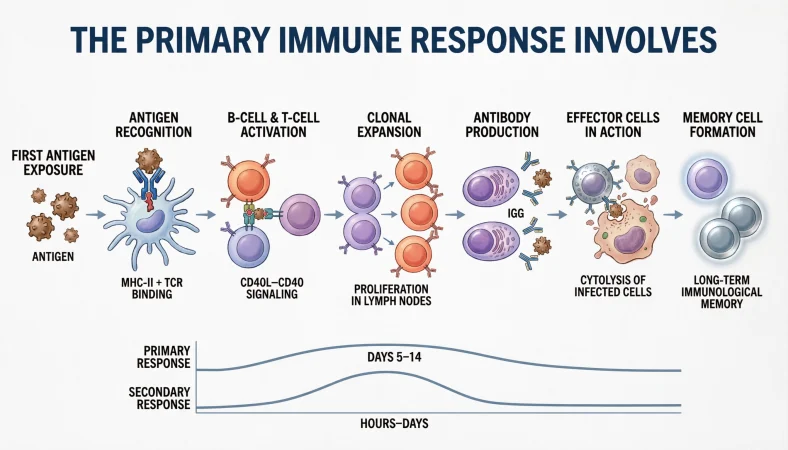
The primary immune response involves the first major immune reaction to a specific antigen. It typically includes antigen recognition, activation of lymphocytes, clonal expansion, antibody production, development of effector cells, and formation of memory cells.
Top alternatives: first immune response, primary immune reaction, first exposure immune response, primary antibody response, adaptive immune response
Ever wondered what actually happens the first time your immune system meets a new pathogen? The answer gets much easier once you break it into steps. The primary immune response involves a coordinated series of events that begins when the immune system encounters an unfamiliar antigen and ends with the development of immune protection and memory.
Whether you are revising for an exam, explaining biology to a friend, preparing study notes, or trying to make sense of an immunology diagram that looks like it was designed to test your patience, understanding the sequence matters.
Unlike the faster secondary response, the primary response takes time because the immune system has to recognise the antigen, activate suitable lymphocytes, multiply those cells, and produce an effective response. Here are clear, memorable ways to understand and explain what happens.
Simple Explanations Of The Primary Immune Response
“The primary immune response happens when the immune system meets an antigen for the first time.”
Example: Use this as a basic biology definition for revision notes.
Meaning: It describes the initial adaptive immune reaction to a particular antigen.
“The primary immune response starts with antigen recognition.”
Example: Use this when outlining the first stage of the response.
Meaning: Immune cells must recognise a specific foreign antigen before mounting a targeted response.
“The immune system activates specific lymphocytes during the primary response.”
Example: Use this in a beginner-friendly explanation.
Meaning: Antigen-specific B cells and T cells become activated.
“B cells can produce antibodies during the primary immune response.”
Example: Use this when discussing antibody-mediated immunity.
Meaning: Activated B cells can differentiate into plasma cells that secrete antibodies.
“T cells help coordinate or carry out cellular immune responses.”
Example: Use this when explaining the role of T lymphocytes.
Meaning: Different T-cell populations perform important functions in adaptive immunity.
“The response takes time because the immune system is building a targeted defence.”
Example: Use this to explain why first exposure is slower.
Meaning: Antigen-specific lymphocytes need activation and expansion before a strong response develops.
“Clonal expansion increases the number of antigen-specific lymphocytes.”
Example: Use this as a study definition.
Meaning: Activated lymphocytes multiply to create many cells capable of responding to the same antigen.
“The primary response creates immune memory.”
Example: Use this when explaining why later exposure can be faster.
Meaning: Some activated lymphocytes become long-lived memory cells.
“Antibody levels usually rise after the initial exposure.”
Example: Use this when describing the antibody response over time.
Meaning: Antibody production develops following activation of appropriate B cells.
“The primary response is generally slower than the secondary response.”
Example: Use this when comparing first and later exposures.
Meaning: The immune system has not yet established a pool of antigen-specific memory cells.
“The first encounter teaches the adaptive immune system what to recognise.”
Example: Use this as a memorable study phrase.
Meaning: Initial exposure leads to the development of antigen-specific memory.
“Primary immunity lays the groundwork for faster future protection.”
Example: Use this as a summary line before an exam.
Meaning: Memory cells produced during the first response support stronger later responses.
Professional Primary Immune Response Descriptions
“The primary immune response is the adaptive immune reaction following initial exposure to a specific antigen.”
Example: Use this in an academic biology explanation.
Meaning: It defines the response according to antigen exposure and adaptive immunity.
“Antigen recognition initiates activation of antigen-specific lymphocytes.”
Example: Use this in a formal immunology summary.
Meaning: Recognition triggers the cellular events required for adaptive immunity.
“Clonal expansion increases the population of antigen-specific B and T lymphocytes.”
Example: Use this when describing lymphocyte activation.
Meaning: Selected lymphocytes proliferate after recognising their relevant antigen.
“Activated B cells differentiate into antibody-secreting plasma cells and memory B cells.”
Example: Use this in an immunology study guide.
Meaning: B-cell activation produces immediate effector cells and longer-term memory cells.
“Activated T cells differentiate into functional effector and memory populations.”
Example: Use this when describing cellular immunity.
Meaning: T-cell activation generates cells that perform immediate and long-term immune functions.
“The primary response generally develops with a measurable delay after initial exposure.”
Example: Use this when explaining response kinetics.
Meaning: Several stages must occur before substantial adaptive immunity develops.
“Antibody production develops progressively during the primary response.”
Example: Use this when describing humoral immunity.
Meaning: Antibody concentrations increase as activated B cells produce antibodies.
“Memory lymphocytes persist after the primary immune response.”
Example: Use this when explaining immunological memory.
Meaning: Long-lived cells remain available for future encounters with the antigen.
“The primary response establishes antigen-specific immunological memory.”
Example: Use this in a formal exam answer.
Meaning: The first response creates the basis for a faster later reaction.
“Primary and secondary immune responses differ in speed and magnitude.”
Example: Use this when introducing a comparison.
Meaning: Secondary responses are generally faster and stronger because memory cells are present.
“The primary response involves both recognition and expansion of antigen-specific clones.”
Example: Use this in a professional summary.
Meaning: Specific lymphocytes must be selected and multiplied to generate an effective adaptive response.
“The primary response integrates cellular and humoral immune mechanisms.”
Example: Use this in an advanced biology explanation.
Meaning: B-cell and T-cell responses work through different but interconnected adaptive mechanisms.
Beginner-Friendly Primary Immune Response Study Lines
“First exposure means first response.”
Example: Use this as a quick revision reminder.
Meaning: The primary immune response occurs after the first encounter with a particular antigen.
“Recognise it, activate cells, multiply, respond, remember.”
Example: Use this as a simple sequence for memorisation.
Meaning: It summarises the major stages of adaptive immune activation.
“B cells make antibodies after activation.”
Example: Use this for basic immunology revision.
Meaning: Activated B cells can develop into plasma cells that secrete antibodies.
“T cells help the immune system organise its attack.”
Example: Use this as an introductory analogy.
Meaning: Helper T cells can coordinate immune responses, while other T cells have specialised functions.
“The first response needs more time.”
Example: Use this when comparing primary and secondary immunity.
Meaning: The immune system must generate antigen-specific effector and memory cells after initial exposure.
“Memory cells are created during the first response.”
Example: Use this as an exam reminder.
Meaning: Some activated lymphocytes become long-lived memory cells.
“Clonal expansion means making more copies of useful immune cells.”
Example: Use this when teaching the concept to a beginner.
Meaning: Antigen-specific lymphocytes multiply after activation.
“Antibodies are part of the targeted defence.”
Example: Use this when introducing humoral immunity.
Meaning: Antibodies recognise specific antigens and contribute to their removal or neutralisation.
“The immune system gets more prepared after the first encounter.”
Example: Use this as a simple memory concept.
Meaning: The primary response establishes immunological memory.
“The primary response is the immune system’s first big lesson.”
Example: Use this as a memorable study phrase.
Meaning: Initial exposure allows the adaptive immune system to develop antigen-specific memory.
“First exposure builds the foundation for future protection.”
Example: Use this in a biology presentation.
Meaning: Memory cells produced during the first response can support later immunity.
“Primary response equals first encounter plus immune memory.”
Example: Use this as a flashcard line.
Meaning: The defining features are initial antigen exposure and subsequent memory formation.
Funny Primary Immune Response Study Lines
“The immune system sees a new antigen and immediately opens a group project.”
Example: Use this as a humorous study caption.
Meaning: Multiple immune cells coordinate to produce an adaptive response.
“First exposure is basically the immune system doing its homework.”
Example: Use this when memorising primary versus secondary responses.
Meaning: The first response establishes information and memory for future encounters.
“B cells said, ‘Let me make some antibodies.’”
Example: Use this as a playful B-cell reminder.
Meaning: Activated B cells can differentiate into plasma cells that produce antibodies.
“The first response takes its time, because apparently immunity needs onboarding.”
Example: Use this as a funny exam revision line.
Meaning: The primary adaptive response develops more slowly than a secondary response.
“Clonal expansion is basically immune cells hitting copy and paste.”
Example: Use this when remembering lymphocyte proliferation.
Meaning: Activated antigen-specific lymphocytes multiply into larger populations.
“Memory cells are the immune system’s ‘I remember this guy’ department.”
Example: Use this as a memorable immunology joke.
Meaning: Memory cells retain antigen-specific information after the initial response.
“Antibodies have entered the chat.”
Example: Use this as a playful antibody caption.
Meaning: Antibody production is an important part of the humoral primary response.
“Primary response: loading…”
Example: Use this when explaining why first exposure is slower.
Meaning: The adaptive immune system needs time to activate and expand specific cells.
“Secondary response: already has the notes.”
Example: Use this when comparing immune responses.
Meaning: Memory cells allow a later response to develop more rapidly.
“Your immune system basically keeps receipts.”
Example: Use this as a memory-cell analogy.
Meaning: Immunological memory preserves information about previous antigen exposure.
“Antigen arrives, immune system starts assembling the squad.”
Example: Use this as a social-media study caption.
Meaning: Specific immune cells are activated and expanded after antigen recognition.
“Biology’s plot twist: the first encounter creates the advantage for the next one.”
Example: Use this as a fun revision line.
Meaning: Primary exposure produces memory cells that improve later responses.
Clever Primary Immune Response Comparisons
“Primary immunity is the first draft; immune memory helps improve the next response.”
Example: Use this when comparing first and later exposures.
Meaning: The initial response creates memory that supports future protection.
“The primary response builds the team before the next match.”
Example: Use this as a simple analogy for immunological memory.
Meaning: The first exposure generates antigen-specific effector and memory cells.
“The first encounter identifies the antigen; memory prepares for its return.”
Example: Use this as an exam-friendly comparison.
Meaning: Recognition during primary exposure is followed by memory-cell formation.
“Primary response is preparation plus action.”
Example: Use this as a short study phrase.
Meaning: The immune system must first activate specific cells before generating an effective response.
“Clonal expansion turns a small specific cell population into a larger response.”
Example: Use this when explaining lymphocyte proliferation.
Meaning: Activated clones multiply to increase the number of cells responding to an antigen.
“Memory cells are the long-term benefit of the first encounter.”
Example: Use this when explaining why primary immunity matters.
Meaning: Memory cells remain after the initial response and can respond during later exposure.
“The primary response is slower because specificity takes preparation.”
Example: Use this as a conceptual explanation.
Meaning: Antigen-specific lymphocytes need time to activate and proliferate.
“Antibodies are the measurable product of part of the humoral response.”
Example: Use this in an immunology discussion.
Meaning: Antibody concentrations can be monitored as part of the B-cell response.
“B cells specialise for antibody production, while T cells provide cellular functions.”
Example: Use this when distinguishing adaptive immune pathways.
Meaning: B and T lymphocytes perform different but complementary roles.
“Primary exposure creates both immediate defenders and future defenders.”
Example: Use this in an advanced study note.
Meaning: Effector cells handle the current response while memory cells support future immunity.
“Immune memory transforms experience into preparedness.”
Example: Use this as a memorable immunology line.
Meaning: Previous antigen exposure leaves behind cells capable of responding more efficiently later.
“The primary response is where immunological memory begins.”
Example: Use this as a concise exam statement.
Meaning: Memory lymphocytes are generated as part of the initial adaptive immune response.
Antibody-Focused Primary Immune Response Lines
“The primary antibody response begins after first exposure to an antigen.”
Example: Use this when introducing humoral immunity.
Meaning: Initial antigen exposure activates antigen-specific B cells.
“Antibody levels generally increase after B-cell activation.”
Example: Use this when explaining an antibody-response graph.
Meaning: Activated B cells produce plasma cells that secrete antibodies.
“IgM is commonly associated with the early primary antibody response.”
Example: Use this in a basic immunology study note.
Meaning: IgM is typically the first major antibody isotype produced in a primary response.
“IgG can become prominent as the primary response develops.”
Example: Use this when discussing antibody class switching.
Meaning: Activated B cells can undergo class switching and produce other antibody isotypes, including IgG.
“Plasma cells are responsible for antibody secretion.”
Example: Use this as a B-cell revision statement.
Meaning: Differentiated B cells called plasma cells produce and release antibodies.
“Memory B cells remain after the initial antibody response.”
Example: Use this when explaining long-term humoral memory.
Meaning: Memory B cells can contribute to faster responses during future exposure.
“Antibodies recognise specific antigenic structures.”
Example: Use this when explaining antibody specificity.
Meaning: Antibodies bind particular molecular features called epitopes.
“The antibody response is antigen-specific.”
Example: Use this in an exam answer.
Meaning: Antibodies generated during adaptive immunity are directed toward particular antigens.
“The primary antibody response usually develops more slowly than the secondary response.”
Example: Use this when comparing antibody graphs.
Meaning: Initial B-cell activation and expansion require time.
“Class switching can change the antibody isotype produced.”
Example: Use this in an advanced immunology note.
Meaning: Activated B cells can produce different antibody classes while retaining antigen specificity.
“Affinity maturation can improve antibody binding during an immune response.”
Example: Use this in an advanced study context.
Meaning: B-cell selection can favour antibodies with stronger binding to the relevant antigen.
“The primary response creates the foundation for a stronger secondary antibody response.”
Example: Use this as a final comparison statement.
Meaning: Memory B cells contribute to faster and often larger antibody responses upon later exposure.
T-Cell-Focused Primary Immune Response Lines
“The primary immune response involves activation of antigen-specific T cells.”
Example: Use this when describing cellular immunity.
Meaning: T cells recognise antigen through their specific receptors in the appropriate presentation context.
“Helper T cells can coordinate adaptive immune responses.”
Example: Use this in an immunology overview.
Meaning: Helper T cells release signals that influence other immune cells.
“Cytotoxic T cells can destroy infected target cells.”
Example: Use this when explaining cellular immune defence.
Meaning: Cytotoxic T cells directly kill certain infected or abnormal cells.
“Antigen presentation helps activate appropriate T cells.”
Example: Use this when describing T-cell recognition.
Meaning: Antigen-presenting cells display antigen-derived peptides to T cells.
“Activated T cells undergo clonal expansion.”
Example: Use this in an exam revision answer.
Meaning: Antigen-specific T cells multiply after activation.
“Some activated T cells become memory T cells.”
Example: Use this when explaining long-term cellular immunity.
Meaning: Memory T cells persist after the initial response.
“T-cell responses can support B-cell activation.”
Example: Use this when explaining immune cooperation.
Meaning: Certain helper T cells provide signals needed for effective B-cell responses.
“The primary T-cell response develops after initial antigen recognition.”
Example: Use this as a simple definition.
Meaning: T-cell activation follows recognition of appropriately presented antigen.
“Cellular immunity is an important part of adaptive immunity.”
Example: Use this when contrasting T-cell and antibody responses.
Meaning: T cells provide immune functions that complement antibody-mediated defence.
“Memory T cells help the body respond to familiar antigens later.”
Example: Use this when comparing primary and secondary immunity.
Meaning: Persistent memory T cells can support a faster later response.
“The first exposure establishes antigen-specific T-cell memory.”
Example: Use this as a study line.
Meaning: The primary response leaves behind memory T cells.
“T cells add coordination and direct cellular action to the primary response.”
Example: Use this as a concise summary.
Meaning: T-cell populations can coordinate immunity and directly eliminate certain target cells.
Exam-Friendly Primary Immune Response Answers
“The primary immune response occurs following first exposure to an antigen.”
Example: Use this as the opening sentence of a short exam answer.
Meaning: It identifies the defining feature of the primary response.
“Antigen recognition activates specific B and T lymphocytes.”
Example: Use this when explaining the initiation stage.
Meaning: Recognition leads to activation of antigen-specific adaptive immune cells.
“Activated lymphocytes undergo clonal expansion.”
Example: Use this as a key marking-point statement.
Meaning: Specific lymphocytes proliferate to increase the size of the immune response.
“B cells differentiate into plasma cells and memory B cells.”
Example: Use this in a question about humoral immunity.
Meaning: B-cell activation produces antibody-secreting and memory populations.
“Plasma cells produce antigen-specific antibodies.”
Example: Use this when discussing antibody production.
Meaning: Plasma cells are specialised for antibody secretion.
“Activated T cells form effector and memory populations.”
Example: Use this when discussing cellular immunity.
Meaning: T-cell activation produces cells for immediate function and future protection.
“The primary response has a relatively long lag period.”
Example: Use this when interpreting an antibody-response graph.
Meaning: Time is required for activation, expansion, differentiation, and antibody production.
“Antibody concentration rises during the primary response.”
Example: Use this when explaining response kinetics.
Meaning: Increasing numbers of plasma cells contribute to increasing antibody levels.
“Memory cells persist after the primary response.”
Example: Use this as a key exam point.
Meaning: Long-lived memory cells remain available for future encounters.
“The secondary response is generally faster because memory cells already exist.”
Example: Use this when asked to compare primary and secondary immunity.
Meaning: Previous exposure leaves behind antigen-specific memory.
“The primary response produces both effector cells and memory cells.”
Example: Use this as a concise final point.
Meaning: The response handles the present antigen while preparing for future exposure.
“Primary immunity establishes the basis of adaptive immunological memory.”
Example: Use this as a strong concluding sentence.
Meaning: Initial exposure creates lasting antigen-specific immune memory.
Chill And Casual Primary Immune Response Explanations
“Basically, the first time your immune system meets an antigen, it has to figure out the response.”
Example: Use this when explaining primary immunity casually.
Meaning: Initial exposure requires recognition and activation of specific immune cells.
“First encounter means slower setup.”
Example: Use this when comparing primary and secondary responses.
Meaning: The first adaptive response needs time to develop.
“The immune system spots the antigen, activates the right cells, and gets moving.”
Example: Use this as a simple overview.
Meaning: Antigen recognition leads to activation and expansion of specific lymphocytes.
“B cells can make antibodies once they are properly activated.”
Example: Use this when explaining humoral immunity informally.
Meaning: Activated B cells can become antibody-producing plasma cells.
“T cells bring their own specialised skills to the response.”
Example: Use this when introducing T-cell functions.
Meaning: Different T-cell types coordinate immunity or destroy target cells.
“The first response takes longer because the immune system is starting from scratch.”
Example: Use this as a casual analogy.
Meaning: There are initially fewer antigen-specific effector and memory cells.
“Memory cells are basically the immune system remembering the assignment.”
Example: Use this as a playful study line.
Meaning: Memory cells preserve antigen-specific information.
“Clonal expansion means the useful immune cells multiply.”
Example: Use this when explaining a difficult term simply.
Meaning: Activated antigen-specific lymphocytes increase in number.
“Antibodies are one of the main products of B-cell activation.”
Example: Use this in a casual study discussion.
Meaning: Plasma cells derived from B cells secrete antibodies.
“Primary response first, faster response later.”
Example: Use this as a quick memory trick.
Meaning: The first exposure establishes memory that supports later responses.
“The immune system basically saves the useful information.”
Example: Use this as a memory-cell analogy.
Meaning: Immunological memory remains after the initial response.
“The whole point is recognition now and better readiness later.”
Example: Use this as a casual summary.
Meaning: The primary response deals with the current antigen and establishes future immune memory.
Smart Primary Immune Response Phrases
“The primary immune response converts first exposure into immunological memory.”
Example: Use this as an advanced revision statement.
Meaning: Initial antigen exposure leads to persistent antigen-specific memory.
“Specificity is the defining strength of adaptive immunity.”
Example: Use this when discussing why lymphocyte selection matters.
Meaning: Adaptive immune cells target particular antigens through specific receptors.
“Clonal selection precedes clonal expansion.”
Example: Use this as a concise immunology study phrase.
Meaning: Antigen recognition selects appropriate lymphocytes, which then proliferate.
“Effector cells handle the immediate response, while memory cells support future protection.”
Example: Use this in an advanced explanation.
Meaning: Different lymphocyte populations serve short-term and long-term functions.
“The primary response is slower but foundational.”
Example: Use this when comparing immune response kinetics.
Meaning: Although initial immunity develops more slowly, it establishes memory.
“Antigen recognition determines which lymphocyte clones respond.”
Example: Use this when explaining specificity.
Meaning: Only lymphocytes with suitable receptors are activated.
“Immune memory is the long-term legacy of antigen exposure.”
Example: Use this as a memorable study line.
Meaning: Memory cells persist after the initial response.
“The primary response connects recognition with adaptive protection.”
Example: Use this in an immunology summary.
Meaning: Antigen recognition initiates the cellular processes that produce targeted immunity.
“B-cell activation links antigen recognition to antibody production.”
Example: Use this when explaining humoral immunity.
Meaning: Activated B cells can differentiate into antibody-secreting plasma cells.
“T-cell activation links antigen recognition with cellular immune functions.”
Example: Use this when explaining cell-mediated immunity.
Meaning: Activated T cells can coordinate immunity or directly attack certain target cells.
“Primary exposure creates the cellular infrastructure for future responses.”
Example: Use this in an advanced study guide.
Meaning: Memory lymphocytes remain after the first response.
“A first immune response is not wasted effort; it builds future readiness.”
Example: Use this as a memorable conclusion to a study section.
Meaning: The primary response produces immunological memory that supports later protection.
Memorable Primary Immune Response One-Liners
“First exposure, first response, lasting memory.”
Example: Use this as a flashcard headline.
Meaning: The primary response begins with initial exposure and produces immune memory.
“Recognise, activate, expand, respond, remember.”
Example: Use this to memorise the overall sequence.
Meaning: It captures the main stages of adaptive immune activation.
“Primary response means meeting the antigen for the first time.”
Example: Use this as a one-line definition.
Meaning: Initial exposure distinguishes the primary response.
“Clonal expansion means more antigen-specific cells.”
Example: Use this when revising lymphocyte proliferation.
Meaning: Activated lymphocytes multiply to strengthen the response.
“Plasma cells make antibodies.”
Example: Use this as a quick B-cell reminder.
Meaning: Plasma cells are specialised antibody-secreting cells.
“Memory cells prepare for the next encounter.”
Example: Use this as a memory-cell flashcard.
Meaning: Memory lymphocytes persist and support future immune responses.
“Primary immunity takes time.”
Example: Use this when remembering response kinetics.
Meaning: Initial adaptive immunity develops through several activation and expansion stages.
“Secondary immunity benefits from immune memory.”
Example: Use this when comparing first and later responses.
Meaning: Existing memory cells help produce a faster subsequent response.
“B cells support antibody-mediated defence.”
Example: Use this as a humoral-immunity reminder.
Meaning: Activated B cells can generate antibody-secreting plasma cells.
“T cells support cellular immunity.”
Example: Use this as a cellular-immunity reminder.
Meaning: T cells coordinate immune activity or directly target certain cells.
“The first response creates the memory advantage.”
Example: Use this as a primary versus secondary response summary.
Meaning: Primary exposure generates memory cells that improve later responses.
“The key word is memory.”
Example: Use this as a final exam revision trick.
Meaning: Immunological memory is one of the most important outcomes of the primary adaptive immune response.
FAQs
What does “the primary immune response involves” mean?
It refers to the series of adaptive immune events that occur after the immune system encounters a particular antigen for the first time. These include antigen recognition, lymphocyte activation, clonal expansion, effector responses, and memory formation.
What cells are involved in the primary immune response?
The main adaptive immune cells are B lymphocytes and T lymphocytes. Other immune cells, including antigen-presenting cells, also play important roles in initiating and coordinating the response.
Does the primary immune response produce antibodies?
Yes. Activated B cells can differentiate into plasma cells that produce antigen-specific antibodies.
Which antibody appears first in a typical primary response?
IgM is generally the first major antibody isotype produced during a primary response, followed by possible production of other isotypes such as IgG after class switching.
Why is the primary immune response slower?
The immune system must first recognise the antigen, activate the appropriate lymphocytes, expand those cells, and differentiate them into effector populations. This takes time.
Does the primary immune response create memory cells?
Yes. Memory B cells and memory T cells can develop during the primary adaptive immune response and persist after the initial response subsides.
What is the difference between a primary and secondary immune response?
The primary response follows the first exposure to an antigen. The secondary response follows a later exposure and is generally faster and stronger because antigen-specific memory cells are already present.
Is the primary immune response innate or adaptive?
The phrase usually refers to the adaptive immune response following first exposure to a particular antigen. Innate immune mechanisms also participate in the overall defence against pathogens.
Does the primary immune response involve T cells?
Yes. T cells can become activated and differentiate into effector and memory populations. Helper T cells can coordinate immune responses, while cytotoxic T cells can destroy certain infected target cells.
Can the primary immune response be described emotionally or casually?
For study content, it is better to keep the biology accurate. Casual analogies such as “the immune system remembers the assignment” can make concepts easier to remember without replacing the scientific explanation.
What is the easiest way to remember the primary immune response?
Try this sequence: recognise, activate, expand, respond, remember. It captures the core progression from antigen recognition to immune memory.
Why does the primary immune response matter?
It not only addresses the initial antigen exposure but also creates antigen-specific memory, giving the immune system an important advantage during future encounters.
Conclusion
Understanding the primary immune response involves much more than memorising a complicated diagram. The core idea is simple: the immune system encounters an antigen, recognises it, activates specific lymphocytes, expands those cells, produces effector responses, and creates memory for the future. B cells can produce antibodies, T cells perform important cellular functions, and memory cells help make later responses faster and more effective.
Once you remember the sequence, immunology becomes much less intimidating. Use the short phrases, clever comparisons, and exam-ready lines to reinforce the concepts in your own words. Save this guide for revision, share it with a fellow biology student, and turn that confusing immune-response chapter into an easy win!