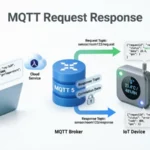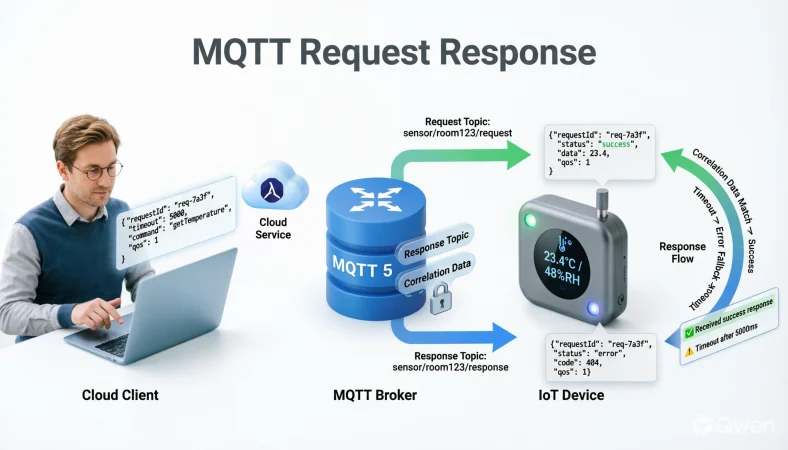
MQTT request response is a messaging pattern where a client publishes a request and another client publishes the result to a designated response topic. MQTT 5 supports this pattern through the Response Topic and Correlation Data properties.
Top alternatives: MQTT request-response pattern, MQTT response topic, MQTT correlation data, MQTT request reply, MQTT 5 request response
If MQTT feels like a group chat where everyone is subscribed but nobody knows who should answer, the request response pattern brings some order to the chaos. Instead of expecting a direct reply from a publish operation, the requester publishes a message, identifies where the response should go, and uses correlation data to match the eventual response with the original request.
MQTT 5 formally supports this pattern with the Response Topic and Correlation Data properties. This becomes especially useful in IoT systems, device commands, telemetry workflows, remote operations, and cloud-to-device communication. Whether you are building a smart home device, industrial controller, connected vehicle system, or backend service, understanding MQTT request response can make asynchronous communication much easier to design, troubleshoot, and scale.
Basic MQTT Request Response Explained
“MQTT request response connects a request with its eventual reply.”
Example: Use this when introducing the pattern to developers who already understand basic MQTT publishing.
Meaning: It provides a structured way to associate a response with a previous request.
“Publish the request, then listen for the response.”
Example: Use this when explaining the basic communication flow.
Meaning: The requester sends a message and waits asynchronously for a result.
“MQTT does not need a traditional synchronous reply.”
Example: Use this when comparing MQTT with conventional request-response APIs.
Meaning: MQTT can handle the exchange through separate published messages.
“The response can travel through its own topic.”
Example: Use this when explaining response routing in MQTT 5.
Meaning: The Response Topic tells the receiver where to publish the reply.
“Correlation data tells you which request the response belongs to.”
Example: Use this when multiple requests can be active at once.
Meaning: It helps the requester match a response with the correct operation.
“Request response makes asynchronous messaging feel organized.”
Example: Use this when explaining why the pattern is useful in distributed systems.
Meaning: It adds structure without turning MQTT into a blocking protocol.
“Think of the response topic as the return address.”
Example: Use this when explaining MQTT request response to beginners.
Meaning: The responder uses the specified topic to send the result back.
“Think of correlation data as the tracking number.”
Example: Use this when several requests may be processed simultaneously.
Meaning: The tracking value identifies the related request.
“MQTT request response is a pattern, not a separate protocol.”
Example: Use this in technical documentation.
Meaning: The pattern uses MQTT messaging features to coordinate requests and responses.
“The broker carries the messages, but your application defines the meaning.”
Example: Use this when designing application-level commands.
Meaning: MQTT transports messages while your application determines what they represent.
“A response does not have to arrive immediately.”
Example: Use this for device commands that may take several seconds.
Meaning: The asynchronous model allows delayed processing.
“MQTT request response works especially well for distributed devices.”
Example: Use this when discussing IoT architectures.
Meaning: Devices can communicate without requiring a direct synchronous connection.
MQTT 5 Request Response
“MQTT 5 added properties designed for request response.”
Example: Use this when comparing MQTT 3.1.1 with MQTT 5.
Meaning: MQTT 5 provides Response Topic and Correlation Data properties for this pattern.
“Response Topic tells the receiver where to answer.”
Example: Use this when documenting a command message.
Meaning: The receiver can publish its response to the specified topic.
“Correlation Data helps identify the matching response.”
Example: Use this when several commands are active simultaneously.
Meaning: The requester can associate returned data with the original request.
“MQTT 5 makes request response cleaner.”
Example: Use this when explaining why MQTT 5 is useful for command workflows.
Meaning: Standardized properties reduce the need for completely custom conventions.
“The response topic should not contain wildcard characters.”
Example: Use this when validating an MQTT 5 request.
Meaning: The Response Topic property is a specific destination rather than a subscription filter.
“Correlation data is application-defined binary data.”
Example: Use this when deciding what identifier to place in a request.
Meaning: Applications can use it to track the relationship between messages.
“MQTT 5 supports asynchronous request tracking.”
Example: Use this when explaining distributed command execution.
Meaning: The requester can identify a response without blocking the connection.
“Request response is one of MQTT 5’s useful messaging patterns.”
Example: Use this when creating an MQTT 5 feature overview.
Meaning: The protocol provides features that make this communication model easier to implement.
“Response Topic and Correlation Data solve different problems.”
Example: Use this during an architecture review.
Meaning: One handles response routing while the other helps identify the related request.
“A response topic answers where, correlation data answers which.”
Example: Use this as a quick developer memory trick.
Meaning: The two properties work together to connect destination and identity.
“MQTT 5 gives request response a standardized vocabulary.”
Example: Use this in a technical presentation.
Meaning: Developers can use defined MQTT properties instead of inventing everything from scratch.
“MQTT 5 request response is asynchronous by design.”
Example: Use this when comparing it with blocking RPC calls.
Meaning: The requester can continue operating while waiting for the published response.
MQTT Response Topic
“Response Topic tells the responder where to publish.”
Example: Use this when documenting a request message.
Meaning: It identifies the destination for the corresponding response.
“Choose response topics that are easy to manage.”
Example: Use this when designing topics for hundreds of devices.
Meaning: Clear naming makes routing and troubleshooting easier.
“Do not treat a response topic like a wildcard subscription.”
Example: Use this when explaining MQTT topic semantics.
Meaning: Response Topic identifies a concrete topic rather than a wildcard filter.
“A response topic can separate replies from requests.”
Example: Use this when designing command and result channels.
Meaning: Different topics can make message flow easier to understand.
“Keep request and response topic naming predictable.”
Example: Use this when building an IoT topic hierarchy.
Meaning: Consistent naming improves maintainability.
“Response topics should support your routing strategy.”
Example: Use this when designing multi-device communication.
Meaning: Topic structure can help direct responses to the correct application.
“Use a dedicated response namespace when appropriate.”
Example: Use this when separating commands from results.
Meaning: A dedicated namespace makes the communication flow clearer.
“Do not bury routing logic in random payload fields.”
Example: Use this when designing MQTT command messages.
Meaning: MQTT 5 provides a standard Response Topic property for response routing.
“Response Topic is metadata about the request.”
Example: Use this when explaining MQTT 5 properties.
Meaning: It describes how the receiver should return the result.
“A clean response topic makes debugging easier.”
Example: Use this when troubleshooting a missing response.
Meaning: Predictable routing helps engineers follow the message path.
“Response topics should reflect ownership and scope.”
Example: Use this when designing enterprise IoT topic structures.
Meaning: Topic organization can make access control and troubleshooting simpler.
“Response Topic is the return route, not the response itself.”
Example: Use this when teaching MQTT 5 request response.
Meaning: The property identifies where the actual response message should be published.
MQTT Correlation Data
“Correlation Data identifies the request behind a response.”
Example: Use this when multiple commands are processed concurrently.
Meaning: It allows the requester to associate a response with its originating request.
“Think of correlation data as a request ID.”
Example: Use this when explaining the concept to a new MQTT developer.
Meaning: It gives each request a value that can be recognized later.
“Generate unique correlation values.”
Example: Use this when designing a high-volume request system.
Meaning: Unique identifiers reduce the chance of matching the wrong response.
“Do not rely only on response arrival order.”
Example: Use this when multiple devices respond at different speeds.
Meaning: Asynchronous messages may arrive in an order different from the requests.
“Correlation data makes concurrent requests manageable.”
Example: Use this when building a cloud-to-device command service.
Meaning: Responses can be matched even when many requests are in flight.
“Keep correlation data meaningful to your application.”
Example: Use this when choosing a request identifier format.
Meaning: A useful identifier makes response tracking easier.
“Correlation data belongs to the request-response relationship.”
Example: Use this when documenting MQTT 5 properties.
Meaning: Its purpose is to associate returned data with the original request.
“A UUID can work as a correlation identifier.”
Example: Use this when designing unique request tracking.
Meaning: A UUID can provide a practical unique value for matching requests and responses.
“Do not confuse correlation data with the payload.”
Example: Use this when explaining MQTT 5 message properties.
Meaning: Correlation Data is a protocol property rather than ordinary application payload content.
“Correlation data helps prevent response mix-ups.”
Example: Use this when a client manages several device commands simultaneously.
Meaning: Each response can be tied back to its originating operation.
“Track correlation IDs through your logs.”
Example: Use this when troubleshooting production MQTT workflows.
Meaning: Logging the identifier makes distributed message tracing easier.
“Correlation data is tiny but extremely useful.”
Example: Use this when explaining why the property matters.
Meaning: A small identifier can connect messages across an asynchronous workflow.
MQTT Request Response Flow
“Step one: publish the request.”
Example: Use this when documenting a basic device command.
Meaning: The requester begins the workflow by publishing an MQTT message.
“Step two: include the response destination.”
Example: Use this when describing MQTT 5 request metadata.
Meaning: The receiver needs a defined route for the response.
“Step three: include correlation data.”
Example: Use this when several operations can overlap.
Meaning: The response can later be matched to the correct request.
“Step four: subscribe to the response topic.”
Example: Use this when preparing the requester before sending commands.
Meaning: The requester needs a way to receive the response.
“Step five: process the request.”
Example: Use this when describing device-side behavior.
Meaning: The responder performs the requested operation.
“Step six: publish the response.”
Example: Use this when explaining the responder workflow.
Meaning: The responder sends the result to the designated response topic.
“Step seven: match the correlation data.”
Example: Use this when processing incoming responses.
Meaning: The requester identifies which operation produced the result.
“Step eight: handle success or failure.”
Example: Use this when designing response payloads.
Meaning: The requester should know whether the requested action completed successfully.
“Keep the workflow asynchronous.”
Example: Use this when designing long-running device commands.
Meaning: The requester does not need to block while the device works.
“Build timeout handling into the flow.”
Example: Use this when a device might become offline.
Meaning: The requester needs a way to handle missing responses.
“Log request and response identifiers together.”
Example: Use this when monitoring production commands.
Meaning: Shared identifiers make message tracing easier.
“Treat every response as an event.”
Example: Use this when designing reactive applications.
Meaning: The client can process responses when they arrive instead of polling constantly.
MQTT Request Response Example
“Request: device/123/status/get.”
Example: Use this when illustrating a device status request.
Meaning: The topic represents an operation asking for current device information.
“Response: app/response/abc123.”
Example: Use this when demonstrating a dedicated response destination.
Meaning: The response can be routed to a topic controlled by the requester.
“Correlation ID: req-abc123.”
Example: Use this when illustrating response matching.
Meaning: The identifier connects the response to the original request.
“Payload: {“command”:”status”}.”
Example: Use this when showing a compact application-level request.
Meaning: The payload describes what operation the device should perform.
“Response payload: {“status”:”online”}.”
Example: Use this when illustrating a successful device response.
Meaning: The responder returns the requested information.
“Response topics can be generated per session.”
Example: Use this when designing multiple application sessions.
Meaning: Session-aware destinations can simplify response routing.
“Correlation IDs can be generated per request.”
Example: Use this when multiple commands can run simultaneously.
Meaning: Each operation receives a unique tracking value.
“Keep response payloads predictable.”
Example: Use this when designing an API-like MQTT service.
Meaning: Consistent response structures make client handling easier.
“Include explicit success information.”
Example: Use this when designing device command responses.
Meaning: The requester can distinguish successful operations from errors.
“Include useful error information.”
Example: Use this when a device rejects a command.
Meaning: The requester can understand why the operation failed.
“Keep command names consistent.”
Example: Use this when creating several related device operations.
Meaning: Predictable naming improves maintainability.
“Document the complete request-response contract.”
Example: Use this when publishing an MQTT API for other teams.
Meaning: Consumers need to understand topics, properties, payloads, and expected responses.
MQTT Request Response For IoT
“IoT devices often need command acknowledgments.”
Example: Use this when sending commands to connected sensors or controllers.
Meaning: Request response can confirm whether a device processed an operation.
“Ask a device for its current status.”
Example: Use this when building a smart home dashboard.
Meaning: The application publishes a request and receives the device state.
“Send a configuration request.”
Example: Use this when updating a connected device remotely.
Meaning: The device can return a success or failure response.
“Request diagnostic information.”
Example: Use this when monitoring industrial equipment.
Meaning: A device can respond with health or diagnostic data.
“Use correlation IDs for remote commands.”
Example: Use this when hundreds of devices receive commands simultaneously.
Meaning: Each command can be traced independently.
“Give every command a clear result.”
Example: Use this when building remote device management.
Meaning: Operators need to know whether the action succeeded.
“Do not assume a device is always online.”
Example: Use this when designing resilient IoT workflows.
Meaning: Missing responses should be handled gracefully.
“Use expiration when old requests should stop mattering.”
Example: Use this when a command becomes irrelevant after a short period.
Meaning: MQTT 5 supports Message Expiry Interval for time-sensitive messages.
“Design for delayed responses.”
Example: Use this when devices operate over unreliable networks.
Meaning: A response may arrive later than expected.
“Make device responses easy to monitor.”
Example: Use this when operating a large fleet.
Meaning: Consistent responses simplify observability.
“Keep commands idempotent where possible.”
Example: Use this when retrying device operations.
Meaning: Repeated delivery should not create unwanted duplicate effects when the operation permits it.
“Treat remote commands like distributed workflows.”
Example: Use this when designing production IoT systems.
Meaning: Network delays, retries, timeouts, and duplicate messages should be expected.
MQTT Request Response For Device Commands
“Request the device to restart.”
Example: Use this for controlled remote maintenance.
Meaning: The application can ask the device to restart and receive a result.
“Request the current configuration.”
Example: Use this when auditing connected devices.
Meaning: The device can return its active configuration.
“Request a firmware status.”
Example: Use this during fleet monitoring.
Meaning: The response can report the installed firmware version or state.
“Request a sensor reading.”
Example: Use this when an application needs an immediate measurement.
Meaning: The device responds with the requested value.
“Request a health check.”
Example: Use this when monitoring remote equipment.
Meaning: The device can return health information.
“Request an operational mode.”
Example: Use this when controlling industrial equipment.
Meaning: The response can confirm the current mode.
“Return a clear command status.”
Example: Use this after sending a remote operation.
Meaning: The requester can distinguish accepted, completed, and failed operations.
“Use correlation data for command tracking.”
Example: Use this when several commands are running at once.
Meaning: Each result can be associated with its originating command.
“Use a dedicated response topic when appropriate.”
Example: Use this when applications need isolated command responses.
Meaning: The response destination can be explicitly defined.
“Log every command identifier.”
Example: Use this when building operational dashboards.
Meaning: Identifiers help engineers trace device actions.
“Handle rejected commands gracefully.”
Example: Use this when a device cannot perform a requested operation.
Meaning: The client should treat failure as a normal response state.
“Do not make success the only expected outcome.”
Example: Use this when defining a command response schema.
Meaning: Production systems need predictable error handling too.
MQTT Request Response And QoS
“QoS and request response solve different problems.”
Example: Use this when designing reliable MQTT command workflows.
Meaning: QoS concerns delivery guarantees while request response concerns application-level replies.
“QoS does not automatically create a business response.”
Example: Use this when someone assumes a PUBACK means the device completed a command.
Meaning: Protocol acknowledgment is not the same as application success.
“A published message can be acknowledged without completing the operation.”
Example: Use this when explaining device command behavior.
Meaning: Message delivery and command execution are separate events.
“Use application responses for command results.”
Example: Use this when a device needs to confirm an operation.
Meaning: A response payload can communicate the actual application outcome.
“Do not treat PUBACK as the final answer.”
Example: Use this when explaining MQTT command processing.
Meaning: A broker acknowledgment does not necessarily mean the device completed the requested task.
“QoS can improve message delivery behavior.”
Example: Use this when choosing MQTT delivery settings.
Meaning: QoS controls how MQTT handles message delivery.
“Request response adds business-level context.”
Example: Use this when a command needs a meaningful result.
Meaning: The response can say what happened after the message was received.
“Choose QoS based on the workload.”
Example: Use this when configuring IoT commands.
Meaning: Different applications have different delivery requirements.
“Do not confuse reliable delivery with reliable execution.”
Example: Use this when reviewing a device control system.
Meaning: Receiving a message does not prove that the requested action succeeded.
“Track command completion separately.”
Example: Use this when designing a remote operation.
Meaning: Application-level responses can communicate completion.
“Use correlation data alongside your response design.”
Example: Use this when several QoS-controlled commands are active.
Meaning: Correlation helps identify the result associated with each request.
“Think in layers: transport, delivery, application.”
Example: Use this when teaching MQTT reliability concepts.
Meaning: Each layer answers a different question about the message lifecycle.
MQTT Request Response With Timeout Handling
“Every request should have a timeout strategy.”
Example: Use this when a device may disconnect unexpectedly.
Meaning: The requester needs a plan for responses that never arrive.
“No response does not always mean failure.”
Example: Use this when working with unreliable networks.
Meaning: Network delays can prevent a response from arriving on schedule.
“Set a practical response deadline.”
Example: Use this for time-sensitive device commands.
Meaning: The application can decide when to stop waiting.
“Track pending requests by correlation ID.”
Example: Use this when many commands are active simultaneously.
Meaning: Each pending operation can have its own timeout.
“Remove expired requests from memory.”
Example: Use this when implementing a long-running MQTT client.
Meaning: Cleanup prevents stale operations from accumulating.
“Do not retry blindly.”
Example: Use this when a device does not respond.
Meaning: Automatic retries can create duplicate operations.
“Know whether the command is safe to repeat.”
Example: Use this when designing retry behavior.
Meaning: Idempotent operations are easier to retry safely.
“Use message expiry when stale messages have no value.”
Example: Use this when commands should become invalid after a set period.
Meaning: MQTT 5 provides a Message Expiry Interval property.
“Return timeout status clearly.”
Example: Use this when a dashboard displays command results.
Meaning: Operators should know whether a command timed out rather than silently disappearing.
“Separate timeout from device rejection.”
Example: Use this when defining response states.
Meaning: A missing response and an explicit failure are different events.
“Log when the request started and expired.”
Example: Use this during production troubleshooting.
Meaning: Timing information helps diagnose network and device problems.
“Make timeout behavior part of the protocol contract.”
Example: Use this when documenting an MQTT command API.
Meaning: Clients should know how long to wait and what happens afterward.
MQTT Request Response Error Handling
“Every response should have a clear success or failure state.”
Example: Use this when designing a device command response.
Meaning: Clients need an unambiguous outcome.
“Return useful error codes.”
Example: Use this when a device rejects a command.
Meaning: The requester can determine what went wrong.
“Keep error messages readable.”
Example: Use this when building operational dashboards.
Meaning: Human-friendly errors speed up troubleshooting.
“Separate transport errors from application errors.”
Example: Use this when documenting MQTT workflows.
Meaning: Connection problems differ from a device rejecting a valid message.
“Do not hide failure inside a vague response.”
Example: Use this when designing response payloads.
Meaning: Clear failure information is easier to process.
“Include the correlation identifier in application tracking.”
Example: Use this when investigating failed commands.
Meaning: Engineers can connect the error to the originating request.
“Use predictable response schemas.”
Example: Use this when several applications consume the same MQTT service.
Meaning: Consistent structures reduce client-side complexity.
“Return enough context to troubleshoot.”
Example: Use this when a command fails because of device state.
Meaning: Useful context can reduce repeated diagnostic requests.
“Avoid exposing unnecessary sensitive information.”
Example: Use this when creating error payloads for connected devices.
Meaning: Error responses should reveal only what consumers need.
“Document retryable errors.”
Example: Use this when building resilient clients.
Meaning: Clients need to know whether repeating a request makes sense.
“Document permanent errors.”
Example: Use this when a command can never succeed under current conditions.
Meaning: Clients can stop wasting resources on impossible retries.
“Treat error responses as first-class messages.”
Example: Use this when designing production MQTT services.
Meaning: Failure handling deserves the same structure and care as successful responses.
MQTT Request Response Architecture Patterns
“Use one response topic for a service.”
Example: Use this when a backend handles many requesters.
Meaning: A shared response channel can simplify topic management when correlation data is reliable.
“Use per-client response topics.”
Example: Use this when responses should remain logically separated.
Meaning: Each client can have a dedicated return route.
“Use session-based response topics.”
Example: Use this when applications create temporary sessions.
Meaning: Session identifiers can help organize related responses.
“Use correlation IDs for concurrent operations.”
Example: Use this when one client sends many requests simultaneously.
Meaning: Responses can be matched without depending on arrival order.
“Use topic hierarchy to organize device commands.”
Example: Use this when managing large fleets.
Meaning: Predictable topic structures improve administration.
“Separate command and response namespaces.”
Example: Use this when designing a large IoT deployment.
Meaning: Different namespaces make traffic easier to understand.
“Use payload schemas consistently.”
Example: Use this when several device models implement the same command.
Meaning: Consistent structures make interoperability easier.
“Track request lifecycle outside the MQTT message.”
Example: Use this when building an enterprise command platform.
Meaning: A database or state store can maintain pending and completed operations.
“Use observability around every request.”
Example: Use this when operating mission-critical IoT systems.
Meaning: Metrics and logs help identify slow or missing responses.
“Design for offline devices.”
Example: Use this when commands target mobile or intermittently connected equipment.
Meaning: The system should expect unavailable responders.
“Keep architecture simple before adding clever routing.”
Example: Use this when creating a small MQTT application.
Meaning: A straightforward request-response design is often easier to maintain.
“Scale the pattern only after measuring traffic.”
Example: Use this when expanding an MQTT platform.
Meaning: Real traffic patterns should guide topic and routing decisions.
MQTT Request Response Best Practices
“Subscribe before publishing the request when practical.”
Example: Use this when a response could arrive very quickly.
Meaning: The requester is ready to receive the response immediately.
“Generate a unique correlation value.”
Example: Use this when several commands can overlap.
Meaning: Unique identifiers reduce response-matching errors.
“Keep response topics predictable.”
Example: Use this when documenting a shared MQTT service.
Meaning: Consistent destinations make the system easier to understand.
“Define response schemas before implementation.”
Example: Use this when multiple teams consume the same MQTT commands.
Meaning: A shared contract prevents inconsistent responses.
“Document timeout behavior.”
Example: Use this when publishing an MQTT integration guide.
Meaning: Clients need to know how long they should wait.
“Document retry behavior.”
Example: Use this when commands may be repeated after network failures.
Meaning: Consumers need to know when retries are safe.
“Use message expiry for time-sensitive messages.”
Example: Use this when an old command should not execute later.
Meaning: MQTT 5 supports message expiration.
“Log correlation identifiers.”
Example: Use this when debugging distributed MQTT workflows.
Meaning: Identifiers provide a practical trace across request and response events.
“Keep payloads compact.”
Example: Use this when devices communicate over constrained networks.
Meaning: Smaller messages can reduce bandwidth and processing demands.
“Avoid unnecessary response chatter.”
Example: Use this when designing high-volume device systems.
Meaning: Only return information the requester actually needs.
“Treat missing responses as an expected scenario.”
Example: Use this when building an unreliable-network application.
Meaning: Devices and networks can disappear, so the client should handle it.
“Test delayed, duplicated, and failed responses.”
Example: Use this before releasing a production IoT workflow.
Meaning: Real systems rarely behave like a perfect local test.
MQTT Request Response Troubleshooting
“Check the response topic first.”
Example: Use this when a request succeeds but no response appears.
Meaning: An incorrect response destination can prevent the requester from receiving the reply.
“Check the subscription.”
Example: Use this when the response topic appears correct.
Meaning: The requester must be subscribed appropriately to receive the response.
“Check correlation data.”
Example: Use this when the response arrives but cannot be matched.
Meaning: A mismatch can make a valid response appear unrelated.
“Check topic permissions.”
Example: Use this when a device cannot publish its response.
Meaning: Authorization rules may block the response publication.
“Check the MQTT version.”
Example: Use this when expecting MQTT 5 request-response properties.
Meaning: Response Topic and Correlation Data are MQTT 5 features.
“Check whether the broker supports the properties you use.”
Example: Use this when working with a managed MQTT service.
Meaning: Broker implementations can have their own supported-feature differences.
“Check the response payload.”
Example: Use this when the response arrives but the application rejects it.
Meaning: The message may be valid MQTT but invalid for your application schema.
“Check timeout settings.”
Example: Use this when the response arrives after the client has stopped waiting.
Meaning: The application may be timing out too aggressively.
“Check message expiry.”
Example: Use this when delayed requests disappear unexpectedly.
Meaning: Expired MQTT 5 messages may no longer be relevant for delivery.
“Check duplicate processing.”
Example: Use this when the same command appears to execute twice.
Meaning: MQTT workflows should be designed with appropriate duplicate handling.
“Trace the complete message path.”
Example: Use this when individual components look healthy but the workflow fails.
Meaning: Distributed failures often occur between components.
“Use correlation IDs to follow the request.”
Example: Use this when analyzing production logs.
Meaning: One identifier can connect request, processing, response, and error events.
MQTT Request Response Versus HTTP
“MQTT request response is asynchronous messaging.”
Example: Use this when comparing it with conventional REST APIs.
Meaning: The request and response can be separate published messages.
“HTTP usually exposes a direct request-response interaction.”
Example: Use this when explaining protocol differences.
Meaning: HTTP clients normally send a request and wait for an HTTP response.
“MQTT works naturally with connected devices.”
Example: Use this when selecting a protocol for IoT communication.
Meaning: MQTT is designed around lightweight publish and subscribe messaging.
“MQTT can keep clients connected.”
Example: Use this when discussing device-to-cloud communication.
Meaning: Persistent MQTT connections can support ongoing messaging.
“HTTP is often convenient for browser-facing APIs.”
Example: Use this when comparing application architectures.
Meaning: HTTP integrates naturally with standard web clients.
“MQTT request response can work without a traditional API endpoint.”
Example: Use this when designing device commands.
Meaning: A broker and topic structure can provide the communication path.
“Correlation data is especially useful when responses are asynchronous.”
Example: Use this when explaining MQTT 5.
Meaning: The requester needs a way to associate delayed responses with requests.
“Response Topic gives MQTT a defined return route.”
Example: Use this when comparing MQTT messaging with simple pub/sub.
Meaning: The requester can explicitly identify where the response should be sent.
“MQTT is not automatically better than HTTP.”
Example: Use this when choosing between protocols.
Meaning: The correct choice depends on application requirements.
“Use MQTT when messaging and device connectivity are central.”
Example: Use this when designing an IoT platform.
Meaning: MQTT can be a natural fit for event-driven connected systems.
“Use HTTP when conventional web request semantics fit better.”
Example: Use this when designing a browser-oriented service.
Meaning: HTTP may be simpler when direct request-response APIs are all you need.
“The architecture matters more than the buzzwords.”
Example: Use this during protocol selection.
Meaning: Choose based on communication patterns, device constraints, reliability, and operational needs.
MQTT Request Response FAQ Style Answers
“What is MQTT request response?”
Example: Use this as a quick answer in technical documentation.
Meaning: It is a pattern where a requester publishes a message and receives a related response through MQTT.
“Does MQTT support request response?”
Example: Use this when answering an MQTT 5 compatibility question.
Meaning: MQTT 5 provides Response Topic and Correlation Data specifically useful for this pattern.
“What is a response topic?”
Example: Use this when explaining MQTT 5 properties.
Meaning: It identifies the topic where the receiver should publish the response.
“What is correlation data?”
Example: Use this when explaining response matching.
Meaning: It is data supplied by the requester to identify which request a response belongs to.
“Is MQTT request response synchronous?”
Example: Use this when comparing MQTT with HTTP.
Meaning: The pattern is generally asynchronous because the response is delivered as a separate MQTT message.
“Can multiple MQTT requests be active?”
Example: Use this when designing a high-volume application.
Meaning: Yes, and correlation identifiers can help match their responses.
“Does PUBACK mean the command succeeded?”
Example: Use this when explaining MQTT acknowledgments.
Meaning: No, a protocol-level acknowledgment is not necessarily an application-level command result.
“Should MQTT responses have error states?”
Example: Use this when designing command payloads.
Meaning: Yes, clear success and failure states make clients easier to build.
“Can MQTT request response work with IoT devices?”
Example: Use this when evaluating an IoT architecture.
Meaning: Yes, it is particularly useful for device commands and asynchronous operations.
“Should MQTT requests have timeouts?”
Example: Use this when designing resilient clients.
Meaning: A timeout prevents indefinitely waiting for a device that may be offline.
“Can response topics be shared?”
Example: Use this when designing a multi-client MQTT service.
Meaning: Shared response topics can work when the application can reliably distinguish responses.
“What is the best MQTT request response design?”
Example: Use this when starting a new IoT project.
Meaning: A good design uses clear topics, correlation identifiers, predictable schemas, timeouts, and explicit error handling.
FAQs
What Does MQTT Request Response Mean?
MQTT request response is a communication pattern where one MQTT client publishes a request and another client publishes a related response. MQTT 5 supports this pattern with the Response Topic and Correlation Data properties.
Is MQTT Request Response The Same As HTTP Request Response?
Not exactly. HTTP commonly uses a direct request followed by a response, while MQTT request response can use separate publish messages and asynchronous delivery. MQTT 5 provides properties specifically designed to connect the two messages.
What Is The MQTT Response Topic?
The Response Topic is an MQTT 5 property that tells the receiver which topic should be used for the response. It must be a specific topic and cannot contain wildcard characters.
What Is MQTT Correlation Data Used For?
Correlation Data helps the original requester determine which request a received response belongs to. This becomes especially important when several requests are active at the same time.
Can MQTT Request Response Be Used For Device Commands?
Yes. It is useful for operations such as requesting device status, changing configuration, running diagnostics, or sending remote commands. AWS documentation also describes MQTT 5 request-response patterns for IoT and connected-device scenarios.
Should You Use A Timeout With MQTT Request Response?
Yes. MQTT communication can involve disconnected devices, network delays, or processing failures, so applications should define what happens when a response does not arrive within the expected time.
Is Humor Appropriate When Explaining MQTT Request Response?
A little humor can make technical content easier to remember, especially in team documentation or educational posts. Just keep protocol names, properties, configuration details, and implementation requirements precise.
What If You Do Not Need A Response?
A simple publish-and-subscribe workflow may be enough. The request-response pattern is most useful when the requester needs a specific result, confirmation, status, or error from another client.
Conclusion
Understanding mqtt request response becomes much easier once you stop thinking of MQTT like a traditional phone call and start thinking of it as an organized messaging workflow. The requester publishes a message, the responder processes it, and the result travels to a defined response topic. MQTT 5 makes the pattern much cleaner through Response Topic and Correlation Data, giving applications both a return destination and a way to match responses with requests.
For real-world IoT systems, add clear payload schemas, correlation IDs, timeout handling, error states, and sensible topic structures. Save this guide, share it with your development team, and keep your MQTT conversations delightfully organized.