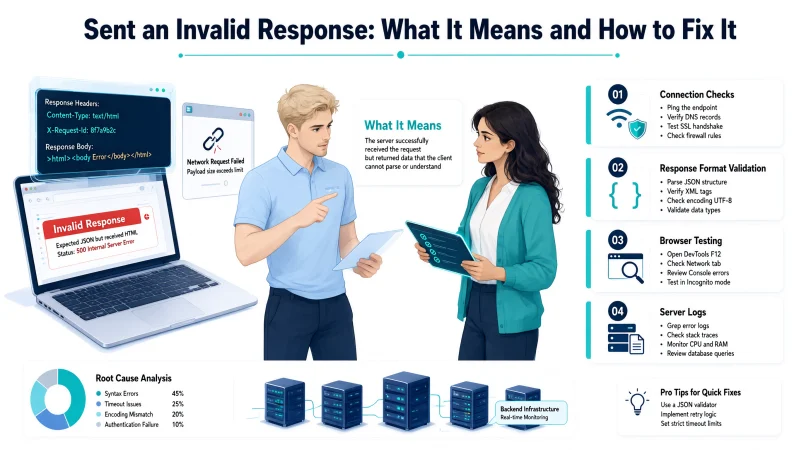
“Sent an invalid response” usually means a website, server, app, or system received a response that did not match the format or requirements it expected. The best next step is to check the error details, refresh the page, verify the request, or troubleshoot the server or application.
Top alternatives: invalid server response meaning, received an invalid response error, server sent an invalid response, website invalid response fix, how to fix an invalid response error.
You click a website, submit a form, or try to open a page, and suddenly you see the message “sent an invalid response.” Annoying, right? One second everything looks fine, and the next your browser or application acts like it received a message written in the wrong language.
Whether you’re troubleshooting a website, checking an API request, working on a WordPress site, or simply trying to finish an online task, this error can leave you wondering what went wrong.
The phrase sent an invalid response generally points to a communication problem between systems, but the exact cause depends on where it appears. It might involve server settings, a malformed request, a browser issue, or an application bug.
Understanding the context helps you choose the right fix instead of randomly clicking refresh like it’s a magical solution. Here are practical explanations and response examples for different situations.
Simple Explanations of “Sent an Invalid Response”
Understanding the Error
1. The server sent information the client could not understand.
Example: Use when explaining the error to someone who is not familiar with web technology.
Meaning: The receiving system could not interpret the response as expected.
2. The response did not match the expected format.
Example: Use when an API returns unexpected data instead of the required JSON structure.
Meaning: The response format may be incompatible with the client.
3. The website could not complete the request properly.
Example: Use when a page fails to load and displays an invalid-response message.
Meaning: Communication between the browser and website did not complete as expected.
Recognizing Response Problems
4. The application received unexpected information.
Example: Use when a mobile app fails after sending a request to a backend service.
Meaning: The returned data may not match what the application expects.
5. The request and response may not be compatible.
Example: Use when a developer is investigating an API integration problem.
Meaning: The client and server may disagree about the expected communication format.
6. The browser could not process the server’s reply.
Example: Use when a browser displays an error instead of opening a webpage.
Meaning: The response may be malformed, incomplete, or otherwise unexpected.
Identifying Possible Causes
7. The response may contain missing information.
Example: Use when an application expects required fields that are absent from the returned data.
Meaning: The response may not satisfy the application’s requirements.
8. The server may have returned an unexpected status or content type.
Example: Use when an API client expects JSON but receives an HTML error page.
Meaning: The server’s reply differs from what the client anticipated.
9. A configuration issue may be affecting communication.
Example: Use when an error appears after a website or server setting changes.
Meaning: Incorrect configuration may be interfering with the request.
Understanding What to Do Next
10. The error needs more context before its cause can be confirmed.
Example: Use when someone reports the message without sharing the application or logs.
Meaning: The exact cause cannot be identified from the wording alone.
11. The application may have encountered an unexpected condition.
Example: Use when a software tool fails during a routine operation.
Meaning: The application may not have handled the response correctly.
12. The system needs troubleshooting to identify the problem.
Example: Use when preparing a support ticket about the error.
Meaning: Further checks are needed to find the underlying cause.
Funny Responses to “Sent an Invalid Response”
Jokes About Confused Technology
1. My computer just said, “That message makes zero sense.”
Example: Use in a team chat when a browser error interrupts your work.
Meaning: Adds humor while describing a confusing technical problem.
2. Even the server is confused today.
Example: Use when a website repeatedly fails to load.
Meaning: Makes a frustrating technical issue feel less serious.
3. The internet is speaking in riddles again.
Example: Use when an error appears without a useful explanation.
Meaning: Jokes about unclear technical messages.
Funny Reactions to Failed Requests
4. My request went in, but common sense stayed out.
Example: Use when a request returns an unexpected result.
Meaning: Lightly pokes fun at the failed communication.
5. The server replied in a language nobody ordered.
Example: Use when an API returns unexpected content.
Meaning: Highlights the mismatch between expected and actual responses.
6. Apparently, my browser needs a translator.
Example: Use when the browser cannot interpret a website response.
Meaning: Turns a compatibility issue into a playful joke.
Internet-Style Humor
7. That response failed the vibe check.
Example: Use in a casual developer chat about a malformed response.
Meaning: Expresses that the response did not meet expectations.
8. The server sent a plot twist instead of a webpage.
Example: Use when an error replaces the page you wanted.
Meaning: Makes an unexpected failure sound amusing.
9. My request got ghosted by the correct response.
Example: Use when a request completes without producing the expected result.
Meaning: Jokes about the missing or incorrect information.
Playful Technical Frustration
10. The website chose confusion over cooperation.
Example: Use when a page fails during a simple task.
Meaning: Expresses playful frustration with the website.
11. Error message of the day: absolutely not.
Example: Use when a recurring system error blocks your progress.
Meaning: Adds a humorous reaction to repeated failure.
12. The server needs a coffee and a fresh start.
Example: Use when a temporary issue appears to be affecting a service.
Meaning: Suggests a reset in a lighthearted way.
Professional Responses to “Sent an Invalid Response”
Reporting and Acknowledging the Issue
1. We are investigating the invalid response reported by the application.
Example: Use in a technical support update after an issue is reported.
Meaning: Confirms that the problem is being investigated.
2. The returned data does not match the expected response format.
Example: Use in an API troubleshooting report.
Meaning: Identifies a possible response-format mismatch.
3. We are reviewing the request and server response logs.
Example: Use when diagnosing a production issue.
Meaning: Describes a practical step toward finding the cause.
Requesting Information and Diagnosing
4. Additional diagnostic information is required to identify the root cause.
Example: Use when a report lacks logs or reproduction steps.
Meaning: Explains why more information is needed.
5. The issue may involve response parsing or server configuration.
Example: Use when several technical causes remain possible.
Meaning: Lists plausible areas for investigation without claiming certainty.
6. We are validating the response against the application’s requirements.
Example: Use during API integration testing.
Meaning: Checks whether the returned information meets expected requirements.
Assessing Impact and Progress
7. The team is assessing the impact on affected users.
Example: Use when the error appears in a live application.
Meaning: Focuses on the scope and severity of the problem.
8. We will share an update after the initial investigation.
Example: Use in a support ticket or incident channel.
Meaning: Sets a reasonable expectation for follow-up communication.
9. The failure appears to occur during request processing.
Example: Use when initial evidence points to the request-handling stage.
Meaning: Identifies the likely stage without overclaiming the cause.
Corrective Actions and Follow-Up
10. We are checking whether recent changes contributed to the error.
Example: Use after a deployment or configuration update.
Meaning: Investigates whether a recent change introduced the issue.
11. The response-handling logic requires further verification.
Example: Use when reviewing code that processes server replies.
Meaning: Indicates that the client-side or backend logic needs checking.
12. We will document the findings and recommended corrective actions.
Example: Use when preparing a formal incident report.
Meaning: Commits to recording the investigation outcome and next steps.
Sarcastic Responses to “Sent an Invalid Response”
Sarcasm About Unhelpful Errors
1. Excellent. A response that refuses to respond properly.
Example: Use in a casual chat after a request fails again.
Meaning: Highlights the irony of an invalid response.
2. Very helpful, error message. Ten out of ten for mystery.
Example: Use when the message provides no clear troubleshooting guidance.
Meaning: Criticizes an unhelpful error description with humor.
3. The server has mastered the art of saying nothing useful.
Example: Use when repeated errors reveal little about the cause.
Meaning: Expresses frustration with vague system feedback.
Complaining About Unnecessary Complexity
4. Because opening a webpage was apparently too easy.
Example: Use when a simple browsing task turns into troubleshooting.
Meaning: Complains playfully about unnecessary complexity.
5. Fantastic. Another technical puzzle nobody requested.
Example: Use when an error interrupts an otherwise routine task.
Meaning: Shows mild irritation at the unexpected problem.
6. The response is invalid, but the confidence is impressive.
Example: Use when a system returns a clear error without a useful explanation.
Meaning: Jokes about the mismatch between certainty and usefulness.
Mocking Missing or Incorrect Results
7. Nothing says productivity like debugging a mystery.
Example: Use when an error delays your planned work.
Meaning: Highlights the time-consuming nature of troubleshooting.
8. Apparently, the correct response was optional.
Example: Use when an API returns unexpected content.
Meaning: Sarcastically points out that the expected result is missing.
9. My favorite feature is the feature that does not work.
Example: Use when a new feature repeatedly produces an error.
Meaning: Expresses disappointment in a playful way.
Witty Technical Criticism
10. The system has chosen chaos over compatibility.
Example: Use when multiple components fail to communicate correctly.
Meaning: Jokes about a compatibility problem.
11. A flawless demonstration of how not to answer a request.
Example: Use when a response fails validation during testing.
Meaning: Criticizes the result without making a personal attack.
12. Maybe the error message needs troubleshooting too.
Example: Use when the error itself is unclear.
Meaning: Suggests that better diagnostics would make the issue easier to solve.
Chill and Casual Responses to “Sent an Invalid Response”
Simple Ways to Describe the Problem
1. Looks like the request didn’t go through properly.
Example: Use when updating a teammate about a failed request.
Meaning: Explains the issue in simple, neutral language.
2. Something’s off with the response.
Example: Use when you notice unexpected output from an application.
Meaning: Points out the mismatch without assuming its cause.
3. Let me try that again.
Example: Use when a retry is reasonable and the issue may be temporary.
Meaning: Communicates a quick attempt to recover.
Quick Troubleshooting Updates
4. I’ll check what the server returned.
Example: Use when investigating an API or website issue.
Meaning: Focuses on examining the actual response.
5. The page isn’t loading as expected.
Example: Use when reporting a browser error to a colleague.
Meaning: Describes the visible problem without technical assumptions.
6. Might be a formatting issue.
Example: Use when the response looks malformed or unexpected.
Meaning: Suggests one possible explanation.
Basic Checks and Possible Causes
7. I’ll refresh and see if it clears up.
Example: Use when a temporary browser issue is plausible.
Meaning: Describes a simple first troubleshooting step.
8. Let me check the connection first.
Example: Use when network problems could be contributing to the failure.
Meaning: Starts with a basic diagnostic check.
9. The app isn’t handling that reply correctly.
Example: Use when an application fails to process returned data.
Meaning: Points toward response handling as a possible issue.
Keeping the Investigation Moving
10. I’ll take another look at the request.
Example: Use when the request parameters might be incorrect.
Meaning: Suggests checking the original input.
11. I’ll grab the error details before changing anything.
Example: Use when you want to preserve useful diagnostic information.
Meaning: Encourages checking evidence before making changes.
12. Let’s figure out where the response went wrong.
Example: Use when working with another person to diagnose a failure.
Meaning: Invites collaborative troubleshooting.
Clever Responses to “Sent an Invalid Response”
Focus on Evidence First
1. Validate the response before blaming the connection.
Example: Use when an API request fails and the response format is unknown.
Meaning: Encourages checking the actual data before choosing a cause.
2. The error is a clue, not the full diagnosis.
Example: Use when a team is drawing conclusions from one message.
Meaning: Reminds everyone that more evidence is needed.
3. Check what arrived, not just what was expected.
Example: Use when debugging a response parser.
Meaning: Encourages inspecting the real response payload.
Check Formats and Status Codes
4. A successful request does not guarantee a usable response.
Example: Use when an HTTP request completes but the returned content cannot be processed.
Meaning: Distinguishes request completion from application-level success.
5. The format matters as much as the content.
Example: Use when an API expects a specific structure such as JSON.
Meaning: Highlights the importance of matching the required format.
6. Read the status code before rewriting the code.
Example: Use when debugging an API response.
Meaning: Encourages checking diagnostic signals before changing implementation.
Reproduce and Compare
7. Compare the expected schema with the returned payload.
Example: Use when required fields may be missing or incorrectly typed.
Meaning: Helps identify structural mismatches.
8. Reproduce the error before attempting a permanent fix.
Example: Use when a bug occurs inconsistently.
Meaning: Makes diagnosis more reliable.
9. Check recent changes before assuming the server is broken.
Example: Use after a deployment or configuration update.
Meaning: Encourages investigating changes that may have introduced the problem.
Narrow Down the Root Cause
10. Separate a network failure from a response-parsing failure.
Example: Use when the request fails at an uncertain stage.
Meaning: Helps narrow down the troubleshooting path.
11. Capture the exact error before clearing the evidence.
Example: Use when a browser or application displays a useful diagnostic message.
Meaning: Preserves information that may help locate the cause.
12. Fix the underlying issue, not just the visible symptom.
Example: Use when a temporary workaround hides a recurring error.
Meaning: Promotes a lasting and evidence-based solution.
Creative Responses to “Sent an Invalid Response”
Make Technical Problems Relatable
1. The message arrived wearing the wrong format.
Example: Use in an informal explanation of malformed data.
Meaning: Makes a response-format mismatch easy to picture.
2. The server took a detour and forgot the destination.
Example: Use when a request produces an unexpected result.
Meaning: Describes a communication failure in a playful way.
3. The data showed up, but it didn’t bring the right paperwork.
Example: Use when required fields or metadata are missing.
Meaning: Illustrates a response that fails validation.
Explain Compatibility Issues
4. The application and server need to get on the same page.
Example: Use when two components expect different response structures.
Meaning: Emphasizes the need for compatible expectations.
5. The response missed the assignment.
Example: Use when returned content does not match the requested result.
Meaning: Adds a relatable phrase to describe an unexpected output.
6. The payload arrived with a few pieces missing.
Example: Use when the response lacks required fields.
Meaning: Suggests incomplete data may be involved.
Describe a Broken Handoff
7. The request reached the door, but the reply got lost.
Example: Use when a request appears to start but no usable response arrives.
Meaning: Describes a possible breakdown in communication.
8. The system needs a cleaner handoff.
Example: Use when response processing fails between components.
Meaning: Points to the need for better integration.
9. The response format took an unexpected plot twist.
Example: Use when a service returns HTML where JSON was expected.
Meaning: Makes a technical mismatch sound less intimidating.
Encourage a Clear Fix
10. The data needs a quick reality check.
Example: Use when validating a suspicious response payload.
Meaning: Encourages checking the returned content.
11. The application expected a map and received a riddle.
Example: Use when a response is valid text but unusable to the application.
Meaning: Describes an output that fails to meet expectations.
12. Let’s get the request and response back in sync.
Example: Use when debugging a client-server integration.
Meaning: Focuses on restoring compatibility between components.
Confident Responses to “Sent an Invalid Response”
Take Ownership of the Investigation
1. I’ll verify the response format and identify the mismatch.
Example: Use when taking ownership of an API troubleshooting task.
Meaning: Shows confidence in a methodical approach.
2. I’ll trace the request from start to finish.
Example: Use when the error’s origin is unclear.
Meaning: Commits to checking the full request flow.
3. I’ll confirm the expected status code and payload.
Example: Use when validating an API integration.
Meaning: Focuses on specific, testable requirements.
Validate the Data and Logs
4. I’ll compare the returned data with the documented schema.
Example: Use when an application expects structured output.
Meaning: Establishes a clear validation step.
5. I’ll review the logs before making changes.
Example: Use when troubleshooting a production issue.
Meaning: Prioritizes evidence over guesswork.
6. I’ll isolate the failing component first.
Example: Use when several services are involved.
Meaning: Breaks a complex problem into manageable parts.
Test Possible Causes
7. I’ll test whether the issue is reproducible.
Example: Use when the error appears intermittently.
Meaning: Establishes whether the problem can be consistently observed.
8. I’ll check whether the latest deployment affected the response.
Example: Use after a release introduces unexpected behavior.
Meaning: Investigates a plausible source of the regression.
9. I’ll validate the fix in a safe test environment.
Example: Use before deploying a corrective change.
Meaning: Emphasizes careful verification.
Report Verified Results
10. I’ll document the cause once the evidence confirms it.
Example: Use when preparing a technical incident summary.
Meaning: Avoids declaring a root cause prematurely.
11. I’ll confirm the response works across the affected scenarios.
Example: Use when checking a fix against multiple requests.
Meaning: Focuses on broader reliability, not just one successful test.
12. I’ll share the verified outcome and any remaining risks.
Example: Use when reporting back to a project team.
Meaning: Communicates results transparently and professionally.
Polite Responses to “Sent an Invalid Response”
Request the Basic Details
1. Could you share the exact error message?
Example: Use when helping a customer or colleague troubleshoot the issue.
Meaning: Requests information needed to investigate.
2. Please let me know which page or request triggered the error.
Example: Use when the report does not identify the affected feature.
Meaning: Helps narrow the problem to a specific location.
3. Would you mind sharing the steps that led to the issue?
Example: Use when trying to reproduce a reported failure.
Meaning: Requests a clear description of the user’s actions.
Ask for Useful Diagnostic Information
4. Could you try again and let me know whether it persists?
Example: Use when a temporary issue is possible.
Meaning: Requests a retry without promising that it will fix the problem.
5. Please include the time the error occurred.
Example: Use when matching a report to server logs.
Meaning: Makes investigation easier.
6. Could you share the relevant response details, with sensitive information removed?
Example: Use when diagnostic data may contain tokens or personal information.
Meaning: Requests evidence while encouraging safe information sharing.
Respond Respectfully
7. Thank you for reporting this. We’ll investigate further.
Example: Use in a customer support response.
Meaning: Acknowledges the report and confirms follow-up.
8. We appreciate your patience while we review the issue.
Example: Use when a fix requires investigation.
Meaning: Maintains a respectful tone during troubleshooting.
9. Could you confirm whether this happens in another browser?
Example: Use when checking whether the problem is browser-specific.
Meaning: Helps compare possible causes.
Clarify the Scope and Follow Up
10. Please let us know whether other requests are affected too.
Example: Use when determining the scope of an error.
Meaning: Helps establish whether the issue is isolated or widespread.
11. We’ll share an update when we have more information.
Example: Use when the cause has not yet been confirmed.
Meaning: Sets a realistic expectation for communication.
12. Thank you for helping us narrow down the cause.
Example: Use after a user supplies useful diagnostic information.
Meaning: Recognizes the user’s cooperation.
Emotional Responses to “Sent an Invalid Response”
Acknowledge the Frustration
1. It’s frustrating when a simple task turns into a technical problem.
Example: Use when acknowledging a colleague’s frustration with a recurring error.
Meaning: Validates the inconvenience without exaggerating it.
2. Let’s take it one step at a time.
Example: Use when someone feels overwhelmed by troubleshooting.
Meaning: Encourages a calm, manageable approach.
3. We don’t need to guess the cause before checking the evidence.
Example: Use when a team is getting stressed about possible explanations.
Meaning: Redirects attention toward facts.
Keep the Problem in Perspective
4. One error doesn’t tell us the whole story.
Example: Use when a single failure creates concern about a larger system.
Meaning: Encourages a measured interpretation.
5. We’ll learn more once we inspect the response details.
Example: Use when the message alone is not enough to diagnose the issue.
Meaning: Reassures the team that further evidence can help.
6. It’s okay to pause before changing multiple settings.
Example: Use when troubleshooting is becoming rushed.
Meaning: Encourages deliberate action rather than random changes.
Preserve Evidence and Narrow the Cause
7. Let’s preserve the logs so we can understand what happened.
Example: Use when the error may disappear after a retry.
Meaning: Prioritizes retaining useful diagnostic evidence.
8. We can narrow this down without solving everything at once.
Example: Use when multiple possible causes are being discussed.
Meaning: Makes a complex problem feel more manageable.
9. The important thing is to find the cause, not assign blame.
Example: Use during a post-incident review.
Meaning: Promotes constructive problem-solving.
Maintain Calm Communication
10. Let’s keep the update factual while the investigation continues.
Example: Use when stakeholders want an immediate explanation.
Meaning: Balances transparency with uncertainty.
11. We can review what worked and what needs improvement afterward.
Example: Use after the immediate issue has been contained.
Meaning: Encourages learning from the incident.
12. A clear next step is progress, even before the full fix.
Example: Use when troubleshooting takes longer than expected.
Meaning: Recognizes incremental progress.
Sweet and Supportive Responses to “Sent an Invalid Response”
Offer Reassurance and Help
1. No worries, let’s work through it together.
Example: Use when a teammate reports an error during a shared task.
Meaning: Offers support without placing blame.
2. Send me the details, and we’ll take a closer look.
Example: Use when someone needs help investigating the issue.
Meaning: Invites collaboration.
3. We’ll start with the simplest checks first.
Example: Use when the cause is still uncertain.
Meaning: Encourages an organized and low-pressure approach.
Encourage Reporting and Evidence Gathering
4. You did the right thing by reporting the error.
Example: Use when a colleague worries that they caused a problem.
Meaning: Reinforces early reporting and transparency.
5. Let’s save the error details before trying anything else.
Example: Use when the message contains potentially useful diagnostic information.
Meaning: Helps preserve evidence while offering guidance.
6. We’ll confirm the cause before choosing a fix.
Example: Use when several explanations are possible.
Meaning: Encourages careful investigation.
Support Teamwork
7. Thanks for catching this early.
Example: Use when a user reports a problem before it spreads.
Meaning: Recognizes the value of reporting issues promptly.
8. We can ask for help if the logs aren’t clear.
Example: Use when a problem requires specialist knowledge.
Meaning: Makes collaboration feel normal and constructive.
9. Let’s keep the next steps clear and manageable.
Example: Use when coordinating a troubleshooting task.
Meaning: Helps the team focus on practical actions.
Validate the Solution and Follow Up
10. We’ll test the solution before calling it fixed.
Example: Use when a proposed change seems promising but is not verified.
Meaning: Reinforces the importance of validation.
11. I’ll help you document what happened.
Example: Use when a team needs a clear incident record.
Meaning: Offers practical support with follow-up work.
12. We’ll get a clearer picture once the checks are complete.
Example: Use when the initial error message provides limited information.
Meaning: Offers realistic reassurance without promising a particular outcome.
Chill and Casual Ways to Report an Invalid Response
Give a Quick Status Update
1. The request came back with an unexpected result.
Example: Use in a casual project channel.
Meaning: Describes the problem without making assumptions.
2. I’m checking the response payload now.
Example: Use when reviewing returned API data.
Meaning: Gives a concise status update.
3. The response doesn’t match what the app expects.
Example: Use when a client cannot process the returned data.
Meaning: Identifies a possible compatibility problem.
Explain the Next Check
4. I’ll check the logs and see what shows up.
Example: Use when beginning a quick investigation.
Meaning: Explains the next diagnostic step.
5. The request may need a closer look.
Example: Use when input parameters could be contributing to the error.
Meaning: Keeps the explanation open to further evidence.
6. I’m going to test the endpoint separately.
Example: Use when isolating an API problem.
Meaning: Describes a way to check the service independently.
Compare and Validate
7. Let’s compare a working request with the failing one.
Example: Use when another request succeeds under similar conditions.
Meaning: Uses comparison to help locate the difference.
8. I’ll check whether the response is valid JSON.
Example: Use when a client expects JSON output.
Meaning: Verifies a common source of parsing problems.
9. The browser might be part of the issue, so I’ll test another one.
Example: Use when a webpage fails only in one browser.
Meaning: Checks whether the issue is browser-specific.
Keep Communication Clear
10. I’ll check the server status before changing anything.
Example: Use when the service may be experiencing a broader problem.
Meaning: Starts with a basic service check.
11. I’ll retry once after saving the error details.
Example: Use when a temporary failure is possible.
Meaning: Combines a cautious retry with evidence preservation.
12. I’ll update everyone when I know more.
Example: Use after starting an investigation.
Meaning: Keeps communication clear without guessing at the cause.
Clever Troubleshooting Responses for Invalid Server Replies
Inspect the Response
1. Check the HTTP status code and response body together.
Example: Use when an API request returns an error.
Meaning: Combines two useful sources of diagnostic information.
2. Confirm that the response content type matches the expected format.
Example: Use when a client expects JSON but receives another content type.
Meaning: Helps identify content-format mismatches.
3. Verify the request headers and required parameters.
Example: Use when the server may be rejecting an improperly formed request.
Meaning: Checks whether the request meets the endpoint’s requirements.
Check Intermediate Systems and Authentication
4. Inspect the raw response before parsing it.
Example: Use when the application throws a parsing exception.
Meaning: Reveals the exact content that the client received.
5. Check whether a proxy or gateway changed the response.
Example: Use when the backend response differs from what the client receives.
Meaning: Considers intermediate systems as a possible source of the problem.
6. Review redirects and authentication behavior.
Example: Use when a request unexpectedly returns a login page or redirect response.
Meaning: Checks whether the client is receiving the intended endpoint’s output.
Verify Compatibility and Completeness
7. Confirm that the endpoint is returning the documented schema.
Example: Use when an API’s structure may have changed.
Meaning: Checks compatibility between the service and its consumers.
8. Test the same request with a known-good client.
Example: Use when trying to separate client-specific behavior from server behavior.
Meaning: Provides a comparison point for troubleshooting.
9. Check for truncated or incomplete response data.
Example: Use when the connection closes unexpectedly or the payload appears cut off.
Meaning: Investigates whether the full response reached the client.
Trace and Reproduce the Failure
10. Review server and application logs around the failure time.
Example: Use when correlating a user’s report with backend events.
Meaning: Helps connect the visible error to server-side activity.
11. Verify that the protocol and TLS settings are compatible.
Example: Use when the connection fails before a normal application response arrives.
Meaning: Checks whether secure communication settings may be involved.
12. Reproduce the issue with the smallest possible request.
Example: Use when a complex request contains many optional parameters.
Meaning: Simplifies testing and makes the cause easier to isolate.
Practical Responses for Fixing “Sent an Invalid Response”
Start With Basic Checks
1. Refresh the page once and check whether the error persists.
Example: Use when a temporary loading issue may have occurred.
Meaning: Tests whether a simple retry resolves the problem.
2. Check your internet connection.
Example: Use when several websites or applications are failing.
Meaning: Rules out a basic connectivity issue.
3. Try opening the page in another browser.
Example: Use when the problem appears limited to one browser.
Meaning: Helps identify a browser-specific cause.
Review Requests and Local Settings
4. Review the URL and request parameters.
Example: Use when the error follows a particular link or API request.
Meaning: Checks for incorrect input.
5. Clear the browser cache only if cached data may be involved.
Example: Use when an older cached page or resource could be interfering.
Meaning: Tests a possible local browser issue without assuming it is the cause.
6. Check whether a VPN or proxy is affecting the connection.
Example: Use when the error appears only on a particular network path.
Meaning: Investigates whether an intermediary is changing or blocking communication.
Inspect Server and API Behavior
7. Review the server logs for the failed request.
Example: Use when you manage the website or application.
Meaning: Helps identify what happened on the server side.
8. Validate the API response against the expected schema.
Example: Use when an integration cannot process returned data.
Meaning: Checks whether the payload meets the required structure.
9. Confirm that the server returns the correct content type.
Example: Use when a client expects a specific response format.
Meaning: Helps prevent parsing and compatibility errors.
Capture Evidence and Escalate
10. Check recent code or configuration changes.
Example: Use when the error began after an update or deployment.
Meaning: Investigates whether a recent change introduced the issue.
11. Capture the exact error and reproduction steps.
Example: Use when escalating the issue to technical support.
Meaning: Gives the support team useful evidence.
12. Contact the website or service administrator if the issue continues.
Example: Use when basic checks fail and you cannot access the server logs.
Meaning: Escalates the problem to someone who can investigate further.
FAQs
What Does “Sent an Invalid Response” Mean?
It usually means a system received a response it could not process as expected.
Why Does My Browser Say It Received an Invalid Response?
Possible causes include server issues, malformed data, browser problems, or connection settings.
Is “Sent an Invalid Response” a Server Error?
It can be related to the server, but the exact cause depends on the browser, application, and error details.
How Do I Fix an Invalid Response Error?
Refresh the page, check the connection, try another browser, and inspect server logs if available.
Can an Invalid Response Error Be Caused by an API?
Yes. An API may return malformed data, an unexpected format, or a response the client cannot process.
Is It Safe to Ignore an Invalid Response Message?
It is better to investigate it if the error persists or affects important tasks.
Can a Browser Cache Cause an Invalid Response?
Sometimes. Cached data may contribute, but many invalid response errors have other causes.
What Does an Invalid JSON Response Mean?
It means the returned content does not follow valid JSON syntax or cannot be parsed as expected.
Can a VPN Cause an Invalid Response Error?
It may contribute if a proxy or intermediary changes or interferes with the connection.
What Should I Include in a Support Ticket?
Include the exact error, affected URL or endpoint, time, reproduction steps, and relevant logs with secrets removed.
Does This Error Mean My Website Is Hacked?
Not by itself. The message alone is not evidence of a security breach.
What Is the First Thing a Developer Should Check?
Inspect the HTTP status code, raw response body, content type, and relevant logs.
Conclusion
Seeing “sent an invalid response” can interrupt your workflow, but the message does not automatically mean something serious is broken. The key is to understand where the error appears and check the evidence before choosing a fix. For everyday browsing, start with the connection and browser. For APIs and websites you manage, inspect the response body, status code, content type, logs, and recent changes.
Clear communication also makes troubleshooting easier, especially when reporting the issue to teammates or support staff. Save this guide for the next time an error appears, share it with someone who needs a quick explanation, and remember: troubleshoot first, panic never.