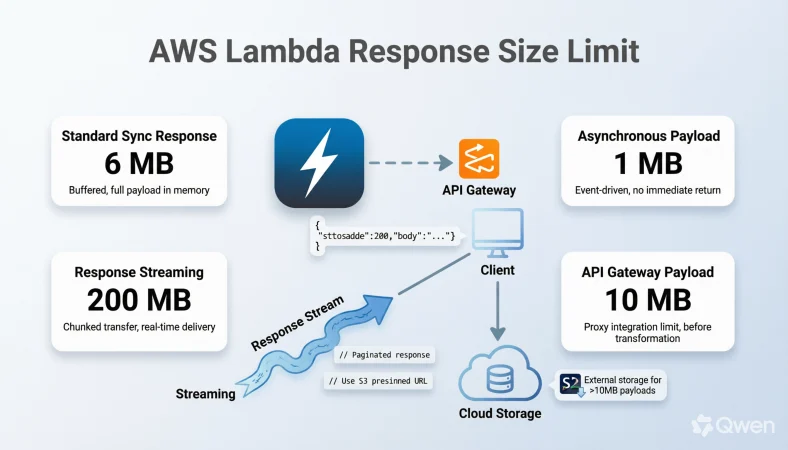
The aws lambda response size limit for a standard synchronous invocation is 6 MB for the request and response payload. Lambda response streaming can support responses up to 200 MB, while asynchronous invocation payloads are limited to 1 MB.
Top alternatives: Lambda response payload limit, AWS Lambda 6 MB limit, Lambda maximum response size, Lambda payload size limit, Lambda response streaming limit
Ever built a Lambda function that works perfectly in testing, only to discover that the response is suddenly too large for production? Yep, the classic “but it worked locally” moment. The aws lambda response size limit matters whenever your function returns large JSON objects, reports, files, search results, images, or generated content.
For standard synchronous Lambda invocations, AWS currently documents a 6 MB limit for both request and response payloads. Asynchronous invocation payloads have a 1 MB limit. AWS also supports response streaming, which can raise the maximum streamed response payload to 200 MB, although responses above the first 6 MB are subject to a 2 MBps bandwidth cap.
Understanding which limit applies to your architecture can save you from confusing errors, unnecessary optimization, and a whole lot of debugging. Here is a practical breakdown.
Basic AWS Lambda Response Size Limit
“The standard synchronous response limit is 6 MB.”
Example: Use this when explaining the default Lambda response ceiling to a development team.
Meaning: A normal synchronous Lambda response can be up to 6 MB.
“Lambda does not give every response unlimited space.”
Example: Use this when a function starts returning increasingly large JSON documents.
Meaning: Invocation payloads have defined service quotas.
“The 6 MB limit applies to the response payload.”
Example: Use this when discussing a standard RequestResponse invocation.
Meaning: The Lambda invocation response is constrained by the documented payload quota.
“Think 6 MB before you think unlimited.”
Example: Use this during architecture planning for a data-heavy function.
Meaning: Standard buffered responses should stay within the 6 MB ceiling.
“Response size is an architecture concern.”
Example: Use this when designing a function that returns large datasets.
Meaning: Payload size should be considered before implementation.
“Large output does not automatically mean more Lambda memory.”
Example: Use this when someone suggests increasing function memory to solve a payload problem.
Meaning: Memory allocation and response-size quotas are separate concerns.
“The response quota is different from execution memory.”
Example: Use this when troubleshooting a function that has plenty of configured memory.
Meaning: More memory does not remove the standard response payload limit.
“6 MB is the key number for buffered synchronous responses.”
Example: Use this in a Lambda sizing checklist.
Meaning: It is the standard maximum for synchronous request and response payloads.
“Check payload size before blaming the function.”
Example: Use this after a function suddenly fails with large output.
Meaning: The response may be exceeding an AWS service quota.
“Small responses are usually easier to operate.”
Example: Use this when comparing a compact API response with a massive document.
Meaning: Smaller payloads can reduce transfer and processing overhead.
“Large JSON can become a hidden problem.”
Example: Use this when an API returns thousands of records.
Meaning: Data volume can push a response toward the service limit.
“Measure the payload instead of guessing.”
Example: Use this before changing the Lambda architecture.
Meaning: Actual response size tells you whether the limit is the real issue.
Synchronous Lambda Response Limit
“RequestResponse uses the 6 MB payload limit.”
Example: Use this when documenting a direct synchronous Lambda invocation.
Meaning: Standard synchronous invocation supports up to 6 MB for request and response payloads.
“Synchronous means the caller waits for the result.”
Example: Use this when explaining why a client receives the Lambda output immediately.
Meaning: The invocation returns the function response directly.
“The synchronous response is not unlimited.”
Example: Use this when a function generates large reports.
Meaning: The response must remain within the supported quota unless streaming is used.
“Check the response before adding more data.”
Example: Use this when expanding an API response schema.
Meaning: Additional fields can push the payload toward the limit.
“Large synchronous responses deserve architectural attention.”
Example: Use this during an API design review.
Meaning: Oversized responses may be better handled through another delivery pattern.
“6 MB is the default ceiling for buffered synchronous output.”
Example: Use this in internal documentation.
Meaning: Standard buffered synchronous responses cannot simply exceed the quota.
“A bigger Lambda function does not mean a bigger response quota.”
Example: Use this when someone proposes increasing memory.
Meaning: Memory size and payload quotas are separate.
“Response size belongs in API planning.”
Example: Use this before launching an endpoint that returns large collections.
Meaning: Payload constraints affect the API design.
“Pagination can keep synchronous responses manageable.”
Example: Use this when returning thousands of database records.
Meaning: Smaller pages prevent unnecessarily large individual responses.
“Return references when the data is huge.”
Example: Use this when generating large files for clients.
Meaning: A reference to stored data can replace a giant inline payload.
“Compression may reduce transferred data, but architecture still matters.”
Example: Use this when considering whether to send bulky content directly.
Meaning: Compression can help transmission, but it does not automatically remove every service limit.
“Measure the serialized response.”
Example: Use this when a response looks small before JSON serialization.
Meaning: The transmitted payload is what matters.
Asynchronous Lambda Payload Limit
“Asynchronous invocation has a 1 MB payload limit.”
Example: Use this when explaining an Event invocation.
Meaning: The asynchronous invocation payload quota is 1 MB.
“Async is not a loophole for huge payloads.”
Example: Use this when someone suggests switching invocation modes just to send more data.
Meaning: Asynchronous invocation has an even smaller payload limit.
“Event invocation changes the payload rules.”
Example: Use this when comparing Event and RequestResponse.
Meaning: Asynchronous invocations support 1 MB rather than 6 MB.
“Do not confuse async processing with large payload support.”
Example: Use this during event-driven architecture planning.
Meaning: Asynchronous execution does not eliminate payload constraints.
“1 MB matters when designing event messages.”
Example: Use this for S3, SNS, or other event-driven workflows.
Meaning: Event payloads must fit the applicable Lambda quota.
“Store large data and send a reference.”
Example: Use this when an event needs to trigger processing of a large file.
Meaning: A pointer to external storage keeps the event lightweight.
“Keep event payloads focused.”
Example: Use this when designing a message schema.
Meaning: Events should carry the information needed to trigger processing rather than entire datasets.
“Do not stuff documents into events.”
Example: Use this when an event contains a large report.
Meaning: Large content is usually better stored separately.
“Use object storage for bulky content.”
Example: Use this when processing large files asynchronously.
Meaning: The event can carry a location instead of the full file.
“Async does not equal unlimited.”
Example: Use this in a serverless architecture discussion.
Meaning: Lambda still enforces payload quotas.
“Check the event size before deployment.”
Example: Use this when testing large messages.
Meaning: Oversized payloads can fail before your function does useful work.
“Design event messages like envelopes, not warehouses.”
Example: Use this when explaining lightweight event design to a team.
Meaning: Events should point toward large data instead of carrying it all.
Lambda Response Streaming Limit
“Response streaming supports up to 200 MB.”
Example: Use this when a buffered response approaches 6 MB.
Meaning: Lambda response streaming can support responses up to 200 MB.
“Streaming changes the 6 MB conversation.”
Example: Use this when evaluating a large HTTP response.
Meaning: Streaming provides a larger maximum response payload than buffered invocation.
“The streaming maximum is 200 MB.”
Example: Use this in an architecture document describing large Lambda responses.
Meaning: Response streaming supports much larger payloads than standard buffered responses.
“Streaming is not simply a bigger buffer.”
Example: Use this when explaining the architectural difference to developers.
Meaning: Data is delivered incrementally rather than waiting for the complete buffered result.
“Streaming can improve time to first byte.”
Example: Use this for a large response that can be generated progressively.
Meaning: Clients can start receiving data before the entire response is complete.
“The first 6 MB of a streamed response is uncapped by the streaming bandwidth rule.”
Example: Use this when estimating delivery performance for a large streamed response.
Meaning: AWS applies the special bandwidth cap only after the initial 6 MB.
“After 6 MB, streaming is capped at 2 MBps.”
Example: Use this when estimating transfer time for a 100 MB response.
Meaning: The remainder of a streamed response is subject to the documented 2 MBps maximum.
“Streaming is useful when the client can consume chunks.”
Example: Use this when returning generated content progressively.
Meaning: Streaming works best when the consumer can process data as it arrives.
“A 200 MB ceiling does not mean instant 200 MB delivery.”
Example: Use this when discussing performance expectations.
Meaning: Large streamed responses can be constrained by the post-6 MB bandwidth limit.
“Streaming is a delivery strategy, not just a quota trick.”
Example: Use this during system architecture planning.
Meaning: Streaming should solve a real response-delivery requirement.
“Check regional availability before depending on streaming.”
Example: Use this when deploying a response-streaming architecture globally.
Meaning: AWS notes that response streaming is not available in every Region.
“Use streaming when large output is genuinely required.”
Example: Use this for reports or generated content that clients consume incrementally.
Meaning: Streaming can be a practical alternative to a buffered response.
Lambda Function URL Response Limits
“Buffered Function URLs have a 6 MB maximum payload.”
Example: Use this when a Function URL returns a large JSON response.
Meaning: Buffered invocation uses the standard 6 MB maximum.
“Function URLs can use response streaming.”
Example: Use this when a Function URL needs to return larger content.
Meaning: The invoke mode can be configured for response streaming.
“RESPONSE_STREAM can raise the maximum to 200 MB.”
Example: Use this when designing a large HTTP response through a Function URL.
Meaning: Streaming supports a substantially larger payload.
“BUFFERED and RESPONSE_STREAM are different modes.”
Example: Use this when configuring a Function URL.
Meaning: The selected invoke mode determines how Lambda delivers the response.
“Buffered waits for the complete response.”
Example: Use this when explaining normal Function URL behavior.
Meaning: The response is available after the payload is complete.
“Streaming sends data as it becomes available.”
Example: Use this for a report generated in multiple chunks.
Meaning: The client can begin receiving content earlier.
“Choose the invoke mode intentionally.”
Example: Use this during Function URL configuration.
Meaning: The mode affects both response size and delivery behavior.
“Streaming can reduce time to first byte.”
Example: Use this when users should see output before generation finishes.
Meaning: Partial content can reach the client sooner.
“Large Function URL responses need streaming or another architecture.”
Example: Use this when output exceeds the buffered limit.
Meaning: A standard buffered response cannot simply grow beyond 6 MB.
“Function URLs are not automatically 200 MB endpoints.”
Example: Use this when documenting response capabilities.
Meaning: The 200 MB limit applies when response streaming is enabled.
“Check the configured invoke mode.”
Example: Use this while troubleshooting a Function URL.
Meaning: BUFFERED and RESPONSE_STREAM have different response limits.
“Test the actual endpoint, not only the Lambda handler.”
Example: Use this when validating a large response in production-like conditions.
Meaning: The delivery path can introduce constraints beyond application code.
API Gateway And Lambda Response Limits
“API Gateway has its own payload limit.”
Example: Use this when Lambda succeeds but an API request still fails.
Meaning: The surrounding service can impose a separate constraint.
“API Gateway’s documented payload limit is 10 MB.”
Example: Use this when comparing API Gateway with Lambda’s standard response limit.
Meaning: API Gateway supports a larger API payload ceiling than standard buffered Lambda responses.
“A 10 MB API Gateway limit does not make Lambda’s response limit 10 MB.”
Example: Use this when designing Lambda proxy integrations.
Meaning: Each service’s quota still applies.
“The smallest applicable limit can become the real bottleneck.”
Example: Use this when mapping a request through multiple AWS services.
Meaning: The end-to-end architecture is constrained by its individual limits.
“Check Lambda and API Gateway separately.”
Example: Use this when troubleshooting a large API response.
Meaning: The two services have distinct quotas.
“API Gateway relays Lambda responses to clients.”
Example: Use this when explaining proxy integration behavior.
Meaning: API Gateway receives the Lambda output and creates the HTTP response.
“Your Lambda handler is only one part of the response path.”
Example: Use this when a function works through direct invocation but fails through an API.
Meaning: Integration layers can affect the final request and response.
“Do not solve an API Gateway problem only inside Lambda.”
Example: Use this during troubleshooting.
Meaning: The gateway’s own limits and configuration should also be checked.
“Large binary responses deserve special attention.”
Example: Use this when returning images or documents through API Gateway.
Meaning: Binary handling and encoding can affect payload behavior.
“Base64 can make binary responses larger.”
Example: Use this when returning binary content through a Lambda proxy integration.
Meaning: Base64 encoding adds overhead to the represented data.
“API Gateway binary media has a 10 MB payload limit.”
Example: Use this when returning binary content through a Lambda proxy integration.
Meaning: AWS documents a 10 MB limit for that API Gateway scenario.
“Map the entire request path before optimizing.”
Example: Use this when Lambda, API Gateway, and a client are all involved.
Meaning: End-to-end limits matter more than one isolated quota.
Lambda Response Size And JSON
“JSON can grow faster than expected.”
Example: Use this when returning nested objects from a database query.
Meaning: Repeated fields and nested structures can create large serialized output.
“Count records before returning them all.”
Example: Use this when an endpoint returns thousands of database rows.
Meaning: Record count is an early warning for payload growth.
“Pagination is your friend.”
Example: Use this when a search endpoint returns a large result set.
Meaning: Smaller pages keep individual responses manageable.
“Do not return fields the client does not need.”
Example: Use this when optimizing a large API object.
Meaning: Removing unnecessary fields reduces payload size.
“Trim redundant metadata.”
Example: Use this when every record contains repeated information.
Meaning: Duplicate data can inflate the serialized response.
“Avoid embedding huge objects inside JSON.”
Example: Use this when returning documents or images as strings.
Meaning: Binary or large content can dramatically increase the payload.
“Return a storage reference instead.”
Example: Use this when a JSON response needs to expose a large file.
Meaning: A URL or object identifier can replace the file itself.
“Serialize before measuring.”
Example: Use this when estimating the size of a JavaScript object.
Meaning: The serialized JSON can differ significantly from the in-memory object.
“Do not trust object size intuition.”
Example: Use this when an object looks small in application code.
Meaning: Serialization adds actual transmitted content.
“Compression is not a substitute for good API design.”
Example: Use this when a response is consistently enormous.
Meaning: Structural optimization can be more sustainable than relying on compression.
“Use compact response schemas.”
Example: Use this when designing a high-volume API.
Meaning: Lean schemas help control payload growth.
“Large JSON usually signals a data-delivery decision.”
Example: Use this during architecture review.
Meaning: Very large JSON may be better delivered through pagination, storage, or streaming.
Lambda Large Response Troubleshooting
“Measure the exact response size first.”
Example: Use this as the first troubleshooting step after a large-response failure.
Meaning: You need the actual payload size before choosing a fix.
“Check whether the invocation is synchronous.”
Example: Use this when comparing a direct SDK invocation with an event trigger.
Meaning: Synchronous and asynchronous payload quotas differ.
“Check whether response streaming is enabled.”
Example: Use this when a Function URL should return more than 6 MB.
Meaning: Streaming can raise the response maximum to 200 MB.
“Check the entire integration chain.”
Example: Use this when Lambda works directly but fails behind an API.
Meaning: Other AWS services may impose their own limits.
“Inspect the serialized body.”
Example: Use this when a JavaScript object seems smaller than expected.
Meaning: The transmitted representation is what matters.
“Look for embedded files.”
Example: Use this when a response suddenly becomes huge after adding attachments.
Meaning: Files encoded inside JSON can rapidly increase payload size.
“Look for accidental data duplication.”
Example: Use this when every record contains repeated nested objects.
Meaning: Redundant content can inflate the response dramatically.
“Check pagination behavior.”
Example: Use this when a query unexpectedly returns thousands of records.
Meaning: Missing pagination can turn a normal API into a payload problem.
“Check base64 encoding.”
Example: Use this when returning binary data through an API integration.
Meaning: Encoding binary content as text increases its size.
“Check logs for the failing invocation path.”
Example: Use this when the application behaves differently in production.
Meaning: Logs can help identify where the response fails.
“Do not immediately increase Lambda memory.”
Example: Use this when the only symptom is an oversized response.
Meaning: Memory configuration does not change the standard payload quota.
“Choose a delivery strategy based on the data.”
Example: Use this after confirming the response exceeds the normal limit.
Meaning: Pagination, object storage, streaming, or another architecture may be more appropriate.
Smart Ways To Handle Large Lambda Responses
“Paginate large datasets.”
Example: Use this for APIs returning thousands of records.
Meaning: Pagination splits one huge response into smaller requests.
“Store files outside the response.”
Example: Use this for generated PDFs, images, or exports.
Meaning: External storage keeps the Lambda response small.
“Return a signed download URL.”
Example: Use this when clients need a generated file.
Meaning: The API can return a reference instead of transferring the entire file through Lambda.
“Use streaming for suitable large responses.”
Example: Use this for content that can be delivered progressively.
Meaning: Streaming supports larger responses and earlier delivery.
“Reduce unnecessary fields.”
Example: Use this when an API returns more data than the client displays.
Meaning: Smaller schemas reduce payload size.
“Move heavy data retrieval behind pagination.”
Example: Use this when database queries return massive result sets.
Meaning: The client receives manageable portions.
“Send metadata first when appropriate.”
Example: Use this when clients need status information before retrieving a large asset.
Meaning: Small metadata responses can point to larger resources.
“Use object storage for exports.”
Example: Use this when generating large CSV files.
Meaning: Storage services are better suited to persistent large objects.
“Separate processing from delivery.”
Example: Use this when a report takes time to generate and is large.
Meaning: A background job can generate the file while another endpoint delivers it.
“Design for the client, not just Lambda.”
Example: Use this when deciding how much data an endpoint should return.
Meaning: Client usability matters as much as service quotas.
“Make large data retrieval intentional.”
Example: Use this when exposing a reporting endpoint.
Meaning: Consumers should request large datasets deliberately rather than accidentally.
“Treat payload size as a product decision.”
Example: Use this during API planning.
Meaning: Response size affects performance, usability, and architecture.
Developer-Friendly AWS Lambda Response Limit Explanations
“Lambda’s standard synchronous response limit is 6 MB.”
Example: Use this as a concise explanation in technical documentation.
Meaning: It directly states the primary quota.
“Async invocation supports a 1 MB payload.”
Example: Use this in event-driven architecture notes.
Meaning: Asynchronous invocation has a smaller payload limit.
“Response streaming supports up to 200 MB.”
Example: Use this in documentation for large Function URL responses.
Meaning: Streaming provides a much larger maximum response.
“The first 6 MB of streamed output is not subject to the 2 MBps cap.”
Example: Use this when explaining streaming performance.
Meaning: The documented 2 MBps bandwidth limit applies after the first 6 MB.
“Streaming is different from buffering.”
Example: Use this when explaining Function URL invoke modes.
Meaning: Streaming delivers output incrementally rather than waiting for completion.
“API Gateway has a separate 10 MB payload quota.”
Example: Use this when documenting an API Gateway and Lambda architecture.
Meaning: Gateway limits should be evaluated independently.
“A service quota is not automatically adjustable.”
Example: Use this when discussing Lambda payload limits.
Meaning: AWS lists synchronous and asynchronous payload quotas as non-adjustable.
“More memory does not remove a payload quota.”
Example: Use this when troubleshooting an oversized response.
Meaning: Resource allocation and payload limits are different settings.
“Large responses should have a deliberate delivery strategy.”
Example: Use this when reviewing an API architecture.
Meaning: Large output should be handled intentionally.
“Payload size should be tested before launch.”
Example: Use this during load and integration testing.
Meaning: Realistic data volumes can expose size problems early.
“A 6 MB limit does not mean every response should approach 6 MB.”
Example: Use this during API optimization.
Meaning: Staying comfortably below the limit provides better operational headroom.
“The right solution depends on the invocation path.”
Example: Use this when comparing SDK, Function URL, and API Gateway architectures.
Meaning: Different delivery mechanisms have different constraints.
AWS Lambda Response Size Limit For Architecture Planning
“Design the response contract before the data grows.”
Example: Use this when building a new API with rapidly increasing records.
Meaning: Payload planning is easier before the response becomes oversized.
“Ask whether the client needs all the data.”
Example: Use this when an endpoint returns an entire database collection.
Meaning: Unnecessary data creates avoidable payload growth.
“Separate files from API metadata.”
Example: Use this when an API needs to provide generated documents.
Meaning: Large files are usually better delivered separately.
“Use pagination for collections.”
Example: Use this when designing search or listing endpoints.
Meaning: Pagination keeps responses predictable.
“Use streaming when progressive delivery makes sense.”
Example: Use this when generating large content over time.
Meaning: Clients can consume output as it becomes available.
“Keep events lightweight.”
Example: Use this when designing asynchronous Lambda workflows.
Meaning: Large event payloads can exceed the 1 MB asynchronous limit.
“Store large objects outside Lambda payloads.”
Example: Use this for images, videos, reports, and exports.
Meaning: External storage avoids stuffing large data into invocation messages.
“Think end to end.”
Example: Use this when Lambda sits behind API Gateway.
Meaning: Every service in the path can influence the final result.
“Measure realistic production data.”
Example: Use this when testing a reporting endpoint.
Meaning: Small test datasets can hide real payload problems.
“Build a response-size budget.”
Example: Use this when setting API engineering guidelines.
Meaning: A target size gives developers a practical boundary before the hard quota.
“Choose architecture before the payload becomes an incident.”
Example: Use this during early system design.
Meaning: Preventing oversized responses is easier than repairing them later.
“Make large responses the exception, not the default.”
Example: Use this when defining API standards.
Meaning: Small, focused responses are generally easier to manage.
AWS Lambda Response Size Limit Comparison
“6 MB is the standard synchronous limit.”
Example: Use this when comparing normal Lambda invocation behavior.
Meaning: Buffered synchronous request and response payloads are limited to 6 MB.
“1 MB is the asynchronous payload limit.”
Example: Use this when comparing Event invocation with RequestResponse.
Meaning: Async payloads have a smaller quota.
“200 MB is the response streaming maximum.”
Example: Use this when comparing buffered and streamed Lambda responses.
Meaning: Streaming supports substantially larger output.
“10 MB is the API Gateway payload limit.”
Example: Use this when documenting the gateway side of a Lambda API.
Meaning: API Gateway has its own separate payload quota.
“6 MB and 200 MB describe different Lambda delivery modes.”
Example: Use this when someone thinks the limits conflict.
Meaning: The first applies to buffered responses, while the second applies to response streaming.
“1 MB and 6 MB describe different invocation types.”
Example: Use this when comparing async and sync Lambda invocations.
Meaning: Invocation type determines the applicable payload quota.
“API Gateway does not replace Lambda’s quota.”
Example: Use this when a gateway can technically accept more than Lambda can return.
Meaning: Both service limits must be respected.
“Streaming is not the same as buffering.”
Example: Use this when discussing why a 200 MB response is possible.
Meaning: Streaming uses a different Lambda invocation mechanism.
“The largest number is not always the relevant number.”
Example: Use this when troubleshooting a specific architecture.
Meaning: The applicable limit depends on the actual invocation path.
“Always identify the bottleneck first.”
Example: Use this when multiple services are involved.
Meaning: The smallest applicable limit can determine what works.
“Architecture determines the practical limit.”
Example: Use this during a serverless design review.
Meaning: Invocation mode and integration services matter.
“Choose the limit that matches your real workload.”
Example: Use this when selecting between buffering, streaming, pagination, and storage.
Meaning: The right architecture depends on the size and behavior of your data.
Common AWS Lambda Response Size Limit Questions
“Can Lambda return more than 6 MB?”
Example: Use this when someone asks about large HTTP responses.
Meaning: Yes, response streaming can support up to 200 MB in supported scenarios.
“Can I increase the 6 MB Lambda response quota?”
Example: Use this when a standard response exceeds the documented limit.
Meaning: The synchronous payload quota is listed as non-adjustable.
“Does Lambda memory affect response size?”
Example: Use this when someone proposes changing memory to fix the quota.
Meaning: Memory allocation does not change the standard response payload limit.
“Is 6 MB the Lambda request limit too?”
Example: Use this when designing a synchronous invocation.
Meaning: AWS documents 6 MB for both synchronous request and response payloads.
“Is the asynchronous limit smaller?”
Example: Use this when comparing invocation types.
Meaning: Yes, asynchronous invocation payloads are limited to 1 MB.
“Does streaming have a bandwidth limit?”
Example: Use this when returning a response larger than 6 MB.
Meaning: After the first 6 MB, Lambda streams the remainder at a maximum of 2 MBps.
“Does API Gateway have its own limit?”
Example: Use this when Lambda is exposed through API Gateway.
Meaning: Yes, API Gateway documents a 10 MB API payload limit.
“Should large files be returned directly from Lambda?”
Example: Use this when generating PDFs or other large files.
Meaning: External object storage or another delivery pattern may be more suitable.
“Does base64 make responses larger?”
Example: Use this when sending binary content through an API integration.
Meaning: Base64 representation adds size compared with the original binary data.
“Should large database results be returned in one response?”
Example: Use this when an API queries thousands of rows.
Meaning: Pagination is often more practical than one oversized response.
“Is response streaming available everywhere?”
Example: Use this when deploying streaming across multiple AWS Regions.
Meaning: AWS notes that response streaming is not available in all Regions.
“What should I do when my Lambda response is too large?”
Example: Use this when an application exceeds the standard payload limit.
Meaning: Consider pagination, external storage, response streaming, or another architecture based on the workload.
FAQs
What Does “AWS Lambda Response Size Limit” Mean?
It refers to the maximum response payload Lambda can return for a particular invocation method. For standard synchronous invocations, AWS documents a 6 MB response limit, while response streaming supports up to 200 MB.
Is the AWS Lambda Response Size Limit 6 MB?
For standard synchronous buffered invocation, yes. AWS lists 6 MB for both request and response payloads. Asynchronous invocation has a 1 MB payload limit.
Can AWS Lambda Return More Than 6 MB?
Yes. Lambda response streaming supports response payloads up to 200 MB in supported configurations. Responses above the first 6 MB are subject to a 2 MBps bandwidth limit.
Can You Increase the 6 MB Lambda Response Limit?
AWS lists the synchronous payload quota as non-adjustable. If the response is too large, consider streaming, pagination, external storage, or a different architecture.
Does Lambda Memory Increase the Response Limit?
No. Increasing function memory does not increase the standard Lambda response payload quota. Memory and payload limits are separate service constraints.
Is the Lambda Limit Different for API Gateway?
API Gateway has its own payload quota, documented as 10 MB for non-WebSocket APIs. That does not change Lambda’s own synchronous response limit.
What Is the Best Solution for a Large Lambda Response?
It depends on the workload. Pagination works well for large datasets, object storage works well for files, and response streaming can work well for large content that can be delivered progressively.
Is Humor Appropriate When Explaining Lambda Limits?
Absolutely, especially in internal documentation or social posts. A little humor can make technical limits easier to remember, but production documentation should keep the actual numbers and conditions precise.
Conclusion
The aws lambda response size limit is one of those serverless details that seems tiny until your application suddenly hits it. The headline number is 6 MB for standard synchronous request and response payloads, while asynchronous invocation is limited to 1 MB. When you genuinely need larger output, Lambda response streaming can support up to 200 MB, with a 2 MBps limit applying after the first 6 MB. The smartest approach is not simply chasing a larger limit.
Use pagination for large datasets, external storage for files, and streaming when progressive delivery makes sense. Save this guide for your next Lambda architecture review, share it with your cloud team, and keep those payloads under control.