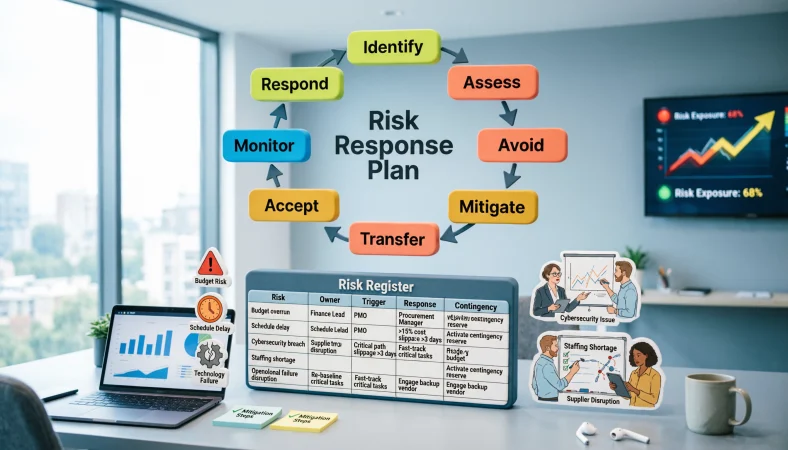
A risk response plan explains what an organization, project team, or business will do when a known risk occurs or becomes more likely. It typically covers risk avoidance, mitigation, transfer, acceptance, monitoring, ownership, triggers, and contingency actions.
Top alternatives: risk management plan, risk mitigation plan, risk action plan, project risk response plan, risk treatment plan
One minute everything is going perfectly, and the next your project has a deadline problem, budget issue, supplier delay, or mysterious “urgent” email sitting in the inbox. That is exactly why a risk response plan matters. It gives teams a practical way to decide what to do before a possible problem turns into an expensive surprise.
Whether you are managing a project, running a business, working with suppliers, planning an event, or simply trying to keep your team’s group chat from becoming an emergency meeting, having clear responses makes a difference.
A good plan identifies important risks, assigns ownership, defines warning signs, and explains whether each risk should be avoided, reduced, transferred, accepted, or handled through a contingency. The goal is not to predict every disaster. It is to make uncertainty easier to manage when reality decides to test your plans.
Risk Response Plan Basics
Know the risk before choosing the response.
Example: Use this when creating a new project risk register.
Meaning: Understanding the risk helps the team select a practical response.
Give every major risk an owner.
Example: Use this when assigning responsibilities during project planning.
Meaning: Ownership makes accountability clear.
Define what success looks like.
Example: Use this when deciding how a risk response should perform.
Meaning: Clear outcomes make the response easier to evaluate.
Write the response before the crisis arrives.
Example: Use this during project planning meetings.
Meaning: Advance preparation reduces rushed decision-making.
Prioritize important risks first.
Example: Use this when a risk register contains dozens of entries.
Meaning: High-impact risks deserve more attention and resources.
Add warning signs to the plan.
Example: Use this when monitoring supplier or budget risks.
Meaning: Early indicators can trigger action before the risk becomes a problem.
Set a response deadline.
Example: Use this when a risk could escalate quickly.
Meaning: Time limits encourage timely action.
Keep the plan easy to understand.
Example: Use this when creating documentation for a mixed team.
Meaning: Simple language makes the plan easier to use.
Connect each response to a specific risk.
Example: Use this when reviewing a large risk register.
Meaning: Clear connections prevent generic responses.
Include contingency actions.
Example: Use this when planning for risks that cannot be completely prevented.
Meaning: Contingency actions provide a backup path when prevention fails.
Review the plan regularly.
Example: Use this during weekly project meetings.
Meaning: Risk conditions can change as the project develops.
Treat the plan as a living document.
Example: Use this throughout a long project.
Meaning: A useful risk plan evolves with new information.
Funny Risk Response Plan Ideas
Plan for problems before they plan for you.
Example: Use this as a lighthearted reminder during project planning.
Meaning: Preparation gives the team a head start.
Because “we’ll figure it out” is not a strategy.
Example: Use this when encouraging better project risk planning.
Meaning: It humorously highlights the weakness of vague preparation.
Keep a backup plan for your backup plan.
Example: Use this when discussing critical project dependencies.
Meaning: Important risks may deserve additional contingency thinking.
Hope is lovely, but documentation is better.
Example: Use this during a risk-management workshop.
Meaning: Written plans provide more practical support than optimism alone.
The spreadsheet saw it coming.
Example: Use this when a previously documented risk becomes real.
Meaning: It celebrates the value of identifying risks early.
Risk happens. Plans help.
Example: Use this as a short team-training slogan.
Meaning: Uncertainty is unavoidable, but preparation can improve the response.
Do not let the deadline become the villain.
Example: Use this when monitoring schedule risks.
Meaning: Early action can prevent deadline pressure from becoming overwhelming.
Your future self would like this risk plan.
Example: Use this when someone postpones risk planning.
Meaning: Preparation today can make future problems easier to handle.
Plot twist detected. Activate the contingency plan.
Example: Use this during a project exercise.
Meaning: It adds humor while emphasizing the importance of backup actions.
The risk register remembers everything.
Example: Use this when documenting recurring project problems.
Meaning: Recording risks helps teams avoid forgetting known issues.
No panic, just Plan B energy.
Example: Use this during contingency-planning discussions.
Meaning: A backup plan encourages calm action when conditions change.
If the plan breaks, read the backup plan.
Example: Use this as a playful project-team reminder.
Meaning: Contingencies exist for situations where the original approach fails.
Professional Risk Response Plan Examples
Assign a responsible risk owner.
Example: Use this when formalizing project governance.
Meaning: A named owner creates clear accountability.
Document the selected response strategy.
Example: Use this when updating an enterprise risk register.
Meaning: Written responses make decisions easier to review.
Define response triggers.
Example: Use this when monitoring operational risks.
Meaning: Triggers indicate when a planned response should begin.
Establish measurable response objectives.
Example: Use this when managing high-priority risks.
Meaning: Objectives provide a way to evaluate response effectiveness.
Align responses with organizational priorities.
Example: Use this when reviewing business risks.
Meaning: Risk actions should support broader business goals.
Identify required response resources.
Example: Use this when planning mitigation activities.
Meaning: Teams need appropriate people, budget, technology, or time to act.
Document escalation requirements.
Example: Use this when a risk could exceed team authority.
Meaning: Escalation rules clarify when additional leadership involvement is needed.
Review residual risk after treatment.
Example: Use this after implementing a mitigation measure.
Meaning: Some level of risk may remain after the response.
Coordinate risk owners across departments.
Example: Use this when risks affect multiple business functions.
Meaning: Cross-functional coordination prevents fragmented responses.
Record response assumptions.
Example: Use this during formal risk planning.
Meaning: Assumptions help explain why a particular response was selected.
Track response progress.
Example: Use this during monthly risk reviews.
Meaning: Progress tracking shows whether planned actions are actually happening.
Close risks only after proper review.
Example: Use this when a previously active risk appears resolved.
Meaning: Formal review reduces the chance of closing a risk too early.
Risk Response Plan For Project Management
Identify project risks early.
Example: Use this during project initiation.
Meaning: Early identification gives the team more time to respond.
Connect risks to project objectives.
Example: Use this when evaluating schedule and budget risks.
Meaning: The connection shows how each risk could affect project success.
Create response actions for high-priority risks.
Example: Use this during project planning.
Meaning: Important risks need more deliberate preparation.
Assign risk owners to project team members.
Example: Use this when building the project risk register.
Meaning: Ownership prevents risks from becoming nobody’s responsibility.
Monitor schedule-related risks.
Example: Use this when dependencies could delay project milestones.
Meaning: Early schedule monitoring can reveal problems before deadlines are affected.
Monitor budget risks.
Example: Use this when project costs are uncertain.
Meaning: Cost monitoring helps identify financial pressure early.
Plan for resource shortages.
Example: Use this when specialist staff are essential to delivery.
Meaning: Backup resources can reduce disruption if availability changes.
Track dependency risks.
Example: Use this when one task depends on another team’s delivery.
Meaning: Dependency monitoring can reveal potential bottlenecks.
Include vendor-related risks.
Example: Use this when external suppliers support the project.
Meaning: Vendor performance can directly affect project delivery.
Review risks at project milestones.
Example: Use this after completing major project phases.
Meaning: Milestones provide useful opportunities to reassess uncertainty.
Update responses when project conditions change.
Example: Use this when scope or requirements change significantly.
Meaning: Old responses may no longer match the current risk environment.
Include risk lessons in project closeout.
Example: Use this after completing the project.
Meaning: Lessons can improve planning for future projects.
Risk Response Plan For Risk Mitigation
Reduce the probability of the risk.
Example: Use this when preventive controls can lower the chance of occurrence.
Meaning: Mitigation focuses on reducing likelihood.
Reduce the impact of the risk.
Example: Use this when the risk cannot be completely prevented.
Meaning: Impact reduction limits potential consequences.
Break large risks into smaller actions.
Example: Use this when a mitigation plan feels overwhelming.
Meaning: Smaller actions are easier to manage and track.
Add preventive controls.
Example: Use this when a process has a known weakness.
Meaning: Preventive controls can reduce the chance of the risk occurring.
Strengthen quality checks.
Example: Use this when errors could create costly rework.
Meaning: Additional checks can identify problems earlier.
Improve staff training.
Example: Use this when human error contributes to a known risk.
Meaning: Training can improve awareness and execution.
Automate repetitive controls.
Example: Use this when manual processes create avoidable errors.
Meaning: Automation can reduce certain forms of human error.
Create technical safeguards.
Example: Use this when technology-related risks are significant.
Meaning: Safeguards can reduce exposure to specific threats.
Improve process documentation.
Example: Use this when inconsistent procedures create risk.
Meaning: Clear processes help teams perform tasks more consistently.
Test mitigation measures.
Example: Use this before relying on a new control.
Meaning: Testing reveals whether the mitigation actually works as intended.
Measure mitigation effectiveness.
Example: Use this during recurring risk reviews.
Meaning: Measurement shows whether the response is reducing exposure.
Keep a backup mitigation option.
Example: Use this when the primary control could fail.
Meaning: An alternative response provides additional resilience.
Risk Response Plan For Risk Avoidance
Change the project approach.
Example: Use this when a planned method creates unacceptable exposure.
Meaning: Changing the approach can remove the source of the risk.
Remove unnecessary risk from the scope.
Example: Use this when a project feature creates disproportionate uncertainty.
Meaning: Eliminating unnecessary exposure can simplify delivery.
Choose a safer supplier.
Example: Use this when a vendor creates significant operational concerns.
Meaning: Supplier selection can eliminate certain vendor-specific risks.
Move away from an unreliable technology.
Example: Use this when a technology creates repeated operational problems.
Meaning: Replacing the technology can remove the associated risk.
Avoid unrealistic deadlines.
Example: Use this when compressed schedules create predictable quality problems.
Meaning: Adjusting the timeline can remove unnecessary schedule pressure.
Remove a fragile dependency.
Example: Use this when a project relies heavily on one external component.
Meaning: Eliminating the dependency can reduce exposure to disruption.
Redesign the process.
Example: Use this when the current workflow repeatedly creates errors.
Meaning: Process redesign can remove the source of recurring risk.
Stop an activity that creates disproportionate exposure.
Example: Use this when a planned activity offers little value compared with its potential downside.
Meaning: Ending the activity can eliminate that specific exposure.
Use an alternative delivery method.
Example: Use this when the original approach creates significant uncertainty.
Meaning: A different method may avoid the original risk.
Move a critical task earlier.
Example: Use this when a late dependency could threaten a deadline.
Meaning: Changing timing can reduce exposure to downstream uncertainty.
Choose proven technology for critical functions.
Example: Use this when experimental technology creates unnecessary project risk.
Meaning: A mature option may remove certain implementation uncertainties.
Accept a smaller scope to avoid major exposure.
Example: Use this when reducing scope makes delivery substantially more predictable.
Meaning: Scope reduction can eliminate risks created by unnecessary complexity.
Risk Response Plan For Risk Transfer
Transfer risk through appropriate insurance.
Example: Use this when financial exposure can be covered through an insurance arrangement.
Meaning: Financial consequences may be shifted according to the agreement.
Use contracts to allocate responsibilities.
Example: Use this when working with external providers.
Meaning: Contract terms can assign specific responsibilities between parties.
Outsource specialized activities when appropriate.
Example: Use this when internal teams lack required expertise.
Meaning: External specialists may assume responsibility for specific activities.
Use service-level agreements.
Example: Use this when vendor performance affects important services.
Meaning: Agreements can establish defined responsibilities and service expectations.
Include liability provisions where appropriate.
Example: Use this during contract planning.
Meaning: Contractual provisions can clarify financial responsibility for certain events.
Transfer operational tasks to qualified providers.
Example: Use this when specialized operations are better handled externally.
Meaning: Responsibility can move to a provider with relevant capabilities.
Use warranties when available.
Example: Use this when purchasing products with defined performance expectations.
Meaning: Warranties can shift certain repair or replacement responsibilities.
Clarify vendor responsibilities in writing.
Example: Use this before signing a major service agreement.
Meaning: Written responsibilities reduce ambiguity.
Review transferred risks periodically.
Example: Use this during vendor governance reviews.
Meaning: A transferred risk still requires oversight.
Check contractual coverage carefully.
Example: Use this before assuming a vendor or insurer covers a specific risk.
Meaning: Actual terms determine what has been transferred.
Maintain internal oversight after transfer.
Example: Use this when outsourcing a critical business process.
Meaning: Transferring responsibility does not remove the need for governance.
Keep contingency options even after transfer.
Example: Use this when a critical service depends on an external provider.
Meaning: External arrangements can still fail or become unavailable.
Risk Response Plan For Risk Acceptance
Accept low-level risks intentionally.
Example: Use this when treatment costs exceed the expected impact of a minor risk.
Meaning: Acceptance can be a deliberate management decision.
Document accepted risks.
Example: Use this when maintaining a formal risk register.
Meaning: Documentation shows that acceptance was considered rather than overlooked.
Define acceptable thresholds.
Example: Use this when deciding which risks require treatment.
Meaning: Thresholds create consistency in decision-making.
Monitor accepted risks.
Example: Use this during regular risk reviews.
Meaning: An accepted risk can become more important as conditions change.
Set triggers for reassessment.
Example: Use this when accepting a risk temporarily.
Meaning: Triggers indicate when the risk should be reviewed again.
Accept risk when treatment is disproportionate.
Example: Use this when a minor risk would require expensive controls.
Meaning: Resources can be directed toward more significant exposures.
Record who approved acceptance.
Example: Use this during formal governance processes.
Meaning: Approval clarifies accountability.
Separate acceptance from ignoring the risk.
Example: Use this when explaining risk management to a new team.
Meaning: Acceptance means consciously deciding to tolerate exposure.
Review accepted risks after major changes.
Example: Use this after a significant business or project change.
Meaning: Changed conditions can alter the original risk calculation.
Keep acceptance decisions current.
Example: Use this during quarterly risk reviews.
Meaning: Old decisions may no longer reflect current circumstances.
Monitor trends around accepted risks.
Example: Use this when an accepted operational issue starts appearing more frequently.
Meaning: Increasing frequency can justify a new response.
Know when acceptance has expired.
Example: Use this when a temporary risk tolerance was approved.
Meaning: Time limits help prevent outdated acceptance decisions.
Risk Response Plan For Contingency Planning
Create a Plan B for important risks.
Example: Use this when a project depends on one critical supplier.
Meaning: A contingency provides an alternative when the original approach fails.
Define the trigger for Plan B.
Example: Use this when developing a supplier backup strategy.
Meaning: Clear triggers prevent delayed action.
Identify contingency resources.
Example: Use this when preparing for staffing shortages.
Meaning: Backup resources need to be available when required.
Document emergency decision authority.
Example: Use this when planning for high-impact disruptions.
Meaning: Teams need to know who can activate contingency actions.
Prepare alternative suppliers.
Example: Use this when supply continuity is important.
Meaning: Additional suppliers can provide options during disruption.
Create backup communication channels.
Example: Use this when planning for technology outages.
Meaning: Alternative communication can keep teams coordinated.
Test contingency procedures.
Example: Use this when preparing for business disruption.
Meaning: Testing shows whether the backup process is practical.
Estimate contingency costs.
Example: Use this when creating a project contingency budget.
Meaning: Financial preparation makes emergency action easier.
Define recovery priorities.
Example: Use this when several business services could be disrupted.
Meaning: Priorities guide the order of recovery.
Keep contingency documentation accessible.
Example: Use this when preparing for an emergency.
Meaning: A plan is only useful if people can find it.
Update contingency plans after exercises.
Example: Use this after a tabletop simulation.
Meaning: Exercises often reveal weaknesses that need correction.
Activate contingencies based on evidence.
Example: Use this when a predefined trigger occurs.
Meaning: Evidence-based activation reduces unnecessary disruption.
Risk Response Plan For Business Operations
Identify operational bottlenecks.
Example: Use this during business continuity planning.
Meaning: Bottlenecks can create major disruptions when demand or conditions change.
Protect critical processes.
Example: Use this when ranking operational risks.
Meaning: Essential processes should receive appropriate response planning.
Map important dependencies.
Example: Use this when a process depends on vendors or technology.
Meaning: Dependency mapping reveals where disruptions could spread.
Plan for staff shortages.
Example: Use this when essential activities rely on a small number of employees.
Meaning: Cross-training and backup staffing can improve resilience.
Plan for equipment failure.
Example: Use this when operations depend on specialized equipment.
Meaning: Backup equipment or repair arrangements can reduce downtime.
Prepare for supplier disruption.
Example: Use this when operations rely on external materials.
Meaning: Supplier alternatives can reduce continuity risks.
Monitor operational warning signs.
Example: Use this when tracking service quality or production performance.
Meaning: Early indicators can reveal growing problems.
Document critical operating procedures.
Example: Use this when preparing for employee absence or turnover.
Meaning: Documentation helps maintain consistency.
Establish escalation paths.
Example: Use this when operational problems can quickly affect customers.
Meaning: Escalation helps serious issues receive timely attention.
Review business continuity dependencies.
Example: Use this during annual planning.
Meaning: Critical dependencies can change as the business evolves.
Test recovery procedures.
Example: Use this before relying on them during a disruption.
Meaning: Testing reveals gaps before an actual emergency.
Learn from operational disruptions.
Example: Use this after a service interruption.
Meaning: Real events provide useful information for improving resilience.
Risk Response Plan For Financial Risks
Monitor budget variance.
Example: Use this during monthly project reviews.
Meaning: Variance can provide an early signal of financial risk.
Create cost thresholds.
Example: Use this when monitoring project spending.
Meaning: Thresholds can trigger review before costs become difficult to control.
Maintain contingency reserves when appropriate.
Example: Use this during financial planning for uncertain projects.
Meaning: Reserves can provide flexibility for unexpected costs.
Review major spending assumptions.
Example: Use this during budget preparation.
Meaning: Weak assumptions can create inaccurate financial expectations.
Plan for price increases.
Example: Use this when projects rely on volatile supplier pricing.
Meaning: Alternative scenarios can reduce exposure to unexpected increases.
Monitor cash-flow risks.
Example: Use this when managing business operations.
Meaning: Cash-flow problems can affect the ability to meet obligations.
Use contractual price protections when appropriate.
Example: Use this when negotiating long-term supplier arrangements.
Meaning: Certain contract terms can reduce exposure to unexpected pricing changes.
Review financial dependencies.
Example: Use this when one customer or supplier represents significant exposure.
Meaning: Concentration can increase financial vulnerability.
Create alternative funding scenarios.
Example: Use this when a project depends on uncertain funding.
Meaning: Backup options can reduce disruption if expected funding changes.
Track financial risk indicators.
Example: Use this during regular management reviews.
Meaning: Indicators can highlight emerging financial pressure.
Escalate major financial risks early.
Example: Use this when projected costs threaten a critical objective.
Meaning: Early escalation gives leadership more options.
Update financial responses as conditions change.
Example: Use this during periods of changing market conditions.
Meaning: Financial assumptions can become outdated quickly.
Risk Response Plan For Technology And Cybersecurity
Identify critical technology dependencies.
Example: Use this when planning IT risk responses.
Meaning: Critical dependencies should receive focused preparation.
Prepare for system outages.
Example: Use this when a business relies heavily on digital services.
Meaning: Outage planning can reduce operational disruption.
Maintain appropriate backups.
Example: Use this when protecting important business information.
Meaning: Recoverable copies can support restoration after certain incidents.
Plan for cybersecurity incidents.
Example: Use this when developing an enterprise technology risk register.
Meaning: Security events can require rapid containment and recovery.
Protect critical accounts.
Example: Use this when reviewing technology access risks.
Meaning: Compromised privileged accounts can create significant exposure.
Document system recovery procedures.
Example: Use this when preparing for technology disruption.
Meaning: Clear recovery steps can reduce confusion.
Test disaster recovery procedures.
Example: Use this when validating technology resilience.
Meaning: Testing helps determine whether recovery plans actually work.
Monitor technology warning indicators.
Example: Use this when managing infrastructure risks.
Meaning: Early technical signals can provide time for intervention.
Maintain vendor contingency options.
Example: Use this when critical software depends on an external provider.
Meaning: Alternatives can reduce dependency risk.
Review technology risks after major changes.
Example: Use this when implementing a new platform.
Meaning: New technology can introduce new dependencies and exposures.
Train employees on technology risks.
Example: Use this when reducing avoidable security or operational mistakes.
Meaning: Awareness can improve the effectiveness of technical controls.
Update technology response plans regularly.
Example: Use this during IT governance reviews.
Meaning: Technology environments change too quickly for static plans.
Risk Response Plan For Monitoring, Review, And Improvement
Review the risk register regularly.
Example: Use this during weekly or monthly project governance meetings.
Meaning: Regular review keeps risk information current.
Track whether responses are completed.
Example: Use this when monitoring mitigation actions.
Meaning: A planned response has little value if nobody implements it.
Measure response effectiveness.
Example: Use this after implementing a major risk treatment.
Meaning: Measurement shows whether the response achieved its intended result.
Review new risks as conditions change.
Example: Use this when a project enters a new phase.
Meaning: New circumstances can introduce new uncertainties.
Retire risks that are no longer relevant.
Example: Use this when a project milestone removes a previous dependency.
Meaning: Removing outdated risks keeps the register useful.
Escalate risks that cross defined thresholds.
Example: Use this when an operational indicator reaches a predefined limit.
Meaning: Thresholds help trigger timely action.
Review residual risk after treatment.
Example: Use this after completing a mitigation activity.
Meaning: Treatment may reduce risk without eliminating it entirely.
Capture lessons from failed responses.
Example: Use this after a mitigation action does not work as expected.
Meaning: Failed responses can reveal valuable planning weaknesses.
Capture lessons from successful responses.
Example: Use this after a major risk is handled effectively.
Meaning: Successful practices can become reusable patterns.
Update ownership when responsibilities change.
Example: Use this after organizational restructuring.
Meaning: Risk ownership must remain aligned with actual responsibilities.
Refresh response assumptions.
Example: Use this during quarterly risk reviews.
Meaning: Old assumptions can make otherwise good plans unreliable.
Turn lessons into action items.
Example: Use this during post-project risk reviews.
Meaning: Improvement becomes meaningful when lessons produce specific changes.
FAQs
What does a risk response plan mean?
A risk response plan explains how a team or organization intends to handle identified risks, including prevention, mitigation, transfer, acceptance, monitoring, and contingency actions.
What are the main types of risk responses?
Common responses include avoiding, mitigating, transferring, and accepting risk. Contingency planning and escalation are also frequently used as supporting approaches.
Is a risk response plan the same as a risk management plan?
Not exactly. A risk management plan describes the overall approach to managing risk, while a risk response plan focuses more specifically on what will be done about identified risks.
What should a risk response plan include?
It can include the identified risk, potential impact, probability, owner, selected response, response actions, triggers, resources, deadlines, contingency measures, and monitoring requirements.
Can a risk response plan be used for projects?
Yes. Project teams commonly use risk response planning to address schedule, budget, resource, quality, supplier, technology, and scope-related risks.
What is a risk response strategy?
A risk response strategy is the chosen approach for dealing with a particular risk. Examples include avoiding the risk, reducing its likelihood or impact, transferring responsibility, or consciously accepting it.
What is the difference between risk mitigation and risk avoidance?
Mitigation attempts to reduce the likelihood or impact of a risk, while avoidance changes the situation so the particular risk is removed or no longer applies.
What is risk transfer?
Risk transfer involves shifting some responsibility or financial exposure to another party through mechanisms such as contracts, insurance, warranties, or outsourcing arrangements.
What does risk acceptance mean?
Risk acceptance means consciously deciding to tolerate a particular level of risk rather than applying additional treatment, usually while continuing to monitor it.
When should a risk response plan be updated?
It should be reviewed whenever major project, business, technology, supplier, financial, or operational conditions change, as well as during scheduled risk reviews.
Is humor appropriate in a risk response plan?
A little humor can work in training materials or team discussions, but formal risk documentation should remain clear, professional, and easy to act on.
What should you do if you do not know how to respond to a risk?
Begin by understanding and assessing the risk, assigning an owner, choosing whether to avoid, mitigate, transfer, or accept it, and defining monitoring and contingency measures.
Conclusion
A strong risk response plan turns uncertainty from a vague “hopefully nothing happens” situation into something your team can actually manage. The goal is not to eliminate every possible risk because, honestly, that would require a crystal ball and probably three extra departments. Instead, identify meaningful risks, choose practical responses, assign owners, watch for warning signs, and prepare contingency actions when prevention is not enough.
Keep reviewing the plan as projects, markets, people, and priorities change. The best response plan is one your team understands and can actually use when pressure arrives. Save this guide, share it with your project team, and turn your next risk conversation into a much more organized one.