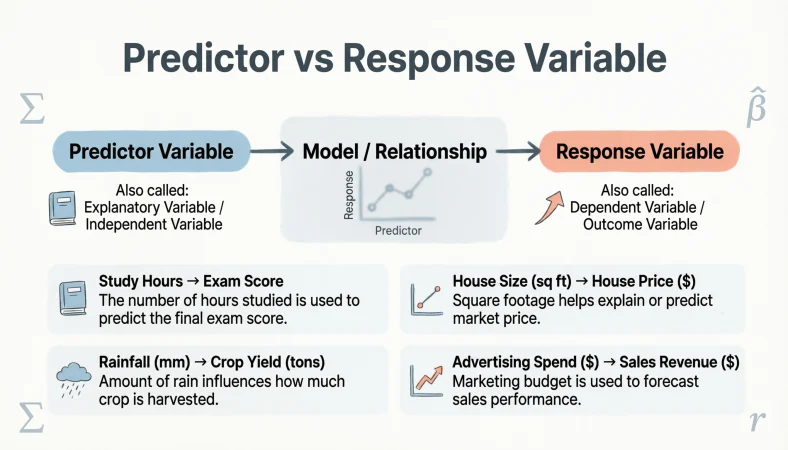
A predictor variable is the variable used to explain or predict an outcome, while a response variable is the outcome being measured or explained. In simple terms, predictor = what you use to make the prediction, response = what you are trying to predict.
Top alternatives: explanatory variable, response variable, predictor variable, independent variable, dependent variable
Ever looked at a statistics question and thought, “Okay, but which variable is actually doing what?” You are definitely not alone. The difference between a predictor and a response variable can feel confusing at first, especially when you are dealing with regression, experiments, research papers, homework, or data analysis.
Whether you are studying for an exam, explaining results to classmates, writing a report at work, or trying to make sense of a graph your professor just dropped into the group chat, knowing the roles of these variables makes everything easier. Understanding predictor vs response variable is mainly about identifying what is being used to explain or predict something and what outcome is being measured. Once you spot that relationship, many statistics questions suddenly become much less intimidating.
Funny Predictor vs Response Variable Explanations
Predictor asks the question, response gives the answer.
Example: Use this when explaining the concept casually to a friend who finds statistics confusing.
Meaning: The predictor helps explain or forecast the response.
Predictor is the setup, response is the result.
Example: Use this as a quick study note before an exam.
Meaning: One variable helps account for the other variable’s observed outcome.
Predictor brings the clues, response brings the plot twist.
Example: Use this when making a statistics presentation more entertaining.
Meaning: The predictor provides information that helps explain the outcome.
Predictor says “watch this,” response says “here’s what happened.”
Example: Use this as a memorable classroom explanation.
Meaning: The predictor is used to anticipate the measured response.
Think predictor first, response second.
Example: Use this as a simple reminder while solving regression questions.
Meaning: The predictor is the input or explanatory side of the relationship.
Predictor does the forecasting, response does the appearing.
Example: Use this when creating flashcards for basic statistics.
Meaning: The predictor helps forecast a response that is actually observed.
Predictor is the detective, response is the evidence.
Example: Use this analogy when a classmate needs a visual way to remember the roles.
Meaning: The predictor helps investigate variation in the response.
Predictor sets the scene, response tells us what happened.
Example: Use this in a study group discussion.
Meaning: The response is the measured outcome associated with the predictor.
Predictor walks in first, response reveals the result.
Example: Use this when explaining a simple regression model.
Meaning: The predictor is used to estimate the response.
Statistics made simple: predict this, measure that.
Example: Use this as a short revision note.
Meaning: Predictors are used for prediction, while responses are measured outcomes.
Predictor is the hint, response is the answer key.
Example: Use this when explaining correlation to someone new to statistics.
Meaning: The predictor provides information about the response.
No mystery: predictor predicts, response responds.
Example: Use this when someone wants the shortest possible explanation.
Meaning: The names describe the basic roles of the two variables.
Simple Predictor vs Response Variable Explanations
The predictor variable helps explain or predict the response variable.
Example: Use this as a straightforward definition in study notes.
Meaning: The predictor provides information about the outcome.
The response variable is the outcome you measure.
Example: Use this when identifying variables in a research question.
Meaning: The response represents what the analysis is trying to understand.
The predictor is the explanatory side of the relationship.
Example: Use this when comparing terminology across statistics textbooks.
Meaning: Predictor variables are often called explanatory variables.
The response is the variable being explained.
Example: Use this when answering a basic statistics worksheet.
Meaning: The response changes or varies in relation to predictors.
Predictors help estimate responses.
Example: Use this as a concise regression definition.
Meaning: Regression models use predictor information to estimate outcomes.
Response variables are commonly called dependent variables.
Example: Use this when connecting statistics terminology across courses.
Meaning: The response often corresponds to the dependent variable.
Predictor variables are commonly called explanatory variables.
Example: Use this when creating a terminology cheat sheet.
Meaning: The predictor is used to explain variation in the response.
Ask “What am I predicting?” to find the response.
Example: Use this trick during an exam.
Meaning: The variable being predicted is generally the response variable.
Ask “What am I using to predict it?” to find the predictor.
Example: Use this when a statistics question gives several variables.
Meaning: The variable used for prediction is the predictor.
The response is usually the main outcome of interest.
Example: Use this when planning a research analysis.
Meaning: Researchers often focus their interpretation on the response.
The predictor provides potential explanatory information.
Example: Use this when describing observational data.
Meaning: A predictor can help account for differences in the response.
The roles depend on the research question.
Example: Use this when two variables could logically play different roles in different studies.
Meaning: A variable is not permanently a predictor or response in every analysis.
Predictor vs Response Variable Examples
Hours studied can predict exam score.
Example: Use this example when learning the basic structure of a regression problem.
Meaning: Hours studied is the predictor and exam score is the response.
Advertising spending can predict sales revenue.
Example: Use this for a business statistics assignment.
Meaning: Advertising spending is the predictor and sales revenue is the response.
Temperature can predict ice cream sales.
Example: Use this when explaining a real-world relationship.
Meaning: Temperature is the predictor and ice cream sales are the response.
Exercise time can predict calories burned.
Example: Use this in a fitness-related statistics example.
Meaning: Exercise time serves as the predictor and calories burned serve as the response.
Age can predict annual healthcare spending.
Example: Use this when discussing population data.
Meaning: Age is the predictor and healthcare spending is the response.
Rainfall can predict crop yield.
Example: Use this for an environmental statistics example.
Meaning: Rainfall is the predictor and crop yield is the response.
Study hours can predict test performance.
Example: Use this when creating a simple classroom example.
Meaning: Study hours provide explanatory information about performance.
House size can predict house price.
Example: Use this for an introductory real estate data example.
Meaning: House size is the predictor and house price is the response.
Sleep duration can predict reaction time.
Example: Use this in a psychology or health research example.
Meaning: Sleep duration is the predictor and reaction time is the response.
Distance traveled can predict fuel consumption.
Example: Use this when explaining transportation data.
Meaning: Distance is the predictor and fuel consumption is the response.
Advertising exposure can predict website visits.
Example: Use this in a digital marketing analytics example.
Meaning: Advertising exposure is the predictor and website visits are the response.
Practice time can predict athletic performance.
Example: Use this when discussing sports performance data.
Meaning: Practice time is the predictor and performance is the response.
Professional Predictor vs Response Variable Explanations
The predictor variable represents an explanatory input in the model.
Example: Use this in a formal statistics report.
Meaning: The predictor contributes information used to model the outcome.
The response variable represents the measured outcome.
Example: Use this in academic writing.
Meaning: The response is the primary variable being modeled.
Regression uses predictors to estimate a response.
Example: Use this when introducing regression methodology in a report.
Meaning: Predictors provide information for estimating the dependent outcome.
The response should be clearly defined before analysis.
Example: Use this during research planning.
Meaning: A clear outcome definition helps determine which variables belong in the model.
Predictor selection should reflect the research question.
Example: Use this in a research methodology discussion.
Meaning: Variables should be included for a defensible analytical reason.
Predictors may be continuous or categorical.
Example: Use this when documenting model variables.
Meaning: Predictor variables can take numerical or group-based forms.
The response may also be continuous or categorical.
Example: Use this when discussing different statistical models.
Meaning: The response type influences which analytical method is appropriate.
Multiple predictors can be used for one response.
Example: Use this when describing multiple regression.
Meaning: Several explanatory variables can jointly model one outcome.
One predictor can sometimes be used to study one response.
Example: Use this when explaining simple linear regression.
Meaning: A simple model may contain one predictor and one response.
Variable roles should be tied to the stated objective.
Example: Use this in a research proposal.
Meaning: The analytical goal determines which variable is treated as the outcome.
Association does not automatically establish causation.
Example: Use this when interpreting observational regression results.
Meaning: A predictor can be associated with a response without causing it.
Clear variable labels make results easier to interpret.
Example: Use this when preparing a professional report.
Meaning: Explicit labels reduce confusion about model structure.
Academic Predictor vs Response Variable Examples
In a study of education, study time may predict grades.
Example: Use this in an introductory research methods assignment.
Meaning: Study time is the predictor and grades are the response.
In economics, income may predict spending.
Example: Use this when illustrating economic data analysis.
Meaning: Income serves as the predictor and spending serves as the response.
In biology, temperature may predict growth rate.
Example: Use this in a laboratory report example.
Meaning: Temperature is the predictor and growth rate is the response.
In psychology, sleep may predict concentration.
Example: Use this when explaining behavioral research.
Meaning: Sleep duration provides information about concentration outcomes.
In medicine, dosage may predict measured drug response.
Example: Use this when discussing experimental variables.
Meaning: Dosage is the predictor and measured response is the outcome.
In agriculture, fertilizer amount may predict crop yield.
Example: Use this in an agricultural research example.
Meaning: Fertilizer amount is the predictor and crop yield is the response.
In marketing, campaign spending may predict conversions.
Example: Use this when discussing digital campaign analysis.
Meaning: Spending acts as a predictor of conversion outcomes.
In sports, training hours may predict performance time.
Example: Use this in a sports analytics assignment.
Meaning: Training hours are the predictor and performance time is the response.
In climate research, rainfall may predict river flow.
Example: Use this for an environmental statistics project.
Meaning: Rainfall provides explanatory information for river flow.
In finance, interest rates may predict borrowing levels.
Example: Use this when illustrating economic relationships.
Meaning: Interest rate is the predictor and borrowing level is the response.
In sociology, demographic factors may predict survey responses.
Example: Use this in a social science methodology discussion.
Meaning: Demographic variables can be predictors of measured responses.
In technology research, processing time may predict system output.
Example: Use this in a data science assignment.
Meaning: Processing time is the predictor and system output is the response.
Casual Predictor vs Response Variable Explanations
Think “what helps me predict?” for the predictor.
Example: Use this when casually teaching someone the distinction.
Meaning: The predictor is the information used to make an estimate.
Think “what am I trying to predict?” for the response.
Example: Use this when revising before a quiz.
Meaning: The response is the target outcome.
Predictor equals useful clue.
Example: Use this as a quick memory trick.
Meaning: Predictors provide information about the outcome.
Response equals measured result.
Example: Use this when writing a flashcard.
Meaning: The response is the observed outcome.
If it helps explain the result, it may be a predictor.
Example: Use this when sorting variables in a dataset.
Meaning: Explanatory variables can function as predictors.
If it is the result being studied, it is likely the response.
Example: Use this during homework.
Meaning: The response is the outcome of interest.
Predictor gives context, response gives the outcome.
Example: Use this when explaining regression casually.
Meaning: The predictor provides information used to model the response.
Response is the star of the research question.
Example: Use this when identifying the main outcome.
Meaning: The response is usually the variable researchers want to understand.
Predictor is the supporting cast.
Example: Use this as a memorable analogy in a study group.
Meaning: Predictors help explain variation in the main outcome.
One question can reveal both roles.
Example: Use this when teaching a beginner how to read research questions.
Meaning: Asking what predicts what can identify both variables.
The wording of the question usually gives the clue.
Example: Use this when solving word problems.
Meaning: Phrases such as “predict,” “explain,” and “outcome” reveal variable roles.
Keep the research question in charge.
Example: Use this when a variable seems capable of playing either role.
Meaning: The study objective determines how the variables are assigned.
Predictor vs Response Variable in Regression
The predictor appears on the explanatory side of a regression model.
Example: Use this when introducing regression notation.
Meaning: Predictors provide inputs for estimating the response.
The response is the outcome modeled by regression.
Example: Use this when interpreting regression output.
Meaning: The model estimates or explains variation in the response.
Simple regression uses one predictor and one response.
Example: Use this in an introductory statistics lesson.
Meaning: Simple regression models one outcome using one predictor.
Multiple regression uses several predictors.
Example: Use this when explaining a more advanced model.
Meaning: Multiple regression incorporates several explanatory variables.
A regression equation connects predictors with the response.
Example: Use this when studying model formulas.
Meaning: The equation describes how predictor information relates to the outcome.
The response is often represented by Y.
Example: Use this when reviewing standard statistical notation.
Meaning: Y commonly represents the dependent or response variable.
A predictor is often represented by X.
Example: Use this when learning regression notation.
Meaning: X commonly represents an explanatory or predictor variable.
The fitted model estimates expected response values.
Example: Use this when discussing regression predictions.
Meaning: Regression produces estimated outcomes based on predictor values.
Residuals describe differences between observed and fitted responses.
Example: Use this when studying regression diagnostics.
Meaning: Residuals measure prediction errors for observed outcomes.
Regression coefficients describe predictor relationships with the response.
Example: Use this when interpreting a regression table.
Meaning: Coefficients quantify modeled changes associated with predictors.
A predictor coefficient needs context for interpretation.
Example: Use this when writing an analysis report.
Meaning: Interpretation depends on units, model structure, and other predictors.
Prediction and explanation are related but not identical goals.
Example: Use this when discussing regression research objectives.
Meaning: A useful predictor does not automatically establish a causal relationship.
Predictor vs Response Variable in Experiments
The response variable is what the experiment measures.
Example: Use this when identifying outcomes in a laboratory experiment.
Meaning: The response captures the observed result.
The predictor may represent an experimental condition.
Example: Use this when discussing treatment groups.
Meaning: The predictor can describe the factor used to compare outcomes.
A treatment level can serve as a predictor.
Example: Use this when explaining an experiment with several treatment doses.
Meaning: Treatment level can be used to model differences in the response.
The measured outcome belongs to the response side.
Example: Use this when designing an experiment.
Meaning: The response is the variable recorded to assess results.
Control variables can also appear as predictors in models.
Example: Use this when discussing adjusted statistical analysis.
Meaning: Additional variables may be included to account for other sources of variation.
Experimental design comes before statistical interpretation.
Example: Use this when explaining why variable roles should be planned early.
Meaning: Clear design helps define predictors and responses properly.
Randomization can support causal interpretation.
Example: Use this when discussing controlled experiments.
Meaning: Random assignment can reduce systematic differences between treatment groups.
A predictor does not always mean a cause.
Example: Use this when distinguishing experiments from observational studies.
Meaning: The predictor label alone does not prove causality.
The response should match the research objective.
Example: Use this when selecting an outcome for a study.
Meaning: The measured response should answer the research question.
Experimental factors may have multiple levels.
Example: Use this when discussing treatment groups.
Meaning: A categorical predictor can contain several experimental conditions.
Repeated measurements can create more complex response structures.
Example: Use this in advanced experimental research.
Meaning: Multiple observations from the same subject may require specialized analysis.
The predictor-response distinction keeps experimental questions organized.
Example: Use this when preparing a research plan.
Meaning: Clear roles make the relationship between treatment and outcome easier to analyze.
Predictor vs Response Variable in Data Science
Predictors are commonly called features in machine learning.
Example: Use this when connecting statistics with data science terminology.
Meaning: Features provide information used to predict a target.
The response is often called the target variable.
Example: Use this when studying supervised learning terminology.
Meaning: The target is the outcome a model is trained to predict.
Features go in, predictions come out.
Example: Use this as a beginner-friendly data science explanation.
Meaning: Input features provide information for estimating the target.
A target variable can be continuous.
Example: Use this when predicting prices or temperatures.
Meaning: Continuous targets represent numerical outcomes.
A target variable can be categorical.
Example: Use this when predicting classes or labels.
Meaning: Categorical responses represent distinct groups or outcomes.
Predictors should be available when making predictions.
Example: Use this when designing a prediction system.
Meaning: A model cannot reliably use information that will not exist at prediction time.
Data leakage can make predictors misleading.
Example: Use this when reviewing a machine learning model.
Meaning: Leakage occurs when training information improperly includes future or target-related information.
Feature engineering changes how predictor information is represented.
Example: Use this when preparing data for modeling.
Meaning: Raw variables can be transformed into useful predictive features.
The target must be clearly defined.
Example: Use this before training a supervised learning model.
Meaning: The model needs a specific outcome to predict.
Training data contains predictors and known responses.
Example: Use this when explaining supervised learning.
Meaning: Models learn patterns from inputs paired with observed targets.
Evaluation compares predictions with actual responses.
Example: Use this when discussing model performance.
Meaning: Prediction quality is assessed against known outcomes.
Good prediction does not automatically mean causal understanding.
Example: Use this when comparing machine learning with scientific explanation.
Meaning: Predictive usefulness and causal interpretation answer different questions.
Predictor vs Response Variable in Research Questions
What predicts the outcome?
Example: Use this question when identifying the predictor in a research problem.
Meaning: The answer usually points toward the explanatory variable.
What is the outcome being measured?
Example: Use this when identifying the response.
Meaning: The measured outcome is generally the response variable.
Does exercise time predict fitness score?
Example: Use this as a simple research question.
Meaning: Exercise time is the predictor and fitness score is the response.
Does income predict monthly spending?
Example: Use this in a social science example.
Meaning: Income is the predictor and spending is the response.
Does temperature predict electricity use?
Example: Use this for an energy research example.
Meaning: Temperature acts as the predictor and electricity use is the response.
Does advertising exposure predict purchases?
Example: Use this in a marketing research question.
Meaning: Advertising exposure is the predictor and purchases are the response.
Does sleep duration predict concentration scores?
Example: Use this in a behavioral research example.
Meaning: Sleep duration is the predictor and concentration score is the response.
Does rainfall predict crop production?
Example: Use this in agricultural research.
Meaning: Rainfall is the predictor and crop production is the response.
Does age predict reaction time?
Example: Use this in a psychology statistics exercise.
Meaning: Age is the predictor and reaction time is the response.
Does training frequency predict race performance?
Example: Use this in a sports research project.
Meaning: Training frequency is the predictor and performance is the response.
Does house size predict selling price?
Example: Use this when practicing regression questions.
Meaning: House size is the predictor and selling price is the response.
Does screen time predict sleep duration?
Example: Use this in a technology behavior study.
Meaning: Screen time is the predictor and sleep duration is the response.
Confident Predictor vs Response Variable Explanations
I know what I am predicting, so I know my response.
Example: Use this as a confident study reminder.
Meaning: Identifying the target outcome reveals the response variable.
I know what I am using to predict it, so I know my predictor.
Example: Use this before answering a regression question.
Meaning: The information used to estimate the outcome is the predictor.
Predictor and response are roles, not personality types.
Example: Use this when explaining why variable roles can change between studies.
Meaning: The same variable can have different roles in different research questions.
The research question tells you the direction.
Example: Use this when a dataset contains many variables.
Meaning: The analytical question determines which variable is the response.
Find the outcome first, then find the predictor.
Example: Use this as an exam strategy.
Meaning: Starting with the target often makes the distinction easier.
If the model predicts it, it is the response.
Example: Use this when reading a model description.
Meaning: The predicted outcome is generally the response variable.
If the model uses it to predict, it is a predictor.
Example: Use this when identifying model inputs.
Meaning: Variables supplying predictive information are predictors.
Do not let the variable names fool you.
Example: Use this when a dataset has confusing column names.
Meaning: Variable roles depend on the analysis rather than labels alone.
One dataset can contain many predictors and one response.
Example: Use this when describing multiple regression.
Meaning: Several variables can jointly explain one outcome.
The response is usually the question mark at the end.
Example: Use this as a memorable revision phrase.
Meaning: It represents what the analysis wants to understand.
The predictor is the evidence brought to the model.
Example: Use this when explaining regression intuitively.
Meaning: Predictors provide information used to estimate the response.
Once the roles click, the terminology gets much easier.
Example: Use this as encouragement for statistics beginners.
Meaning: Understanding the basic relationship simplifies later statistical concepts.
Common Predictor vs Response Variable Mistakes
Mistake: assuming predictor always means cause.
Example: Use this when reviewing an observational study.
Meaning: A predictor can be associated with an outcome without causing it.
Mistake: calling every independent variable a predictor without context.
Example: Use this when comparing experimental and observational terminology.
Meaning: Terminology can depend on the statistical framework and study design.
Mistake: choosing the predictor based only on the variable name.
Example: Use this when working with an unfamiliar dataset.
Meaning: The research question should guide variable roles.
Mistake: forgetting what the study is trying to predict.
Example: Use this when answering a word problem.
Meaning: Identifying the outcome first can prevent role confusion.
Mistake: treating correlation as proof of causation.
Example: Use this when interpreting observational regression.
Meaning: Association alone does not demonstrate a causal effect.
Mistake: ignoring the measurement scale.
Example: Use this when selecting an analytical method.
Meaning: Variable type affects how the model should be constructed.
Mistake: assuming every response variable is numerical.
Example: Use this when learning classification models.
Meaning: Responses can also be categorical.
Mistake: assuming every predictor must be numerical.
Example: Use this when studying regression with categorical predictors.
Meaning: Predictors can be categorical as well as numerical.
Mistake: confusing an input with an outcome.
Example: Use this when reading a machine learning workflow.
Meaning: Inputs are predictors and the target is the response.
Mistake: ignoring the research objective.
Example: Use this when designing a statistical study.
Meaning: The objective determines what should be modeled as the response.
Mistake: interpreting a coefficient without checking its units.
Example: Use this when reading regression output.
Meaning: Coefficients only make sense in the context of measurement scales.
Mistake: assuming the relationship works in reverse automatically.
Example: Use this when explaining predictor and response roles.
Meaning: Predictive modeling direction depends on the stated analytical question.
Predictor vs Response Variable Study Notes
Predictor = explanatory variable.
Example: Use this as a one-line flashcard definition.
Meaning: Predictor variables help explain or predict an outcome.
Response = outcome variable.
Example: Use this when making exam revision cards.
Meaning: The response is the outcome being studied.
X often represents a predictor.
Example: Use this when reviewing common regression notation.
Meaning: X is frequently used for explanatory variables.
Y often represents a response.
Example: Use this when memorizing standard model notation.
Meaning: Y commonly denotes the outcome variable.
Predictors help estimate Y.
Example: Use this when revising regression basics.
Meaning: Predictor information is used to estimate the response.
Response tells you what happened.
Example: Use this as a simple memory phrase.
Meaning: The response represents an observed outcome.
Predictor tells you what information was used.
Example: Use this when reviewing a model diagram.
Meaning: Predictors supply information for prediction.
Response is the target of interest.
Example: Use this when writing study notes.
Meaning: Researchers often focus their analysis on the response.
Multiple predictors can work together.
Example: Use this when revising multiple regression.
Meaning: Several explanatory variables can jointly model one response.
Variable roles come from the question.
Example: Use this when revising before an exam.
Meaning: The research question determines the analytical roles.
Association is not automatically causation.
Example: Use this as an interpretation reminder.
Meaning: Predictive relationships do not necessarily represent causal effects.
Always identify the outcome before modeling.
Example: Use this as a final exam checklist.
Meaning: Defining the response clarifies the structure of the analysis.
Predictor vs Response Variable Quiz Style
Question: Which variable is being predicted?
Example: Use this as a practice question before an exam.
Meaning: The answer identifies the response variable.
Question: Which variable provides predictive information?
Example: Use this when testing your understanding of regression terminology.
Meaning: The answer identifies the predictor.
Question: If X predicts Y, which is the response?
Example: Use this as a quick self-test.
Meaning: Y is the response in that setup.
Question: If X predicts Y, which is the predictor?
Example: Use this during flashcard practice.
Meaning: X is the predictor in that setup.
Question: Is house price predicted by house size?
Example: Use this in an introductory statistics quiz.
Meaning: House size is the predictor and price is the response.
Question: Is exam score predicted by study time?
Example: Use this as a classroom practice question.
Meaning: Study time is the predictor and exam score is the response.
Question: Is crop yield predicted by rainfall?
Example: Use this in an agriculture statistics exercise.
Meaning: Rainfall is the predictor and crop yield is the response.
Question: Is sales revenue predicted by advertising spending?
Example: Use this for a business analytics quiz.
Meaning: Advertising spending is the predictor and revenue is the response.
Question: Is reaction time predicted by sleep duration?
Example: Use this for a psychology statistics exercise.
Meaning: Sleep duration is the predictor and reaction time is the response.
Question: Is fuel use predicted by driving distance?
Example: Use this in a transportation data exercise.
Meaning: Distance is the predictor and fuel use is the response.
Question: Is performance predicted by practice time?
Example: Use this in a sports analytics quiz.
Meaning: Practice time is the predictor and performance is the response.
Question: Is electricity use predicted by temperature?
Example: Use this in an environmental data exercise.
Meaning: Temperature is the predictor and electricity use is the response.
Predictor vs Response Variable Social Media Friendly Explanations
Predictor is what you know, response is what you want to know.
Example: Use this as an Instagram study caption.
Meaning: Predictors provide information about the outcome.
X predicts Y, and suddenly statistics makes sense.
Example: Use this as a short educational social post.
Meaning: X can represent the predictor while Y represents the response.
Predictor brings the data, response brings the result.
Example: Use this as a statistics infographic caption.
Meaning: The predictor provides information used to model the outcome.
Trying to find the response? Find the thing being predicted.
Example: Use this in a study carousel.
Meaning: The predicted variable is generally the response.
Trying to find the predictor? Find the thing doing the predicting.
Example: Use this as a quick revision post.
Meaning: The variable used for prediction is the predictor.
Statistics cheat code: predict = response.
Example: Use this as a memorable study graphic phrase.
Meaning: The response is the outcome being predicted.
Statistics cheat code: predicting with = predictor.
Example: Use this in a short educational post.
Meaning: The variable supplying predictive information is the predictor.
Predictor vs response, finally explained without the textbook headache.
Example: Use this as a social caption introducing a statistics guide.
Meaning: The distinction becomes simpler when framed around prediction and outcome.
The predictor gives clues, the response gives results.
Example: Use this in a classroom infographic.
Meaning: Predictors provide information while responses represent measured outcomes.
Know the question, know the variables.
Example: Use this as a study reminder.
Meaning: The research question reveals the relationship between predictor and response.
Predict the outcome, identify the response.
Example: Use this in a revision post.
Meaning: The predicted outcome is the response variable.
Use the input to understand the output.
Example: Use this when introducing data science terminology.
Meaning: Predictors act as inputs while the response acts as the target output.
Advanced Predictor vs Response Variable Concepts
A model can contain several predictors for one response.
Example: Use this when discussing multiple regression.
Meaning: Several explanatory variables can jointly contribute to an outcome model.
Predictors may interact with one another.
Example: Use this when studying advanced regression models.
Meaning: The effect or association of one predictor can depend on another variable.
A response can be transformed before modeling.
Example: Use this when discussing statistical transformations.
Meaning: Transformations can sometimes improve model behavior or interpretation.
Predictors can also be transformed.
Example: Use this when explaining nonlinear relationships.
Meaning: Transformations can represent relationships in a more suitable form.
Categorical predictors can use indicator variables.
Example: Use this when studying regression with groups.
Meaning: Categories can be represented numerically for modeling.
A response distribution influences model choice.
Example: Use this when comparing linear and logistic regression.
Meaning: The nature of the outcome affects the appropriate statistical approach.
Predictor correlation can affect interpretation.
Example: Use this when discussing multicollinearity.
Meaning: Strong relationships among predictors can make individual coefficients harder to interpret.
Residual analysis helps assess a fitted response model.
Example: Use this when checking regression assumptions.
Meaning: Residual patterns can reveal problems with the model.
Prediction intervals describe uncertainty around predicted responses.
Example: Use this when interpreting regression predictions.
Meaning: Predictions are estimates and can include uncertainty.
Confidence intervals describe uncertainty around estimated parameters.
Example: Use this when reading regression output.
Meaning: Parameter estimates are subject to sampling uncertainty.
A strong predictor in one context may not be strong in another.
Example: Use this when comparing different datasets.
Meaning: Predictive relationships depend on the population, variables, and study design.
Statistical significance and predictive usefulness are different ideas.
Example: Use this when interpreting model results.
Meaning: A statistically detectable relationship does not automatically guarantee practical predictive value.
Clever Predictor vs Response Variable Memory Tricks
Predictor predicts, response responds.
Example: Use this as the fastest possible memory trick.
Meaning: The names describe their basic statistical roles.
P comes before R.
Example: Use this when memorizing predictor and response order.
Meaning: Predictor information is conceptually used before observing the response.
Ask “predict what?” and you find the response.
Example: Use this during an exam.
Meaning: The answer to that question is the outcome being predicted.
Ask “predict with what?” and you find the predictor.
Example: Use this when sorting variables.
Meaning: The answer is the information used for prediction.
Input predicts output.
Example: Use this when connecting statistics with computing.
Meaning: Predictor variables act as inputs and the response is the modeled output.
Clue versus outcome.
Example: Use this as a two-word flashcard.
Meaning: Predictor is the clue, while response is the outcome.
Explain versus explained.
Example: Use this when remembering explanatory-variable terminology.
Meaning: The predictor explains or predicts, while the response is explained.
X helps estimate Y.
Example: Use this when revising regression notation.
Meaning: X commonly represents predictors and Y commonly represents the response.
Feature versus target.
Example: Use this when studying machine learning.
Meaning: Features correspond to predictors and the target corresponds to the response.
Cause is not guaranteed.
Example: Use this as an interpretation warning.
Meaning: A predictor relationship does not by itself establish causality.
Question first, labels second.
Example: Use this when variable names seem confusing.
Meaning: The research question should determine the roles.
If you can say “predict X using Y,” X is the response.
Example: Use this as a practical exam trick.
Meaning: The thing being predicted is the response and the thing used is the predictor.
Predictor vs Response Variable Final Cheat Sheet
Predictor = variable used for prediction.
Example: Use this as the first line of a final revision sheet.
Meaning: The predictor supplies information for estimating an outcome.
Response = variable being predicted or measured as the outcome.
Example: Use this as the second line of a revision sheet.
Meaning: The response is the target outcome.
Explanatory variable is another name for predictor.
Example: Use this when a textbook uses different terminology.
Meaning: Both terms commonly describe variables used to explain an outcome.
Dependent variable is often another name for response.
Example: Use this when comparing statistical terminology.
Meaning: The response is commonly treated as the dependent outcome.
Feature often means predictor in machine learning.
Example: Use this when switching between statistics and data science.
Meaning: Features are model inputs used to predict the target.
Target often means response in machine learning.
Example: Use this when reading a machine learning tutorial.
Meaning: The target is the outcome the model predicts.
X commonly represents the predictor.
Example: Use this when reading a regression equation.
Meaning: X is a standard symbol for explanatory information.
Y commonly represents the response.
Example: Use this when reviewing regression notation.
Meaning: Y is commonly used for the outcome.
Multiple predictors can explain one response.
Example: Use this when reviewing multiple regression.
Meaning: A model can include several explanatory variables.
The same variable can change roles across studies.
Example: Use this when comparing different research questions.
Meaning: Variable roles are determined by the analytical objective.
Association does not equal causation.
Example: Use this when interpreting observational findings.
Meaning: A predictor-response relationship does not automatically prove a causal effect.
When confused, ask what predicts what.
Example: Use this as the final line on a statistics cheat sheet.
Meaning: Identifying the prediction direction usually reveals both variable roles.
FAQs
What does predictor vs response variable mean?
A predictor variable is used to explain or predict an outcome. A response variable is the outcome being measured, explained, or predicted.
Is the predictor variable the independent variable?
Often, yes. In many statistical contexts, predictor and independent variable are used similarly, but the terminology can depend on the study design and analytical method.
Is the response variable the dependent variable?
Usually, yes. The response variable is commonly referred to as the dependent variable because it represents the outcome being modeled.
Can a variable be a predictor in one study and a response in another?
Yes. Variable roles depend on the research question. For example, income could predict spending in one study but be modeled as an outcome in another study.
What is an easy way to identify the response variable?
Ask, “What am I trying to predict or explain?” The answer is generally the response variable.
What is an easy way to identify the predictor variable?
Ask, “What information am I using to predict the outcome?” The answer is generally the predictor variable.
Can there be multiple predictor variables?
Yes. Multiple regression and many other models can use several predictors to explain or predict one response.
Can the response variable be categorical?
Yes. Responses can be categorical, such as yes/no outcomes or multiple classes, as well as numerical.
Can predictor variables be categorical?
Yes. Predictors can be numerical or categorical depending on the research question and statistical model.
Is a predictor always a cause?
No. A predictor can be associated with a response without causing it, especially in observational research.
Can predictor vs response variable be used professionally?
Absolutely. The terms are standard in statistics, research, regression, data science, machine learning, and many academic and professional settings.
Is humor appropriate when learning predictor and response variables?
Definitely. A simple joke or memorable analogy can make the distinction easier to remember, especially when preparing for an exam.
Conclusion
Understanding predictor vs response variable does not have to feel like decoding an ancient statistics textbook. The easiest approach is to ask two simple questions: “What am I trying to predict?” and “What am I using to predict it?” The first answer usually identifies the response, while the second identifies the predictor. From regression homework and research projects to data science and everyday examples, this little distinction can make complicated questions much easier to handle.
Try explaining the concept using a funny analogy, a real-world example, or a quick memory trick until it sticks. Save this guide for revision, share it with your study group, and reuse the examples whenever statistics starts acting mysterious again.