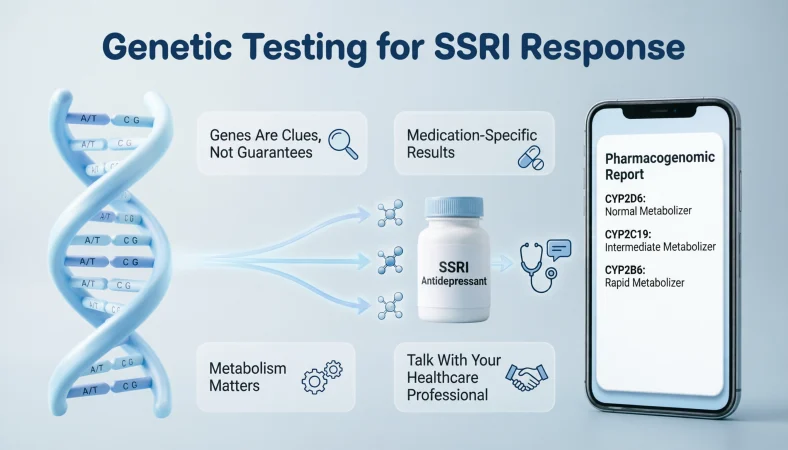
Genetic testing for SSRI response usually refers to pharmacogenetic testing that looks at genetic differences affecting how a person may process or tolerate certain antidepressants. Some tests can provide useful information about medication metabolism, but they cannot guarantee which SSRI will work best for an individual.
Top alternatives: SSRI pharmacogenetic testing, genetic testing for antidepressant response, antidepressant DNA testing, pharmacogenomic testing for SSRIs, SSRI genetic testing
If you have ever wondered why one antidepressant works well for one person but feels like a terrible match for another, you are not alone. Questions about genetic testing for SSRI response often show up in searches, health forums, DMs, appointments, and conversations with friends who are trying to make sense of antidepressant treatment.
The idea sounds almost futuristic: check your DNA and find the medication that fits. But real pharmacogenetics is more nuanced than a simple “DNA says yes” or “DNA says no.” Certain genes can affect how the body metabolizes some SSRIs and other serotonin reuptake inhibitors, which may help clinicians think about dosing or potential tolerability. However, genes are only one part of the picture, and testing does not guarantee treatment success.
Simple Genetic Testing For SSRI Response Explanations
“It checks whether your genes may affect how you process certain antidepressants.”
Example: Use this when explaining pharmacogenetic testing to someone who has never heard of it.
Meaning: It gives a simple explanation without promising a specific treatment outcome.
“Think of it as one more piece of the medication puzzle.”
Example: Use this when someone assumes DNA testing gives the complete answer.
Meaning: It emphasizes that genetics is only one factor in treatment decisions.
“Your DNA can influence how your body handles some medicines.”
Example: Use this when explaining why genetic differences may matter.
Meaning: It introduces the basic idea behind pharmacogenetics.
“It is about medication processing, not reading your entire medical future.”
Example: Use this when someone expects a genetic test to predict everything.
Meaning: It keeps expectations realistic.
“Some genes can affect how quickly certain medicines are metabolized.”
Example: Use this for a straightforward educational explanation.
Meaning: It focuses on drug metabolism rather than guaranteed effectiveness.
“The test may help explain why medication exposure differs between people.”
Example: Use this when discussing different medication experiences.
Meaning: It highlights variation in drug processing.
“Genetics can provide clues, not guarantees.”
Example: Use this as a short educational caption.
Meaning: It makes the limits of testing clear.
“A pharmacogenetic test looks for medication-related genetic differences.”
Example: Use this when defining the test in simple language.
Meaning: It explains what the test actually examines.
“It can help clinicians consider metabolism when choosing or dosing some medicines.”
Example: Use this when discussing the clinical purpose of testing.
Meaning: It describes a potential use without overstating it.
“DNA is part of the story, not the whole story.”
Example: Use this when someone thinks genetics determines treatment.
Meaning: It reminds readers that clinical decisions involve multiple factors.
“The goal is better-informed treatment discussions, not a magic medication match.”
Example: Use this when discussing expectations before testing.
Meaning: It separates useful information from exaggerated promises.
“Genetic testing can add context to an antidepressant decision.”
Example: Use this when describing where testing fits into care.
Meaning: It presents testing as an additional source of information.
Professional Genetic Testing For SSRI Response Phrases
“Pharmacogenetic testing may provide information relevant to antidepressant metabolism.”
Example: Use this in a professional health education article.
Meaning: It describes the test accurately without promising efficacy.
“Genotype-informed prescribing should be interpreted alongside clinical factors.”
Example: Use this in a professional discussion of treatment planning.
Meaning: It emphasizes that genetics should not be considered in isolation.
“CYP2D6, CYP2C19, and CYP2B6 can be relevant to serotonin reuptake inhibitor pharmacogenetics.”
Example: Use this when discussing genes involved in medication metabolism.
Meaning: It identifies commonly relevant metabolic genes.
“Pharmacogenetic results may help identify patients with altered medication metabolism.”
Example: Use this when describing a potential clinical benefit.
Meaning: It focuses on drug exposure rather than guaranteed response.
“Genetic results should be interpreted in the context of the specific medication.”
Example: Use this when explaining why test reports cannot be read generically.
Meaning: It recognizes that gene-drug relationships vary.
“A genotype result does not independently determine antidepressant selection.”
Example: Use this in formal patient education.
Meaning: It prevents overinterpretation of genetic findings.
“Clinical history remains important when interpreting pharmacogenetic results.”
Example: Use this when discussing treatment decisions.
Meaning: It recognizes previous medication response and other patient factors.
“Drug interactions can influence medication exposure beyond genetic variation.”
Example: Use this in a professional pharmacology explanation.
Meaning: It reminds readers that genetics is not the only influence on metabolism.
“Testing may be more informative in selected clinical situations than as a universal screening step.”
Example: Use this when discussing who might consider testing.
Meaning: It avoids presenting testing as necessary for everyone.
“The clinical value of a result depends on the quality and interpretation of the test.”
Example: Use this when comparing different testing approaches.
Meaning: It highlights the importance of validated testing and professional interpretation.
“Pharmacogenetics can complement, rather than replace, clinical judgment.”
Example: Use this in a professional presentation.
Meaning: It positions genetic information as supportive evidence.
“Medication decisions should consider both genetic and non-genetic factors.”
Example: Use this when summarizing responsible prescribing.
Meaning: It reinforces a balanced approach.
Beginner-Friendly SSRI Genetic Testing Lines
“Your genes may affect how your body handles some antidepressants.”
Example: Use this for a beginner-friendly explanation.
Meaning: It introduces pharmacogenetics without technical language.
“The test does not tell your future.”
Example: Use this when someone expects a definitive prediction.
Meaning: It sets a realistic boundary.
“Different people can process the same medicine differently.”
Example: Use this when explaining individual variation.
Meaning: It makes the reason for pharmacogenetics easy to understand.
“A DNA test can sometimes provide extra information about medication metabolism.”
Example: Use this for an introductory health article.
Meaning: It explains the potential usefulness of testing.
“It is not as simple as finding one perfect antidepressant gene.”
Example: Use this when correcting an oversimplified assumption.
Meaning: It explains that treatment response is complex.
“Some genetic differences affect drug levels in the body.”
Example: Use this when explaining metabolism.
Meaning: It focuses on a key pharmacogenetic concept.
“Your doctor may use genetic information as one factor in treatment planning.”
Example: Use this when describing clinical use.
Meaning: It places the test within a broader decision-making process.
“A result can be interesting without being a final answer.”
Example: Use this when discussing consumer test reports.
Meaning: It encourages cautious interpretation.
“The important question is what the result means for a specific medicine.”
Example: Use this when someone has a general genetic report.
Meaning: It shifts attention toward gene-drug relevance.
“Not every genetic difference changes antidepressant treatment.”
Example: Use this when explaining test limitations.
Meaning: It prevents unnecessary worry about every detected variant.
“Pharmacogenetics sounds complicated, but the basic idea is simple.”
Example: Use this when introducing the topic to beginners.
Meaning: It makes the subject feel more approachable.
“The test provides information, not instructions to change medication.”
Example: Use this when explaining safe use.
Meaning: It emphasizes that medication changes require clinical guidance.
Funny Genetic Testing For SSRI Response Lines
“Apparently my DNA has opinions about medication.”
Example: Use this as a light social caption about pharmacogenetics.
Meaning: It turns a technical topic into approachable humor.
“My genes entered the medication group chat.”
Example: Use this for a playful educational post.
Meaning: It jokingly describes genetics becoming part of treatment discussions.
“DNA said, ‘Let’s talk metabolism.’”
Example: Use this when explaining pharmacogenetic testing casually.
Meaning: It makes the scientific concept more memorable.
“My chromosomes have entered the treatment meeting.”
Example: Use this as a humorous caption.
Meaning: It playfully frames genetics as another source of information.
“Plot twist: medication metabolism can have a genetic component.”
Example: Use this when introducing pharmacogenetics online.
Meaning: It presents the scientific idea with playful surprise.
“My DNA apparently has a résumé.”
Example: Use this when joking about genetic information influencing medication discussions.
Meaning: It adds humor without claiming genetics determines treatment.
“Genetics brought notes to the appointment.”
Example: Use this as a social-media-friendly explanation.
Meaning: It humorously suggests genetic results provide extra context.
“My genes are contributing to the group project.”
Example: Use this when discussing multiple factors in treatment.
Meaning: It emphasizes that genetics is only one contributor.
“Science really said, ‘Check the DNA too.’”
Example: Use this for a playful educational caption.
Meaning: It introduces pharmacogenetic testing casually.
“The medication mystery just got a DNA subplot.”
Example: Use this when explaining why testing can be considered.
Meaning: It makes the concept feel less intimidating.
“My DNA did not come here to make things simple.”
Example: Use this when discussing the complexity of pharmacogenetics.
Meaning: It acknowledges that genetic interpretation can be nuanced.
“Welcome to the episode where genetics meets pharmacology.”
Example: Use this as a fun educational opener.
Meaning: It frames the topic as an intersection of two scientific fields.
Clever Genetic Testing For SSRI Response Phrases
“Genes can influence exposure, but exposure is not the same as outcome.”
Example: Use this when explaining why metabolism does not equal guaranteed response.
Meaning: It separates pharmacokinetics from clinical effectiveness.
“Think gene-drug relationship, not gene-drug destiny.”
Example: Use this in an educational post about testing limitations.
Meaning: It emphasizes association without determinism.
“A genetic result becomes useful when connected to the right medication.”
Example: Use this when discussing interpretation.
Meaning: It highlights the importance of gene-drug context.
“Pharmacogenetics adds information, not certainty.”
Example: Use this as a concise educational statement.
Meaning: It summarizes the limits of genetic prediction.
“Metabolism can be genetic; treatment success is multifactorial.”
Example: Use this in a more advanced educational setting.
Meaning: It distinguishes metabolic variation from overall treatment response.
“The interesting question is not just what gene you have, but what it means for the drug.”
Example: Use this when discussing genetic reports.
Meaning: It encourages context-based interpretation.
“A genotype is data; clinical interpretation gives that data meaning.”
Example: Use this in professional health content.
Meaning: It explains why raw genetic results are not enough.
“The smartest result is the one interpreted in context.”
Example: Use this as an educational tagline.
Meaning: It promotes careful interpretation.
“DNA can explain part of the pharmacology, not every part of the patient experience.”
Example: Use this when discussing limitations.
Meaning: It acknowledges the complexity of medication response.
“Genetic testing is a tool for questions, not a shortcut around clinical care.”
Example: Use this in patient education.
Meaning: It encourages informed discussion rather than self-treatment.
“The result matters only when the gene-drug evidence supports its use.”
Example: Use this when evaluating test reports.
Meaning: It emphasizes evidence-based interpretation.
“Good pharmacogenetic interpretation asks what changes clinically.”
Example: Use this for professional audiences.
Meaning: It focuses attention on actionable information.
Antidepressant Metabolism Focused Responses
“CYP2C19 can affect the metabolism of several serotonin reuptake inhibitors.”
Example: Use this when explaining why CYP2C19 appears on pharmacogenetic reports.
Meaning: It identifies an important metabolic pathway.
“CYP2D6 can also influence the metabolism of some antidepressants.”
Example: Use this in an educational overview.
Meaning: It introduces another important drug-metabolizing enzyme.
“CYP2B6 may matter for certain serotonin reuptake inhibitors.”
Example: Use this when discussing the broader pharmacogenetic picture.
Meaning: It explains that more than one metabolic gene may be relevant.
“A poor metabolizer may process some medicines more slowly.”
Example: Use this when explaining metabolizer categories.
Meaning: It describes the basic concept of reduced metabolic activity.
“An ultrarapid metabolizer may process certain medicines faster than expected.”
Example: Use this in a pharmacogenetics explainer.
Meaning: It describes increased metabolic activity in simple terms.
“Intermediate metabolism falls between common reference categories.”
Example: Use this when explaining metabolizer classifications.
Meaning: It provides a simple description of an intermediate phenotype.
“Metabolizer status can help explain differences in drug exposure.”
Example: Use this when discussing why genotype matters.
Meaning: It connects genetic information with pharmacokinetics.
“A metabolic difference does not automatically mean a medication will fail.”
Example: Use this when correcting an overly negative interpretation.
Meaning: It separates altered metabolism from guaranteed treatment failure.
“A metabolic difference does not automatically mean a medication is unsafe.”
Example: Use this when explaining test results carefully.
Meaning: It prevents unnecessary alarm.
“Dose and medication decisions depend on the specific gene-drug relationship.”
Example: Use this when explaining clinical interpretation.
Meaning: It emphasizes that recommendations are medication-specific.
“Other medicines can affect metabolic pathways too.”
Example: Use this when discussing drug interactions.
Meaning: It reminds readers that genotype is not the only influence on metabolism.
“Your reported phenotype is one factor clinicians may consider.”
Example: Use this when explaining how results enter treatment planning.
Meaning: It keeps the result in proper clinical context.
Patient-Friendly Genetic Testing For SSRI Response Lines
“It is okay to ask your doctor what genetic testing could add to your treatment plan.”
Example: Use this when encouraging an informed appointment discussion.
Meaning: It supports patient participation without recommending testing universally.
“Ask what the test can actually tell you before ordering it.”
Example: Use this when someone is considering a commercial test.
Meaning: It encourages realistic expectations.
“Ask whether the result would change your treatment plan.”
Example: Use this when discussing whether testing may be useful.
Meaning: It focuses attention on practical clinical value.
“Bring your medication history to the conversation.”
Example: Use this before discussing pharmacogenetic results with a clinician.
Meaning: It recognizes that previous treatment experience matters.
“Ask which genes and medications the test actually covers.”
Example: Use this when comparing testing options.
Meaning: It encourages attention to test scope.
“Ask how the result will be interpreted.”
Example: Use this before taking a genetic test.
Meaning: It highlights the importance of professional interpretation.
“A test result should make your conversation clearer, not more confusing.”
Example: Use this when explaining the goal of testing.
Meaning: It frames testing as a support for informed discussion.
“Do not stop or change an antidepressant because of a genetic report alone.”
Example: Use this as an important patient-safety reminder.
Meaning: It emphasizes that medication changes should involve a healthcare professional.
“Ask whether your test is clinically validated for the question you are asking.”
Example: Use this when considering a direct-to-consumer report.
Meaning: It encourages evidence-aware decision-making.
“Ask whether your result is actionable for your current medication.”
Example: Use this when reviewing a pharmacogenetic report.
Meaning: It distinguishes useful findings from interesting but non-actionable data.
“Genetic testing is worth discussing when you have a clear clinical question.”
Example: Use this when deciding whether to bring up testing.
Meaning: It promotes purposeful rather than random testing.
“Your healthcare professional can help put the result into context.”
Example: Use this after receiving a genetic report.
Meaning: It encourages professional interpretation.
Short And Social-Media-Friendly Genetic Testing Lines
“DNA can influence medication metabolism.”
Example: Use this as a short educational caption.
Meaning: It summarizes the basic concept.
“Genes are clues, not guarantees.”
Example: Use this for a concise pharmacogenetics post.
Meaning: It emphasizes uncertainty appropriately.
“Pharmacogenetics meets antidepressant care.”
Example: Use this as a short educational headline.
Meaning: It introduces the topic clearly.
“Your genes are one piece of the puzzle.”
Example: Use this for an Instagram graphic.
Meaning: It highlights the multifactorial nature of treatment.
“Genetics can add context to medication decisions.”
Example: Use this as a professional social caption.
Meaning: It describes potential usefulness without exaggeration.
“Metabolism matters, but so does the bigger picture.”
Example: Use this when discussing treatment decisions.
Meaning: It balances genetic and clinical factors.
“Not destiny. Just data.”
Example: Use this as a memorable educational line.
Meaning: It reminds readers that genetic results are informational.
“DNA gives clues. Clinicians give context.”
Example: Use this as a graphic caption.
Meaning: It emphasizes professional interpretation.
“Genetic testing is information, not a prescription.”
Example: Use this as a patient-safety reminder.
Meaning: It discourages self-directed medication changes.
“One test cannot predict every treatment outcome.”
Example: Use this when correcting exaggerated claims.
Meaning: It sets realistic expectations.
“Genes matter. So do symptoms, history, and context.”
Example: Use this in a health education post.
Meaning: It reinforces multifactorial treatment planning.
“Pharmacogenetics: useful clues, careful interpretation.”
Example: Use this as an infographic heading.
Meaning: It captures the balanced approach.
Confident Genetic Testing For SSRI Response Statements
“I want to understand all the relevant information before choosing a medication.”
Example: Use this when preparing for a healthcare appointment.
Meaning: It communicates thoughtful participation in treatment decisions.
“I would like to know whether pharmacogenetic testing is relevant to my situation.”
Example: Use this when raising the subject with a clinician.
Meaning: It asks for personalized guidance rather than assuming testing is necessary.
“Can we discuss whether my medication history makes testing useful?”
Example: Use this when you have questions about previous antidepressant experiences.
Meaning: It invites a clinically relevant conversation.
“I understand that genetics is only one factor.”
Example: Use this when discussing test results responsibly.
Meaning: It shows realistic expectations.
“I want evidence-based information, not a guaranteed medication match.”
Example: Use this when evaluating testing claims.
Meaning: It prioritizes accuracy over marketing promises.
“I would rather understand the limitations before interpreting the result.”
Example: Use this before testing.
Meaning: It encourages informed decision-making.
“What would this result actually change?”
Example: Use this as a practical appointment question.
Meaning: It focuses on whether testing has clinical value.
“Which gene-drug relationships are relevant to my medication?”
Example: Use this when reviewing a pharmacogenetic test.
Meaning: It asks for medication-specific interpretation.
“Can we separate metabolism information from claims about treatment response?”
Example: Use this when evaluating a report.
Meaning: It recognizes an important distinction in pharmacogenetics.
“I want my test results interpreted alongside my medical history.”
Example: Use this when discussing a report with a clinician.
Meaning: It supports comprehensive decision-making.
“I am interested, but I do not want to overinterpret the result.”
Example: Use this when discussing genetic testing online or in person.
Meaning: It expresses curiosity while maintaining appropriate caution.
“I want to use genetic information responsibly.”
Example: Use this as a patient-centered statement.
Meaning: It emphasizes careful use of test results.
Emotional And Reassuring Genetic Testing Lines
“Not finding the right medication immediately does not mean you are out of options.”
Example: Use this when supporting someone frustrated with treatment.
Meaning: It offers reassurance without making medical promises.
“It is understandable to want more answers when treatment feels uncertain.”
Example: Use this when discussing interest in pharmacogenetics.
Meaning: It validates the desire for clarity.
“You do not have to figure out medication decisions alone.”
Example: Use this when encouraging someone to speak with a clinician.
Meaning: It emphasizes professional support.
“A genetic test can provide information, but it cannot carry the whole burden of the decision.”
Example: Use this when discussing expectations.
Meaning: It acknowledges both potential value and limitations.
“It is okay to ask questions about why a medication was chosen.”
Example: Use this when encouraging patient communication.
Meaning: It supports active participation in healthcare.
“Confusing results deserve a clear explanation, not a panic spiral.”
Example: Use this when someone feels overwhelmed by a report.
Meaning: It encourages calm professional interpretation.
“One result does not define your treatment journey.”
Example: Use this when discussing uncertain genetic findings.
Meaning: It prevents a single test from becoming overly important.
“Your experience with medication matters too.”
Example: Use this when explaining the limits of genetics.
Meaning: It recognizes real-world treatment history.
“It is reasonable to want treatment decisions that feel informed.”
Example: Use this when discussing pharmacogenetic testing.
Meaning: It validates informed decision-making.
“Good healthcare conversations leave room for questions.”
Example: Use this when encouraging patients to speak openly.
Meaning: It reinforces collaborative care.
“A report can give information without giving every answer.”
Example: Use this when explaining uncertain findings.
Meaning: It normalizes incomplete certainty.
“Curiosity is useful when it comes with context.”
Example: Use this as a reassuring educational statement.
Meaning: It encourages learning without overinterpretation.
SSRI Response Testing Myths And Reality Lines
“Myth: One DNA test can tell you exactly which SSRI will work.”
Example: Use this as the opening of a myth-busting post.
Meaning: It introduces a common misconception.
“Reality: Genetic testing does not guarantee antidepressant success.”
Example: Use this directly after a myth.
Meaning: It establishes a realistic expectation.
“Myth: A genetic result replaces a clinician.”
Example: Use this in patient education.
Meaning: It challenges the idea that reports can independently guide treatment.
“Reality: Results need clinical context.”
Example: Use this as a concise myth-busting statement.
Meaning: It emphasizes interpretation.
“Myth: Every genetic difference changes medication treatment.”
Example: Use this when explaining test results.
Meaning: It corrects overinterpretation.
“Reality: Only some gene-drug relationships have established clinical relevance.”
Example: Use this in evidence-focused content.
Meaning: It distinguishes useful associations from unsupported claims.
“Myth: Faster metabolism automatically means a medicine will not work.”
Example: Use this when discussing metabolizer categories.
Meaning: It prevents an overly simplistic conclusion.
“Reality: Metabolism and clinical response are related concepts, but they are not identical.”
Example: Use this in an educational article.
Meaning: It explains why pharmacokinetic findings should not be treated as guaranteed outcome predictions.
“Myth: A consumer report can tell you to change your medication.”
Example: Use this as a safety-focused social post.
Meaning: It challenges unsafe interpretation.
“Reality: Medication changes should be discussed with a healthcare professional.”
Example: Use this when explaining responsible use.
Meaning: It provides a clear safety boundary.
“Myth: Genetics explains every antidepressant side effect.”
Example: Use this when discussing treatment variability.
Meaning: It challenges genetic determinism.
“Reality: Medication response depends on multiple biological and clinical factors.”
Example: Use this as a closing myth-busting statement.
Meaning: It presents a more complete view of antidepressant treatment.
Smart Questions About Genetic Testing For SSRI Response
“Would pharmacogenetic testing change how we approach my current medication?”
Example: Use this as an appointment question before ordering a test.
Meaning: It focuses on practical clinical usefulness.
“Which genes are relevant to the medication we are considering?”
Example: Use this when discussing a specific SSRI.
Meaning: It asks for medication-specific information.
“What does my metabolizer status actually mean?”
Example: Use this after receiving a test result.
Meaning: It asks for a plain-language interpretation.
“Does this result affect dosing, medication choice, or neither?”
Example: Use this when reviewing a pharmacogenetic report.
Meaning: It separates different possible clinical implications.
“How strong is the evidence behind this result?”
Example: Use this when evaluating a test report.
Meaning: It encourages evidence-based interpretation.
“Could another medication I take affect the same enzyme?”
Example: Use this when discussing metabolism.
Meaning: It recognizes that drug interactions can influence exposure.
“Does my previous medication history change how useful testing might be?”
Example: Use this during a treatment discussion.
Meaning: It connects genetic information with clinical history.
“Is this test clinically validated for the question I am asking?”
Example: Use this before purchasing a pharmacogenetic test.
Meaning: It encourages scrutiny of the test’s purpose and evidence.
“What are the limitations of this specific report?”
Example: Use this after receiving test results.
Meaning: It encourages balanced interpretation.
“Could the result be different if the test covers different genetic variants?”
Example: Use this when comparing laboratories.
Meaning: It acknowledges differences in testing platforms.
“What should I do with a result that does not have a clear recommendation?”
Example: Use this when a report contains uncertain information.
Meaning: It encourages professional interpretation rather than guessing.
“Can we review this result alongside the medication’s official prescribing information?”
Example: Use this in a detailed clinical discussion.
Meaning: It encourages integration of genetic and established medication guidance.
Professional And Formal Genetic Testing Statements
“Pharmacogenetic testing may complement conventional antidepressant treatment planning.”
Example: Use this in a formal health article.
Meaning: It presents testing as supplementary information.
“The clinical interpretation of pharmacogenetic results should remain medication-specific.”
Example: Use this in professional educational content.
Meaning: It discourages broad conclusions from isolated genetic findings.
“Genotype-derived metabolizer status may inform consideration of drug exposure.”
Example: Use this in technical pharmacology content.
Meaning: It connects genotype with pharmacokinetic reasoning.
“Clinical recommendations depend on the strength of evidence for the relevant gene-drug association.”
Example: Use this when discussing evidence standards.
Meaning: It emphasizes that not every association is actionable.
“Pharmacogenetic findings should be integrated with clinical history and current medications.”
Example: Use this in formal patient education.
Meaning: It supports comprehensive interpretation.
“Genetic information does not independently establish antidepressant efficacy.”
Example: Use this when discussing the limitations of predictive testing.
Meaning: It avoids overstating what genetic information can establish.
“Some serotonin reuptake inhibitors have pharmacogenetic considerations involving CYP enzymes.”
Example: Use this in an academic overview.
Meaning: It introduces metabolic gene-drug relationships.
“Testing platforms may differ in the variants they assess.”
Example: Use this when discussing laboratory differences.
Meaning: It explains why reports can vary.
“Rare variants and non-genetic factors may complicate predicted metabolizer status.”
Example: Use this in advanced educational material.
Meaning: It acknowledges limitations in phenotype prediction.
“Stable patients already doing well may have less reason to pursue additional pharmacogenetic information.”
Example: Use this when discussing appropriate use.
Meaning: It reflects the principle that testing should have a meaningful clinical question.
“Pharmacogenomic information should be interpreted using current clinical guidance.”
Example: Use this in a professional presentation.
Meaning: It encourages evidence-based use.
“Genetic information represents one component of individualized medication management.”
Example: Use this as a formal summary statement.
Meaning: It places pharmacogenetics within personalized care.
Chill And Casual Genetic Testing Explanations
“Basically, your DNA may affect how you process some meds.”
Example: Use this when explaining pharmacogenetics to a friend.
Meaning: It gives the simplest version of the concept.
“It is more ‘extra info’ than ‘crystal ball.’”
Example: Use this when someone expects a perfect prediction.
Meaning: It keeps the tone casual while setting limits.
“Genes can give clues, but they do not run the whole show.”
Example: Use this in a casual conversation.
Meaning: It emphasizes that other factors matter too.
“Think of it as another data point.”
Example: Use this when discussing a test result casually.
Meaning: It presents the result as additional information.
“Your DNA might explain part of the medication puzzle.”
Example: Use this with someone curious about testing.
Meaning: It describes potential usefulness without exaggeration.
“It is not a ‘pick my perfect antidepressant’ button.”
Example: Use this when correcting unrealistic expectations.
Meaning: It clearly rejects the idea of guaranteed medication selection.
“The science is interesting, but the details matter.”
Example: Use this when discussing pharmacogenetic reports.
Meaning: It encourages careful interpretation.
“One gene result does not tell the whole story.”
Example: Use this when someone focuses on one variant.
Meaning: It emphasizes complexity.
“The useful part is what the result means for a specific drug.”
Example: Use this when looking at a report.
Meaning: It directs attention toward clinical relevance.
“DNA is invited to the appointment, but it is not the only guest.”
Example: Use this as a playful explanation.
Meaning: It reinforces that many factors contribute to treatment decisions.
“Ask questions before letting a report stress you out.”
Example: Use this when someone receives an alarming-looking result.
Meaning: It encourages calm professional interpretation.
“Interesting result? Yes. Automatic answer? Not necessarily.”
Example: Use this as a short educational caption.
Meaning: It balances curiosity with caution.
Memorable Genetic Testing For SSRI Response One-Liners
“Genes can influence the journey, but they do not write the ending.”
Example: Use this as a memorable health education caption.
Meaning: It distinguishes genetic influence from guaranteed outcomes.
“Pharmacogenetics turns DNA into clinical clues.”
Example: Use this as an educational headline.
Meaning: It describes the purpose of genetic information.
“Know the gene, understand the drug, keep the context.”
Example: Use this as an infographic tagline.
Meaning: It encourages medication-specific interpretation.
“The goal is informed care, not perfect prediction.”
Example: Use this when summarizing pharmacogenetic testing.
Meaning: It captures the realistic purpose of testing.
“Genetic testing can inform a conversation, not replace one.”
Example: Use this as a patient education line.
Meaning: It encourages discussion with healthcare professionals.
“DNA offers clues; clinical care connects the dots.”
Example: Use this as a social-media caption.
Meaning: It highlights the role of clinical interpretation.
“A test result is information, not an instruction manual.”
Example: Use this when discussing consumer genetic reports.
Meaning: It discourages self-directed treatment changes.
“Metabolism is one chapter in the antidepressant story.”
Example: Use this in educational content.
Meaning: It reminds readers that response involves more than drug processing.
“The smartest genetic result is the one you understand.”
Example: Use this as an infographic line.
Meaning: It emphasizes clear interpretation.
“Personalized medicine still needs personal context.”
Example: Use this in a professional or social post.
Meaning: It explains why individual clinical factors remain important.
“Good genetics starts with good questions.”
Example: Use this before a discussion of pharmacogenetic testing.
Meaning: It encourages purposeful use of testing.
“Your genes are part of the picture, not the whole frame.”
Example: Use this as a memorable conclusion to an educational post.
Meaning: It reinforces the multifactorial nature of medication response.
FAQs
What does genetic testing for SSRI response mean?
It generally refers to pharmacogenetic testing that examines genetic variants that may affect how a person metabolizes or responds to certain serotonin reuptake inhibitor antidepressants. The strongest clinical applications are medication-specific and should be interpreted carefully.
Can genetic testing tell me which SSRI will work best?
Not with certainty. Genetic testing can provide information relevant to metabolism and, for some gene-drug pairs, potential response or adverse-effect considerations, but it cannot guarantee that a particular SSRI will work for you.
Is genetic testing the same as testing for depression?
No. Pharmacogenetic testing looks at genetic information related to medication response or metabolism. It is not a diagnostic test for depression.
Can the results have an emotional or personal meaning?
They can feel personal because they involve your DNA and treatment experience. However, a genetic result should not be interpreted as a statement about your worth, personality, or future mental health.
Is genetic testing for SSRI response used professionally?
Pharmacogenetic information can be considered in clinical care for certain medications and gene-drug relationships. Professional guidelines include recommendations involving genes such as CYP2D6, CYP2C19, and CYP2B6 for serotonin reuptake inhibitors.
Can I use a consumer genetic test to decide which antidepressant to take?
You should not start, stop, or change an antidepressant based on a consumer genetic report alone. The FDA specifically warns that some pharmacogenetic tests make unsupported claims about predicting medication response, and treatment decisions should involve a healthcare professional.
What genes are commonly discussed with SSRI pharmacogenetics?
CYP2C19 and CYP2D6 are important examples, while CYP2B6 may also be relevant for certain serotonin reuptake inhibitors. Other genes have been studied, but the strength and clinical usefulness of different associations vary.
Does a genetic result guarantee fewer side effects?
No. A genetic result may identify certain metabolism-related considerations for some medications, but it cannot guarantee that side effects will or will not occur.
Is humor appropriate when discussing genetic testing for SSRI response?
Light humor can make a complicated topic easier to discuss, especially in educational or social content. However, medication decisions and mental health concerns deserve respectful treatment, so humor should never minimize someone’s symptoms or experience.
What if I do not want genetic testing?
That is completely reasonable. Pharmacogenetic testing is not automatically necessary for everyone, and its usefulness depends on the individual clinical situation, medication, and available evidence.
What should I ask before taking a test?
Ask what genes and medications are covered, whether the test is clinically validated for your question, how the result will be interpreted, and whether the result is expected to change your treatment plan.
Can genetics explain every difference in antidepressant response?
No. Medication response can involve genetics, drug interactions, age, health conditions, adherence, symptoms, environment, and many other factors. CPIC also notes that metabolizer status can be influenced by non-genetic factors such as other medications and certain physiological or lifestyle factors.
Conclusion
Genetic testing for SSRI response can be an interesting and sometimes useful part of a broader conversation about personalized medication care, but it is not a crystal ball for antidepressant success. The most helpful mindset is simple: use genetic information as one piece of evidence, understand what a specific gene-drug relationship actually means, and keep the bigger clinical picture in view. A good result should create better questions, not instant conclusions.
If you are considering testing, discuss its potential value with a qualified healthcare professional and avoid changing medication based on a report alone. Save this guide for later, share it with someone researching pharmacogenetics, and keep asking smart questions about your care.