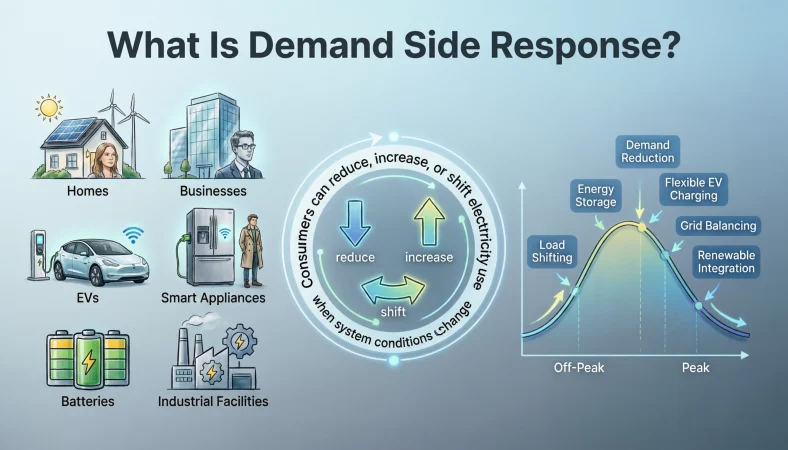
Demand side response is a way of managing electricity demand by encouraging homes and businesses to reduce, increase, or shift their electricity use when the power system needs it. In simple terms, electricity users adjust when they consume power instead of using the same amount at all times.
Top alternatives: demand response, demand-side flexibility, electricity demand response, flexible energy use, energy demand management
Ever wondered why your electricity use might need to change when the grid gets busy? That is where what is demand side response becomes an important question. You might encounter the term while reading about smart meters, renewable energy, electricity bills, energy markets, business operations, or the future of the power grid.
Unlike a traditional approach where electricity generation constantly tries to follow demand, demand side response also gives consumers a role in balancing the system. A factory might move energy-intensive production to a different time, a building could adjust heating or cooling, or a household could charge an electric vehicle when electricity is more readily available.
It sounds technical, but the basic idea is surprisingly simple: use electricity more flexibly when the grid benefits from it. Here is a clear, practical breakdown of what demand side response means, how it works, and why it matters.
Simple What Is Demand Side Response Explanations
“Demand side response means changing electricity use when the grid needs it.”
Example: Use this as a beginner-friendly definition in an energy article.
Meaning: Electricity consumers adjust their consumption to help balance the power system.
“Demand side response lets consumers become more flexible with electricity use.”
Example: Use this when introducing the concept to someone new to energy management.
Meaning: Consumers can change when or how much electricity they consume.
“It is about shifting or adjusting demand, not simply generating more power.”
Example: Use this when comparing demand response with traditional generation.
Meaning: The system can respond to pressure by changing consumption as well as increasing supply.
“Demand response can reduce electricity use during busy periods.”
Example: Use this when explaining peak-demand management.
Meaning: Consumers may temporarily lower consumption when electricity demand is high.
“Demand response can also move electricity use to another time.”
Example: Use this when explaining flexible consumption.
Meaning: Some electricity activities can be postponed until a more suitable period.
“The goal is a more flexible electricity system.”
Example: Use this in a simple overview of demand side response.
Meaning: Flexibility helps the grid respond to changing supply and demand.
“Businesses can participate in demand side response.”
Example: Use this when discussing commercial energy users.
Meaning: Companies can adjust flexible operations to support the electricity system.
“Homes can participate through smart energy technologies.”
Example: Use this when discussing residential flexibility.
Meaning: Smart devices can help households automatically or manually change consumption.
“Electric vehicles can provide flexible electricity demand.”
Example: Use this in an article about EV charging and the grid.
Meaning: EV charging can sometimes be scheduled for periods that better suit the power system.
“Heating and cooling can sometimes be shifted.”
Example: Use this when explaining flexible household or building loads.
Meaning: Temperature-related energy use can sometimes be adjusted without significantly affecting comfort.
“Demand side response connects consumers with grid needs.”
Example: Use this as a broad conceptual summary.
Meaning: Consumers become active participants in electricity-system management.
“The simple idea is: use energy at smarter times.”
Example: Use this as a memorable social-media-friendly explanation.
Meaning: Demand response encourages electricity consumption to become more flexible.
Professional What Is Demand Side Response Descriptions
“Demand side response is a mechanism for modifying electricity consumption in response to system conditions.”
Example: Use this in a professional energy report.
Meaning: It describes demand response as deliberate changes in consumption based on grid requirements.
“Demand response provides flexibility on the consumer side of the electricity system.”
Example: Use this in an energy-management presentation.
Meaning: Flexible demand becomes a resource for balancing the electricity network.
“Participants may reduce, increase, or shift electricity consumption.”
Example: Use this when explaining the different forms of demand flexibility.
Meaning: Demand response is broader than simply turning equipment off.
“Demand side response can support system balancing.”
Example: Use this in a professional explanation of grid operations.
Meaning: Flexible demand can help match electricity consumption with available supply.
“Demand response can contribute to peak-demand management.”
Example: Use this when discussing grid capacity.
Meaning: Adjusting consumption can reduce pressure during periods of high demand.
“Flexible demand can complement variable renewable generation.”
Example: Use this in a renewable-energy discussion.
Meaning: Consumers can sometimes shift consumption to periods when renewable generation is more available.
“Demand response can involve automated or manual load adjustments.”
Example: Use this when describing participation methods.
Meaning: Technology can automate changes, while users can also respond directly to signals.
“Commercial and industrial loads can provide significant flexibility.”
Example: Use this in a business-energy discussion.
Meaning: Large energy users may have substantial controllable consumption.
“Residential demand response can use smart appliances and energy-management systems.”
Example: Use this when discussing household participation.
Meaning: Digital technology can coordinate flexible residential loads.
“Demand response can operate through price signals or direct control.”
Example: Use this when describing market mechanisms.
Meaning: Participants may respond to changing prices or authorized control signals.
“Demand flexibility can reduce the need for some short-term system adjustments.”
Example: Use this in a grid-planning discussion.
Meaning: Flexible consumption can help the system respond without relying entirely on additional generation.
“Demand side response is increasingly relevant to modern electricity-system design.”
Example: Use this as a professional concluding statement.
Meaning: Flexible demand is becoming more important as electricity systems become more dynamic.
Beginner-Friendly What Is Demand Side Response Lines
“Think of demand side response as moving your electricity use around.”
Example: Use this when explaining the concept to a complete beginner.
Meaning: Some electricity consumption can happen at different times without losing its useful purpose.
“The grid gets busy, so users can adjust their demand.”
Example: Use this when explaining peak periods.
Meaning: Consumers can sometimes respond when electricity demand puts pressure on the system.
“Instead of only making more electricity, we can sometimes use less.”
Example: Use this when comparing supply and demand solutions.
Meaning: Reducing consumption can help balance the system.
“Sometimes the trick is simply using power later.”
Example: Use this when explaining load shifting.
Meaning: Delaying flexible consumption can reduce demand during a busy period.
“A smart EV charger can wait for a better charging time.”
Example: Use this as a practical example.
Meaning: EV charging can sometimes be scheduled according to grid or price conditions.
“A building can adjust heating or cooling when appropriate.”
Example: Use this when discussing commercial buildings.
Meaning: HVAC systems can sometimes provide flexible electricity demand.
“Factories can move some energy-heavy activities.”
Example: Use this when explaining industrial flexibility.
Meaning: Industrial processes may have operations that can be rescheduled.
“Demand response makes electricity users part of the solution.”
Example: Use this when explaining the bigger picture.
Meaning: Consumers can actively contribute to grid flexibility.
“It does not always mean sitting in the dark.”
Example: Use this when someone thinks demand response means turning everything off.
Meaning: Demand response can involve small adjustments and timing changes rather than complete shutdowns.
“Flexibility can be automated.”
Example: Use this when introducing smart energy systems.
Meaning: Software and connected devices can respond to electricity-system signals automatically.
“The goal is smarter timing, not simply lower consumption.”
Example: Use this when explaining demand shifting.
Meaning: Demand response can focus on when electricity is used rather than only how much is used.
“Demand response is basically grid-friendly energy timing.”
Example: Use this as a memorable beginner explanation.
Meaning: Consumers change electricity timing in ways that support system needs.
Funny What Is Demand Side Response Study Lines
“Demand side response is the grid saying, ‘Can we move that electricity use a little?’”
Example: Use this as a humorous study caption.
Meaning: It presents demand response as a friendly request for flexible consumption.
“The electricity grid just discovered scheduling.”
Example: Use this when explaining load shifting.
Meaning: Demand response involves arranging flexible consumption at more useful times.
“Your washing machine has entered the energy market.”
Example: Use this as a playful smart-home example.
Meaning: Flexible household appliances can sometimes participate in demand response.
“Peak demand walked in, and the smart thermostat understood the assignment.”
Example: Use this when explaining automated demand management.
Meaning: Smart controls can adjust energy use during demanding periods.
“Demand response: because electricity has a calendar too.”
Example: Use this as a social-media-friendly explanation.
Meaning: Electricity consumption can sometimes be scheduled according to system conditions.
“The grid said ‘not now,’ and the EV charger said ‘fair enough.’”
Example: Use this when discussing flexible EV charging.
Meaning: Charging can sometimes be postponed to a more suitable time.
“Peak demand is basically the electricity rush hour.”
Example: Use this as a beginner-friendly analogy.
Meaning: Peak demand describes periods when electricity consumption is especially high.
“Demand response gives electricity consumption a flexible schedule.”
Example: Use this as a lighthearted study phrase.
Meaning: Flexible loads can adjust their timing.
“The grid wants balance, not chaos.”
Example: Use this as a playful energy-study caption.
Meaning: Demand response helps coordinate electricity supply and consumption.
“Smart energy use is basically adulting for electricity.”
Example: Use this on social media when explaining energy flexibility.
Meaning: It humorously describes more deliberate electricity consumption.
“Electricity demand said, ‘I need options.’”
Example: Use this as a meme-style explanation.
Meaning: Flexible demand gives the system more ways to respond to changing conditions.
“Demand side response: less panic, more planning.”
Example: Use this as a memorable revision line.
Meaning: Flexibility can help the system handle demand changes more smoothly.
Clever What Is Demand Side Response Comparisons
“Demand response manages consumption instead of relying only on supply.”
Example: Use this when comparing demand-side and supply-side approaches.
Meaning: Electricity users can become part of system balancing.
“Generation can respond to demand, but demand can respond too.”
Example: Use this as a conceptual explanation.
Meaning: Demand response recognizes electricity consumption as a flexible system resource.
“Demand side response turns flexibility into an energy asset.”
Example: Use this in an energy-market discussion.
Meaning: Adjustable consumption can have practical value for grid management.
“The cheapest electricity is not always the most useful electricity at every moment.”
Example: Use this when discussing time-based energy use.
Meaning: The timing of consumption can matter alongside total consumption.
“Demand response is about when electricity is used as much as how much is used.”
Example: Use this when explaining load shifting.
Meaning: Timing is central to many demand-response strategies.
“A flexible load can behave like a controllable resource.”
Example: Use this in a technical discussion.
Meaning: Some electricity demand can be adjusted in response to system needs.
“Smart technology makes flexible demand easier to coordinate.”
Example: Use this when discussing automation.
Meaning: Digital systems can monitor conditions and control eligible loads.
“Renewables make flexible demand increasingly valuable.”
Example: Use this in a renewable-grid discussion.
Meaning: Flexible consumption can help accommodate changing renewable electricity output.
“Demand response can reduce pressure without building generation for every peak.”
Example: Use this when discussing capacity planning.
Meaning: Managing demand can sometimes reduce the need for additional peak capacity.
“Energy flexibility is a timing strategy.”
Example: Use this as a concise explanation.
Meaning: Flexible consumption changes when electricity is used.
“The consumer becomes an active grid participant.”
Example: Use this when describing the broader significance of demand response.
Meaning: Electricity users can influence system operation through flexible demand.
“Demand response is the bridge between consumption and grid management.”
Example: Use this as a conceptual summary.
Meaning: It connects everyday electricity use with wider power-system requirements.
Practical What Is Demand Side Response Examples
“An EV charges overnight instead of during an evening peak.”
Example: Use this as a straightforward household example.
Meaning: Charging is shifted away from a period of high electricity demand.
“A washing machine runs at a lower-demand time.”
Example: Use this when explaining residential load shifting.
Meaning: A flexible appliance changes its operating schedule.
“A commercial building slightly adjusts cooling.”
Example: Use this when discussing building energy management.
Meaning: HVAC demand can sometimes be modified to reduce electricity use during a peak period.
“A factory postpones a flexible production process.”
Example: Use this when explaining industrial demand response.
Meaning: Energy-intensive activity can be rescheduled when operationally practical.
“A battery changes when it charges.”
Example: Use this when explaining flexible energy assets.
Meaning: Battery charging can be coordinated with electricity-system conditions.
“A water heater operates during a preferred period.”
Example: Use this as a household flexibility example.
Meaning: Heating can sometimes be scheduled without preventing the user from having hot water.
“A supermarket adjusts refrigeration within safe operating limits.”
Example: Use this when explaining commercial flexibility.
Meaning: Controlled equipment can sometimes provide limited flexibility while maintaining required conditions.
“A data centre shifts suitable workloads.”
Example: Use this when discussing digital infrastructure.
Meaning: Some computing activities may be moved to periods with more favorable electricity conditions.
“A heat pump changes its operating schedule.”
Example: Use this when discussing smart heating.
Meaning: Heating demand can sometimes be coordinated with electricity-system needs.
“A business reduces non-essential electricity use during a peak.”
Example: Use this in a commercial energy-management example.
Meaning: Optional consumption can be temporarily reduced.
“A smart home automatically manages selected appliances.”
Example: Use this when explaining automated demand response.
Meaning: Connected devices can adjust electricity consumption based on programmed signals.
“An industrial site increases consumption when excess electricity is available.”
Example: Use this when explaining that demand response can sometimes increase demand.
Meaning: Flexible loads can consume more electricity during suitable system conditions.
Professional Benefits Of What Is Demand Side Response
“Demand response can support grid reliability.”
Example: Use this in a professional energy overview.
Meaning: Flexible demand can help the system respond to changing conditions.
“It can help manage peak electricity demand.”
Example: Use this when discussing system capacity.
Meaning: Demand adjustments can reduce pressure during high-demand periods.
“It can provide additional system flexibility.”
Example: Use this in a grid-modernisation report.
Meaning: Flexible loads give operators another way to balance the system.
“Demand response can support renewable integration.”
Example: Use this in a clean-energy discussion.
Meaning: Flexible consumption can help align demand with variable renewable generation.
“It can create value from flexible electricity consumption.”
Example: Use this when discussing energy markets.
Meaning: Participants may benefit from programs or prices that reward flexibility.
“Demand response can improve energy-system efficiency.”
Example: Use this when discussing system optimisation.
Meaning: Better coordination between demand and available supply can reduce inefficiencies.
“It can reduce stress during periods of high demand.”
Example: Use this when explaining peak management.
Meaning: Flexible consumption can ease pressure on network infrastructure.
“Demand response can provide an alternative to some conventional peak resources.”
Example: Use this in a capacity-planning discussion.
Meaning: Flexible demand can sometimes reduce reliance on additional peak generation.
“Consumers can gain greater visibility into electricity use.”
Example: Use this when discussing smart energy programs.
Meaning: Demand-response participation can encourage more active energy management.
“Businesses can improve operational awareness of energy consumption.”
Example: Use this in a commercial context.
Meaning: Participation can encourage companies to understand and manage flexible loads.
“Automation can make demand flexibility easier to operate.”
Example: Use this in a technology-focused discussion.
Meaning: Automated controls can respond faster and reduce manual effort.
“Flexible demand can become an important part of future energy systems.”
Example: Use this as a professional conclusion.
Meaning: Increasing electrification and renewable generation can increase the value of demand flexibility.
Consumer-Friendly What Is Demand Side Response Phrases
“You may be able to save money by using electricity at certain times.”
Example: Use this when explaining time-based energy programs to households.
Meaning: Some demand-response programs use prices to encourage consumers to shift usage.
“Your smart meter can help track when you use electricity.”
Example: Use this when introducing household energy monitoring.
Meaning: Smart metering can provide more detailed information about consumption.
“Your EV does not always need to charge immediately.”
Example: Use this when discussing flexible charging.
Meaning: Charging can sometimes be scheduled around electricity prices or grid conditions.
“Your heating system may be able to adjust automatically.”
Example: Use this when explaining smart-home flexibility.
Meaning: Connected heating equipment can sometimes respond to programmed signals.
“Flexible electricity use can fit around your routine.”
Example: Use this when explaining demand shifting.
Meaning: The aim is to move suitable activities without unnecessarily disrupting daily life.
“You do not have to change everything.”
Example: Use this when making demand response less intimidating.
Meaning: Participation can focus on selected flexible loads.
“Small changes across many homes can add up.”
Example: Use this when explaining aggregated demand response.
Meaning: Many small adjustments can collectively provide meaningful system flexibility.
“Smart appliances can make timing easier.”
Example: Use this when discussing automated household participation.
Meaning: Connected appliances can schedule their operation based on selected conditions.
“Demand response can make your electricity use more intentional.”
Example: Use this as a consumer-friendly explanation.
Meaning: It encourages awareness of when energy is consumed.
“Flexibility does not always mean inconvenience.”
Example: Use this when addressing consumer concerns.
Meaning: Automated controls and suitable scheduling can reduce disruption.
“Your electricity habits can become part of a bigger grid solution.”
Example: Use this when explaining the wider benefit.
Meaning: Household flexibility can contribute to system-level balancing.
“Smart energy timing can benefit both users and the grid.”
Example: Use this as a simple closing line.
Meaning: Well-designed programs can align consumer interests with electricity-system needs.
Technical What Is Demand Side Response Concepts
“Demand response changes electricity consumption in response to external signals.”
Example: Use this in a technical energy explanation.
Meaning: Demand can be adjusted after receiving price, control, or system-condition signals.
“Load shifting moves consumption from one period to another.”
Example: Use this when defining a major demand-response strategy.
Meaning: Electricity use is rescheduled rather than necessarily eliminated.
“Load reduction temporarily decreases electricity consumption.”
Example: Use this when explaining peak-demand response.
Meaning: Participants reduce demand during specified periods.
“Load increase can absorb electricity during suitable periods.”
Example: Use this when discussing flexible demand that increases consumption.
Meaning: Some loads can operate when additional electricity consumption is beneficial.
“Automated demand response uses control systems to adjust flexible loads.”
Example: Use this when discussing advanced energy-management systems.
Meaning: Software and hardware can coordinate demand changes automatically.
“Price-responsive demand reacts to electricity price signals.”
Example: Use this in an energy-market explanation.
Meaning: Consumers adjust usage when prices encourage them to do so.
“Direct-load control allows authorised systems to manage selected equipment.”
Example: Use this when describing controlled demand-response programs.
Meaning: Certain loads can be adjusted through an agreed control mechanism.
“Aggregators can combine many small flexible loads.”
Example: Use this in a modern electricity-market discussion.
Meaning: Multiple consumers can be grouped into a larger flexible resource.
“Baseline calculations can estimate what consumption would have been without a response.”
Example: Use this in a technical demand-response discussion.
Meaning: A baseline provides a reference for measuring changes in electricity use.
“Response duration describes how long a demand adjustment can be maintained.”
Example: Use this when discussing demand-response performance.
Meaning: Different flexible loads can provide flexibility for different lengths of time.
“Response time describes how quickly a flexible load can react.”
Example: Use this when explaining technical performance.
Meaning: Some resources can respond rapidly while others require preparation.
“Not every electricity load is equally flexible.”
Example: Use this when explaining practical limitations.
Meaning: Flexibility depends on equipment, processes, user needs, and operational constraints.
Renewable Energy And What Is Demand Side Response
“Demand response can help align electricity use with renewable generation.”
Example: Use this in a renewable-energy article.
Meaning: Flexible demand can sometimes shift consumption toward periods of high renewable output.
“Solar generation often changes throughout the day.”
Example: Use this when explaining why timing matters.
Meaning: Electricity supply from solar varies with daylight and weather conditions.
“Flexible loads can use more electricity when renewable output is available.”
Example: Use this when discussing solar integration.
Meaning: Demand can sometimes be shifted toward periods of stronger renewable generation.
“EV charging can potentially follow renewable availability.”
Example: Use this in an EV and clean-energy discussion.
Meaning: Charging schedules can sometimes be coordinated with renewable production.
“Demand response can help manage variable electricity supply.”
Example: Use this when explaining renewable-grid challenges.
Meaning: Flexible demand can respond when renewable output changes.
“Wind generation can vary with weather conditions.”
Example: Use this as background for demand flexibility.
Meaning: Wind power output is not constant, creating opportunities for flexible demand.
“Flexible demand can complement energy storage.”
Example: Use this when comparing grid flexibility technologies.
Meaning: Demand response and storage can both help manage changes in electricity supply and demand.
“Not every renewable peak matches consumer demand.”
Example: Use this when explaining energy timing.
Meaning: Renewable electricity may be abundant at times when traditional demand is lower.
“Demand response can help turn timing challenges into flexibility opportunities.”
Example: Use this as a conceptual explanation.
Meaning: Consumers can sometimes adjust when they use electricity to better match available supply.
“Electrification makes demand flexibility increasingly relevant.”
Example: Use this in a future-energy discussion.
Meaning: More electric vehicles, heating, and industrial processes can create new flexible loads.
“Renewables and flexible demand can work together.”
Example: Use this as a simple renewable-energy summary.
Meaning: Flexible consumption can help accommodate variable renewable generation.
“A smarter grid manages both supply and demand.”
Example: Use this as a memorable closing line.
Meaning: Modern grid management increasingly considers flexibility on both sides of the electricity system.
Business-Friendly What Is Demand Side Response Strategies
“Businesses can identify electricity loads that can be shifted.”
Example: Use this when starting a commercial energy-management plan.
Meaning: Companies first need to identify which activities have operational flexibility.
“Production schedules can sometimes be adjusted around electricity conditions.”
Example: Use this when discussing industrial participation.
Meaning: Certain energy-intensive operations may be moved to different periods.
“HVAC systems can provide flexible demand in suitable buildings.”
Example: Use this when discussing commercial properties.
Meaning: Heating and cooling loads can sometimes be adjusted within operational requirements.
“Battery systems can support flexible electricity management.”
Example: Use this when discussing commercial energy assets.
Meaning: Batteries can alter their charging or discharging schedules.
“Smart energy-management software can coordinate multiple loads.”
Example: Use this in a technology-focused business explanation.
Meaning: Software can manage several flexible assets together.
“Businesses should protect critical operations first.”
Example: Use this when explaining practical demand-response planning.
Meaning: Flexibility should not compromise essential production, safety, or service requirements.
“Energy audits can reveal demand-response opportunities.”
Example: Use this when recommending a starting point for businesses.
Meaning: Understanding electricity consumption helps identify flexible loads.
“Automation can reduce the workload of manual participation.”
Example: Use this when discussing automated programs.
Meaning: Systems can execute approved demand changes without constant human intervention.
“Businesses can compare flexibility with operational costs.”
Example: Use this when evaluating participation.
Meaning: Demand-response decisions should consider financial and operational impacts.
“Flexible demand can become part of a broader energy strategy.”
Example: Use this in a business sustainability plan.
Meaning: Demand response can complement efficiency, storage, renewable generation, and energy procurement.
“Monitoring is essential for understanding demand-response performance.”
Example: Use this when discussing program evaluation.
Meaning: Consumption data helps determine whether flexibility strategies are working as intended.
“The best strategy balances savings, reliability, and operations.”
Example: Use this as a business-focused conclusion.
Meaning: Demand response should support the company’s goals without creating unacceptable disruption.
Chill And Casual What Is Demand Side Response Explanations
“Basically, demand response means being flexible with when you use power.”
Example: Use this when explaining the concept casually.
Meaning: The main idea is changing electricity timing when practical.
“The grid gets busy, and flexible users can help out.”
Example: Use this with someone unfamiliar with energy systems.
Meaning: Consumers can adjust demand during periods of system pressure.
“Think of it as electricity scheduling.”
Example: Use this as a quick explanation.
Meaning: Some energy activities can be moved to different times.
“Your EV does not have to charge the second you plug it in.”
Example: Use this when explaining flexible EV charging.
Meaning: Charging can sometimes wait for a more suitable period.
“Some appliances can wait their turn.”
Example: Use this as a casual smart-home example.
Meaning: Flexible appliances can operate later instead of immediately.
“Demand response is not just about switching everything off.”
Example: Use this when correcting a common misunderstanding.
Meaning: It can involve shifting, adjusting, or even increasing demand.
“It is all about using electricity more strategically.”
Example: Use this when explaining the concept informally.
Meaning: Consumers can consider timing as well as total consumption.
“The grid likes flexibility.”
Example: Use this as a short social-media line.
Meaning: Flexible demand can help the electricity system respond to changing conditions.
“Smart devices make this much easier.”
Example: Use this when discussing automation.
Meaning: Connected technology can manage flexible loads automatically.
“Peak demand is electricity rush hour.”
Example: Use this as an easy analogy.
Meaning: Peak demand is a period when electricity consumption is especially high.
“Demand response gives the grid more breathing room.”
Example: Use this when explaining peak management casually.
Meaning: Adjusting consumption can reduce pressure on the system.
“In short, use power smarter, not necessarily less.”
Example: Use this as a final beginner-friendly summary.
Meaning: Demand response often focuses on timing and flexibility rather than simply reducing total consumption.
Smart And Witty What Is Demand Side Response Phrases
“Demand response makes electricity demand flexible instead of fixed.”
Example: Use this as a concise educational tagline.
Meaning: It highlights the ability to adjust consumption according to system conditions.
“The grid does not just need more power; sometimes it needs smarter timing.”
Example: Use this in a social-media explainer.
Meaning: Better timing of consumption can help balance electricity demand and supply.
“Flexible demand is a hidden energy resource.”
Example: Use this when discussing the potential of consumer flexibility.
Meaning: Existing electricity consumption can provide useful system flexibility.
“Your electricity use can become part of the grid’s toolkit.”
Example: Use this as a modern energy tagline.
Meaning: Consumer demand can contribute to electricity-system management.
“Peak demand meets smart scheduling.”
Example: Use this as an infographic headline.
Meaning: Demand response addresses high-demand periods through flexible timing.
“Electricity flexibility starts on the demand side.”
Example: Use this as a concise energy statement.
Meaning: Consumers can contribute to system flexibility by adjusting consumption.
“The future grid needs flexible consumers.”
Example: Use this in a forward-looking energy discussion.
Meaning: Electrification and changing generation patterns increase the importance of flexible demand.
“Demand response turns timing into value.”
Example: Use this as a business or energy-market tagline.
Meaning: Changing when electricity is consumed can create economic or system benefits.
“Smart grids need smart demand.”
Example: Use this as a short infographic phrase.
Meaning: Digital grid infrastructure works best when demand can respond flexibly.
“Flexible electricity use is a grid superpower.”
Example: Use this as a playful social-media line.
Meaning: Demand flexibility can provide valuable balancing capability.
“Less peak pressure, more flexible power.”
Example: Use this as an energy campaign phrase.
Meaning: Demand response can help manage high-demand periods.
“When demand can move, the grid gets more options.”
Example: Use this as a final conceptual statement.
Meaning: Flexible demand gives the electricity system additional ways to respond to changing conditions.
Short What Is Demand Side Response Revision Lines
“Demand response means flexible electricity demand.”
Example: Use this as a flashcard definition.
Meaning: Consumers adjust electricity consumption in response to system or market conditions.
“Reduce demand when the grid is under pressure.”
Example: Use this as a peak-demand reminder.
Meaning: Consumers may temporarily lower electricity use during high-demand periods.
“Shift demand to another time.”
Example: Use this as a load-shifting study line.
Meaning: Flexible consumption can be rescheduled.
“Increase demand when conditions are favorable.”
Example: Use this when reviewing two-way demand flexibility.
Meaning: Some flexible loads can consume more electricity during suitable periods.
“Smart meters can support better energy awareness.”
Example: Use this as a household-energy reminder.
Meaning: More detailed consumption information can help users understand when electricity is being used.
“EV charging can be flexible.”
Example: Use this as a modern demand-response example.
Meaning: EV charging can sometimes be scheduled around system conditions.
“HVAC can provide flexible demand.”
Example: Use this when reviewing building flexibility.
Meaning: Heating and cooling can sometimes be adjusted within acceptable limits.
“Industrial loads can offer major flexibility.”
Example: Use this as an industrial energy note.
Meaning: Some industrial processes consume substantial electricity and may have scheduling flexibility.
“Demand response can support renewable integration.”
Example: Use this as a renewable-energy flashcard.
Meaning: Flexible demand can help accommodate variable renewable generation.
“Automation makes response faster.”
Example: Use this when reviewing automated demand response.
Meaning: Automated systems can adjust eligible loads quickly after receiving signals.
“Flexible demand supports grid balance.”
Example: Use this as a final study reminder.
Meaning: Demand adjustments can help maintain a better balance between electricity supply and consumption.
“The key word is flexibility.”
Example: Use this when memorising the whole concept.
Meaning: Flexibility is the central idea behind demand side response.
FAQs
What is demand side response?
Demand side response is the practice of changing electricity consumption in response to electricity-system conditions, prices, or other signals. Users may reduce, increase, or shift demand depending on the type of program.
Is demand side response the same as demand response?
The terms are often used interchangeably. “Demand response” is the shorter and more common expression, while “demand side response” emphasizes that the flexibility comes from the electricity-demand side of the system.
How does demand side response work?
A consumer or business identifies flexible electricity loads and adjusts them when requested or when market conditions make it beneficial. The adjustment can happen manually or automatically.
Does demand side response mean using less electricity?
Not necessarily. It can involve reducing consumption, shifting consumption to another time, or increasing consumption when additional demand is useful.
What is an easy example of demand side response?
An electric vehicle charging overnight rather than during an evening demand peak is a simple example. The vehicle still receives energy, but the timing of electricity use changes.
Can households participate in demand side response?
Yes. Depending on the available program and technology, households may participate through smart meters, EV chargers, batteries, heating systems, smart appliances, or other flexible loads.
Can businesses use demand side response?
Yes. Businesses with flexible electricity consumption can potentially adjust equipment, heating and cooling, production schedules, batteries, or other suitable loads.
Is demand side response good for renewable energy?
It can be. Flexible demand may help match electricity consumption with periods when renewable generation is more available, which can support the integration of variable renewable resources.
Does demand side response save money?
It can, depending on the electricity market, tariff, program, technology, and participant’s ability to shift consumption. Some programs offer financial incentives for reducing or changing demand at specific times.
Is demand side response the same as energy efficiency?
No. Energy efficiency generally aims to reduce the amount of energy needed to perform a task. Demand response focuses more on changing when or how electricity is consumed in response to system conditions.
Is demand side response used professionally?
Yes. It is relevant to electricity utilities, grid operators, energy suppliers, aggregators, businesses, smart-grid developers, policymakers, and energy-management professionals.
Can demand side response be automated?
Yes. Automated demand response can use software, smart meters, connected equipment, building-management systems, EV chargers, batteries, and other technologies to adjust eligible loads.
Does demand side response affect comfort?
It can, but well-designed programs aim to focus on flexible loads and acceptable adjustments. Automation can also help minimise inconvenience for participants.
Why is demand side response becoming more important?
Growing electrification, renewable generation, electric vehicles, smart technology, and changing electricity demand can increase the value of flexible consumption. A more flexible demand side can give the electricity system additional ways to respond.
What should I say if someone asks me to explain demand side response simply?
A clear answer is: “It means changing when or how much electricity you use so the grid can manage supply and demand more effectively.”
Is humor appropriate when explaining demand side response?
Yes, especially in social posts, presentations, study notes, or beginner-friendly content. For formal reports, technical documents, and professional communications, keep the explanation precise and use humor sparingly.
Conclusion
So, what is demand side response? At its heart, it is about making electricity demand more flexible. Instead of assuming consumers must always use power at the same time and in the same way, demand response allows suitable activities to be reduced, increased, or shifted when system conditions call for it. From EV charging and smart appliances to industrial processes and commercial heating, many different loads can potentially play a role.
The idea matters because modern electricity systems are becoming more dynamic, especially as renewable generation and electrification grow. Once you understand that demand can be managed alongside supply, the whole concept becomes much easier. Save this guide, share it with your energy-curious friends, and keep exploring the smarter side of electricity!