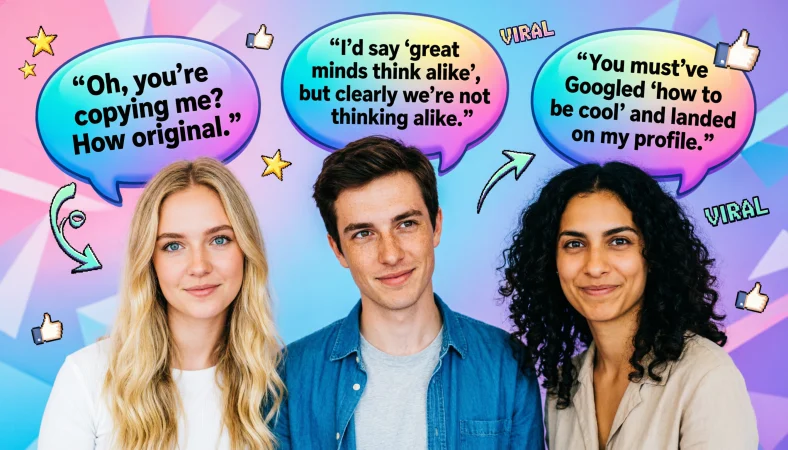
If you’re wondering how to respond to copycat, your answer can be funny, confident, or playful depending on the situation. A copycat meme reply can turn the accusation into a joke, while copy answer and you are a copycat may call for a clever comeback such as “I prefer to call it inspiration.”
Top alternatives: “Great minds think alike,” “Imitation is flattering,” “You noticed!”, “Original enough to be copied,” “At least you have good taste.”
Getting called a “copycat” can be anything from friendly teasing to a not-so-subtle accusation. Whether someone is joking around or genuinely thinks you copied them, the right comeback can keep things light without making the situation more dramatic than it needs to be.
Knowing how to respond to copycat depends heavily on the tone behind the comment. A friend might call you a copycat because you bought the same shoes, used the same phrase, or suddenly developed the same obsession with a TV show. In that situation, a playful comeback is usually enough. If someone is genuinely annoyed, though, a calm response can prevent a silly accusation from turning into an unnecessary argument. You do not always need a courtroom-level defence for copying the same coffee order.
Online, the phrase can take on an even more playful personality. A copycat meme reply can turn “you are a copycat” into an easy joke, while copy answer may be used when someone thinks you simply repeated their response instead of coming up with your own. Whether you want to sound witty, sarcastic, unbothered, or friendly, the best reply is one that fits the relationship and keeps the conversation moving naturally.
Copycat Meme Reply
A copycat meme reply works well when someone is clearly teasing you rather than making a serious accusation. Try something like “Copying greatness takes skill too 😂” to turn the moment into a joke.
Copy Answer
If someone says copy answer, they may be pointing out that you gave the same answer as them. A playful response could be “We clearly have the same brain today 😂.”
You Are a Copycat
When someone says you are a copycat, you can answer with “Great minds think alike!” if you want to keep things friendly. For a cheekier comeback, try “Or maybe you just have excellent taste in ideas.”
Funny Responses
“Great minds think alike.”
Use it when a friend jokingly accuses you of copying them.
Meaning: You are playfully suggesting that you both simply had the same idea.
“You noticed? I was trying to be subtle.”
Use it when someone catches a harmless similarity.
Meaning: You are jokingly admitting it without taking the accusation seriously.
“Copycat? I prefer trend researcher.”
Use it when you want a goofy excuse for doing something similar.
Meaning: You turn the accusation into a playful compliment toward yourself.
“Oops, my originality subscription expired.”
Use it in a funny text or group chat.
Meaning: You are poking fun at yourself instead of getting defensive.
“I call it creative borrowing.”
Use it when the similarity is obvious but harmless.
Meaning: You are giving the situation a deliberately ridiculous spin.
“At least I copied something good.”
Use it when someone has something worth imitating.
Meaning: You are teasing them while giving them a compliment.
“Relax, I added my own seasoning.”
Use it when your version clearly has some differences.
Meaning: You are saying you made the idea your own.
“My bad, your idea looked lonely.”
Use it when teasing a friend about copying their idea.
Meaning: You are making the imitation sound intentionally silly.
“The inspiration was simply too powerful.”
Use it after recreating someone’s style or idea.
Meaning: You are humorously admitting they influenced you.
“I plead guilty to having excellent taste.”
Use it when someone accuses you of copying their style.
Meaning: You are confidently turning the accusation into praise.
“Copying? No, we accidentally downloaded the same update.”
Use it when you both do something surprisingly similar.
Meaning: You are framing the coincidence as a funny shared experience.
“Don’t blame me for recognizing greatness.”
Use it when someone jokingly complains about being copied.
Meaning: You are playfully suggesting their idea was too good to ignore.
“I was just testing your originality detector.”
Use it when you want a ridiculous excuse.
Meaning: You are making the accusation part of the joke.
“Coincidence has entered the chat.”
Use it for a quick social media reply.
Meaning: You are dismissing the similarity with playful internet humor.
“Looks like we share one brain cell.”
Use it with a close friend who had the same idea.
Meaning: You are highlighting your funny similarity in a friendly way.
Amazing Responses
“Funny how my version still gets noticed.”
Use it when someone is being unnecessarily competitive.
Meaning: You are confidently pointing attention back toward yourself.
“If I wanted your exact version, I’d have asked.”
Use it when the accusation is serious and annoying.
Meaning: You are making it clear that you have your own judgment.
“Being similar isn’t the same as being you.”
Use it when someone acts possessive over a general idea.
Meaning: You are calmly reminding them that similarity does not equal identity.
“Don’t flatter yourself too much.”
Use it when someone assumes everything you do comes from them.
Meaning: You are pushing back against their inflated assumption.
“Your confidence is copying my confidence.”
Use it when someone is being overly dramatic.
Meaning: You are turning their accusation back into a joke.
“I didn’t know you owned that idea.”
Use it when someone claims ownership over something ordinary.
Meaning: You are challenging the idea that they have exclusive rights to it.
“You must really like my version.”
Use it when they keep focusing on your similarity.
Meaning: You are subtly suggesting their attention proves your version is interesting.
“If resemblance bothers you, that’s a you problem.”
Use it when you want a firm boundary.
Meaning: You are refusing to accept unnecessary criticism.
“I promise your identity is safe.”
Use it when someone exaggerates a harmless similarity.
Meaning: You are mocking their concern without becoming aggressive.
“Not everything revolves around your idea.”
Use it when someone repeatedly claims credit.
Meaning: You are firmly rejecting their assumption.
“You discovered coincidence. Congratulations.”
Use it when someone is acting overly proud about noticing a similarity.
Meaning: You are sarcastically minimizing their accusation.
“I can see why you’d want credit.”
Use it when someone seems desperate for recognition.
Meaning: You are calling out their behavior with controlled sarcasm.
“Copycat is a big word for coincidence.”
Use it when the similarities are minor.
Meaning: You are telling them they are overreacting.
“Your ego got here before the evidence did.”
Use it when someone makes an accusation without proof.
Meaning: You are criticizing their assumption rather than the person themselves.
“I think you’ll survive this.”
Use it when someone dramatically complains about being copied.
Meaning: You are playfully telling them the situation is not that serious.
Flirty Responses
“Maybe I just like your style.”
Use it when a crush playfully calls you a copycat.
Meaning: You are turning the accusation into a subtle compliment.
“Can you blame me for taking inspiration from you?”
Use it when you want to add romantic energy.
Meaning: You are openly suggesting they influence you.
“Careful, I might start copying your heart next.”
Use it during playful flirting.
Meaning: You are turning the copying joke into romantic banter.
“Maybe we’re just on the same wavelength.”
Use it when you both keep having similar ideas.
Meaning: You are suggesting a deeper connection.
“I guess I have a type, and apparently it’s your vibe.”
Use it when copying their style becomes a flirtatious joke.
Meaning: You are hinting that you like what they bring.
“If I’m copying you, it’s definitely because you’re cute.”
Use it when the mood is openly flirty.
Meaning: You are using the accusation as an excuse to compliment them.
“Maybe your influence is getting dangerous.”
Use it when they tease you about picking up their habits.
Meaning: You are playfully admitting they have an effect on you.
“Looks like you’re becoming my favorite inspiration.”
Use it when you want something sweet and flirty.
Meaning: You are telling them they have caught your attention.
“Don’t worry, I’ll give you credit for being adorable.”
Use it when teasing someone you like.
Meaning: You are mixing playful sarcasm with affection.
“Maybe we’re accidentally becoming a matching set.”
Use it when you have several similarities.
Meaning: You are hinting at compatibility.
“I only copy people worth noticing.”
Use it when you want a confident flirt.
Meaning: You are subtly telling them they stand out to you.
“Your vibe is contagious.”
Use it when you’ve picked up their habits or style.
Meaning: You are complimenting their personality.
“Maybe the universe wants us to match.”
Use it when the similarity feels funny and romantic.
Meaning: You are turning coincidence into playful destiny.
“Fine, you caught me admiring your taste.”
Use it when they call out a similar style choice.
Meaning: You are admitting admiration in a flirty way.
“If copying you gets me closer to you, I might keep doing it.”
Use it with someone you’re already flirting with.
Meaning: You are making your attraction obvious while keeping it playful.
Polite Responses
“I think we just had a similar idea.”
Use it when you want to keep things calm.
Meaning: You are offering a neutral explanation without arguing.
“I didn’t intend to copy you.”
Use it when someone genuinely feels uncomfortable.
Meaning: You are respectfully clarifying your intentions.
“I can understand why it looked similar.”
Use it when you want to acknowledge their perspective.
Meaning: You are validating their observation without admitting wrongdoing.
“It was actually a coincidence.”
Use it when the similarity happened naturally.
Meaning: You are giving a straightforward explanation.
“I appreciate you pointing it out.”
Use it when the conversation needs maturity.
Meaning: You are responding respectfully instead of becoming defensive.
“I had a similar thought independently.”
Use it in a calm discussion.
Meaning: You are explaining that the idea came from you separately.
“I see the resemblance, but it wasn’t intentional.”
Use it when the similarity is obvious.
Meaning: You are acknowledging the situation while clarifying intent.
“Let’s not make it a bigger issue than it is.”
Use it when the accusation starts becoming dramatic.
Meaning: You want to keep the conversation reasonable.
“I respect your perspective.”
Use it when you disagree but want to remain courteous.
Meaning: You are keeping the exchange civil.
“I think there may have been a misunderstanding.”
Use it when the accusation is based on incorrect information.
Meaning: You are calmly opening the door to clarification.
“I wasn’t trying to take credit for your idea.”
Use it when ownership is the real concern.
Meaning: You are directly addressing the potential misunderstanding.
“We can compare the ideas and clear it up.”
Use it when the situation needs facts.
Meaning: You are offering a practical solution.
“I understand your concern.”
Use it when someone is genuinely upset.
Meaning: You are showing empathy without automatically accepting blame.
“Let’s keep things respectful.”
Use it when the conversation becomes hostile.
Meaning: You are setting a clear boundary.
“I think we’re both coming from different perspectives.”
Use it when neither person agrees.
Meaning: You are choosing diplomacy over confrontation.
Creative Responses
“Originality took a coffee break.”
Use it when you want a quirky joke.
Meaning: You are humorously admitting that similarities happen.
“The creative universe connected our Wi-Fi.”
Use it when two people come up with the same idea.
Meaning: You are turning coincidence into a playful image.
“Consider it a remix, not a replica.”
Use it when your version has noticeable differences.
Meaning: You are emphasizing your personal twist.
“Same recipe, different chef.”
Use it when two ideas look similar but aren’t identical.
Meaning: You are highlighting individual creativity.
“Your idea was the trailer, mine is the sequel.”
Use it when joking with a friend.
Meaning: You are framing your version as a playful continuation.
“We accidentally joined the same creative timeline.”
Use it in a group chat or DM.
Meaning: You are describing the coincidence in a fun way.
“Call it parallel creativity.”
Use it when you want something clever and short.
Meaning: You are suggesting that both ideas developed independently.
“The inspiration fairy has no loyalty.”
Use it when someone jokes that you borrowed their idea.
Meaning: You are making creativity sound unpredictable.
“Same canvas, different brushstrokes.”
Use it when the concepts are similar but personalized.
Meaning: You are emphasizing individual expression.
“I didn’t copy the vibe, I upgraded the playlist.”
Use it when someone accuses you of copying a style.
Meaning: You are joking that your version has its own flavor.
“Call the resemblance a happy accident.”
Use it when the similarity wasn’t planned.
Meaning: You are giving coincidence a playful label.
“We clearly subscribed to the same idea newsletter.”
Use it when you both think alike.
Meaning: You are making the shared idea sound ridiculous and funny.
“The originality department is investigating.”
Use it when you want a dramatic joke.
Meaning: You are pretending the situation is an official investigation.
“It’s giving synchronized creativity.”
Use it for a modern social media response.
Meaning: You are reframing copying as shared creative energy.
“Two creators, one suspiciously similar brain cell.”
Use it when a friend catches a similarity.
Meaning: You are celebrating the coincidence through humor.
Sarcastic Responses
“Wow, you solved the mystery.”
Use it when someone makes an obvious observation.
Meaning: You are sarcastically teasing them for stating the obvious.
“Thank you for your investigative services.”
Use it when someone acts like a detective.
Meaning: You are mocking their dramatic discovery.
“Alert the authorities immediately.”
Use it when the accusation is obviously exaggerated.
Meaning: You are humorously pretending the situation is an emergency.
“Someone call the originality police.”
Use it when the conversation is playful.
Meaning: You are exaggerating the accusation for comedic effect.
“I may never recover from this accusation.”
Use it when someone is teasing you.
Meaning: You are pretending to be dramatically devastated.
“My reputation is ruined. What will I tell the internet?”
Use it in a group chat.
Meaning: You are making the accusation sound absurdly serious.
“Thank goodness you caught me.”
Use it when you want playful sarcasm.
Meaning: You are pretending the copying was a secret crime.
“Please, spare me the courtroom drama.”
Use it when someone keeps arguing.
Meaning: You want them to stop overreacting.
“I confess to absolutely nothing.”
Use it when the accusation is clearly joking.
Meaning: You are playfully refusing to admit anything.
“This is the scandal of the century.”
Use it when someone makes a tiny issue dramatic.
Meaning: You are exaggerating the situation for humor.
“Should I prepare my apology statement?”
Use it when someone acts offended.
Meaning: You are sarcastically pretending to take the accusation seriously.
“I’ll alert my legal team.”
Use it when a friend jokes that you copied them.
Meaning: You are turning the accusation into mock drama.
“Please don’t cancel me over this.”
Use it for playful online banter.
Meaning: You are joking about exaggerated social consequences.
“I hope the copycat committee approves.”
Use it when someone is being overly serious.
Meaning: You are mocking the supposed authority behind their accusation.
“Congratulations on your groundbreaking discovery.”
Use it when someone proudly points out an obvious similarity.
Meaning: You are using sarcasm to make their complaint seem less important.
Cute Responses
“Maybe we just think alike.”
Use it with a close friend or someone you like.
Meaning: You are turning the similarity into something sweet.
“Twinsies!”
Use it when the copying is harmless and funny.
Meaning: You are embracing the similarity playfully.
“Same brain, different day.”
Use it when you and someone else repeatedly have similar ideas.
Meaning: You are celebrating your connection.
“Look at us being accidentally adorable.”
Use it when you match someone else’s style.
Meaning: You are making the situation affectionate and lighthearted.
“I guess your vibe rubbed off on me.”
Use it with someone you’re close to.
Meaning: You are saying their personality influenced you.
“We’re just accidentally matching.”
Use it when your outfits or choices are similar.
Meaning: You are treating the coincidence as cute.
“Maybe it’s friendship telepathy.”
Use it with a best friend.
Meaning: You are joking that your connection explains the similarity.
“Great minds really do sync sometimes.”
Use it when you both have the same idea.
Meaning: You are framing the coincidence positively.
“You inspire me more than you know.”
Use it when someone genuinely influences your style.
Meaning: You are offering a sincere compliment.
“Okay, maybe I borrowed a tiny bit of your sparkle.”
Use it when you want a warm, playful response.
Meaning: You are admitting influence in an affectionate way.
“We’re clearly on the same wavelength.”
Use it when your choices keep matching.
Meaning: You are highlighting your connection.
“Don’t worry, your style is safe with me.”
Use it when teasing someone about a copied look.
Meaning: You are reassuring them while keeping things playful.
“I call this friendship synchronization.”
Use it with someone you know well.
Meaning: You are making your similarities sound adorable.
“Maybe your good taste is contagious.”
Use it when you’ve adopted someone’s style.
Meaning: You are complimenting them while joking about copying.
“We make a pretty cute copy-paste team.”
Use it with a close friend or crush.
Meaning: You are turning the accusation into a sweet connection.
Dramatic Responses
“How could you accuse me like this?”
Use it when a friend is clearly joking.
Meaning: You are pretending to be deeply offended for laughs.
“After everything we’ve been through?”
Use it when you want maximum playful drama.
Meaning: You are acting as though the accusation is a betrayal.
“I thought we had something special.”
Use it when turning a tiny accusation into fake heartbreak.
Meaning: You are exaggerating the situation for comedy.
“My heart will never be the same.”
Use it when someone playfully calls you a copycat.
Meaning: You are pretending their comment has emotionally destroyed you.
“This friendship may never recover.”
Use it with a close friend who enjoys dramatic jokes.
Meaning: You are making the accusation sound like a major betrayal.
“I need a moment to process this.”
Use it when someone teases you unexpectedly.
Meaning: You are humorously pretending to be shocked.
“Someone get the tissues.”
Use it when you want an exaggerated reaction.
Meaning: You are turning a small disagreement into melodrama.
“I can’t believe this is how my story ends.”
Use it for an over-the-top group chat response.
Meaning: You are making the accusation sound hilariously catastrophic.
“Tell my family I loved them.”
Use it only with people who understand your humor.
Meaning: You are exaggerating the situation to absurd levels.
“The betrayal is real.”
Use it when someone jokingly calls you out.
Meaning: You are pretending their comment seriously wounded you.
“I came here to create, not to be accused.”
Use it when you want mock outrage.
Meaning: You are humorously defending your creative intentions.
“This accusation will haunt me forever.”
Use it in playful texting.
Meaning: You are deliberately overreacting for comedic effect.
“I demand an immediate investigation.”
Use it when the conversation is already playful.
Meaning: You are pretending the accusation requires official action.
“My character arc did not prepare me for this.”
Use it when you want a dramatic internet-style comeback.
Meaning: You are framing the accusation as an unexpected plot twist.
“And this is how legends fall.”
Use it when you want maximum theatrical energy.
Meaning: You are jokingly presenting the moment as your downfall.
Chill And Casual Responses
“Haha, we just had the same idea.”
Use it when someone casually points out a similarity.
Meaning: You are keeping the situation relaxed.
“Could be a coincidence.”
Use it when you don’t want unnecessary drama.
Meaning: You are offering a simple explanation.
“Maybe we’re just on the same wavelength.”
Use it with friends or coworkers.
Meaning: You are making the similarity sound natural.
“I see why you think that.”
Use it when you want to acknowledge their point.
Meaning: You are staying calm without admitting fault.
“Fair enough.”
Use it when you don’t feel like arguing.
Meaning: You are casually accepting their observation.
“Haha, my bad if it looked that way.”
Use it when the similarity was accidental.
Meaning: You are keeping things friendly while clarifying intent.
“No copy-paste involved, promise.”
Use it in a casual text.
Meaning: You are lightly denying intentional copying.
“We clearly have similar taste.”
Use it when the similarity is harmless.
Meaning: You are turning the situation into a positive observation.
“Guess we were thinking alike.”
Use it when two ideas happen to match.
Meaning: You are treating the situation as coincidence.
“I didn’t even realize we matched.”
Use it when the similarity surprises you.
Meaning: You are honestly acknowledging the coincidence.
“It’s all good.”
Use it when you want to end the topic quickly.
Meaning: You are signaling that there is no need for conflict.
“Nothing personal, just a funny coincidence.”
Use it when someone seems mildly bothered.
Meaning: You are keeping the exchange peaceful.
“We both have good taste, apparently.”
Use it when the similarity is about style.
Meaning: You are turning the accusation into a compliment.
“No hard feelings.”
Use it when the conversation gets slightly tense.
Meaning: You are making it clear you don’t want an argument.
“Let’s call it accidental matching.”
Use it when you want a simple, friendly ending.
Meaning: You are reframing the situation without taking sides.
Confident Responses
“I know what I like, and I go with it.”
Use it when someone questions your style.
Meaning: You are confidently asserting your independence.
“Similarity doesn’t erase my originality.”
Use it when the accusation is serious.
Meaning: You are making it clear that your work or style remains your own.
“I trust my own ideas.”
Use it when someone assumes you copied them.
Meaning: You are showing confidence in your creativity.
“I don’t need to copy anyone to stand out.”
Use it when you want a strong but controlled response.
Meaning: You are emphasizing your self-confidence.
“I have my own style.”
Use it when discussing clothing, content, or personality.
Meaning: You are clearly establishing your individuality.
“Being inspired isn’t the same as being identical.”
Use it when you acknowledge influence but maintain your independence.
Meaning: You are distinguishing inspiration from copying.
“My version speaks for itself.”
Use it when someone compares your work to theirs.
Meaning: You are confidently standing behind what you created.
“I don’t compete with people I admire.”
Use it when the accusation comes from someone you respect.
Meaning: You are showing confidence without becoming hostile.
“You can notice the similarity without defining me by it.”
Use it when someone keeps labeling you.
Meaning: You are asserting control over how you’re perceived.
“I know where my ideas came from.”
Use it when you genuinely created something independently.
Meaning: You are confidently defending your position.
“I’m comfortable with my originality.”
Use it when someone tries to make you doubt yourself.
Meaning: You are showing that their accusation does not shake your confidence.
“I don’t need permission to have similar taste.”
Use it when someone acts possessive over a style or trend.
Meaning: You are confidently rejecting unnecessary control.
“You can call it copying; I know my intentions.”
Use it when the accusation becomes personal.
Meaning: You are prioritizing your own understanding of the situation.
“My identity isn’t that easy to duplicate.”
Use it when someone makes a dramatic accusation.
Meaning: You are confidently separating yourself from the comparison.
“I can appreciate your idea and still have my own.”
Use it when you want confidence without hostility.
Meaning: You are asserting independence while remaining respectful.
Clever Responses
“Influence and imitation aren’t twins.”
Use it when someone confuses inspiration with copying.
Meaning: You are making a smart distinction between the two.
“Similar outcome, different thought process.”
Use it when you reached a comparable result independently.
Meaning: You are emphasizing that the path can be different.
“Originality isn’t measured by being completely different.”
Use it during a serious discussion about creativity.
Meaning: You are explaining that similar ideas can still be original.
“Two people can reach the same answer.”
Use it when your ideas happen to match.
Meaning: You are pointing out that coincidence is possible.
“A familiar idea can still have a fresh execution.”
Use it when discussing creative work.
Meaning: You are highlighting the importance of how an idea is developed.
“Same concept, different fingerprint.”
Use it when two things look similar but have distinct identities.
Meaning: You are emphasizing individual execution.
“Maybe we’re just reading the same cultural room.”
Use it when discussing trends.
Meaning: You are suggesting that shared influences explain the similarity.
“You call it copying; I call it parallel thinking.”
Use it when you want a confident intellectual comeback.
Meaning: You are reframing the accusation as shared thought.
“The idea existed before either of us touched it.”
Use it when someone claims ownership over a common concept.
Meaning: You are reminding them that broad ideas are often shared.
“Similarity is evidence of overlap, not automatically theft.”
Use it when the discussion is becoming serious.
Meaning: You are separating resemblance from intentional copying.
“Good ideas tend to travel.”
Use it when someone’s concept influenced you.
Meaning: You are suggesting that ideas naturally spread.
“Creativity rarely happens in a vacuum.”
Use it when discussing inspiration.
Meaning: You are acknowledging that creators influence one another.
“The execution tells the real story.”
Use it when two projects share a general concept.
Meaning: You are emphasizing the differences in how the idea was developed.
“Maybe the trend reached us both.”
Use it when a popular style explains the similarity.
Meaning: You are pointing toward a shared cultural influence.
“If resemblance were proof, everyone would be copying everyone.”
Use it when someone makes an overly broad accusation.
Meaning: You are challenging the logic behind their claim.
Sweet Responses
“Maybe you inspire me more than you realize.”
Use it when someone genuinely influences you.
Meaning: You are turning the accusation into a heartfelt compliment.
“I think we just have similar tastes.”
Use it when you want to keep things positive.
Meaning: You are framing the similarity as something you share.
“Honestly, I take it as a compliment.”
Use it when someone says you’re copying their style.
Meaning: You are choosing positivity instead of defensiveness.
“Maybe your good ideas rubbed off on me.”
Use it with someone you appreciate.
Meaning: You are giving them credit in a warm way.
“I like that we think alike.”
Use it when a friend points out a similarity.
Meaning: You are celebrating the connection.
“It’s kind of cute that we keep doing the same things.”
Use it with someone close to you.
Meaning: You are treating the similarity as an affectionate trait.
“Maybe we’re more alike than we thought.”
Use it when several similarities appear.
Meaning: You are suggesting a deeper connection.
“I wouldn’t mind sharing good ideas with you.”
Use it when the conversation is friendly.
Meaning: You are framing creativity as something you can enjoy together.
“Your style is definitely easy to appreciate.”
Use it when someone notices you’ve adopted their style.
Meaning: You are complimenting them while explaining your influence.
“I hope you know imitation isn’t meant as disrespect.”
Use it when someone is genuinely bothered.
Meaning: You are reassuring them about your intentions.
“I admire what you do, honestly.”
Use it when their work or style truly inspires you.
Meaning: You are replacing defensiveness with sincere appreciation.
“Maybe we just have a similar creative spark.”
Use it with a creative friend.
Meaning: You are describing the similarity as something positive.
“I think it’s sweet that we notice the same things.”
Use it when the similarity involves shared interests.
Meaning: You are making the connection feel meaningful.
“Good taste recognizes good taste.”
Use it when you want a playful compliment.
Meaning: You are saying that similarity comes from shared appreciation.
“I’m happy our ideas crossed paths.”
Use it when you want a warm, thoughtful response.
Meaning: You are presenting the similarity as a positive connection.
Clever And Playful Responses
“Copycat? More like collaborative coincidence.”
Use it when the situation is clearly harmless.
Meaning: You are giving the accusation a clever new label.
“I didn’t copy the blueprint, just admired the architecture.”
Use it when someone’s idea inspired you.
Meaning: You are separating admiration from direct imitation.
“The resemblance is doing a little too much today.”
Use it when the similarity is funny.
Meaning: You are joking about how obvious the coincidence looks.
“Same energy, different operating system.”
Use it when your styles are similar but not identical.
Meaning: You are highlighting your individuality with humor.
“Call it a coincidence with excellent timing.”
Use it when the similarity happened unexpectedly.
Meaning: You are making the timing part of the joke.
“Apparently originality comes with matching moments.”
Use it when you and someone else have similar ideas.
Meaning: You are playfully challenging the idea that similarity equals copying.
“We’re both guilty of having taste.”
Use it when discussing a shared trend.
Meaning: You are turning the accusation into mutual praise.
“I didn’t steal the vibe; I caught the wave.”
Use it when you follow a popular style.
Meaning: You are saying you participated in a trend rather than copied someone.
“Same flavor, different recipe.”
Use it when your versions have noticeable differences.
Meaning: You are emphasizing individual creativity.
“Apparently the idea had good marketing.”
Use it when someone’s concept influenced you.
Meaning: You are joking that the idea was persuasive.
“I see your accusation and raise you a coincidence.”
Use it when someone playfully calls you out.
Meaning: You are turning their accusation into a friendly game.
“The copycat allegations are getting spicy.”
Use it when a group chat starts teasing you.
Meaning: You are acknowledging the drama with humor.
“Maybe originality and similarity can coexist.”
Use it when you want something thoughtful but short.
Meaning: You are pointing out that being similar does not automatically mean being unoriginal.
“Looks like creativity chose chaos today.”
Use it when the similarity is unexpectedly obvious.
Meaning: You are turning the coincidence into a playful story.
“Same chapter, different handwriting.”
Use it when two people share a general idea.
Meaning: You are saying the core may be similar while the personal expression differs.
FAQs
What Does “Copycat” Mean?
“Copycat” usually describes someone who imitates another person’s behavior, style, idea, appearance, or actions. It can be playful teasing or a serious accusation depending on the context.
How Do You Respond to a Copycat Comment?
Match your response to the situation. Try “Great minds think alike” for something playful, “It was a coincidence” for something neutral, or “I have my own style” for a confident response.
Is Being Called a Copycat Always Negative?
No. Friends often use “copycat” jokingly when two people have matching outfits, habits, jokes, or ideas. The tone and relationship usually reveal whether it is serious.
What Is a Flirty Response to Being Called a Copycat?
Try something like, “Maybe I just like your vibe” or “I only copy people worth noticing.” These replies turn the accusation into playful romantic banter.
What If Someone Seriously Accuses Me of Copying Them?
Stay calm and explain your intentions. If the idea genuinely came from you independently, you can say, “I had a similar thought independently” without turning the situation into an argument.
Can Humor Make a Copycat Situation Better?
Absolutely, when the situation is lighthearted. A funny response can lower tension and keep the conversation friendly, but avoid jokes if the other person is genuinely upset.
What If I Actually Was Inspired by Them?
You can acknowledge it honestly. Saying, “I really liked your idea, so it inspired my version” can show appreciation while making the distinction between inspiration and direct copying.
Should You Get Defensive When Someone Says “Copycat”?
Usually, no. A calm, confident response often works better than an emotional reaction, especially when the accusation is vague or playful.
Can I Use These Replies on Social Media?
Yes. Short responses work especially well in comments, DMs, captions, and group chats because they are quick, readable, and easy to adapt.
What’s a Professional Way to Respond to “Copycat”?
Try, “I developed the idea independently, although I can understand why there is a resemblance.” It keeps the conversation respectful and focused on facts.
Conclusion
Being called a copycat does not have to derail the conversation. Sometimes the perfect comeback is funny enough to make everyone laugh, while other moments call for a calm explanation or a confident boundary. The key is knowing your audience, reading the tone, and choosing words that sound like you.
A playful response can turn teasing into banter, while a thoughtful response can prevent a small misunderstanding from becoming unnecessary drama. Whether you’re replying to a friend, coworker, crush, follower, or someone in your DMs, confidence always makes your words land better. Save your favorites, remix them to match your personality, and keep a few ready for the next unexpected “copycat” moment.











1 thought on “150+ Clever Responses To “Copycat” That Are Perfect For Texts, DMs & Real Life In 2026”