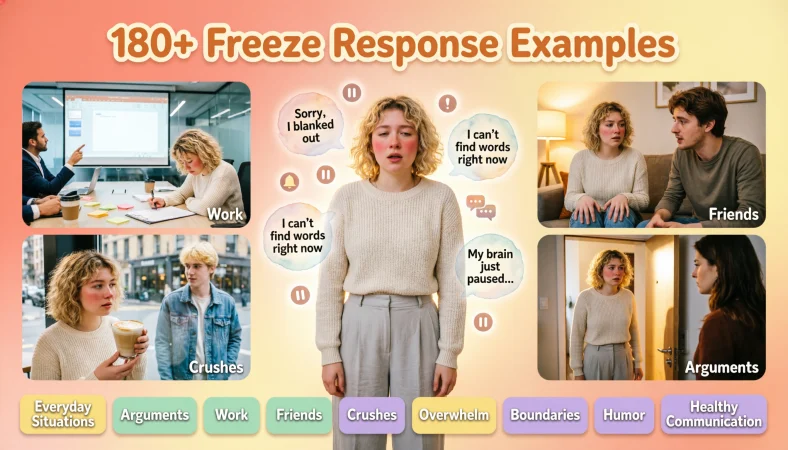
Freeze response examples show how people may suddenly go quiet, feel unable to move, struggle to speak, or mentally shut down when overwhelmed or threatened. Useful alternatives include: going silent under pressure, feeling stuck, shutting down emotionally, being unable to respond, needing a moment to process.
Ever had a moment when your brain basically hit the loading screen at the worst possible time? You know what you want to say, but nothing comes out. That can happen during an argument, stressful conversation, unexpected confrontation, workplace pressure, or even an awkward DM. These are some of the everyday freeze response examples people experience when their nervous system feels overwhelmed.
Unlike simply choosing to stay quiet, freezing can feel automatic and surprisingly difficult to control. Understanding what is happening can make these moments less confusing and help you respond with more patience. Whether you are dealing with a friend, crush, coworker, family member, or yourself, knowing how to recognize a freeze response matters. Sometimes the best response is not a perfect comeback. Sometimes it is simply giving yourself a second to breathe, process, and find your words.
Freeze Response Examples In Everyday Situations
“I suddenly went completely quiet.”
Example: Use this when explaining why you stopped talking during an intense conversation.
Meaning: It describes an automatic moment of silence caused by feeling overwhelmed.
“My mind just went blank.”
Example: Use this when you knew the topic but could not think clearly in the moment.
Meaning: It shows that stress temporarily disrupted your ability to respond.
“I felt completely stuck.”
Example: Use this when describing a situation where you wanted to act but could not.
Meaning: It communicates a strong feeling of being unable to move forward.
“I couldn’t get the words out.”
Example: Use this after struggling to speak during an emotional or stressful moment.
Meaning: It explains that speaking suddenly felt difficult.
“I froze for a second.”
Example: Use this for a brief reaction to something unexpected or overwhelming.
Meaning: It describes a temporary pause before your brain catches up.
“Everything felt like too much at once.”
Example: Use this when several stressful things happen simultaneously.
Meaning: It explains that the situation exceeded your immediate coping capacity.
“I just shut down.”
Example: Use this when you became unusually quiet during a difficult situation.
Meaning: It communicates emotional or mental withdrawal under pressure.
“I couldn’t figure out what to do next.”
Example: Use this when stress made decision-making unusually difficult.
Meaning: It shows how overwhelm can interrupt normal problem-solving.
“I felt like I was on pause.”
Example: Use this when describing a strange sense of being temporarily unable to react.
Meaning: It presents freezing in simple, relatable language.
“My brain needed a minute.”
Example: Use this when you need time before answering a difficult question.
Meaning: It communicates the need for processing time without overexplaining.
“I knew what was happening, but I couldn’t react.”
Example: Use this when awareness remained but action felt impossible.
Meaning: It highlights the difference between noticing something and responding to it.
“I completely locked up.”
Example: Use this when describing a stronger freeze reaction during pressure.
Meaning: It conveys feeling mentally or physically unable to respond.
Freeze Response Examples During Arguments
“I need a second before I answer.”
Example: Use this when an argument becomes intense and you need to collect your thoughts.
Meaning: It creates space without abandoning the conversation.
“I’m overwhelmed right now.”
Example: Use this when the discussion becomes emotionally difficult to process.
Meaning: It honestly communicates that your emotions are getting too intense.
“I hear you, but I need a moment.”
Example: Use this when you want to acknowledge the other person without answering immediately.
Meaning: It shows respect while protecting your processing time.
“I don’t want to say something I don’t mean.”
Example: Use this when silence happens because you are afraid of reacting emotionally.
Meaning: It explains that pausing is intentional rather than dismissive.
“Give me a minute to think.”
Example: Use this when you need a short break during a heated disagreement.
Meaning: It asks for breathing room before continuing.
“I’m not ignoring you.”
Example: Use this when someone mistakes your silence for avoidance.
Meaning: It reassures them that your quietness has another reason.
“I’m having trouble finding my words.”
Example: Use this when emotions make speaking difficult.
Meaning: It explains your silence without blaming the other person.
“Can we slow this down?”
Example: Use this when the conversation is moving faster than you can process.
Meaning: It requests a calmer pace.
“I want to talk about this, just not while I’m overwhelmed.”
Example: Use this when you want to continue the discussion later.
Meaning: It combines reassurance with a healthy boundary.
“I need a little space to process this.”
Example: Use this after hearing something emotionally heavy.
Meaning: It asks for time without rejecting the conversation.
“I’m here, my brain is just buffering.”
Example: Use this with someone who understands your humor during tense moments.
Meaning: It lightly explains that your processing speed has temporarily slowed.
“Let me gather my thoughts.”
Example: Use this when you want to answer thoughtfully instead of reacting instantly.
Meaning: It signals a brief and respectful pause.
Freeze Response Examples At Work
“I need a moment to process that question.”
Example: Use this when an unexpected question catches you off guard in a meeting.
Meaning: It buys time while remaining professional.
“Could you give me a second to think about that?”
Example: Use this when you need a brief pause before answering a colleague.
Meaning: It politely creates thinking space.
“I want to make sure I give you an accurate answer.”
Example: Use this when pressure makes an immediate response difficult.
Meaning: It frames the pause as careful consideration.
“Let me collect my thoughts.”
Example: Use this during a presentation or discussion when your mind goes blank.
Meaning: It gives you a professional way to regain focus.
“I’ll come back to that once I’ve reviewed the details.”
Example: Use this when you cannot confidently answer on the spot.
Meaning: It replaces pressure with a practical next step.
“That caught me off guard.”
Example: Use this after receiving an unexpected workplace question.
Meaning: It openly explains why your response was delayed.
“I need a little time to think this through.”
Example: Use this when a decision requires more consideration.
Meaning: It communicates thoughtful hesitation rather than refusal.
“Could we revisit this in a few minutes?”
Example: Use this when a stressful meeting makes immediate discussion difficult.
Meaning: It requests a short pause while keeping the conversation active.
“I’m processing the information.”
Example: Use this when you become quiet after receiving several details at once.
Meaning: It explains your silence in a clear professional way.
“I don’t have an immediate answer.”
Example: Use this when pressure makes guessing feel unhelpful.
Meaning: It establishes honesty without pretending certainty.
“Let me write that down and respond properly.”
Example: Use this when verbal pressure makes organizing your thoughts difficult.
Meaning: It shifts the response into a more manageable format.
“I appreciate the question. Let me think for a moment.”
Example: Use this when you want to remain composed during a formal discussion.
Meaning: It combines professionalism with a reasonable processing pause.
Freeze Response Examples In Social Situations
“Sorry, I totally froze there.”
Example: Use this after becoming unusually quiet during a social interaction.
Meaning: It casually explains the sudden silence.
“My brain left the group chat for a second.”
Example: Use this with friends who appreciate playful internet humor.
Meaning: It makes a brief freeze moment feel lighter.
“I had absolutely no words.”
Example: Use this after an unexpected comment leaves you speechless.
Meaning: It communicates genuine surprise or overwhelm.
“I needed a second to process that.”
Example: Use this when someone says something you did not expect.
Meaning: It explains your delayed reaction naturally.
“That caught me completely off guard.”
Example: Use this after an unexpected question or announcement.
Meaning: It shows that surprise caused your hesitation.
“I was mentally buffering.”
Example: Use this when you want a funny explanation for temporary silence.
Meaning: It compares slow processing to a device loading.
“I forgot how conversations work for a minute.”
Example: Use this after awkwardly freezing around someone you like.
Meaning: It humorously acknowledges social nervousness.
“I promise I heard you.”
Example: Use this when someone thinks your silence means you were not listening.
Meaning: It reassures them that you were paying attention.
“I was trying to figure out what to say.”
Example: Use this when you genuinely need time before responding.
Meaning: It shows that the silence came from processing.
“That was a lot to take in.”
Example: Use this when someone shares unexpected or emotional information.
Meaning: It acknowledges the weight of the moment.
“My social battery needed a reboot.”
Example: Use this when social pressure makes you temporarily withdraw.
Meaning: It uses humor to describe needing a reset.
“Give me one second, I’m catching up.”
Example: Use this when a group conversation moves too quickly.
Meaning: It asks for a small pause so you can re-engage.
Freeze Response Examples When Feeling Overwhelmed
“I’m overwhelmed, so I need to pause.”
Example: Use this when too many emotions or demands arrive at once.
Meaning: It clearly communicates your need for a break.
“I can’t process everything right now.”
Example: Use this when several stressful issues become difficult to handle simultaneously.
Meaning: It acknowledges your current mental limits.
“I need to take this one thing at a time.”
Example: Use this when a situation feels too complicated all at once.
Meaning: It creates a manageable path forward.
“I’m feeling overloaded.”
Example: Use this when pressure starts affecting your ability to respond.
Meaning: It describes a state of emotional or mental overload.
“I need some quiet before I can think clearly.”
Example: Use this when noise, conflict, or pressure makes processing harder.
Meaning: It asks for a calmer environment.
“I’m not ready to answer yet.”
Example: Use this when someone expects an immediate response.
Meaning: It establishes that you need more time.
“Everything hit me at once.”
Example: Use this after several stressful events happen close together.
Meaning: It explains why your reaction became unusually quiet.
“I’m taking a moment to reset.”
Example: Use this when stepping away briefly helps you regain composure.
Meaning: It presents the pause as intentional recovery.
“I need to breathe and regroup.”
Example: Use this when emotions make immediate action difficult.
Meaning: It emphasizes calming down before continuing.
“I’m here, I just need a minute.”
Example: Use this when you want others to know you are still present.
Meaning: It separates needing time from withdrawing completely.
“My brain has reached maximum capacity.”
Example: Use this with trusted friends when overwhelm feels intense.
Meaning: It uses humor to describe mental overload.
“Let me get myself together first.”
Example: Use this when you need a brief pause before continuing.
Meaning: It communicates the need to regain emotional balance.
Freeze Response Examples In Difficult Conversations
“I want to answer, but I need a moment.”
Example: Use this when an important conversation becomes difficult to process.
Meaning: It shows willingness to communicate while requesting time.
“This is difficult for me to process.”
Example: Use this when the subject carries emotional weight.
Meaning: It honestly communicates the impact of the conversation.
“I don’t know what to say right now.”
Example: Use this when words genuinely fail you.
Meaning: It avoids pretending you have an immediate answer.
“Can we come back to this later?”
Example: Use this when continuing immediately feels overwhelming.
Meaning: It requests a temporary pause rather than ending communication.
“I need to understand what I’m feeling first.”
Example: Use this when emotions are confusing or intense.
Meaning: It prioritizes reflection before responding.
“I’m listening, even if I’m quiet.”
Example: Use this when someone interprets silence as disinterest.
Meaning: It reassures them that you remain engaged.
“I’m having a hard time responding right now.”
Example: Use this when stress interferes with speaking.
Meaning: It explains the difficulty without assigning blame.
“Please give me a little time.”
Example: Use this when you need space before answering something important.
Meaning: It makes a direct and respectful request.
“I don’t want to rush my answer.”
Example: Use this when the conversation deserves a thoughtful response.
Meaning: It turns hesitation into deliberate reflection.
“I’m trying to process what you just said.”
Example: Use this after hearing something unexpected or emotional.
Meaning: It explains the silence as active processing.
“I need a pause, not an escape.”
Example: Use this when you want to reassure someone that you will return to the discussion.
Meaning: It distinguishes temporary space from avoidance.
“I care about this conversation, which is why I need a second.”
Example: Use this when silence might otherwise seem dismissive.
Meaning: It shows that your pause comes from wanting to respond carefully.
Freeze Response Examples For Anxiety And Nervousness
“I got nervous and froze.”
Example: Use this when nerves suddenly make responding difficult.
Meaning: It directly connects the freeze to nervousness.
“My nerves took over for a second.”
Example: Use this after unexpectedly becoming quiet.
Meaning: It describes how nervousness temporarily affected your response.
“I knew what I wanted to say, then forgot everything.”
Example: Use this after freezing during a high-pressure moment.
Meaning: It captures the frustrating experience of mental blankness.
“My brain went offline.”
Example: Use this when you want a casual explanation for suddenly freezing.
Meaning: It humorously describes temporary difficulty thinking.
“I got overwhelmed by the moment.”
Example: Use this when the situation felt emotionally intense.
Meaning: It explains that the moment itself became difficult to handle.
“I needed a second to calm my nerves.”
Example: Use this before returning to a stressful interaction.
Meaning: It shows that calming down can improve your ability to respond.
“I wasn’t ignoring you, I was nervous.”
Example: Use this when someone mistakes your silence for disinterest.
Meaning: It clarifies that nervousness caused the quietness.
“My words disappeared at the worst possible time.”
Example: Use this when nervousness makes speaking unexpectedly difficult.
Meaning: It adds humor to an uncomfortable moment.
“I got stuck in my head.”
Example: Use this when overthinking contributes to freezing.
Meaning: It describes becoming mentally caught up in thoughts.
“I needed a moment to settle down.”
Example: Use this when nervous energy prevents a natural response.
Meaning: It communicates the need for emotional regulation.
“My confidence took a tiny vacation.”
Example: Use this with friends when nerves make you freeze.
Meaning: It playfully explains a temporary loss of confidence.
“I’m okay, just a little nervous.”
Example: Use this when someone notices you becoming unusually quiet.
Meaning: It reassures them while honestly naming the emotion.
Freeze Response Examples When Someone Confronts You
“I wasn’t prepared for that confrontation.”
Example: Use this when an unexpected confrontation leaves you unable to respond.
Meaning: It explains why you became quiet.
“I need a moment before I respond.”
Example: Use this when someone confronts you and emotions immediately rise.
Meaning: It creates room for a thoughtful answer.
“I heard what you said.”
Example: Use this when you cannot respond fully but want to acknowledge the person.
Meaning: It confirms that their words reached you.
“I’m not ready to discuss this yet.”
Example: Use this when confrontation becomes too intense.
Meaning: It establishes a clear conversational boundary.
“That caught me by surprise.”
Example: Use this when the confrontation was completely unexpected.
Meaning: It explains the initial lack of response.
“I need some time to think about this.”
Example: Use this when immediate confrontation makes thinking difficult.
Meaning: It requests processing time before continuing.
“I don’t want to react impulsively.”
Example: Use this when you want to avoid responding emotionally.
Meaning: It frames your pause as responsible communication.
“Let’s talk when we’re both calmer.”
Example: Use this when the conversation becomes emotionally heated.
Meaning: It encourages a more productive discussion later.
“I’m taking in what you said.”
Example: Use this when you need time to process criticism or accusations.
Meaning: It shows that you are listening rather than dismissing the issue.
“I need a minute before I can explain myself.”
Example: Use this when pressure makes your thoughts difficult to organize.
Meaning: It asks for time to communicate clearly.
“I’m not avoiding the conversation.”
Example: Use this when someone assumes your silence means escape.
Meaning: It reassures them that you still intend to address the issue.
“I want to respond thoughtfully, not react emotionally.”
Example: Use this when confrontation creates strong feelings.
Meaning: It emphasizes deliberate communication.
Freeze Response Examples With Friends
“Sorry, I froze for a second.”
Example: Use this when you suddenly stop responding during a conversation with a friend.
Meaning: It gives a simple explanation for your silence.
“You caught me completely off guard.”
Example: Use this after a friend asks an unexpected question.
Meaning: It explains why you needed extra time.
“My brain needed a reboot.”
Example: Use this when you want to keep the explanation playful.
Meaning: It turns a brief freeze into a relatable joke.
“I was listening, I just had no words.”
Example: Use this after a friend shares surprising news.
Meaning: It confirms that silence did not mean disinterest.
“Give me a second, bestie.”
Example: Use this when a close friend gives you unexpected information.
Meaning: It asks for processing time in a warm, casual way.
“That information needed a loading screen.”
Example: Use this when a friend says something surprising or complicated.
Meaning: It humorously describes slow processing.
“I genuinely didn’t know how to react.”
Example: Use this when a friend’s news leaves you speechless.
Meaning: It shows that the situation exceeded your usual response.
“I needed a minute to process that.”
Example: Use this when the conversation becomes emotionally significant.
Meaning: It communicates that you are still engaged but need time.
“My thoughts were buffering.”
Example: Use this when your response takes longer than expected.
Meaning: It uses internet humor to explain temporary mental hesitation.
“I wasn’t being weird, I just froze.”
Example: Use this when your silence creates an awkward moment.
Meaning: It reassures your friend that the behavior was not intentional.
“Okay, my brain has returned.”
Example: Use this when you finally know what you want to say.
Meaning: It playfully signals that you are ready to continue.
“I’m good, just processing.”
Example: Use this when you want to reassure a friend without giving a long explanation.
Meaning: It communicates that your quietness is temporary.
Freeze Response Examples With A Crush
“Sorry, you made me forget my entire vocabulary.”
Example: Use this when nervousness around a crush makes you freeze.
Meaning: It turns your awkward silence into a playful compliment.
“I got nervous for absolutely no reason.”
Example: Use this when your crush catches you off guard.
Meaning: It hints at attraction while keeping the tone light.
“You caught me at a very brainless moment.”
Example: Use this when you suddenly cannot think of a reply.
Meaning: It playfully admits that nerves affected your response.
“My brain stopped working for a second.”
Example: Use this when your crush says something unexpectedly charming.
Meaning: It suggests their presence affected your ability to respond.
“I had a response, then you smiled.”
Example: Use this when a crush makes you lose your train of thought.
Meaning: It gives the freeze a subtle flirty explanation.
“Okay, you definitely caught me off guard.”
Example: Use this after your crush says something unexpected.
Meaning: It acknowledges surprise without becoming overly serious.
“I promise I’m usually better with words.”
Example: Use this when you freeze during a romantic interaction.
Meaning: It hints that nervousness is unusual for you.
“You make it surprisingly hard to think.”
Example: Use this when you want a confident but playful flirt.
Meaning: It turns your hesitation into a compliment.
“My brain just needed a romantic loading screen.”
Example: Use this with someone who enjoys playful texting.
Meaning: It makes nervousness cute and humorous.
“I was trying to act normal.”
Example: Use this when your crush makes you unusually nervous.
Meaning: It lightly reveals that their presence affects you.
“I got shy for a second, okay?”
Example: Use this when you want to admit nervousness without making it heavy.
Meaning: It gives your freeze a cute explanation.
“You really know how to leave me speechless.”
Example: Use this when a crush says something charming or unexpected.
Meaning: It turns your silence into a flattering romantic signal.
Freeze Response Examples For Setting Boundaries
“I need a pause before continuing.”
Example: Use this when a conversation becomes too intense to process comfortably.
Meaning: It creates a clear but respectful boundary.
“I’m not able to answer that right now.”
Example: Use this when someone pressures you for an immediate response.
Meaning: It gives you permission to delay the answer.
“I need some space to think.”
Example: Use this when you need distance before making a decision.
Meaning: It communicates a reasonable need for processing time.
“I’ll respond when I’m ready.”
Example: Use this when someone keeps demanding an immediate answer.
Meaning: It reinforces your right to choose your timing.
“Please slow down.”
Example: Use this when the conversation feels too fast or intense.
Meaning: It asks the other person to reduce the pressure.
“I need a break from this conversation.”
Example: Use this when continuing feels emotionally overwhelming.
Meaning: It creates a direct boundary around the discussion.
“I’m listening, but I need you to give me time.”
Example: Use this when you want to remain engaged without being rushed.
Meaning: It balances connection with personal space.
“I cannot process this while being pressured.”
Example: Use this when someone expects an immediate decision.
Meaning: It explains why pressure makes responding harder.
“Let’s pause and come back to this.”
Example: Use this when both people need time to settle down.
Meaning: It keeps the door open for future communication.
“I need to step away for a moment.”
Example: Use this when taking a brief break helps you regain composure.
Meaning: It clearly communicates temporary withdrawal.
“I’m not comfortable answering right now.”
Example: Use this when a question crosses your personal boundary.
Meaning: It gives a firm but polite response.
“I need time, and I’d appreciate you respecting that.”
Example: Use this when someone continues pushing after you request space.
Meaning: It establishes a stronger and more direct boundary.
Freeze Response Examples For Self-Compassion
“I’m allowed to need a moment.”
Example: Use this as a reminder after freezing during a difficult situation.
Meaning: It replaces self-criticism with patience.
“Freezing does not mean I failed.”
Example: Use this when you feel embarrassed about your reaction.
Meaning: It separates an automatic response from personal worth.
“My reaction made sense in that moment.”
Example: Use this when reflecting on a stressful experience.
Meaning: It encourages understanding instead of harsh judgment.
“I can respond when I’m ready.”
Example: Use this when pressure makes you feel rushed.
Meaning: It reinforces the value of giving yourself processing time.
“I don’t have to have the perfect response.”
Example: Use this after replaying an awkward conversation in your head.
Meaning: It reduces pressure to perform perfectly.
“One awkward moment does not define me.”
Example: Use this after feeling embarrassed about freezing socially.
Meaning: It puts the moment into perspective.
“I can try again later.”
Example: Use this when you wish you had said something differently.
Meaning: It reminds you that conversations can continue.
“My brain was protecting me from overload.”
Example: Use this as a compassionate reflection on a stressful reaction.
Meaning: It encourages curiosity about the response instead of shame.
“I’m learning what helps me feel safe.”
Example: Use this when reflecting on recurring stressful situations.
Meaning: It shifts attention toward self-awareness and coping.
“I can take things one step at a time.”
Example: Use this when everything feels difficult at once.
Meaning: It makes a large problem feel more manageable.
“I deserve patience from myself too.”
Example: Use this after criticizing yourself for becoming quiet.
Meaning: It encourages self-kindness during difficult moments.
“I can breathe, pause, and begin again.”
Example: Use this when you want a simple reset after freezing.
Meaning: It emphasizes recovery rather than perfection.
Freeze Response Examples For Recovering After The Moment
“I know I went quiet earlier, and I’m ready to talk now.”
Example: Use this when returning to a conversation after needing time.
Meaning: It reconnects without pretending the pause never happened.
“I’ve had time to process it.”
Example: Use this when you are finally ready to discuss what happened.
Meaning: It signals that your thoughts are clearer now.
“I wish I had answered differently earlier.”
Example: Use this when reflecting on a response you could have handled better.
Meaning: It acknowledges the moment without excessive self-blame.
“I froze earlier, but I want to explain myself now.”
Example: Use this when you want to reopen an important conversation.
Meaning: It directly connects the earlier silence with your current readiness.
“I know my silence may have been confusing.”
Example: Use this when someone could have misunderstood your reaction.
Meaning: It recognizes how freezing may look from the outside.
“Thank you for giving me time.”
Example: Use this when someone respected your request for space.
Meaning: It expresses appreciation for their patience.
“I’m ready to continue this conversation.”
Example: Use this when you feel prepared to return to the topic.
Meaning: It clearly signals renewed engagement.
“I understand what I want to say now.”
Example: Use this when processing has helped you organize your thoughts.
Meaning: It communicates increased clarity.
“I needed that pause more than I realized.”
Example: Use this after taking time successfully reduces overwhelm.
Meaning: It acknowledges the value of stepping back.
“I’m glad we can talk about it calmly now.”
Example: Use this when a difficult conversation resumes in a safer tone.
Meaning: It encourages constructive communication.
“I didn’t have the words then, but I do now.”
Example: Use this when you finally understand how you want to respond.
Meaning: It shows that delayed communication can still be meaningful.
“Thanks for not rushing me.”
Example: Use this when someone allows you to process without pressure.
Meaning: It recognizes supportive communication.
Freeze Response Examples For Understanding Someone Else
“You don’t have to answer immediately.”
Example: Use this when someone becomes quiet during a difficult conversation.
Meaning: It reduces pressure and gives them processing space.
“Take your time.”
Example: Use this when someone appears overwhelmed by a question or situation.
Meaning: It communicates patience without demanding an explanation.
“I’m here when you’re ready.”
Example: Use this when a friend needs time before talking.
Meaning: It offers support without forcing conversation.
“You’re not in trouble for needing a moment.”
Example: Use this when someone looks worried about freezing.
Meaning: It reassures them that taking time is acceptable.
“We can slow this down.”
Example: Use this when a conversation becomes overwhelming for someone.
Meaning: It creates a calmer pace.
“You can think before you answer.”
Example: Use this when someone appears pressured to respond instantly.
Meaning: It gives permission to process.
“I’m listening whenever you’re ready.”
Example: Use this when someone cannot immediately explain what they are feeling.
Meaning: It offers attention without pressure.
“It’s okay if you need a break.”
Example: Use this when someone seems overloaded during a difficult discussion.
Meaning: It normalizes taking temporary space.
“You don’t need the perfect words.”
Example: Use this when someone worries about explaining themselves correctly.
Meaning: It lowers performance pressure.
“We can come back to this later.”
Example: Use this when continuing the conversation seems unhelpful.
Meaning: It keeps communication open while allowing time.
“I’m not going anywhere.”
Example: Use this with someone you trust who needs reassurance.
Meaning: It communicates steady support without demanding immediate engagement.
“Take the time you need.”
Example: Use this when someone clearly needs more processing space.
Meaning: It prioritizes patience over speed.
Freeze Response Examples That Sound Calm And Confident
“I need a moment, then I’ll answer.”
Example: Use this when you want to pause without sounding uncertain.
Meaning: It combines confidence with a clear timeline.
“Let me think before I respond.”
Example: Use this when a thoughtful answer matters more than speed.
Meaning: It shows deliberate communication.
“I’m processing that.”
Example: Use this when you need time but want to stay composed.
Meaning: It communicates calm mental processing.
“I’ll answer once I’ve gathered my thoughts.”
Example: Use this in situations where immediate answers are unnecessary.
Meaning: It presents your pause as intentional.
“I’m taking a second to respond thoughtfully.”
Example: Use this when emotions are present but you want to remain composed.
Meaning: It shows self-control.
“I don’t need to rush this answer.”
Example: Use this when someone pressures you unnecessarily.
Meaning: It reinforces your right to take time.
“Give me a moment.”
Example: Use this when you need a brief and direct pause.
Meaning: It communicates a simple boundary.
“I have thoughts, I just need to organize them.”
Example: Use this when your mind feels crowded during a conversation.
Meaning: It explains hesitation without apologizing excessively.
“I’m going to pause before I continue.”
Example: Use this when emotions are rising during a discussion.
Meaning: It shows intentional self-management.
“I’ll respond when I can give this my full attention.”
Example: Use this when the subject deserves careful consideration.
Meaning: It communicates responsibility and focus.
“I’m not stuck, I’m thinking.”
Example: Use this when someone mistakes your pause for confusion.
Meaning: It confidently distinguishes silence from helplessness.
“A thoughtful answer takes a minute.”
Example: Use this when you want to normalize taking time before responding.
Meaning: It frames patience as a strength.
Freeze Response Examples With Humor
“My brain just crashed and restarted.”
Example: Use this with friends after suddenly forgetting what you wanted to say.
Meaning: It humorously describes temporary mental shutdown.
“Please hold, my thoughts are loading.”
Example: Use this when someone asks an unexpected question.
Meaning: It turns delayed processing into a playful message.
“My brain has entered airplane mode.”
Example: Use this when you temporarily cannot process a conversation.
Meaning: It humorously describes feeling mentally disconnected.
“I have left the chat mentally.”
Example: Use this when overwhelm makes you go quiet for a moment.
Meaning: It uses internet language to describe temporary withdrawal.
“The words were there five seconds ago.”
Example: Use this after suddenly forgetting what you planned to say.
Meaning: It captures the frustration of mental blankness.
“My internal Wi-Fi disconnected.”
Example: Use this when your thoughts suddenly stop cooperating.
Meaning: It compares mental freezing with losing a connection.
“My brain requested a timeout.”
Example: Use this when you need a quick pause during a stressful moment.
Meaning: It makes your need for space feel casual.
“I’m buffering. Please stand by.”
Example: Use this with someone who enjoys playful tech humor.
Meaning: It jokingly asks for more processing time.
“My vocabulary has temporarily resigned.”
Example: Use this after becoming speechless.
Meaning: It humorously exaggerates your inability to find words.
“That question broke my brain for a second.”
Example: Use this when something unexpectedly difficult catches you off guard.
Meaning: It turns hesitation into a lighthearted reaction.
“My thoughts are loading at 2%.”
Example: Use this when your response is taking longer than expected.
Meaning: It playfully communicates slow processing.
“One second, my brain is doing maintenance.”
Example: Use this when you need a short pause before answering.
Meaning: It makes a brief mental reset sound funny and casual.
Freeze Response Examples For Healthy Communication
“I need time to process before we continue.”
Example: Use this when you want to communicate your needs clearly during stress.
Meaning: It combines honesty, boundaries, and respect.
“I’m listening, but I need a slower pace.”
Example: Use this when information or emotion is arriving too quickly.
Meaning: It asks for communication that feels easier to process.
“I want to understand before I respond.”
Example: Use this when a thoughtful answer matters.
Meaning: It prioritizes understanding over reacting quickly.
“Can we take this one point at a time?”
Example: Use this when multiple issues are being discussed simultaneously.
Meaning: It makes the conversation more manageable.
“I need a moment to regulate and then I can continue.”
Example: Use this when emotional intensity affects your ability to speak.
Meaning: It communicates a need to regain calm before continuing.
“I’m not ready to answer, but I’m willing to revisit it.”
Example: Use this when you cannot respond immediately but want future communication.
Meaning: It keeps the relationship or discussion open.
“Please don’t interpret my silence as agreement.”
Example: Use this when freezing could be misunderstood as acceptance.
Meaning: It clearly separates silence from consent or agreement.
“I need more information before I can answer.”
Example: Use this when uncertainty contributes to hesitation.
Meaning: It identifies a practical reason for delaying the response.
“I’m going to pause so I can communicate clearly.”
Example: Use this when you want to prevent confusion during a stressful discussion.
Meaning: It presents pausing as a communication skill.
“I appreciate your patience while I process this.”
Example: Use this when someone gives you time to respond.
Meaning: It recognizes supportive communication.
“I’ll let you know when I’m ready to continue.”
Example: Use this when you need stronger control over the timing of a conversation.
Meaning: It establishes a clear personal boundary.
“I want us to handle this without rushing each other.”
Example: Use this when both people are emotionally affected by a discussion.
Meaning: It encourages patience and mutual respect.
FAQs
What does a freeze response mean?
A freeze response is an automatic pause or shutdown when someone feels overwhelmed, stressed, or threatened.
What are common freeze response examples?
Going silent, feeling stuck, losing your words, or struggling to decide what to do are common examples.
Can a freeze response happen during an argument?
Yes. Intense conflict can overwhelm someone and make speaking or acting feel temporarily difficult.
Is freezing the same as ignoring someone?
No. Freezing can happen automatically, while ignoring someone is usually a more deliberate choice.
Can a freeze response happen around a crush?
Yes. Nervousness, excitement, or emotional intensity can make someone temporarily lose their words.
How should you respond to someone who freezes?
Give them space, avoid pressure, and let them know they can respond when they feel ready.
Is a freeze response unprofessional at work?
Not necessarily. Taking a brief moment to process a difficult question can be completely appropriate.
What can I say if I freeze during a conversation?
Try, “I need a moment to process that,” or “Let me gather my thoughts before I answer.”
What if I do not mean to freeze?
You can simply explain that you became overwhelmed and needed time before responding.
Is humor appropriate when discussing a freeze response?
Light humor can help with trusted people, but serious situations usually call for empathy first.
Conclusion
Freeze moments can make you feel like your brain suddenly pressed pause, but they do not automatically say anything negative about your character, intelligence, or feelings. The right words can help explain what happened, create breathing room, and keep conversations respectful. Whether you need a professional response, a funny text, a calm boundary, or a reassuring message for someone else, there is more than one way to handle the moment.
Try the responses that match your personality and situation instead of forcing yourself into one style. Save this list for the next time your words disappear at the worst possible moment, share it with someone who needs it, and come back whenever you need a little conversational backup.