
The term “rabbit hole” means getting deeply involved in a topic, activity, or line of thought, often without realizing how much time has passed. It usually starts with something small, such as watching one video, searching for a word, or reading an interesting fact, but quickly leads to hours of exploring related information.
The phrase can describe curiosity, unexpected discoveries, or getting distracted by something fascinating. For example, if you search for one historical fact and end up reading about ancient civilizations for three hours, you have officially gone down a rabbit hole.
Have you ever searched for one simple answer online and somehow ended up watching videos, reading articles, and exploring completely unrelated topics hours later? You started with one question, but your curiosity took you somewhere you never expected.
That’s exactly what people mean when they say they have gone down a rabbit hole. Whether it’s researching a celebrity, spree-watching YouTube videos, exploring conspiracy theories, or getting lost in a random Wikipedia article, it can happen to anyone.
Understanding the rabbit hole meaning helps you recognize how people use this popular expression in everyday conversations, social media posts, and online discussions. The phrase comes from Alice’s Adventures in Wonderland by Lewis Carroll, in which Alice follows a rabbit down a hole and enters a strange, unfamiliar world.
Today, people use it metaphorically to describe becoming deeply absorbed in something that leads to more questions, discoveries, and unexpected experiences. In this guide, we’ll explore its definition, origin, examples, and common ways to use it naturally.
What Does Rabbit Hole Mean?
The expression rabbit hole describes a path that leads someone into something increasingly complicated, surprising, or time-consuming. It often begins with a small question or simple action. Before long, that first step leads to dozens of new questions, discoveries, and distractions.
Imagine looking up one fact about an actor. You find an interview, then an old movie, then a discussion about the movie’s production, and eventually a video about a completely unrelated event from twenty years ago. You started with one question, but now you’ve spent two hours watching videos. That’s a rabbit hole.
The phrase can describe both positive and negative experiences. Someone might fall into a rabbit hole while researching family history and discover fascinating details about their ancestors. Another person might spend an entire evening reading confusing online theories without finding a clear answer.
In everyday language, it usually suggests that a person has gone much further into a subject than they originally planned.
Simple Definition
A rabbit hole is an activity, subject, or chain of discoveries that draws someone deeper into it, often unexpectedly.
In simple words: You start with one thing, follow it into another, and suddenly find yourself much farther down than you expected.
Where Does the Expression Come From?
The familiar expression is strongly associated with Alice’s Adventures in Wonderland, the 1865 novel by English author Lewis Carroll.
In the story, Alice sees a White Rabbit and follows it. The rabbit disappears down a hole, and Alice follows it into an extraordinary underground world filled with unusual characters and strange events. Her journey begins with curiosity, but it quickly takes her somewhere she could never have predicted.
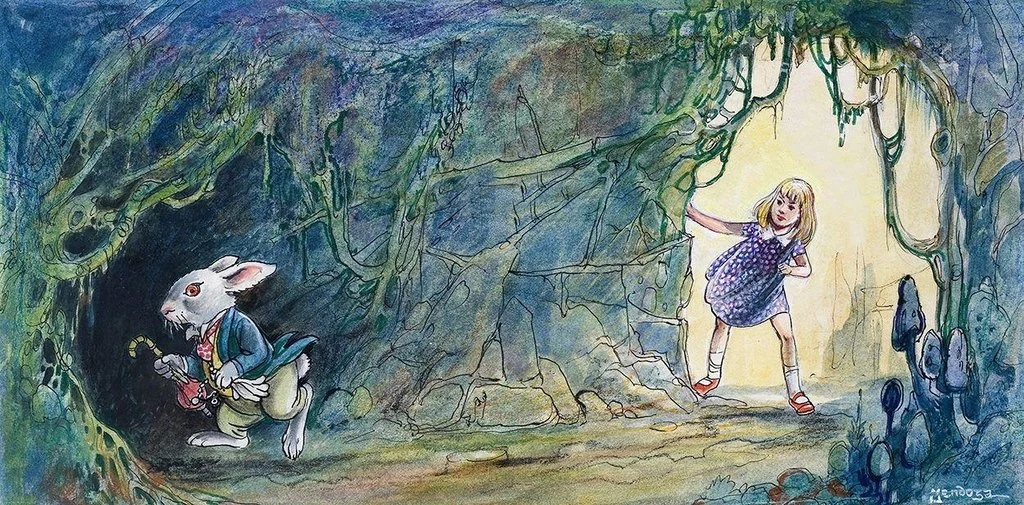
That scene provides the central image behind the modern expression. Following the rabbit means following curiosity into an unfamiliar experience. The hole represents the entrance to something deeper, stranger, or more complicated than expected.
The story itself is fictional, of course. Real rabbits dig burrows for shelter, protection, and raising their young. But the modern figurative expression draws its meaning from Carroll’s imaginative scene, not from the everyday behavior of rabbits.
Over time, the phrase became a common way to describe getting pulled into an absorbing subject or situation. It now appears in conversations about internet browsing, research, entertainment, conspiracy theories, and personal interests.
The connection is supported by the book’s opening chapter, which describes Alice following the White Rabbit into a hole and falling through what seems like a deep well. The scene captures the idea of entering an unfamiliar world without knowing where the journey will lead.
There is also an interesting detail about the expression’s history: the literal phrase existed before Carroll’s novel, but the familiar figurative meaning became associated with his story. Dictionary references place that figurative use in the 1930s.
How People Use the Phrase in Everyday Life
The expression appears in casual conversations, workplace discussions, entertainment reviews, and online posts. Its meaning depends on what someone is describing, but the central idea remains the same: one thing leads to another, and the person gets pulled deeper into the experience.
Here are some common situations where people use it.
1. Internet Browsing
This is probably one of the most familiar modern uses. Someone opens a website to answer a quick question, follows a few links, and ends up reading about something completely different.
For example:
- “I went down a Wikipedia rabbit hole last night.”
- “One YouTube video turned into a three-hour rabbit hole.”
- “I was looking for a recipe and ended up watching videos about ancient Roman food.”
The expression fits because online content is connected through recommendations, links, search results, and related topics. Each click offers another direction to explore.
2. Research and Learning
A rabbit hole isn’t always a waste of time. Researchers, students, writers, and curious readers often find useful information by following unexpected leads.
For instance, someone researching the history of the Titanic might begin with the ship’s construction. That could lead to information about Edwardian engineering, ocean navigation, passenger records, and the history of Southampton.
The original research question may remain important, but the journey becomes much broader than expected.
3. Hobbies and Personal Interests
People also use the phrase when a new interest becomes surprisingly absorbing.
Someone might start learning about mechanical keyboards and eventually compare switches, keycaps, layouts, sound profiles, and custom-built boards. A casual interest can turn into a serious hobby.
Other examples include:
- Collecting vintage cameras.
- Learning about Japanese history.
- Exploring classic rock albums.
- Researching houseplants.
- Studying the history of video games.
The phrase often carries a positive feeling in these situations. It suggests excitement, curiosity, and the pleasure of discovering something new.
4. Complicated Problems
Sometimes the expression describes a situation that becomes more confusing the longer someone investigates it.
A simple billing question might lead to several charges, unclear policies, and multiple customer service departments. What looked like a quick fix becomes a complicated process.
People might say, “I don’t want to go down that rabbit hole again.”
Here, the expression carries frustration rather than excitement. The person wants to avoid getting trapped in a chain of complications.
Real-Life Examples of Rabbit Hole in Sentences
Context makes the expression easier to understand. Notice how the following examples describe different experiences, even though they use the same phrase.
| Example sentence | What it means |
| I fell down a rabbit hole researching old Hollywood movies. | The research became much longer and more absorbing than expected. |
| That documentary sent me down a rabbit hole. | The documentary sparked further investigation. |
| We went down a political rabbit hole during lunch. | The discussion became complicated and difficult to leave. |
| I found a rabbit hole of vintage fashion videos. | The videos led to a long series of related content. |
| Don’t go down that rabbit hole right now. | Avoid getting distracted by a complicated subject. |
| Her interest in astronomy became a rabbit hole. | She became deeply absorbed in learning about astronomy. |
| The investigation opened a whole new rabbit hole. | The investigation revealed more questions or complications. |
| I only wanted to check one review, but I went down a rabbit hole. | A small task turned into a lengthy search. |
These examples show that the expression can describe curiosity, distraction, frustration, or deep interest. The surrounding sentence tells the reader which feeling is intended.
Different Types of Rabbit Holes
Not every rabbit hole feels the same. Some are entertaining, some are educational, and others can become frustrating. Understanding the difference helps explain why people use the expression in so many situations.
The Curiosity Rabbit Hole
This happens when one question leads to several more. You begin with a simple subject, discover something unexpected, and want to understand every detail.
For example, looking up the origin of a common phrase might lead you to its history, older versions, famous literary appearances, and changes in modern usage.
It is usually an enjoyable experience because the person is learning something new.
The Internet Rabbit Hole
An internet rabbit hole develops through repeated browsing. A person watches a video, opens a suggested clip, reads comments, and follows another link.
Platforms such as YouTube, Reddit, and Wikipedia can make this experience especially easy because related content is always available. The next interesting thing is usually only one click away.
The downside? You may forget why you opened your browser in the first place.
The Conspiracy Rabbit Hole
This expression can also describe becoming absorbed in unusual or unverified theories. A person may begin with a question about a public event and gradually encounter increasingly elaborate claims.
This type deserves extra caution. Spending more time reading about a theory does not automatically make it more reliable. Check original documents, reputable reporting, and credible evidence rather than treating repeated online claims as facts.
The Emotional Rabbit Hole
Sometimes people use the phrase for a pattern of thoughts that becomes difficult to stop.
For example, someone might revisit an awkward conversation, imagine what the other person meant, remember older disagreements, and create several possible explanations. A small concern can turn into hours of overthinking.
In this context, the expression describes getting caught in a cycle of thoughts rather than exploring an interesting subject.
The Creative Rabbit Hole
Writers, artists, musicians, and designers often follow unexpected ideas while working on a project.
A writer researching one historical detail might discover a fascinating character who inspires an entirely new story. A musician exploring one genre might uncover several artists who influence their next song.
These experiences can be productive, even when they take the original project in a different direction.
Why Do People Fall Down Rabbit Holes?
Curiosity is a major reason. When people encounter something surprising, they often want to know what happened before it, what comes next, and how it connects to other things.
Online content makes this process easier. Search engines provide related results, video platforms recommend more clips, and social media feeds introduce new subjects based on previous activity.
There is also the simple pleasure of finding something unexpected. A person searching for information about a favorite film might discover an interview with its director, then learn about the filming location, and eventually explore the history of the entire genre.
Another reason is that some subjects have no obvious endpoint. History, music, science, technology, and culture contain layers of information that can lead in countless directions.
However, not every rabbit hole is useful. If an activity begins interfering with sleep, work, responsibilities, or peace of mind, it may be time to step away. Curiosity is valuable, but it does not need to take over the whole day.
Rabbit Hole vs. Similar Expressions
Several English expressions describe getting distracted, exploring a subject, or becoming involved in something complicated. They may sound similar, but they are not interchangeable in every situation.
| Expression | Meaning | Example |
| Rabbit hole | A subject or situation that draws someone deeper and deeper | I fell down a rabbit hole researching ancient Egypt. |
| Rabbit trail | A side topic or digression that takes attention away from the main subject | We followed a rabbit trail during the meeting. |
| Wormhole | An unexpected connection or shortcut into another subject; also a scientific term | That article was a wormhole into 1980s music. |
| Vicious cycle | A repeating pattern in which one problem causes another | Stress and poor sleep created a vicious cycle. |
| Obsession | A persistent, intense focus on something | His obsession with vintage watches grew over time. |
| Tangent | A shift away from the main point of a discussion | She went off on a tangent about old movies. |
| Deep dive | A focused and detailed examination of a subject | The report takes a deep dive into renewable energy. |
Rabbit Hole vs. Deep Dive
These two expressions are especially easy to confuse.
A deep dive usually describes an intentional, organized investigation. A person chooses to examine a topic carefully and may have a clear goal.
A rabbit hole is often less planned. One discovery leads to another, and the original purpose can disappear along the way.
For example, a student preparing a detailed report about climate change is taking a deep dive into the subject. If that student starts researching one unusual weather event and spends the evening reading about unrelated historical mysteries, they may have fallen down a rabbit hole.
Rabbit Hole vs. Tangent
A tangent usually refers to moving away from the main subject during a conversation or piece of writing.
A rabbit hole can involve a much longer chain of exploration. It may happen while talking, reading, browsing, or working on a project.
In other words, a tangent is often a change of direction, while a rabbit hole suggests getting pulled deeper into that new direction.
Is Going Down a Rabbit Hole Positive or Negative?
It can be either. The expression does not automatically describe a bad experience.
A positive rabbit hole can lead to new skills, interesting discoveries, useful research, or a hobby that brings genuine enjoyment. Someone learning about photography, for example, might discover lighting techniques, camera history, editing methods, and famous photographers.
A negative experience is more likely when the activity becomes stressful, misleading, or difficult to stop. Spending hours reading unverified claims or repeatedly checking upsetting information may leave someone feeling more confused than informed.
The context makes the difference.
If a person says, “I went down a rabbit hole learning about space,” they probably mean they enjoyed exploring the subject. If they say, “That legal issue became a rabbit hole,” they may be describing a frustrating situation with too many complications.
It is also possible for the same experience to be both enjoyable and distracting. You might learn something fascinating while still realizing that you spent far longer than planned.
FAQs
Is rabbit hole an idiom?
Yes. In figurative use, it is an idiom based on the scene in Lewis Carroll’s Alice’s Adventures in Wonderland.
What does “falling down the rabbit hole” mean?
It means becoming deeply involved in something, often without planning to spend so much time on it.
What does “how deep does the rabbit hole go” mean?
It asks how complicated, extensive, or surprising a subject or situation might become.
Can you use rabbit hole in professional writing?
Yes, but it is informal. In formal reports, phrases such as “extended investigation” may be more suitable.
Is rabbit hole slang?
It is an established English expression used informally. Its online meaning is especially common in casual conversations.
What does “rabbit hole of information” mean?
It describes a chain of information that leads to more topics, questions, and discoveries.
Final Thoughts
A rabbit hole can be an exciting discovery, a frustrating distraction, or an unexpectedly complicated situation. The expression has lasted because it captures a familiar experience: following one small curiosity and finding yourself somewhere you never planned to go. The next time a quick search turns into an entire evening of reading and watching, you’ll know exactly what to call it.









1 thought on “Rabbit Hole Meaning: Definition, Origin, And Real-Life Examples For 2026.”