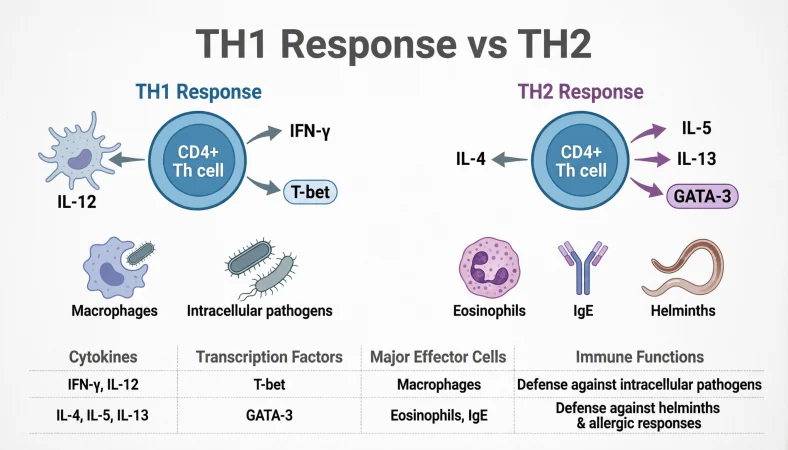
The TH1 response vs TH2 comparison describes two major CD4+ T helper cell patterns. TH1 responses are generally associated with cell-mediated immunity and intracellular pathogens, while TH2 responses are associated with antibody-supported immunity, especially against extracellular parasites and allergic inflammation.
Top alternatives: TH1 vs TH2 immunity, TH1 and TH2 responses compared, TH1 TH2 cytokines, TH1 versus TH2 immune response, TH1 TH2 differentiation
If immunology has ever made your brain feel like it needs its own immune response, you are definitely not alone. The TH1 response vs TH2 topic becomes much easier once you separate the cells, cytokines, targets, and functions. TH1 cells generally support cell-mediated immune activity, particularly against intracellular pathogens, while TH2 cells promote immune functions important for extracellular parasites and are strongly associated with allergic responses.
You may encounter this comparison in university notes, medical exams, research papers, laboratory discussions, or quick study sessions where every cytokine suddenly looks like a password. Understanding the difference matters because TH1 and TH2 are not simply two competing teams.
They represent different patterns of helper T-cell differentiation and immune coordination. This guide breaks down the comparison into simple, memorable, and study-friendly explanations.
Simple TH1 Response vs TH2 Explanations:
“TH1 is mainly linked to cell-mediated immunity.”
Example: Use this as a quick study line when reviewing helper T-cell functions.
Meaning: TH1 cells generally promote immune activity involving activated macrophages and other cellular defenses.
“TH2 is mainly linked to humoral and anti-parasite immunity.”
Example: Use this when memorising the broad role of TH2 cells.
Meaning: TH2 responses support antibody-associated immunity and defenses against many extracellular parasites.
“TH1 and TH2 are different helper T-cell response patterns.”
Example: Use this as a basic definition before studying their details.
Meaning: The comparison describes distinct CD4+ T-helper differentiation programs.
“TH1 responses favor intracellular pathogen control.”
Example: Use this when studying infections caused by organisms that live inside host cells.
Meaning: TH1 activity is particularly important for cellular defenses against intracellular microbes.
“TH2 responses are important in helminth defense.”
Example: Use this during parasite-immunity revision.
Meaning: TH2-associated mechanisms help defend against many multicellular parasites.
“IFN-γ is strongly associated with TH1 responses.”
Example: Use this as a cytokine memory cue.
Meaning: Interferon-gamma is a major cytokine associated with TH1 biology.
“IL-4 is strongly associated with TH2 differentiation.”
Example: Use this when reviewing the cytokines involved in TH2 development.
Meaning: IL-4 plays a central role in promoting the TH2 differentiation program.
“TH1 activates macrophage-centered defenses.”
Example: Use this when studying cell-mediated immune mechanisms.
Meaning: TH1 cytokines can enhance macrophage antimicrobial activity.
“TH2 supports eosinophils and IgE-associated responses.”
Example: Use this when reviewing allergic or anti-parasite immunity.
Meaning: TH2-associated cytokines contribute to eosinophil activity and IgE production.
“TH1 and TH2 have different signature cytokine profiles.”
Example: Use this as an introductory exam note.
Meaning: Their cytokine patterns help distinguish their immune functions.
“TH1 versus TH2 is about immune specialization.”
Example: Use this when explaining the concept to a beginner.
Meaning: Different helper T-cell programs coordinate different types of immune defense.
“Neither response is simply the ‘good’ or ‘bad’ one.”
Example: Use this when explaining the comparison in a balanced way.
Meaning: Each response can be useful or harmful depending on the immune context.
Professional TH1 Response vs TH2 Descriptions:
“TH1 differentiation supports cell-mediated immune responses.”
Example: Use this in an academic explanation of helper T-cell biology.
Meaning: TH1 cells coordinate immune mechanisms centered on cellular antimicrobial activity.
“TH2 differentiation supports type 2 immune responses.”
Example: Use this in a research or educational description.
Meaning: TH2 cells coordinate cytokine-driven immune mechanisms characteristic of type 2 immunity.
“TH1 responses are characterized by IFN-γ production.”
Example: Use this in a concise immunology summary.
Meaning: IFN-γ is a prominent functional marker of TH1 responses.
“TH2 responses are characterized by cytokines including IL-4, IL-5, and IL-13.”
Example: Use this in a study note comparing cytokine profiles.
Meaning: These cytokines represent important components of type 2 immune activity.
“TH1 immunity is particularly relevant to intracellular pathogens.”
Example: Use this when discussing host defense mechanisms.
Meaning: TH1-mediated immunity helps address pathogens residing within cells.
“TH2 immunity contributes to anti-helminth responses.”
Example: Use this when describing parasite-related immunity.
Meaning: Type 2 responses are important in defenses against many helminths.
“TH1 and TH2 differentiation depends on the cytokine environment.”
Example: Use this when explaining how helper T-cell subsets develop.
Meaning: Cytokine signals influence which differentiation pathway activated CD4+ cells follow.
“T-bet is a major transcription factor associated with TH1 differentiation.”
Example: Use this in a molecular immunology summary.
Meaning: T-bet promotes the TH1 transcriptional program.
“GATA-3 is a major transcription factor associated with TH2 differentiation.”
Example: Use this when discussing molecular regulation of TH2 cells.
Meaning: GATA-3 supports the TH2 differentiation program.
“TH1 and TH2 responses can influence each other.”
Example: Use this when explaining immune polarization.
Meaning: Cytokines from one pathway can affect development or activity of the other.
“The TH1/TH2 framework describes functional polarization rather than absolute categories.”
Example: Use this in an advanced immunology discussion.
Meaning: Modern immune responses can involve overlapping and more complex pathways.
“TH1 and TH2 profiles should be interpreted within their biological context.”
Example: Use this when discussing experimental findings.
Meaning: Cytokine patterns do not always represent a simple one-subset-versus-another situation.
Beginner-Friendly TH1 Response vs TH2 Lines:
“Think TH1 for inside-the-cell threats.”
Example: Use this as a beginner memory trick.
Meaning: TH1 responses are strongly associated with intracellular pathogen defense.
“Think TH2 for parasites and allergy-type immunity.”
Example: Use this when teaching the broad TH2 concept.
Meaning: TH2 biology is strongly associated with helminth defense and allergic inflammation.
“TH1 talks to macrophages.”
Example: Use this as a simplified study phrase.
Meaning: TH1 cytokines help activate macrophage-mediated antimicrobial functions.
“TH2 helps with eosinophils and IgE.”
Example: Use this when memorising common TH2-associated effects.
Meaning: TH2 cytokines contribute to eosinophil responses and IgE production.
“IFN-γ points toward TH1.”
Example: Use this as a quick exam memory cue.
Meaning: IFN-γ is a classic TH1-associated cytokine.
“IL-4 points toward TH2.”
Example: Use this when learning the key TH2 differentiation signal.
Meaning: IL-4 strongly promotes TH2 differentiation.
“T-bet goes with TH1.”
Example: Use this as a molecular memory trick.
Meaning: T-bet is a key transcription factor supporting TH1 development.
“GATA-3 goes with TH2.”
Example: Use this during transcription-factor revision.
Meaning: GATA-3 is strongly associated with TH2 differentiation.
“TH1 is more cellular; TH2 is more type 2.”
Example: Use this only as a broad beginner-level memory aid.
Meaning: The phrase captures their general functional distinction without covering every detail.
“TH1 and TH2 are both CD4+ helper T-cell subsets.”
Example: Use this as the starting point for a study card.
Meaning: Both arise from the broader CD4+ T-cell population.
“Different signals push helper T cells toward different programs.”
Example: Use this when explaining differentiation simply.
Meaning: Cytokine environments and transcription factors influence helper T-cell specialization.
“The immune system has more than one helper strategy.”
Example: Use this when introducing T-helper diversity.
Meaning: Immune protection depends on multiple coordinated helper-cell programs.
Funny TH1 Response vs TH2 Study Lines:
“TH1 brought the macrophage backup.”
Example: Use this as a humorous revision cue.
Meaning: You are associating TH1 immunity with macrophage activation.
“TH2 entered the parasite group chat.”
Example: Use this for a playful study post.
Meaning: You are connecting TH2 immunity with helminth defense.
“IFN-γ just screamed TH1.”
Example: Use this when memorising signature cytokines.
Meaning: You are using humor to remember the strong TH1 association.
“IL-4 walked in wearing a TH2 badge.”
Example: Use this for a lighthearted immunology flashcard.
Meaning: You are linking IL-4 with TH2 differentiation.
“T-bet is firmly on Team TH1.”
Example: Use this when studying transcription factors.
Meaning: You are remembering T-bet as a TH1-associated regulator.
“GATA-3 has entered the TH2 era.”
Example: Use this for a playful study caption.
Meaning: You are associating GATA-3 with the TH2 program.
“TH1 said: activate the macrophages.”
Example: Use this when creating a memorable study joke.
Meaning: You connect TH1 signaling with macrophage activation.
“TH2 said: where are my eosinophils?”
Example: Use this as a humorous parasite-immunity memory cue.
Meaning: You associate TH2 biology with eosinophil responses.
“Immunology really made two teams and called it studying.”
Example: Use this when joking about the TH1/TH2 comparison.
Meaning: You make the concept feel less intimidating.
“TH1 versus TH2: the cytokine edition.”
Example: Use this as a playful heading for revision notes.
Meaning: You frame the comparison around their characteristic cytokines.
“One likes intracellular threats, the other has parasite business.”
Example: Use this as a casual memory line.
Meaning: You highlight their broad target differences.
“My brain says TH1, TH2, and then requests a coffee.”
Example: Use this before an immunology study session.
Meaning: You use relatable humor to make a difficult topic feel lighter.
Clever TH1 Response vs TH2 Comparisons:
“TH1 is the intracellular defense specialist.”
Example: Use this as a compact comparison statement.
Meaning: You highlight the classic TH1 association with intracellular pathogens.
“TH2 is the type 2 immunity specialist.”
Example: Use this when defining TH2 in one line.
Meaning: You emphasize its characteristic immune program.
“Follow the cytokine trail to identify the helper pathway.”
Example: Use this as an exam strategy.
Meaning: Cytokine patterns can provide clues about the dominant helper response.
“IFN-γ suggests TH1; IL-4, IL-5, and IL-13 suggest TH2.”
Example: Use this for rapid cytokine revision.
Meaning: You pair commonly associated cytokines with their respective pathways.
“T-bet points toward TH1; GATA-3 points toward TH2.”
Example: Use this for transcription-factor revision.
Meaning: Each transcription factor is strongly associated with a different differentiation program.
“Think location first: intracellular versus extracellular.”
Example: Use this when trying to remember the broad distinction.
Meaning: Pathogen location can help guide the expected immune response.
“Think function second: macrophage activation versus type 2 effector activity.”
Example: Use this when comparing mechanisms.
Meaning: Functional consequences help distinguish the pathways.
“TH1 and TH2 are programs, not personality types.”
Example: Use this to avoid oversimplifying immune responses.
Meaning: Helper-cell polarization reflects biological differentiation rather than rigid identities.
“Cytokines are the clues, transcription factors are the directors.”
Example: Use this as a memorable molecular biology analogy.
Meaning: Cytokines help shape differentiation while transcription factors regulate gene-expression programs.
“The immune context decides which response makes sense.”
Example: Use this when discussing different infections.
Meaning: The appropriate helper response depends on the threat and surrounding signals.
“A TH1 answer without cytokines is missing part of the story.”
Example: Use this when building detailed study notes.
Meaning: Cytokine profiles are central to understanding TH1 function.
“A TH2 answer without IL-4, IL-5, or IL-13 is leaving clues on the table.”
Example: Use this during exam preparation.
Meaning: These cytokines are useful markers for remembering major TH2 functions.
TH1 Cytokine Response Statements:
“TH1 cells produce IFN-γ.”
Example: Use this as a core cytokine revision statement.
Meaning: IFN-γ is one of the defining cytokines associated with TH1 responses.
“IFN-γ enhances macrophage activation.”
Example: Use this when explaining TH1 effector function.
Meaning: IFN-γ helps macrophages develop stronger antimicrobial activity.
“IL-12 promotes TH1 differentiation.”
Example: Use this when reviewing the signals that favor TH1 development.
Meaning: IL-12 is an important cytokine driving TH1 polarization.
“TH1 responses support cellular antimicrobial immunity.”
Example: Use this when summarizing the pathway.
Meaning: TH1 cytokines coordinate cellular defenses against certain pathogens.
“TH1 activity is important against many intracellular microbes.”
Example: Use this when studying host-pathogen interactions.
Meaning: TH1 immunity helps control pathogens that occupy intracellular niches.
“T-bet supports the TH1 transcriptional program.”
Example: Use this in molecular immunology notes.
Meaning: T-bet regulates genes associated with TH1 differentiation and function.
“IFN-γ is a useful marker of TH1-associated activity.”
Example: Use this when interpreting an immunology experiment.
Meaning: Increased IFN-γ can indicate TH1-skewed immune activity, depending on context.
“TH1 responses can support cytotoxic immune functions indirectly.”
Example: Use this when discussing broader cellular immunity.
Meaning: TH1 cytokines can help create an environment that supports cellular antimicrobial responses.
“TH1 immunity is strongly associated with macrophage-mediated pathogen control.”
Example: Use this in an academic summary.
Meaning: Activated macrophages are important effectors influenced by TH1 cytokines.
“Excessive TH1 activity can contribute to inflammatory tissue damage.”
Example: Use this when discussing immune-mediated pathology.
Meaning: A useful immune response can become harmful when inflammation is excessive or poorly regulated.
“TH1 responses are not limited to a single cytokine.”
Example: Use this when correcting an oversimplified study note.
Meaning: TH1 biology involves a broader network of cytokines and immune interactions.
“TH1 immunity represents coordinated cellular defense rather than one isolated reaction.”
Example: Use this as an advanced summary statement.
Meaning: Multiple immune cells and signaling pathways participate in TH1-associated responses.
TH2 Cytokine Response Statements:
“TH2 cells produce IL-4, IL-5, and IL-13.”
Example: Use this as a core TH2 cytokine study line.
Meaning: These cytokines are major components of the TH2 response.
“IL-4 promotes TH2 differentiation.”
Example: Use this when reviewing helper T-cell development.
Meaning: IL-4 is a central signal favoring TH2 polarization.
“IL-5 supports eosinophil responses.”
Example: Use this when studying type 2 immune mechanisms.
Meaning: IL-5 promotes eosinophil development, survival, and activation.
“IL-13 contributes to mucus production and airway responses.”
Example: Use this when reviewing type 2 inflammation.
Meaning: IL-13 can influence epithelial and airway responses.
“TH2 immunity is important in many helminth infections.”
Example: Use this when studying parasite defense.
Meaning: TH2-associated mechanisms contribute to immune responses against helminths.
“TH2 cytokines support IgE-associated immunity.”
Example: Use this when revising antibody class switching.
Meaning: TH2 signaling can promote conditions that favor IgE production.
“GATA-3 supports TH2 differentiation.”
Example: Use this when reviewing transcription factors.
Meaning: GATA-3 is a key regulator of the TH2 gene-expression program.
“TH2 activity is strongly linked with allergic inflammation.”
Example: Use this when discussing immune-mediated allergy.
Meaning: Type 2 immune mechanisms play an important role in many allergic diseases.
“Eosinophils are important effectors in many TH2-associated responses.”
Example: Use this as a study reminder.
Meaning: Eosinophils participate in parasite defense and allergic inflammation.
“TH2 responses can influence barrier tissues.”
Example: Use this when discussing airway or mucosal immunity.
Meaning: Type 2 cytokines can alter epithelial and tissue responses.
“TH2 immunity is more than just IgE.”
Example: Use this when correcting an oversimplified definition.
Meaning: TH2 responses involve multiple cytokines, cells, and tissue effects.
“TH2 responses can protect against parasites but also contribute to allergy.”
Example: Use this as a balanced summary.
Meaning: The same immune pathway can be protective in one context and harmful in another.
Exam-Friendly TH1 Response vs TH2 Answers:
“TH1: IFN-γ, IL-12, T-bet, macrophages, intracellular pathogens.”
Example: Use this as a rapid revision card before an exam.
Meaning: These are major concepts associated with TH1 biology.
“TH2: IL-4, IL-5, IL-13, GATA-3, eosinophils, helminths.”
Example: Use this for last-minute TH2 revision.
Meaning: These are major concepts associated with TH2 biology.
“TH1 equals cellular immunity.”
Example: Use this as a basic exam memory cue.
Meaning: TH1 responses are strongly associated with cell-mediated immune defense.
“TH2 equals type 2 immunity.”
Example: Use this as a broad conceptual cue.
Meaning: TH2 cells coordinate a characteristic type 2 immune program.
“IFN-γ is the classic TH1 cytokine.”
Example: Use this when a multiple-choice question asks for a TH1-associated cytokine.
Meaning: IFN-γ is a major cytokine linked to TH1 cells.
“IL-4 is the classic TH2 differentiation cytokine.”
Example: Use this when reviewing helper T-cell polarization.
Meaning: IL-4 strongly supports the TH2 pathway.
“T-bet points to TH1.”
Example: Use this for a transcription-factor question.
Meaning: T-bet is strongly associated with TH1 differentiation.
“GATA-3 points to TH2.”
Example: Use this for rapid molecular revision.
Meaning: GATA-3 is strongly associated with TH2 differentiation.
“Macrophage activation points toward TH1.”
Example: Use this when interpreting an immune-response scenario.
Meaning: TH1-associated IFN-γ can activate macrophage antimicrobial functions.
“Eosinophil activation points toward TH2.”
Example: Use this when interpreting parasite or allergic inflammation questions.
Meaning: TH2 cytokines, especially IL-5, support eosinophil responses.
“Helminths suggest TH2; intracellular microbes suggest TH1.”
Example: Use this as a pathogen-based exam shortcut.
Meaning: The broad pathogen location and type can help identify the likely helper response.
“Always match the cytokine to the pathway before choosing the answer.”
Example: Use this when solving difficult immunology multiple-choice questions.
Meaning: Cytokine associations can help distinguish closely related options.
Comparison-Style TH1 Response vs TH2 Lines:
“TH1 favors intracellular defense; TH2 favors type 2 immunity.”
Example: Use this as a one-line comparison.
Meaning: You summarize their broad functional differences.
“TH1 is associated with IFN-γ; TH2 is associated with IL-4, IL-5, and IL-13.”
Example: Use this when making a cytokine comparison table.
Meaning: You identify their major cytokine patterns.
“TH1 uses T-bet; TH2 uses GATA-3.”
Example: Use this when studying differentiation regulators.
Meaning: Each pathway has a characteristic transcriptional regulator.
“TH1 supports macrophage activation; TH2 supports eosinophil-associated responses.”
Example: Use this when comparing effector mechanisms.
Meaning: Different helper pathways influence different immune effector cells.
“TH1 is strongly linked to intracellular pathogens; TH2 to helminths.”
Example: Use this for pathogen-based revision.
Meaning: Each pathway is classically associated with different categories of threats.
“TH1 can drive protective cellular inflammation; TH2 can drive protective type 2 inflammation.”
Example: Use this for a balanced immunology explanation.
Meaning: Both pathways can produce useful inflammation when appropriately regulated.
“TH1 and TH2 differ in cytokines, transcription factors, and effector functions.”
Example: Use this as a study summary.
Meaning: Their distinction occurs at several levels of immune regulation.
“TH1 and TH2 are related but functionally distinct CD4+ programs.”
Example: Use this in an academic comparison.
Meaning: Both arise from CD4+ T cells but develop different functional profiles.
“TH1 is not simply the opposite of TH2.”
Example: Use this when avoiding an overly simplistic model.
Meaning: Their relationship involves cross-regulation and context rather than a perfect binary.
“A TH1 response is not automatically better than a TH2 response.”
Example: Use this when explaining immune balance.
Meaning: The useful response depends on the type of threat.
“TH2 activity is not limited to allergy.”
Example: Use this when correcting a common misconception.
Meaning: TH2 responses also play important roles in parasite defense and tissue immunity.
“TH1 activity is not limited to one infection.”
Example: Use this when explaining broader immune function.
Meaning: TH1-associated mechanisms participate in multiple cellular immune contexts.
Chill And Casual TH1 Response vs TH2 Explanations:
“TH1 is basically the intracellular-defense crew.”
Example: Use this when explaining the topic casually to a classmate.
Meaning: You simplify the main TH1 role without going deeply into mechanisms.
“TH2 is the parasite-and-type-2-immunity crew.”
Example: Use this as an informal study explanation.
Meaning: You highlight the broad TH2 association.
“IFN-γ? Think TH1.”
Example: Use this as a quick flashcard cue.
Meaning: You connect IFN-γ with TH1.
“IL-4? Think TH2.”
Example: Use this for fast cytokine recall.
Meaning: You connect IL-4 with TH2.
“Macrophages make me think TH1.”
Example: Use this during casual revision.
Meaning: You associate macrophage activation with TH1 immunity.
“Eosinophils make me think TH2.”
Example: Use this when remembering type 2 effector cells.
Meaning: You associate eosinophil activity with TH2 responses.
“T-bet is Team TH1.”
Example: Use this as an informal memory trick.
Meaning: You connect the transcription factor T-bet with TH1.
“GATA-3 is Team TH2.”
Example: Use this when memorising transcription factors.
Meaning: You connect GATA-3 with TH2.
“TH1 handles the inside-the-cell problem.”
Example: Use this as a simple study phrase.
Meaning: TH1 immunity is strongly associated with intracellular pathogens.
“TH2 handles the classic type 2 response.”
Example: Use this when explaining the broad pathway.
Meaning: TH2 cells coordinate type 2 immune activity.
“Same CD4+ family, different job descriptions.”
Example: Use this as a casual explanation.
Meaning: TH1 and TH2 cells arise from CD4+ T cells but have different functions.
“Immunology: because one helper T cell type was apparently not enough.”
Example: Use this as a study caption.
Meaning: You add humor to a complex immune-cell classification.
Advanced TH1 Response vs TH2 Concepts:
“TH1 differentiation is promoted by IL-12 and regulated by T-bet.”
Example: Use this in an advanced immunology study note.
Meaning: IL-12 signaling and T-bet are central components of TH1 development.
“TH2 differentiation is promoted by IL-4 and regulated by GATA-3.”
Example: Use this when reviewing molecular TH2 biology.
Meaning: IL-4 and GATA-3 are major components of the TH2 differentiation program.
“TH1-derived IFN-γ can suppress aspects of TH2 differentiation.”
Example: Use this when studying cross-regulation.
Meaning: TH1-associated cytokine signaling can influence the development of type 2 responses.
“TH2-associated cytokines can suppress aspects of TH1 activity.”
Example: Use this when studying reciprocal immune regulation.
Meaning: Type 2 cytokines can influence the development and activity of TH1 responses.
“Helper T-cell differentiation is shaped by antigen, cytokines, and cellular context.”
Example: Use this in a detailed immunology explanation.
Meaning: Multiple signals contribute to helper-cell specialization.
“TH1 and TH2 responses can coexist within complex immune environments.”
Example: Use this when moving beyond simplified textbook models.
Meaning: Real immune responses are not always purely polarized.
“Modern immunology includes additional helper T-cell subsets beyond TH1 and TH2.”
Example: Use this when discussing the limits of the classic framework.
Meaning: TH17, Tfh, Treg, and other programs add complexity to CD4+ T-cell biology.
“TH1 and TH2 remain useful conceptual models.”
Example: Use this in an educational summary.
Meaning: Despite newer discoveries, the framework remains helpful for understanding immune polarization.
“Cytokine networks are more interconnected than simple TH1 versus TH2 diagrams suggest.”
Example: Use this in advanced study notes.
Meaning: Immune signaling involves overlapping pathways rather than isolated boxes.
“Transcription-factor networks help stabilize helper T-cell identities.”
Example: Use this in molecular immunology discussions.
Meaning: Regulatory networks reinforce characteristic differentiation programs.
“Immune polarization depends on both environmental and cellular signals.”
Example: Use this when explaining why responses differ between tissues.
Meaning: Local conditions can shape helper T-cell behavior.
“The TH1/TH2 framework is a starting point, not the entire map.”
Example: Use this as an advanced study reminder.
Meaning: The model is useful but does not capture every aspect of CD4+ T-cell biology.
Smart TH1 Response vs TH2 Study Phrases:
“Remember the cytokines, then remember the functions.”
Example: Use this when creating a compact revision strategy.
Meaning: Cytokine associations provide a useful route to understanding function.
“TH1: IFN-γ and macrophages.”
Example: Use this as a two-part flashcard.
Meaning: You pair a signature cytokine with an important effector function.
“TH2: IL-4, IL-5, IL-13 and eosinophils.”
Example: Use this for quick revision.
Meaning: You connect major TH2 cytokines with a key effector cell.
“Intracellular pathogen? Consider TH1.”
Example: Use this when solving an exam scenario.
Meaning: Intracellular infections commonly call for TH1-associated cellular immunity.
“Helminth infection? Consider TH2.”
Example: Use this as a pathogen-based memory cue.
Meaning: Helminths commonly trigger type 2 immune responses.
“Macrophage activation? Think IFN-γ.”
Example: Use this when recalling TH1 mechanisms.
Meaning: IFN-γ is an important activator of macrophage antimicrobial functions.
“Eosinophils? Think IL-5.”
Example: Use this when studying type 2 immunity.
Meaning: IL-5 is strongly associated with eosinophil biology.
“IgE class switching? Think IL-4 and IL-13.”
Example: Use this during antibody-response revision.
Meaning: IL-4 and IL-13 can promote signals that support IgE production.
“T-bet means TH1; GATA-3 means TH2.”
Example: Use this as a transcription-factor memory line.
Meaning: These regulators are strongly associated with their respective pathways.
“Do not confuse the cytokine with the transcription factor.”
Example: Use this when building detailed notes.
Meaning: Cytokines and transcription factors play different roles even when they point toward the same pathway.
“Use pathogen type, cytokines, and effector cells together.”
Example: Use this when answering a complex exam question.
Meaning: Multiple clues provide a more reliable interpretation than one fact alone.
“If the question feels tricky, build the pathway backward.”
Example: Use this when a scenario gives an effector cell or cytokine first.
Meaning: Working from cytokine or function back to the helper subset can simplify the problem.
Study-Friendly TH1 Response vs TH2 Summaries:
“TH1: cellular defense against intracellular threats.”
Example: Use this as a one-line revision summary.
Meaning: You capture the broad functional role of TH1 immunity.
“TH2: type 2 defense against helminths and related inflammation.”
Example: Use this as a quick TH2 summary.
Meaning: You capture its classic parasite and inflammatory associations.
“TH1 cytokine: IFN-γ.”
Example: Use this for rapid flashcard review.
Meaning: IFN-γ is a major TH1-associated cytokine.
“TH2 cytokines: IL-4, IL-5, IL-13.”
Example: Use this for rapid cytokine recall.
Meaning: These are major cytokines associated with TH2 responses.
“TH1 transcription factor: T-bet.”
Example: Use this when revising helper T-cell differentiation.
Meaning: T-bet is a central TH1-associated transcription factor.
“TH2 transcription factor: GATA-3.”
Example: Use this during molecular revision.
Meaning: GATA-3 is a central TH2-associated transcription factor.
“TH1 effector connection: macrophages.”
Example: Use this when reviewing cellular immunity.
Meaning: TH1 cytokines strongly influence macrophage activation.
“TH2 effector connection: eosinophils.”
Example: Use this when reviewing type 2 immunity.
Meaning: TH2 cytokines support eosinophil-associated responses.
“TH1 classic pathogen: intracellular microbes.”
Example: Use this as a pathogen memory cue.
Meaning: TH1 immunity is particularly important against intracellular organisms.
“TH2 classic pathogen: helminths.”
Example: Use this as a parasite-immunity memory cue.
Meaning: TH2 responses play a major role in helminth defense.
“TH1 pathology can involve excessive cellular inflammation.”
Example: Use this when studying immune-mediated tissue injury.
Meaning: Overactive TH1-associated inflammation can become harmful.
“TH2 pathology can involve allergic and eosinophilic inflammation.”
Example: Use this when reviewing type 2 inflammatory diseases.
Meaning: Excessive TH2 activity can contribute to allergic inflammation.
Memorable TH1 Response vs TH2 Lines:
“TH1 goes intracellular; TH2 goes type 2.”
Example: Use this as a catchy revision phrase.
Meaning: You distinguish the pathways by their broad immune associations.
“IFN-γ belongs in the TH1 memory box.”
Example: Use this before an immunology exam.
Meaning: You reinforce the association between IFN-γ and TH1.
“IL-4 belongs in the TH2 memory box.”
Example: Use this during cytokine revision.
Meaning: You reinforce the association between IL-4 and TH2.
“T-bet wears the TH1 jersey.”
Example: Use this as a playful transcription-factor memory cue.
Meaning: T-bet is strongly associated with TH1 differentiation.
“GATA-3 wears the TH2 jersey.”
Example: Use this when memorising TH2 regulation.
Meaning: GATA-3 is strongly associated with TH2 differentiation.
“Macrophages hear the TH1 signal.”
Example: Use this when remembering IFN-γ effects.
Meaning: TH1 cytokines can promote macrophage activation.
“Eosinophils hear the TH2 signal.”
Example: Use this when studying type 2 effector mechanisms.
Meaning: TH2 cytokines support eosinophil-associated responses.
“Parasites often call for TH2.”
Example: Use this as a simple helminth memory cue.
Meaning: Helminth infections commonly stimulate type 2 immunity.
“Intracellular microbes often call for TH1.”
Example: Use this when reviewing pathogen-specific immunity.
Meaning: Intracellular pathogens commonly require strong cellular immune responses.
“TH1 and TH2 are different routes to immune coordination.”
Example: Use this as a conceptual summary.
Meaning: Both pathways coordinate immune defenses through different mechanisms.
“Same immune system, different response strategy.”
Example: Use this when explaining the comparison to beginners.
Meaning: The body can use different helper-cell programs depending on the challenge.
“Learn the pattern, not just the list.”
Example: Use this before memorising cytokines and transcription factors.
Meaning: Understanding relationships makes recall easier than memorising isolated facts.
FAQs:
What does TH1 response vs TH2 mean?
It refers to the comparison between two major CD4+ helper T-cell differentiation programs. TH1 responses are classically associated with cell-mediated immunity and intracellular pathogens, while TH2 responses are associated with type 2 immunity, helminth defense, and allergic inflammation.
What is the main difference between TH1 and TH2?
The simplest distinction is functional. TH1 responses emphasize cellular antimicrobial defense, especially against intracellular pathogens, while TH2 responses emphasize type 2 immune mechanisms, including eosinophil activity, IgE-associated responses, and helminth defense.
Which cytokines are associated with TH1?
IFN-γ is the classic TH1-associated cytokine. IL-12 is also important because it promotes TH1 differentiation, while other cytokines can participate depending on the biological context.
Which cytokines are associated with TH2?
The major TH2-associated cytokines are IL-4, IL-5, and IL-13. They contribute to different aspects of type 2 immunity, including IgE-associated responses, eosinophil activity, mucus production, and tissue responses.
Is TH1 associated with intracellular pathogens?
Yes. TH1 immunity is classically important for controlling many intracellular pathogens because it promotes cellular immune mechanisms, including macrophage activation through IFN-γ.
Is TH2 associated with parasites?
Yes. TH2 responses are particularly important in defense against many helminths and other multicellular parasites. Their cytokines can promote eosinophil, mast-cell, antibody, and barrier-related responses.
Is TH1 better than TH2?
No. Neither pathway is universally better. The appropriate immune response depends on the type of threat, tissue environment, and broader immune context.
Can TH2 responses cause allergies?
Yes. TH2-associated mechanisms play a major role in many allergic conditions. Cytokines such as IL-4, IL-5, and IL-13 can contribute to IgE production, eosinophilic inflammation, and tissue responses.
What transcription factor is associated with TH1?
T-bet is the major transcription factor classically associated with TH1 differentiation and function.
What transcription factor is associated with TH2?
GATA-3 is the major transcription factor classically associated with TH2 differentiation and function.
Can TH1 and TH2 responses occur at the same time?
Complex immune responses can involve overlapping pathways rather than a perfectly exclusive TH1 or TH2 response. The classic TH1/TH2 model is useful, but modern immunology recognizes considerably more complexity.
Is the TH1 and TH2 model still useful?
Yes. It remains a helpful framework for understanding immune polarization, cytokines, helper T-cell differentiation, and host defense, although it does not represent every CD4+ T-cell subset or every real-world immune response.
Is there an emotional or flirty meaning to TH1 response vs TH2?
No. Unlike conversational phrases, this is a scientific immunology term. If someone uses it casually in a message, they are most likely discussing biology, medicine, research, or studying rather than expressing an emotional or romantic meaning.
How should I use a TH1 response vs TH2 template in academic writing?
Use clear scientific language and verify terminology against your course materials or relevant literature. Avoid treating a simplified template as a substitute for the specific definitions, mechanisms, or evidence required by your assignment or research context.
Conclusion:
Understanding TH1 response vs TH2 becomes much easier when you stop treating it like a giant cytokine memorization challenge and start connecting the pieces. Think TH1 with IFN-γ, T-bet, macrophage activation, and intracellular pathogens. Think TH2 with IL-4, IL-5, IL-13, GATA-3, eosinophils, IgE-associated responses, and helminths.
Then remember that real immune responses are more flexible than a simple two-column chart. Use these phrases as quick study cues, exam reminders, or starting points for deeper revision. Save this guide for your next immunology session, share it with a study partner, and revisit the sections that keep escaping your memory. Happy studying, and may your cytokines finally stop looking like Wi-Fi passwords!