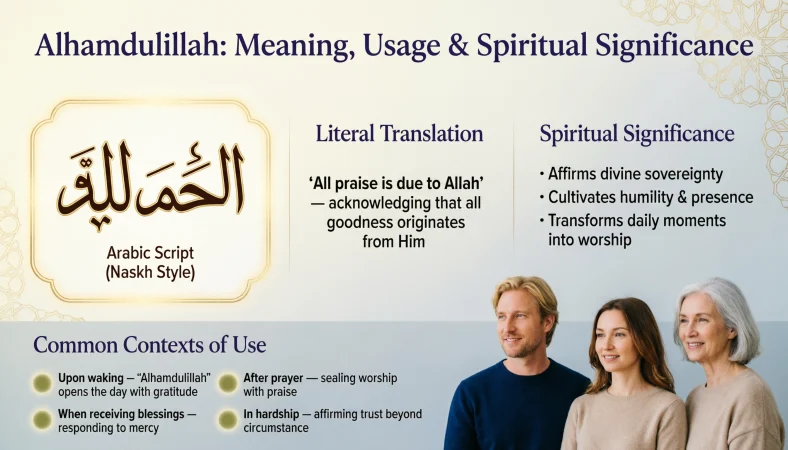
Alhamdulillah is an Arabic phrase meaning “All praise is due to Allah” or “Praise be to Allah.” Muslims commonly say it to express gratitude, praise, contentment, or thankfulness to Allah in both happy and difficult moments.
Top alternatives: Praise be to Allah, All thanks belong to Allah, Thanks be to Allah, I am grateful to Allah, Glory and praise belong to Allah
Some words carry an entire feeling in just one breath, and Alhamdulillah is one of them. You may see it in texts, DMs, social media captions, family conversations, or hear it after someone shares good news. But what does it actually mean? The meaning of Alhamdulillah goes deeper than simply saying “thank God.”
It expresses praise and gratitude to Allah and can be used when someone receives a blessing, feels relieved, celebrates good news, or remains thankful during a difficult moment. It is a phrase of faith, gratitude, and recognition of Allah’s goodness.
Whether someone says it after getting a new job, recovering from illness, finishing an exam, or simply answering “How are you?”, understanding the phrase helps you appreciate its spiritual and everyday significance.
1. Basic Meaning Of Alhamdulillah
“Alhamdulillah means all praise is due to Allah.”
Use this when someone asks for the simplest definition of the phrase.
Meaning: It describes praise and gratitude directed toward Allah.
“Alhamdulillah means praise be to Allah.”
Use this as a short English translation.
Meaning: It expresses acknowledgment of Allah’s praise.
“It means thanks and praise belong to Allah.”
Use this when explaining the phrase casually.
Meaning: It combines thankfulness with praise.
“Alhamdulillah expresses gratitude to Allah.”
Use this when someone wants the spiritual meaning.
Meaning: It highlights thankfulness for Allah’s blessings.
“It is a phrase of praise and gratitude.”
Use this for a quick explanation.
Meaning: It captures the two central ideas behind the expression.
“It means praising Allah for His blessings.”
Use this when discussing everyday usage.
Meaning: It connects the phrase with gratitude for blessings.
“Alhamdulillah is an expression of thankfulness to Allah.”
Use this when explaining its religious significance.
Meaning: It emphasizes gratefulness toward Allah.
“It reminds us to recognize Allah’s blessings.”
Use this in a faith-focused explanation.
Meaning: It connects gratitude with awareness of divine blessings.
“It can mean praise and thanks to Allah.”
Use this when someone needs an easy translation.
Meaning: It gives a natural English interpretation.
“Alhamdulillah is more than simply ‘thank you.’”
Use this when explaining its deeper meaning.
Meaning: It points to both praise and gratitude.
“It expresses appreciation for Allah’s favors.”
Use this in a thoughtful discussion.
Meaning: It recognizes blessings as coming from Allah.
“Alhamdulillah is a beautiful expression of gratitude.”
Use this when describing why Muslims use it often.
Meaning: It emphasizes the phrase’s thankful and spiritual character.
2. Meaning Of Alhamdulillah In English
“Praise be to Allah.”
Use this as the most familiar English rendering.
Meaning: It expresses praise directed toward Allah.
“All praise belongs to Allah.”
Use this for a more literal explanation.
Meaning: It emphasizes that all praise is ultimately due to Allah.
“All thanks and praise are for Allah.”
Use this when explaining the broader sense.
Meaning: It includes both gratitude and praise.
“Praise and gratitude belong to Allah.”
Use this for a simple educational explanation.
Meaning: It captures the phrase’s thankful nature.
“I praise Allah for His blessings.”
Use this as a natural explanation of the sentiment.
Meaning: It expresses personal gratitude toward Allah.
“Thanks be to Allah.”
Use this as a concise English equivalent.
Meaning: It communicates thankfulness to Allah.
“I am grateful to Allah.”
Use this when explaining its emotional sense.
Meaning: It focuses on personal gratitude.
“All praise is for Allah.”
Use this in faith-based writing.
Meaning: It emphasizes complete praise of Allah.
“Praise belongs to Allah in every situation.”
Use this when explaining its wider spiritual application.
Meaning: It reflects gratitude in both ease and difficulty.
“It is an expression of praise for Allah.”
Use this in an educational context.
Meaning: It explains the phrase without overcomplicating it.
“It is a declaration of gratitude and praise.”
Use this for a concise definition.
Meaning: It combines the phrase’s main ideas.
“Alhamdulillah can be translated as ‘Praise be to Allah.’”
Use this when someone asks directly for the translation.
Meaning: It gives the commonly understood English meaning.
3. Meaning Of Alhamdulillah In Arabic
“Alhamdulillah is written الحمد لله in Arabic.”
Use this when someone wants to see the original script.
Meaning: It identifies the Arabic form of the phrase.
“Alhamdulillah is pronounced al-ham-du-lil-lah.”
Use this when helping someone pronounce it.
Meaning: It provides an easy pronunciation guide.
“الحمد لله means praise be to Allah.”
Use this when introducing the Arabic expression.
Meaning: It connects the original script with its English meaning.
“Alhamdulillah begins with ‘Alhamd,’ meaning praise.”
Use this for a basic language explanation.
Meaning: It points to the praise element in the phrase.
“The phrase includes ‘Allah,’ referring to God.”
Use this when explaining the wording.
Meaning: It identifies who is being praised.
“Alhamdulillah is a common Arabic expression of praise.”
Use this when discussing everyday language.
Meaning: It explains its linguistic role.
“The phrase is widely used in Muslim speech.”
Use this when describing cultural usage.
Meaning: It highlights its common place in Muslim communication.
“Its Arabic form carries both praise and gratitude.”
Use this when discussing meaning beyond translation.
Meaning: It explains its richer emotional sense.
“Alhamdulillah is often written in Arabic calligraphy.”
Use this when discussing artistic or decorative uses.
Meaning: It notes its popularity in Islamic visual culture.
“The phrase is recognized across many Muslim communities.”
Use this when discussing its global usage.
Meaning: It highlights its broad cultural familiarity.
“Alhamdulillah is an Arabic phrase used to praise Allah.”
Use this as a straightforward language explanation.
Meaning: It defines the expression clearly.
“The original Arabic wording gives the phrase its distinctive identity.”
Use this in a language-focused discussion.
Meaning: It recognizes the importance of its Arabic form.
4. When To Say Alhamdulillah
“Say Alhamdulillah when you receive good news.”
Use this after hearing something positive.
Meaning: It expresses gratitude for the good news.
“Say Alhamdulillah after receiving a blessing.”
Use this when acknowledging something beneficial.
Meaning: It shows appreciation for the blessing.
“Say Alhamdulillah when you feel grateful.”
Use this in everyday moments of thankfulness.
Meaning: It gives voice to gratitude.
“Say Alhamdulillah after recovering from difficulty.”
Use this when expressing relief.
Meaning: It recognizes gratitude after hardship.
“Say Alhamdulillah when something goes well.”
Use this after a successful outcome.
Meaning: It expresses praise and thankfulness.
“Say Alhamdulillah when answering how you are doing.”
Use this in ordinary Muslim conversation.
Meaning: It can communicate gratitude for one’s condition.
“Say Alhamdulillah after accomplishing something important.”
Use this after reaching a personal milestone.
Meaning: It attributes gratitude for the achievement to Allah.
“Say Alhamdulillah when appreciating everyday blessings.”
Use this during simple moments of gratitude.
Meaning: It encourages recognition of ordinary blessings.
“Say Alhamdulillah during moments of relief.”
Use this after stressful situations resolve.
Meaning: It expresses thankfulness for relief.
“Say Alhamdulillah during both happy and challenging times.”
Use this when discussing Islamic gratitude.
Meaning: It reflects thankfulness regardless of circumstances.
“Say Alhamdulillah when you want to praise Allah.”
Use this as a broad explanation of its purpose.
Meaning: It directly reflects the phrase’s central function.
“Say Alhamdulillah whenever your heart feels thankful.”
Use this in an inspirational context.
Meaning: It connects the phrase with sincere gratitude.
5. Alhamdulillah After Good News
“Alhamdulillah, that’s wonderful news.”
Use this after someone shares a positive update.
Meaning: It celebrates the news while expressing gratitude to Allah.
“Alhamdulillah, what a blessing.”
Use this when someone receives something valuable.
Meaning: It recognizes the good news as a blessing.
“Alhamdulillah, I am so grateful.”
Use this after receiving personal good news.
Meaning: It expresses sincere thankfulness.
“Alhamdulillah, everything worked out.”
Use this after a successful outcome.
Meaning: It communicates relief and gratitude.
“Alhamdulillah, another reason to be thankful.”
Use this for a joyful social media caption.
Meaning: It highlights gratitude for a positive moment.
“Alhamdulillah, Allah has made it easy.”
Use this after something difficult becomes manageable.
Meaning: It credits Allah for the ease.
“Alhamdulillah, my heart is full.”
Use this for an emotional happy moment.
Meaning: It expresses deep gratitude and happiness.
“Alhamdulillah for this beautiful blessing.”
Use this after receiving something meaningful.
Meaning: It openly acknowledges gratitude to Allah.
“Alhamdulillah, better than I hoped.”
Use this when results exceed expectations.
Meaning: It expresses thankful surprise.
“Alhamdulillah, today brought good news.”
Use this in a cheerful caption or message.
Meaning: It celebrates a positive day.
“Alhamdulillah, I couldn’t be more thankful.”
Use this for especially meaningful news.
Meaning: It emphasizes strong gratitude.
“Alhamdulillah, what a beautiful moment.”
Use this after an emotional milestone.
Meaning: It combines happiness with praise.
6. Alhamdulillah During Difficult Times
“Alhamdulillah, I will remain grateful.”
Use this during a challenging period.
Meaning: It expresses gratitude despite difficulty.
“Alhamdulillah in every situation.”
Use this as a short faith-based reminder.
Meaning: It reflects gratitude regardless of circumstances.
“Alhamdulillah for the strength to keep going.”
Use this after overcoming a difficult day.
Meaning: It expresses gratitude for perseverance.
“Alhamdulillah, there is still something to be thankful for.”
Use this during hardship.
Meaning: It focuses attention on remaining blessings.
“Alhamdulillah, this too will pass.”
Use this as an encouraging faith-based message.
Meaning: It combines patience with trust and gratitude.
“Alhamdulillah for every lesson.”
Use this after learning from a difficult experience.
Meaning: It recognizes growth within hardship.
“Alhamdulillah for patience and strength.”
Use this when facing uncertainty.
Meaning: It expresses gratitude for inner resilience.
“Alhamdulillah, I trust Allah’s plan.”
Use this when circumstances are uncertain.
Meaning: It communicates faith and reliance on Allah.
“Alhamdulillah, even difficult days have blessings.”
Use this as a reflective message.
Meaning: It encourages gratitude during adversity.
“Alhamdulillah for making it through today.”
Use this after a particularly challenging day.
Meaning: It expresses gratitude for getting through difficulty.
“Alhamdulillah, I am learning to be patient.”
Use this when describing personal growth.
Meaning: It connects hardship with patience and gratitude.
“Alhamdulillah, I choose gratitude.”
Use this as a motivational caption.
Meaning: It emphasizes maintaining thankfulness intentionally.
7. Alhamdulillah For Health
“Alhamdulillah for good health.”
Use this when appreciating physical well-being.
Meaning: It expresses gratitude for health.
“Alhamdulillah, I am feeling better.”
Use this after recovering from sickness.
Meaning: It communicates relief and gratitude.
“Alhamdulillah for the gift of health.”
Use this in a reflective message.
Meaning: It recognizes health as a blessing.
“Alhamdulillah, recovery is going well.”
Use this when sharing a positive recovery update.
Meaning: It expresses gratitude for improvement.
“Alhamdulillah for every healthy day.”
Use this as a gratitude-focused caption.
Meaning: It appreciates each day of well-being.
“Alhamdulillah, I am grateful to feel strong again.”
Use this after recovering from weakness.
Meaning: It celebrates renewed strength.
“Alhamdulillah for the blessing of wellness.”
Use this in thoughtful writing.
Meaning: It acknowledges good health as a blessing.
“Alhamdulillah, today I feel much better.”
Use this when reassuring friends or family.
Meaning: It communicates improvement with gratitude.
“Alhamdulillah for another day.”
Use this as a simple daily expression.
Meaning: It shows gratitude for being given another day.
“Alhamdulillah for the strength to recover.”
Use this after a period of illness.
Meaning: It expresses appreciation for recovery and strength.
“Alhamdulillah for every moment of well-being.”
Use this in a reflective caption.
Meaning: It encourages appreciation for good health.
“Alhamdulillah, health is truly a blessing.”
Use this when discussing gratitude.
Meaning: It highlights the value of good health.
8. Alhamdulillah For Family
“Alhamdulillah for my family.”
Use this in a family appreciation post.
Meaning: It expresses gratitude for loved ones.
“Alhamdulillah for the people Allah has blessed me with.”
Use this for a heartfelt caption.
Meaning: It recognizes loved ones as blessings.
“Alhamdulillah for family, love, and togetherness.”
Use this after a family gathering.
Meaning: It celebrates family connection.
“Alhamdulillah, I am surrounded by people I love.”
Use this during a meaningful family moment.
Meaning: It expresses gratitude for companionship.
“Alhamdulillah for every family moment.”
Use this with family photos.
Meaning: It appreciates shared memories.
“Alhamdulillah for parents who care.”
Use this when expressing appreciation for parents.
Meaning: It recognizes parental love as a blessing.
“Alhamdulillah for siblings who make life brighter.”
Use this in a playful family caption.
Meaning: It expresses affection for siblings.
“Alhamdulillah for a home filled with love.”
Use this after a warm family gathering.
Meaning: It expresses gratitude for a loving home.
“Alhamdulillah for family support.”
Use this after receiving encouragement.
Meaning: It appreciates emotional support from family.
“Alhamdulillah for memories made together.”
Use this after a family celebration.
Meaning: It values shared experiences.
“Alhamdulillah for having loved ones to lean on.”
Use this during a difficult period.
Meaning: It expresses gratitude for family support.
“Alhamdulillah, family is one of life’s greatest blessings.”
Use this as a heartfelt caption.
Meaning: It celebrates the importance of family.
9. Alhamdulillah For Success
“Alhamdulillah, I did it.”
Use this after completing an important goal.
Meaning: It celebrates success while giving praise to Allah.
“Alhamdulillah for this achievement.”
Use this after receiving an award or milestone.
Meaning: It expresses gratitude for success.
“Alhamdulillah, hard work paid off.”
Use this after achieving a long-term goal.
Meaning: It celebrates effort and gratitude together.
“Alhamdulillah, another goal accomplished.”
Use this as a social media caption.
Meaning: It marks progress with thankfulness.
“Alhamdulillah for opening this door.”
Use this after receiving an opportunity.
Meaning: It expresses gratitude for a new path.
“Alhamdulillah, I made it through.”
Use this after completing something challenging.
Meaning: It communicates relief and gratitude.
“Alhamdulillah for every step that brought me here.”
Use this for a major milestone.
Meaning: It appreciates the journey toward success.
“Alhamdulillah, this moment means so much.”
Use this after a meaningful achievement.
Meaning: It combines emotional pride with gratitude.
“Alhamdulillah for the opportunity to succeed.”
Use this after receiving a valuable chance.
Meaning: It recognizes opportunity as a blessing.
“Alhamdulillah, dreams are becoming reality.”
Use this after reaching a personal goal.
Meaning: It expresses joyful gratitude.
“Alhamdulillah for the journey and the result.”
Use this after finishing a major project.
Meaning: It appreciates both the process and outcome.
“Alhamdulillah, grateful for how far I’ve come.”
Use this for a reflective milestone post.
Meaning: It celebrates progress with humility.
10. Alhamdulillah In Daily Conversation
“Alhamdulillah, I’m doing well.”
Use this when someone asks how you are.
Meaning: It communicates well-being with gratitude.
“Alhamdulillah, everything is okay.”
Use this when reassuring someone.
Meaning: It expresses contentment and thankfulness.
“Alhamdulillah, today has been good.”
Use this during casual conversation.
Meaning: It shares a positive update with gratitude.
“Alhamdulillah, I got home safely.”
Use this after arriving home.
Meaning: It expresses gratitude for safety.
“Alhamdulillah, I finished my work.”
Use this after completing a task.
Meaning: It communicates relief and gratitude.
“Alhamdulillah, things are getting better.”
Use this during an improving situation.
Meaning: It expresses hope and thankfulness.
“Alhamdulillah, I’m grateful for today.”
Use this in a casual or reflective message.
Meaning: It expresses appreciation for the day.
“Alhamdulillah, all is well.”
Use this as a short everyday response.
Meaning: It communicates contentment.
“Alhamdulillah, I can’t complain.”
Use this in informal conversation.
Meaning: It expresses satisfaction with a grateful tone.
“Alhamdulillah, another day completed.”
Use this after a long day.
Meaning: It expresses gratitude for getting through the day.
“Alhamdulillah, life is moving forward.”
Use this when discussing personal progress.
Meaning: It conveys optimism and gratitude.
“Alhamdulillah for today.”
Use this as a short daily caption.
Meaning: It expresses simple appreciation for the present day.
11. Alhamdulillah In Social Media Captions
“Alhamdulillah for this beautiful life.”
Use this beneath a joyful photo.
Meaning: It expresses gratitude for life.
“Alhamdulillah, always grateful.”
Use this as a simple Instagram caption.
Meaning: It communicates an ongoing attitude of gratitude.
“Alhamdulillah for the little things.”
Use this with everyday-life photos.
Meaning: It appreciates small blessings.
“Alhamdulillah for today and everything in it.”
Use this for a daily reflection.
Meaning: It expresses broad gratitude.
“Alhamdulillah, another chapter begins.”
Use this after starting something new.
Meaning: It celebrates a new beginning with gratitude.
“Alhamdulillah for answered prayers.”
Use this after receiving something hoped for.
Meaning: It expresses gratitude for a favorable outcome.
“Alhamdulillah for every blessing, seen and unseen.”
Use this for a thoughtful faith-based post.
Meaning: It recognizes both obvious and unnoticed blessings.
“Alhamdulillah, grateful beyond words.”
Use this after an emotional milestone.
Meaning: It expresses deep thankfulness.
“Alhamdulillah, one day at a time.”
Use this during a personal journey.
Meaning: It communicates patience and gratitude.
“Alhamdulillah for this moment.”
Use this with a special memory.
Meaning: It appreciates the present experience.
“Alhamdulillah, the heart knows what gratitude feels like.”
Use this for an emotional caption.
Meaning: It gives gratitude a warm, personal tone.
“Alhamdulillah, blessings upon blessings.”
Use this after several positive events.
Meaning: It celebrates an abundance of blessings.
12. Emotional Meaning Of Alhamdulillah
“Alhamdulillah can express deep gratitude.”
Use this when explaining its emotional side.
Meaning: It shows heartfelt thankfulness.
“It can bring a feeling of peace.”
Use this when discussing emotional comfort.
Meaning: It connects gratitude with inner calm.
“It can express relief after hardship.”
Use this after a difficult experience ends.
Meaning: It combines relief with praise.
“It can reflect contentment with Allah’s decree.”
Use this in a thoughtful faith discussion.
Meaning: It describes gratitude and acceptance.
“It can express gratitude even when life is imperfect.”
Use this when discussing difficult seasons.
Meaning: It shows that thankfulness does not require perfect circumstances.
“Alhamdulillah can turn an ordinary moment into a grateful one.”
Use this in inspirational writing.
Meaning: It encourages awareness of everyday blessings.
“It can remind the heart to focus on blessings.”
Use this as a spiritual reflection.
Meaning: It encourages positive gratitude.
“It can express humility after success.”
Use this after achieving something important.
Meaning: It keeps achievement connected to gratitude.
“It can express hope during uncertainty.”
Use this when circumstances are unclear.
Meaning: It reflects faith alongside gratitude.
“It can be a reminder that blessings should not be taken for granted.”
Use this in reflective content.
Meaning: It encourages appreciation.
“Alhamdulillah can carry gratitude, peace, and humility.”
Use this when describing its emotional depth.
Meaning: It summarizes several feelings associated with the phrase.
“It can help a person remember what is still good.”
Use this during difficult circumstances.
Meaning: It encourages gratitude despite challenges.
13. Spiritual Significance Of Alhamdulillah
“Alhamdulillah is an expression of praise toward Allah.”
Use this in an Islamic educational article.
Meaning: It explains its central spiritual purpose.
“It reminds Muslims to recognize Allah’s blessings.”
Use this when discussing gratitude in Islam.
Meaning: It connects the phrase with awareness of blessings.
“It encourages a grateful heart.”
Use this in spiritual reflections.
Meaning: It highlights gratitude as a personal quality.
“It can be said in times of ease and difficulty.”
Use this when explaining its broad significance.
Meaning: It shows that praise is not limited to happy moments.
“It reflects humility before Allah.”
Use this after discussing personal achievements.
Meaning: It recognizes that blessings ultimately come from Allah.
“It reminds believers that blessings deserve gratitude.”
Use this in faith-based writing.
Meaning: It encourages appreciation.
“It can encourage contentment.”
Use this when discussing spiritual attitudes.
Meaning: It connects praise with being thankful for one’s circumstances.
“It is deeply connected with Islamic expressions of gratitude.”
Use this when explaining Muslim religious language.
Meaning: It places the phrase within a wider faith tradition.
“It helps express praise without making gratitude only about oneself.”
Use this in a reflective discussion.
Meaning: It directs praise toward Allah.
“It can accompany moments of reflection and remembrance.”
Use this when discussing personal worship.
Meaning: It shows how the phrase can become part of spiritual life.
“Alhamdulillah reflects recognition of Allah’s goodness and blessings.”
Use this in educational content.
Meaning: It summarizes its spiritual message.
“The phrase encourages people to notice blessings around them.”
Use this as an inspirational explanation.
Meaning: It connects faith with everyday gratitude.
14. Alhamdulillah Versus Thank God
“Alhamdulillah is often translated as ‘Praise be to Allah.’”
Use this when comparing the phrases.
Meaning: It gives the commonly understood English translation.
“‘Thank God’ and Alhamdulillah can both express gratitude.”
Use this when explaining similarities.
Meaning: It recognizes their shared thankful feeling.
“Alhamdulillah specifically names Allah.”
Use this when discussing the distinction.
Meaning: It identifies the Islamic reference in the phrase.
“Alhamdulillah includes praise as well as gratitude.”
Use this when explaining its fuller sense.
Meaning: It shows that the phrase is broader than simple thanks.
“The phrase has a distinct Islamic and Arabic context.”
Use this in a cultural explanation.
Meaning: It acknowledges its religious identity.
“Alhamdulillah can be used naturally in everyday Muslim speech.”
Use this when explaining usage.
Meaning: It highlights its role in daily communication.
“Its meaning goes beyond being a casual expression of relief.”
Use this when discussing its spiritual depth.
Meaning: It points to praise and gratitude toward Allah.
“Alhamdulillah carries a strong sense of praise.”
Use this in a language comparison.
Meaning: It emphasizes the word’s praise component.
“Both expressions can communicate thankfulness, but their contexts differ.”
Use this when making a careful comparison.
Meaning: It recognizes similarities without treating them as identical.
“Alhamdulillah is especially meaningful within Islamic faith.”
Use this in an educational article.
Meaning: It highlights the religious context.
“The phrase can express gratitude while remembering Allah.”
Use this when explaining its spiritual use.
Meaning: It connects thankfulness with remembrance.
“Alhamdulillah has a specific Arabic wording and Islamic significance.”
Use this when distinguishing it from English expressions.
Meaning: It explains its cultural and religious identity.
15. Beautiful Ways To Explain Alhamdulillah
“Alhamdulillah means finding a reason to be grateful in every day.”
Use this for an inspirational caption.
Meaning: It presents gratitude as a daily mindset.
“Alhamdulillah is gratitude spoken from the heart.”
Use this for emotional writing.
Meaning: It gives the phrase a warm and personal interpretation.
“Alhamdulillah means praising Allah for every blessing.”
Use this for a simple faith-based explanation.
Meaning: It connects praise directly with blessings.
“Alhamdulillah is a reminder that every blessing deserves appreciation.”
Use this in reflective content.
Meaning: It encourages gratitude.
“Alhamdulillah is a beautiful way to say, ‘I am grateful to Allah.’”
Use this for beginners learning the phrase.
Meaning: It provides an accessible explanation.
“Alhamdulillah means keeping gratitude close to the heart.”
Use this in an inspirational post.
Meaning: It describes gratitude as an ongoing attitude.
“Alhamdulillah is praise wrapped in gratitude.”
Use this as a memorable short definition.
Meaning: It combines the phrase’s two central themes.
“Alhamdulillah reminds us to notice the blessings we already have.”
Use this in motivational writing.
Meaning: It encourages appreciation for existing blessings.
“Alhamdulillah is a small phrase with a deeply meaningful message.”
Use this as an introduction to the topic.
Meaning: It emphasizes its emotional and spiritual depth.
“Alhamdulillah means recognizing good while remembering Allah.”
Use this when explaining its everyday significance.
Meaning: It connects gratitude with remembrance of Allah.
“Alhamdulillah turns gratitude into a beautiful expression of faith.”
Use this in social content.
Meaning: It links thankfulness with religious devotion.
“Alhamdulillah is a reminder to praise Allah through every season of life.”
Use this in thoughtful faith-based writing.
Meaning: It expresses gratitude across changing circumstances.
FAQs.
What Does Alhamdulillah Mean?
Alhamdulillah commonly means “Praise be to Allah” or “All praise is due to Allah.” It expresses praise, gratitude, and thankfulness.
Is Alhamdulillah The Same As Thank God?
They can communicate a similar feeling of gratitude, but Alhamdulillah specifically praises and refers to Allah and has a distinct Islamic and Arabic context.
Why Do Muslims Say Alhamdulillah?
Muslims may say Alhamdulillah to express gratitude for blessings, good news, health, safety, success, relief, or everyday moments.
Can You Say Alhamdulillah During Difficult Times?
Yes. It can be used during hardship to express gratitude, patience, trust, and recognition of the blessings that remain.
What Does Alhamdulillah Mean After Good News?
After good news, it generally expresses gratitude and praise to Allah for the positive outcome or blessing.
What Does Alhamdulillah Mean In A Text?
In a text, it usually communicates thankfulness or that something is going well. The exact feeling depends on the context.
Is Alhamdulillah Used In Everyday Conversation?
Yes. It is commonly used in everyday Muslim communication, including when answering questions about one’s health, family, work, or general well-being.
What Is The Arabic For Alhamdulillah?
It is written الحمد لله in Arabic.
Is Alhamdulillah Only Used When Something Good Happens?
No. It can be used in both good and difficult circumstances as an expression of praise and gratitude toward Allah.
Can Non-Muslims Use Alhamdulillah?
Anyone can learn and understand the phrase, but because it is a meaningful Islamic expression, it is best to use it respectfully and understand its religious context.
What Is A Simple Meaning Of Alhamdulillah?
A simple explanation is “Praise be to Allah” or “All thanks and praise belong to Allah.”
Is Alhamdulillah A Prayer?
It is an expression of praise and gratitude to Allah. Depending on context, it can also form part of personal worship, remembrance, or everyday religious speech.
What Does Alhamdulillah Mean Emotionally?
Emotionally, it can communicate gratitude, relief, peace, humility, contentment, and appreciation.
Why Is Alhamdulillah Important?
It encourages people to recognize blessings and direct praise and gratitude toward Allah.
How Do You Respond When Someone Says Alhamdulillah?
A natural response depends on the situation. You can acknowledge their gratitude with phrases such as “Alhamdulillah,” “MashaAllah,” or a warm response related to what they shared.
Conclusion
The meaning of Alhamdulillah reaches far beyond a simple translation. It is a powerful expression of praise, gratitude, humility, and appreciation toward Allah. People may say it after good news, during ordinary days, after overcoming difficulties, or simply when recognizing a blessing. That flexibility is part of what makes the phrase so meaningful in everyday Muslim life.
Whether you are learning Arabic, exploring Islamic expressions, or trying to understand a phrase you see in texts and social media, knowing its context makes its beauty much clearer. Keep this guide handy when you need a quick explanation, share it with someone learning the phrase, and let gratitude have a little more room in your everyday words.