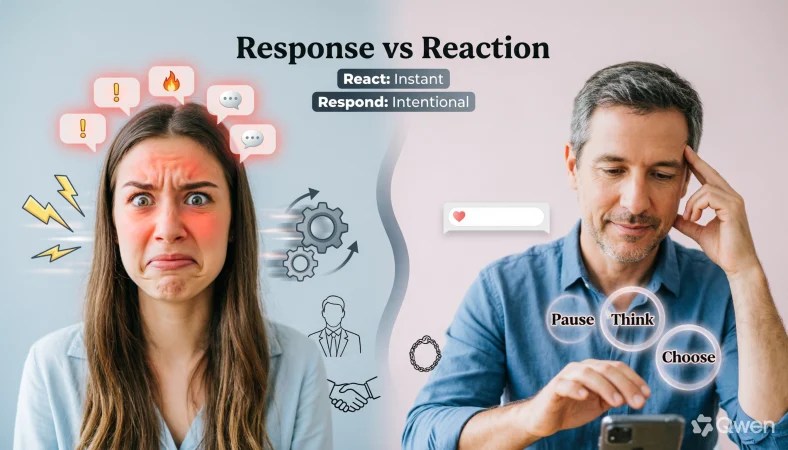
Response vs reaction comes down to how you handle a situation. A reaction is often immediate and emotional, while a response is usually more thoughtful, intentional, and controlled. Knowing the difference can help in texts, DMs, friendships, relationships, work, and everyday conversations.
Top alternatives: thoughtful response, emotional reaction, calm response, instant reaction, intentional reply
When something happens, your first instinct can be surprisingly loud. Maybe someone sends a confusing text, your friend makes a questionable comment, your crush leaves you on read, or your coworker drops an unexpected message into the group chat.
Do you react immediately, or take a breath and respond? That is where response vs reaction becomes genuinely useful. The two words sound similar, but they describe very different ways of handling moments. A reaction often happens automatically, while a response gives you a little more control over what you say or do next.
Understanding that difference can improve everything from texting and DMs to friendships, dating, family conversations, and workplace communication. Sometimes the smartest move is not the fastest one. A two-second pause can save you from sending the paragraph you will regret five minutes later.
Funny Response vs Reaction Examples
“My brain needs a loading screen.”
Use this when something happens so unexpectedly that you need a moment to process it.
Meaning: It humorously shows that you are choosing to think before reacting.
“That was my reaction, not my final answer.”
Use this after giving an overly dramatic first response.
Meaning: It separates your instant emotion from your considered opinion.
“Let me reboot emotionally.”
Use this when a conversation catches you off guard.
Meaning: You need time to calm down before responding properly.
“My face reacted before my manners did.”
Use this when your expression gives away your honest feelings.
Meaning: Your automatic reaction happened before you could control it.
“I almost replied with my intrusive thoughts.”
Use this when you nearly sent an unfiltered message.
Meaning: You are joking about choosing restraint over an impulsive response.
“Reaction pending, response under construction.”
Use this when you need time before answering.
Meaning: You are deliberately pausing instead of responding emotionally.
“That deserved a dramatic pause.”
Use this when someone delivers surprising news.
Meaning: You are acknowledging the moment without rushing into a reaction.
“My first thought was not HR-approved.”
Use this for a funny workplace-safe explanation after being surprised.
Meaning: Your immediate reaction was stronger than what you eventually chose to say.
“I nearly typed the whole Netflix finale.”
Use this when you almost overexplained your feelings in a message.
Meaning: You are laughing at your urge to react dramatically.
“Give me five business minutes.”
Use this when someone expects an immediate answer.
Meaning: You want a little processing time before responding.
“My reaction clocked in early.”
Use this after accidentally showing your feelings.
Meaning: Your instinctive emotion appeared before your thoughtful response.
“I chose peace over paragraph mode.”
Use this when you deliberately avoid sending an emotional essay.
Meaning: You are proud of responding calmly instead of reacting impulsively.
Thoughtful Response vs Reaction Examples
“I want to think about that first.”
Use this when someone says something important or unexpected.
Meaning: You are choosing reflection instead of an immediate emotional reaction.
“Let me process what you said.”
Use this during a serious conversation.
Meaning: You need time to understand the situation before responding.
“I hear you, and I want to answer thoughtfully.”
Use this when emotions are running high.
Meaning: You are showing respect while slowing down the conversation.
“My first feeling is not necessarily my final opinion.”
Use this when discussing a sensitive issue.
Meaning: You recognize that emotions can change after reflection.
“I do not want to answer while I am upset.”
Use this during an argument or tense exchange.
Meaning: You are protecting the conversation from an impulsive reaction.
“Let me understand the situation properly.”
Use this when the details are unclear.
Meaning: You prefer facts and understanding before forming a response.
“I need a moment to choose my words.”
Use this when you care about how your message will land.
Meaning: You are intentionally communicating rather than reacting.
“I understand why I feel this way, but I want to think it through.”
Use this when strong emotions are involved.
Meaning: You acknowledge your feelings without letting them control your response.
“I would rather respond than react.”
Use this when a conversation starts becoming heated.
Meaning: You are choosing self-control and thoughtful communication.
“Let me look at this from both sides.”
Use this when there are competing perspectives.
Meaning: You want a balanced response instead of an instant judgment.
“I am listening before I answer.”
Use this when someone needs to feel heard.
Meaning: You are prioritizing understanding over immediate reaction.
“I want my answer to reflect what I actually mean.”
Use this when a message could easily be misunderstood.
Meaning: You are being intentional about your communication.
Calm Response vs Reaction Examples
“Let’s take a breath and talk about it.”
Use this when emotions start rising during a disagreement.
Meaning: You want to replace an emotional reaction with a calm discussion.
“I am not going to react emotionally.”
Use this when someone is deliberately provoking you.
Meaning: You are choosing composure instead of giving an impulsive response.
“I can be upset and still respond calmly.”
Use this during a difficult conversation.
Meaning: Strong feelings do not have to control your behavior.
“Let’s slow this down.”
Use this when a conversation is moving too quickly.
Meaning: You want space to think before answering.
“I understand your point.”
Use this when you disagree but want to keep things respectful.
Meaning: You acknowledge the other person’s perspective without reacting defensively.
“I would like to discuss this when we are both calm.”
Use this during a heated personal or professional exchange.
Meaning: You are postponing the conversation to avoid an emotional reaction.
“I am going to think before I answer.”
Use this when you feel yourself getting irritated.
Meaning: You are intentionally creating space between emotion and communication.
“There is no need to rush this conversation.”
Use this when someone pressures you for an immediate answer.
Meaning: You are protecting your ability to respond thoughtfully.
“I can handle this without making it bigger.”
Use this when a minor problem starts feeling dramatic.
Meaning: You are choosing perspective over escalation.
“I am choosing clarity over emotion.”
Use this when misunderstandings are developing.
Meaning: You want to focus on understanding rather than reacting.
“Let’s focus on what actually happened.”
Use this when assumptions are taking over a discussion.
Meaning: You are steering the conversation toward facts.
“I am calm enough to talk about it now.”
Use this after taking time away from an argument.
Meaning: You are returning with a more controlled mindset.
Professional Response vs Reaction Examples
“Thank you for raising the issue.”
Use this when a coworker brings up a concern unexpectedly.
Meaning: You acknowledge the issue without reacting defensively.
“I will review this and get back to you.”
Use this when you need time before answering professionally.
Meaning: You are replacing an instant reaction with a considered response.
“Let me look into the details first.”
Use this when someone asks about an unclear situation at work.
Meaning: You want accurate information before responding.
“I appreciate the feedback.”
Use this when receiving criticism professionally.
Meaning: You acknowledge the feedback without letting emotion take over.
“I understand the concern.”
Use this during a workplace disagreement.
Meaning: You are showing professionalism instead of responding defensively.
“I would like to clarify a few points.”
Use this when a message contains confusing information.
Meaning: You want to understand the issue before forming a response.
“I will consider that and follow up.”
Use this after receiving an unexpected suggestion.
Meaning: You are taking time to evaluate the idea.
“Let’s focus on finding a solution.”
Use this when a workplace problem starts becoming personal.
Meaning: You are redirecting attention from reaction to constructive action.
“I understand your perspective.”
Use this when discussing a disagreement with a colleague.
Meaning: You can acknowledge another viewpoint without automatically agreeing.
“Could we review the situation together?”
Use this when you need more context before responding.
Meaning: You prefer collaboration over assumption.
“I would prefer to respond once I have the full information.”
Use this when details are incomplete.
Meaning: You value accuracy over speed.
“Let’s address the issue objectively.”
Use this when emotions begin influencing a professional discussion.
Meaning: You want facts and professionalism to guide the conversation.
Creative Response vs Reaction Examples
“My emotions sent the first draft.”
Use this when your first thought feels very different from your final answer.
Meaning: Your reaction came first, but your response required editing.
“Pause, process, then press send.”
Use this as a reminder before answering a difficult message.
Meaning: You are encouraging intentional communication.
“Feelings first, wisdom second.”
Use this when explaining why reactions can be immediate.
Meaning: Emotion often appears before thoughtful reasoning.
“My reaction was the trailer, not the movie.”
Use this when your first response does not represent the full story.
Meaning: An instant reaction may not reflect your final position.
“I am editing my emotional draft.”
Use this before sending a sensitive text.
Meaning: You are refining your words before communicating.
“The pause is part of the answer.”
Use this when silence helps you think.
Meaning: Taking time can be a meaningful part of responding well.
“Not every feeling needs a microphone.”
Use this when deciding not to voice every immediate emotion.
Meaning: You can experience a feeling without acting on it.
“My brain voted for patience.”
Use this after deciding not to respond impulsively.
Meaning: You are choosing thoughtful communication.
“Reaction mode: muted.”
Use this jokingly when someone tries to provoke you.
Meaning: You are refusing to give an immediate emotional reaction.
“I am giving my response a second draft.”
Use this when your first message feels too emotional.
Meaning: You are improving your communication before sending it.
“Plot twist: I thought before replying.”
Use this after handling a difficult situation calmly.
Meaning: You chose reflection instead of instinct.
“Emotional Wi-Fi disconnected.”
Use this when you need space to calm down.
Meaning: You are humorously saying you need a break before responding.
Clever Response vs Reaction Examples
“Fast is not always smart.”
Use this when someone expects an immediate answer.
Meaning: Speed does not automatically make a response better.
“The first thought is not always the best thought.”
Use this during an emotional conversation.
Meaning: Initial reactions can change after reflection.
“I can acknowledge it without reacting to it.”
Use this when someone says something provocative.
Meaning: You recognize the situation without allowing it to control you.
“Pause is a strategy, not avoidance.”
Use this when someone questions why you are taking time to answer.
Meaning: A deliberate pause can help create a better response.
“Emotion gives information, not always instructions.”
Use this when discussing emotional reactions.
Meaning: Feelings matter, but they do not always need immediate action.
“I would rather be accurate than immediate.”
Use this when facts are uncertain.
Meaning: You prioritize a thoughtful answer over a rushed reaction.
“I can change my response without denying my feelings.”
Use this during a personal disagreement.
Meaning: You can respect your emotions while still choosing your behavior.
“A reaction happens; a response is chosen.”
Use this when explaining the difference between the two concepts.
Meaning: The key distinction is often automatic emotion versus intentional action.
“My feelings are valid, but so is my self-control.”
Use this when emotions are intense.
Meaning: You can respect your feelings without acting impulsively.
“I am responding to the situation, not the adrenaline.”
Use this during a tense moment.
Meaning: You are deliberately separating emotion from action.
“Thinking time can improve communication.”
Use this when someone wants an instant answer.
Meaning: Reflection often produces clearer communication.
“I am choosing the outcome, not feeding the moment.”
Use this when someone tries to provoke you.
Meaning: You are focused on what happens next rather than the immediate emotion.
Sarcastic Response vs Reaction Examples
“Wow, look at me using emotional maturity.”
Use this jokingly after staying calm during an argument.
Meaning: You are playfully celebrating restraint.
“Imagine thinking I would react immediately.”
Use this when someone expects you to lose your temper.
Meaning: You are confidently refusing to play along.
“My dramatic reaction has been postponed.”
Use this when something annoys you but you choose patience.
Meaning: You are joking about delaying an emotional response.
“Sorry, I am currently choosing common sense.”
Use this when someone expects an impulsive answer.
Meaning: You are choosing thoughtfulness instead of reacting.
“I almost reacted, but growth happened.”
Use this after handling a frustrating moment well.
Meaning: You are humorously highlighting personal restraint.
“My patience just got promoted.”
Use this when you remain calm under pressure.
Meaning: You are joking that your self-control has improved.
“The reaction department is closed today.”
Use this when someone tries to start an argument.
Meaning: You are refusing to engage emotionally.
“I will be dramatic later, thanks.”
Use this when you need to stay composed in the moment.
Meaning: You are choosing timing over impulse.
“My impulse control deserves a certificate.”
Use this after avoiding an unnecessary argument.
Meaning: You are proudly acknowledging your restraint.
“I had a reaction, then remembered I have manners.”
Use this after receiving an irritating message.
Meaning: You stopped yourself from responding harshly.
“That deserved a reaction, but I chose peace.”
Use this when someone says something ridiculous.
Meaning: You noticed the provocation but decided not to escalate.
“Congratulations, you almost got a paragraph.”
Use this when you nearly sent a long emotional message.
Meaning: You are joking about how close you came to overreacting.
Cute Response vs Reaction Examples
“My heart reacted before my brain.”
Use this when someone unexpectedly says something sweet.
Meaning: Your emotional response happened instantly.
“That made me smile before I could think.”
Use this after receiving a lovely message.
Meaning: Your genuine happiness appeared naturally.
“Okay, that was adorable.”
Use this when someone does something unexpectedly sweet.
Meaning: You are responding warmly to their gesture.
“You caught me off guard in the cutest way.”
Use this after a sweet surprise.
Meaning: Their action created a happy, unexpected reaction.
“I need a second to process how sweet that was.”
Use this when someone compliments you sincerely.
Meaning: You are pleasantly overwhelmed.
“My smile gave me away.”
Use this when your feelings become obvious.
Meaning: Your natural reaction revealed your happiness.
“That definitely got a happy reaction.”
Use this after receiving a thoughtful message.
Meaning: You genuinely appreciated what happened.
“Okay, my heart has opinions.”
Use this when something makes you unexpectedly emotional.
Meaning: You are playfully admitting that your feelings are involved.
“You really know how to make me smile.”
Use this when someone consistently brightens your mood.
Meaning: You are expressing warm appreciation.
“That was impossible not to love.”
Use this after a sweet gesture.
Meaning: You found the moment genuinely touching.
“My reaction was basically instant happiness.”
Use this when describing your response to good news.
Meaning: The situation created immediate positive emotion.
“You just made my whole mood better.”
Use this after someone sends an encouraging message.
Meaning: Their action had a noticeable positive effect on you.
Flirty Response vs Reaction Examples
“You really know how to get a reaction out of me.”
Use this when someone sends a teasing or charming message.
Meaning: You are playfully admitting that they affect you.
“Careful, I might start liking this attention.”
Use this when someone is being especially charming.
Meaning: You are flirting while pretending to be cautious.
“That reaction was definitely not accidental.”
Use this after intentionally showing interest.
Meaning: You are openly acknowledging attraction.
“You make it difficult to stay composed.”
Use this when someone is flirting confidently.
Meaning: Their charm is affecting your usual self-control.
“Okay, that definitely got my attention.”
Use this after a bold compliment.
Meaning: You are showing interest without being too intense.
“My reaction says more than my words do.”
Use this when your feelings are obvious.
Meaning: Your nonverbal response may reveal attraction.
“You knew exactly what you were doing, didn’t you?”
Use this after playful teasing from someone you like.
Meaning: You are acknowledging their intentional flirtation.
“I was trying to stay chill. Then you texted.”
Use this when a crush sends an unexpected message.
Meaning: Their attention makes it harder to remain casual.
“That was a dangerous thing to say to me.”
Use this when someone gives you a particularly tempting compliment.
Meaning: You are playfully warning them that you are interested.
“I cannot promise a completely neutral reaction.”
Use this when someone is obviously flirting.
Meaning: You are admitting that their behavior affects you.
“You are becoming very good at getting my attention.”
Use this when someone repeatedly catches your interest.
Meaning: You are flirting while acknowledging their effect.
“Well, now you have my full attention.”
Use this when a crush says something intriguing.
Meaning: You are confidently signaling interest.
Dramatic Response vs Reaction Examples
“That reaction deserves its own soundtrack.”
Use this when an event feels unusually dramatic.
Meaning: You are exaggerating the emotional intensity for humor.
“I need a moment because that was a lot.”
Use this after receiving unexpected news.
Meaning: You need time to process the emotional impact.
“My emotions just entered season finale mode.”
Use this when something feels extremely dramatic.
Meaning: You are comparing the moment to an intense TV finale.
“I was not emotionally prepared for that.”
Use this after an unexpected confession or surprise.
Meaning: The situation triggered a strong emotional reaction.
“That changed the entire plot.”
Use this when new information changes your perspective.
Meaning: You are acknowledging how dramatically the situation shifted.
“My reaction was honestly cinematic.”
Use this when your response was unusually expressive.
Meaning: You are playfully exaggerating your emotional reaction.
“I need to sit with that one.”
Use this after hearing something difficult or surprising.
Meaning: You need emotional space before responding.
“Well, that escalated emotionally.”
Use this when a simple conversation suddenly becomes intense.
Meaning: The emotional reaction became stronger than expected.
“My brain needs a dramatic intermission.”
Use this when you need a break from an intense conversation.
Meaning: You are asking for processing time.
“That was not on today’s emotional schedule.”
Use this when something unexpected happens.
Meaning: You were completely unprepared for the situation.
“I have approximately seventeen feelings about this.”
Use this when you cannot easily describe your emotions.
Meaning: You are humorously expressing emotional complexity.
“Let me recover before I answer.”
Use this after an intense or surprising message.
Meaning: You want to regain composure before responding.
Chill And Casual Response vs Reaction Examples
“Let me think about it.”
Use this when you do not want to rush an answer.
Meaning: You are keeping things relaxed while taking time to respond.
“Fair point.”
Use this when someone makes a reasonable observation.
Meaning: You acknowledge their point without overreacting.
“Yeah, I get you.”
Use this during a casual conversation.
Meaning: You show understanding without making the moment overly serious.
“I hear you.”
Use this when someone shares an opinion or concern.
Meaning: You are acknowledging them calmly.
“Let’s see how it plays out.”
Use this when the outcome is uncertain.
Meaning: You prefer to observe before reacting.
“No big deal, we can figure it out.”
Use this when a small problem appears.
Meaning: You are keeping the situation relaxed.
“I will get back to you.”
Use this when you need time before answering.
Meaning: You are calmly postponing your response.
“All good, I just needed a second.”
Use this after taking time to process something.
Meaning: You are explaining your pause without creating drama.
“I am taking it one step at a time.”
Use this when a situation feels uncertain.
Meaning: You are avoiding unnecessary emotional reactions.
“No rush.”
Use this when you want to remove pressure from the conversation.
Meaning: You are encouraging calm communication.
“Let’s not overthink it.”
Use this when emotions begin making a simple issue complicated.
Meaning: You want to keep perspective and avoid overreaction.
“I am good, just processing.”
Use this when someone notices that you are quiet.
Meaning: You are taking time to understand your feelings.
Confident Response vs Reaction Examples
“I choose how I respond.”
Use this when someone tries to provoke you.
Meaning: You are emphasizing personal control.
“You do not get to decide my reaction.”
Use this when someone expects you to react emotionally.
Meaning: You are confidently setting a boundary.
“I am not reacting just because you want me to.”
Use this when someone is intentionally provoking you.
Meaning: You refuse to give them control over your behavior.
“I know what I mean, and I will say it clearly.”
Use this during a potentially confusing conversation.
Meaning: You are confident in your communication.
“I can handle this conversation calmly.”
Use this when the situation feels tense.
Meaning: You trust yourself to remain composed.
“I do not need an instant answer.”
Use this when someone pressures you.
Meaning: You are comfortable taking time before responding.
“My response does not need to match your energy.”
Use this when someone communicates aggressively.
Meaning: You can remain composed even when others are not.
“I am responsible for what I say next.”
Use this after feeling provoked.
Meaning: You recognize that your response is your choice.
“I can disagree without losing control.”
Use this during a heated discussion.
Meaning: Confidence allows you to maintain composure while disagreeing.
“I am choosing clarity over conflict.”
Use this when an argument starts escalating.
Meaning: You are prioritizing resolution over emotional reaction.
“I will answer when I am ready.”
Use this when someone demands an immediate response.
Meaning: You are confidently protecting your boundaries.
“I do not have to prove my point through emotion.”
Use this during a disagreement.
Meaning: You trust your position without needing an explosive reaction.
Emotional Response vs Reaction Examples
“That really affected me.”
Use this when something has a genuine emotional impact.
Meaning: You are honestly acknowledging your feelings.
“I need some time to process this.”
Use this after receiving difficult news.
Meaning: The situation requires emotional reflection before communication.
“I reacted because it mattered to me.”
Use this when explaining an emotional response.
Meaning: Your reaction came from genuine emotional investment.
“I was overwhelmed in the moment.”
Use this after responding more strongly than intended.
Meaning: You recognize that intense emotion influenced your behavior.
“I understand my reaction better now.”
Use this after reflecting on an emotional situation.
Meaning: You have gained perspective after the initial feelings settled.
“I was hurt, so my first response was emotional.”
Use this when explaining a difficult reaction honestly.
Meaning: You are taking responsibility while explaining the emotion behind it.
“I needed time before I could explain how I felt.”
Use this when a conversation was emotionally difficult.
Meaning: Your feelings needed time to become clear.
“I care, which is why I reacted strongly.”
Use this when explaining an intense response to someone important.
Meaning: Your emotional investment influenced your reaction.
“I am still figuring out what I feel.”
Use this when you cannot yet identify your emotions.
Meaning: You are being honest instead of forcing an immediate answer.
“That touched a sensitive part of me.”
Use this when something unexpectedly brings up strong feelings.
Meaning: The situation affected you more deeply than expected.
“I want to respond honestly, not emotionally.”
Use this during a serious personal conversation.
Meaning: You want your words to reflect your genuine thoughts.
“My feelings came out faster than my words.”
Use this when your reaction happened before you could explain yourself.
Meaning: Your emotions appeared before you could communicate them clearly.
Sweet Response vs Reaction Examples
“Thank you for understanding me.”
Use this when someone responds patiently to your emotions.
Meaning: You appreciate their kindness and emotional support.
“That means more to me than you know.”
Use this after someone says something deeply supportive.
Meaning: Their words had a meaningful emotional impact.
“I really appreciate your patience.”
Use this when someone gives you time to process.
Meaning: You value their willingness to let you respond at your own pace.
“You made that easier for me.”
Use this when someone handles a sensitive situation kindly.
Meaning: Their behavior helped reduce emotional pressure.
“I am glad we can talk about things like this.”
Use this during an honest relationship conversation.
Meaning: You appreciate open and safe communication.
“Thank you for giving me space to think.”
Use this when someone does not pressure you for an answer.
Meaning: You appreciate their respect for your processing time.
“I feel heard.”
Use this after someone listens carefully.
Meaning: You feel understood rather than dismissed.
“That was really thoughtful of you.”
Use this after someone responds considerately.
Meaning: You appreciate their intentional kindness.
“I needed that calm energy.”
Use this when someone helps settle a tense situation.
Meaning: Their composure made you feel safer and more comfortable.
“I appreciate you letting me explain.”
Use this when someone listens instead of jumping to conclusions.
Meaning: You value their patience and openness.
“You handled that beautifully.”
Use this when someone responds maturely during tension.
Meaning: You admire their calm and thoughtful communication.
“That response made me feel understood.”
Use this after a meaningful conversation.
Meaning: Their words created emotional reassurance and connection.
Relationship Response vs Reaction Examples
“I want us to understand each other, not win.”
Use this during a disagreement with a partner or close friend.
Meaning: You are prioritizing connection over being right.
“Let’s talk instead of assuming.”
Use this when misunderstandings start affecting a relationship.
Meaning: You prefer communication over emotional reactions.
“I care about this, so I want to respond carefully.”
Use this during an important relationship conversation.
Meaning: Your care motivates you to communicate thoughtfully.
“I do not want one emotional moment to define us.”
Use this after a disagreement.
Meaning: You recognize that temporary reactions should not determine the whole relationship.
“Can we start this conversation again?”
Use this when the first attempt became too emotional.
Meaning: You want another chance to communicate more effectively.
“I understand why you reacted that way.”
Use this when trying to validate someone’s feelings.
Meaning: You are acknowledging their emotional experience without necessarily agreeing.
“I want to explain, not defend myself.”
Use this when a misunderstanding needs clarification.
Meaning: You are aiming for understanding instead of an argument.
“I would rather solve this than keep reacting to it.”
Use this when the same disagreement keeps returning.
Meaning: You want a lasting solution instead of repeated emotional exchanges.
“Your feelings matter to me.”
Use this when someone feels ignored or misunderstood.
Meaning: You are showing emotional care and openness.
“Let’s give each other a little breathing room.”
Use this when both people are becoming overwhelmed.
Meaning: Temporary space can prevent an impulsive reaction.
“I am listening, even if I need time to answer.”
Use this when a partner wants an immediate response.
Meaning: Silence does not necessarily mean indifference.
“I want my response to help us, not hurt us.”
Use this before discussing a sensitive issue.
Meaning: You are thinking about the long-term effect of your words.
Boundary-Setting Response vs Reaction Examples
“I am not comfortable discussing this right now.”
Use this when a conversation crosses your comfort level.
Meaning: You are calmly establishing a boundary.
“I need some space before continuing.”
Use this when an argument becomes overwhelming.
Meaning: You are protecting yourself from an impulsive reaction.
“I understand what you are saying, but I disagree.”
Use this when you want to disagree respectfully.
Meaning: You can maintain your position without escalating emotionally.
“That does not work for me.”
Use this when someone asks you to accept something you dislike.
Meaning: You are communicating a clear boundary without unnecessary explanation.
“I am willing to talk when we can both be respectful.”
Use this when someone’s tone becomes aggressive.
Meaning: You are setting a condition for healthy communication.
“I will not respond to insults.”
Use this when someone becomes disrespectful.
Meaning: You are refusing to participate in an unhealthy exchange.
“I need time to decide.”
Use this when someone pressures you for an immediate answer.
Meaning: You are asserting your right to think before responding.
“Please give me a moment.”
Use this when you feel yourself becoming emotional.
Meaning: You are creating space before speaking.
“I hear your opinion, but I will make my own decision.”
Use this when someone pressures you to act a certain way.
Meaning: You respect their view without surrendering your autonomy.
“I am not available for this conversation right now.”
Use this when the timing is emotionally or practically inappropriate.
Meaning: You are setting a clear communication boundary.
“We can discuss the issue without attacking each other.”
Use this during a tense disagreement.
Meaning: You are asking for respectful communication.
“I will respond when I can do so calmly.”
Use this when you know an immediate reply would be emotional.
Meaning: You are choosing self-control over impulse.
Social Media Response vs Reaction Examples
“Let me not comment while I am annoyed.”
Use this before responding to a frustrating post.
Meaning: You are preventing an emotional online reaction.
“Some things do not need a response.”
Use this when deciding not to engage with online drama.
Meaning: Silence can sometimes be more effective than replying.
“I saw it, processed it, and moved on.”
Use this after encountering something irritating online.
Meaning: You refuse to let a post control your mood.
“Draft saved, dignity preserved.”
Use this after deciding not to post an angry reply.
Meaning: You chose restraint over public conflict.
“I am choosing not to feed the comments.”
Use this when a discussion becomes unnecessarily hostile.
Meaning: You are refusing to encourage online negativity.
“That post got a reaction, but not a reply.”
Use this when something affects you but you decide not to engage.
Meaning: Feeling something does not require responding publicly.
“Not every notification deserves my energy.”
Use this when ignoring provocative messages or comments.
Meaning: You are protecting your attention and peace.
“I almost replied, then remembered the internet is forever.”
Use this after avoiding an impulsive comment.
Meaning: You are choosing caution over an emotional online response.
“Seen, understood, ignored.”
Use this when someone posts something you do not want to engage with.
Meaning: You acknowledge it without giving it additional attention.
“My reaction belongs in drafts.”
Use this when your first response is too emotional to post.
Meaning: You are choosing private processing over public conflict.
“I am not turning a comment section into a courtroom.”
Use this when an online disagreement becomes excessive.
Meaning: You prefer to avoid unnecessary public arguments.
“Scroll, breathe, move on.”
Use this when social media content irritates you.
Meaning: You are choosing emotional distance instead of instant engagement.
Workplace Conflict Response vs Reaction Examples
“Let’s address the issue directly.”
Use this when a workplace misunderstanding develops.
Meaning: You want productive communication rather than emotional escalation.
“I would like to understand what happened.”
Use this after receiving unexpected criticism.
Meaning: You are seeking context before responding defensively.
“Can we discuss the facts first?”
Use this when emotions are dominating a workplace disagreement.
Meaning: You want evidence and clarity to guide the conversation.
“I appreciate you bringing this to my attention.”
Use this when a colleague raises a concern.
Meaning: You acknowledge the issue professionally without reacting negatively.
“Let’s work toward a solution.”
Use this when a disagreement starts becoming personal.
Meaning: You are focusing on resolution instead of blame.
“I would like to clarify my position.”
Use this when your words have been misunderstood.
Meaning: You are calmly explaining your perspective.
“I understand the concern, and I will review it.”
Use this after receiving workplace feedback.
Meaning: You are acknowledging the concern while giving yourself time to assess it.
“Let’s keep the discussion constructive.”
Use this when workplace communication becomes tense.
Meaning: You are encouraging respectful problem-solving.
“I do not want to respond based on assumptions.”
Use this when information is incomplete.
Meaning: You prefer facts before forming an opinion.
“I am happy to discuss this professionally.”
Use this when someone approaches you aggressively.
Meaning: You are willing to communicate but expect respectful behavior.
“Let’s take a step back and review what happened.”
Use this when emotions have complicated a workplace issue.
Meaning: You want a calmer and more objective perspective.
“I will respond once I have reviewed everything.”
Use this when an immediate answer could be inaccurate.
Meaning: You prioritize careful judgment over speed.
Wise Response vs Reaction Examples
“Not everything deserves an immediate answer.”
Use this when someone pressures you to respond quickly.
Meaning: You recognize the value of patience.
“Feel it, then choose what to do with it.”
Use this when explaining emotional self-control.
Meaning: Feelings can be acknowledged without automatically becoming actions.
“A pause can change the entire conversation.”
Use this after realizing how helpful reflection can be.
Meaning: Taking a moment can prevent unnecessary conflict.
“You can control your response, even when you cannot control the situation.”
Use this when discussing difficult circumstances.
Meaning: Your behavior remains within your control even when events are not.
“The strongest response is sometimes a calm one.”
Use this when someone expects confrontation.
Meaning: Composure can communicate confidence and strength.
“React less, understand more.”
Use this as a simple reminder during tense moments.
Meaning: Understanding can create better outcomes than immediate emotion.
“Give your thoughts time to catch up with your feelings.”
Use this when emotions arrive faster than reasoning.
Meaning: Reflection can help align emotion with judgment.
“You do not have to answer every emotional invitation.”
Use this when someone tries to pull you into an argument.
Meaning: You can choose whether a situation deserves your engagement.
“A response is a choice.”
Use this when explaining personal responsibility.
Meaning: You have influence over what you do after an initial reaction.
“Silence can be a thoughtful response.”
Use this when there is nothing productive to add.
Meaning: Not speaking can sometimes be more intentional than reacting.
“Your first feeling deserves attention, not automatic action.”
Use this when discussing emotional awareness.
Meaning: Feelings are worth noticing without immediately obeying them.
“Choose the response you will be proud of later.”
Use this before sending a difficult message.
Meaning: Long-term perspective can improve short-term communication.
Quick One-Liner Response vs Reaction Examples
“Let me think.”
Use this when you need a brief pause.
Meaning: You are not ready to respond immediately.
“I hear you.”
Use this when acknowledging someone’s point.
Meaning: You are showing that you are listening.
“Give me a second.”
Use this when something catches you off guard.
Meaning: You need a short moment to process.
“I need context.”
Use this when the situation is unclear.
Meaning: You want information before reacting.
“Fair enough.”
Use this when accepting another person’s perspective.
Meaning: You acknowledge their point without overexplaining.
“Let me process that.”
Use this when someone shares unexpected information.
Meaning: You need time before forming a thoughtful response.
“I understand.”
Use this during a serious conversation.
Meaning: You are acknowledging what the other person said.
“I will respond later.”
Use this when you are too emotional to answer properly.
Meaning: You are intentionally delaying the response.
“Noted.”
Use this in concise professional or casual communication.
Meaning: You acknowledge the information without adding unnecessary emotion.
“I need a minute.”
Use this when your first reaction is strong.
Meaning: You are creating space before speaking.
“Let’s talk calmly.”
Use this when an argument starts escalating.
Meaning: You want communication instead of emotional conflict.
“I would rather think first.”
Use this when someone wants an immediate opinion.
Meaning: You value a considered response over an impulsive reaction.
FAQs:
What is the difference between a response and a reaction?
A reaction is usually immediate and can be driven by emotion or instinct. A response is generally more intentional and gives you time to consider what you want to say or do.
Is a reaction always emotional?
No. Reactions can be physical, mental, or emotional. However, people often use the word reaction when describing an automatic or immediate emotional response.
Can a response also be emotional?
Absolutely. A thoughtful response can still be emotional. The key difference is that you have more awareness and control over how you communicate that emotion.
What does response vs reaction mean in relationships?
In relationships, the difference often comes down to communication style. Reacting may involve answering from frustration or hurt, while responding means considering both your feelings and the other person’s perspective.
Can response vs reaction apply to flirting?
Yes. A reaction can reveal an immediate attraction or excitement, while a response is the words or behavior you intentionally choose after feeling that emotion.
What is a professional way to explain response vs reaction?
You can say that a reaction is an immediate or automatic response to an event, while a response is a more deliberate action based on thought, context, and intention.
What if I do not actually mean my first reaction?
You can simply acknowledge it and clarify. Saying that you reacted emotionally and would like to explain what you actually mean can help prevent misunderstandings.
Is humor appropriate when talking about response vs reaction?
Yes, especially in casual conversations, social media posts, and friendships. Humor can make the distinction easier to remember, as long as it does not dismiss someone’s genuine feelings.
Which is better, a response or a reaction?
Neither is automatically better in every situation. Reactions are natural and can provide useful emotional information, while thoughtful responses are often more helpful when communication, boundaries, or important decisions are involved.
How can I respond instead of reacting?
Pause before answering, identify what you are feeling, consider the facts, and choose words that reflect what you actually want to communicate. Even a few seconds can make a difference.
Conclusion
Understanding response vs reaction can completely change the way you handle conversations. A reaction may arrive instantly, especially when emotions are running high, but a response gives you the chance to choose your words with intention. That difference matters in texts, DMs, friendships, dating, family conversations, social media, and the workplace.
You do not have to suppress your feelings or become emotionless. You simply get to decide what happens after the feeling appears. Try a funny response when the moment is light, a calm response when things get tense, or a thoughtful one when the conversation matters. Save this list, share it with someone who needs it, and reuse your favourite lines whenever the moment calls for them.