The n8n HTTP response node usually refers to the Respond to Webhook node, which lets an n8n workflow control what HTTP response is returned to a webhook caller. It is especially useful when you need custom response data, status codes, headers, or response timing.
Top alternatives: n8n Respond to Webhook node, n8n HTTP response, n8n webhook response, n8n custom HTTP response, n8n webhook response node
Ever built an n8n workflow that works perfectly, only to realize the person or application calling your webhook is sitting there waiting for the right HTTP response? Yep, that tiny response step can suddenly become the main character.
The n8n HTTP response node is commonly searched by developers who want to return custom data, control response behavior, handle errors, or make webhook-based workflows feel more polished. In n8n, the Respond to Webhook node is designed for controlling the response sent back from a Webhook-triggered workflow.
Whether you are building an API endpoint, connecting SaaS platforms, handling form submissions, creating automation for work, or testing a workflow with friends and teammates, choosing the right response structure matters. A clean response can make integrations easier to debug, easier to maintain, and much less likely to produce the classic “Why did my webhook return that?” moment.
Funny n8n HTTP Response Node Ideas
“The webhook asked, so we answered.”
Example: A developer adds a custom response after a successful webhook process.
Meaning: It humorously describes the node’s role in returning an answer.
“HTTP response, but make it organized.”
Example: A workflow returns structured JSON instead of a vague message.
Meaning: It celebrates a clean response design.
“Webhook received. Brain loading. Response incoming.”
Example: A workflow performs several steps before responding.
Meaning: It humorously describes delayed processing.
“The webhook has spoken.”
Example: A workflow sends its final response after processing data.
Meaning: It gives the response a playful sense of finality.
“200 OK, emotionally too.”
Example: A successful workflow returns HTTP status 200.
Meaning: It turns a technical success into a joke.
“No response? Not on my watch.”
Example: A developer checks a workflow that previously failed to return data.
Meaning: It highlights the importance of explicitly handling responses.
“Webhook went in, JSON came out.”
Example: A workflow transforms incoming data before responding.
Meaning: It summarizes a simple webhook flow.
“Response node doing response-node things.”
Example: A developer configures a custom webhook response.
Meaning: It playfully describes the node’s purpose.
“The API wanted closure.”
Example: A workflow sends a final response after completing an operation.
Meaning: It jokes about completing an HTTP exchange.
“Less waiting, more responding.”
Example: A developer improves the timing of a webhook workflow.
Meaning: It emphasizes efficient responses.
“Webhook received. Vibes returned.”
Example: A workflow sends a friendly JSON confirmation.
Meaning: It gives a technical response a playful personality.
“Status code says we survived.”
Example: A successful automation returns a positive status code.
Meaning: It celebrates successful workflow execution.
Professional n8n HTTP Response Node Responses
“Return a structured JSON response.”
Example: An API workflow sends predictable fields to another application.
Meaning: It promotes consistent integration behavior.
“Set the response status deliberately.”
Example: A workflow distinguishes successful requests from validation failures.
Meaning: It encourages meaningful HTTP responses.
“Keep response schemas consistent.”
Example: Several webhook endpoints follow the same JSON structure.
Meaning: Consistency makes integrations easier to maintain.
“Return only the data the caller needs.”
Example: A webhook sends a concise result instead of the entire execution dataset.
Meaning: Smaller responses are easier to consume.
“Use response headers when integration requirements call for them.”
Example: A workflow returns a required content type or custom header.
Meaning: Headers can communicate important response metadata.
“Separate processing from response formatting.”
Example: A workflow prepares business data before the response node.
Meaning: Clear separation improves workflow organization.
“Handle unsuccessful requests explicitly.”
Example: A workflow returns a suitable status when validation fails.
Meaning: Errors should be communicated clearly.
“Document the expected response structure.”
Example: An API team records webhook response fields for developers.
Meaning: Documentation reduces integration confusion.
“Test successful and unsuccessful paths.”
Example: A developer tests both valid and invalid webhook payloads.
Meaning: Response behavior should work across scenarios.
“Use predictable field names.”
Example: Every response uses fields such as success, message, and data.
Meaning: Predictability simplifies client-side handling.
“Keep response logic close to the workflow outcome.”
Example: A response node follows validation and processing steps.
Meaning: Placement makes workflow logic easier to understand.
“Treat webhook responses as part of the API contract.”
Example: A team agrees on response formats before connecting a new service.
Meaning: The response becomes a reliable integration interface.
Beginner-Friendly n8n HTTP Response Node Tips
“Start with the Webhook node.”
Example: A beginner creates a webhook trigger before configuring the response.
Meaning: The workflow needs an HTTP entry point before returning a webhook response.
“Add Respond to Webhook when you need custom control.”
Example: A developer wants to decide exactly what the caller receives.
Meaning: The response node provides explicit response handling.
“Return simple JSON first.”
Example: A beginner starts with a small object containing a success message.
Meaning: Simple payloads make testing easier.
“Test the webhook before adding complexity.”
Example: A learner verifies the basic request and response path first.
Meaning: Early testing makes troubleshooting easier.
“Name the response node clearly.”
Example: A workflow uses the name “Return Success Response.”
Meaning: Descriptive names make large workflows easier to read.
“Check the execution data.”
Example: A beginner inspects the data available before configuring the response.
Meaning: Understanding incoming data helps create the correct response.
“Do not return everything by default.”
Example: A workflow sends only selected fields to the caller.
Meaning: Focused responses are easier to consume.
“Use expressions for dynamic values.”
Example: A response includes a user ID from the incoming request.
Meaning: Expressions allow response content to change per execution.
“Test with realistic payloads.”
Example: A developer sends the same kind of JSON a production client will use.
Meaning: Realistic testing catches integration problems early.
“Read the response like the client will.”
Example: A developer checks whether another application can easily parse the returned JSON.
Meaning: Client usability matters as much as workflow execution.
“Keep the first response simple.”
Example: A beginner returns one message and one status field.
Meaning: Simplicity creates a strong foundation.
“Build complexity only after the basics work.”
Example: A developer adds authentication and branching after confirming the basic webhook response.
Meaning: Incremental development reduces confusion.
Creative n8n HTTP Response Node Ideas
“Turn raw workflow data into a friendly API response.”
Example: A workflow converts internal fields into clean public-facing JSON.
Meaning: It separates internal structure from external presentation.
“Create reusable response formats.”
Example: Multiple workflows return a common success structure.
Meaning: Reusable formats improve consistency.
“Return useful metadata with the result.”
Example: A response includes an operation ID and processing status.
Meaning: Metadata can help clients track results.
“Build custom validation responses.”
Example: Invalid input returns a clear message explaining the problem.
Meaning: Good errors help users fix requests.
“Create lightweight webhook APIs.”
Example: A workflow receives data, processes it, and returns a compact result.
Meaning: n8n can support practical automation endpoints.
“Use dynamic response messages.”
Example: The response changes depending on the workflow outcome.
Meaning: Dynamic messaging makes responses more informative.
“Return normalized data.”
Example: Several incoming formats are converted into one response structure.
Meaning: Normalization makes downstream systems easier to manage.
“Add request identifiers.”
Example: A workflow returns a generated reference value.
Meaning: Identifiers help with troubleshooting and tracking.
“Design responses around the caller.”
Example: A mobile app receives only fields needed by its interface.
Meaning: Client-focused responses reduce unnecessary complexity.
“Create separate success and failure structures.”
Example: Validation errors follow a predictable error schema.
Meaning: Clients can handle different outcomes consistently.
“Use response data as the workflow’s final handshake.”
Example: A webhook returns a final processing result after all required steps.
Meaning: The response closes the request cleanly.
“Make every response tell a useful story.”
Example: A response explains whether processing succeeded and what happened.
Meaning: Useful output is better than a generic confirmation.
Clever n8n HTTP Response Node Strategies
“Process first, respond second.”
Example: A workflow validates and transforms data before returning its final response.
Meaning: It encourages deliberate response timing.
“Return less, communicate more.”
Example: A response contains concise fields instead of a massive payload.
Meaning: Useful information matters more than volume.
“Design the response before designing the workflow.”
Example: A developer defines the expected JSON contract first.
Meaning: The desired output can guide workflow architecture.
“Treat errors as first-class responses.”
Example: Invalid requests receive structured error information.
Meaning: Failure paths deserve as much design attention as success paths.
“Make the client’s job boring.”
Example: An API returns consistent fields on every request.
Meaning: Predictable APIs are easier to integrate.
“One webhook, one clear contract.”
Example: A team documents exactly what an endpoint accepts and returns.
Meaning: Clear contracts reduce integration surprises.
“Keep internal fields internal.”
Example: A workflow removes implementation-specific data before responding.
Meaning: Public responses should expose only necessary information.
“Use meaningful status information.”
Example: A response distinguishes accepted, successful, and invalid requests.
Meaning: Status information improves client behavior.
“Do not confuse processing with presentation.”
Example: Backend data is transformed before being returned.
Meaning: Response formatting should suit the consumer.
“Make debugging possible without making responses huge.”
Example: A response includes a request identifier rather than full execution details.
Meaning: Small references can aid troubleshooting.
“Predictability beats cleverness.”
Example: A workflow uses straightforward response fields across endpoints.
Meaning: Reliable structure is more valuable than unnecessary complexity.
“Design for the next developer too.”
Example: A workflow uses clear node names and consistent response formats.
Meaning: Maintainability matters after the original builder leaves.
API-Friendly n8n HTTP Response Node Examples
“Return { success: true } for a simple completion response.”
Example: A lightweight automation confirms successful processing.
Meaning: It gives the caller a simple success signal.
“Return { success: false, error: … } for validation failures.”
Example: A workflow rejects incomplete input.
Meaning: It communicates failure in a structured way.
“Return the created record ID.”
Example: A workflow creates a database record and sends its identifier back.
Meaning: The caller can reference the newly created resource.
“Return processed customer data.”
Example: A workflow enriches customer information before responding.
Meaning: The response delivers the workflow’s useful output.
“Return a request identifier.”
Example: A workflow generates a tracking reference for an operation.
Meaning: Clients can use the identifier for support or status tracking.
“Return validation results.”
Example: A webhook checks several submitted fields and reports the outcome.
Meaning: Clients receive actionable feedback.
“Return a processing status.”
Example: A long-running workflow indicates that processing has started.
Meaning: The caller receives useful state information.
“Return a compact summary.”
Example: A workflow processes many records but returns only totals.
Meaning: The response avoids unnecessary payload size.
“Return normalized fields.”
Example: A webhook converts inconsistent input names into standard fields.
Meaning: Downstream systems receive predictable data.
“Return an error code with a message.”
Example: A failed validation produces a machine-readable code and human-readable explanation.
Meaning: Both software and people can understand the problem.
“Return timestamps when useful.”
Example: A workflow returns when processing completed.
Meaning: Timing information can support auditing and debugging.
“Return only contract-approved fields.”
Example: An API response excludes internal workflow information.
Meaning: Contract discipline keeps integrations clean.
Error Handling With The n8n HTTP Response Node
“Validate before responding.”
Example: A webhook checks required fields before processing data.
Meaning: Invalid requests can be rejected early.
“Return useful error messages.”
Example: A response identifies a missing required field.
Meaning: Clear errors make troubleshooting easier.
“Avoid exposing internal stack details.”
Example: A public API returns a safe error message instead of internal execution information.
Meaning: External responses should not reveal unnecessary implementation details.
“Use consistent error fields.”
Example: Every failure includes error and message fields.
Meaning: Clients can handle errors predictably.
“Distinguish validation from processing errors.”
Example: A workflow uses different error categories for bad input and internal failures.
Meaning: Different problems deserve different handling.
“Keep error responses concise.”
Example: A failed request returns a short explanation and reference ID.
Meaning: Useful errors do not need huge payloads.
“Log details internally when appropriate.”
Example: A workflow records troubleshooting information separately from the public response.
Meaning: Developers can investigate without exposing sensitive details.
“Test failure branches deliberately.”
Example: A developer sends malformed input to verify error behavior.
Meaning: Error paths should be tested rather than assumed.
“Give clients actionable information.”
Example: A response identifies which field needs correction.
Meaning: Actionable errors reduce repeated failed requests.
“Keep status handling consistent.”
Example: Similar validation failures use the same response conventions.
Meaning: Consistency improves client integration.
“Avoid vague messages.”
Example: A workflow replaces “Something went wrong” with a specific validation explanation.
Meaning: Specific errors are more useful.
“Treat failures as part of the API design.”
Example: The team documents both successful and unsuccessful response formats.
Meaning: Robust APIs plan for failure from the beginning.
n8n HTTP Response Node For Webhook Workflows
“Use Webhook as the entry point.”
Example: An external application sends an HTTP request to an n8n webhook.
Meaning: The webhook receives the incoming request.
“Use Respond to Webhook for controlled output.”
Example: A workflow needs to return custom JSON after processing.
Meaning: The response node gives the workflow explicit response control.
“Keep the response path easy to follow.”
Example: Processing nodes lead clearly toward the response node.
Meaning: Clear flow makes webhook logic easier to maintain.
“Return the result after validation.”
Example: A webhook checks submitted information before responding.
Meaning: Validation should happen before confirming success.
“Return a useful error when input fails.”
Example: An invalid payload receives a structured response.
Meaning: The caller learns what went wrong.
“Use response data that matches the webhook contract.”
Example: A connected service expects specific JSON fields.
Meaning: Matching the contract prevents integration failures.
“Test the webhook from outside n8n.”
Example: A developer uses an API client to send a real HTTP request.
Meaning: External testing validates the complete integration.
“Inspect execution results while debugging.”
Example: A developer checks workflow data after receiving an unexpected response.
Meaning: Execution data helps locate problems.
“Keep response content intentional.”
Example: A workflow returns a small confirmation rather than internal execution data.
Meaning: Intentional output improves API quality.
“Document what callers should expect.”
Example: An integration guide lists request and response examples.
Meaning: Documentation makes adoption easier.
“Test both valid and invalid webhook calls.”
Example: A developer tests missing fields and successful submissions.
Meaning: Both paths need reliable responses.
“Treat the webhook as a real API boundary.”
Example: A workflow receives requests from an external application.
Meaning: API design principles still matter in automation workflows.
Dynamic n8n HTTP Response Node Ideas
“Return the incoming user ID.”
Example: A webhook response includes the identifier supplied by the caller.
Meaning: Dynamic expressions can personalize output.
“Return the processed record ID.”
Example: A database node creates a record before the response.
Meaning: The caller receives the new resource reference.
“Return a calculated total.”
Example: A workflow calculates an invoice total before responding.
Meaning: The response can contain workflow-generated values.
“Return a dynamic message.”
Example: The response changes based on whether processing succeeds.
Meaning: Dynamic messages provide relevant feedback.
“Return a workflow-generated timestamp.”
Example: A response includes the completion time.
Meaning: The caller receives useful execution metadata.
“Return selected input fields.”
Example: A webhook echoes a safe subset of submitted information.
Meaning: Responses can selectively reuse input data.
“Return a conditional status.”
Example: A workflow reports different states based on validation results.
Meaning: Dynamic status information communicates outcomes.
“Return a calculated score.”
Example: A workflow evaluates incoming information and returns a score.
Meaning: n8n can transform input into useful output.
“Return a normalized email address.”
Example: A workflow standardizes an incoming email before responding.
Meaning: The response can show processed data.
“Return a generated reference code.”
Example: A workflow creates a tracking value for the request.
Meaning: The caller gets a unique reference.
“Return selected database fields.”
Example: A lookup finds a record and the response returns only required fields.
Meaning: Dynamic data can be shaped for the consumer.
“Return a result based on workflow branching.”
Example: Different branches produce different response content.
Meaning: Responses can reflect actual processing outcomes.
Advanced n8n HTTP Response Node Strategies
“Design response schemas before implementation.”
Example: A team agrees on JSON fields before building the workflow.
Meaning: Output requirements guide development.
“Use consistent success envelopes.”
Example: Multiple endpoints return similar success structures.
Meaning: Standardization simplifies integrations.
“Use consistent error envelopes.”
Example: Every endpoint follows the same error format.
Meaning: Clients can implement reusable error handling.
“Separate synchronous and asynchronous workflows.”
Example: Long-running operations are designed differently from quick requests.
Meaning: Response strategy should match processing time.
“Avoid unnecessary response payloads.”
Example: A workflow returns a result summary instead of raw intermediate data.
Meaning: Smaller responses are easier to maintain.
“Track request identifiers.”
Example: Each incoming operation receives a reference value.
Meaning: Request IDs connect responses with logs and troubleshooting.
“Design for retries.”
Example: A webhook workflow handles repeated requests safely.
Meaning: Reliable APIs should consider duplicate delivery.
“Keep response behavior predictable.”
Example: Similar inputs consistently produce similar response structures.
Meaning: Predictability improves client confidence.
“Separate sensitive information from public output.”
Example: Internal credentials and private metadata never enter the response.
Meaning: Response design should respect security boundaries.
“Use validation before expensive operations.”
Example: A workflow checks required fields before contacting external services.
Meaning: Invalid requests can fail early.
“Monitor webhook performance.”
Example: A team tracks slow webhook executions.
Meaning: Performance monitoring helps identify workflow bottlenecks.
“Review response contracts after workflow changes.”
Example: A developer checks API output after modifying nodes.
Meaning: Workflow updates should not silently break consumers.
Practical n8n HTTP Response Node Workflow Ideas
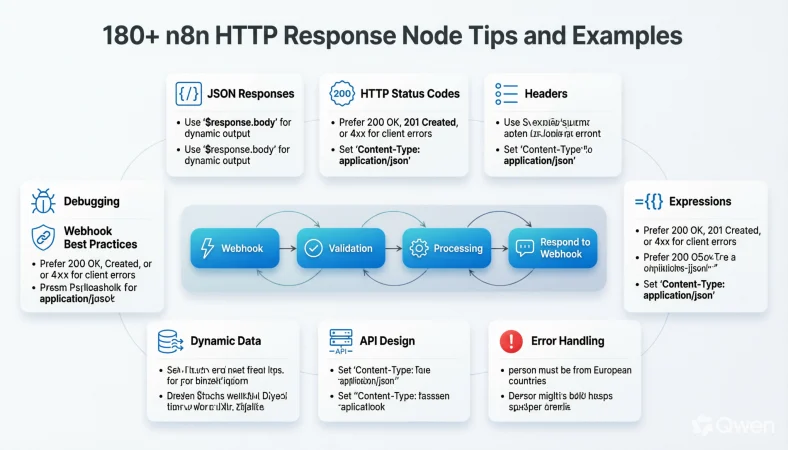
“Webhook → Validate → Process → Respond.”
Example: A basic API workflow validates input before completing an operation.
Meaning: It provides a clean request-processing pattern.
“Webhook → Database → Respond.”
Example: A webhook retrieves a record and returns selected data.
Meaning: The workflow turns database information into an API response.
“Webhook → API Request → Respond.”
Example: n8n calls another service and returns selected results.
Meaning: The workflow acts as an integration layer.
“Webhook → IF → Success/Error Response.”
Example: Input validation determines which response path runs.
Meaning: Branching creates clearer outcome handling.
“Webhook → Transform → Respond.”
Example: Incoming JSON is reshaped before being returned.
Meaning: n8n can act as a data transformation layer.
“Webhook → Authentication → Process → Respond.”
Example: A protected endpoint checks credentials before processing.
Meaning: Access control can occur before sensitive operations.
“Webhook → Search → Respond.”
Example: A request searches a database and returns matching records.
Meaning: n8n can expose search-style automation endpoints.
“Webhook → Create → Respond.”
Example: A request creates a record and returns its ID.
Meaning: The caller receives confirmation and a useful reference.
“Webhook → Update → Respond.”
Example: An external system triggers an update and receives the result.
Meaning: The response confirms workflow completion.
“Webhook → Delete → Respond.”
Example: A request removes a record and receives a status result.
Meaning: The caller gets a clear completion signal.
“Webhook → Conditional Logic → Custom Response.”
Example: Different business rules produce different output.
Meaning: Response content can reflect workflow logic.
“Webhook → Background Processing → Status Response.”
Example: A long operation begins and the caller receives a processing status.
Meaning: The response strategy can suit longer workflows.
Short n8n HTTP Response Node Study Notes
“Webhook receives the request.”
Example: A learner reviews the first step of a webhook workflow.
Meaning: It identifies the workflow entry point.
“Respond to Webhook sends the controlled response.”
Example: A student reviews the node’s main purpose.
Meaning: It describes explicit webhook response handling.
“JSON is common for API responses.”
Example: A developer returns structured data to an external service.
Meaning: JSON provides a practical machine-readable format.
“Status codes communicate outcomes.”
Example: A workflow distinguishes successful and unsuccessful requests.
Meaning: HTTP status information helps clients interpret results.
“Headers carry response metadata.”
Example: A response includes content-related metadata.
Meaning: Headers provide information alongside the body.
“Expressions make responses dynamic.”
Example: A response includes values generated during execution.
Meaning: Output can change based on workflow data.
“Validation protects workflow logic.”
Example: A webhook checks required fields before processing.
Meaning: Validation prevents unsuitable input from moving forward.
“Error responses should be useful.”
Example: A failed request identifies the problematic field.
Meaning: Good errors improve troubleshooting.
“Small responses are easier to consume.”
Example: An API returns only necessary information.
Meaning: Focused payloads reduce client complexity.
“Response design is API design.”
Example: A team documents response fields for an external integration.
Meaning: Webhook output should be treated as a public contract.
“Test response behavior externally.”
Example: A developer sends HTTP requests using an API client.
Meaning: External testing verifies real integration behavior.
“Document expected responses.”
Example: A developer writes example success and error payloads.
Meaning: Documentation makes integrations easier.
Smart n8n HTTP Response Node Troubleshooting Ideas
“Check whether the workflow reached the response node.”
Example: A developer traces execution after receiving no expected output.
Meaning: The response cannot behave as expected if its path never runs.
“Inspect the execution data.”
Example: A developer reviews the values entering the response stage.
Meaning: Incorrect input can produce incorrect output.
“Check the response structure.”
Example: A client rejects a JSON payload because fields are missing.
Meaning: Output must match the expected contract.
“Verify the webhook configuration.”
Example: A developer confirms the workflow uses the intended webhook setup.
Meaning: Trigger configuration affects response behavior.
“Test with a minimal payload.”
Example: A developer removes optional fields while debugging.
Meaning: Smaller tests make problems easier to isolate.
“Test the success path first.”
Example: A developer verifies basic response behavior before testing complex errors.
Meaning: Establishing a working baseline simplifies debugging.
“Then test failure paths.”
Example: A developer submits invalid data after confirming success.
Meaning: Error behavior needs independent testing.
“Check expressions carefully.”
Example: A response contains an empty value because a referenced field is missing.
Meaning: Expression references must match available workflow data.
“Check content types when relevant.”
Example: A client expects JSON but receives an unexpected format.
Meaning: Response formatting must match client expectations.
“Look for unexpected branches.”
Example: An IF node routes the request away from the expected response.
Meaning: Branching can change response behavior.
“Review external client expectations.”
Example: A third-party service requires a particular response structure.
Meaning: The receiving system may be the source of the problem.
“Simplify before rebuilding.”
Example: A developer temporarily removes optional nodes while debugging.
Meaning: A minimal workflow makes the failing component easier to identify.
Confident n8n HTTP Response Node Best Practices
“Know exactly what your webhook returns.”
Example: A developer documents the response before sharing the endpoint.
Meaning: Clear expectations prevent integration confusion.
“Keep response schemas stable.”
Example: An API maintains field names across workflow updates.
Meaning: Stability protects existing consumers.
“Validate input early.”
Example: Required fields are checked immediately after the webhook.
Meaning: Early validation prevents wasted processing.
“Return meaningful outcomes.”
Example: A successful operation returns a clear result rather than an empty body.
Meaning: Useful responses improve integration quality.
“Keep internal implementation private.”
Example: A response excludes internal workflow metadata.
Meaning: Public APIs should expose only necessary information.
“Use clear node names.”
Example: Nodes are named according to their business purpose.
Meaning: Naming makes workflows easier to maintain.
“Test before publishing.”
Example: Developers test expected request and response combinations.
Meaning: Testing reduces avoidable production issues.
“Document edge cases.”
Example: An API guide describes what happens with missing fields.
Meaning: Edge-case documentation makes integrations more predictable.
“Keep error handling intentional.”
Example: Failed requests follow a documented error structure.
Meaning: Error behavior should not be accidental.
“Monitor important webhook workflows.”
Example: A team reviews execution failures and latency.
Meaning: Monitoring helps maintain reliability.
“Avoid unnecessary response complexity.”
Example: A simple operation returns a simple JSON result.
Meaning: Complexity should serve a real requirement.
“Design for maintainability.”
Example: A workflow uses readable node names and predictable output.
Meaning: Good structure helps future developers understand it.
FAQs:
What is the n8n HTTP response node?
The phrase usually refers to n8n’s Respond to Webhook node. It is used to control the response returned to a caller when a workflow is triggered through a Webhook node.
Is “HTTP Response” the official n8n node name?
In current n8n documentation, the relevant built-in node is called Respond to Webhook. People may search for it using terms such as “n8n HTTP response node” or “n8n webhook response node.”
What is the Respond to Webhook node used for?
It lets a webhook workflow explicitly control the HTTP response sent back to the requesting client. This is useful when you need custom response data or response behavior.
Can the n8n HTTP response node return JSON?
Yes. A common pattern is to process incoming webhook data and return a structured JSON response to the caller.
Can the response be dynamic?
Yes. Response values can be based on data produced earlier in the workflow, making it possible to return IDs, messages, calculations, statuses, or other generated values.
Can I return an error response?
You can design workflow logic to distinguish successful processing from validation or other failure conditions and return an appropriate response structure.
Should I use a simple response or a detailed response?
Use the smallest response that gives the caller everything it actually needs. A predictable, focused response is usually easier to integrate.
Is humor appropriate when documenting an n8n HTTP response workflow?
Sure. A little humor can make technical documentation and team notes more memorable. For production API documentation, however, keep the actual response contract clear and precise.
What if I do not actually need a custom webhook response?
If the default webhook behavior meets your integration requirements, you may not need additional response customization. Use explicit response handling when your workflow needs more control.
Can the node be used with complex workflows?
Yes. It can be useful in workflows involving validation, branching, database operations, API calls, transformations, and other processing steps where the caller needs a deliberate final response.
What should I check when my webhook response is not working?
Check the webhook configuration, workflow path, response node placement, incoming data, expressions, response structure, and the expectations of the external client.
Is the n8n HTTP response node useful for APIs?
Yes. Webhook-triggered workflows can be designed as lightweight API-style endpoints, with deliberate request validation, processing, and response structures.
Conclusion
The n8n HTTP response node may sound like a tiny piece of an automation workflow, but getting the response right can make a huge difference. Whether you are returning JSON, handling validation errors, sending a record ID, building an API-style webhook, or simply confirming that an automation worked, a clean response keeps integrations predictable.
Start simple, test both success and failure paths, and design the output around the application receiving it. Once the basics click, you can build much more polished webhook workflows without turning every response into a debugging mystery. Save this guide for your next n8n project, share it with your developer friends, and keep building workflows that actually answer when someone calls.