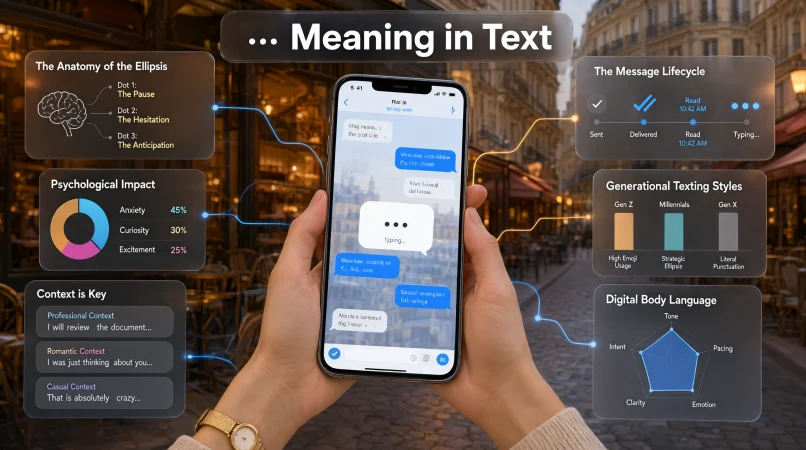
The symbol “…” (three dots) is called an ellipsis in texting and written communication. It can represent a pause, unfinished thought, hesitation, suspense, or something left unsaid. In text messages, its meaning often depends on the conversation and the sender’s tone.
For example, someone replying “Okay…” might sound unsure, disappointed, annoyed, or hesitant, while “Wait…” can suggest surprise or that they need a moment to think. People also use three dots to create suspense, show awkwardness, or make a message feel more dramatic.
Have you ever received a text that simply says “Fine…” or “Really…” and wondered what the person actually meant? Three little dots might look harmless, but they can completely change the tone of a message. Sometimes they suggest hesitation, sometimes disappointment, and other times they make a conversation feel awkward or mysterious.
Depending on who sends them and what you’re discussing, those dots can leave you thinking about what the person is trying to say but isn’t expressing directly.
Understanding the … meaning in text can help you interpret messages more accurately and avoid unnecessary misunderstandings. Known as an ellipsis in grammar and punctuation, this symbol traditionally indicates omitted words, an unfinished sentence, or a pause in writing.
However, its use in texting and online conversations has developed beyond traditional grammar. People now use it to communicate emotions, create suspense, express uncertainty, or suggest an unspoken reaction.
In this guide, we’ll explore what three dots mean in texting, how their meaning changes with context, and common examples of how people use them in everyday conversations.
Table of Contents
- What Does … Mean in Text?
- Why Do People Use Three Dots in Messages?
- Different Meanings of … Depending on Context
- How Three Dots Change the Tone of a Message
- Examples of … in Real Text Conversations
- … vs. Other Texting Punctuation
- Is Using Three Dots Rude or Passive-Aggressive?
- How to Respond to … in a Text
- When Should You Use an Ellipsis?
- FAQs
- Conclusion
What Does … Mean in Text?
The three dots (…) are known as an ellipsis. In writing, an ellipsis indicates that something has been omitted, a sentence has been left unfinished, or a thought continues beyond the words shown. In digital conversations, people also use it to communicate a pause or suggest that there is more behind what they are saying.
Unlike a word with one clear definition, this punctuation mark can communicate several different feelings. Someone might use it because they are thinking, unsure what to say, waiting for your reaction, or deliberately leaving a sentence incomplete.
For example:
- “I was going to tell you something…” suggests that the person has more to say.
- “Okay…” may sound uncertain or disappointed.
- “Well…” can introduce hesitation or an awkward response.
- “You really did that…” may express surprise, disbelief, or sarcasm.
The punctuation does not automatically make a message negative. A friend who regularly uses three dots may simply have a different texting style from someone who prefers short sentences and full stops.
What Is an Ellipsis?
An ellipsis is a punctuation mark made up of three dots. Its traditional purpose is to show that words have been left out or that a sentence or thought trails off.
In everyday digital communication, its function has expanded. People use it to recreate the pauses, hesitation, and unfinished thoughts that naturally occur during spoken conversations.
Think about how someone might speak when they are unsure: “I mean… I don’t know.” The dots represent that small break in speech. In a text, they help create a similar effect without using extra words.
Why Do People Use Three Dots in Messages?
Texting removes many details that help us understand face-to-face conversations. We cannot always hear someone’s voice, see their facial expression, or notice how long they pause before answering. Punctuation can fill some of that gap.
Three dots are particularly useful because they let a person leave a thought open rather than finishing it directly.
1. To Show a Pause
A sender may use an ellipsis to suggest that they are stopping briefly before continuing. It can make a message feel more natural, especially when someone is explaining something complicated or emotional.
Example: “I wanted to ask you something… but I’m not sure how.”
The pause makes the speaker sound hesitant rather than direct.
2. To Express Hesitation
Sometimes people know what they want to say but are uncomfortable saying it. Three dots can show that they are choosing their words carefully.
Example: “I guess we could try…”
This sounds less certain than “I guess we could try.” The unfinished feeling suggests that the person may still have doubts.
3. To Build Suspense
An ellipsis can make someone curious about what comes next. It creates a small gap that encourages the reader to wait for the rest of the message.
Example: “You’re not going to believe what happened…”
The sender is deliberately holding back information to create anticipation.
4. To Suggest Something Is Left Unsaid
People sometimes use three dots when they do not want to explain their full thoughts. The reader is left to interpret what might be missing.
Example: “I thought you understood…”
Depending on the situation, this could communicate disappointment, frustration, or sadness.
5. To Make a Reply Sound Less Direct
A short message can sometimes sound harsh. Adding an ellipsis may soften it, although it can also make the sender seem uncertain.
Example: “Maybe later…”
This feels less definite than “Not today.” It leaves room for another conversation or decision.
6. To Create a Dramatic Effect
Some people use three dots simply because they enjoy dramatic or playful texting.
Example: “And then he walked into the room…”
The punctuation makes an ordinary story feel more theatrical. It can also be used for humor when the sender wants the reader to imagine an exaggerated reaction.
Different Meanings of … Depending on Context
The same punctuation can communicate completely different emotions. A message from a close friend may feel playful, while the same message from a frustrated partner may feel serious.
Here is how the meaning can change depending on the situation.
| Possible meaning | Example text | What it may suggest |
| Hesitation | “I don’t know…” | The person feels unsure |
| Suspense | “Wait until you hear this…” | Something interesting is coming |
| Disappointment | “I expected more…” | The person feels let down |
| Confusion | “What do you mean…” | They are trying to understand |
| Sarcasm | “That’s just perfect…” | They may mean the opposite |
| Awkwardness | “So…” | They do not know how to continue |
| Unfinished thought | “I was thinking…” | More information may follow |
| Playfulness | “Guess what…” | They are creating anticipation |
| Frustration | “Seriously…” | They may be annoyed |
| Uncertainty | “Maybe…” | They are not fully convinced |
These are possible interpretations, not fixed definitions. You should consider the surrounding conversation before deciding what someone means.
Does … Mean Someone Is Annoyed?
It can, but not always. A message such as “Fine…” may sound irritated because the punctuation makes the answer feel incomplete. However, the sender might simply be distracted or unsure how to respond.
Compare these two messages:
- “That’s fine.”
- “That’s fine…”
The first sounds straightforward. The second can suggest hesitation, disappointment, or an unspoken concern. Still, punctuation alone cannot confirm someone’s emotions.
Can … Mean Someone Is Flirting?
Yes, particularly when the conversation is playful. Someone might use an ellipsis to create suspense or hint that they have something teasing to say.
For example, “I have a surprise for you…” may sound flirtatious if the conversation already has a romantic tone. In a different situation, it could simply introduce an ordinary announcement.
Context does the real work.
How Three Dots Change the Tone of a Message
A small punctuation mark can change how a sentence feels without changing its actual words. This is especially noticeable in short messages, where there is little additional information to guide the reader.
Consider the sentence “I miss you.”
- I miss you. A direct, simple statement.
- I miss you… A more emotional or reflective statement.
- I miss you!!! An enthusiastic or intense expression.
- I miss you? A question or uncertain reaction, depending on context.
The words remain almost identical, but the tone changes.
The Role of Age and Texting Habits
People do not all use punctuation in the same way. Some prefer traditional grammar and use ellipses whenever a thought trails off. Others use them casually, even when a normal comma or full stop would work.
A person who learned to type in a more formal writing environment may use three dots differently from someone who mostly communicates through social media. These differences can create misunderstandings, particularly when two people interpret the same punctuation through different habits.
There is no universal texting rule that says an ellipsis always sounds angry, passive-aggressive, or sad.
Examples of … in Real Text Conversations
The easiest way to understand the punctuation is to see how it works in different situations. The examples below show how three dots can change the feeling of an otherwise ordinary message.
Casual Conversations
- “I was just about to call you…” suggests that the sender had something in mind.
- “Well… what are we doing today?” creates a relaxed pause before a question.
- “I might come over later…” leaves the plan open.
- “That’s actually interesting…” suggests curiosity or mild surprise.
- “Let me think about it…” communicates that the person needs time.
Romantic Conversations
- “I was thinking about you…” can sound affectionate or suggestive.
- “You looked really good today…” creates a gentle, personal tone.
- “I have something to tell you…” builds anticipation.
- “I wish you were here…” makes the message feel emotional.
- “Maybe we should go out sometime…” expresses interest without making a direct invitation.
Funny Conversations
- “You really ate the whole pizza…”
- “I trusted you with one simple task…”
- “That outfit is certainly a choice…”
- “You have some explaining to do…”
- “I can’t believe you actually said that…”
These examples can sound playful among friends, especially when both people understand each other’s humor. Without that shared understanding, they may seem judgmental.
Serious or Emotional Conversations
- “I thought we were okay…” suggests concern about a relationship.
- “I don’t know what to say…” communicates emotional uncertainty.
- “I really needed you…” may express hurt or disappointment.
- “I hope things get better…” sounds gentle and supportive.
- “I guess this is goodbye…” creates a sad or final tone.
In emotional conversations, an ellipsis can make a message feel heavier. It may suggest that the sender has more feelings than they are ready to express.
… vs. Other Texting Punctuation
Three dots are only one way people communicate tone through punctuation. Understanding the differences can help you avoid reading too much into a short reply.
| Punctuation | Name | Common texting effect |
| … | Ellipsis | Pause, hesitation, suspense, or unfinished thought |
| . | Period | Complete statement; can sound direct or formal |
| ! | Exclamation mark | Excitement, emphasis, or enthusiasm |
| ? | Question mark | Question, uncertainty, or request for clarification |
| ?! | Question and exclamation marks | Surprise, disbelief, or strong reaction |
| !! | Double exclamation marks | Extra excitement or emphasis |
Ellipsis vs. Period
A period usually signals that a sentence is complete. An ellipsis can make the same sentence feel unfinished or emotionally open.
For example, “I understand.” sounds clear and final. “I understand…” may suggest that the person has reservations or wants to say more.
Ellipsis vs. Exclamation Mark
An exclamation mark adds energy or emphasis. An ellipsis usually slows the message down.
“That’s amazing!” sounds excited. “That’s amazing…” could sound thoughtful, uncertain, or sarcastic, depending on the conversation.
Ellipsis vs. Question Mark
A question mark asks for an answer or signals uncertainty. An ellipsis leaves something open without necessarily asking a question.
For instance, “Are you coming?” is a direct question. “So you’re coming…” may sound like the sender is waiting for confirmation or reacting to something already discussed.
Is Using Three Dots Rude or Passive-Aggressive?
Sometimes, but it depends on how the punctuation is used. An ellipsis can make a reply sound cold or indirect when the words are already tense.
For example, if someone asks, “Did you finish the assignment?” and receives “I did…” they might wonder whether something went wrong. The dots create uncertainty that a simple “Yes, I did” would avoid.
The phrase “passive-aggressive” describes communication that expresses irritation or criticism indirectly instead of addressing it openly. Three dots can contribute to that impression, but they do not prove that the sender intends to be passive-aggressive.
Signs That the Dots May Have a Negative Tone
Look at the whole message rather than the punctuation alone. A negative interpretation may be more likely when:
- The sender has already expressed frustration.
- The message follows an argument or disagreement.
- The wording seems unusually short or cold.
- The sender repeatedly uses unfinished statements instead of answering directly.
- Their usual texting style is noticeably different.
Even then, it is better to ask than to assume. A person may be busy, tired, or simply using punctuation out of habit.
How to Respond to … in a Text
If someone sends you three dots, you do not need to panic or create a complicated interpretation. The best response depends on the message and your relationship with the sender.
| Their message | Possible reply |
| “Okay…” | “Is everything alright?” |
| “Well…” | “What’s on your mind?” |
| “I have something to tell you…” | “I’m listening!” |
| “I thought you knew…” | “I might have missed something. Tell me.” |
| “Maybe…” | “No pressure. Take your time.” |
| “Seriously…” | “Wait, what happened?” |
| “I miss you…” | “I miss you too.” |
| “Guess what…” | “Okay, now I’m curious.” |
If You Are Confused
A simple clarification is often the best option. Try asking, “What do you mean?” or “Is there something you’re not saying?” This gives the other person a chance to explain without turning a small punctuation choice into an argument.
If It Feels Passive-Aggressive
Avoid immediately responding with anger. You can say, “I’m not sure how to read that. Are you upset about something?” It addresses the possible tension without accusing the sender of having a particular intention.
If It Is Clearly Playful
Match the energy. If someone uses three dots to create suspense, respond with curiosity or humor rather than treating the message like a serious warning.
When Should You Use an Ellipsis?
Three dots are useful when you want to show that a thought is incomplete, create a pause, or give a sentence a particular emotional tone. They can make informal messages sound more like spoken conversation.
However, using them in every message can make your writing difficult to interpret. If every answer ends with three dots, people may struggle to tell when you are joking, hesitating, or genuinely unhappy.
A few practical guidelines help:
- Use an ellipsis when you intentionally want to leave a thought unfinished.
- Use it to create suspense before revealing information.
- Avoid adding it to every short reply.
- Choose direct wording when clarity matters.
- In professional messages, use complete sentences unless an unfinished thought is intentional.
For example, “I’ll review the document and send my feedback tomorrow” is clearer in a work email than “I’ll review the document…” The second version may leave the reader wondering whether you have finished explaining your plan.
The same principle applies to personal conversations. If you want someone to understand your feelings, clear words are usually more reliable than punctuation alone.
FAQs
Are three dots grammatically correct?
Yes. An ellipsis is a recognized punctuation mark used to show omitted words or an unfinished thought.
Should there be a space between the dots?
No. In ordinary digital texting, three consecutive dots are commonly typed together as ….
Can three dots replace a question mark?
Not usually. An ellipsis can show hesitation, but a question mark is clearer when you are asking something directly.
Are three dots and the ellipsis symbol (…) the same?
They serve the same basic purpose. The ellipsis character is a single typographic symbol, while three periods are typed separately.
Why does someone put three dots after every message?
It may simply be their personal typing habit. Some people use ellipses to create pauses or soften their messages without intending a particular emotion.
Conclusion
Three dots may look like a tiny detail, but they can change how a text message feels. They can suggest hesitation, suspense, humor, disappointment, or an unfinished thought, depending on the situation.
Before assuming someone is annoyed or being indirect, consider their usual texting style and the conversation around the message. Clear communication matters more than punctuation, especially when emotions are involved.











1 thought on “… Meaning In Text: What Three Dots Really Mean In Messages In 2026.”