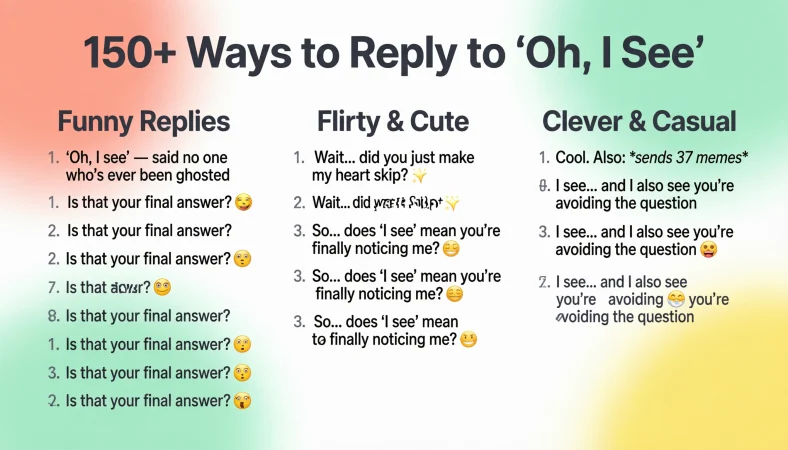
When someone says “Oh, I see,” your reply can keep the chat flowing instead of letting the conversation quietly disappear. Try adding humor, curiosity, warmth, or a follow-up question depending on the vibe.
Top alternatives: “Now you know!”, “Exactly!”, “Yep, that’s the idea!”, “Makes sense, right?”, “What do you think?”
Funny Responses
“And now you have unlocked the lore.”
Use this when someone finally understands a story or explanation.
Meaning: It humorously makes your explanation sound like secret backstory.
“Look at you, connecting the dots.”
Use this when they finally understand what you meant.
Meaning: It playfully celebrates their realization.
“Congratulations, detective.”
Use this after explaining something obvious or funny.
Meaning: It jokingly treats their understanding like a major investigation.
“We love a successful learning moment.”
Use this when the conversation has a playful, casual vibe.
Meaning: It adds humor while acknowledging that they understand.
“Yep, class dismissed.”
Use this after giving a surprisingly detailed explanation.
Meaning: It jokingly suggests the lesson is officially over.
“See? I do make sense sometimes.”
Use this when you are teasing yourself about your explanation.
Meaning: It keeps things light and self-deprecating.
“That’s one mystery solved.”
Use this when they finally understand something confusing.
Meaning: It turns an ordinary explanation into a funny achievement.
“Welcome to the plot.”
Use this when someone finally catches up with what is happening.
Meaning: It playfully suggests they have entered the main storyline.
“Your brain has officially loaded.”
Use this with a close friend who enjoys teasing.
Meaning: It jokingly celebrates their moment of understanding.
“Big revelation, huh?”
Use this when they react to something obvious.
Meaning: It gently pokes fun at how dramatic their realization sounds.
“And that concludes today’s TED Talk.”
Use this after sending a long explanation.
Meaning: It humorously acknowledges that you have said plenty.
“I’ll invoice you for the explanation later.”
Use this after explaining something complicated.
Meaning: It jokingly pretends your explanation was a paid service.
“Glad we could solve that national emergency.”
Use this when the issue was actually minor.
Meaning: It exaggerates the situation for comedic effect.
“Your understanding has been approved.”
Use this when you want to sound mock-serious.
Meaning: It turns their acknowledgment into a silly official announcement.
“Perfect, my work here is done.”
Use this when you want to wrap up the topic playfully.
Meaning: It humorously signals that your explanation succeeded.
Flirty Responses
“Oh, you see? Good, I was hoping you’d catch that.”
Use this when the conversation has a subtle romantic vibe.
Meaning: It hints that there may have been something intentional behind your words.
“Now that you see it, what are you going to do about it?”
Use this when you want to turn their acknowledgment into playful tension.
Meaning: It invites them to make the next move.
“I like the way you’re finally getting me.”
Use this with someone you already have chemistry with.
Meaning: It suggests that understanding each other feels attractive.
“See? We’re already getting on the same wavelength.”
Use this when you want to highlight a growing connection.
Meaning: It frames understanding as a sign of compatibility.
“Good. I was starting to wonder if you were paying attention.”
Use this when teasing someone you like.
Meaning: It playfully challenges them while keeping the flirtation alive.
“And I thought I’d have to explain myself over coffee.”
Use this when you want to sneak a date suggestion into the conversation.
Meaning: It casually introduces the idea of spending time together.
“Now you see why I’m interesting.”
Use this when you want a confident, playful comeback.
Meaning: It lightly promotes your personality while flirting.
“Careful, understanding me might make you like me more.”
Use this when the chat already has romantic energy.
Meaning: It confidently teases them about developing feelings.
“Exactly. You’re catching on fast.”
Use this when you want to compliment their attention.
Meaning: It creates playful chemistry through teasing.
“Good, because I was hoping you’d notice.”
Use this when your previous message had a hidden compliment or hint.
Meaning: It implies that you wanted their attention specifically.
“Now tell me what you see.”
Use this when you want to encourage a deeper or flirtier response.
Meaning: It invites them to reveal their thoughts.
“Took you long enough.”
Use this with someone comfortable enough for playful teasing.
Meaning: It creates flirtatious tension by pretending they were slow to catch on.
“I knew you’d get there eventually.”
Use this when you want a cheeky response.
Meaning: It playfully challenges them while keeping the mood warm.
“Good, we’re making progress.”
Use this when you want to tease someone you are interested in.
Meaning: It jokingly suggests your connection is developing.
“Now you see me a little better.”
Use this during a more personal conversation.
Meaning: It suggests that opening up creates emotional closeness.
Polite Responses
“Exactly, I’m glad that makes sense.”
Use this in a friendly conversation where you want to sound considerate.
Meaning: It politely confirms that your explanation was understood.
“Yep, that’s pretty much it.”
Use this when someone acknowledges your explanation.
Meaning: It confirms their understanding in a relaxed way.
“Right, you got it.”
Use this when someone understands your point.
Meaning: It gives them a simple and encouraging confirmation.
“Yes, that’s what I meant.”
Use this when clarity matters.
Meaning: It directly confirms that they understood you correctly.
“Exactly, thanks for understanding.”
Use this when discussing something slightly personal or important.
Meaning: It shows appreciation for their response.
“That’s right.”
Use this when you want to keep your answer short.
Meaning: It simply confirms their interpretation.
“Yep, you understood me perfectly.”
Use this when they accurately interpret your message.
Meaning: It reassures them that they got your point right.
“I’m glad I could explain it clearly.”
Use this after discussing something complicated.
Meaning: It politely acknowledges the successful explanation.
“Absolutely, that’s what I was getting at.”
Use this when their response matches your intended point.
Meaning: It confirms that you are on the same page.
“Exactly, you’ve got it.”
Use this when you want to sound warm and encouraging.
Meaning: It reassures them that their understanding is correct.
“Yes, that’s the idea.”
Use this when keeping the conversation straightforward.
Meaning: It confirms the central point without adding unnecessary detail.
“Correct, that’s what I meant.”
Use this when precision matters.
Meaning: It clearly validates their interpretation.
“Glad we’re clear.”
Use this after resolving a misunderstanding.
Meaning: It signals that the issue has been settled.
“Yep, that sums it up nicely.”
Use this when they have understood the situation accurately.
Meaning: It compliments their concise understanding.
“Exactly, thanks for following along.”
Use this when explaining a longer story or idea.
Meaning: It shows appreciation for their attention.
Clever Responses
“Seeing is the easy part. Understanding is where it gets interesting.”
Use this when you want a thoughtful comeback.
Meaning: It suggests there is more depth beneath what they just understood.
“Now we’re getting somewhere.”
Use this when their acknowledgment opens the door to a deeper discussion.
Meaning: It signals that the conversation is progressing.
“Exactly, context is everything.”
Use this when the situation depends on background details.
Meaning: It emphasizes the importance of understanding the bigger picture.
“That’s one way of looking at it.”
Use this when you want to leave room for another interpretation.
Meaning: It acknowledges their understanding without fully agreeing.
“Now you have the missing piece.”
Use this when you have just explained something important.
Meaning: It suggests your explanation completed the picture.
“And suddenly everything makes sense.”
Use this when the conversation involves a realization.
Meaning: It playfully emphasizes the moment of clarity.
“Exactly. You’re seeing the bigger picture now.”
Use this during a deeper conversation.
Meaning: It suggests they now understand the wider context.
“That’s the short version.”
Use this after explaining a complicated situation.
Meaning: It hints that there is more to the story.
“You see it now, but there’s definitely more to it.”
Use this when you want to keep them curious.
Meaning: It encourages them to ask another question.
“And that’s where things get interesting.”
Use this when you want to continue telling a story.
Meaning: It creates curiosity about what comes next.
“Exactly, but don’t stop there.”
Use this when you want them to think more deeply.
Meaning: It encourages further discussion instead of ending the exchange.
“Now you’re asking the right questions.”
Use this when they have finally understood the important part.
Meaning: It encourages their curiosity.
“You caught the surface level. There’s more underneath.”
Use this during a meaningful conversation.
Meaning: It suggests the topic deserves deeper exploration.
“That’s the gist, anyway.”
Use this when you want to keep your explanation casual.
Meaning: It confirms the basic idea without claiming it covers everything.
“Exactly. Consider that chapter one.”
Use this when telling a story with more details to come.
Meaning: It playfully promises that the conversation can continue.
Sarcastic Responses
“Wow, a breakthrough.”
Use this when someone takes a while to understand something obvious.
Meaning: It lightly mocks their delayed realization.
“Gold star for you.”
Use this with a friend who appreciates sarcasm.
Meaning: It playfully rewards them for finally getting the point.
“Look who figured it out.”
Use this when teasing someone about their realization.
Meaning: It sarcastically highlights that they finally understood.
“Amazing work, Sherlock.”
Use this when they discover something that was easy to figure out.
Meaning: It humorously compares them to a detective.
“Only took us forever.”
Use this after a long misunderstanding.
Meaning: It jokes about how long it took to reach clarity.
“Glad we finally got there.”
Use this when someone eventually understands your point.
Meaning: It sarcastically celebrates the delayed conclusion.
“Groundbreaking discovery.”
Use this when their realization is extremely obvious.
Meaning: It exaggerates their discovery for comedic effect.
“Congratulations on your arrival.”
Use this when someone finally catches up.
Meaning: It jokingly treats understanding as a journey.
“The lightbulb finally switched on.”
Use this when teasing someone who was slow to understand.
Meaning: It playfully describes their sudden realization.
“I was beginning to lose hope.”
Use this when someone finally understands your point.
Meaning: It uses exaggerated frustration for humor.
“We can all sleep peacefully now.”
Use this when a tiny misunderstanding has been resolved.
Meaning: It dramatically exaggerates the importance of the moment.
“Well, that took a plot twist.”
Use this when their realization comes unexpectedly late.
Meaning: It turns the moment into a humorous storyline.
“Your detective badge is in the mail.”
Use this when someone figures out an obvious clue.
Meaning: It sarcastically praises their detective skills.
“And people said miracles weren’t real.”
Use this when their realization took forever.
Meaning: It exaggerates their achievement for comedic effect.
“We finally have clarity. Historic day.”
Use this after clearing up something simple.
Meaning: It humorously treats the moment as a major event.
Cute Responses
“Hehe, now you see.”
Use this when you want a soft and playful tone.
Meaning: It keeps the exchange warm and adorable.
“Yay, you get me.”
Use this when someone understands your feelings or point.
Meaning: It shows happiness about being understood.
“Exactly, you’re catching on.”
Use this when you want to sound playful and affectionate.
Meaning: It gently celebrates their understanding.
“Aww, glad you understand.”
Use this when the conversation feels sweet.
Meaning: It expresses warmth and appreciation.
“See? We’re on the same page.”
Use this when you want to highlight connection.
Meaning: It suggests mutual understanding.
“You get it, and I love that.”
Use this when talking with someone close to you.
Meaning: It shows appreciation for their ability to understand you.
“Now you know a little more about me.”
Use this after sharing something personal.
Meaning: It highlights growing familiarity.
“Look at us understanding each other.”
Use this when you want a playful relationship vibe.
Meaning: It celebrates your connection.
“That makes me happy.”
Use this when being understood genuinely matters to you.
Meaning: It communicates simple emotional appreciation.
“Good, because I wanted you to understand.”
Use this after sharing something meaningful.
Meaning: It shows that their understanding was important to you.
“You’re getting me more and more.”
Use this during a developing friendship or relationship.
Meaning: It suggests increasing emotional familiarity.
“See, I knew you’d get it.”
Use this when you trust the person to understand you.
Meaning: It communicates confidence in your connection.
“That’s why you’re one of my favorites.”
Use this with a close friend or romantic interest.
Meaning: It turns their understanding into a playful compliment.
“Okay, you officially understand me now.”
Use this after revealing something personal.
Meaning: It makes their understanding feel special.
“A little clearer now, right?”
Use this when you want to keep things gentle and conversational.
Meaning: It casually checks whether they understand.
Dramatic Responses
“At last, the truth has been revealed.”
Use this when someone finally understands your explanation.
Meaning: It playfully turns a normal realization into a dramatic event.
“And suddenly, the entire story makes sense.”
Use this when explaining something with several details.
Meaning: It exaggerates the importance of their realization.
“The moment we’ve all been waiting for.”
Use this when someone finally gets your point.
Meaning: It adds playful drama to the situation.
“And there it is, the missing piece.”
Use this when their acknowledgment completes the story.
Meaning: It makes their understanding sound significant.
“Finally, the clouds have parted.”
Use this when clearing up confusion.
Meaning: It humorously portrays understanding as a dramatic revelation.
“A historic moment for us all.”
Use this when something simple has finally been understood.
Meaning: It exaggerates the moment for fun.
“The truth has entered the chat.”
Use this when you have revealed something important.
Meaning: It gives the explanation a dramatic internet-style twist.
“And now you know the whole saga.”
Use this when telling a long story.
Meaning: It makes your explanation sound like an epic tale.
“This changes everything.”
Use this when the realization is surprisingly important.
Meaning: It adds playful suspense to the conversation.
“We have reached enlightenment.”
Use this when someone finally understands.
Meaning: It jokingly describes basic understanding as profound wisdom.
“The mystery has officially been solved.”
Use this when clearing up confusion.
Meaning: It makes the resolution sound much more dramatic than it is.
“Cue the emotional soundtrack.”
Use this when you want to exaggerate the moment.
Meaning: It adds playful cinematic drama.
“And just like that, the puzzle is complete.”
Use this when your explanation fills in the missing details.
Meaning: It presents understanding as the final piece of a puzzle.
“This is the character development I needed.”
Use this when someone finally understands your perspective.
Meaning: It humorously frames the moment as personal growth.
“We survived the misunderstanding.”
Use this after resolving confusion.
Meaning: It turns a minor issue into a dramatic victory.
Chill And Casual Responses
“Yep, exactly.”
Use this when you want a simple everyday response.
Meaning: It confirms their understanding without making the conversation heavy.
“Yeah, pretty much.”
Use this when you agree with their interpretation.
Meaning: It casually confirms the point.
“You got it.”
Use this when you want to keep things relaxed.
Meaning: It tells them they understood correctly.
“That’s about it.”
Use this when there is nothing more to explain.
Meaning: It keeps the exchange simple.
“Yep, that’s the deal.”
Use this when explaining a situation casually.
Meaning: It confirms the basic facts.
“Exactly, nothing too complicated.”
Use this when you want to reassure them.
Meaning: It suggests the situation is straightforward.
“Yeah, now you know.”
Use this when sharing information.
Meaning: It casually acknowledges that they are informed.
“Pretty much, yeah.”
Use this when you want a low-key response.
Meaning: It confirms their understanding without overexplaining.
“Yep, you’re following.”
Use this when explaining something informally.
Meaning: It confirms that they are keeping up.
“That’s the gist.”
Use this after giving the main idea.
Meaning: It signals that they have the essential information.
“Exactly, you see it.”
Use this when their interpretation is correct.
Meaning: It confirms that they understand your perspective.
“Yep, makes sense now.”
Use this when you want to keep the tone relaxed.
Meaning: It acknowledges shared clarity.
“For sure.”
Use this when you want a short, natural confirmation.
Meaning: It casually agrees with their response.
“Yep, basically.”
Use this when the details are not important.
Meaning: It confirms the general idea.
“All good, you got the point.”
Use this after explaining something quickly.
Meaning: It reassures them that they understood what mattered.
Confident Responses
“Exactly, I knew you’d understand.”
Use this when you are confident about your explanation.
Meaning: It shows certainty while keeping the tone friendly.
“Yep, that’s exactly what I meant.”
Use this when you want to sound clear and assured.
Meaning: It confidently confirms your message.
“Now you see where I’m coming from.”
Use this during a disagreement or serious discussion.
Meaning: It emphasizes that your perspective has become clearer.
“Exactly, I made my point.”
Use this when you have successfully explained yourself.
Meaning: It signals confidence in your position.
“Good, because I meant every word.”
Use this when your previous statement was intentional.
Meaning: It emphasizes sincerity and confidence.
“Now you understand the energy.”
Use this when discussing a vibe, attitude, or situation.
Meaning: It confidently reinforces the feeling behind your words.
“Exactly. No confusion now.”
Use this when clearing up a misunderstanding.
Meaning: It establishes clarity with confidence.
“That’s what I was saying from the start.”
Use this when they finally understand your original point.
Meaning: It confidently reminds them that your message was consistent.
“Yep, and I stand by it.”
Use this when your statement involves an opinion.
Meaning: It shows confidence in what you said.
“Now you’re seeing things my way.”
Use this during playful debate.
Meaning: It confidently teases them about agreeing with you.
“Exactly. Case closed.”
Use this when you consider the matter settled.
Meaning: It confidently signals the end of the argument.
“You see it now, and that’s all that matters.”
Use this when you want to close a misunderstanding.
Meaning: It emphasizes reaching mutual clarity.
“Yep, I knew the explanation would land.”
Use this when your point has finally been understood.
Meaning: It expresses confidence in your communication.
“Exactly. I don’t think I could have said it better.”
Use this when they summarize your point accurately.
Meaning: It confidently approves their interpretation.
“Now we’re speaking the same language.”
Use this when you reach mutual understanding.
Meaning: It highlights clarity and connection.
Emotional Responses
“I’m glad you understand where I’m coming from.”
Use this after sharing something personal.
Meaning: It expresses relief at being emotionally understood.
“That actually means a lot to me.”
Use this when their acknowledgment feels meaningful.
Meaning: It shows genuine appreciation.
“I really wanted you to understand that.”
Use this when discussing something close to your heart.
Meaning: It communicates that their understanding matters emotionally.
“Thanks for hearing me out.”
Use this after opening up about a difficult situation.
Meaning: It shows gratitude for their attention and patience.
“I feel better knowing you understand.”
Use this when you have been worried about being misunderstood.
Meaning: It expresses emotional relief.
“That’s all I wanted, for you to understand.”
Use this during a heartfelt conversation.
Meaning: It shows that mutual understanding was your main goal.
“I appreciate you seeing my side.”
Use this when discussing a disagreement.
Meaning: It acknowledges their willingness to consider your perspective.
“It feels good to be understood.”
Use this when the conversation has become personal.
Meaning: It openly expresses the comfort of emotional connection.
“I was nervous you might misunderstand me.”
Use this when your message could easily be taken the wrong way.
Meaning: It reveals vulnerability and explains why their response matters.
“Thanks for getting where I’m coming from.”
Use this after sharing your feelings.
Meaning: It communicates appreciation for their empathy.
“I’m happy we cleared that up.”
Use this after resolving a misunderstanding.
Meaning: It expresses relief and emotional reassurance.
“I just wanted to be honest with you.”
Use this after revealing something personal.
Meaning: It emphasizes sincerity and openness.
“It means a lot that you listened.”
Use this when someone gives you their full attention.
Meaning: It expresses gratitude for their emotional support.
“I hope that helps you understand me a little better.”
Use this after explaining your feelings or behavior.
Meaning: It invites deeper understanding without demanding it.
“I’m glad I could finally explain it properly.”
Use this when something has been misunderstood for a while.
Meaning: It expresses relief at finally being clear.
Sweet Responses
“I’m glad you see what I mean.”
Use this when you want to sound warm and sincere.
Meaning: It appreciates their understanding.
“Thanks for understanding me.”
Use this after discussing something personal.
Meaning: It expresses genuine gratitude.
“That makes me happy.”
Use this when their acknowledgment feels reassuring.
Meaning: It communicates simple happiness.
“I knew you’d understand.”
Use this with someone you trust.
Meaning: It shows confidence in your bond.
“That’s all I wanted.”
Use this when being understood was the main goal.
Meaning: It emphasizes emotional clarity.
“I appreciate you.”
Use this when their response feels supportive.
Meaning: It turns the moment into a sincere expression of gratitude.
“You always get me.”
Use this with someone close to you.
Meaning: It highlights familiarity and emotional connection.
“I’m glad we understand each other.”
Use this when you want to emphasize mutual respect.
Meaning: It celebrates shared understanding.
“That’s why I like talking to you.”
Use this when their response makes you feel comfortable.
Meaning: It compliments their ability to listen and understand.
“You make things easier to explain.”
Use this when someone listens patiently.
Meaning: It suggests you feel comfortable communicating with them.
“Thanks for being so understanding.”
Use this when they respond kindly to a personal matter.
Meaning: It shows appreciation for their empathy.
“I’m glad you’re with me on this.”
Use this when discussing a shared decision or opinion.
Meaning: It expresses a sense of teamwork.
“That means more than you know.”
Use this when their understanding genuinely touches you.
Meaning: It communicates deeper appreciation.
“You’re sweet for understanding.”
Use this when you want to add warmth.
Meaning: It combines gratitude with a gentle compliment.
“Okay, now I feel understood.”
Use this after explaining something emotional.
Meaning: It communicates comfort and reassurance.
Creative Responses
“And the fog has officially lifted.”
Use this when someone finally understands the situation.
Meaning: It creatively describes confusion disappearing.
“Welcome to the other side of the explanation.”
Use this after giving someone new information.
Meaning: It humorously treats understanding like entering a new world.
“The puzzle piece has clicked.”
Use this when their response shows sudden understanding.
Meaning: It compares clarity to completing a puzzle.
“And just like that, the picture becomes clearer.”
Use this when explaining a complicated situation.
Meaning: It creatively describes the value of context.
“The dots have connected.”
Use this when someone finally understands the bigger picture.
Meaning: It describes their realization in a playful way.
“You have officially entered the context zone.”
Use this when background information changes their understanding.
Meaning: It humorously highlights the importance of context.
“The plot thickens, but at least we’re on the same page.”
Use this when the situation is complicated.
Meaning: It mixes humor with reassurance that you understand each other.
“One tiny explanation, one giant leap for understanding.”
Use this when your explanation solves a misunderstanding.
Meaning: It dramatically celebrates a small breakthrough.
“And suddenly, the pieces behave.”
Use this when confusing details finally make sense.
Meaning: It creatively describes everything falling into place.
“Welcome to chapter two.”
Use this when your explanation leads to more details.
Meaning: It signals that the conversation can continue.
“Now the storyline makes sense.”
Use this when explaining a complicated situation.
Meaning: It frames understanding as following a story.
“The context fairy has done her job.”
Use this with someone who enjoys playful humor.
Meaning: It jokingly credits context for solving the confusion.
“And there goes the confusion, running for its life.”
Use this after clearing up a misunderstanding.
Meaning: It gives confusion a funny imaginary personality.
“The brain cells have reached an agreement.”
Use this when someone finally understands your point.
Meaning: It humorously describes mental clarity.
“And that, my friend, is the missing ingredient.”
Use this when revealing an important detail.
Meaning: It creatively suggests your explanation completed the situation.
Romantic Responses
“I’m glad you understand me.”
Use this when talking to someone you feel emotionally close to.
Meaning: It emphasizes intimacy and mutual understanding.
“You’re getting to know the real me.”
Use this after sharing something personal.
Meaning: It suggests emotional closeness is growing.
“I like that you actually listen.”
Use this when someone pays attention to your feelings.
Meaning: It turns their understanding into a meaningful compliment.
“See why we make a good team?”
Use this when you want to highlight compatibility.
Meaning: It playfully suggests that you work well together.
“Now you understand my little world.”
Use this when sharing personal details.
Meaning: It creates a sense of intimacy.
“I like being understood by you.”
Use this when you want to be openly affectionate.
Meaning: It expresses that their attention feels special.
“Maybe you’re starting to figure me out.”
Use this when teasing someone romantically.
Meaning: It creates playful mystery and chemistry.
“That’s one thing I really like about you.”
Use this when their understanding impresses you.
Meaning: It turns the moment into a personal compliment.
“You make me feel seen.”
Use this during a deeper romantic conversation.
Meaning: It expresses emotional appreciation for their attention.
“I guess you’re learning my language.”
Use this when you feel increasingly understood.
Meaning: It playfully describes growing compatibility.
“You’re becoming dangerously good at understanding me.”
Use this when you want romantic teasing.
Meaning: It combines affection with playful flirtation.
“I like where this understanding is going.”
Use this when the connection feels promising.
Meaning: It hints at growing romantic interest.
“Now you know a little secret about me.”
Use this after sharing something personal.
Meaning: It creates a sense of intimacy and exclusivity.
“Keep paying attention, you might learn a lot about me.”
Use this when you want to encourage further connection.
Meaning: It playfully invites them to get closer.
“Maybe you understand me better than most people do.”
Use this during a sincere romantic moment.
Meaning: It makes the other person feel uniquely important.
Conversation-Starting Responses
“Exactly! What do you think about it?”
Use this when you want to turn their acknowledgment into a discussion.
Meaning: It invites their opinion and keeps the chat moving.
“Yep! Have you ever been in a situation like that?”
Use this when discussing a personal experience.
Meaning: It encourages them to share something about themselves.
“Now that you see, what would you do?”
Use this when you want their perspective.
Meaning: It turns your explanation into an interactive conversation.
“Exactly. Does that make sense to you?”
Use this when you want to check their understanding.
Meaning: It gives them an easy opening to respond.
“Right! Want to hear the funny part?”
Use this when your story has more entertaining details.
Meaning: It creates curiosity and encourages them to continue listening.
“Yep, and there’s actually more to it.”
Use this when you have another detail to share.
Meaning: It gives them a reason to ask what happened next.
“Exactly. What’s your take?”
Use this during a discussion about opinions or choices.
Meaning: It directly invites their perspective.
“Now you know. What would you have done?”
Use this when discussing a decision or situation.
Meaning: It encourages them to imagine themselves in your position.
“Yeah, pretty much. Have you experienced that too?”
Use this when trying to find common ground.
Meaning: It shifts the focus toward their personal experience.
“That’s the short version. Want the full story?”
Use this when you have more context available.
Meaning: It creates an easy opportunity for them to ask for more.
“Exactly. Which part surprised you most?”
Use this after explaining something unexpected.
Meaning: It invites a specific and engaging response.
“Yep, now I’m curious what you think.”
Use this when you genuinely want their opinion.
Meaning: It shows interest in their thoughts.
“That’s it. So what would you say?”
Use this when you want to avoid ending the conversation.
Meaning: It puts the conversational ball back in their court.
“Exactly! Does that change your opinion?”
Use this when new information might affect their perspective.
Meaning: It encourages a more thoughtful response.
“Now that you know, tell me something I don’t know.”
Use this during a playful conversation.
Meaning: It keeps the exchange moving by challenging them to share something too.
Playful Responses
“Oh, you see now? We’re making progress.”
Use this when teasing someone lightly.
Meaning: It playfully celebrates their realization.
“Look at you getting it.”
Use this with a friend or someone you are comfortable teasing.
Meaning: It affectionately pokes fun at them.
“Finally, we’re synced.”
Use this when you reach mutual understanding.
Meaning: It gives the moment a fun, modern vibe.
“See? I’m not as confusing as I look.”
Use this when your explanation was unexpectedly complicated.
Meaning: It uses self-deprecating humor to keep things light.
“Your brain has entered the chat.”
Use this when someone finally catches on.
Meaning: It playfully celebrates their realization.
“You’re catching on, I’m impressed.”
Use this when teasing someone you like.
Meaning: It mixes playful praise with light sass.
“Okay, now we’re cooking.”
Use this when the conversation starts becoming interesting.
Meaning: It signals that things are progressing in a fun way.
“That’s the reaction I was waiting for.”
Use this when their acknowledgment is satisfying or funny.
Meaning: It suggests you were curious about how they would respond.
“See? We got there eventually.”
Use this after a misunderstanding.
Meaning: It lightly jokes about the journey to understanding.
“Achievement unlocked: understanding me.”
Use this when someone finally figures out your point.
Meaning: It turns understanding into a playful game achievement.
“Okay, you’re officially paying attention.”
Use this when someone catches an important detail.
Meaning: It playfully praises their attentiveness.
“I knew you’d catch the vibe.”
Use this when discussing an unspoken feeling or mood.
Meaning: It highlights shared intuition.
“Now we’re on the same frequency.”
Use this when you feel understood.
Meaning: It playfully describes being mentally in sync.
“And that’s how we avoid unnecessary confusion.”
Use this after clearing up a misunderstanding.
Meaning: It turns the moment into a light lesson.
“You passed the vibe check.”
Use this when their understanding impresses you.
Meaning: It playfully approves their response.
FAQs
What does “Oh, I see” mean?
It usually means “I understand” or “Now I understand what you mean.” Depending on the tone, it can also sound neutral, surprised, curious, or slightly dismissive.
Is “Oh, I see” a good response in texting?
Yes, but it can sometimes feel like a conversation stopper. Adding a question, opinion, joke, or follow-up thought can make the chat feel more natural.
What does “Oh, I see” mean emotionally?
Emotionally, it can show that someone is processing what you said. Their tone and the messages around it matter more than the phrase itself.
Can “Oh, I see” be flirty?
It can be, especially if the surrounding conversation already has romantic energy. The phrase itself is not automatically flirty, but emojis, teasing, and context can change the vibe.
How do I reply to “Oh, I see” from a crush?
Try something playful like “Now you see why I’m interesting,” “What do you think?” or “Careful, you might learn too much about me.”
What should I say if I want to keep the conversation going?
Ask an open-ended question such as “What do you think?” or “Have you ever experienced that?” This gives the other person something specific to answer.
How do I reply professionally to “Oh, I see”?
Keep it clear and polite with replies such as “Exactly, that’s what I meant,” “Yes, that’s correct,” or “Glad that clarifies things.”
What if “Oh, I see” sounds sarcastic?
Match the energy carefully. You can use a light response such as “Yep, now you’re caught up” or simply clarify your point if the situation is serious.
What if I do not want to continue the conversation?
A simple “Yep, exactly” or “That’s pretty much it” can naturally close the topic without sounding rude.
Is humor appropriate when replying to “Oh, I see”?
Absolutely, especially with friends, close coworkers, or someone you know enjoys sarcasm. Avoid jokes if the conversation is sensitive or professional.
Can “Oh, I see” mean someone is annoyed?
Sometimes, but not necessarily. A short reply may sound annoyed when paired with a dry tone, delayed messages, or other signs of frustration.
What is the best overall reply to “Oh, I see”?
If you want to keep things moving, “Exactly! What do you think?” is a strong choice because it confirms their understanding and invites them to contribute.
Conclusion
Knowing how to reply to “Oh, I see” can turn a tiny acknowledgment into a much better conversation. You can keep things funny with a clever joke, add a little flirtation with playful teasing, or simply ask a question that gives the other person something worth answering.
The best response depends on the relationship, mood, and situation, so do not be afraid to switch up your style. A small sentence can completely change the energy of a chat. Save these replies for your next texting moment, send the ones that match your vibe, and share this list with someone who always gets stuck after “Oh, I see.” Keep the conversation alive!