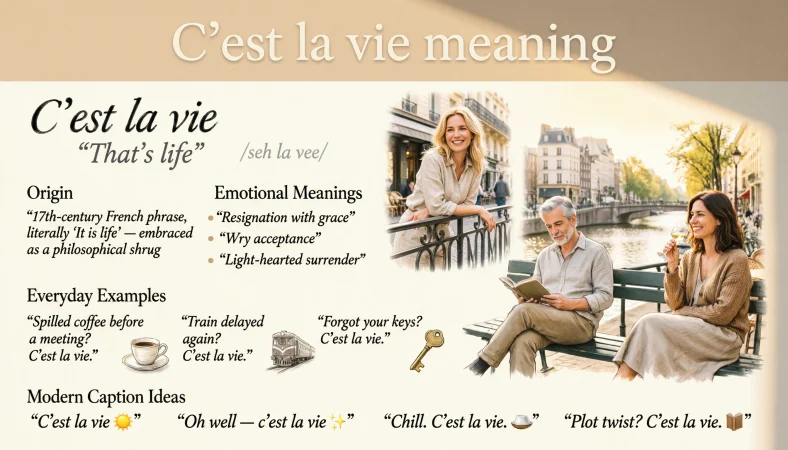
C’est la vie is a French expression that literally means “that’s life.” It is commonly used when accepting something disappointing, unexpected, or simply beyond your control with a calm, philosophical attitude.
Top alternatives: That’s life, It is what it is, Such is life, What can you do?, Life goes on
C’est la vie sounds effortlessly cool, but its meaning is actually pretty simple. You might use it after missing a train, losing an opportunity, dealing with an awkward situation, or accepting that things did not go according to plan. The phrase carries a sense of acceptance rather than complete happiness about what happened.
In everyday English, c’est la vie can sound thoughtful, casual, humorous, dramatic, or even slightly sarcastic depending on the situation and your tone.
Ever had one of those days where everything goes slightly wrong and all you can do is shrug? Your plans get canceled, your favorite snack disappears from the menu, your train leaves early, or your carefully organized weekend turns into absolute chaos. That is exactly where c’est la vie fits.
The French phrase has become a familiar expression in English conversations, texts, captions, DMs, and everyday chats. It essentially means “that’s life,” but its charm comes from the attitude behind it. Saying c’est la vie can show acceptance without sounding overly dramatic. It can be thoughtful, funny, relaxed, or even a little cheeky.
Understanding the c’est la vie meaning helps you know when to use it naturally and what alternatives work when you want a different tone. Sometimes, a tiny French phrase says everything.
What Does C’est la Vie Mean?
C’est la vie literally translates from French as “that’s life.” It is generally used to acknowledge that something unfortunate, disappointing, or unexpected has happened and cannot easily be changed.
The phrase often communicates acceptance rather than approval. You are not necessarily saying that you like what happened. You are simply recognizing that life includes disappointments and deciding to move forward.
For example, if your plans get canceled at the last minute, you might say, “C’est la vie.” In another situation, you might use it jokingly after eating the last slice of cake.
The expression can therefore carry several shades of meaning:
- Acceptance
- Resignation
- Humor
- Calmness
- Perspective
- Indifference
- Optimism about moving forward
The exact feeling depends heavily on the context and tone.
Where Does C’est la Vie Come From?
C’est la vie is a French expression made up of three simple words:
- C’est means “it is” or “that is.”
- La means “the.”
- Vie means “life.”
Together, c’est la vie translates literally as “that’s life.”
The phrase has been adopted into English because it expresses an idea that is easy to understand across cultures: life does not always go according to plan.
Today, you may see it in casual conversations, social media captions, songs, fashion, movies, memes, and everyday writing. English speakers generally use it as a borrowed French expression rather than translating it every time.
Its French pronunciation is approximately “say lah vee.”
12 Ways to Express Acceptance
“That’s life.”
Use this when something disappointing happens but you do not want to dwell on it.
Meaning: It shows simple acceptance of an unavoidable situation.
“It is what it is.”
Use this after a situation turns out differently than expected.
Meaning: It communicates acceptance without unnecessary frustration.
“Such is life.”
Use this when you want a slightly more thoughtful alternative.
Meaning: It suggests that ups and downs are simply part of living.
“What can you do?”
Use this after something happens that is outside your control.
Meaning: It shows that there is little point in worrying about the outcome.
“Life goes on.”
Use this when you want to focus on moving forward.
Meaning: It reminds you that one setback does not stop everything else.
“That’s just how things go sometimes.”
Use this when comforting yourself or someone else.
Meaning: It normalizes occasional disappointment.
“I’ll roll with it.”
Use this when plans change unexpectedly.
Meaning: It shows flexibility and a relaxed attitude.
“No use stressing over it.”
Use this when worrying will not change the result.
Meaning: It encourages emotional calm.
“We move.”
Use this for a short, modern response in casual chats.
Meaning: It signals that you are ready to move past the situation.
“On to the next.”
Use this after a failed attempt or missed opportunity.
Meaning: It focuses attention on future possibilities.
“It happens.”
Use this when something goes wrong but is not worth overthinking.
Meaning: It expresses casual acceptance.
“Guess that’s how the story goes.”
Use this when you want a slightly poetic touch.
Meaning: It accepts an unexpected turn of events with perspective.
12 Funny Responses and Alternatives
“Well, that went beautifully.”
Use this after a harmless situation goes hilariously wrong.
Meaning: The humor comes from pretending the opposite happened.
“And that’s today’s plot twist.”
Use this when an ordinary day suddenly becomes unpredictable.
Meaning: It turns disappointment into a funny story.
“Life said, ‘Not today.’”
Use this after plans fall apart.
Meaning: It humorously blames life for the unexpected outcome.
“Adding that to the character development.”
Use this after an awkward or mildly painful experience.
Meaning: It jokes that the experience will make you wiser.
“Well, at least we got a story.”
Use this when something goes wrong but becomes memorable.
Meaning: It finds a positive angle in an unfortunate moment.
“The universe has jokes.”
Use this after an ironic coincidence.
Meaning: It suggests that life seems to enjoy unexpected twists.
“Okay, life, I get the message.”
Use this when several things go wrong in a row.
Meaning: It humorously pretends life is sending you a lesson.
“That was not on my bingo card.”
Use this after an unexpected event.
Meaning: It playfully highlights how surprising the situation was.
“Well, that escalated politely.”
Use this when something becomes unexpectedly complicated.
Meaning: It adds understated humor to the situation.
“Another day, another plot twist.”
Use this when your plans keep changing.
Meaning: It treats everyday chaos like an ongoing comedy.
“Five stars for the experience, zero stars for the outcome.”
Use this after an amusing failure.
Meaning: It humorously separates the memorable experience from the bad result.
“C’est la comedy.”
Use this when you want to playfully remix the original phrase.
Meaning: It turns the serious expression into a lighthearted joke.
12 Sarcastic Ways to Use C’est la Vie
“C’est la vie, apparently.”
Use this when you are mildly annoyed but trying to stay relaxed.
Meaning: It communicates acceptance with a sarcastic edge.
“C’est la vie, what a masterpiece.”
Use this when everything has gone hilariously wrong.
Meaning: It exaggerates appreciation for an obviously messy situation.
“C’est la vie, because apparently planning was optional.”
Use this after carefully made plans collapse.
Meaning: It pokes fun at the situation.
“C’est la vie, I guess the universe had other plans.”
Use this when circumstances completely change unexpectedly.
Meaning: It combines resignation with playful sarcasm.
“C’est la vie, courtesy of bad timing.”
Use this when timing ruins an otherwise good opportunity.
Meaning: It blames unfortunate timing in a humorous way.
“C’est la vie, and somehow I’m still surprised.”
Use this after a predictable disappointment.
Meaning: It jokingly admits that you should have expected it.
“C’est la vie, because why would anything be simple?”
Use this when a straightforward task becomes complicated.
Meaning: It highlights unnecessary difficulty.
“C’est la vie, starring me as the confused main character.”
Use this when you end up in an absurd situation.
Meaning: It turns your confusion into a playful joke.
“C’est la vie, but make it inconvenient.”
Use this when something happens at the worst possible time.
Meaning: It adds humor to frustrating circumstances.
“C’est la vie, my personal reminder to expect nothing.”
Use this after repeated disappointments.
Meaning: It jokingly expresses lowered expectations.
“C’est la vie, because apparently chaos had an appointment.”
Use this when your day becomes unexpectedly messy.
Meaning: It personifies chaos for comedic effect.
“C’est la vie, I shall pretend this was character building.”
Use this after an awkward mistake.
Meaning: It makes light of an experience that was not ideal.
12 Cute Ways to Use C’est la Vie
“C’est la vie, sweetheart.”
Use this when comforting someone after a small disappointment.
Meaning: It combines acceptance with affection.
“C’est la vie, we’ll make a better memory next time.”
Use this when plans do not work out.
Meaning: It keeps the mood hopeful.
“C’est la vie, but at least we have each other.”
Use this when something goes wrong during time with someone you care about.
Meaning: It emphasizes companionship over circumstances.
“C’est la vie, little detours are part of the journey.”
Use this when plans change unexpectedly.
Meaning: It gives the situation a warm, optimistic perspective.
“C’est la vie, tomorrow gets another chance.”
Use this after a difficult day.
Meaning: It reminds someone that a fresh start is possible.
“C’est la vie, let’s find something fun instead.”
Use this when an activity gets canceled.
Meaning: It redirects disappointment toward a new plan.
“C’est la vie, hugs fix approximately everything.”
Use this when comforting a friend.
Meaning: It uses humor and affection to soften disappointment.
“C’est la vie, we’re still smiling.”
Use this when something does not go according to plan.
Meaning: It celebrates a positive attitude.
“C’est la vie, darling. We’ve got this.”
Use this when encouraging someone through a setback.
Meaning: It combines acceptance with reassurance.
“C’est la vie, sunshine.”
Use this as a playful caption after a minor disappointment.
Meaning: It keeps the situation light and cheerful.
“C’est la vie, one tiny disaster at a time.”
Use this when joking about everyday mishaps.
Meaning: It turns small problems into something amusing.
“C’est la vie, but make the next chapter cute.”
Use this after closing the door on an unpleasant experience.
Meaning: It expresses hope for better things ahead.
12 Flirty Uses of C’est la Vie
“C’est la vie, but meeting you was definitely worth it.”
Use this when talking about how an unexpected meeting turned into something special.
Meaning: It adds romantic warmth to the idea of chance.
“C’est la vie, maybe the universe wanted us here.”
Use this when flirting about an unexpected encounter.
Meaning: It playfully suggests fate brought you together.
“C’est la vie, I’m not complaining about where this is going.”
Use this when a romantic situation develops unexpectedly.
Meaning: It signals interest while staying relaxed.
“C’est la vie, and somehow you became my favorite plot twist.”
Use this when someone unexpectedly becomes important to you.
Meaning: It frames attraction as a pleasant surprise.
“C’est la vie, but I’d happily repeat this part.”
Use this after a memorable date or romantic moment.
Meaning: It hints that you want more time together.
“C’est la vie, I suppose I’ll keep flirting with you.”
Use this when playful flirting has become a regular thing.
Meaning: It confidently shows continued romantic interest.
“C’est la vie, you’re making this whole life thing more interesting.”
Use this when someone makes your everyday life feel exciting.
Meaning: It gives the compliment a playful romantic twist.
“C’est la vie, and you’re my favorite coincidence.”
Use this when talking about an unexpected connection.
Meaning: It expresses affection through the idea of chance.
“C’est la vie, but I definitely like this chapter.”
Use this when a new romance feels promising.
Meaning: It shows that you are enjoying the relationship.
“C’est la vie, guess I got lucky this time.”
Use this when someone you like gives you attention.
Meaning: It playfully communicates attraction and appreciation.
“C’est la vie, but I wouldn’t mind getting closer.”
Use this when the conversation has a clear romantic vibe.
Meaning: It expresses interest without being overly intense.
“C’est la vie, maybe fate has good taste.”
Use this when joking about the two of you meeting.
Meaning: It turns fate into a playful compliment.
12 Clever Uses of C’est la Vie
“C’est la vie, not c’est la catastrophe.”
Use this when you want to keep a minor problem in perspective.
Meaning: It reminds everyone that the situation is not as serious as it feels.
“C’est la vie, not the end of the story.”
Use this after a setback.
Meaning: It separates one disappointing moment from the bigger picture.
“C’est la vie, but perspective is free.”
Use this when someone is overthinking a small problem.
Meaning: It encourages a calmer outlook.
“C’est la vie, followed by c’est demain.”
Use this when you want to emphasize tomorrow.
Meaning: It playfully suggests that every difficult day eventually passes.
“C’est la vie, so let’s not make it worse.”
Use this when frustration is tempting people to overreact.
Meaning: It encourages emotional restraint.
“C’est la vie, but lessons are part of the price.”
Use this after making a mistake.
Meaning: It suggests that difficult experiences can still teach something valuable.
“C’est la vie, not a permanent sentence.”
Use this when discussing a temporary disappointment.
Meaning: It reminds someone that circumstances can change.
“C’est la vie, then comes the next decision.”
Use this when focusing on what to do after something goes wrong.
Meaning: It shifts attention from the past to action.
“C’est la vie, but choices still matter.”
Use this when discussing circumstances you cannot control.
Meaning: It balances acceptance with personal responsibility.
“C’est la vie, with a side of perspective.”
Use this as a thoughtful caption or response.
Meaning: It suggests taking setbacks less personally.
“C’est la vie, but never c’est la fin.”
Use this when encouraging someone after disappointment.
Meaning: It emphasizes that one setback does not define the future.
“C’est la vie, keep the lesson and lose the regret.”
Use this after a mistake or missed opportunity.
Meaning: It encourages growth without endless self-blame.
12 Chill and Casual Uses
“C’est la vie, honestly.”
Use this when you want a relaxed response to minor disappointment.
Meaning: It shows calm acceptance.
“C’est la vie, we’ll see what happens.”
Use this when the outcome is uncertain.
Meaning: It keeps expectations relaxed.
“C’est la vie, no big deal.”
Use this when something goes slightly wrong.
Meaning: It shows that you are not overly bothered.
“C’est la vie, onto better things.”
Use this after something does not work out.
Meaning: It shifts attention toward future opportunities.
“C’est la vie, we move on.”
Use this when you are ready to leave an issue behind.
Meaning: It communicates closure.
“C’est la vie, happens to everyone.”
Use this when reassuring someone after a mistake.
Meaning: It normalizes ordinary human errors.
“C’est la vie, let’s grab food.”
Use this when you want to quickly move past disappointment.
Meaning: It replaces frustration with something enjoyable.
“C’est la vie, next plan.”
Use this after an event gets canceled.
Meaning: It shows that you are ready to make new plans.
“C’est la vie, we tried.”
Use this when an attempt does not succeed.
Meaning: It recognizes the effort without dwelling on the result.
“C’est la vie, all good.”
Use this when you want a simple, reassuring tone.
Meaning: It tells others that you are okay with what happened.
“C’est la vie, we’ll laugh about it later.”
Use this after an awkward moment.
Meaning: It suggests that the situation will eventually become a funny memory.
“C’est la vie, keep it moving.”
Use this when you want a confident, casual attitude.
Meaning: It encourages moving forward rather than overthinking.
12 Thoughtful and Emotional Uses
“C’est la vie, some things simply are not meant to stay.”
Use this when reflecting on a relationship or life change.
Meaning: It expresses acceptance of impermanence.
“C’est la vie, even endings can teach us something.”
Use this after an emotional experience.
Meaning: It focuses on growth rather than loss.
“C’est la vie, I’m grateful for what it was.”
Use this when letting go of something meaningful.
Meaning: It honors the past without clinging to it.
“C’est la vie, not every chapter gets the ending we imagined.”
Use this when discussing an unexpected life change.
Meaning: It accepts that reality does not always follow our plans.
“C’est la vie, some memories are meant to remain memories.”
Use this when reflecting on the past.
Meaning: It acknowledges that not everything needs to return.
“C’est la vie, I’ll carry the lesson forward.”
Use this after a meaningful mistake or disappointment.
Meaning: It turns experience into personal growth.
“C’est la vie, healing takes time.”
Use this when accepting an emotional process.
Meaning: It shows patience with yourself.
“C’est la vie, I cannot change yesterday.”
Use this after regretting something from the past.
Meaning: It emphasizes acceptance of what cannot be undone.
“C’est la vie, some doors close so others can open.”
Use this after losing an opportunity.
Meaning: It expresses hope for something new.
“C’est la vie, I choose peace over replaying the past.”
Use this when deciding to stop overthinking.
Meaning: It prioritizes emotional peace.
“C’est la vie, I loved the moment while it lasted.”
Use this when remembering a meaningful experience.
Meaning: It values the experience without demanding permanence.
“C’est la vie, tomorrow still has possibilities.”
Use this after a difficult day or disappointment.
Meaning: It keeps hope alive while accepting reality.
12 Confident Uses
“C’est la vie. I’ll figure out the next move.”
Use this after an unexpected setback.
Meaning: It shows confidence instead of panic.
“C’est la vie, I’m not letting it ruin my day.”
Use this when something minor goes wrong.
Meaning: It demonstrates emotional control.
“C’est la vie, I know when to let go.”
Use this when ending an unproductive situation.
Meaning: It communicates self-awareness and confidence.
“C’est la vie, I’ll make another opportunity.”
Use this after missing an important chance.
Meaning: It shows determination.
“C’est la vie, setbacks do not scare me.”
Use this when encouraging yourself.
Meaning: It communicates resilience.
“C’est la vie, I’m still moving forward.”
Use this after disappointment.
Meaning: It makes progress more important than the setback.
“C’est la vie, I know my worth.”
Use this when walking away from something that does not serve you.
Meaning: It communicates self-respect.
“C’est la vie, I refuse to chase what is not working.”
Use this when letting go of a frustrating situation.
Meaning: It emphasizes healthy boundaries.
“C’est la vie, better things can happen.”
Use this after a missed opportunity.
Meaning: It keeps your outlook optimistic.
“C’est la vie, I’ll take the lesson and keep going.”
Use this after making a mistake.
Meaning: It shows resilience and maturity.
“C’est la vie, one setback does not define me.”
Use this when rebuilding confidence.
Meaning: It separates your identity from a temporary failure.
“C’est la vie, watch what happens next.”
Use this when you are confident about the future.
Meaning: It creates a sense of anticipation and determination.
12 Poetic and Creative Uses
“C’est la vie, where every ending leaves a little light behind.”
Use this as a reflective caption after a major change.
Meaning: It finds hope inside an ending.
“C’est la vie, the road was never meant to be straight.”
Use this when reflecting on unexpected life turns.
Meaning: It presents uncertainty as part of the journey.
“C’est la vie, written in detours and unexpected chapters.”
Use this for a thoughtful social media caption.
Meaning: It compares life to an unpredictable story.
“C’est la vie, yesterday fades and tomorrow waits.”
Use this after leaving the past behind.
Meaning: It encourages moving toward the future.
“C’est la vie, sometimes the wrong turn becomes the best story.”
Use this after an unexpected adventure.
Meaning: It suggests mistakes can lead to memorable experiences.
“C’est la vie, a little chaos between beautiful moments.”
Use this when describing the ups and downs of life.
Meaning: It balances difficulty with appreciation.
“C’est la vie, let the unexpected write a few lines.”
Use this when plans change.
Meaning: It welcomes spontaneity.
“C’est la vie, the chapter changed without asking permission.”
Use this after an unexpected life event.
Meaning: It acknowledges circumstances beyond your control.
“C’est la vie, every storm eventually edits the sky.”
Use this when encouraging someone through a difficult period.
Meaning: It expresses hope after hardship.
“C’est la vie, collecting moments instead of perfect plans.”
Use this as a travel or lifestyle caption.
Meaning: It values experiences over control.
“C’est la vie, imperfect days still belong to the story.”
Use this after a disappointing day.
Meaning: It reminds you that imperfect moments still matter.
“C’est la vie, let the next page surprise you.”
Use this when starting a new chapter.
Meaning: It expresses curiosity about what comes next.
12 Professional and Formal Alternatives
“That is simply part of the process.”
Use this when discussing an ordinary setback at work.
Meaning: It frames difficulties as a normal part of progress.
“These things happen.”
Use this when reassuring a colleague after a minor mistake.
Meaning: It keeps the response calm and professional.
“We can work with the situation.”
Use this when circumstances change unexpectedly.
Meaning: It focuses on finding a practical solution.
“Let’s focus on what we can control.”
Use this when a problem involves factors outside your influence.
Meaning: It redirects attention toward useful action.
“We’ll adjust and move forward.”
Use this when plans need to change.
Meaning: It communicates flexibility and professionalism.
“It did not go as planned, but we can adapt.”
Use this after an unsuccessful outcome.
Meaning: It acknowledges the problem without becoming negative.
“We can take this as a learning experience.”
Use this after an error or missed opportunity.
Meaning: It emphasizes improvement.
“Let’s consider our next option.”
Use this when the original plan is no longer possible.
Meaning: It keeps the conversation solution-focused.
“Sometimes circumstances change.”
Use this when explaining an unexpected outcome.
Meaning: It recognizes uncertainty without assigning blame.
“We’ll take the lesson and proceed.”
Use this after a professional setback.
Meaning: It combines reflection with forward movement.
“There is no benefit in dwelling on it.”
Use this when discussing an issue that cannot be changed.
Meaning: It encourages practical thinking.
“Let’s move forward with the information we have.”
Use this when decisions must be made despite uncertainty.
Meaning: It encourages constructive action.
12 Romantic and Relationship Uses
“C’est la vie, but I’m glad life brought us together.”
Use this when reflecting on how you met someone special.
Meaning: It expresses appreciation for the relationship.
“C’est la vie, you make the unexpected feel worth it.”
Use this when someone makes an unpredictable situation better.
Meaning: It expresses romantic appreciation.
“C’est la vie, I like where our story is going.”
Use this when a relationship is developing positively.
Meaning: It communicates excitement about the future.
“C’est la vie, some surprises are actually wonderful.”
Use this after an unexpected romantic moment.
Meaning: It frames the person as a pleasant surprise.
“C’est la vie, I would choose this chapter again.”
Use this when appreciating your relationship.
Meaning: It expresses contentment and affection.
“C’est la vie, somehow you became my favorite part.”
Use this when giving a romantic compliment.
Meaning: It tells someone they have become important to you.
“C’est la vie, I guess we were meant to cross paths.”
Use this when discussing how you met.
Meaning: It playfully suggests fate.
“C’est la vie, and I’m keeping this memory.”
Use this after a meaningful romantic experience.
Meaning: It shows that the moment matters emotionally.
“C’est la vie, but I hope this story keeps going.”
Use this when expressing romantic interest.
Meaning: It hints at wanting a future together.
“C’est la vie, you were an unexpected favorite.”
Use this as a playful romantic compliment.
Meaning: It suggests the attraction was pleasantly surprising.
“C’est la vie, I did not plan on liking you this much.”
Use this when admitting growing feelings.
Meaning: It expresses affection in a playful way.
“C’est la vie, maybe the best things are unplanned.”
Use this when talking about an unexpected relationship.
Meaning: It celebrates spontaneous connections.
12 Short Text and Social Media Uses
“C’est la vie ✨”
Use this as a short caption after an unexpected day.
Meaning: It communicates calm acceptance with a stylish touch.
“C’est la vie, we move.”
Use this for a casual post about moving forward.
Meaning: It signals resilience in a modern way.
“C’est la vie 🤷”
Use this after something minor goes wrong.
Meaning: The shrug emoji reinforces acceptance.
“C’est la vie, next chapter.”
Use this when starting over.
Meaning: It communicates closure and renewal.
“C’est la vie, onto better things.”
Use this after a disappointing experience.
Meaning: It focuses on what comes next.
“C’est la vie, no regrets.”
Use this when reflecting on a past choice.
Meaning: It suggests acceptance without excessive self-blame.
“C’est la vie, we tried.”
Use this after an unsuccessful attempt.
Meaning: It acknowledges the effort and accepts the result.
“C’est la vie, life continues.”
Use this as a reflective caption.
Meaning: It emphasizes that one event does not stop life.
“C’est la vie, plot twist.”
Use this after something unexpected happens.
Meaning: It turns surprise into playful storytelling.
“C’est la vie, keep going.”
Use this when posting an encouraging message.
Meaning: It combines acceptance with perseverance.
“C’est la vie, and that’s okay.”
Use this when embracing an imperfect outcome.
Meaning: It communicates peace with reality.
“C’est la vie, tomorrow is another day.”
Use this after a rough day.
Meaning: It encourages a fresh start.
12 Casual Reactions to Disappointment
“C’est la vie, I guess.”
Use this when you are slightly disappointed but not devastated.
Meaning: It communicates mild resignation.
“Well, c’est la vie.”
Use this when you want a simple, natural reaction.
Meaning: It acknowledges the situation without overexplaining.
“C’est la vie, nothing we can do.”
Use this when the outcome cannot be changed.
Meaning: It emphasizes acceptance.
“C’est la vie, lesson learned.”
Use this after making a mistake.
Meaning: It turns the experience into something useful.
“C’est la vie, we’ll try again.”
Use this after an unsuccessful attempt.
Meaning: It combines acceptance with optimism.
“C’est la vie, not worth stressing about.”
Use this when the issue is relatively minor.
Meaning: It prioritizes peace over frustration.
“C’est la vie, tomorrow can be better.”
Use this after a bad day.
Meaning: It leaves room for hope.
“C’est la vie, take the L and keep going.”
Use this in casual internet-style conversation.
Meaning: It accepts a loss while encouraging forward movement.
“C’est la vie, happens sometimes.”
Use this when responding to an everyday mishap.
Meaning: It normalizes the experience.
“C’est la vie, onto the next thing.”
Use this when you are ready to change focus.
Meaning: It communicates forward momentum.
“C’est la vie, at least we know now.”
Use this after learning something disappointing.
Meaning: It finds value in having more information.
“C’est la vie, still here.”
Use this after a challenging experience.
Meaning: It emphasizes resilience.
12 Philosophical Ways to Express the Same Idea
“Life rarely follows the script.”
Use this when discussing unexpected circumstances.
Meaning: It recognizes life’s unpredictability.
“Not everything is ours to control.”
Use this when someone is struggling with uncertainty.
Meaning: It encourages acceptance of limitations.
“Every season changes eventually.”
Use this when talking about difficult periods.
Meaning: It suggests that circumstances are temporary.
“Life comes with both wins and losses.”
Use this when putting disappointment into perspective.
Meaning: It recognizes that setbacks are part of life.
“Sometimes acceptance is the answer.”
Use this when a situation cannot be changed.
Meaning: It encourages peace rather than resistance.
“The unexpected is part of the journey.”
Use this when plans change.
Meaning: It presents uncertainty as natural.
“We cannot rewrite every outcome.”
Use this when reflecting on the past.
Meaning: It accepts that some results cannot be undone.
“A setback is still part of the path.”
Use this after a failed attempt.
Meaning: It frames failure as part of progress.
“Life teaches through experience.”
Use this after making a mistake.
Meaning: It highlights the value of learning.
“Some things are better accepted than explained.”
Use this when searching for reasons becomes exhausting.
Meaning: It suggests that not every event needs a perfect explanation.
“The road changes, and we adapt.”
Use this when circumstances shift unexpectedly.
Meaning: It emphasizes resilience and flexibility.
“What happens next is still unwritten.”
Use this after disappointment.
Meaning: It leaves room for future possibilities.
12 Witty Ways to Say It Without Saying C’est la Vie
“Well, that’s one way for the day to go.”
Use this after an unexpected event.
Meaning: It lightly acknowledges the situation.
“Guess the universe had different plans.”
Use this when circumstances change suddenly.
Meaning: It playfully blames fate for the outcome.
“We take the lesson and leave the drama.”
Use this after an avoidable mistake.
Meaning: It encourages learning without unnecessary negativity.
“Not ideal, but onward.”
Use this when something does not work out.
Meaning: It accepts disappointment and moves forward.
“The plan failed, the day continues.”
Use this after a canceled plan.
Meaning: It reminds you that life keeps moving.
“Well, tomorrow has entered the chat.”
Use this after a rough day.
Meaning: It humorously focuses on a fresh start.
“Guess that chapter wrote itself.”
Use this after an unexpected experience.
Meaning: It presents the event as part of life’s story.
“We cannot win every round.”
Use this after a setback.
Meaning: It accepts occasional losses.
“The detour is officially part of the journey.”
Use this when plans take an unexpected turn.
Meaning: It reframes inconvenience as experience.
“Not the ending I ordered.”
Use this after an unexpected outcome.
Meaning: It humorously expresses disappointment.
“Well, that happened.”
Use this after an awkward or surprising event.
Meaning: It acknowledges what happened without overreacting.
“And just like that, we improvise.”
Use this when plans suddenly change.
Meaning: It shows adaptability with humor.
12 Ways to Use C’est la Vie in Captions
“C’est la vie, collecting memories instead of expectations.”
Use this for a travel or lifestyle photo.
Meaning: It emphasizes enjoying experiences without demanding perfection.
“C’est la vie, one chapter at a time.”
Use this for a reflective personal post.
Meaning: It presents life as an ongoing journey.
“C’est la vie, but make it memorable.”
Use this for a fun social media caption.
Meaning: It encourages enjoying the moment.
“C’est la vie, beautifully imperfect.”
Use this when sharing an imperfect but meaningful moment.
Meaning: It celebrates flaws and authenticity.
“C’est la vie, still smiling.”
Use this after overcoming a difficult period.
Meaning: It communicates resilience.
“C’est la vie, finding beauty in the detours.”
Use this for travel or adventure content.
Meaning: It celebrates unexpected experiences.
“C’est la vie, no perfect script required.”
Use this when posting about personal growth.
Meaning: It suggests that life does not need to be perfectly planned.
“C’est la vie, letting the story unfold.”
Use this for a calm lifestyle post.
Meaning: It communicates patience and openness.
“C’est la vie, choosing peace today.”
Use this after a stressful experience.
Meaning: It emphasizes emotional calm.
“C’est la vie, grateful for the ride.”
Use this for a nostalgic post.
Meaning: It expresses appreciation for life’s journey.
“C’est la vie, turning pages.”
Use this when starting a new chapter.
Meaning: It represents moving forward.
“C’est la vie, here for the plot.”
Use this for a playful, modern caption.
Meaning: It treats life’s unpredictability as part of the fun.
FAQs
What does c’est la vie mean?
C’est la vie literally means “that’s life.” It is used to accept an event or situation that cannot easily be changed.
Is c’est la vie French?
Yes. C’est la vie is a French expression that has become widely used in English.
Is c’est la vie positive or negative?
It can be either. Usually, it expresses calm acceptance rather than happiness or sadness. Your tone and situation determine the emotional meaning.
Can c’est la vie be flirty?
Yes. In a romantic conversation, it can become playful or flirty when paired with a compliment or reference to an unexpected connection.
Can I use c’est la vie in a professional setting?
You can, but it may sound casual or slightly resigned. In formal workplace situations, alternatives such as “We can adapt,” “These things happen,” or “Let’s focus on the next step” are usually more appropriate.
Is c’est la vie rude?
Not normally. However, saying it to someone who is genuinely upset can sound dismissive if the situation requires empathy first.
How do you pronounce c’est la vie?
A common English approximation is “say lah vee.”
What is another way to say c’est la vie?
Common alternatives include “That’s life,” “It is what it is,” “Such is life,” “Life goes on,” and “What can you do?”
Does c’est la vie mean giving up?
Not necessarily. It usually means accepting what has already happened. You can accept a situation while still taking action to improve what happens next.
Is c’est la vie appropriate for social media captions?
Absolutely. It works especially well for reflective, travel, lifestyle, nostalgic, humorous, and personal-growth captions.
Can c’est la vie be funny?
Yes. You can use it humorously after small mishaps, awkward moments, canceled plans, or unexpected plot twists.
What is the emotional meaning of c’est la vie?
Emotionally, it often communicates acceptance, perspective, resignation, calmness, or resilience. It essentially says, “This happened, and I am choosing not to let it consume me.”
Conclusion
Knowing the c’est la vie meaning gives you more than a French phrase for your vocabulary. It gives you a stylish way to acknowledge life’s unpredictable moments without turning every setback into a full emotional documentary. Whether you use it after canceled plans, an awkward mistake, a missed opportunity, or simply one of those “what even happened today?” moments, the phrase fits beautifully.
The best part is that you can change its personality with your tone. Make it funny, thoughtful, romantic, confident, poetic, or completely casual. Save your favorite alternatives, reuse them in texts and captions, and let your words match the moment. Life rarely follows the script, so when things go sideways, smile, shrug, and keep moving. C’est la vie!