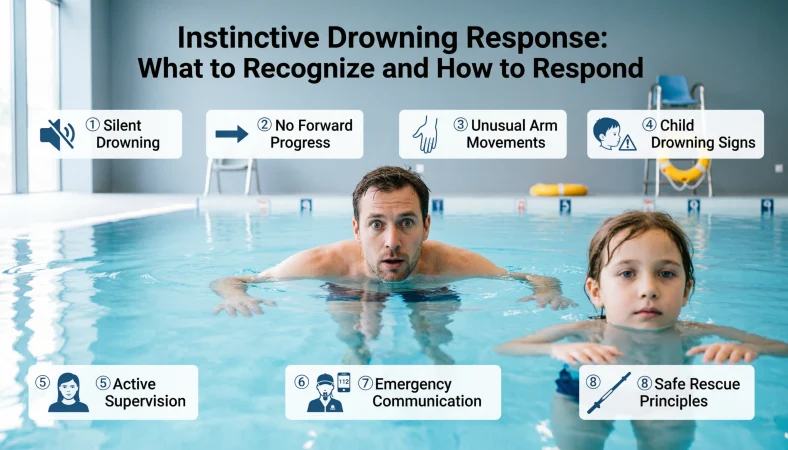
The instinctive drowning response describes the automatic behaviors a person may show while struggling to keep their airway above water. These can include a vertical body position, arms pressing downward, little or no forward progress, and an inability to call for help.
Top alternatives: drowning response, instinctive drowning behavior, signs of drowning, active drowning response, drowning recognition signs
A person struggling in water may not look like the dramatic movie version of drowning. There may be no loud shouting, giant splashes, or obvious waving. The instinctive drowning response is a term used to describe automatic behaviors that can occur when someone is struggling to keep their mouth and nose above the surface.
In everyday situations, that knowledge matters whether you are at a swimming pool, beach, lake, water park, or simply supervising children near water. The response can involve pressing the arms downward, staying nearly vertical, appearing unable to move forward, or becoming unusually quiet.
Understanding these signs can help people recognize a potential emergency instead of assuming someone is simply playing, swimming awkwardly, or being unusually quiet. Because drowning can happen quickly and is often silent, recognizing trouble early is an important part of water safety.
Instinctive Drowning Response Basics
“The body is trying to keep the airway clear.”
Example: Use this when explaining the basic purpose of the instinctive drowning response in a water-safety article.
Meaning: The body is automatically working to keep the mouth and nose above water.
“It is an automatic survival response.”
Example: Use this when explaining why a struggling swimmer may not behave deliberately.
Meaning: The behavior can happen automatically as the person tries to breathe.
“The swimmer may become nearly vertical.”
Example: Use this when describing a common visual sign of active drowning.
Meaning: The person may be upright without making useful forward progress.
“The arms may press downward.”
Example: Use this when describing what a rescuer might observe.
Meaning: The person may push against the water to lift the body and airway.
“Forward movement may stop.”
Example: Use this when explaining why someone can look like they are swimming but remain in one place.
Meaning: The person’s effort may be focused on staying above the surface rather than moving.
“Calling for help may not happen.”
Example: Use this when correcting the assumption that drowning always involves shouting.
Meaning: Breathing takes priority, leaving little ability to call out.
“The response can look surprisingly quiet.”
Example: Use this when discussing real-world drowning recognition.
Meaning: A drowning emergency may not create the dramatic noise people expect.
“The person may appear focused on breathing.”
Example: Use this when describing visible distress near the surface.
Meaning: Their movements may center on keeping the airway above water.
“The behavior is about survival, not performance.”
Example: Use this when explaining why struggling movements can look unusual.
Meaning: The movements are driven by the immediate need to breathe.
“Drowning recognition starts with observation.”
Example: Use this when discussing the role of attentive supervision.
Meaning: Watching behavior closely can help identify trouble.
“A quiet swimmer can still be in danger.”
Example: Use this when teaching families about drowning signs.
Meaning: Silence does not automatically mean everything is fine.
“Movie drowning is not the real-world standard.”
Example: Use this when making water-safety education more memorable.
Meaning: Real drowning can be much quieter and less dramatic than fiction suggests.
Instinctive Drowning Response Signs
“Little or no forward progress.”
Example: Use this when describing a swimmer who appears to be trying but stays in the same area.
Meaning: The person may be struggling to stay afloat rather than swim effectively.
“Vertical in the water.”
Example: Use this when listing recognizable signs of active drowning.
Meaning: The swimmer may remain upright without being able to move normally.
“Arms pressing downward.”
Example: Use this when describing an automatic attempt to support the body.
Meaning: The arms may push against the water to help keep the head up.
“Head low in the water.”
Example: Use this when discussing a person who appears unusually close to the surface.
Meaning: The airway may be difficult to keep above the water.
“Mouth barely above the surface.”
Example: Use this when explaining why a swimmer may not be able to speak.
Meaning: The person may have only enough airway clearance to breathe.
“Head tilted back.”
Example: Use this when describing a possible drowning sign.
Meaning: The person may instinctively position the head to keep the mouth above water.
“Glassy or unfocused eyes.”
Example: Use this when teaching visual recognition.
Meaning: The person’s attention may appear impaired or distressed.
“Unusual silence.”
Example: Use this when correcting the expectation of loud calls for help.
Meaning: A drowning person may not have enough breath to shout.
“Climbing-like arm movements.”
Example: Use this when explaining a commonly described drowning behavior.
Meaning: The arms may move as if the person is trying to climb toward the surface.
“No effective swimming rhythm.”
Example: Use this when distinguishing ordinary swimming from distress.
Meaning: Normal coordinated movement may break down during drowning.
“Repeated submerging.”
Example: Use this when discussing a swimmer whose mouth repeatedly disappears below the surface.
Meaning: The person may be struggling to maintain airway access.
“Sudden loss of movement.”
Example: Use this when explaining why ongoing observation remains important.
Meaning: A person can progress from active struggle to a motionless state.
The American Red Cross identifies several warning signs, including lack of forward progress, a vertical position, arms pressing down, and difficulty calling for help.
Instinctive Drowning Response Meaning
“It means the body is struggling to breathe.”
Example: Use this when giving a simple definition to a general audience.
Meaning: The phrase describes automatic behavior associated with respiratory distress in water.
“It describes a recognizable drowning pattern.”
Example: Use this when introducing the term in educational content.
Meaning: It refers to behaviors that may appear during active drowning.
“It is not a deliberate signal.”
Example: Use this when explaining why a person may not wave for assistance.
Meaning: The movements are generally automatic rather than planned.
“It can interfere with communication.”
Example: Use this when explaining why shouting may be absent.
Meaning: Breathing demands can prevent normal speech.
“It can limit swimming ability.”
Example: Use this when describing why a person stops making progress.
Meaning: The immediate effort to breathe can override normal swimming movement.
“It can happen very quickly.”
Example: Use this when discussing why water supervision matters.
Meaning: A drowning emergency can develop rapidly.
“It may look different in children.”
Example: Use this when explaining age-related differences.
Meaning: Young children may struggle in positions that differ from the classic upright pattern.
“It is a water-emergency warning sign.”
Example: Use this in a family water-safety guide.
Meaning: Recognizing the behavior should prompt immediate attention.
“It is not the same as ordinary swimming.”
Example: Use this when teaching inexperienced observers.
Meaning: The movements may lack normal coordinated progress.
“It can be silent.”
Example: Use this when emphasizing an important drowning fact.
Meaning: Noise is not required for a serious drowning emergency.
“It can be mistaken for play.”
Example: Use this when discussing crowded pools or beaches.
Meaning: Unusual movement can be overlooked if observers expect dramatic distress.
“Recognition can happen before complete submersion.”
Example: Use this when explaining why watching the water matters.
Meaning: Signs of trouble may be visible while the person is still near the surface.
Drowning is defined by the CDC as respiratory impairment resulting from submersion or immersion in liquid, and it can be fatal or nonfatal.
Instinctive Drowning Response In Children
“Children may not look like adults in distress.”
Example: Use this when discussing child water safety.
Meaning: A child’s body position and movements may differ from adult patterns.
“A child may become horizontal.”
Example: Use this when explaining why adult assumptions can be misleading.
Meaning: Young children may struggle face-down rather than remaining upright.
“Quiet behavior deserves attention.”
Example: Use this when supervising children near water.
Meaning: Silence can be a warning sign rather than reassurance.
“Watch for missing forward progress.”
Example: Use this when observing a child who appears to be swimming.
Meaning: Effort without movement may indicate distress.
“Look beyond splashing.”
Example: Use this when teaching parents what to watch for.
Meaning: Drowning may occur without dramatic splashing.
“Keep visual contact.”
Example: Use this when discussing active supervision.
Meaning: Continuous observation makes it easier to notice subtle changes.
“Do not assume unusual movement is play.”
Example: Use this when discussing poolside recognition.
Meaning: A strange movement pattern may indicate an emergency.
“Know the child’s swimming ability.”
Example: Use this when discussing risk awareness.
Meaning: Expectations should match the child’s actual water skills.
“Use a dedicated water watcher.”
Example: Use this when describing safer supervision practices.
Meaning: One person should actively monitor swimmers rather than becoming distracted.
“Put the phone down during supervision.”
Example: Use this when discussing practical attention around pools.
Meaning: Distraction can make a rapidly developing emergency easier to miss.
“Keep young swimmers within close supervision.”
Example: Use this when discussing child safety around water.
Meaning: Young or inexperienced swimmers require attentive monitoring.
“Swimming lessons do not replace supervision.”
Example: Use this when explaining layered water safety.
Meaning: Water skills can help, but children still need close supervision.
The CDC notes that drowning can happen in seconds and is often silent, while the American Red Cross emphasizes constant, focused supervision around water.
Instinctive Drowning Response In Adults
“Adults may also become unexpectedly quiet.”
Example: Use this when explaining that drowning signs are not limited to children.
Meaning: Adults can experience silent distress too.
“Look for stalled movement.”
Example: Use this when observing an adult swimmer who seems unable to reach safety.
Meaning: Lack of progress can signal trouble.
“Watch for an upright struggle.”
Example: Use this when explaining common active drowning behavior.
Meaning: A vertical swimmer who cannot move normally may need immediate attention.
“Notice unusual arm positioning.”
Example: Use this when describing a potential warning sign.
Meaning: Downward pressing arms can indicate an effort to stay above water.
“Do not wait for shouting.”
Example: Use this when correcting a common misconception.
Meaning: A drowning person may not have enough breath to call out.
“Watch experienced swimmers too.”
Example: Use this when discussing water safety for adults.
Meaning: Swimming ability does not eliminate every drowning risk.
“Alcohol can increase water danger.”
Example: Use this when discussing common risk factors responsibly.
Meaning: Alcohol can impair judgment and physical coordination around water.
“Fatigue can change swimming behavior.”
Example: Use this when explaining why a capable swimmer may suddenly struggle.
Meaning: Exhaustion can reduce effective movement and endurance.
“Currents can overwhelm strong swimmers.”
Example: Use this when discussing open-water safety.
Meaning: Environmental conditions can create emergencies even for skilled swimmers.
“Cold water can change the situation quickly.”
Example: Use this when discussing open-water conditions.
Meaning: Cold exposure can affect physical ability and endurance.
“A strong swimmer can still need help.”
Example: Use this when teaching observers not to make assumptions.
Meaning: Skill level does not guarantee safety in every circumstance.
“Treat unusual water behavior seriously.”
Example: Use this when summarizing adult drowning recognition.
Meaning: Prompt attention is safer than assuming everything is normal.
Instinctive Drowning Response Vs. Normal Swimming
“Normal swimming creates forward progress.”
Example: Use this when teaching observers what coordinated swimming looks like.
Meaning: A swimmer normally moves purposefully through the water.
“Drowning may produce little progress.”
Example: Use this when distinguishing distress from normal activity.
Meaning: Survival effort can replace effective swimming.
“Normal swimming has coordinated strokes.”
Example: Use this when discussing basic visual recognition.
Meaning: Controlled movement generally looks different from drowning behavior.
“Drowning can disrupt coordination.”
Example: Use this when explaining why movements may look unusual.
Meaning: Respiratory distress can interfere with normal swimming patterns.
“Normal swimming allows communication.”
Example: Use this when discussing why silence can matter.
Meaning: A comfortable swimmer generally has more ability to speak.
“Drowning can make speech impossible.”
Example: Use this when correcting expectations about calling for help.
Meaning: The person’s breathing effort may leave no capacity for shouting.
“Normal swimming changes direction intentionally.”
Example: Use this when explaining purposeful movement.
Meaning: A swimmer usually controls where they are going.
“A drowning person may stay in place.”
Example: Use this when identifying a potential emergency.
Meaning: The person may be unable to make useful progress.
“Normal play has recoverable pauses.”
Example: Use this when discussing children in pools.
Meaning: Playful behavior usually includes periods of normal recovery and interaction.
“Drowning can look unusually focused.”
Example: Use this when discussing visual cues.
Meaning: The person’s attention may be centered entirely on breathing.
“Splashing alone does not define drowning.”
Example: Use this when teaching water-safety recognition.
Meaning: Some drowning events are surprisingly quiet.
“Behavior matters more than movie stereotypes.”
Example: Use this when making drowning education memorable.
Meaning: Real-world signs should guide recognition rather than fictional expectations.
Instinctive Drowning Response And Silent Drowning
“Drowning can be silent.”
Example: Use this as a key takeaway in a water-safety article.
Meaning: A person may not make loud sounds while in serious trouble.
“Silence is not proof of safety.”
Example: Use this when supervising swimmers.
Meaning: Quiet behavior should still be observed carefully.
“A quiet emergency is still an emergency.”
Example: Use this when discussing drowning recognition.
Meaning: Lack of noise does not reduce the seriousness of the situation.
“Look at movement, not volume.”
Example: Use this when teaching observers what to watch.
Meaning: Physical behavior can reveal distress even when no one is shouting.
“Watch for stalled swimming.”
Example: Use this when identifying possible drowning.
Meaning: A person may appear active while making no meaningful progress.
“Watch the face.”
Example: Use this when describing visual recognition.
Meaning: Head position and facial expression can provide useful clues.
“Watch the hands.”
Example: Use this when explaining arm behavior.
Meaning: Pressing downward can be an important sign.
“Watch the body position.”
Example: Use this when discussing drowning recognition.
Meaning: An unusual vertical or face-down position can indicate trouble.
“Do not wait for a perfect checklist.”
Example: Use this when discussing real-time water safety.
Meaning: A potential emergency deserves attention even when every sign is not present.
“Trust noticeable changes in behavior.”
Example: Use this when supervising familiar swimmers.
Meaning: Sudden changes can be meaningful warning signs.
“Recognize the emergency early.”
Example: Use this when summarizing drowning prevention.
Meaning: Early recognition can support faster emergency action.
“Quiet does not mean okay.”
Example: Use this as a memorable safety reminder.
Meaning: Silence should never automatically reassure an observer.
The American Red Cross states that drowning is often quiet and may involve a person who cannot call out or wave for help.
Instinctive Drowning Response In Pools
“Scan the entire pool.”
Example: Use this when describing active pool supervision.
Meaning: Observation should cover all swimmers rather than one small area.
“Watch the deep end closely.”
Example: Use this when discussing areas where less-confident swimmers may struggle.
Meaning: Deeper water can make self-rescue more difficult.
“Look for stalled swimmers.”
Example: Use this when monitoring a busy pool.
Meaning: Lack of progress can be a warning sign.
“Notice unusual vertical positions.”
Example: Use this when discussing active drowning signs.
Meaning: Upright struggling without progress can indicate distress.
“Do not confuse struggle with play.”
Example: Use this when teaching pool observers.
Meaning: Unusual movement deserves attention.
“Keep supervision distraction-free.”
Example: Use this when discussing practical pool safety.
Meaning: Focused observation reduces the chance of missing subtle emergencies.
“Use a designated water watcher.”
Example: Use this when planning family pool supervision.
Meaning: One person should have clear responsibility for watching swimmers.
“Rotate the water watcher when needed.”
Example: Use this when discussing long periods of supervision.
Meaning: Planned handoffs can help maintain attention.
“Keep rescue equipment accessible.”
Example: Use this when discussing pool safety preparation.
Meaning: Appropriate equipment should be available before an emergency occurs.
“Know the pool’s emergency procedures.”
Example: Use this when preparing families or staff.
Meaning: Familiarity can reduce confusion during an emergency.
“Know where emergency numbers are posted.”
Example: Use this when discussing pool readiness.
Meaning: Easy access to emergency information supports rapid communication.
“Treat sudden silence as worth checking.”
Example: Use this when supervising children.
Meaning: A sudden change in sound or activity can deserve immediate attention.
Instinctive Drowning Response At Beaches And Lakes
“Open water changes the risk.”
Example: Use this when introducing beach and lake safety.
Meaning: Currents, waves, depth, and weather can make conditions less predictable.
“Watch swimmers near currents.”
Example: Use this when discussing river, lake, or coastal conditions.
Meaning: Moving water can affect a swimmer’s ability to make progress.
“Notice unexpected drifting.”
Example: Use this when monitoring someone in open water.
Meaning: Movement away from a safe area can signal difficulty.
“Respect changing conditions.”
Example: Use this when discussing outdoor water activities.
Meaning: Weather and water conditions can change quickly.
“Swim where lifeguards are present when possible.”
Example: Use this when discussing safer recreational swimming choices.
Meaning: Lifeguarded areas provide trained observation and emergency support.
“Wear an appropriate life jacket when required.”
Example: Use this when discussing boating or activities where flotation equipment is appropriate.
Meaning: Properly fitted flotation equipment can add an important layer of protection.
“Watch the whole swimming area.”
Example: Use this when supervising a group at a beach or lake.
Meaning: Open water makes focused observation especially important.
“Do not rely on noise to reveal trouble.”
Example: Use this when discussing silent drowning.
Meaning: An emergency may happen without obvious shouting.
“Watch for swimmers who stop progressing.”
Example: Use this when monitoring open-water activity.
Meaning: A lack of forward movement can indicate distress.
“Know the local emergency plan.”
Example: Use this before spending time at unfamiliar water locations.
Meaning: Preparation helps people understand how to summon assistance.
“Keep children within close supervision.”
Example: Use this when discussing family beach trips.
Meaning: Children can move into dangerous areas quickly.
“Respect the water instead of challenging it.”
Example: Use this as a memorable open-water safety reminder.
Meaning: Safe behavior starts with recognizing environmental risks.
The American Red Cross recommends swimming in lifeguarded areas when possible and emphasizes focused supervision and water safety preparation.
Instinctive Drowning Response And Water Safety
“Learn basic water safety.”
Example: Use this when creating a family safety checklist.
Meaning: Water knowledge provides a foundation for safer behavior.
“Learn swimming skills.”
Example: Use this when discussing drowning prevention.
Meaning: Swimming education can improve water competence.
“Keep supervision active.”
Example: Use this when discussing children near water.
Meaning: Being physically nearby is not the same as actively watching.
“Use appropriate flotation equipment.”
Example: Use this when discussing boating and water activities.
Meaning: Suitable flotation equipment adds protection in relevant situations.
“Know the emergency plan.”
Example: Use this when preparing for a pool or beach outing.
Meaning: People should know how to get professional help quickly.
“Keep emergency communication available.”
Example: Use this when discussing water safety preparation.
Meaning: Rapid access to emergency services can matter during a water emergency.
“Recognize distress early.”
Example: Use this when teaching drowning prevention.
Meaning: Early recognition creates an opportunity for faster action.
“Do not rely on swimming ability alone.”
Example: Use this when discussing overall risk reduction.
Meaning: Skills do not remove every environmental or medical risk.
“Respect water conditions.”
Example: Use this when discussing beaches, lakes, and rivers.
Meaning: Environmental conditions can affect safety.
“Keep rescue equipment accessible.”
Example: Use this when discussing pool and waterfront preparation.
Meaning: Appropriate equipment should be available before it is needed.
“Know CPR and first aid.”
Example: Use this when discussing preparedness.
Meaning: Formal training can help people respond during emergencies.
“Make supervision non-negotiable.”
Example: Use this when summarizing child water safety.
Meaning: Active supervision should remain a core safety practice.
The CDC recommends swimming and water-safety skills while stressing that children who have swimming lessons still need close and constant supervision.
Instinctive Drowning Response Recognition Tips
“Look for no forward progress.”
Example: Use this as a quick recognition reminder.
Meaning: A swimmer who cannot advance may be in distress.
“Look for a vertical body.”
Example: Use this when teaching active drowning recognition.
Meaning: An upright swimmer unable to move normally can be a warning sign.
“Look for downward arm pressure.”
Example: Use this when explaining instinctive movement.
Meaning: Pressing down may be an attempt to keep the head above water.
“Look for repeated submersion.”
Example: Use this when observing someone near the surface.
Meaning: Repeatedly losing airway access can indicate serious trouble.
“Look for unusual silence.”
Example: Use this when teaching families.
Meaning: A lack of shouting does not rule out drowning.
“Look for a fixed or unfocused gaze.”
Example: Use this when discussing visible distress.
Meaning: Changes in eye focus may accompany an emergency.
“Look for unusual head position.”
Example: Use this when describing possible drowning behavior.
Meaning: A tilted or low head position may reflect efforts to breathe.
“Look for sudden changes.”
Example: Use this when monitoring familiar swimmers.
Meaning: A rapid change from normal activity can be significant.
“Watch the swimmer, not the splash.”
Example: Use this when correcting common drowning myths.
Meaning: Movement patterns provide more useful information than dramatic noise.
“Ask whether the person is making progress.”
Example: Use this when assessing a swimmer from a safe position.
Meaning: Progress is a practical visual clue.
“Treat uncertainty seriously.”
Example: Use this when someone appears unusual in the water.
Meaning: Potential distress deserves attention rather than casual dismissal.
“Recognize first, react safely.”
Example: Use this when summarizing emergency awareness.
Meaning: Identification should be followed by a response that does not put another person in danger.
Instinctive Drowning Response And Lifeguard Awareness
“Scan continuously.”
Example: Use this when discussing lifeguard surveillance.
Meaning: Ongoing observation helps identify changes quickly.
“Recognize behavior, not just noise.”
Example: Use this when teaching surveillance skills.
Meaning: Drowning can be quiet.
“Track swimmer movement.”
Example: Use this when discussing effective observation.
Meaning: Changes in movement can reveal distress.
“Notice swimmers who stop progressing.”
Example: Use this when explaining visual scanning.
Meaning: Lack of movement can be a warning sign.
“Watch for unusual body positions.”
Example: Use this when describing active drowning recognition.
Meaning: Body position can provide important clues.
“Know the difference between distress and play.”
Example: Use this when discussing recognition training.
Meaning: Not every unusual movement has the same meaning.
“Stay ready to activate emergency procedures.”
Example: Use this when discussing professional water supervision.
Meaning: Preparedness supports a quicker organized response.
“Keep rescue equipment ready.”
Example: Use this when discussing lifeguard preparedness.
Meaning: Equipment should be available rather than searched for during an emergency.
“Follow trained rescue procedures.”
Example: Use this when discussing professional response.
Meaning: Lifeguards should rely on their formal training rather than improvisation.
“Protect the rescuer too.”
Example: Use this when discussing emergency response.
Meaning: A rescue should not unnecessarily create another victim.
“Communicate the emergency clearly.”
Example: Use this when discussing coordinated response.
Meaning: Clear communication helps involve appropriate support.
“Keep skills current.”
Example: Use this when discussing lifeguard readiness.
Meaning: Regular training helps maintain practical emergency skills.
The Red Cross emphasizes recognizing signs, activating help, and responding without putting the rescuer in unnecessary danger.
Instinctive Drowning Response Myths
“Myth: Drowning is always loud.”
Example: Use this when correcting a common misconception.
Meaning: Drowning can be quiet and difficult to notice.
“Myth: A drowning person always waves.”
Example: Use this when discussing visual stereotypes.
Meaning: A person may be using their arms to stay above water rather than wave.
“Myth: Strong swimmers cannot drown.”
Example: Use this when discussing water safety.
Meaning: Swimming ability does not eliminate every risk.
“Myth: More splashing always means more danger.”
Example: Use this when teaching recognition.
Meaning: Serious drowning can occur without dramatic splashing.
“Myth: Silence means everything is fine.”
Example: Use this when discussing active supervision.
Meaning: Quietness can occur during drowning.
“Myth: Children always call for help.”
Example: Use this when discussing child safety.
Meaning: Children may be unable to communicate during a drowning event.
“Myth: Swimming lessons make supervision unnecessary.”
Example: Use this when discussing prevention.
Meaning: Even capable swimmers need appropriate supervision.
“Myth: Drowning only happens in deep water.”
Example: Use this when discussing general water safety.
Meaning: Drowning can occur wherever submersion causes respiratory impairment.
“Myth: You will always have plenty of time.”
Example: Use this when discussing why supervision matters.
Meaning: Drowning can progress quickly.
“Myth: Every drowning looks identical.”
Example: Use this when discussing recognition.
Meaning: Signs can vary with age, circumstances, and the person’s position in the water.
“Myth: Movies teach accurate drowning behavior.”
Example: Use this when making water-safety education memorable.
Meaning: Fiction often exaggerates or changes how drowning appears.
“Myth: You should wait for certainty.”
Example: Use this when discussing potential emergencies.
Meaning: A concerning situation deserves prompt attention rather than unnecessary delay.
Instinctive Drowning Response And Emergency Awareness
“Recognize the warning signs.”
Example: Use this when summarizing drowning awareness.
Meaning: Early recognition is the first step toward getting appropriate help.
“Alert the lifeguard.”
Example: Use this when a lifeguard is present during a water emergency.
Meaning: Trained personnel can initiate the appropriate emergency response.
“Call emergency medical services.”
Example: Use this when discussing a suspected drowning emergency.
Meaning: Professional emergency assistance should be activated promptly.
“Do not put yourself in unnecessary danger.”
Example: Use this when discussing rescue safety.
Meaning: A rescuer should avoid becoming another victim.
“Use reach or throw methods when appropriate.”
Example: Use this when describing general Red Cross water-rescue guidance.
Meaning: Reaching or throwing assistance can help without requiring an unsafe entry into the water.
“Follow trained rescue procedures.”
Example: Use this when discussing formal water-safety education.
Meaning: Emergency response should follow established training.
“Start appropriate emergency care when trained.”
Example: Use this when discussing what happens after a person is removed from water.
Meaning: Trained responders should follow current first-aid and CPR guidance.
“Use an AED when appropriate and available.”
Example: Use this when discussing emergency care after a drowning incident.
Meaning: An AED may be part of the emergency response when indicated.
“Keep emergency numbers accessible.”
Example: Use this when preparing a pool or waterfront area.
Meaning: Easy access can reduce communication delays.
“Learn CPR before you need it.”
Example: Use this when encouraging water-safety preparation.
Meaning: Formal training is more useful than trying to learn during a crisis.
“Know the local rescue system.”
Example: Use this when visiting unfamiliar swimming locations.
Meaning: Local emergency procedures can vary.
“Safety starts before the emergency.”
Example: Use this as a closing awareness statement.
Meaning: Preparation, supervision, and training reduce avoidable risks.
The Red Cross recommends alerting a lifeguard when present, activating emergency medical services, and using appropriate trained rescue and CPR procedures.
Best Instinctive Drowning Response Takeaways
“Watch for no forward progress.”
Example: Use this as the first item in a quick water-safety checklist.
Meaning: A swimmer who cannot move forward may be in trouble.
“Watch for vertical struggling.”
Example: Use this when teaching people to recognize active drowning.
Meaning: Upright struggle without effective movement can be a warning sign.
“Watch for arms pressing down.”
Example: Use this when explaining the instinctive drowning response.
Meaning: The movement can be an automatic attempt to keep the airway above water.
“Do not wait for shouting.”
Example: Use this when correcting the most common drowning stereotype.
Meaning: A drowning person may be unable to call out.
“Take sudden silence seriously.”
Example: Use this when supervising children or groups.
Meaning: A sudden quiet change can signal a problem.
“Watch the whole swimmer.”
Example: Use this when explaining effective observation.
Meaning: Body position, movement, face, and progress all matter.
“Know the difference between distress and normal activity.”
Example: Use this when teaching families and new swimmers.
Meaning: Recognition depends on understanding what normal movement looks like.
“Use active supervision.”
Example: Use this when discussing child water safety.
Meaning: Focused attention is more protective than simply being nearby.
“Know how to summon help.”
Example: Use this when preparing for water emergencies.
Meaning: Emergency communication should be straightforward.
“Learn CPR and first aid.”
Example: Use this when discussing preparedness.
Meaning: Formal training can provide useful emergency skills.
“Protect yourself during rescue.”
Example: Use this when discussing emergency response.
Meaning: The rescuer should avoid creating an additional emergency.
“Remember that drowning can happen quickly.”
Example: Use this as the final water-safety reminder.
Meaning: Consistent attention matters because emergencies can develop in a short time.
FAQs
What is the instinctive drowning response?
The instinctive drowning response involves automatic behaviors during drowning, such as an upright position, downward arm movements, little forward progress, and difficulty calling for help.
What does instinctive drowning response mean?
It means the body may automatically make certain movements to keep the mouth and nose above water when a person is struggling to breathe. The behavior is not necessarily a deliberate signal for help.
What are the signs of the instinctive drowning response?
Possible signs include little or no forward progress, vertical positioning, arms pressing down, unusual silence, a low or tilted head, and difficulty speaking or waving.
Can someone drowning call for help?
They may not be able to. A drowning person’s immediate effort may be focused on breathing, leaving little ability to shout or communicate normally.
Is drowning always loud?
No. Drowning is often quiet, which is one reason attentive supervision and recognition of physical warning signs are important.
Can children show the instinctive drowning response differently?
Yes. Children may have different body positions and may become horizontal or face-down rather than showing the classic upright pattern.
Is the instinctive drowning response the same as swimming?
No. Normal swimming generally involves purposeful movement and forward progress, while drowning behavior can involve struggling primarily to keep the airway above water.
Is drowning always fatal?
No. Drowning can be fatal or nonfatal. Survivors can experience outcomes ranging from no lasting injury to serious health problems.
What should you do if someone appears to be drowning?
Alert a lifeguard if one is present, activate emergency medical services, and follow appropriate trained rescue procedures without putting yourself in unnecessary danger.
Should you jump into the water to rescue someone?
Untrained rescuers should avoid putting themselves in danger. The Red Cross promotes safer approaches such as reaching or throwing assistance when appropriate and emphasizes protecting the rescuer.
Does swimming ability prevent drowning?
No. Swimming skills can contribute to water safety, but they do not eliminate all drowning risks. Supervision and awareness remain important.
Why is recognizing the instinctive drowning response important?
Recognizing unusual movement, lack of progress, vertical positioning, downward arm pressure, and silence can help an observer identify a potential emergency instead of waiting for dramatic signs.
Conclusion
Understanding the instinctive drowning response can make water-safety awareness much more practical because real drowning may look nothing like the dramatic scenes shown in movies. A person in trouble may be quiet, unable to wave, unable to call out, or simply appear stuck in the water. Knowing what to watch for can help families, swimmers, caregivers, and bystanders recognize that something is wrong sooner.
The key is not memorizing one perfect sign but paying attention to unusual behavior, lack of progress, body position, and changes in normal activity. Save this guide for your next water-safety refresher, share it with family and friends, and consider formal swimming, first-aid, and CPR training. Stay alert, stay prepared, and keep water safety a priority.