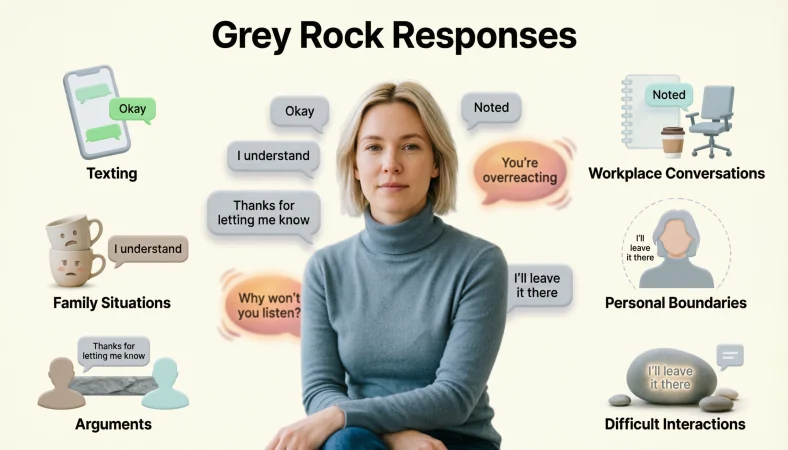
Grey rock responses are short, neutral, low-emotion replies designed to avoid feeding unnecessary conflict, drama, or attention-seeking behavior. The goal is to stay calm, uninteresting, and focused on practical information rather than getting pulled into an argument.
Top alternatives: neutral responses, short boundary replies, low-emotion responses, calm replies, minimal responses
Sometimes the best response is the one that gives absolutely nothing for an argument to grab onto. If someone keeps provoking you through texts, DMs, work messages, family conversations, or everyday interactions, grey rock responses can help you keep things brief and emotionally neutral. Instead of explaining every feeling, defending yourself, or matching someone’s energy, you give a simple answer and move on.
Think less “winning the conversation” and more “not auditioning for season 47 of unnecessary drama.” These responses can be especially useful when you need to communicate about practical matters without opening the door to another argument. The trick is consistency. A grey rock response works best when it stays calm, factual, and boring rather than becoming sarcastic or secretly provocative. The aim is not to punish someone with silence, but to avoid giving unproductive conversations extra fuel.
Simple Grey Rock Responses
“Okay.”
Example: Use this when someone makes a comment that does not require a detailed answer.
Meaning: It acknowledges the message without adding emotional fuel.
“I see.”
Example: Use this when you want to acknowledge what was said without agreeing with it.
Meaning: It shows that you heard the person without inviting debate.
“Alright.”
Example: Use this when a conversation starts becoming unnecessarily complicated.
Meaning: It keeps the response neutral and brief.
“Noted.”
Example: Use this for practical information that needs acknowledgment.
Meaning: It confirms receipt without opening another discussion.
“Thanks for letting me know.”
Example: Use this when someone provides information you simply need to acknowledge.
Meaning: It keeps the exchange polite and contained.
“I understand.”
Example: Use this when someone explains their position and you do not want to argue.
Meaning: It acknowledges their statement without taking responsibility for their viewpoint.
“Sure.”
Example: Use this for a simple request that does not require discussion.
Meaning: It gives a minimal acknowledgment.
“That’s fine.”
Example: Use this when there is no practical reason to continue the conversation.
Meaning: It closes the topic without emotional elaboration.
“Got it.”
Example: Use this when someone gives you information you need to remember.
Meaning: It confirms understanding without encouraging more commentary.
“Okay, thanks.”
Example: Use this when you want to acknowledge something and end the exchange.
Meaning: It combines politeness with a natural stopping point.
“Understood.”
Example: Use this when responding to a straightforward instruction or update.
Meaning: It communicates acknowledgment without emotional engagement.
“I’ll keep that in mind.”
Example: Use this when someone offers an opinion you do not want to debate.
Meaning: It acknowledges the comment without promising agreement.
Polite Grey Rock Responses
“Thanks for your message.”
Example: Use this when you want to remain courteous during an uncomfortable exchange.
Meaning: It keeps communication civil without inviting personal discussion.
“I appreciate the information.”
Example: Use this when someone provides a practical update.
Meaning: It acknowledges useful information without encouraging emotional conversation.
“Thanks, I’ll take note of that.”
Example: Use this when someone makes a point you do not want to discuss further.
Meaning: It politely closes the topic.
“I’ll consider it.”
Example: Use this when someone gives unsolicited advice.
Meaning: It avoids arguing while making no commitment.
“That’s one way to look at it.”
Example: Use this when someone shares an opinion you do not want to challenge.
Meaning: It acknowledges their perspective without endorsing it.
“I hear you.”
Example: Use this when you want to acknowledge someone’s words without discussing the emotional details.
Meaning: It shows recognition without creating a debate.
“Thanks for explaining.”
Example: Use this when someone gives a lengthy explanation.
Meaning: It provides polite acknowledgment while keeping your response short.
“I understand your point.”
Example: Use this when you want to recognize a viewpoint without agreeing.
Meaning: It separates understanding from approval.
“Thanks for sharing.”
Example: Use this when someone offers an opinion you do not need to engage with.
Meaning: It politely acknowledges the information.
“I’ll keep that in mind.”
Example: Use this when someone gives advice that you do not intend to discuss.
Meaning: It closes the conversation without confrontation.
“That’s noted.”
Example: Use this when you want a professional-sounding acknowledgment.
Meaning: It signals that the information has been received.
“I appreciate you letting me know.”
Example: Use this when someone sends an update that requires no further discussion.
Meaning: It maintains courtesy while keeping emotional distance.
Calm Grey Rock Responses
“Let’s keep this simple.”
Example: Use this when someone tries to turn a practical issue into an emotional argument.
Meaning: It redirects attention toward the basic matter.
“There’s nothing more to add.”
Example: Use this when the same topic keeps circling back.
Meaning: It signals that you are not continuing the discussion.
“I’m keeping things straightforward.”
Example: Use this when someone pushes for an emotional explanation.
Meaning: It communicates a preference for simple communication.
“I’m not going into that.”
Example: Use this when someone asks for personal details you do not want to share.
Meaning: It establishes a clear limit without unnecessary explanation.
“That’s all I have to say about it.”
Example: Use this when repeated questions are becoming unproductive.
Meaning: It closes the subject firmly.
“I’m focusing on the practical part.”
Example: Use this when emotions begin overshadowing the actual issue.
Meaning: It redirects the conversation toward useful information.
“Let’s stick to the facts.”
Example: Use this when someone introduces accusations or speculation.
Meaning: It encourages factual communication instead of emotional debate.
“I don’t have anything else to add.”
Example: Use this when you have already answered a question.
Meaning: It prevents the conversation from expanding unnecessarily.
“I’m keeping this brief.”
Example: Use this when you need to communicate without getting drawn into details.
Meaning: It clearly signals a limited response.
“That’s okay.”
Example: Use this when an emotional reaction would only prolong the exchange.
Meaning: It keeps the tone neutral.
“I’ll leave it there.”
Example: Use this when you want to end an unproductive discussion.
Meaning: It creates a calm stopping point.
“No further comment.”
Example: Use this when someone continues pushing for a reaction.
Meaning: It communicates that you are not participating further.
Short Grey Rock Responses
“Yep.”
Example: Use this for a simple factual question that needs a minimal answer.
Meaning: It provides acknowledgment without elaboration.
“Nope.”
Example: Use this when a direct negative answer is enough.
Meaning: It answers clearly without creating extra discussion.
“Maybe.”
Example: Use this when you do not want to explain your thoughts.
Meaning: It keeps the answer intentionally limited.
“Possibly.”
Example: Use this when certainty is unnecessary or unwanted.
Meaning: It provides a neutral answer without additional detail.
“I don’t know.”
Example: Use this when someone expects you to speculate.
Meaning: It avoids inventing an explanation.
“Not sure.”
Example: Use this when you genuinely do not have an answer.
Meaning: It keeps the response factual and minimal.
“Could be.”
Example: Use this when someone makes a claim you do not need to debate.
Meaning: It acknowledges possibility without agreement.
“I’ll see.”
Example: Use this when someone asks about a future decision.
Meaning: It avoids making a commitment.
“We’ll see.”
Example: Use this when the outcome is uncertain.
Meaning: It keeps expectations neutral.
“Okay then.”
Example: Use this when you want to acknowledge an ending statement.
Meaning: It provides a simple closing response.
“Fair enough.”
Example: Use this when you do not want to challenge another person’s position.
Meaning: It acknowledges their perspective without continuing the debate.
“Noted.”
Example: Use this when you want the shortest possible acknowledgment.
Meaning: It confirms that you received the information.
Professional Grey Rock Responses
“Thanks for the update.”
Example: Use this when a workplace message needs acknowledgment but no discussion.
Meaning: It keeps communication professional and focused.
“I’ll review it.”
Example: Use this when someone sends information requiring consideration.
Meaning: It acknowledges receipt without making an immediate commitment.
“Understood. I’ll proceed accordingly.”
Example: Use this when responding to a practical workplace instruction.
Meaning: It confirms understanding and keeps the exchange task-focused.
“I’ll follow up if necessary.”
Example: Use this when someone sends information that may or may not require action.
Meaning: It avoids unnecessary back-and-forth.
“Thanks, I’ve received it.”
Example: Use this when confirming receipt of a document or message.
Meaning: It closes the communication professionally.
“I’ll take care of that.”
Example: Use this when a straightforward task has been assigned.
Meaning: It confirms action without emotional discussion.
“Please send the relevant details.”
Example: Use this when someone gives vague information.
Meaning: It redirects the conversation toward practical facts.
“Let’s keep the discussion focused on the task.”
Example: Use this when workplace communication becomes personal.
Meaning: It establishes a professional boundary.
“I’ll respond when I have the necessary information.”
Example: Use this when someone pressures you for an immediate answer.
Meaning: It sets a calm and practical limit.
“That has been noted.”
Example: Use this in formal workplace communication.
Meaning: It acknowledges the issue without emotional engagement.
“I’ll address the relevant point.”
Example: Use this when a message contains unnecessary personal commentary.
Meaning: It redirects attention toward the actual work issue.
“No action is required from me at this stage.”
Example: Use this when someone attempts to create unnecessary work or discussion.
Meaning: It clearly communicates your current position.
Confident Grey Rock Responses
“I’m comfortable with my decision.”
Example: Use this when someone repeatedly questions a choice you have already made.
Meaning: It communicates confidence without inviting an argument.
“I’ve made my position clear.”
Example: Use this when someone keeps asking the same question.
Meaning: It reinforces your boundary.
“I’m not changing my mind.”
Example: Use this when pressure continues after you have decided.
Meaning: It communicates finality.
“That doesn’t require a response from me.”
Example: Use this when someone makes a provocative statement.
Meaning: It refuses to give the statement extra attention.
“I know what I’m comfortable with.”
Example: Use this when someone challenges your boundaries.
Meaning: It reinforces personal limits.
“I’ll handle it in my own way.”
Example: Use this when someone tries to control your approach.
Meaning: It calmly reinforces autonomy.
“I don’t need to explain that further.”
Example: Use this when someone demands repeated justification.
Meaning: It establishes that your explanation has ended.
“My answer remains the same.”
Example: Use this when someone keeps revisiting a decision.
Meaning: It communicates consistency.
“I’m not discussing that.”
Example: Use this when someone pushes into a private topic.
Meaning: It sets a direct conversational boundary.
“I’ve heard your opinion.”
Example: Use this when someone continues giving unsolicited commentary.
Meaning: It acknowledges their position without accepting it.
“That’s your view.”
Example: Use this when someone presents an opinion as an unquestionable fact.
Meaning: It separates their belief from your position.
“I’m comfortable leaving it there.”
Example: Use this when you want to end the conversation confidently.
Meaning: It communicates that no further discussion is needed.
Grey Rock Responses for Arguments
“I’m not arguing about this.”
Example: Use this when a discussion starts becoming repetitive or hostile.
Meaning: It declines participation in the argument.
“We don’t need to agree.”
Example: Use this when disagreement is not worth extending.
Meaning: It accepts different views without continuing the conflict.
“I’ve already answered that.”
Example: Use this when someone repeatedly asks the same question.
Meaning: It prevents circular conversation.
“I’m not going back and forth.”
Example: Use this when messages become repetitive.
Meaning: It signals that you will not participate in a prolonged exchange.
“This conversation isn’t productive.”
Example: Use this when the discussion stops moving toward a solution.
Meaning: It identifies the lack of progress without attacking the person.
“I’m stepping away from this discussion.”
Example: Use this when you need to disengage.
Meaning: It creates space without adding another argument.
“There’s no need to make this bigger.”
Example: Use this when someone is escalating a minor disagreement.
Meaning: It encourages de-escalation.
“I’m not engaging with accusations.”
Example: Use this when the conversation becomes personally accusatory.
Meaning: It declines to defend against unsupported claims.
“Let’s leave it here.”
Example: Use this when continuing would only create more tension.
Meaning: It provides a simple closing point.
“I’m not discussing this further.”
Example: Use this when your boundary has already been stated.
Meaning: It makes your disengagement clear.
“I don’t have anything else to say.”
Example: Use this when the discussion has reached a natural end.
Meaning: It signals that you are finished responding.
“We’ve covered this already.”
Example: Use this when someone keeps reopening the same disagreement.
Meaning: It discourages another round of the argument.
Grey Rock Responses for Personal Questions
“Nothing much.”
Example: Use this when someone asks for unnecessary details about your day.
Meaning: It provides a harmless but limited answer.
“Same as usual.”
Example: Use this when you do not want to discuss your routine.
Meaning: It gives minimal personal information.
“I’ve just been busy.”
Example: Use this when someone asks what you have been doing.
Meaning: It answers without providing specific details.
“Just handling a few things.”
Example: Use this when you want to keep your plans private.
Meaning: It gives a vague but polite answer.
“Nothing exciting.”
Example: Use this when someone pushes for details about your activities.
Meaning: It keeps the conversation deliberately uninteresting.
“I’m keeping things private.”
Example: Use this when someone asks something personal.
Meaning: It directly establishes a privacy boundary.
“I’d rather not get into that.”
Example: Use this when a question becomes intrusive.
Meaning: It declines to provide personal information.
“Everything is fine.”
Example: Use this when someone expects an emotional explanation.
Meaning: It gives reassurance without opening a deeper conversation.
“Just taking care of myself.”
Example: Use this when someone asks about personal plans.
Meaning: It offers a general answer without details.
“I’ve got it handled.”
Example: Use this when someone presses for information about a personal matter.
Meaning: It communicates that you do not need to elaborate.
“Nothing I need to discuss.”
Example: Use this when someone keeps asking about a private issue.
Meaning: It closes the subject.
“I’m keeping that to myself.”
Example: Use this when you want a firm but calm privacy boundary.
Meaning: It makes your decision not to share clear.
Grey Rock Responses to Provocation
“Okay.”
Example: Use this when someone clearly wants an emotional reaction.
Meaning: It gives them very little material to continue with.
“If you say so.”
Example: Use this when someone makes a statement you do not need to challenge.
Meaning: It avoids taking the bait.
“That’s your opinion.”
Example: Use this when someone presents a personal judgment about you.
Meaning: It separates their opinion from your identity.
“I’m not responding to that.”
Example: Use this when a message is deliberately provocative.
Meaning: It refuses to participate in the provocation.
“Noted.”
Example: Use this when someone wants a stronger emotional reaction.
Meaning: It provides acknowledgment without engagement.
“I hear what you’re saying.”
Example: Use this when someone is trying to pull you into an argument.
Meaning: It recognizes their words without accepting their framing.
“That’s fine.”
Example: Use this when someone expects you to become defensive.
Meaning: It keeps the exchange emotionally flat.
“I don’t have a response to that.”
Example: Use this when a comment is designed to provoke rather than communicate.
Meaning: It declines the invitation to argue.
“You’re entitled to your view.”
Example: Use this when someone strongly expresses an opinion.
Meaning: It acknowledges their right to an opinion without agreeing.
“I’ll leave that with you.”
Example: Use this when someone makes an accusation you do not want to debate.
Meaning: It returns responsibility for the statement to the speaker.
“I’m not taking that personally.”
Example: Use this when someone attempts to trigger an emotional reaction.
Meaning: It communicates emotional distance.
“There’s nothing useful for me to add.”
Example: Use this when further engagement would only prolong the exchange.
Meaning: It closes the interaction without confrontation.
Grey Rock Responses for Texts and DMs
“Okay, thanks.”
Example: Use this when a message does not require a detailed response.
Meaning: It acknowledges the text and naturally ends the exchange.
“Got it.”
Example: Use this when someone sends practical information.
Meaning: It confirms that you received it.
“I’ll let you know.”
Example: Use this when someone asks for a decision you have not made.
Meaning: It avoids giving unnecessary details.
“Not sure yet.”
Example: Use this when someone pressures you for an answer.
Meaning: It gives an honest but limited response.
“I’m busy right now.”
Example: Use this when you need to stop a conversation.
Meaning: It communicates that you are unavailable.
“I’ll get back to you.”
Example: Use this when an immediate response is unnecessary.
Meaning: It creates space without escalating the interaction.
“Thanks for checking in.”
Example: Use this when someone asks personal questions by text.
Meaning: It stays polite without opening a deeper discussion.
“All good here.”
Example: Use this when someone asks how things are going.
Meaning: It provides a simple status update.
“Nothing to report.”
Example: Use this when someone expects personal details.
Meaning: It keeps the response deliberately limited.
“I’m keeping things simple.”
Example: Use this when a text conversation becomes unnecessarily complicated.
Meaning: It signals that you are not interested in extended discussion.
“Okay, noted.”
Example: Use this when you want to acknowledge a message without continuing it.
Meaning: It confirms receipt and closes the topic.
“Take care.”
Example: Use this when you want a polite ending to a conversation.
Meaning: It creates a friendly but clear stopping point.
Grey Rock Responses for Family Situations
“Everything’s fine.”
Example: Use this when a family member asks for details you do not want to share.
Meaning: It provides reassurance without opening a personal discussion.
“I’m doing okay.”
Example: Use this when you want to answer a personal question briefly.
Meaning: It gives a basic update without elaboration.
“Nothing new.”
Example: Use this when someone repeatedly asks about your life.
Meaning: It keeps the answer short and neutral.
“I’ll handle it.”
Example: Use this when relatives offer unwanted involvement.
Meaning: It calmly reinforces your independence.
“Thanks for your concern.”
Example: Use this when someone asks intrusive questions out of concern.
Meaning: It acknowledges their intention without sharing more.
“I’d rather keep that private.”
Example: Use this when family members ask about sensitive personal matters.
Meaning: It establishes a respectful boundary.
“I’ve got things under control.”
Example: Use this when someone repeatedly questions your choices.
Meaning: It communicates confidence without inviting debate.
“I’ll think about it.”
Example: Use this when relatives offer unsolicited advice.
Meaning: It acknowledges the advice without promising to follow it.
“That’s something I’m handling myself.”
Example: Use this when you want to keep a personal issue private.
Meaning: It clearly communicates independence.
“There isn’t much to say.”
Example: Use this when someone keeps asking for details.
Meaning: It discourages further questioning.
“I appreciate you asking.”
Example: Use this when you want to remain polite but private.
Meaning: It acknowledges their interest without revealing information.
“Let’s talk about something else.”
Example: Use this when a family conversation moves into an uncomfortable topic.
Meaning: It redirects the discussion toward a safer subject.
Grey Rock Responses for Workplace Drama
“I’m focused on the work.”
Example: Use this when colleagues try to pull you into workplace gossip.
Meaning: It redirects attention toward professional responsibilities.
“I haven’t heard anything about that.”
Example: Use this when someone asks you to participate in gossip.
Meaning: It avoids speculation and keeps you out of the discussion.
“You should speak to them directly.”
Example: Use this when someone wants you to take sides in a workplace dispute.
Meaning: It redirects the issue to the people involved.
“I’m staying out of it.”
Example: Use this when colleagues invite you into office conflict.
Meaning: It clearly communicates nonparticipation.
“I’m here to get the work done.”
Example: Use this when workplace drama becomes distracting.
Meaning: It reinforces your professional focus.
“I don’t have enough information to comment.”
Example: Use this when someone asks you to judge a workplace situation.
Meaning: It avoids speculation.
“Let’s keep this professional.”
Example: Use this when communication becomes personal.
Meaning: It redirects the interaction toward appropriate workplace conduct.
“I’ll focus on my responsibilities.”
Example: Use this when someone tries to involve you in unrelated issues.
Meaning: It reinforces your boundaries.
“I’m not getting involved.”
Example: Use this when a colleague asks you to take a side.
Meaning: It establishes clear distance from the conflict.
“That’s between you and them.”
Example: Use this when someone asks you to mediate an interpersonal dispute.
Meaning: It returns responsibility to the people directly involved.
“I don’t have anything to add.”
Example: Use this when workplace gossip continues around you.
Meaning: It gives the conversation no additional material.
“Let’s get back to the task.”
Example: Use this when a discussion moves away from productive work.
Meaning: It redirects everyone toward the actual objective.
Grey Rock Responses With Strong Boundaries
“I’m not discussing this.”
Example: Use this when someone repeatedly pushes a topic you have closed.
Meaning: It sets a direct boundary.
“That topic is private.”
Example: Use this when someone asks intrusive questions.
Meaning: It communicates that the subject is not open for discussion.
“I’ve answered that already.”
Example: Use this when someone keeps requesting the same explanation.
Meaning: It reinforces the limit without adding more information.
“I’m not available for this conversation.”
Example: Use this when someone approaches you at an unsuitable time.
Meaning: It establishes a clear boundary around your availability.
“I’m choosing not to discuss it.”
Example: Use this when you want a calm but firm refusal.
Meaning: It communicates that withholding information is intentional.
“I won’t be continuing this conversation.”
Example: Use this when an interaction becomes unproductive.
Meaning: It clearly signals disengagement.
“Please respect that boundary.”
Example: Use this when someone ignores your previous request.
Meaning: It asks directly for your limit to be respected.
“I’m not explaining myself again.”
Example: Use this when repeated demands for justification continue.
Meaning: It prevents endless explanation.
“That doesn’t need to be discussed.”
Example: Use this when someone raises a private issue unnecessarily.
Meaning: It closes the subject.
“I’ll decide what I share.”
Example: Use this when someone feels entitled to personal information.
Meaning: It reinforces your control over your own information.
“I’m ending this conversation now.”
Example: Use this when you need a definitive stopping point.
Meaning: It communicates a clear decision to disengage.
“We can discuss the practical issue only.”
Example: Use this when communication must continue for a specific reason.
Meaning: It limits the conversation to necessary information.
Grey Rock Responses That Stay Friendly
“Hope you’re doing well.”
Example: Use this when you need to remain courteous without becoming personal.
Meaning: It keeps the tone pleasant while limiting engagement.
“Thanks, I appreciate it.”
Example: Use this when someone offers a helpful comment.
Meaning: It acknowledges the gesture without extending the conversation.
“Sounds good.”
Example: Use this for a straightforward plan or update.
Meaning: It provides friendly acknowledgment.
“That works for me.”
Example: Use this when confirming a practical arrangement.
Meaning: It keeps communication focused on the arrangement.
“Thanks for checking.”
Example: Use this when someone asks about something practical.
Meaning: It acknowledges their effort without opening a personal topic.
“All good.”
Example: Use this when someone asks whether there is a problem.
Meaning: It gives a short, reassuring answer.
“No worries.”
Example: Use this when an issue does not need further discussion.
Meaning: It keeps the tone relaxed and brief.
“Take care.”
Example: Use this when you want to end a conversation kindly.
Meaning: It closes the exchange without inviting more discussion.
“Hope that helps.”
Example: Use this after providing a simple factual answer.
Meaning: It gives the interaction a natural ending.
“Have a good one.”
Example: Use this when you want a casual closing message.
Meaning: It ends the interaction on a neutral note.
“Thanks for letting me know.”
Example: Use this when acknowledging a simple update.
Meaning: It remains polite without encouraging additional details.
“Wishing you well.”
Example: Use this when ending an interaction respectfully.
Meaning: It communicates goodwill while maintaining distance.
Best Grey Rock Responses for Difficult Conversations
“I’m keeping my response brief.”
Example: Use this when you know a conversation could easily become lengthy.
Meaning: It sets expectations for limited engagement.
“I’ll respond to what is necessary.”
Example: Use this when someone sends a long message filled with accusations.
Meaning: It limits your response to relevant points.
“I’m not engaging with the personal comments.”
Example: Use this when a practical issue becomes personal.
Meaning: It separates the useful issue from unnecessary commentary.
“Let’s keep communication factual.”
Example: Use this when emotions begin taking over a practical discussion.
Meaning: It redirects attention toward verifiable information.
“I’ve provided the information I have.”
Example: Use this when someone demands more details than you can provide.
Meaning: It communicates that your contribution is complete.
“I’m not going to debate this.”
Example: Use this when someone tries to turn a disagreement into a prolonged argument.
Meaning: It clearly declines the debate.
“I’ll deal with what needs to be dealt with.”
Example: Use this when someone questions your handling of a situation.
Meaning: It reinforces your focus on practical action.
“There’s no need to continue this.”
Example: Use this when the discussion is going nowhere.
Meaning: It creates a calm exit point.
“I’m keeping this conversation respectful and brief.”
Example: Use this when communication is becoming tense.
Meaning: It sets expectations for tone and length.
“I’ve heard you.”
Example: Use this when someone keeps repeating their position.
Meaning: It acknowledges them without inviting another round.
“I’m going to leave this here.”
Example: Use this when you want to stop responding.
Meaning: It provides a clear conversational ending.
“I’ll communicate when there’s something practical to discuss.”
Example: Use this when repeated messages contain little useful information.
Meaning: It establishes a boundary around future communication.
FAQs
What are grey rock responses?
Grey rock responses are brief, neutral replies intended to reduce emotional engagement and avoid giving unnecessary attention to provocative, intrusive, or unproductive interactions.
Why are they called grey rock responses?
The name comes from the idea of behaving like an ordinary grey rock: neutral, uninteresting, and difficult to draw into an emotionally charged interaction.
What is the best grey rock response?
There is no single best response. Simple phrases such as “Okay,” “Noted,” “I understand,” and “Thanks for letting me know” can work when they genuinely fit the situation.
Are grey rock responses rude?
Not necessarily. A grey rock response can be polite and respectful. The important difference is that it limits unnecessary engagement rather than deliberately insulting or provoking someone.
Can grey rock responses be used at work?
Yes. Professional versions such as “Thanks for the update,” “I’ll review it,” and “Let’s keep this focused on the task” can help keep workplace communication practical.
Can you use grey rock responses over text?
Yes. Text messages are often a natural setting for brief, neutral replies because you can answer only what is necessary without extending the conversation.
Are grey rock responses manipulative?
The goal should be to manage your own engagement and maintain healthy boundaries, using clear communication when a direct conversation is safe and productive.
What should you say if you do not actually want to use a grey rock response?
You can simply state your boundary directly, such as “I don’t want to discuss that” or “I need some space right now.” Direct communication may be more appropriate when the situation allows it.
Can grey rock responses be emotional?
They are generally designed to remain emotionally neutral. If you need to express genuine feelings or resolve an important issue, a more direct and honest conversation may be appropriate.
Can grey rock responses be funny?
Light humor can work in low-stakes situations, but sarcasm can accidentally add emotional fuel. Neutral, boring language is usually more consistent with the grey rock approach.
Should you ignore someone completely instead?
Not always. If communication is necessary, a short factual response can be more practical than complete silence. The right approach depends on the situation and the reason for communicating.
When should you stop using grey rock responses?
For safety concerns, threats, harassment, coercion, or serious situations, prioritize support, documentation, professional guidance, or emergency assistance over conversational techniques alone.
Conclusion
The right grey rock responses can make difficult conversations feel a lot less exhausting. Instead of explaining every detail, defending every decision, or getting pulled into endless back-and-forth, you can keep your words short, calm, and focused on what actually matters. The key is consistency. A neutral reply works best when it is genuinely neutral, not secretly designed to provoke another reaction.
Whether you are handling texts, workplace drama, intrusive questions, family tension, or an uncomfortable conversation, choose wording that matches the situation and your boundaries. Try a few options from this list, save the ones that feel natural, and keep them ready for moments when less really is more. Share this guide with someone who needs calmer conversations, too.










1 thought on “180+ Grey Rock Responses To Keep Conversations Calm, Brief And Boring In 2026”