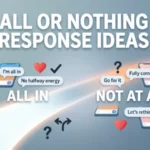
An all or nothing response shows that you are treating a situation as completely one way or completely the other, with little room in between. It can sound confident, funny, emotional, flirty, sarcastic, or surprisingly honest depending on the context.
Top alternatives: Take it or leave it, Go big or go home, Fully committed, No middle ground, All in or not at all
Ever get a message where “maybe” simply does not exist? Someone wants an all-in answer, a firm decision, or a response with absolutely zero middle ground. That is where an all or nothing response can make a conversation instantly more interesting.
You might use one while texting a friend, replying to a crush, discussing plans at work, settling an argument, or joking around in a group chat. The tone matters because the same two-word answer can sound confident in one situation and wildly dramatic in another.
A good response makes your intention obvious without making things awkward. Whether you are choosing commitment, rejecting hesitation, flirting, setting a boundary, or simply adding some personality to the chat, these responses give you plenty of ways to say exactly where you stand without sounding like a broken record.
Funny All or Nothing Responses
All in, apparently my common sense called in sick.
Example: Use it when you are enthusiastically committing to a fun but slightly questionable plan.
Meaning: It shows excitement while joking about your lack of caution.
Why choose one when I can choose everything?
Example: Use it when someone presents several tempting options.
Meaning: It humorously rejects the idea of limiting yourself.
Go big or order dessert twice.
Example: Use it when making a playful decision about a night out.
Meaning: It turns all-or-nothing thinking into a food joke.
Zero hesitation, maximum chaos.
Example: Use it when agreeing to an impulsive adventure with friends.
Meaning: It shows enthusiastic commitment with humor.
My answer has no loading screen. Yes.
Example: Use it when someone wants an immediate decision.
Meaning: It communicates instant confidence.
Halfway is not on today’s menu.
Example: Use it when you are jokingly refusing to compromise.
Meaning: It makes your firm stance playful.
I came here to commit, not browse.
Example: Use it when choosing something you genuinely want.
Meaning: It shows decisive enthusiasm.
Either legendary or a learning experience.
Example: Use it before trying something unpredictable.
Meaning: It humorously accepts either success or failure.
My decision-making department has spoken.
Example: Use it when announcing a firm choice.
Meaning: It makes your decision sound officially final.
All gas, no overthinking.
Example: Use it when finally committing after a long debate.
Meaning: It encourages action instead of hesitation.
I don’t do samples, I order the full experience.
Example: Use it when joking about fully committing to something.
Meaning: It playfully emphasizes going all in.
The middle ground has been evicted.
Example: Use it when refusing to stay undecided.
Meaning: It turns a firm decision into a funny image.
Bold All or Nothing Responses
I’m either fully in or fully out.
Example: Use it when clearly communicating your position on an important decision.
Meaning: It establishes a strong boundary.
If I choose it, I choose it properly.
Example: Use it when explaining your commitment to a plan.
Meaning: It shows that you take decisions seriously.
I do not do half-hearted.
Example: Use it when describing your approach to relationships or goals.
Meaning: It communicates strong personal standards.
If we’re doing this, we’re doing it properly.
Example: Use it when committing to a project or plan.
Meaning: It shows determination and seriousness.
No halfway energy from me.
Example: Use it when making your expectations clear.
Meaning: It communicates a preference for genuine commitment.
I know where I stand.
Example: Use it when someone questions your position.
Meaning: It shows certainty and self-confidence.
I choose with intention.
Example: Use it when discussing an important personal decision.
Meaning: It suggests your choices are deliberate.
Once I’m in, I’m in.
Example: Use it when reassuring someone about your commitment.
Meaning: It communicates loyalty and consistency.
I would rather be certain than lukewarm.
Example: Use it when explaining why you avoid indecision.
Meaning: It values clarity over uncertainty.
My answer is firm.
Example: Use it when someone keeps asking you to reconsider.
Meaning: It establishes a clear position.
I either believe in it or I don’t.
Example: Use it when discussing trust, goals, or personal values.
Meaning: It emphasizes authenticity.
Half measures are not my thing.
Example: Use it when describing your personality.
Meaning: It shows a preference for complete commitment.
Flirty All or Nothing Responses
If I like you, you’ll know.
Example: Use it when a crush is trying to figure out whether you are interested.
Meaning: It communicates confidence and openness.
I’m either flirting or behaving suspiciously.
Example: Use it when teasing someone about obvious chemistry.
Meaning: It keeps romantic interest playful and mysterious.
If we’re doing chemistry, let’s make it obvious.
Example: Use it when flirting with someone who clearly likes you.
Meaning: It suggests you are comfortable with mutual attraction.
I’m not interested in almost.
Example: Use it when discussing romantic intentions.
Meaning: It signals that you want something genuine.
All in sounds good if it’s with you.
Example: Use it when responding romantically to someone you trust.
Meaning: It expresses affection and willingness to commit.
You had me at hello, unfortunately.
Example: Use it when playfully admitting attraction.
Meaning: It gives a charming, slightly dramatic confession.
If we’re catching feelings, let’s not pretend we’re not.
Example: Use it when romantic tension has become obvious.
Meaning: It encourages honest communication about attraction.
One chance, one heart, full commitment.
Example: Use it when expressing serious romantic interest.
Meaning: It communicates emotional sincerity.
You make the all-in option tempting.
Example: Use it when someone has made a strong romantic impression.
Meaning: It compliments their ability to inspire commitment.
I could play it safe, but where’s the fun in that?
Example: Use it when flirting with someone adventurous.
Meaning: It shows romantic confidence.
My answer gets very easy when you’re involved.
Example: Use it when someone asks whether you want to spend time together.
Meaning: It suggests strong personal interest.
With you, I’m not exactly looking for the middle ground.
Example: Use it when hinting at serious attraction.
Meaning: It creates romantic intensity without being overly serious.
Polite All or Nothing Responses
I appreciate the choice, but I need a little flexibility.
Example: Use it when someone presents only two rigid options.
Meaning: It respectfully asks for more room.
I understand your position, but I see another possibility.
Example: Use it during a respectful disagreement.
Meaning: It acknowledges their view while offering an alternative.
I would prefer to consider the middle ground.
Example: Use it when a decision feels unnecessarily extreme.
Meaning: It politely resists an all-or-nothing approach.
I can commit once I have enough information.
Example: Use it when someone wants an immediate decision.
Meaning: It explains why you need more context.
I would rather make a thoughtful choice.
Example: Use it when someone pressures you to decide quickly.
Meaning: It prioritizes careful consideration.
There may be more than two options here.
Example: Use it during a disagreement or planning discussion.
Meaning: It gently challenges a false choice.
I see both sides of the situation.
Example: Use it when discussing a complicated issue.
Meaning: It shows balance and understanding.
I am open to finding a compromise.
Example: Use it when resolving a disagreement.
Meaning: It signals cooperation.
Let me think before I commit.
Example: Use it when you need time before giving an answer.
Meaning: It sets a polite boundary around decision-making.
I would like to understand the options first.
Example: Use it when someone expects an immediate yes or no.
Meaning: It requests useful context.
I respect the choice, but I need another option.
Example: Use it when the available choices do not suit you.
Meaning: It communicates disagreement respectfully.
I think we can find a better balance.
Example: Use it when trying to soften an extreme position.
Meaning: It encourages compromise.
Professional All or Nothing Responses
I would prefer a data-driven decision.
Example: Use it when a workplace discussion becomes overly binary.
Meaning: It encourages decisions based on evidence.
Let’s evaluate the available options first.
Example: Use it during a project planning discussion.
Meaning: It promotes informed decision-making.
I am committed once the objectives are clear.
Example: Use it when discussing responsibility for a project.
Meaning: It shows willingness to commit after clarification.
We may need a broader range of options.
Example: Use it when a proposal offers only two choices.
Meaning: It encourages more flexible thinking.
Let’s separate urgency from certainty.
Example: Use it when colleagues want a rushed decision.
Meaning: It reminds the team that speed does not guarantee accuracy.
I can support the decision once the risks are understood.
Example: Use it when evaluating a business proposal.
Meaning: It shows cautious but constructive commitment.
Let’s identify the practical middle ground.
Example: Use it when negotiating workplace priorities.
Meaning: It encourages a balanced solution.
I would like to review the implications first.
Example: Use it when a decision could have significant consequences.
Meaning: It communicates professionalism and caution.
We can be decisive without being inflexible.
Example: Use it when a team is becoming overly rigid.
Meaning: It supports confident but adaptable decision-making.
Let’s define what success looks like first.
Example: Use it before committing resources to a project.
Meaning: It establishes clear criteria for the decision.
I am open to a stronger alternative.
Example: Use it when someone proposes an all-or-nothing solution.
Meaning: It encourages better ideas without creating conflict.
Let’s make the decision based on priorities.
Example: Use it when several competing options exist.
Meaning: It brings the discussion back to practical goals.
Creative All or Nothing Responses
My heart prefers bold chapters.
Example: Use it when making a meaningful life decision.
Meaning: It suggests courage and emotional commitment.
The middle lane is closed for renovations.
Example: Use it when joking about your preference for decisive choices.
Meaning: It creatively rejects indecision.
I’m choosing the plot with the better ending.
Example: Use it when deciding between two exciting possibilities.
Meaning: It frames the choice as part of a personal story.
If destiny wants subtle, it picked the wrong person.
Example: Use it when describing your bold personality.
Meaning: It humorously celebrates directness.
I came for the full-color version, not the demo.
Example: Use it when choosing a complete experience.
Meaning: It communicates enthusiasm for going all in.
My compass points directly toward commitment.
Example: Use it when expressing dedication to something.
Meaning: It suggests clear direction.
Either the stars align or they learn my name.
Example: Use it when approaching a big opportunity with confidence.
Meaning: It adds dramatic determination.
I don’t do tiny adventures.
Example: Use it when agreeing to an exciting plan.
Meaning: It shows enthusiasm for memorable experiences.
The universe loves a decisive main character.
Example: Use it when encouraging someone to make a bold choice.
Meaning: It celebrates confidence and action.
My comfort zone just got a cancellation notice.
Example: Use it when trying something new.
Meaning: It signals willingness to take a risk.
The safe option can watch from the sidelines.
Example: Use it when choosing an exciting opportunity.
Meaning: It shows preference for bold action.
I’m writing the yes-or-no version, not the maybe edition.
Example: Use it when someone keeps asking you to decide.
Meaning: It emphasizes a desire for clarity.
Sarcastic All or Nothing Responses
Because apparently nuance went on vacation.
Example: Use it when someone reduces a complicated issue to two choices.
Meaning: It sarcastically points out the lack of nuance.
Sure, let’s pretend those are the only two options.
Example: Use it during an overly simplistic debate.
Meaning: It challenges the false choice.
Ah yes, the famous middle ground shortage.
Example: Use it when someone refuses to compromise.
Meaning: It mocks rigid thinking.
Nothing says reasonable like an extreme decision.
Example: Use it when someone proposes an unnecessarily drastic solution.
Meaning: It highlights the absurdity of the approach.
Why consider details when we can just panic?
Example: Use it when someone rushes toward an extreme decision.
Meaning: It humorously criticizes impulsive thinking.
Excellent, nuance has officially left the building.
Example: Use it when a conversation becomes too black and white.
Meaning: It sarcastically calls out oversimplification.
Two choices, zero emotional damage. Hopefully.
Example: Use it when making a difficult decision.
Meaning: It adds humor to an uncertain situation.
Love the confidence, questioning the strategy.
Example: Use it when someone is extremely certain about a questionable choice.
Meaning: It separates confidence from good judgment.
Bold strategy. Let’s see how that goes.
Example: Use it when a friend chooses the extreme option.
Meaning: It offers playful skepticism.
Subtlety clearly did not make the shortlist.
Example: Use it when someone takes an extreme approach.
Meaning: It jokes about the lack of moderation.
Well, that escalated efficiently.
Example: Use it when a small issue becomes a major decision.
Meaning: It humorously acknowledges the escalation.
I see we’re choosing maximum drama today.
Example: Use it when someone refuses a moderate solution.
Meaning: It playfully calls attention to the dramatic approach.
Cute All or Nothing Responses
All in, little heart and all.
Example: Use it when expressing wholehearted enthusiasm.
Meaning: It communicates sweet commitment.
My heart says yes before my brain finishes loading.
Example: Use it when happily agreeing to something.
Meaning: It shows genuine excitement.
I’m choosing the happy option.
Example: Use it when deciding between two possibilities.
Meaning: It prioritizes joy.
Full heart, full effort.
Example: Use it when committing to someone or something meaningful.
Meaning: It expresses sincere dedication.
No tiny feelings over here.
Example: Use it when admitting strong affection.
Meaning: It playfully emphasizes emotional intensity.
You make the all-in choice feel easy.
Example: Use it when expressing affection toward someone.
Meaning: It shows that their presence inspires confidence.
I’m bringing my whole heart to this.
Example: Use it when committing emotionally.
Meaning: It communicates sincerity.
Big yes from my tiny emotional committee.
Example: Use it when happily agreeing to something.
Meaning: It makes enthusiasm sound cute and humorous.
I’m choosing the version with more smiles.
Example: Use it when selecting a fun option.
Meaning: It shows a preference for happiness.
No half hugs, only full commitment.
Example: Use it when joking about affection.
Meaning: It expresses warmth through playful exaggeration.
My heart already picked.
Example: Use it when you feel emotionally certain.
Meaning: It suggests genuine affection or preference.
All the cozy vibes say yes.
Example: Use it when giving a warm, playful approval.
Meaning: It communicates comfort and positivity.
Dramatic All or Nothing Responses
There will be no peaceful middle ground today.
Example: Use it when jokingly announcing a firm decision.
Meaning: It makes a simple choice sound theatrical.
I have chosen my destiny.
Example: Use it when committing to a major or amusing decision.
Meaning: It dramatically celebrates certainty.
The moment has arrived. I’m all in.
Example: Use it when finally making a big decision.
Meaning: It creates suspense around commitment.
Let history record this decision.
Example: Use it when making a humorous dramatic choice.
Meaning: It exaggerates the importance of the moment.
There are only two roads, and I’m taking the dramatic one.
Example: Use it when choosing an entertaining option.
Meaning: It embraces theatricality.
My fate has been sealed.
Example: Use it when making a final decision.
Meaning: It presents commitment as irreversible.
The universe demanded an answer, so here it is.
Example: Use it when finally deciding after hesitation.
Meaning: It turns a simple choice into a cosmic event.
This is not a maybe moment.
Example: Use it when emphasizing certainty.
Meaning: It signals that you have made up your mind.
The decision has become legendary.
Example: Use it when celebrating a bold choice.
Meaning: It adds exaggerated importance.
I have crossed the line into full commitment.
Example: Use it when no longer wanting to reconsider.
Meaning: It communicates a strong final decision.
The middle ground has fallen.
Example: Use it when joking about an extreme choice.
Meaning: It dramatically declares the end of compromise.
Tonight, we choose destiny over hesitation.
Example: Use it before an exciting plan.
Meaning: It encourages confident action.
Chill And Casual All or Nothing Responses
I’m either in or I’m chilling at home.
Example: Use it when deciding whether to join a social plan.
Meaning: It gives a relaxed yes-or-no choice.
Honestly, I’m all in.
Example: Use it when casually showing strong support.
Meaning: It communicates straightforward enthusiasm.
No stress, just pick a lane.
Example: Use it when encouraging a friend to decide.
Meaning: It keeps decision-making light and casual.
I’m good either way, but I’m leaning yes.
Example: Use it when you are flexible but have a preference.
Meaning: It communicates openness with a slight preference.
Let’s just go for it.
Example: Use it when choosing action over hesitation.
Meaning: It encourages an easygoing commitment.
I’m down, fully.
Example: Use it when agreeing to a plan.
Meaning: It communicates casual enthusiasm.
No need to overthink it. I’m in.
Example: Use it when someone keeps debating a simple choice.
Meaning: It encourages moving forward.
I’m not halfway interested.
Example: Use it when expressing genuine enthusiasm.
Meaning: It shows strong interest without sounding overly dramatic.
If we’re doing it, let’s enjoy it.
Example: Use it when agreeing to participate fully.
Meaning: It encourages positive involvement.
I’m leaning hard toward yes.
Example: Use it when you strongly favor an option.
Meaning: It communicates clear preference.
Either way, we’ll make it work.
Example: Use it when both choices are manageable.
Meaning: It shows flexibility and confidence.
I’m keeping it simple: yes or no.
Example: Use it when you want to avoid unnecessary overthinking.
Meaning: It values clarity and simplicity.
Confident All or Nothing Responses
I know what I want.
Example: Use it when someone questions your decision.
Meaning: It communicates certainty and self-awareness.
If I choose you, I choose you completely.
Example: Use it when expressing strong loyalty in a relationship.
Meaning: It communicates wholehearted commitment.
I do not need ten options to know my answer.
Example: Use it when someone overcomplicates a straightforward decision.
Meaning: It shows decisiveness.
My standards are clear.
Example: Use it when discussing boundaries or expectations.
Meaning: It communicates self-respect.
I’m not afraid of commitment.
Example: Use it when reassuring someone about your intentions.
Meaning: It shows emotional confidence.
I trust my decision.
Example: Use it when someone challenges a choice you have made.
Meaning: It demonstrates self-belief.
I would rather choose boldly than hesitate forever.
Example: Use it when taking an important opportunity.
Meaning: It values courage over indecision.
My yes means yes, and my no means no.
Example: Use it when establishing clear boundaries.
Meaning: It emphasizes clarity and respect.
I am comfortable standing by my choice.
Example: Use it when defending a personal decision.
Meaning: It communicates confidence without hostility.
I don’t need permission to know what works for me.
Example: Use it when someone pressures you to change your choice.
Meaning: It reinforces independence.
When I’m committed, I show up.
Example: Use it when discussing reliability or relationships.
Meaning: It connects commitment with action.
I choose with confidence and move forward.
Example: Use it when ending a long decision-making process.
Meaning: It communicates certainty and forward momentum.
Emotional All or Nothing Responses
I cannot give you half of my heart.
Example: Use it when discussing serious romantic feelings.
Meaning: It communicates emotional honesty and depth.
If I care, I care deeply.
Example: Use it when explaining your emotional personality.
Meaning: It shows that your feelings are sincere.
I would rather be honest than pretend I am unsure.
Example: Use it during a vulnerable conversation.
Meaning: It prioritizes emotional authenticity.
My feelings are not halfway.
Example: Use it when admitting strong affection.
Meaning: It communicates genuine emotional intensity.
I either trust you or I need space.
Example: Use it when discussing relationship boundaries.
Meaning: It emphasizes the importance of trust.
I want something real, not something temporary.
Example: Use it when discussing romantic intentions.
Meaning: It expresses a desire for meaningful connection.
If I’m here, I’m here with my whole heart.
Example: Use it when reassuring someone about your commitment.
Meaning: It communicates sincere emotional presence.
I cannot pretend something matters less than it does.
Example: Use it when discussing meaningful feelings.
Meaning: It acknowledges emotional honesty.
I would rather feel deeply than feel nothing.
Example: Use it when talking about emotional vulnerability.
Meaning: It embraces genuine feeling.
Some things deserve your whole heart.
Example: Use it when encouraging someone to commit to something meaningful.
Meaning: It suggests that important experiences deserve full effort.
I am not looking for almost.
Example: Use it when discussing relationships or personal goals.
Meaning: It communicates a desire for completeness.
When I care, I show it.
Example: Use it when explaining how you express affection.
Meaning: It connects feelings with action.
Sweet All or Nothing Responses
If I am choosing you, I am choosing you wholeheartedly.
Example: Use it when reassuring someone about your loyalty.
Meaning: It expresses sincere commitment.
I would rather give my best than give half.
Example: Use it when discussing relationships, work, or personal goals.
Meaning: It values genuine effort.
You deserve the whole version of me.
Example: Use it when expressing deep affection.
Meaning: It communicates openness and sincerity.
I am here because I want to be.
Example: Use it when reassuring someone that your presence is genuine.
Meaning: It expresses voluntary commitment.
My favorite choices are the ones that feel right.
Example: Use it when making a heartfelt decision.
Meaning: It prioritizes emotional certainty.
I would rather be sincere than impressive.
Example: Use it when discussing meaningful relationships.
Meaning: It values authenticity over appearances.
When something matters, I make room for it.
Example: Use it when showing commitment to a person or goal.
Meaning: It demonstrates that priorities follow genuine care.
I am choosing what brings peace to my heart.
Example: Use it when making a personal decision.
Meaning: It emphasizes emotional well-being.
I want the kind of connection that feels complete.
Example: Use it when discussing romantic relationships.
Meaning: It expresses a desire for meaningful closeness.
You make commitment feel natural.
Example: Use it when someone makes you feel secure.
Meaning: It expresses appreciation and affection.
I am not afraid to care completely.
Example: Use it when discussing emotional vulnerability.
Meaning: It shows courage in expressing feelings.
Some choices just feel like home.
Example: Use it when describing a person, place, or decision that feels deeply right.
Meaning: It communicates comfort and emotional certainty.
Clever All or Nothing Responses
Binary thinking is efficient, but context exists.
Example: Use it when challenging an overly simplistic argument.
Meaning: It points out that real situations can be more complicated.
I can commit without abandoning nuance.
Example: Use it during a thoughtful disagreement.
Meaning: It balances decisiveness with flexibility.
Two options do not automatically mean two outcomes.
Example: Use it when someone presents a false choice.
Meaning: It encourages broader thinking.
My answer is clear, but my reasoning has layers.
Example: Use it when explaining a firm decision.
Meaning: It shows that certainty can still involve thoughtful analysis.
I prefer decisions with context attached.
Example: Use it when discussing a complicated situation.
Meaning: It values informed choices.
Certainty and simplicity are not the same thing.
Example: Use it when someone confuses confidence with oversimplification.
Meaning: It distinguishes firm decisions from simplistic reasoning.
I can choose decisively without thinking narrowly.
Example: Use it when defending a balanced approach.
Meaning: It promotes confident flexibility.
The answer may be binary, but the reasoning is not.
Example: Use it when giving a yes-or-no conclusion after careful thought.
Meaning: It shows that simple answers can come from complex analysis.
I am choosing the outcome, not the drama.
Example: Use it when avoiding unnecessary conflict.
Meaning: It focuses attention on practical results.
A firm decision can still leave room for better information.
Example: Use it when explaining why you may reconsider later.
Meaning: It balances confidence with adaptability.
I like clarity, not unnecessary extremes.
Example: Use it when discussing decision-making preferences.
Meaning: It supports directness without rigid thinking.
My answer is intentional, not impulsive.
Example: Use it when defending a confident choice.
Meaning: It emphasizes thoughtful certainty.
FAQs
What Does “All or Nothing Response” Mean?
An all or nothing response is an answer that treats a situation as having two extreme possibilities, such as completely agreeing or completely refusing, with little room for compromise.
Can an All or Nothing Response Be Emotional Or Flirty?
Yes. In romantic conversations, it can communicate strong attraction, commitment, emotional honesty, or a desire for a relationship that feels genuine rather than uncertain.
How Can I Use an All or Nothing Response Professionally?
Use clear, confident wording when a firm decision is appropriate, but avoid unnecessary extremes. Professional situations often benefit from flexibility, context, and practical compromise.
What If I Do Not Actually Mean an All or Nothing Response?
Choose a softer answer such as “I need more time,” “I’m leaning toward yes,” or “Let’s consider another option.” You do not have to force yourself into a binary choice.
Is Humor Appropriate in an All or Nothing Response?
Absolutely, especially in texts, group chats, and casual conversations. For serious relationships, work matters, or sensitive topics, make sure the joke does not hide what you genuinely mean.
Conclusion
An all or nothing response can make your message feel confident, funny, romantic, direct, or deeply honest. The trick is choosing a tone that matches the moment. Sometimes you need a firm “I’m all in,” while another situation calls for a playful “the middle ground has been evicted.” Your response does more than answer a question.
It shows personality, boundaries, confidence, and sometimes even your feelings. Do not be afraid to experiment with different styles until you find the wording that sounds naturally like you. Save this list for your next tricky text, share it with a friend who always overthinks decisions, and reuse your favorite lines whenever the moment calls for clarity. Pick your vibe, choose your words, and own your answer.